

Archive
element:where
EdTech
Q&A: The Online Teaching Landscape
Online and blended teaching is a new art and skill for teachers today. It requires a unique set of skills to connect with students remotely and stay current with new technologies. Teresa Scavulli, K12, Inc.’s Vice President of Academic Services, joins us today to share her insights on online and blended teaching through training, professional development and informal learning.
Personalized Learning
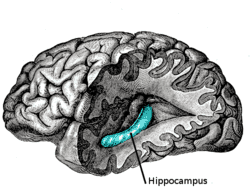
Matthew Peterson on The Neural Basis of Learning
Matthew Peterson, MIND Research Institute, suggests that educators should create learning environments with more hypothesis-driven learning. This strategy is built into a special temporal game-based approach called ST Math. In school districts with district-wide adoption and high levels of participation, ST Math has helped double math proficiency.

Leadership
Staff Picks: Higher Ed, Digital Learning, Math Education, SmartTech
Karen Picks “Changing the Economics of Higher Education” Karen says, “I’m a big believer in higher education, having served on a community college board, and we have quite a few college degrees in our family, but both of my children obtained their degrees with alternative/combination high school-college…
EdTech
Education Leaders Talk Blended Learning & STEM at Edtech Symposium
Tom Vander Ark kicked off the MIND Research Institute's annual symposium, Learning Without Boundaries, with in-depth discussion around blended learning and the ways that we can invent the future of learning. Education leaders shared their hopes and concerns this morning. Many expressed hopes to improve student learning responsibility, increase quality learning time, and extend the school the day with blended learning and education technology.
EdTech
Education Leaders Meet for MIND Research Institute’s Annual Symposium
More than 350 administrators, teachers and philanthropists will join MIND Research Institute, a neuroscience and research-based education non-profit, for its 8th Annual Symposium, Learning Without Boundaries, at the Westin Hotel in Long Beach, Calif. today.
Personalized Learning
Extreme “Make” Over Computer Lab Edition!
Lately, with all this focus on mobile learning, the computer lab has been getting a bad rap - labeled as a place where students sit disconnected from each other, learning how to type or create PowerPoint presentations. That method of using technology is already outdated and, frankly, boring. But, the reality is, most schools have a computer lab and I’m not sure we want to throw them out just yet! They’re not (all) bad places. They are just not always being used effectively.

Personalized Learning
From LMS to Learning Ecosystems
EdWeek’s Ian Quillen reviewed a Don McIntosh report on the learning management systems (LMS) market. Adaptive content, social learning, smart engines, lots of open content, and an explosion of mobile apps are expanding aspirations. The RttT states have proposals out for instructional improvement systems that ask for ecosystem like capabilities; that and the shift to online assessments that will take place in most states in 25 months will accelerate ecosystem development.
Personalized Learning
Digital Learning Leads to Deeper Learning
We think digital learning can lead to deeper learning. We’re writing a paper with a framework of evidence. A little brainstorming led to a list of ten benefits we’ve seen: Engagement: media that grabs attention Motivation: encouragement to go deeper Persistence: capturing more learning hours per day Production: ability…
EdTech
Infographic: The Rise of the AP
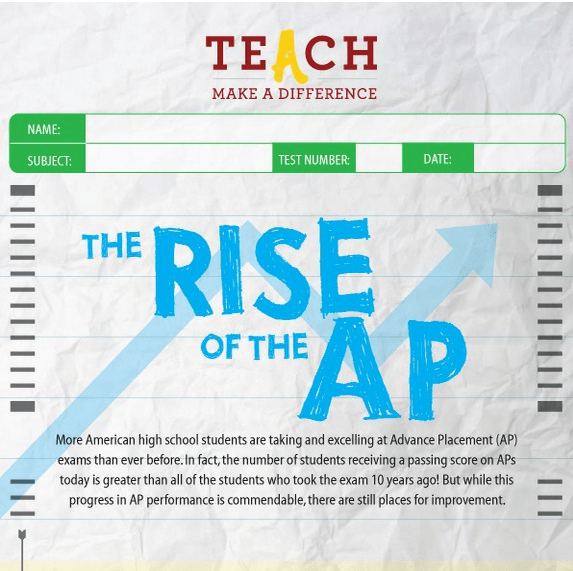
Tom Vander Ark often says that one of the best ways to introduce online or blended learning in high schools is to offer additional Advanced Placement (AP) courses online. It’s a win-win for the school and students. Schools offer additional desirable classes without dramatically increasing costs and while testing…

EdTech
SCE Launches Digital Learning Challenge
SCE, a Chicago-based social investment organization, launched a “Digital Learning Challenge” by inviting letters of inquiry that could lead to up to $250,000 in grants. The announcement is worth reading just because it is an interesting premise--that shifting even a portion of the out-of-school media time of low income youth to productive learning activities can make a big difference.