

Personalized Learning
How to Leverage Backchanneling & the Long Tail of Learning
We’ve all been there. Two colleagues across the room tap away at their phones, while the principal describes the rationale for cutbacks in funding for new technology initiatives. (Or switch out the colleagues for students while you are delivering an essential lecture on freedom of speech.) Their jabbing thumbs are punctuated by muffled giggles, as the digital text flies across the room. Is this a rude disruption or an extension of learning?
Personalized Learning
What I’m Seeing: Productive Post-Secondary
Wow, the edtech space seems to have exploded. The number and quality of startups is remarkable as is the inflow of talent and investment. Over the next weeks I’ll discuss some of the emerging capabilities I’m seeing in these ten categories: Productive post-secondary: taking outcomes and value seriously…

EdTech
Apps: Students Tap Into Video for Physics Learning
We experience concepts of physics daily. Whether we're walking, playing sports, driving a car, the concepts are naturally occurring all around us. What if we could capture the movement around us to learn and evaluate basic physics so that we could then learn to identify it daily in our lives?
EdTech
Edupreneur Inspires Artistic Creativity With Math as a Medium
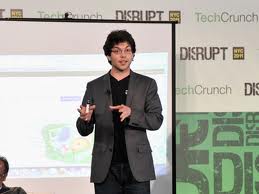
Meet Eli Luberoff. He skipped out of kindergarten, took a month off from sixth grade, dropped out of eighth grade, and then left high school altogether two weeks into tenth grade before graduating from Yale University. Yet despite these early challenges in the education system, he’s decided to devote a career to improving the experience for others by becoming one of the market’s newest entrepreneurs.

Personalized Learning
Deeper Learning Not Lighter Journalism
One thing that really disappoints me is newspaper reporters that try so hard to be cute that they miss–or botch–a story. Stephanie Simon from Reuters is a pandering case in point. After a number of my colleagues invested a lot of time with her discussing the Hewlett Foundation sponsored Automated…
EdTech
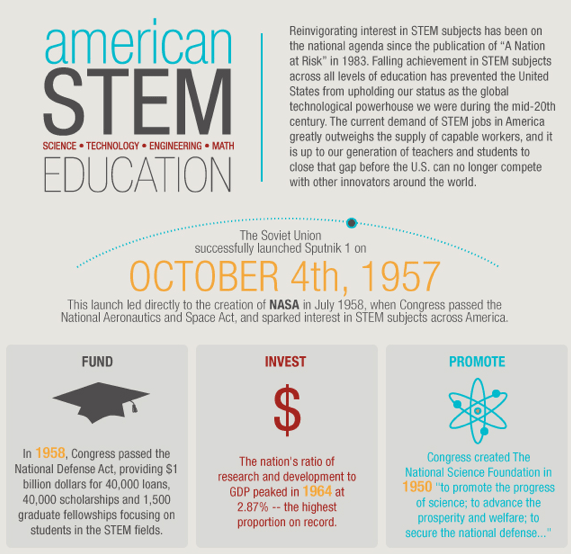
Infographic: The Decline of STEM Education in the U.S.
A focus in science, technology, engineering and math (STEM) began officially with the launch of Sputnik 1 October 4, 1957. This launched the beginning of NASA and government-mandated funding for students interested in STEM careers. From this point forward, a series of dominos fell on funding, scholarships, foundations and more to stimulate U.S. growth and expansion of science. This had a dramatic affect on generating increased interest in STEM until 1992.

EdTech
10 Elementary Learning Apps Recommended by a Speech Therapist
Increasingly, apps and games are used in the classroom to motivate learning around language, math and more. Many companies are leveraging the talents and specialties of education professionals and therapists to deliver increased learning quality in its technologies.
EdTech
Startups Say a New Platform is Dawning in the Wake of LMS
A new generation of learning management systems (LMS) is currently dawning, says CEO Paul Lambert of the upcoming startup Matygo. Matygo, a course delivery platform developed in Vancouver, B.C., was a LAUNCHedu finalist at SXSWedu in Austin, Texas this March.

EdTech
NYCan Makes the Case for Early College
NYCan just released Start College Early, Finish College Strong. Students participating in early college programs can earn up to two years of college credit while in high school and potentially graduate with an associate’s degree. As the NYCan blog says, “Right now, these programs are only reaching a small portion of the kids who need them most.” Read the story of Precious and tell me why we shouldn’t dramatically expand early college.
EdTech
Technovation Challenge Launches to Build Women in Technology
The Technovation Challenge, a program to promote women in technology by giving girls the skills and confidence they need to be successful in computer science and entrepreneurship, will be held on Saturday, April 28th and the National Pitch Night will be held on Thursday, May 3rd from 6-9PM.