

Competency-Based Education
When a student completes a writing test in a locked browser, we learn what they can do alone. But the world asks something harder: can they use AI without being used by it? In this sharp and timely essay, Eric Tucker argues that assessment for writing, speaking, and listening has not kept pace with how communication actually works, and maps a practical path forward. Education leaders navigating AI policy, curriculum design, and high-stakes testing will find both a diagnostic and a blueprint here.
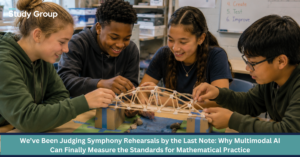
For decades, math assessments have measured the residue of thinking rather than thinking itself. In this sharp, research-grounded piece, Eric Tucker argues that multimodal AI can finally make the Standards for Mathematical Practice visible, capturing spoken arguments, strategic shifts, and productive struggle in real time. For district leaders and curriculum directors rethinking assessment infrastructure, this is essential reading on what it means to measure what actually matters.

As AI accelerates into every corner of schooling, education leaders face a question that is both urgent and deeply human: who holds the gavel? In this provocative new piece, Eric Tucker argues that the real risk is not AI itself but our failure to govern it proportionally, treating a graduation algorithm with the same scrutiny as a spelling hint. This consequence-tiered framework gives leaders, policymakers, and educators a practical architecture for protecting learners while keeping innovation alive.
The forthcoming brief Prioritizing Students with Disabilities in AI Policy (EALA/New America) highlights a critical reality: 73% of students with disabilities use AI for coursework, and 57% of special educators use it to draft IEPs. Yet, 0% of AI-based interventions in a 2025 systematic review rate as “Low…

Explore how education fMRI can enhance understanding of student assessment beyond mere scores and classifications.
Explore the potential of Advancing Multimodal AI to reshape educational metrics and enhance human potential measurement.
To deliver on the promise of human potential, we must rebalance from the “assessment OF education” to “assessment FOR education,” transforming measurement into a dynamic pedagogical transaction that actively improves teaching and learning.
Hand Isaac Newton a tablet for a physics exam today, and he would bomb it—his brilliance obscured by an inability to navigate a simulation. We educators commit this malpractice against neurodivergent students daily, diagnosing their minds as deficient instead of our broken tests. Myth vs. Science Pamela Cantor,…
Discover how multi-modal AI can transform educational assessment design for greater efficiency and usability.
ECD, UDL, and The Cow Path Educational measurement is at a crossroads. Multimodal artificial intelligence (AI) finally opens a pathway to move beyond the industrial-era, one-size-fits-all summative test in favor of unobtrusive, agentic, and adaptive assessment. But directing raw computing power at children without guardrails is ill-advised. Using…