


Archive: 2012

EdTech
10 Things I’d Do Right Now as a High School Principal
At the Moorseville edtech conference (#Connection12 on Twitter) this week a Midwest high school principal serving about 700 students asked me for some advice on the shift to digital learning. Borrowing from advice to superintendents, here's 10 things I'd do right now as a high school principal.

Personalized Learning
How to Build a Basic Toolbox for 21st-Century Learning
I remember exactly how I felt when I put together my first real toolbox. The gray no-nonsense plastic container, made by Rubbermaid, would house the essential tools I needed now that I was twenty-something and on my own. I bought a hammer, of course, two kinds of screwdrivers (one with a Phillips head and one with a flat head), a foldout miniature saw, some nails and screws, and a measuring tape. I mainly used the toolbox to hang pictures in my apartment, but oh my, did it make me feel empowered!

Personalized Learning
10 Ways to Ensure Parents Won’t Need to Ask ‘What Did You Do at School Today?’
I think parents don’t like it, or, at the very least, get annoyed when they ask their children, “what did you do at school today?” and the answer is “nothing.” (I actually know this to be true, not from statistics or action research, but because I am a mom and this is usually what my kids answer when I ask and I get annoyed).
EdTech
Adobe Announces the 2012 Adobe Educators’ Choice Awards
Every year educators create outstanding lesson plans to help students learn, understand and uncover their passions. We want to ensure that the hard work does not go unnoticed. Starting this week, educators can win great prizes by simply submitting their best projects, lesson plans, curricula and tutorials to the 2012 Educators’ Choice Awards.
Personalized Learning
Building the Digital Learning Superhighway
Next month there will be a lot of U.S. students holding an iPad looking at a spinning wheel. Cheaper devices, powerful apps, successful school models, and preparation for online assessments is boosting student access to technology. But in most places, the pipes won't be ready for all the traffic.

Personalized Learning
TheraWeb Meets Students’ Individual Learning Needs
By: Jaclyn Norton. Special education departments in schools throughout the country - namely in rural communities - experience a struggle betweenproviding immediate on-location support to students, while combating challenges that inhibit these counseling resources. Factors such as budget cuts, client distance, and shortage of counselors hinder students access to this specialized support, creating a significant demand for therapy in schools.
Personalized Learning
DIY: Finding a Co-Founder
I hadn't given much thought to the challenge of finding co-founders until Jessica Alter announced the education version of FounderDating, a partnership with Teach For America. We profiled the effort to match up interested and talented edupreneurs on Getting Smart last week and I called Jessica to learn more about what problem she was trying to solve.
EdTech
We Need to Develop Expert Screen Readers
Isn’t it odd that the Common Core State Standards (CCSS) for reading does not introduce electronic reading until fifth grade? Since children increasingly read from screens on computers, eReaders like iPods or Kindles, and smartphones, shouldn’t they learn to read from day one on the very media they have comfortably used since they were toddlers?
Personalized Learning
A New Bumper Sticker: My Student is More Proficient Than Your Student!
How do we serve the parents like my neighbor who want to be involved in their student’s education but don’t understand the changes that are occurring? Some say it will take a minimum of three generations before the changes we are proposing become the expected classroom culture. Regardless of whether it takes a single school year or several generations, what we need to remember is that we are on this course for a long time.
EdTech
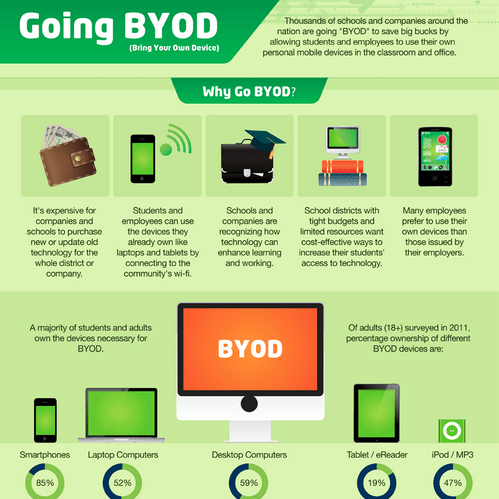
Infographic: Are You Going BYOD?
As another school year begins many leaders will again question whether or not to implement a Bring Your Own Device (BYOD) or Technology (BYOT) policy in their classrooms. The infographic below highlights many of the pros and cons to letting students use personal devices in the classrooms.