

The Need For Investment in Human Infrastructure: Transportation
Key Points
-
School transportation costs are rising due to inflation, shrinking enrollments, and special education needs, making it imperative to adopt innovative strategies for sustainability.
-
Districts must prioritize equitable access through thoughtful transportation planning, ensuring all students can access educational opportunities regardless of location.
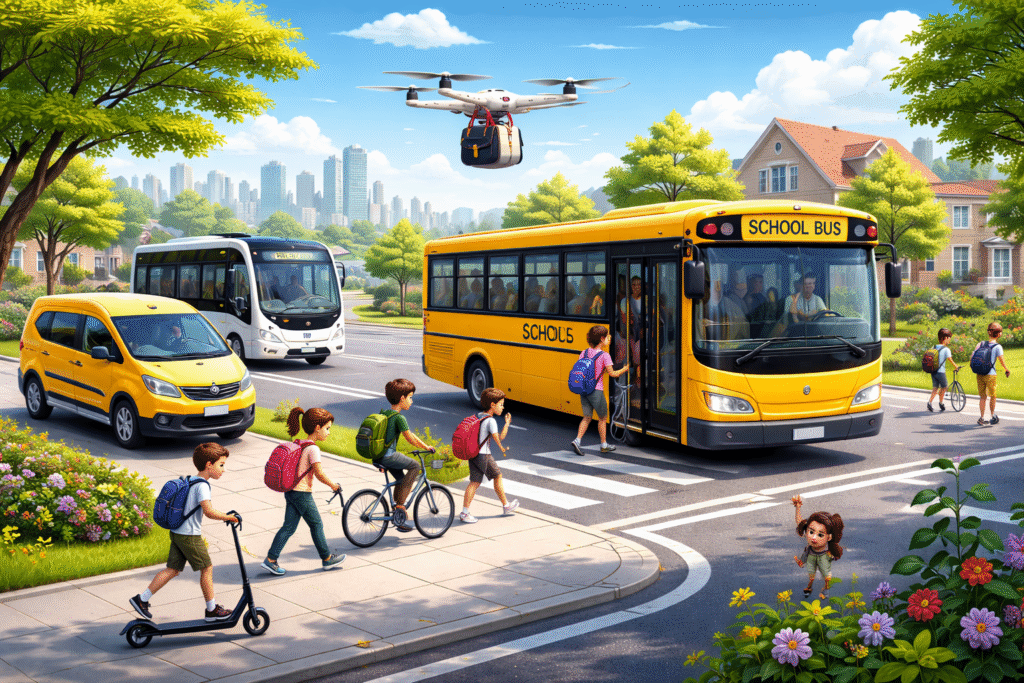
Pupil transportation is a complex, highly context-dependent education subsystem. While only about 4% of most school district budgets, it will be disproportionately important in the second half of this decade because it is key to equal access and opportunity, it has an asymmetrical impact on customer satisfaction, and it’s an increasing budget pressure as an under-reimbursed expense. Let’s explore the implications of these three factors (budget, service, equity) in reverse order.
Why Pupil Transportation is Putting the Squeeze on District Budgets
National expenditures for pupil transportation exceed $28 billion annually–nearly $600 per pupil (range of $300-$1,000) or about $1200 per transported student since only half of the students ride the bus.
Inflation-adjusted transportation costs have more than doubled in the last 50 years, but since other education costs have also risen, the percentage hasn’t increased dramatically. While almost every state provides some funding for pupil transportation, local school districts have been paying an increasing proportion of the transportation tab, now often 60-70% of the total (a growing unfunded mandate).
Special Needs Transport is the Fastest Growing and Most Underfunded
Special education and special needs (including Section 504) transportation are the highest-cost and lowest-reimbursement sectors of the transportation budget. Historically, the per-pupil cost for a student with an Individualized Education Program (IEP) or 504 plan is roughly 10 times higher than for a general education student. And, the number riders with special needs is growing, up to 22% in 2024. Districts often are left covering 40%-60% of the cost from their local general funds. Section 504 receives virtually zero dedicated federal or state funding.
Utilization Rates Down to 50%
Transportation cost jumped 8-10% per year during COVID due to fuel volatility and the need to aggressively raise wages to attract and retain drivers. Bus driver shortages remain a challenge (8 of 10 school administrators say school bus driver shortages are a problem in their school or district).
Costs per pupil are also increasing in most districts because of a decline in school bus ridership resulting from shrinking enrollments (demographic shifts and competition) and families opting out of bus service or exercising choice. Bus utilization rates hit a 10-year low this year, dropping to roughly 50% nationally (from a historical average of 55%).
Lower ridership presents a gnarly cost problem. Most districts operate their own buses (about a third of big districts contract for at least a portion of transportation) and have limited ability to adjust the size and composition of the fleet. Maintenance, insurance, and bus depot staffing do not scale down linearly with lower enrollment and utilization. Additionally, fleet and route inertia mean that an aging neighborhood that loses 15% of its students is still serviced by the same 72-passenger bus to pick up the remaining students.
Walking and biking to school has declined even faster than riding a bus. Fifty years ago, nearly half of the students walked or biked to school. By 2024, it had dropped to about 12% (except for a few places where community-led movements created safe routes for active transport).
Equity remains a pressing concern, with 88% of districts reporting access gaps. System administrators are also concerned about maintenance costs (25%), inefficient routes and schedules (24%), meeting regulatory compliance requirements (23%), student safety (20%), coordinating schedules (20%), and improving communication with families (19%).
Leaders need to ask themselves the following questions about transportation service delivery and budget (the noticing portion of the Innovation Framework):
- Do you know your transportation cost? The unreimbursed portion? The cost per transported student? The utilization rate?
- If your utilization rate is less than 60%, do you have measures of customer satisfaction? Are measures of dissatisfaction about educational programming or transportation service delivery?
- Are you taking full advantage of your state transportation reimbursement? Is your system being strategic about school choice and program location?
How Strategic Shifts Improve Efficiency & Service Delivery
Pupil transportation is a fragile system with a complex set of dependencies and asymmetric risk. Performance is not viewed on a linear scale from “bad” to “good.” Instead, it is viewed as a binary: it is either “broken” or “invisible.” The risk profile is asymmetric because the “upside” of performing well is capped at a neutral baseline (i.e., students get home safely on time), while the “downside” of performing poorly is virtually limitless. For a bus to be on time, dozens of things must go right simultaneously. Asymmetric services are sensitive to disorder with no way to “over-perform” to make up for the loss.
Because transportation is the “gateway” to the school day, a 15-minute delay can cause a domino effect: a parent is late for work, a student misses a breakfast program, or a child is left standing in the rain. This creates a permanent state of high-stakes stress for administrators, where a “good day” is simply one where nothing happened.
To survive the changing ridership, financial pressure and asymmetric risk, school districts are making a series of shifts away from traditional models.
Strategic Shifts: Special Needs Transport
To address the challenges of special needs transportation, 37% of surveyed districts report using alternative transportation companies like HopSkipDrive or EverDriven for SPED/504 routes. Even though the per-mile cost may be higher, it can be cheaper than running a mostly-empty 24-passenger bus.
Whenever safely possible, districts are mainstreaming students onto regular routes with specialized equipment to capture the efficiency of a high-capacity bus. Neighboring districts are increasingly sharing buses for out-of-district placements, so one bus can pick up three students from three different districts heading to the same regional special needs school.
Strategic Shifts: Going Electric
The first $3 billion of the EPA’s Clean School Bus Program (CSBP) spurred growth in electric buses from 1000 to over 5,100 (with orders for 14,000), transporting roughly 265,000 students daily.
An electric bus costs $350,000–$450,000, almost triple the price of a diesel bus (~$150,000). The CSBP provided grants of up to $395,000 per bus, making them free for prioritized districts. ESBP is not likely to be renewed, but the remaining $2 billion (scheduled for award this fall will continue momentum through 2026.
Electric buses provide fuel and maintenance savings compared to diesel, which (even without a purchase incentive) can yield a 7-12 year break-even. In addition to climate-friendly benefits, electric buses offer next-gen CTE opportunities to students to work on e-vehicles and can serve as broadband hubs during power outages.
The likely loss of federal adoption incentives means adoption will continue, but at a slower pace, centered in specific states. Several states have made adoption mandatory. For example, New York requires all new bus purchases to be zero-emission by 2027, and Washington and California have similar 2035 targets.
Strategic Shifts: Scheduling and Communication
The transportation routing software market is dominated by a few legacy giants (Tyler, Transfiners, and Education Logistics). While these three handle the bulk of traditional districts, several other players are popular in specific niches:
- Busology Tech serves over 50% of the largest school districts in North America with a multi-calendar interface that handles complex student schedules.
- Samsara for K-12 is the fastest-growing player in the telematics and safety space. While often used alongside routing software, it is the most popular for real-time GPS, cloud-synced cameras, and “Stop Paddle” monitoring.
- Safe Fleet offers the popular Here Comes the Bus app, which provides parent-facing communication and ridership tracking.
- BusBoss is a routing software that integrates with leading SIS systems.
Most popular tools are no longer just digital maps; they now use AI to adjust routes based on traffic patterns and driver shortages automatically. Real-time location transparency has become a standard requirement for districts to reduce parent phone calls.
Strategic Shift: Unified Transportation Systems
There are at least 15 cities with a unified enrollment system that use a single application and a common timeline to apply for both traditional public schools and charter schools. None of these cities have fully unified transportation, but a couple of cities have some integration. Seattle and Washington D.C. make city buses and trains free for all people under 18. DC SchoolConnect is a city-run program that provides shared, van-based transportation for district and charter students in certain high-need wards. In New York City, the Student OMNY Card is distributed by schools and provides four free subway and bus rides a day.
Leaders need to ask themselves the following questions about potential transportation system improvements (the design portion of the Innovation Framework):
- Do your performance targets recognize asymmetric risk? Do you have robust mitigation and response strategies in place?
- Are special education placements strategic? Have you considered alternative and cooperative transportation options?
- Is your district and state on the path to electric buses? Do you have a funding strategy/partner?
- Have you used smart tools to improve route efficiency and parents with ride tracking?
- Have you explored integrating services with other schools and municipal providers?
Transported Choice Equals Educational Equity
The vast majority of school districts use attendance boundaries as their primary mechanism for managing enrollment and determining transportation eligibility. If you live within the defined boundary for a school and meet the distance requirement (e.g., more than 1.5 miles away), the district must provide transportation. Federal law (McKinney-Vento) mandates that transportation be provided regardless of boundaries for students experiencing homelessness or those with specific Special Education needs.
The influence of attendance boundaries is weakening due to the rapid expansion of open enrollment laws across the country. More than one-third of states have open enrollment laws that require districts to accept out-of-boundary students if they have open seats. However, in most districts, students exercising school choice forfeit the right to transportation. About 85% of large urban districts provide transportation for specialized magnet or Career and Technical Education (CTE) programs, as these are viewed as district-wide assets.
In addition to increasing school choice, there is demand for more experience choice especially work-based learning for high school students. Client-connected projects, entrepreneurial experiences and particularly internships often demand time on site with community partners and require transportation for equitable access. NAF and College Board support teamship (internships in teams) in part to improve logistical efficiency and access.
Staggered Starts Boost Efficiency but May Rob Teens of Sleep
School start times are the other important driver of fleet requirements. Nearly all mid-to-large-sized districts utilize a two- or three-tier system where a bus performs three cycles every morning and afternoon. Without this staggering, a district would need roughly three times as many buses and drivers to pick up all K–12 students at once, which is financially and logistically impossible for most.
Tiered transportation systems are the reason American high schools have historically started before 8:00 AM. Adolescent Sleep Laws in states like California and Florida (effective 2026) mandate that high schools start no earlier than 8:30 AM, causing a reshuffling of start times (with early elementary starts) and/or expanded bus fleets (and exacerbating the driver shortage problem).
Clark County (Las Vegas) recently announced realigned start times. Most high schools will shift from their current ~7:00 AM start to 8:30 AM, a 90-minute delay designed to reduce rates of anxiety, depression, and first-period absences. However, to maintain efficiency, the nation’s largest bus fleet will retain a three-cycle system with middle schools moving to 7:30 AM starts. To ensure success, the district is buying new buses, hiring additional drivers, and standardizing start times for speciality schools.
Equitable Pathway Access in Dallas ISD
Dallas ISD is a national leader in transportation choice, particularly through its robust network of Magnet, P-TECH, and Career Institute programs. Dallas has refined a “hub-and-spoke” transportation model that allows students to access high-quality specialty programs regardless of their home ZIP code.
Strategic program location is key to equitable access across Dallas. There is a P-TECH (an accelerated career pathway) at each comprehensive high school and a Career Institute site in each quadrant of the city with mid-day shuttles providing access to half-day career and technical education.
Last year, DISD provided all elementary bus riders with a SmartRide Card to track when students board and exit a bus and provide parents with real-time notifications of their child’s location.
DISD spends about $72 million on transportation, about $2,000 per choice student (about 50% higher than the national urban average), with only 22% reimbursed by the state. The district views transported choice as an equity investment, ensuring that a student in a lower-income neighborhood in South Dallas has the same physical access to a P-TECH, CTE or magnet program in North Dallas as a student living next door to the school.
Community Organized Active Transit
A few urban communities are increasing active transportation by identifying and supporting safe walking and riding routes. In Seattle, active transportation rates among elementary students reached 30% in 2025.
“Bike Buses” are organized groups of 50+ students and caregivers who ride a set route together once a week. Similarly, Walking School Buses are supervised groups that “pick up” kids at their front doors.
E-scooters and e-bikes are becoming common modes of transportation but may require schools to provide charging and secure racks.
Embarc Education in Chicago teaches “Urban Orienteering,” a learning module that provides high school students with agency, navigation, and access to their city.
Leaders should ask themselves the following questions about potential transportation system improvements (the ecosystem portion of the Innovation Framework):
- Is the portfolio of school and program options designed for equitable access (considering location, enrollment, and transportation)?
- Are you coordinating calendars/schedules with career centers, community college
- Have you weighed the tradeoffs of later start times versus efficiency (of a three-cycle transportation system)?
- Is the city/county and community involved in supporting active transportation and student use of municipal systems?
Conclusions
Pupil transportation is a complex, highly context-dependent education subsystem exhibiting asymmetric risk. It is an asset-heavy service that does not nimbly adjust to shrinking utilization and, with chronic underfunding, is adding to mounting school district budget pressure.
Efforts to boost system efficiency (like three cycles) place unfortunate constraints on most school systems (like three start times and boundary limits to ride eligibility).
The rise of alternative transportation (i.e., EverDriven, HopSkipDrive) has been steady and most useful in supporting riders with special needs. The shift to electric has stalled for the time being (in most states) and the shift to autonomous vehicles appears to be at least a decade away. (Out of school, parent-approved teen use of rideshare is expanding with some AV pilots underway.)
Parents are quickly gaining ride tracking capabilities (addressing the asymmetric information gap), and that trust building might begin to reverse the slump in utilization.
Expanding choice (in and outside school systems) is the most important trend influencing transportation. It’s making attendance boundary systems less relevant and pressuring systems to expand transportation services to create regional ecosystems where students in every zip code have equitable access to a quality option.


0 Comments
Leave a Comment
Your email address will not be published. All fields are required.