


Gianna Biaggi on the Magnolia Project
Key Points
-
Students benefit most from career-connected learning when it begins with exploration, reflection, and agency rather than early tracking into narrow pathways.
-
Rural schools can expand access to meaningful real-world learning by building local partnerships and using regional consortium models to share opportunities.
Shownotes





In this episode of the Getting Smart Podcast, Nate McClennen sits down with Gianna Biaggi, founder and executive director of the Magnolia Project, to explore how schools can treat the community as campus. Together, they discuss how Magnolia Project connects middle and high school students with local mentors through immersive, hands-on learning experiences that build agency, engagement, and career awareness. From rural partnerships to durable skills to the power of reflection, this conversation highlights a compelling model for expanding real-world learning and helping every student imagine a future that fits who they are.
Outline
- (00:00) Introduction & Expanded Learning
- (02:01) Gianna’s Story: From Teacher to Founder
- (05:59) Building the Magnolia Project
- (12:00) The Program Model
- (21:18) Durable Skills & Student Outcomes
- (34:06) Lessons Learned & What’s Next
Introduction & Expanded Learning
Nate McClennen: Hello, everyone. This is Nate, and welcome to the Getting Smart Podcast. We’ve been thinking a lot about expanded learning ecosystems, and indeed it’s a fifth element of our innovation framework. What we mean by that is: How can we tap into the larger community outside of schools to build authentic, real-world, and high-quality learning experiences for every single student, and not just a select few?
Around the country, schools and districts are attempting to build models to enable all students to experience real-world learning prior to graduation.
And we know that demand is much higher than supply. It is tricky to get every student in an internship. So today we are exploring a powerful model of regional transformation called the Magnolia Project, which is based in Northern California. This initiative is a living example of what happens when we begin treating the larger community as a campus.
And the Magnolia Project embodies this by connecting middle and high school students with local industry mentors to build our favorite durable skills and transferable skills and real-world agency. And their mission is simple but profound: to ensure every student can bloom. And I love that idea of every student blooming, regardless of the climate or soil they’re planted in.
And today we’re going to dig into how they’re scaling this model, the impact of those 8,000 hours of hands-on learning, and how they’re helping students design their own futures. So I’m excited to be joined by Gianna Biaggi, executive director and founder of the Magnolia Project. So welcome. Thank you for taking the time out of your busy schedule, and I’m excited to have you here today.
Gianna Biaggi: Thanks for having me.
Nate McClennen: All right, so we’re going to start with my favorite question. You’ve got to think back to your K-12 experience, so this can happen anytime during your K-12 experience. What was your favorite learning experience? That is defined as where you learned the most and you were the most engaged.
So what story do you have to share with me?
Gianna’s Story: From Teacher to Founder
Gianna Biaggi: I grew up in Sonoma County, where Magnolia Project is headquartered, and I went to public schools in Sonoma County. And I had a newspaper class. It was an elective class. I don’t even remember why I got put in the class. I think I probably just did the form wrong or something. And our teacher—she’s still teaching at my high school—she’s amazing, Alison Manchester. She let us do all of it. So it was 10th, 11th, and 12th graders. And we had an editor, sports journalists, and I had somehow gotten the job of selling ads.
I don’t know why. I can’t remember why. But I had to go out and bug people and walk from my high school, half a mile down the block, to the little local shoe store or to a bakery and be like, “Hi, we need you to buy ad space because we need a hundred bucks so we can print the Dragon’s Tale,” which is what the newspaper was called.
So people could read it. And she was so amazing because she totally trusted us. I didn’t know what I was doing. None of us knew what we were doing. But she really trusted us to try something and fail. I sold maybe two ads in the first month, and my target was like 15, right? So I failed like 9,000 times.
And every time I would do an ad pitch, it was different because I could never figure it out. So I just think her trust in us to do this—she just let me leave campus and I was like, “I’m going to sell my ads,” and walking around—it really gave me a lot of confidence. It gave me this really interesting skill, which I have to do all day long now, which is getting people to want to do something that they don’t really know that much about.
Right? Like why would someone at the shoe store want to buy ads from the high schoolers and their newspaper? And she really helped me work with my peers in a way that was not just us working together because, OK, we have to do this project, but because we had this really concrete goal to accomplish.
And we would fight. I remember people would yell at each other, but all in good fun and all what I imagine an actual newsroom looks like, right? And so it was so real to me that I can still feel that feeling of, “Oh my God, I have to go sell an ad right now,” 15 years later.
And it was just so, so powerful—her trust and belief in us to be able to create this product. She hung out while we were doing this. She was very helpful, but she never told us what to do. We had to figure it all out ourselves.
Nate McClennen: Right, right. Oh, it’s such a great example of purposeful work. When you give young people agency—the ability to make decisions—and purposeful work, you had to go and create something that actually is tangible. And you had a lot of freedom to do what you wanted. And the teacher was the guide on the side. So it feels like that experience sort of may have informed where you are now. But you ended up being a teacher for a while, and then you pivoted into this intermediary work with Magnolia Project.
Tell us a little bit about your story. Why did you leave the classroom and jump into this community project? What was the need? Where did you see the opportunity?
Gianna Biaggi: So I attended Sonoma County public schools, and then I went off to college, like you said, and then I became a teacher, like you said.
And I spent a lot of time teaching in other communities and with other people’s kids, which was totally fine, and I loved it. And I always felt like I would be at a couple of really innovative schools and think, why are we not doing this in Santa Rosa? I don’t understand why our kids are any different than these kids that I’m in front of right now. Right? And so it felt very important to me to be able to innovate where I grew up. I thought I could get more done in Santa Rosa, too, because I was local to the community. That actually didn’t end up helping as much as I thought it would, but in some cases it made it harder.
But I always felt this idea: If I have all these resources and I’ve gotten this fancy education, I really should be sharing it with kids who have had my similar life experience. That just felt really important to me.
Nate McClennen: Students in Santa Rosa weren’t getting those experiences. What was the first step? What did you do first? Because sometimes our listeners say, how do you start these things? What does this look like?
Building the Magnolia Project
Gianna Biaggi: It’s hard. You have to be really, really persistent. So I was probably, with a team in Santa Rosa, but with me leading it and being in charge, I think we approached three or four school districts and asked for a pilot, and I consistently was told no. We would get a board presentation—no, no, no. They would shut it all down.
So I finally approached two schools, two rural schools actually, which has really informed our model. One in rural West Sonoma County, Guerneville School, where the whole town of Guerneville has 5,000 people in it. There’s 170 kids in the whole school, K-8. And then one in rural Northern Sonoma County in Geyserville. Very similar. There’s 60 kids in the sixth- through 12th-grade middle and high school. So these are small, rural communities, and the two superintendents were awesome and they just had an appetite to do something different and they trusted us, and so they were willing to pilot with us.
That took about a year and a half to get the opportunity to pilot this inside of a school district because people are really risk-averse. Ironically, now all of the districts that were like, no, no, we can never do this—we now have contracts with all of them, so they’re always welcome back into the family.
Nate McClennen: Right, right.
Gianna Biaggi: It can be like that. I understand where people are coming from. New stuff can be really, really hard. So I guess I would just share with people: You have to be really persistent and you have to be really patient, and someday you will find the right match. It just took us finding the right match districts to make this pilot work.
Nate McClennen: Yeah. I mean, I think it’s all—we see that a lot—is that you have to find the people that have a real pain point or a need out there that you’re able to provide some support for. Because there’s initiative soup at any district. There’s so many things going on at all times.
And if you don’t fit into that, or if you’re an extra, it’s not necessarily going to work. So these rural schools—what was the first thing? What was the pitch to them? “Hey, we’ll find community partners”? Or was the pitch, “We’ll do programming with your students”? What did it look like for those early pilots?
Gianna Biaggi: So the pitch was: I will come, I will be fingerprinted, I’m a former teacher, I will come for free, I will bring all the money in, and we will do some different programming with your students—middle schoolers and high schoolers. And we had an idea of what that was. We will do some off-campus connections with industry, we’ll do some stuff on campus, but it was not as flushed out the way it is today.
And what I think sold the districts on it was that they were struggling with engagement. So I could say, hey, I taught at a school where this was the norm, where we had a lot of interaction with community partners and engagement was really high, right? And so these school leaders were reflective enough to understand that this was a need, that they had to boost engagement. And I’m so grateful still that they trusted me. Who am I, right? They trusted me to be able to do this work with them.
Nate McClennen: Right. And so it feels like engagement was the challenge they were trying to solve. Did you go in thinking this was going to be a workforce or career-type play? Or did you go in saying, I just want to create better, more engaging learning experiences for young people?
Gianna Biaggi: So this was the year after COVID. It was like that horrible—you remember, we had the mask year, and then we had the—so that was 2021-2022, and then 2022-2023 was our first full pilot. But it was like, I am sure you remember after COVID, it was like, what is school?
Nate McClennen: Right, right, right.
Gianna Biaggi: Yeah. What’s being—nobody knew. Adults didn’t know, kids didn’t know, parents didn’t know. So that was a year where it was this, like, you’re an eighth grader, but you act more like a fourth grader. What’s going on? Oh, you missed a lot of socialization, right? That was part of it.
To be totally transparent, I really don’t love all the workforce-development framing in public education. I have real issues with it. I really think that it’s not—I don’t like this idea that we’re just training kids to go do auto or do welding. I think we should give kids a variety of sampling opportunities and different experiences and let them pick.
And one of the things I really—even as a high schooler at my high school—I was like, why? And maybe I’m just a butthead, but we would have 60 kids in auto and I’d be like, there’s 10,000 people in our town. We don’t need 60 mechanics. The numbers never made sense to me. You know what I mean? Like, why are we doing this? And even my brothers would be in those classes and they would just be like, well, why do you care? And I’m like, I don’t know. The numbers don’t work.
So instead of—I hate this idea—if we’re just pushing kids toward employment, I think employment is important and economic opportunity is really important. And I think a better way to do it is to give kids lots of opportunities, lots of agency, and help them figure out what’s best for them. So that’s a big part of our model.
I get really nervous when people are like, oh, come to this school and just do a pathway for kids that don’t want to go to college and they all want to be mechanics. I’m like, well, how do you know that? And also, how do you know in eighth grade that all these kids don’t want to go to college? I’m so glad you have a crystal ball. Please share it with me. You know what I mean? So I’m a little wary of that.
I see our vision as more like school should be more embedded into the community. Students should have a variety of different experiences, and let’s give kids a lot of agency to make really good economic decisions for them.
Nate McClennen: Yeah, it’s so interesting. It resonates with—we have a blog. I’ve done a lot of work in place-based education, connecting learning to community. And I have this hypothesis that students first need to understand their community. Then they need to understand, so what does it mean to work collaboratively in projects? And then maybe start thinking about what professions might be available based on the market, their community, where they want to go.
But I do see there is, as you know and as you just said, so much energy behind: Let’s create a bunch of pathways. Let’s enroll as many people as possible in those pathways. And once you get in, it’s a little bit tricky to shift.
Gianna Biaggi: Mm-hmm.
Nate McClennen: And so they’re a little bit locked in. So, OK. I get a sense of how it started. I love the idea of persistence and really thinking about the challenge of engagement. You found the coalition of the willing early on, which is really important. What does it look like now? So here we are a handful of years later. What’s the program look like in a nutshell?
The Program Model
Gianna Biaggi: So right now we partner with 19 public schools in Sonoma County, where I grew up, and Marin County, which is our neighbor to the south. And our programs are hands-on, semester-long career exploration and apprenticeship pathways. They’re fully embedded into an academic class during the school day.
So this is also a hill that I just die on, because why are we doing this work outside of English or math or science? That doesn’t make sense, right? So our pre- and post-work curriculum is all Common Core English language arts-aligned.
So there’s three phases to the pathway: pre-work, ELA Common Core-aligned—you know, some of our schools do not have space to do the pre-work in English language arts. We totally get that. They do have to do it, though. So we don’t work with schools unless they’re willing to do the pre- and the post-work, because it’s focused on self-awareness, understanding your community, understanding the economics of where we live, right?
Like in Sonoma County, if you want to be a bazillionaire, what do you need to do? You maybe cannot work in a restaurant, right? You need to have a business or something like that. A lot of self-awareness. So many of my students were so good at just regurgitating Huck Finn because I was like, oh, I love Huck Finn. But when I would be like, what do you like, they had no idea.
So I’m like, this project—like Magnolia Project—is paying for the sins in my past. So the pre-work and the post-work are really focused on that. Who are you? What do you like? What do you not like? Are you someone that doesn’t like to work on a team? OK, here are 15 industries or careers that are not a good fit for you, right? But here are things you can do, and here are ways you can have an economically empowered future.
So our pre-work is embedded into a core academic class during the school day. Then we do an immersive experience. So we pause school for a week. Students first do an interview with a group of mentors that have been curated from the local community.
We have two types of mentors. We have mentors where students physically go to them at their business. So a student might go to the dentist’s office or the Humane Society or the women’s shelter, right? And then we have mentors that have really cool, amazing skills and talents, and they come to our kids. Because not all of our kids, especially because we do a lot of middle school work, are ready to go off campus or should go off campus.
So we have a really great fashion design program on campus. We have cosmetology, we have trade skills, we do a ton of art. Everybody’s like, art’s not a career. It’s marketing. So we do a lot of art on campus. We do entrepreneurship, right? We do all that stuff on campus with a group of mentors as well.
Students interview with their mentor the first day of the week, and then the subsequent days of the week, they’re physically off campus at the site of the business, nonprofit, or government agency—with the fire department, with the women’s shelter—or they’re on campus working with a mentor in a small group for the whole school day.
So they’re not doing math, English, science. They’re instead doing fashion design for four days. So they’re sewing and creating clothing, right? And learning about, OK, how do you price a piece of clothing? They’re doing film, they’re doing cooking, they’re doing trade skills, right? Anything that we can do that is available either on or off campus, we try to make it work for our kids.
After that immersive experience, students then come back to school. There’s post-work, there’s reflection, which is the most important part of what we do. So our post-work curriculum is really focused on metacognition. So our goal is that students are not just, well, I used a hammer and that was great. They’re instead thinking about, OK, I’m someone who likes a job where I work with my hands.
And there’s a lot of different things you can do if you like to work with your hands. You can do nails, you can be an ASL interpreter, right? You can be a carpenter. You can do sculpture, right? There’s lots of different things you can do and lots of different degreed or non-degree pathways you can take depending on what your experience has been, working with your hands or not working with your hands.
So our goal is to really help students sample something for the future and then really help them reflect on what they learned and what they want to do, to incorporate that into the next step, whether it’s college, career, gap year, entrepreneurship, military, et cetera.
Nate McClennen: So, OK. I have a sense of it. So they are doing their pre-work. You’re embedded into the classroom for some period of time. It’s not the whole semester, or are you actually taking over the ELA class for the semester in lieu of the teacher? How does that look in terms of time commitment?
Gianna Biaggi: So there are like seven required ELA components that need to be done before and after the program. So it’s four before, three after the immersive experience. OK, so there are seven required components. We have 30 hours of lessons, though.
So some of our schools love Magnolia Project and they’re willing to dedicate two days a week for the whole semester to Magnolia Project, right? So like the other three days they may be doing Tom Sawyer, and then the two days they’re doing Magnolia Project.
Some of our schools and districts, because of consolidations and just lots of stuff going on, they’re not able to do that. So they’re only able to do the required pre-work and post-work curriculum pieces. But we will not work with a school unless they’re willing to do the pre- and the post-work, because otherwise this immersive experience is decontextualized for our kids.
Nate McClennen: Ah.
Gianna Biaggi: And then they don’t see the value in it, you know?
Nate McClennen: So the minimum program structure is pre- and post-work plus the weeklong immersive.
Gianna Biaggi: Mm-hmm.
Nate McClennen: And then during that weeklong immersive, are all students in the grade or whatever—the middle school, et cetera—are they all doing it at once?
Gianna Biaggi: Yeah. So we work with some really small schools. Like Geyserville School has, I think, like 39 middle schoolers. So that’s easy. Let’s get all of them. They can all do it. We’ll have kids at the sheriff’s office and at the fire department, and we’ll have fashion design on campus and cosmetology.
We work with some larger comprehensive middle schools, like in Santa Rosa, where we are a class within the school day. So we’re serving 60 to 70 students. I wish we could serve all 700 of those middle schoolers. At this point, we cannot. That doesn’t mean that might not change, but we’ll serve 70 or 80 kids in that immersive from that one school site.
Nate McClennen: Got it, got it. And then mostly focused on middle school, which you seem to be describing, or could the same model apply to high school? And then how does that interact with traditional CTE pathways? Is it distinct from them, or how are schools thinking about that at the high school level?
Gianna Biaggi: So I would say 50% of our work is in seventh and eighth grade, and the other 50% is at the high school level. I personally taught middle school. I like eight, nine, and 10. We have really good engagement data from our kids after they do our program—from eighth, ninth, and 10th graders—because they’re still figuring out what works for them and what doesn’t.
And so we feel like it’s a really good investment for an eighth grader to do this because they can understand, OK, if I want to go work at the sheriff’s office, what do I need? A high school diploma? Four years of college? Sometimes in 11th and 12th grade, unfortunately, it can be almost too late.
Nate McClennen: Right, right, right.
Gianna Biaggi: Oh my gosh, you didn’t do A-G, which is the California—these dumb standards for the UCs and the CSUs. They’re just—
Nate McClennen: I know. Yeah.
Gianna Biaggi: They’re just extra bureaucracy. So that can be hard. Like in 11th grade, the kid’s going to have to really pivot, right? Or we’ll have kids do our program in 11th grade and they’re like, I knew I wanted to be a doctor. They spend a week with a doctor. Ooh, no.
But we’d rather they pivot in 11th grade than in their third year of med school. We do serve 11th and 12th graders as well. We are in the process of redesigning some of that programming to add, for our 11th and 12th graders, some additional stuff that we think will make the experience stronger for them, including coaching, so working with a coach that can really help with college and career stuff.
Because our counselors are so impacted in the districts that we serve, students often do not get a one-on-one meeting with them, or maybe they get one over four years. And if you don’t have an adult at home who can help you, that’s a really tricky situation to be in.
And then we’re also looking at adding a passion project for 11th and 12th graders as well, right? So how do we make sure that those dynamo 11th- and 12th-graders that want to do something that’s independent and entrepreneurial have the support and resources to be able to do that as well?
Nate McClennen: Right. And have you piloted that yet, or that’s in the future?
Gianna Biaggi: We’re piloting it in the fall, which is going to be awesome.
Nate McClennen: Oh, good.
Gianna Biaggi: Yes, we’re really excited about it.
Nate McClennen: We’re big fans of passion projects, for sure. And I like how you’ve set it up with this previous programming. You could see that it builds upon what you’ve previously done. Do you have a sense that students—is it all seventh graders or part of the seventh grade? Does seventh grade do it, and then they can do it again in eighth grade, then do it again in ninth grade? Or do you find that your partners mostly are doing it as a one-time experience?
Gianna Biaggi: I think about half of our districts are sequential, so we’ll serve seventh and eighth graders, or eighth and ninth graders. And then about half, we’re sometimes a one-off, which is hard. In an ideal world, we would have kids for multiple years. However, we’re just going to try to do the best that we can within our big bureaucratic school districts.
Nate McClennen: Yeah, yeah. No, that makes sense. OK, so let’s pivot to—we’ve been thinking a lot about durable skills. And I know you talk about durable skills and transferable skills and these things like collaboration and creativity and communication. And it feels that, in the broader sense of the nation and in the world right now, employers are wanting—they’re seeing less and less proficiency in these from young people.
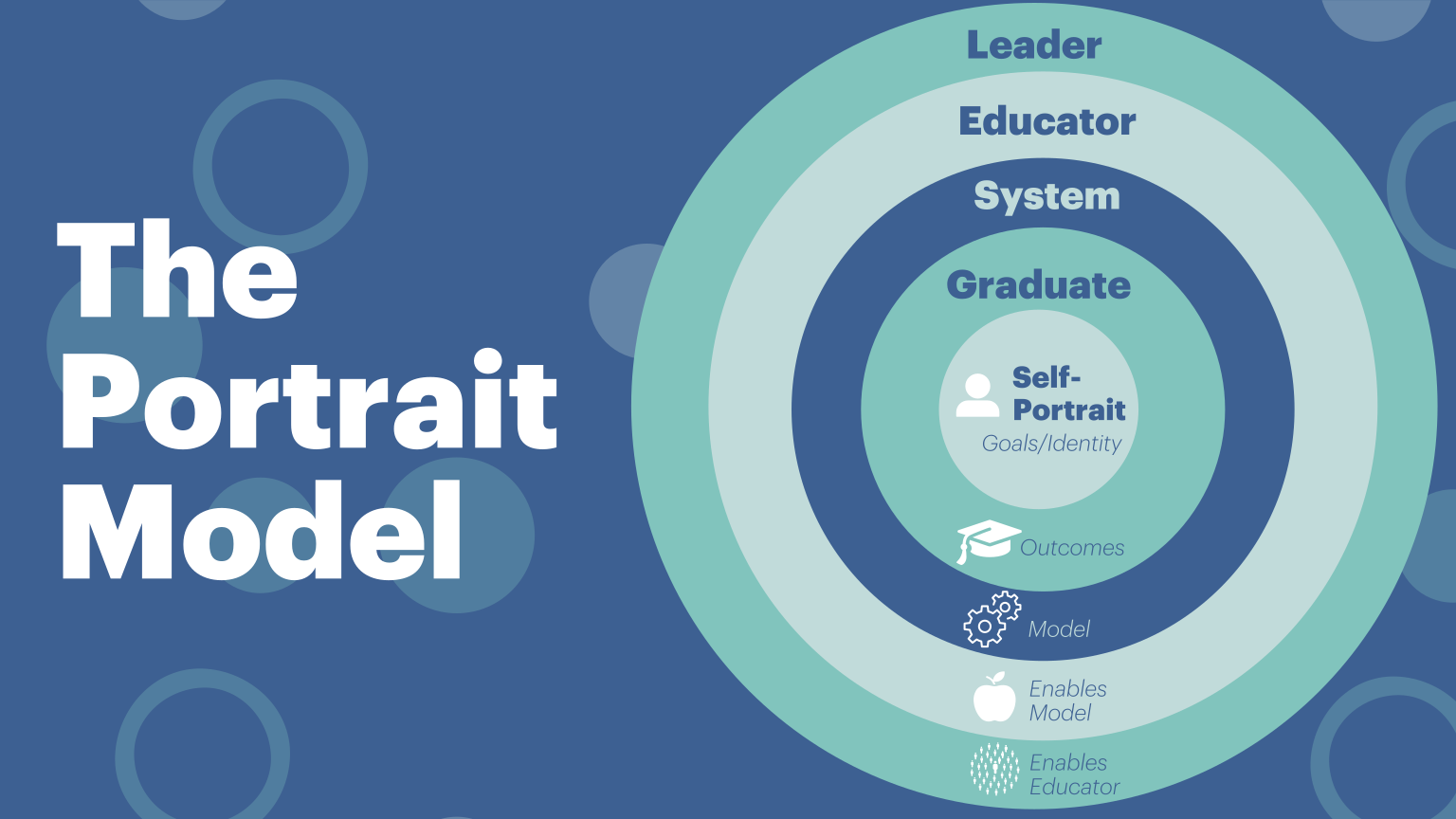
And so more and more districts are jumping on building, say, a portrait of a graduate or a set of competencies that are different from their standards of learning. How are you—do you have an intentional set of durable skills that are designed, baked into your program, that you’re measuring against? Or do you connect with, if a school already has a portrait of a graduate? How does that work in terms of those outcomes?
Durable Skills & Student Outcomes
Gianna Biaggi: So we look at agency—student agency, student engagement, motivation, confidence, and readiness for college and career. And really the big, I think, win for us and for our model and for folks that are trying to do this work is that before our programs and after our program, students report way higher levels of understanding that their academic work is relevant to the future.
So that’s really, really important for us, especially at the middle school level, capturing kids in seventh and eighth grade before they become that disengaged 11th- and 12th-grader that doesn’t want to go to school. It’s really important to us that we capture them and help them understand that maybe they don’t love—I didn’t love doing long division—but I have to do, like, I have to do long division every day. And so I do need to learn that skill, right?
So how do we help, instead of just telling kids you’ll need to use this skill in the future—because everyone says, no, you won’t, right? Instead of just telling kids that, how do we show them that? You know, if you become a firefighter or a cop, you have to read and write every day. Every time you leave the station, you have to write a report about it, right?
So how do we help them understand through their own lived experience and their own connection with our mentors that all these things they’re learning in math, English, and science do have value and have power in their adult life?
Nate McClennen: Right, right. No, that makes sense. Yeah. I appreciate sort of—we’re thinking a lot about how do we have broader sets of measurement and evaluation, because we know that when we hyperfocus on an ELA or a math score, that will tell us something, but it doesn’t tell us everything.
And so I love the idea of you thinking about these primary goals of: Do they feel engaged? Do they feel like they have agency? Do they feel ready for college and career? When those proxies are in place and you have positive scores there, it feels like other things follow—academics follow, et cetera, et cetera.
So, in terms of the program implementation, if you get this data and it says, hey, the students are more engaged, they feel more ready, they have more agency—have you experienced or seen some of the work in your program then impact other classes in the school because of your program? And you may not have any control over those other classes, but because of the success of yours, you see it implemented in other areas.
Gianna Biaggi: I think one of the things that we see quite a bit is superintendents, principals, administrators, even paraprofessionals, will walk through the immersive week and they’ll one, be like, oh my God, this kid hates my class. They hate math. They’re doing all this amazing math in cooking, right? They’re doing fractions in their head. They’re doing half a cup plus a quarter cup, right? It’s whoa.
So we are able to showcase our students in a very different light, right? I know when I was a teacher, sometimes you have really preconceived notions about a kid based on how they’re doing in your class, and then you see them do something and you’re like, oh my God, they’re super talented. They’re a really great artist, or whatever, right?
So I think that’s one thing—kind of changing the narrative around some of our kids, right? Strengthening relationships between teachers and students. And what we hear from folks that visit us is that, oh, this is a great idea. We could do this in this class, right? Or this mentor who’s teaching marketing right now, she could come and be part of this seminar class we’re doing in English.
And we love that, right? We’re like, yes, please continue to work with our mentors after our semester with you is up. So I think one, during the immersive week, teachers aren’t grinding it out, having to teach six periods a day like they normally are. So their brain space is a little bit freed up to think and to rest, which they need to be able to do.
And when they come through our stuff, they’re able to see different connections, synchronicities that they might not have seen before, and think about how their own classes could look a little bit different.
Nate McClennen: Right. Yeah, I love that. It’s sort of this diffusion of innovation that I think is really important when intermediaries come in and work with districts. How do your ideas and the work that you’re doing then spark other ideas? So I appreciate that.
So I’ve done a ton of work in the rural space, and I know how hard it is sometimes to build community partners. Often there’s actually just not a lot of them, which is one of the issues. How are you thinking about community partner recruitment? What does that look like? What are the promises that you make to them? What kind of training, if at all, do you offer them? Do they see a benefit in the students coming to them? I’m sort of curious what your community partnerships look like.
Gianna Biaggi: Yeah, so we work—I would say, I think it’s like 40% of our schools are small and rural, and the other 60% are more suburban. We’re outside of San Francisco, so some people, if you’re in San Francisco, you might say we’re all rural. It kind of depends on your vantage point.
You know, it’s interesting. People come to us, and we recruit folks for a variety of different reasons. In our more rural school districts and communities, those folks tend to have a real clear, distinct connection to the school. So if they’re a firefighter, they might be like, I went to that school, right? Or my kid goes to that school, or my niece goes to that school. And they’re willing to help out because it is Guerneville School. That is why they’re there.
For schools that are in quote-unquote bigger places—you know, Santa Rosa, there’s 160,000 people here—folks feel connected to the community and they understand that they might need to hire someday or they might want to retire and sell their business, right?
Like we have a cosmetologist who works with us. She’s amazing, and she someday wants to be able to hire two new women for her salon, and she can’t find anybody. So it’s really important to her that she goes into the high school and teaches these cosmetology classes, gets students excited, and then she hopes that in three or four years, there will be a young person that wants to work at her salon.
So I think we’re kind of hitting both angles with our rural districts. One thing I think we’ve done well, too, is we actually run consortiums. So we have small, rural schools where there’s eight seventh graders, 10 kids in the whole school, and those students do not get a lot of programming because they’re so small. So we bring groups of four to five really tiny rural schools together to an area that is proximate to where they are, where there are more businesses. And then we’re able to use community partners in that region.
So we end up busing kids from West Marin to Point Reyes Station, which is where all the businesses are, and from west Sonoma County to Guerneville, where all the businesses are, so that way kids that are in a tiny school on the Sonoma Coast where there are four eighth graders can still participate. And they get the added bonus of a little bit more socialization, getting to meet kids from other small rural schools that they’ll eventually go to high school with.
Shorts Content
Nate McClennen: So this is within a day. It’s not an overnight experience. They’re just busing in for the day.
Gianna Biaggi: No, they come in for the immersive. Yeah. So we’ll bring together like four school districts. They’re all their own district, which I don’t understand, but we’ll bring together four small, rural school districts and we’ll say, we’re going to serve all your eighth graders, right?
So the pre-work will happen independently at their little school sites. Then during the immersive week, all the eighth graders will come to one location. They’ll all be mixed together from Guerneville School and Fort Ross and Montgomery Elementary School, and they’ll all work together for these immersive experiences. And then they’ll go back to their individual campuses and they’ll do the reflections, the post-work, things like that independently.
Nate McClennen: Got it, got it. And so community partners—are they building programs specifically for these immersive weeks, or are they continuing on their normal, this is what we do as our business and students can tap into this? How much adjustment are the community partners making? And I know it might be really super variable depending on the business, but I’m always interested in how community members prep for this work and how they see it.
Gianna Biaggi: So all of our folks go through, obviously, a Live Scan fingerprint and then a training. We have two types of mentors, so we have mentors that we send kids to and then mentors that work on campus. So our trainings are different.
For folks that we send kids to, we focus on child protection, helping mentors understand what a middle schooler can and can’t do, and what would be the most valuable for them to see, right? So if a student is at a restaurant for the week, because of the law they might not be able to be prepping everything, but they can work with the host or hostess or they can learn about the accounting behind a restaurant. There’s lots of different things that they can do.
For our on-campus mentors, they’re amazing. They’re all small business owners in the community. So like our fashion teacher, she runs her own tailoring company, right? We recruit them and we teach them how to teach, basically. So these are people with really great skills, really great temperaments, and we just take their amazing skills and we work with them to turn them into classes.
And then those classes are repeated across the different schools that we work with. So the fashion design class—we own all the supplies, the teacher moves across the different school sites that we serve with us. So they get a bit more training on, you know, how do you build a lesson that’s engaging? What are students actually doing, right? Our whole goal is kids are doing stuff with their hands. They’re not just sitting. What are they doing for these three or four days?
And the students need to create a final work product, whether it’s a birdhouse in trade skills or a necklace in the jewelry class or a piece of clothing in the fashion class. There needs to be a final product that they’re working toward.
Nate McClennen: And is that true when they’re off campus, or is off campus more of an internship, following along, job shadow-type experience?
Gianna Biaggi: Off campus is much more variable, and it’s much more, we trust the adult to show and work with the student in the way that works best for them, right? So if we have one student at the library, we trust the librarian to be the expert in being a librarian. And we want that student to have a well-rounded experience, and we train them on how we think this is best done, but we are not able to force them to do a final product.
Anything on campus, though, the kids create final products. They create, they make 9,000 mistakes, they revise, they iterate. They’re doing all the things that we do in the workplace. They’re just doing it in the context of this industry-aligned project.
Nate McClennen: Right. And so when you partner with a district, are you going in saying, hey, we’re going to build a set of off-campus and on-campus experiences and the ratio is going to be up to you based on the students and things like that? Or is there a method behind how many off campus, how many on campus, et cetera?
Gianna Biaggi: It’s a bit different for every context and community, right? Some of our—in west Sonoma County, we have a really great group of mentors that have been with us forever and want to participate off campus. Our on-campus mentors—you know, there’s a lot of really cool stuff you can do with students on campus, and because we own all the supplies, all we need is a facility. And a lot of the times, we’re in California, you can do stuff outside, right?
So we try to offer as many on-campus options as possible to our students, and we have a variety of things from trades to solar technology to coding, fashion design, cosmetology, and cooking. Because if a student feels like there’s nothing for them off campus, there’s usually always something for them that’s cool and different on campus.
And we feel really strongly that that project, that hands-on iterative project—even if that’s all you get out of Magnolia Project, that you created something, it was bad, you had to revise it, and it got better—that’s a huge win for us, right? Because our students are not necessarily getting that in their academic context.
Nate McClennen: Right, right. Have you noticed any difference in survey data between on-campus and off-campus in terms of students’ perception of these two experiences?
Gianna Biaggi: It’s so funny. Before the program, we hear from kids a lot like, oh, I don’t want to be on campus, I don’t want to be on campus, right? Which I totally get. And then they do the on-campus stuff and then they’re like, oh, it was like the greatest thing ever. It was great.
So I think there’s this idea that you can’t have a meaningful learning experience at your school campus, right? Because you want to do something different. And this is really, really different. I don’t think they understand that just because you are in your English classroom, but we’ve moved all the desks to the side and you are just cutting hair all day on a mannequin, it’s going to be really different than your English class.
We often say to kids, just try it and see. And that’s what they tell us. We also, because some of our school districts have had massive consolidations—middle schools moving onto high school campuses—we’ve actually started moving a lot of our immersive programs fully off campus, hosting them at a Boys & Girls Club or a youth center. So everybody is kind of off campus now.
Nate McClennen: Right, and they just get bused over there or whatever the case may be.
Gianna Biaggi: Yeah, because there’s no space for the kids even to have their academic classes. There’s definitely not going to be space for us.
Nate McClennen: Because of the consolidation or whatever the issue.
Gianna Biaggi: Yeah, yeah. So we bus them, and then everybody gets to be off campus, which is cool.
Nate McClennen: Yeah. And then week by week, you must just be in a bunch of different places running these immersive programs. You and your team are traveling around to various places and implementing, implementing, implementing. That’s kind of the way your programming works.
Gianna Biaggi: Yeah, yeah. I have an amazing team of five that really make sure that all of these things can happen for our kids.
Nate McClennen: Gianna, this is amazing. Really good work. I love seeing it. Your energy and enthusiasm is contagious, so I appreciate that. Our listeners are mostly school leaders, a lot of innovative educators, a lot of people thinking about real-world learning. What have you learned? What’s been your big learning over the last handful of years since you started this amazing program?
Lessons Learned & What’s Next
Gianna Biaggi: I think the first thing—we get feedback all the time from folks like, oh, why aren’t you—there are not a ton of big corporations where we are. We don’t have Sony or something in Santa Rosa.
Nate McClennen: Right, right.
Gianna Biaggi: But people are always like, why aren’t you working with these giant corporations? And I’m like, because of red tape, right? I think what I would really suggest to folks is you really should—local businesses are the ones that really care about local schools. They’re the ones sponsoring Little League. They’re the ones doing Rotary, right?
I think 94% of our businesses are owned locally. We have two businesses out of our 150 partners that are not locally owned and operated. Everything else is local. All of our on-campus mentors are small, local business owners.
And so I think while it can look sexy and flashy to be like, oh, we have kids working at Apple, that’s never going to be a reality for our kids because we’re in Santa Rosa, and our kids get really good experiences because our mentors are really, really local and they’re really committed to the community.
And we don’t have to wait two years to get 19 people to sign off on something. We can just make it happen because it’s a small, family-owned business. So that’s the first thing I would really, really encourage folks to do, is really think about who are the local people that really, really care about the school, because they’re going to be the ones who really want to help you.
Nate McClennen: Yep. Yeah, I love that. What’s next? I mean, this program’s grown. Is this the size you and your team want it? Do you want to expand? What’s the vision?
Gianna Biaggi: We’re expanding into a third county next year, into Mendocino County, which is north of Sonoma County. We’re revamping our high school programming to include coaching, to include lots of different things, to really include more information about college too, because we found that that was a gap.
And we’re launching a program to fund small businesses of folks in our communities that are 16 to 35, because those folks are someday going to become our mentors, right? And so we want to be able to fund their small business, their small food truck, or their small hat-making business, or their small—you know, we’ve got really cool people running really cool small businesses that just need a little bit of money to get supplies or get a website set up, knowing that in five or 10 years they’ll be back as a mentor, right? Teaching our food truck career exploration or teaching our hat-making career exploration or things like that.
In the long term, we do have aspirations to expand to another state, especially at the middle school level. We think what we’re doing is very unique in middle school and especially in rural schools. So yeah, that’s kind of where we’re going.
Nate McClennen: I definitely think there’s some real possibility in the model, especially in rural schools, which are trying to figure out how to do this well. I really love that idea of funding the future partners of your particular program. It’s almost feeding back into itself and knowing that in order for your model to work, you need a lot of small businesses. And so helping them with microfunding and microgrants is helpful.
And I also appreciate the college counseling piece. I think the national ratio is one to a couple hundred or something, like one college counselor for a couple hundred students. And so most students get very little contact point. And so they get it from family and friends and online and now AI or whatever the case may be. But where to build in more mentorship around that, I think, is going to be really helpful as well.
So, Gianna, this has been awesome. I’ve learned a ton. I love what you all have done, and I’m just going to give a quick summary of what I heard, some of the mic-drop moments for me.
So I love that you started with this challenge of engagement. I think that fundamentally in schools, when students are engaged, they will learn more. And I think that’s really important. Don’t pigeonhole in early. It’s a shared worry that both you and I have—making sure that it’s matched to community demand, making sure there’s flexibility. You said, give students lots of opportunity and agency, and then let them pick and choose and make decisions. And again, that just doesn’t happen very much. And so when it does, your program is facilitating it.
Your measurements, I think, are important for our listeners. This idea of, are we measuring engagement, readiness for college and career, and agency? I think these expanded measures of success are something that your program is really highlighting and focusing on.
I pushed you on this idea of, does it spark ideas outside of the program? And I’m curious whether, over time, you can make that even more intentional. Is that something that could be part of the design of your program? But I love that it’s happening organically.
Rural connections, recognizing future needs, and then you ended with this small-business model of how do you refund back into the community to help foster and support your program for the future.
So really grateful for your time today. Thanks so much. I think our listeners are really going to enjoy it, and good luck as you expand to maybe another state and a third county next year and things like that. So thanks so much.
Guest Bio
Gianna Biaggi
Gianna Biaggi founded the Magnolia Project through a High Tech High New School Creation Fellowship in 2021. She is a social entrepreneur, former teacher and administrator. She has a B.A. in International Studies from Kenyon College, an M.Ed. from the High Tech High Graduate School of Education, and a CTE Credential. Gianna has had professional fellowships from Future Founders and the Watson Institute, and is the 2017 winner of the Samuel Huntington Award for Public Service.
Links

0 Comments
Leave a Comment
Your email address will not be published. All fields are required.