

Vriti Saraf on Reimagining the Teacher’s Role for the AI Age
Key Points
-
AI should be used to redesign—not just automate—teaching. Education leaders should be careful not to use AI only for efficiency or test-score gains. The bigger opportunity is to free educators for deeper relational, advisory, and design-centered work.
-
The future of teaching may be team-based and role-differentiated. Instead of expecting one teacher to do everything, schools may need ecosystems of adults with specialized roles such as learning architect, life navigator, or community connector.
Shownotes





In this episode of the Getting Smart Podcast, Nate McClennen sits down with Vriti Saraf, CEO of Ed3, to explore a timely and essential question: How do we move from using AI for efficiency to using AI for human flourishing in education? Drawing on Ed3’s new research, The Emerging Role of Teachers in the Age of AI, the conversation examines how artificial intelligence is already reshaping teaching, why the future of education must center human relationships, and what new teacher personas—like learning architect, life navigator, and community connector—might emerge in more adaptive, student-centered systems. Together, Nate and Vriti unpack the risks of automation, the promise of redesigned educator roles, and why this moment demands not just better tools, but a bold rethinking of teaching, learning, and equity.
Outline
- (0:00) Introduction & Topic Overview
- (4:19) Genesis of the Portrait of a Teacher Project
- (14:57) AI’s Impact on Human Connection & Teacher Relationships
- (22:23) Future Teacher Personas & Role Specialization
- (39:30) Hopes for the Future of Education
Introduction & Topic Overview
Nate McClennen: Welcome back to the Getting Smart Podcast. Excited that everyone is with us today. I’m your host, Nate McClennen, and today we are tackling a question that sits at the intersection of our innovation framework and the rapid rise of artificial intelligence and how that impacts education.
The question that we’re thinking about today is, how do we move from AI for efficiency to AI for human flourishing in education systems? In our framework, we talk about these broader learning outcomes and effective learning models to reach these outcomes. And we know that to implement these effective learning models to allow every student to thrive, the role of the teacher must shift.
As with any new advance, the danger is making ineffective practices more efficient, and we don’t want that to happen. The opportunity that we have is that emerging technology can reshape teaching and learning so that the role of an educator can shift to better meet the needs of all students. In this process of shifting, changing, and adapting to a new technology, we have to listen to educators as we redesign.
So, how has their role already changed with the use of AI tools, and how might it change more? These are the questions that new research from Ed3 explores in their latest report, The Emerging Role of Teachers in the Age of AI, after surveying over 1,000 educators to find out where the friction is, and more importantly, where the hope lies.
So, joining us today to discuss how we navigate this boundary of the human and AI roles and the future of learning is the CEO of Ed3, Vriti Saraf. And I’m so excited, Vriti, to have you here today. Ed3 is a nonprofit that empowers educators on emerging technologies through online courses, a global community of practice, and research and development. Vriti and I have known each other for a long time and had a lot of adventures together in the education world.
So, Vriti, welcome to the show. Excited to have you here today.
Vriti Saraf: Thank you. I’m glad to be here.
Nate McClennen: All right. So, my favorite question that I get to ask every podcast participant: let’s start with your own education because you have ended up as an educator and being in the education world and doing a lot of interesting things.
But in your K-12 years, either in school or out of school, what was your best educational experience? I mean, where were you most engaged, and where did you have the highest level of learning? And what’s the story behind that?
Vriti Saraf: So, I don’t think I was the best kind of student in my K-12 experience, and I’ll be honest, I don’t remember much from my K-12 experience because I think I spent most of my time socializing and enjoying things like field trips and those hands-on learning experiences. So, I’d say art class, but I’ll be honest, the moment when I started becoming really metacognitive and understanding learning for what it actually is was when I became a teacher through Teach For America.
When I became a teacher, I started realizing the experiences that I had in K-12 were insufficient because I never learned how to learn. So actually, I think the first moment I ever realized that I know how to learn now is when I became a Teach For America teacher.
Through the hands-on experiences, through teaching other people, through being immersed in the teaching experience without having much training, to be honest, that was the most pivotal learning experience I’ve ever had in my entire life, and that’s actually what changed my entire perspective about teaching and education.
Nate McClennen: That’s so funny. It seems like I’m having this hypothesis more and more that every high school student should take some sort of education course so that they’re actually metareflecting on what it means to learn, what it means to be taught well, all these kinds of pieces, no matter if you’re going to go into education or not.
I, too, when I started teaching, it was the first time I started to think about what quality learning looks like, right? So, well, makes sense. And so now here we are a number of years later, and you are running this awesome organization called Ed3, which is doing so many good things about helping teachers learn about AI and implement great practices in the classroom and bringing a bunch of people together and doing the R&D around it.
Genesis of the Portrait of a Teacher Project
Nate McClennen: So you have this great project about what is the role of the teacher in the age of AI, sort of a fundamental question that a lot of people are asking. So what’s the genesis for this project? How did it emerge? How did you all get involved in it?
Vriti Saraf: Yeah.
Vriti Saraf: So, I’ve been in the teacher professional development space for about 15 years now, and so my mind is always on how teachers are impacted by any technology that’s coming out.
If you remember, in April 2024, the Pew Research Center report that detailed the current state of teaching in America reported that 80% of teachers say that they don’t have enough time to get their work done, 70% report that their school is understaffed, and more than half would not advise a young person to become a teacher.
That was really alarming for me. Teaching is such an unsustainable profession for those reasons. But when ChatGPT came out earlier in 2022, even before that study came out, I had already started writing about AI and thinking about how schooling and learning could completely change because of it.
I thought that report would potentially instigate people to make the connections between AI and teaching, but it didn’t really happen. And the worst part of that was that when it did start happening, when AI started becoming more popular, the education industry picked up AI as a means to either make things more efficient for teachers or to replace the teacher entirely.
And I knew that both narratives were really shortsighted and would steer the industry in the wrong direction. So the Portrait of a Teacher project was ideated within Ed3 kind of like a Trojan horse because we knew that it was absolutely important for us to understand how the role of the teacher would change, but it was couched in a larger aspiration that we’re not just going to make more efficient what’s already broken.
We want to actually improve how our industry operates and how the teaching profession is valued. And so that’s really what the genesis of the project was, which is we really want to think about how the industry will change at large and how we can bring the teaching profession with it so that it becomes much more sustainable, but in a way that’s not perpetuating the same status quo as before.
Nate McClennen: Right, right. And I appreciate this idea of not just efficiency and at the same time not replacement. And perhaps the media, writ large, likes to talk about these big pieces. Either it’s just doing something that has already been done, we just make the things that don’t work even more efficient, or teachers can be replaced. But of course, it’s not as simple as that, right?
So you structured this in these three different parts, I think, right? And so you’ve released Part 1 and then you just released Part 2. So can you talk about the first couple of parts and then what’s next?
Vriti Saraf: Yeah, so there are three research strands that we’ve identified that could potentially help us identify a larger set of tools and frameworks that’ll help any school or state identify what their portraits of a teacher or personas of a teacher are.
So the first research strand is called Between Promise to Practice, and we’re trying to identify what role AI has in education today, how teachers are using it today, and how the ed-tech ecosystem is developing tools that will actually create the digital ecosystem for teachers to operate in.
So, for example, if ed-tech companies are only building lesson-planning AI tools, then that’s all teachers will have access to, and that’s what the digital ecosystem will become, right? And that’s what the industry will do. They’ll just use AI for lesson planning. And so we’re trying to map the current state of AI utility right now and what signals that provides for where it might go.
Then the second research strand is called the Architecture of the Teacher Role, and we’re trying to identify what all the things are that teachers currently do. If we were to integrate AI into those responsibilities at many different intensity levels, how might that role change? What new roles might emerge? What roles might be completely automated? Things like that.
And then basically allow educators to sort of mess with some sort of visual that will allow them to actually see different combinations of those responsibilities to create different personas.
And then the third research strand that was just recently funded is called the Science of Artificial Relationships. The purpose of that is we know that AI companions are becoming a lot more ubiquitous among young people, but also adults, and we know that’s impacting the way that people are creating relationships with each other and with AI bots, and that’s inevitably going to have an impact on how people learn, on how people form relationships, on how people connect with each other.
And so what impact does that have on the way that teachers are forming relationships with students, the authority of teachers, and the responsibilities of teachers in helping students understand these types of technologies? So that’s the third strand.
Basically, all of that culminates into a set of frameworks, competencies, and tools that will allow anyone to generate their own personas for their own context.
Nate McClennen: Right. So eventually it’s a tool set. The ultimate product is a tool set that states could use, districts could use, schools could use to help inform what the future of educators looks like in their particular context, right? You’re not trying to mandate or prescribe. You’re trying to create a framework—
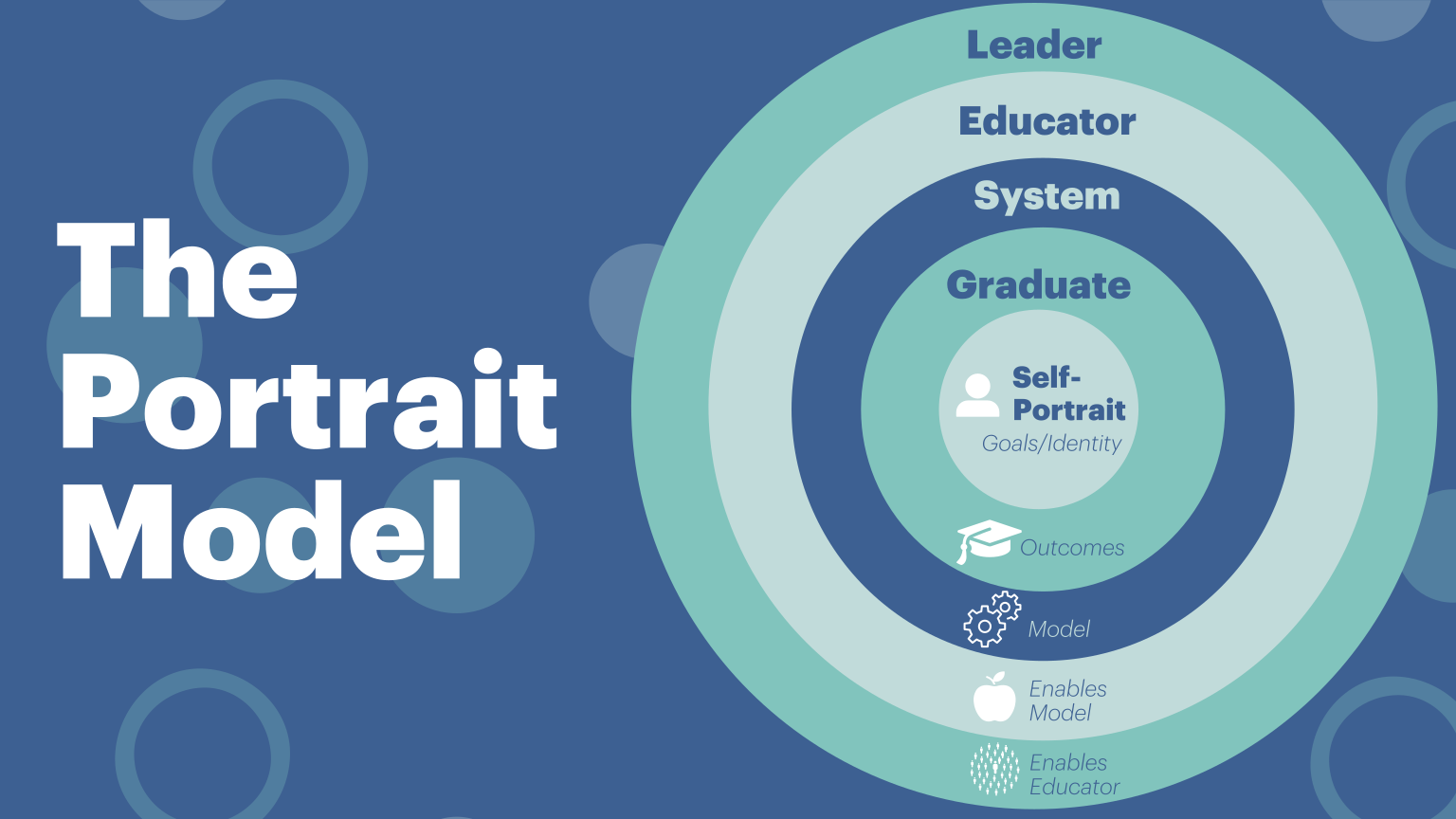
Vriti Saraf: A set of guidelines. No, I think it would be incredibly foolish of us to say that there is one portrait of a teacher that everybody needs to aspire to, especially because there’s one thing that we’ve realized. The Portrait of a Graduate oftentimes leads to this process that you do with your community members, which leads to one set of competencies that every graduate should aspire to.
Whereas with the Portrait of a Teacher, we’re finding that that’s actually not going to work because teachers work in an ecosystem that serves different needs for different students. And so there’s probably going to be multiple portraits or multiple personas that we want.
Nate McClennen: Yeah. We’ll dig into that a little bit more because I’m super interested in the report that was just released. You started to talk a bit about these personas, and we’ll jump into that.
But it feels like the major conclusion overall in what you looked at with all these 1,100-plus surveys was that the current use of AI is not really transformative, right? It’s in the additive world. It’s adding something. It might be replacing something, like you said, for lesson planning. It might be efficiency-based.
Do you think this is going to change over time, or is there a danger that it just stays in this status quo? I mean, we know that education is pretty immutable. It’s hard to shift our sector. We know that. Is there a danger there, or is there an opportunity here?
Vriti Saraf: Probably both.
Nate McClennen: Yeah.
Vriti Saraf: We know that change is inevitable with AI because of how powerful AI is.
I think a lot of people see AI as a tool, but it’s really an infrastructural technology that’s getting embedded into a lot of our digital ecosystem without us even realizing it. And I think it’s going to become so ubiquitous that it’s just going to be like your phone or the internet, where you just use it without even thinking about it.
And so AI is going to absolutely transform a lot of things. I think the question is whether our industry will embrace a new model for transformation or whether it will cling to the systems that currently exist.
So if we cling to what currently exists and we’re still really focused on standardized testing, we’re really focused on 30 kids in a classroom and one-to-one instruction and didactic instruction and things like that, which is what most public schools currently are operating in, I think the AI conversation may lead us more to automation and more AI tutors that help kids on a standardized test and potentially fewer humans in the loop.
I wrote a blog post several months ago about the equity conversation that we’re having about AI right now, how AI is available in some areas and not in other areas, and demographically, under-resourced students are not having access to good AI tools. And that’s all true right now.
But I think ultimately, if we continue on this path that we’re going down right now, in five to 10 years the equity conversation is not going to be who has access to AI. It’s going to be who has access to humans because humans are going to be a lot more expensive than AI.
And so that’s where I see, if we continue being mired in the current systems and don’t think about transformation in a way that’s actually changing the industry, I think we’re actually going to get to a point where there’s going to be so much automation, especially in under-resourced schools, that we’re just not going to have a lot of humans in the loop.
But if we can start rethinking models for teaching and learning where we really push our imagination for what students can accomplish, raise the expectations for what adults and youth are able to actually do in the classroom, and really focus on student-centered learning experiences that are more about immersive learning and emergent curriculum, well, there’s a ton of technology out there that’s way more advanced than the LLMs that we have currently.
Things like wearable AI technology can actually go with you to adapt a learning experience and create more personalized pathways that can basically allow students to be more practical in their learning and more real-world in their learning without being tied to a classroom.
But those obviously require a lot of systemic changes and a lot of assessment changes. But that, I think, would be way more interesting to think about.
Nate McClennen: Right. It’s sort of the Alpha School premise, which has been all over the news. But regardless of what people believe about Alpha School, the concept is: how do you do the work better that is better served by AI to free up more time to do more real-world experiences, more relationship-building, more human connection?
And I think the equity question is real. We’re starting to see this percolate, as you said, this idea of who gets access to this human-connected, community-connected time. And it has to be everybody. It can’t just be some people. But the tendency will be, the more affordable way will be, “Oh, automate as much as possible because that’s cheaper,” right?
So I think there’s a real danger there that you’re noting. And so that pivots to a nice segue into our next question. Teachers talked a lot about the most important pieces being relationships, connection, emotional attunement. All the skills of how you connect with students seem to be the things that were maybe most important and also less likely to be disrupted, I think.
AI’s Impact on Human Connection & Teacher Relationships
Nate McClennen: So where do you see AI tools being designed, or how can tools be designed, to extend these? And maybe you touched on that in your last response, but if this is important, humans in the loop, how will AI actually enhance humans in the loop? Thinking on that?
Vriti Saraf: Yeah. So this is a really complicated question, more complicated than I think it seems.
We had this open-response question about, if AI could do everything, what remains truly human about a teacher? And we got, I think, over 700 responses where educators wrote paragraphs of content about relationships and connection, and it was really beautiful to see.
But the reason why I think it’s complicated, and the reason why it’s going to be really controversial in the next even three years, is because of the popularity of AI companions and because of the anthropomorphism of AI.
If we continue honoring human relationships and connection, which is what our survey respondents were talking about, we can use AI tools to support difficult conversations and personalized connections through conversation analysis, right? We can use time-saving tools that can make more room for human connections. We can use AI tools that can help teachers notice better patterns about student emotional states.
That’s a really hard thing, especially in classrooms where there are students coming from different backgrounds and different developmental needs and different emotional needs. And so AI being able to identify what teachers should be focused on would be amazing, right?
There are reflection tools and journaling tools that can help students become more self-aware. Translation tools are amazing to help with communication both with students and with families. And I’m sure there are a ton of other examples here where AI can really empower educators and students to build those relationships.
But the place that gets really complicated is that, as AI companions become more popular, we’re going to start seeing people use AI to displace human connections.
Nate McClennen: Mm-hmm.
Vriti Saraf: And that’s not just vulnerable youth, right? We’re not just talking about the folks who are more susceptible to these parasocial relationships, but your average, happy, healthy youth and adults are going to start relying on these tools to brainstorm responses to a text that might be difficult to answer or to have an outlet to talk to when you either can’t afford a therapist or don’t want a therapist or don’t want to talk to a human therapist.
Those things are going to become a lot more ubiquitous, and they’re going to become a lot more popular for people. And when that happens, I think this question is going to become really, really hard.
So I don’t know what the answer is necessarily to how we ensure that human relationships are elevated above robotic relationships, but that’s one of the reasons why we have that third strand, which is the Science of Artificial Relationships, because we suspect this kind of human-to-AI relationship is going to impact learning and cognition, and it’s going to change the way that teachers have to operate and the way that teachers have to respond to students.
But in order to really understand that, we’re launching an investigation and several-month study to basically understand what the signals are that are going to help us understand where this is all headed.
Nate McClennen: Yeah. It’s fascinating. I think about this a lot, especially in light of more and more districts and systems saying, “Hey, no cell phones in schools.” And there are some that are going as far as saying, “Hey, we’re going to remove technology from schools.” Yet the ocean that young people and adults are going to swim in increasingly will be AI-supported.
AI will become the plumbing, right? I think it’s not about whether you’re choosing to use AI or not. AI will just be part of the system, just like the internet has become for our generation, right? So I wonder a bit about what happens then.
If every student has a companion outside of class, and that companion is effective not only on the relationship piece but on the academic piece, what opportunities does that set up for the educators?
And so maybe this is an important way to segue into this next question about personas. You make some great persona statements that a teacher isn’t just one role. Already we have this, right? You’re certified in English or science or health or PE, whatever the case may be. But you actually take this in a different slant. You say that there are different role responsibilities and approaches. Can you talk a little bit about that and what that might look like and how that may reshape how we think about teaching in the one-teacher, one-classroom model?
Vriti Saraf: Sure, yeah. So there are two big things that came out of this report.
One was in that open-response question. A lot of educators identified their role as not just being instructional, but actually doing a lot of other things like helping with career navigation, helping students feel heard, helping students make connections with each other.
And so what we did, and this is not an opinion of the project, this is just what we found from the data, we basically took all their responses and categorized them and bundled them into the types of roles that they were saying they would have in the future.
A lot of these roles are not necessarily subject roles, but they’re almost roles that help students navigate their world in different ways, whether it’s navigating pedagogy, navigating their emotions, navigating their sense of self, navigating their career choices, things like that.
And that became a really interesting throughline that we realized is going to actually impact the educator role more so than, let’s say, a subject or content expertise. Because if AI can handle the content, then adults can become that much more nuanced perspective that can help students make better choices in life.
And so that’s what we started seeing. And that was just from the data. Then what we realized was that when we’re creating this Portrait of a Teacher toolkit, we really have to make sure that states and educational leaders, whoever is using our toolkits, are going to be able to identify a team of teachers or an ecosystem of roles that can help students on a holistic level.
And the truth is, teachers today are already performing a wide system of roles, right?
Nate McClennen: Right, right, right.
Vriti Saraf: And that’s probably why teaching is so unsustainable. But imagine if educators could specialize in a different type of expertise that changes the temporal rhythm and the relationship architecture between students and teachers. And that, I think, becomes something that we could potentially aspire to.
And then also look at our current systems and pull out things that we’re currently doing that could fit into a different role, that could bring a different set of talent and expertise into the education ecosystem. Because right now, most of the talent going into education are educators who have been trained to be teachers. But what if there were a different type of talent that could actually bolster the way that students are experiencing learning?
Nate McClennen: Yeah. You know, Next Education Workforce at ASU has been thinking about this, right, about the different roles, and not necessarily in relationship to AI. But I think there’s a there there.
Future Teacher Personas & Role Specialization
Nate McClennen: Let’s talk about a few. So you had something like a learning architect or a life navigator. What’s ironic is that right now teachers are probably already doing these. They just wear many, many hats. You put on your life navigator hat, your learning architect hat, and then all these other hats, and they get stacked up and stacked up and you run around with your head cut off because it’s too hard to do them all.
And so what you’re positing is that maybe, just maybe, there’s hope in that AI may allow us to free up more time to spend on these important connection pieces and this bigger hypothesis around there may be different roles for teachers. You may be the life navigator, and that’s the role you have. Or you may be the learning architect that’s designing learning experiences. You may be the community connector that’s out there in the community building all these different pieces that are important for students.
So there’s this teaming effect. But really, how do we change the system, right? Schools of education are not set up to design in this way. So we need some brave new education schools to step forward or existing education schools to say, “We’re redesigning the role.” Also, licensure gets in the way. What does the shift look like in your future-predicted state? How do we get from now to then?
Vriti Saraf: I think you make a really good point that I think a lot of people don’t think about, which is when we think about school change, we often start with the school and we often think about how a school system can change to adapt to this.
But the truth is, the school system is third or fourth in terms of the changes that need to happen in order to make something like this happen. So what you’re talking about is really where we need to start, which is how talent is created through education schools, how talent is certified through certification systems, how talent is developed and nurtured at schools, and then what type of roles actually exist.
So I think the main conversation, or the most important conversation, is to actually start from the first principles here, right? Where are we actually creating talent? For what reason? What kind of ecosystem is being created because of the talent that we’re creating?
And then the most important thing that drives a lot of educators and education systems is policy and certification, right?
Nate McClennen: Yeah.
Vriti Saraf: So how are teachers being certified? For what are they being certified? For what are schools willing to pay them? Those are the conversations that I think will need to be had before a school can even start thinking about how do we actually change our internal ecosystem to bring on more personas.
Nate McClennen: Right. You wonder if it’s almost sort of like you can get additions to your teaching license or addendums, right? So could you imagine that these different roles, however a community defines them, because you present a set of personas that could be modified for any particular ecosystem, that’s the power of the toolkit. But you could imagine that as an add-on, right?
Vriti Saraf: Yeah. One analogy that I was thinking about was, are you familiar with the difference between an MD and, I think it’s called a DO?
Nate McClennen: Yeah, osteopathy. I’m not familiar with the difference. I know that when I go to the doctor, they either have one of those initials or the other initials after their name.
Vriti Saraf: Yeah. So the thing that I’ve learned is that DOs have a medical degree, but they tend to be more holistic in the way that they approach medicine.
Nate McClennen: Ah, interesting.
Vriti Saraf: And they think about, how does your headache connect with the rest of your body? Are there any natural remedies that can help with this? And is there a way that we can prevent this in the future, right? So it’s more of a holistic thing.
A lot of medical professionals are starting to get certified as DOs, and they’re starting to think a little bit more holistically about their patient, which I think is awesome because I don’t want to be prescribed medicine right away. I want to actually understand the stem and the root cause of why I’m experiencing something and then be able to avoid it in the future.
Whereas what most doctors do is, “I want to stop your pain right now. Here’s some medicine. Come back to me if it happens again,” right?
Nate McClennen: Right, right.
Vriti Saraf: And so I wonder if we can think about that with teacher roles in the short term, which is, are there things that teachers can get certified in? In the short term, as they’re getting certified in a specific subject, can they add an element of a life navigator into their certification or an element of a community connector into their certification so that we can start thinking about how one teacher who has expertise in a subject area can get really well-developed and have more expertise in another relational concept, and then that gets distributed across a teacher team or across a school and then those folks can serve students better?
I think in the short term, that might be an interesting way to navigate it. But in the long term, I feel like there really does need to be a differentiation between all the roles so that there can be an ecosystem that supports one another.
Nate McClennen: Right. I mean, imagine what would happen if you—and this is where AI could be helpful here—you have a particular student who has a particular set of needs and aspirations and goals and visions, and they’re still going to be connected to some content set, right, that’s required. If it’s in the public sector, it’ll be the standards or whatever the case may be. I don’t think those are going away.
Imagine if there was some tool that would say, “All right, well, for your particular reflection and vision and where you want to head, let’s assign you a set of these teachers that have particular certification in these various,” what you called, “relational roles.”
I don’t know what the bucket is, but something along those lines. You get a life navigator and you get a community connector, and then that builds your support team that would typically maybe be served right now in the system by one adviser, if you’re lucky, or a career college counselor adviser that would be one for 200 kids, right? We just don’t have the systems to do that well.
So maybe these added persona certifications could be interesting there.
Vriti Saraf: So several years ago I traveled to Bali, to Ubud, to visit the Green School.
Nate McClennen: Oh yeah. Yeah, yeah.
Vriti Saraf: And I don’t know if they currently have this model, but back then, this is how they described it, and I thought it was so brilliant.
For their high school, starting in junior year, I believe, instead of assigning subjects and teachers to students, they actually allow the students to pitch for credits. And so what they do is they say to a student, “You design a project for the next two years that you’re going to work on, and you have to pitch for physics credits, biology credits, whatever.”
Nate McClennen: Yeah.
Vriti Saraf: And you have to make sure that you actually satisfy all of your credit requirements, but through your project. And once you pitch that project with those credits, there’s going to be an advisory committee that basically will assign you an educator that is an expert in that area of the project, somebody who will be able to advise you from a different perspective, another person for community-building, another person that will advise you in this other area.
So basically, it’s a team of educators that specifically advise on the success of that project, along with other students and other parents that become embedded into that project over the course of two years. And then at the end of two years, you basically present this project and what you’ve learned and how you’ve learned about it and all that kind of stuff and how you’ve earned those credits.
What’s brilliant about that is, obviously it’s an emergent style where students get to choose their own project-based learning adventure, but also because they get access to experts who are going to actually help them navigate this two-year journey in a way that is really adaptive and personalized and doesn’t necessarily focus entirely on subject.
So I thought that was a really interesting model.
Nate McClennen: Yeah. And you see Jeffco Open School in Colorado, which is a public school that’s been operating for 50 years, doing a similar thing with these massive portfolios and capstone projects and advisory groups.
The question I always have is scale. How do you do that in a large suburban or urban system? How do you make sure that it’s set up? And that’s again where I think perhaps AI tools can help us with this.
So you need the talent pool to be developed in a way that amplifies the skills that a lot of teachers are already using, but maybe is a lot more precise around it, and then some sort of tools to help reassign, reallocate, and create the best possible adult support teams for those individuals.
So, all right, interesting. I want to ask the hardest question here to see what your prediction is. We’ve danced around this issue, but core content, ELA, math, maybe the sciences, whatever the case may be, is that increasingly going to be taught by AI in one-to-one systems like Khan Academy or i-Ready or all these adaptive technologies that have been around and now are being supercharged?
We have some predictors out there that are starting to say that may be true. We haven’t been able to really put a dent in our broad-scale testing, if you’re going to use that as a measure of success. Is that going to happen? That’s my first question. And then, will that allow teachers to do different things, or will teachers always have a role in this core content?
Vriti Saraf: Yes, some sort of measuring system is important, assessment systems are important, but I don’t think standardized tests are going to be the way of the future, and I certainly hope they’re not.
So I think if they’re not going to be the way of the future, then I don’t think that automation and AI tutoring and things like that are going to be the dominant force in education. Ultimately, the goal is for students to have holistic experiences where they can learn about themselves and the world and others and build different foundational capacities for education.
But in order to do that, I think we need to expand the way that we operate in education and the learning systems that we have. And I think AI can definitely help with that.
Nate McClennen: Right. And I think it kind of comes back to this fundamental question: If we keep assessment and the system as status quo, AI will probably amplify the status quo, right? So if we are focusing on a single test score for students, then AI will be used more and more to help increase those test scores.
If we rethink AI and assessment more broadly, which many, many people are thinking about, like a broader idea of assessment, AI could potentially be used to draw out and amplify ways to meet the standards. Because it is important that every student is literate in both math and ELA. That’s really, really important.
We’re not there yet, but let’s do it in a way that’s more real-time, more focused, more relevant, more contextualized, and have some ability to say, “Hey, a student is doing this project. They’re demonstrating proficiency in this particular standard,” et cetera, rather than a point-specific test at a certain time of year where the results get released three months later and just have no impact on the students.
So I’m hopeful that we move toward the latter rather than the former, right?
And then my last question as we wrap this up is this: You have these other personas around moral guide or ethical steward, things that sometimes schools are a little bit hesitant to deal with, right, because this is dealing with deep values. And yet my personal opinion and my hopeful opinion is that this is the real work, right? We need people who have moral grounding, adults who are moral grounding and who are the ethical stewards of decision-making in the world, et cetera.
In an AI-rich world, does teaching these skills become even more important? Does it become absolutely core, just like ELA and math are core?
Vriti Saraf: Yeah. I think we know the answer, which is—
Nate McClennen: It’s a loaded question, Vriti. It’s a loaded question, but I want to conclude on a loaded question.
Vriti Saraf: And the truth is, ethics is subjective in this age where some people think something is ethical and other people think something else is ethical.
And I think this is also going to be a really complicated place because AI, as we know, is flooding the media with misinformation and things that are convincing people of situations or events that are potentially not good for the world, convincing people that they are good for the world, right? Or that some leaders are good for the world, or that some practices are good for the world.
And so I think that’s where the ethics conversation is going to really break down. And so I think what we first need to do, going back to the graduate schools of education, is really help teachers identify a code of ethics that is going to be true to them and that is then going to, I think, influence the way that students operate.
And I don’t think this conversation of ethics is ever going to be a clean conversation because humans are flawed and everybody thinks in different ways. So I think this is going to be one of those things where, yes, the ethical steward conversation is going to be really important, but ethics itself is pretty complicated.
So yeah, I think it’s just going to be one of those things where we’re going to have to rely on mass consensus to get us to a good place, but there will be pockets that will probably continue being a little bit more controversial.
Nate McClennen: Yeah, no, for sure. Always, right? And that’s just the world we live in.
As you and I have talked about a lot in other conversations, it is going to be more and more important to address these issues because it’s going to be harder and harder to determine what’s true and what’s not true in this media-soaked world.
I read a stat yesterday that now over 30% of websites on the internet have been AI-generated and/or AI-supported in their generation.
Vriti Saraf: Yeah.
Nate McClennen: And it’s only going to become more and more common. And we know that influences the brains of humans, right? So, all right, we’ve got to wrap here.
Vriti, awesome conversation. We’re going to put all the links into the resources. What’s the best use case in terms of this thing gets produced, you’re going to produce the third part, which is going to be really interesting around these artificial relationships, you’re building out all these tools that people can interact with—what, in the best-case scenario, do you hope people will take away from this?
Vriti Saraf: For educators, I’m hoping it’s going to help them see more possibility for what their role could be and help them get rejuvenated for their profession and start approaching the profession in potentially different ways.
The purpose of this is also a grassroots movement. So it’s not just about empowering leaders, but it’s empowering educators on the ground, which is why we have a public group called the BrainTrust that anyone can join and get internal updates on.
And the other thing is, once we do deliver these tools, we do want statewide efforts to recognize the importance of identifying how the teacher role is going to change and then basically build their personas to then cascade into districts and schools, and for graduate schools to also consider that.
So the goal is changing perspectives and then doing something about that, essentially.
Nate McClennen: Yeah, that’s great. Well, I encourage everyone listening to go to the website, and we’ll put that in the show notes so that people can quickly find it. I think it’s a super useful tool, Vriti, and thanks for putting it out there.
Hopes for the Future of Education
Nate McClennen: Here are just a couple of really brief conclusions, and it’s around hope because I’m thinking a lot about hope these days.
From this conversation, I think hope is AI making the teaching profession stronger and more desirable, right?
Vriti Saraf: Agreed.
Nate McClennen: So that’s number one. Number two, hope is that AI allows everyone to have access to humans in the future and teams of humans that will support thriving and learner thriving, right?
Vriti Saraf: Yeah.
Nate McClennen: And then maybe number three is hope is rethinking how we amplify the existing talent and all the multiple hats that teachers wear and put sweat equity into every single day in the teaching profession in a more intentional, designed way to help rethink how teams of adults are working with young people in a way that’s sustainable, manageable, and amplifying the talents that they already have.
So those are my three takeaway messages from today, and I just really appreciate the work of Ed3, your work, and your leadership there. Thanks for taking the time this morning to come talk.
Vriti Saraf: Thank you for having me, and I totally agree with your hopes.
Nate McClennen: Okay. Have a great day.
Vriti Saraf: You too.
Guest Bio
Vriti Saraf
Vriti Saraf is co-founder and CEO of Ed3 (ed3global.com), a non-profit that prepares educators for the future through coursework, research & development, and a global community of practice. Vriti started her career as a Teach for America teacher in Brooklyn, NY. She has served as a professor, a dean, & a director in public, private, & charter schools both locally & internationally across k12 & higher education. She currently serves in advisory roles at XPrize, Full Steam Forward, and Mi Primer Bitcoin. You can access her blog at (ed3world.substack.com).
Links




0 Comments
Leave a Comment
Your email address will not be published. All fields are required.