


For Whom: Signals
Signals are how proficiency and growth are communicated and recognized — through transcripts, credentials, portfolios, and reports.
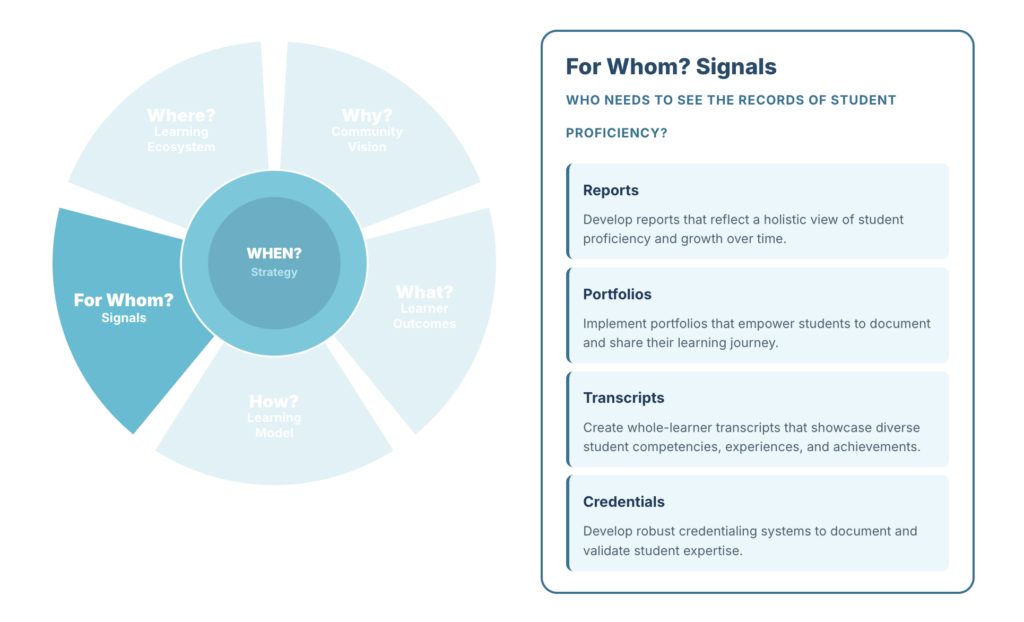
Signals describe how learning is communicated and to whom. They are the mechanisms a system uses to make growth legible — to students who need to understand where they are, to families who need to see progress over time, to educators who need to make informed instructional decisions, and to colleges, employers, and community partners who need to recognize readiness when a young person walks through their door.
In most traditional systems, signals are blunt instruments. A letter grade condenses weeks of complex learning into a single character. A course list on a transcript tells you what a student sat through but not what they can actually do. A diploma signals completion but says nothing about competency. These signals were designed for a different era and a narrower definition of success, and many communities are discovering that they no longer reflect the outcomes they actually care about.
The Learning Innovation Framework examines four connected components that together form a coherent signaling system: Reports, which offer periodic views of a learner’s progress and proficiency; Portfolios, which give learners a place to curate and reflect on evidence of their growth over time; Transcripts, which provide a multi-year summary of achievement and experience; and Credentials, which validate specific competencies and skills in ways that can travel with learners into whatever comes next. None of these is new on its own. What is new — and what this element is about — is designing them as a coherent system, one where each tool reinforces the others and all of them point back to the outcomes your community has defined.
The keyword in “For Whom” is the word for. Signals are not just records. They are communications. They are sent by the system and received by specific people who need to understand something specific in order to act. A report that an educator cannot interpret is not a useful report. A portfolio that a family cannot make sense of is not doing its job. A credential that a college admissions office has never encountered and doesn’t trust is not yet portable. Designing strong signals means thinking carefully not just about what information you want to communicate, but who needs to receive it, what they need to understand from it, and whether the form you have chosen actually gets it there.
Select a segment from the wheel to see its details here
Getting Smart Resources
Beyond Report Cards: Louisville Students Use Portfolios to Curate and Defend Their Personal Learning Record
This Getting Smart article examines how Louisville schools are replacing or supplementing traditional report cards with student-led portfolio systems that allow learners to curate evidence of their growth and defend their learning records to an audience. The resource details how students take ownership of documenting their competencies, experiences, and achievements in ways that go beyond letter grades, presenting a more holistic and personalized picture of what they know and can do. For practitioners and school leaders, it offers a concrete model of assessment transformation that shifts power to students while addressing long-standing critiques of standardized grading systems. It matters because reimagining how learning is reported is foundational to broader innovation efforts — if schools change instruction and curriculum but keep the same reporting structures, the signal sent to students, families, and post-secondary institutions remains unchanged.
Expressing Learning Journeys Through Digital Portfolios
This resource from Getting Smart examines how digital portfolios can serve as dynamic tools for capturing and communicating student learning over time, moving beyond static assessments to create ongoing records of growth, reflection, and achievement. It explores how portfolios function as “signals” — evidence-rich artifacts that students, educators, and families can use to understand learning in a more holistic and authentic way than traditional grades or test scores allow. The resource is particularly relevant for school leaders and practitioners working to shift toward competency-based or personalized learning models, where demonstrating mastery through curated evidence matters more than seat time or standardized measures. By centering student agency in the documentation process, digital portfolios also support the development of metacognitive skills, helping learners articulate what they know, how they’ve grown, and where they’re headed.
How Digital Portfolios Empower Student Ownership of Learning
Getting Smart’s resource on digital portfolios examines how shifting from traditional assessment models to portfolio-based documentation can fundamentally change the relationship students have with their own learning. The resource explores practical strategies for implementing digital portfolios that capture student growth, reflection, and evidence of competency over time, rather than relying solely on grades or standardized measures. It addresses how portfolios can serve multiple purposes simultaneously — supporting personalized learning, authentic assessment, and student agency — while also giving teachers and school leaders meaningful insight into learner development. For practitioners exploring competency-based or learner-centered models, this resource provides a concrete entry point into rethinking how learning is made visible, owned, and communicated by students themselves.
Active Parent Engagement and the Role of Digital Portfolios
This resource from Getting Smart examines how digital portfolios can serve as a powerful bridge between schools and families by making student learning visible, ongoing, and meaningful beyond report cards and standardized assessments. It explores how portfolios shift parent engagement from passive reception of grades to active participation in understanding their child’s growth, skills, and learning process over time. The resource offers practical insight into how schools can use digital portfolio platforms to facilitate richer conversations between educators, students, and families, fostering a shared understanding of what competency and progress actually look like. For practitioners and school leaders pursuing competency-based or learner-centered models, this matters because authentic parent engagement is often an underdeveloped lever in education transformation, and portfolios offer a concrete, evidence-based tool for closing that gap.
Podcast: How Better Transcripts Will Improve College Admissions, Employment, and Licensing
This Getting Smart podcast episode examines how reimagining academic transcripts can strengthen the systems students rely on to demonstrate their learning and qualifications across college admissions, employment, and professional licensing. It explores the limitations of traditional transcripts and makes the case for richer, more comprehensive records that capture a fuller picture of student competencies, experiences, and achievements beyond letter grades and course names. For practitioners and school leaders pursuing learning innovation, this resource is directly relevant to the growing movement around competency-based education, mastery transcripts, and learner profiles, offering practical context for why and how credential reform connects to real-world outcomes for students. The conversation highlights how better signaling systems can reduce inequity, improve opportunity matching, and make student learning more legible to the institutions and employers who evaluate it.
Podcast: Laurie Gagnon and Cory Henwood on Learner Records and Next Gen Credentialing in Utah
This Getting Smart podcast episode features Laurie Gagnon and Cory Henwood discussing learner records and next-generation credentialing initiatives underway in Utah, offering practitioners and school leaders a ground-level look at how one state is rethinking how student learning is documented and recognized. The conversation explores how traditional transcripts fall short in capturing the full range of student skills, competencies, and experiences, and what more comprehensive learner record systems can do to address that gap. For educators and leaders pursuing competency-based or personalized learning models, this episode provides concrete context around policy, implementation, and the stakeholder coordination required to shift credentialing systems at scale. It is particularly relevant for those working on portrait of a graduate initiatives, alternative credentialing, or interoperability of student data across systems. The Utah example serves as a practical reference point for understanding what systemic change in learning recognition can look like when driven by intentional state-level
On Building a Network of Schools Using the One Stone Growth Transcript
This resource from Getting Smart examines how One Stone, a student-led nonprofit school in Idaho, developed and implemented a Growth Transcript as an alternative to traditional academic records. It explores the practical process of building a network of schools around this model, detailing how competency-based, holistic student documentation can capture skills, experiences, and character alongside or instead of conventional grades. The resource offers school leaders concrete insight into what it takes to design, pilot, and scale a non-traditional transcript system across multiple schools, including the stakeholder alignment and philosophical shifts required. For practitioners pursuing learner-centered transformation, it matters because transcript reform is one of the most consequential and least-addressed levers in reimagining how student achievement is recognized, communicated, and valued by colleges and employers.
Skills Transcripts at Scale: Why The ETS & MTC Partnership is a Big Deal
This Getting Smart resource examines the partnership between ETS and the Mastery Transcript Consortium (MTC) to develop and scale skills-based transcripts that move beyond traditional letter grades and Carnegie units. It explores how this collaboration aims to create a credible, widely recognized alternative credentialing system that captures students’ competencies, skills, and dispositions in ways that conventional transcripts cannot. For practitioners and school leaders, the resource offers insight into the practical and systemic implications of reimagining how student learning is documented and communicated to colleges and employers. This matters for education transformation because transcript reform sits at the intersection of assessment, credentialing, and equity—changing what schools measure ultimately reshapes what and how they teach, making this partnership a significant lever for shifting the broader education system.
Expanding Access, Value and Experiences Through Credentials
This resource from Getting Smart examines how credentials beyond traditional diplomas can expand opportunity and signal learner achievement in more meaningful ways. It explores the growing ecosystem of badges, certifications, micro-credentials, and alternative pathways that communicate student skills and competencies to employers, higher education institutions, and communities. The resource offers practitioners and school leaders a framework for thinking about how credential design and recognition can better reflect what students actually know and can do, particularly for learners underserved by conventional transcript-based systems. For educators pursuing innovation, it matters because rethinking credentialing is central to building more equitable, transparent, and future-ready learning systems that connect school experiences to real-world value.
A New Infrastructure for Learning Credentials (
A New Infrastructure for Learning Credentials” from Getting Smart examines the evolving landscape of learner recognition beyond traditional diplomas and transcripts, exploring how emerging credential systems can more accurately capture the full range of student skills, competencies, and experiences. The resource investigates digital badges, micro-credentials, and interoperable credential frameworks that allow learners to document and communicate learning from multiple contexts, including work-based, community, and non-traditional settings. For practitioners and school leaders, it offers a practical lens on how schools can begin redesigning their recognition systems to reflect what students actually know and can do, rather than seat time or course completion alone. This matters because credential infrastructure directly shapes college admissions, workforce entry, and equity—students whose strengths fall outside conventional grading systems are often rendered invisible, and new credentialing approaches offer a concrete mechanism for changing that.
New Pathways: Credentialed Learning
New Pathways: Credentialed Learning” is a resource from Getting Smart that examines the evolving landscape of alternative credentials and non-traditional pathways for recognizing student learning beyond conventional transcripts and diplomas. It explores how stackable credentials, microcredentials, badges, and competency-based recognition systems are being designed and implemented across K-12 and postsecondary contexts to better capture the full range of what learners know and can do. The resource offers practitioners and school leaders concrete signals about where credentialing innovation is heading, drawing on emerging models from schools, districts, and workforce partners who are rethinking how learning gets validated and communicated. For education transformation, this matters because the traditional transcript fails to represent skills, dispositions, and experiences that employers and colleges increasingly value, making credentialing reform a critical lever for equity and student agency.
Town Hall Recap: The Landscape of Credentialing Experiences
This resource from Getting Smart is a recap of a town hall discussion focused on the evolving landscape of credentialing experiences in education. It captures key insights, perspectives, and conversations from practitioners, innovators, and leaders examining how credentials beyond traditional transcripts and diplomas can better signal learner skills, competencies, and experiences to colleges and employers. The resource offers a snapshot of where the field currently stands, surfacing emerging models, challenges, and opportunities in alternative and stackable credentialing systems. For practitioners and school leaders pursuing learning innovation, it provides a grounding in the broader credentialing movement, helping them understand how shifts in how learning is recognized and communicated can drive more equitable, competency-based pathways for students.
Technology We Need: Documenting the complete Learner Record
Technology We Need: Documenting the Complete Learner Record” is a resource from Getting Smart that examines the technological infrastructure required to capture and communicate a comprehensive picture of student learning beyond traditional transcripts and grades. It explores emerging credentialing systems, tools, and platforms that can document skills, competencies, experiences, and achievements across a learner’s full educational journey. The resource is particularly relevant for school leaders and practitioners working to shift from seat-time-based accountability toward mastery and competency-based models, where richer learner data becomes essential for student agency and equitable opportunity. For those navigating the growing landscape of digital credentials, badges, and learner profiles, this piece offers grounding in both the practical possibilities and the systemic challenges of implementing a more complete learner record at scale.
Podcast: Ryan Lufkin on Instructure, Acquisition and The Future of Credentialing
This Getting Smart podcast episode features Ryan Lufkin of Instructure discussing the company’s strategic acquisitions and their implications for the future of digital credentialing in education. Lufkin explores how Instructure’s expanding portfolio positions it to connect learning management systems with verifiable credentials, giving institutions new ways to recognize and communicate learner achievement. The conversation is particularly relevant for school leaders and practitioners navigating the shift toward competency-based and stackable credentialing systems, offering insight into how edtech infrastructure is evolving to support these models. For those tracking how platforms, data, and credentials intersect, this episode provides a grounded, industry-level perspective on where the credentialing landscape is heading and what that means for designing learning systems that are both flexible and future-ready.
TownHall Recap: Badging & Credentialing (
This resource is a recap from Getting Smart’s TownHall series focused on badging and credentialing as alternative or supplementary forms of recognizing student learning. It likely summarizes key discussions, insights, and practitioner perspectives on how digital badges and micro-credentials can signal competencies that traditional transcripts and letter grades often fail to capture. The resource is relevant for school leaders and educators looking to broaden how student achievement is documented and communicated to colleges, employers, and other stakeholders. As competency-based and personalized learning models gain traction, credentialing systems become a critical infrastructure question, and this recap offers accessible, practitioner-grounded thinking on how schools can begin or refine that work.
A Community Micro-Credentials Effort Connects Students to Local Employers
This Getting Smart resource examines a community-based micro-credentials initiative that creates direct pathways between students and local employers by offering stackable, competency-based credentials tied to real workforce needs. It explores how regional partnerships between schools, businesses, and community organizations can validate student skills in ways that traditional transcripts fail to capture, making learning visible and meaningful beyond the classroom. The resource highlights practical models for designing and implementing micro-credential systems that reflect local labor market demands while expanding equitable access to career pathways. For practitioners and school leaders, it offers a concrete example of how credential innovation can serve as a lever for systemic transformation—aligning educational outcomes with community economic priorities and giving students tangible, employer-recognized evidence of their capabilities.
States Partner on Micro-Credentials to Personalize Teacher Learning
This Getting Smart resource examines how state education agencies are collaborating to develop micro-credentials as a flexible, competency-based approach to professional learning for teachers. It explores how these stackable, targeted credentials allow educators to demonstrate mastery of specific skills on their own timeline, moving away from traditional seat-time models toward evidence-based recognition of professional growth. The resource details how interstate partnerships are expanding the ecosystem of available micro-credentials, making personalized teacher development more scalable and portable across systems. For practitioners and school leaders, this matters because it signals a broader shift in how educator effectiveness is defined, recognized, and supported — with direct implications for hiring, retention, coaching structures, and how schools design professional learning pathways that actually respond to individual teacher needs.
Digital Credentials: A Better Way to Capture and Communicate Learning
Digital Credentials: A Better Way to Capture and Communicate Learning, published by Getting Smart, examines how digital badges and micro-credentials can more accurately represent what students know and can do beyond traditional transcripts and letter grades. The resource explores how schools and districts can design and implement credentialing systems that recognize a broader range of competencies, skills, and achievements, including those developed through project-based learning, extracurriculars, and work-based experiences. It offers practical framing for practitioners and leaders on how digital credentials function as verifiable, shareable signals of learning that can follow students into higher education and the workforce. For educators pursuing competency-based or personalized learning models, this resource matters because it directly addresses the gap between what schools are teaching and what current assessment and reporting systems are able to communicate to outside stakeholders.
Expanding Access, Value and Experiences Through Credentials
This resource from Getting Smart examines how credentials beyond traditional diplomas can expand opportunity and signal learner achievement in more meaningful ways. It explores the growing ecosystem of badges, certifications, micro-credentials, and alternative pathways that communicate student skills and competencies to employers, higher education institutions, and communities. The resource offers practitioners and school leaders a framework for thinking about how credential design and recognition can better reflect what students actually know and can do, particularly for learners underserved by conventional transcript-based systems. For educators pursuing innovation, it matters because rethinking credentialing is central to building more equitable, transparent, and future-ready learning systems that connect school experiences to real-world value.
How to Credential?
How to Credential?” from Getting Smart is a resource examining the evolving landscape of alternative credentialing in education, exploring how schools, districts, and learning organizations can design and implement meaningful credential systems beyond traditional transcripts and diplomas. It offers practitioners and school leaders practical frameworks for thinking about how learning can be recognized, validated, and communicated through badges, microcredentials, competency-based records, and other emerging signal systems. The resource addresses a critical gap in education transformation: the misalignment between what students actually know and can do and what conventional credentials capture and convey to colleges, employers, and the broader world. For leaders redesigning learning models, this resource provides a foundation for understanding credentialing not just as an administrative function but as a strategic tool for equity, learner agency, and systemic change.
What to Credential?
What to Credential?” is a resource from Getting Smart that examines the growing movement to expand credentialing beyond traditional academic transcripts to include skills, competencies, and experiences that better reflect a learner’s full range of capabilities. It offers practitioners and school leaders a framework for thinking critically about which learning outcomes are worth formally recognizing, how to design meaningful credential systems, and what criteria should guide those decisions. The resource engages with questions about employer value, learner equity, and institutional credibility that are central to making alternative credentials actionable rather than symbolic. For educators driving innovation, this matters because credentialing is ultimately a signal system—and rethinking what gets signaled, and to whom, is foundational to building education models that serve all learners and align with real-world pathways.
Badging and Micro-Credentialing: How Education and Employment Can Benefit from Using Skills Profiles
This Getting Smart resource examines how digital badges and micro-credentials can create more precise, stackable signals of learner competency that go beyond traditional transcripts and degrees. It explores how skills profiles built through badging systems can bridge the gap between educational achievement and workforce readiness, giving employers clearer insight into what candidates actually know and can do. The resource is particularly relevant for school and district leaders considering how to redesign recognition and credentialing systems to better reflect mastery-based or competency-based learning progressions. For practitioners driving learning innovation, it offers a practical framework for understanding how micro-credentialing can motivate learners, validate non-traditional learning experiences, and strengthen connections between education pathways and employment outcomes.
Additional Resources
Building Coherent Grading and Reporting Systems in Competency-Based Education
Aurora Institute
The Aurora Institute’s “Building Coherent Grading and Reporting Systems in Competency-Based Education” is a practitioner-focused resource that guides schools and districts in redesigning how student learning is measured and communicated within competency-based education (CBE) frameworks. It addresses one of the most persistent implementation challenges in CBE: creating grading and reporting systems that accurately reflect mastery of skills and knowledge rather than seat time, compliance, or averaged performance. The resource offers concrete guidance on aligning transcripts, report cards, and grading policies to competency-based principles, helping educators move away from traditional letter grades that obscure what students actually know and can do. For school leaders navigating the shift to CBE, this matters because incoherent grading systems undermine the entire model—when reporting structures contradict competency-based values, stakeholder trust erodes and students lose the clear feedback loops essential to mastery-based progression.
Sweet Home Central School District (NY) – Elementary School
Sweet Home Central School District (NY)
The Sweet Home Central School District in New York offers a practitioner-focused resource examining how an elementary school within the district uses Signals reports to inform instructional decision-making and student support. Signals reports function as data tools that surface early indicators of student progress, engagement, or risk, allowing educators to intervene proactively rather than reactively. This resource provides school leaders and practitioners with a concrete, real-world example of how a public district school has integrated data reporting into its regular practice at the elementary level. For those exploring learning innovation, it matters because it demonstrates how actionable data systems can be embedded into existing school structures to drive more responsive, evidence-informed teaching without requiring wholesale systemic overhaul.
Utah Schools for the Blind and Deaf – Working to Create Standards-Based Report Cards
Digital Promise
This Digital Promise resource documents how Utah Schools for the Blind and Deaf undertook the complex work of developing standards-based report cards tailored to the unique needs of students with visual and hearing impairments. It offers an in-depth look at the practical challenges and decision-making processes involved in aligning reporting systems to academic standards while honoring the diverse learning profiles of specialized student populations. The resource provides school leaders with a concrete example of how to rethink traditional grading and reporting structures to better communicate student progress in meaningful, equitable ways. For practitioners driving learning innovation, this case is particularly valuable because it demonstrates that standards-based reporting reform is not one-size-fits-all and requires intentional design when serving students whose educational experiences differ significantly from mainstream settings.
Fulton County Schools – Building the Components of a Competency-Based Framework
Digital Promise
This Digital Promise report examines how Fulton County Schools in Georgia developed and implemented the foundational components of a competency-based education (CBE) framework, detailing the district’s strategic process for defining competencies, aligning instructional practices, and building systems that prioritize demonstrated mastery over seat time. The resource offers school and district leaders a concrete case study of how a large, diverse public school system navigated the structural and cultural shifts required to move toward competency-based progressions, including insights on stakeholder engagement, policy alignment, and the role of professional learning. For practitioners and leaders exploring CBE or personalized learning models, this report matters because it translates an often abstract reform concept into actionable district-level practice, providing a replicable roadmap grounded in the real challenges and decisions of a system operating at scale.
Competency-based Reporting Playbook
Learner Centered Collaborative
The Competency-based Reporting Playbook, developed by Learner Centered Collaborative, is a practical guide designed to help schools and districts move away from traditional letter grades toward reporting systems that communicate what students actually know and can do. It offers concrete tools, frameworks, and examples for designing and implementing competency-based report cards and progress reports that provide meaningful, actionable information to students, families, and educators. The resource addresses common implementation challenges, including stakeholder communication and system alignment, making it useful for schools at various stages of the transition. For practitioners and leaders pursuing learner-centered transformation, this playbook matters because reporting systems are a high-leverage lever—how progress is communicated shapes expectations, equity, and the degree to which assessment actually drives learning rather than simply ranking students.
Transparently Tracking and Communicating Progress and Growth in Competency-Based Schools
Aurora Institute
This resource from the Aurora Institute addresses one of the most practical and persistent challenges in competency-based education: how schools communicate student progress in ways that are meaningful, accurate, and transparent to students, families, and educators. It examines the design and use of reporting systems that move beyond traditional letter grades to convey what students actually know and can do relative to specific competencies. The resource offers guidance on aligning reporting tools and communication practices with the principles of competency-based learning, helping schools ensure that progress data reflects genuine mastery rather than compliance or time-served. For practitioners and leaders navigating the shift to competency-based systems, this matters because weak or inconsistent communication of student progress can undermine stakeholder trust and stall broader transformation efforts—making credible, transparent reporting not just a logistical concern but a strategic one.
CBE in Practice: Grading
CompetencyWorks
CBE in Practice: Grading is a practitioner-focused resource from CompetencyWorks that examines how competency-based education systems approach grading as a meaningful signal of student learning rather than a measure of compliance or time spent. It explores how schools and districts can redesign grading practices to accurately reflect what students know and can do, addressing common challenges such as separating academic mastery from behaviors like attendance or effort. The resource offers concrete guidance on building grading systems that are transparent, equitable, and aligned to clearly defined competencies, making it particularly useful for schools in transition from traditional point-accumulation models. For education leaders pursuing systemic transformation, this resource matters because grading reform is often one of the most contested and culturally embedded barriers to implementing competency-based education at scale.
CompetencyWorks Resources
CompetencyWorks
CompetencyWorks Resources is a curated collection of reports, guides, and research publications produced by CompetencyWorks, a leading initiative focused on advancing competency-based education (CBE) in K-12 and higher education settings. The collection offers practitioners and school leaders access to signals reports that track emerging trends, policy developments, and implementation insights across the competency-based learning landscape, drawing on real examples from schools and systems navigating this shift. These resources provide actionable evidence and frameworks that help educators move beyond traditional seat-time models toward personalized, mastery-focused approaches where students advance upon demonstrated proficiency. For those driving education transformation, the CompetencyWorks library serves as a reliable reference point for understanding both the promise and the practical challenges of CBE, grounding innovation efforts in research rather than assumption.
Measuring Student Progress in Competency-Based Education Programs
California Competes
California Competes’ report *Measuring Student Progress in Competency-Based Education Programs* examines how schools and institutions can effectively track and document student learning within competency-based education (CBE) frameworks, where advancement is tied to demonstrated mastery rather than seat time. The resource explores the tools, metrics, and systems used to assess student progress in CBE contexts, offering practitioners and leaders concrete guidance on aligning measurement practices with the core principles of competency-based approaches. For school leaders pursuing personalized or mastery-based learning models, this report is particularly valuable because credible, defensible progress measurement is one of the most persistent implementation challenges in CBE—without it, programs struggle to earn stakeholder trust and meet accountability requirements. As interest in alternatives to traditional grading and credit systems grows, this resource provides evidence-informed direction for building assessment infrastructure that genuinely reflects what students know and can do.
Strategies for Tracking Student Progress
Knack
Knack’s “Strategies for Tracking Student Progress” is a practitioner-focused resource that explores how educators and school leaders can use reporting tools and data signals to monitor student learning over time. It offers concrete strategies for interpreting progress indicators, identifying patterns in student performance, and using that information to make timely instructional decisions. The resource is particularly relevant for schools working to move beyond summative assessment toward continuous, evidence-informed approaches to teaching and learning. For leaders driving education transformation, it provides a practical framework for building a data-responsive culture where student progress is visible, actionable, and central to instructional planning.
21st Century Skills Assessment – Digital Promise
Digital Promise
Digital Promise’s 21st Century Skills Assessment resource examines how educators and school leaders can meaningfully measure competencies like collaboration, communication, critical thinking, and creativity—skills that traditional standardized tests often fail to capture. The resource explores portfolio-based assessment as a viable signal for documenting and evaluating student growth across these dimensions, offering frameworks and evidence-based approaches for implementing authentic assessment practices. It addresses the practical challenges schools face when moving beyond test scores to demonstrate learning that matters in real-world contexts. For practitioners and leaders pursuing genuine learning innovation, this resource provides grounded guidance on building assessment systems that align with deeper learning goals, making it particularly valuable for schools working to shift culture and practice around how student achievement is defined and evidenced.
Digital Portfolios + Micro-credentials = Massive Impact for Students
Digital Promise
Digital Promise presents a practical resource examining how the integration of digital portfolios and micro-credentials can create powerful evidence of student learning beyond traditional grades and transcripts. The resource explores how these two tools work in combination—portfolios providing the space for students to document and reflect on their work, while micro-credentials offer verified, competency-based recognition of specific skills—creating a more complete and credible picture of student achievement. For practitioners and school leaders, this matters because it directly addresses the limitations of conventional assessment systems that fail to capture the full range of what students know and can do, particularly for learners whose strengths are underrepresented by standardized measures. The resource is grounded in Digital Promise’s work at the intersection of competency-based education and learner agency, making it relevant for schools actively redesigning how they recognize and communicate student growth.
Taking the Time to Reflect and Learn with e-Portfolios
Digital Promise
Digital Promise’s resource on e-portfolios examines how digital portfolio systems can serve as tools for meaningful reflection and ongoing learning for both students and educators. The resource explores how e-portfolios move beyond simple document storage to become structured spaces where learners document growth, revisit their thinking, and make their learning processes visible over time. It addresses practical implementation considerations, including how to build reflection habits into portfolio use and how educators can model the same reflective practices they expect from students. For practitioners and school leaders, this resource matters because it connects portfolio use directly to deeper learning outcomes rather than treating it as an administrative or compliance exercise. As schools look to shift toward competency-based and learner-centered models, understanding how to leverage e-portfolios as genuine reflective tools—rather than digital filing cabinets—is essential to making that transformation stick.
Ultimate Guide to Student Portfolios
UnRulr
The Ultimate Guide to Student Portfolios, developed by UnRulr, is a comprehensive resource designed to help educators and school leaders implement portfolio-based assessment as a meaningful alternative or complement to traditional grading systems. It offers practical frameworks, strategies, and guidance for building portfolio practices that capture the full range of student learning, growth, and skill development over time. The resource addresses common implementation challenges, making it accessible for schools at varying stages of portfolio adoption. For practitioners exploring learning innovation, it matters because portfolios represent a shift toward student agency, authentic demonstration of competency, and richer evidence of learning — critical components of any serious effort to reimagine how schools measure and communicate what students know and can do.
As Schools Embrace Mastery Learning, and Confront Challenges of GPAs and College Admissions, Consortium Creates New ‘Bridge’ Transcript
The74
This article from The74 examines the growing tension between mastery-based learning models and traditional college admissions systems that rely on GPA and standardized transcripts. It profiles a consortium of schools that has developed a “bridge” transcript designed to translate competency-based student records into formats that colleges and universities can readily interpret and evaluate. The resource offers practitioners and school leaders a concrete case study in how institutions are tackling one of the most persistent structural barriers to mastery learning adoption — the transcript problem — with a collaborative, systems-level solution. For educators pursuing competency-based or proficiency-based reform, this piece matters because it demonstrates that the challenge is not insurmountable and that cross-school collaboration can produce practical tools that protect students’ college access while preserving the integrity of innovative learning models.
Mastery Transcript Consortium
MTC
The Mastery Transcript Consortium (MTC) is a network of schools working to replace the traditional A-F graded transcript with a competency-based alternative that communicates student learning in richer, more meaningful ways. Rather than reducing a student’s achievements to numerical grades and course credits, the MTC transcript documents demonstrated mastery across a range of skills, knowledge areas, and personal qualities, supported by evidence of actual student work. The resource offers schools a framework, tools, and a collaborative community for redesigning how learning is recognized and reported, including guidance on defining competencies and building credible, portable records that colleges and universities can interpret. For education leaders, this matters because the traditional transcript actively constrains curriculum design and assessment practice, and MTC represents a concrete, systems-level attempt to change the signal itself rather than simply improving what happens inside classrooms. Schools exploring competency-based education, alternative assessment, or broader learning transformation will find MTC a rig
Rethinking the High School Transcript for the Future of Learning
Aurora Institute
The Aurora Institute’s “Rethinking the High School Transcript for the Future of Learning” examines how the traditional high school transcript fails to capture the full range of student competencies, experiences, and achievements that matter in today’s world. The resource explores emerging models for reimagining transcripts as more comprehensive records that document mastery-based learning, skills, and competencies beyond seat time and course grades. It highlights real examples of districts and schools developing new credentialing approaches and addresses the policy, technical, and cultural barriers to adoption. For practitioners and school leaders pursuing competency-based or mastery-based education, this resource offers both a compelling case for change and practical insight into what more equitable, future-focused student records can look like.
The Move to Mastery Transcripts
AASA
The Move to Mastery Transcripts is a resource from AASA that documents conversations and insights around shifting from traditional grading and credit systems to mastery-based approaches in K-12 education. It offers practitioners and school leaders access to real dialogue, likely featuring educators, administrators, and innovators who have navigated the practical and policy challenges of redesigning transcripts to reflect what students actually know and can do. The resource is particularly relevant as schools increasingly question whether conventional transcripts — built around seat time and letter grades — accurately signal student competency to colleges and employers. For leaders pursuing competency-based or mastery learning models, these transcripts provide grounded perspectives on how to reimagine credentialing in ways that better serve students and align with the demands of modern learning environments.
Capturing and Communicating Learning Requires More Than Time-Based Measures
KnowledgeWorks
KnowledgeWorks’ resource “Capturing and Communicating Learning Requires More Than Time-Based Measures” examines the limitations of traditional transcripts and credit-hour systems as tools for documenting student learning, arguing that seat time is an inadequate proxy for actual competency and growth. The resource explores emerging approaches to learner records that more authentically capture skills, competencies, and experiences — including mastery-based progressions and comprehensive learner records — positioning transcripts as active communication tools rather than administrative artifacts. For practitioners and school leaders pursuing competency-based or personalized learning models, this resource matters because transcript redesign is often an underestimated barrier to innovation; without credible documentation systems that colleges, employers, and families trust, alternative learning pathways struggle to gain legitimacy and scale. It offers practical framing for why reimagining how learning is recorded is foundational to — not separate from — broader education transformation efforts.
Talking with Families About Transcripts and Grading in a Personalized, Competency-Based Environment
KnowledgeWorks
This KnowledgeWorks resource addresses one of the most practical communication challenges schools face when shifting to personalized, competency-based learning: explaining new transcript and grading systems to families accustomed to traditional letter grades and GPA. It provides guidance and talking points to help educators and school leaders bridge the gap between innovative assessment practices and parent understanding, reducing resistance that often stalls competency-based implementation. The resource recognizes that even well-designed systems can fail if families don’t trust or comprehend how student progress is being measured and reported. For practitioners navigating the cultural and relational dimensions of education transformation, this tool offers concrete support for one of the most human-centered aspects of systemic change—building family confidence in new ways of demonstrating and documenting learning.
Going Beyond the Traditional: Next Gen Credentials and Flexible Learning Pathways
Aurora Institute
The Aurora Institute’s “Going Beyond the Traditional: Next Gen Credentials and Flexible Learning Pathways” is a resource examining how competency-based and alternative credentialing systems can replace or complement traditional seat-time and grade-based measures of student achievement. It explores next-generation credential models—including digital badges, micro-credentials, and learner profiles—that capture a broader and more accurate picture of what students know and can do. The resource provides practitioners and school leaders with frameworks and examples for designing credentialing systems that recognize diverse learning experiences, whether in-person, online, or through work-based and community settings. For educators driving transformation, it matters because rigid credentialing structures remain one of the most significant systemic barriers to truly personalized, competency-based learning—and this resource directly confronts that challenge with actionable alternatives.
Designing a Rigorous Micro-Credential Assessment Process to Verify Mastery of Competencies: Key Considerations
US Dept of Ed
This resource from the U.S. Department of Education examines how to build rigorous assessment processes within micro-credential systems to ensure learners have genuinely mastered specific competencies rather than simply completed coursework. It outlines key design considerations for developing assessments that are valid, reliable, and defensible — addressing issues such as evidence standards, evaluator calibration, and the criteria needed to make mastery determinations meaningful. The resource is particularly relevant for schools and districts exploring competency-based pathways, alternative credentialing, or professional learning systems that need to move beyond seat-time measures. For education leaders, it offers a practical framework for ensuring that micro-credentials carry real signal value — meaning they communicate something trustworthy and actionable about what a learner knows and can do. As interest in stackable credentials and personalized learning grows, this kind of assessment infrastructure guidance is essential for preventing credentialing from becoming a superficial exercise.