


Podcast: Jo Boaler On the Limitless Mind and Learning Math That Matters
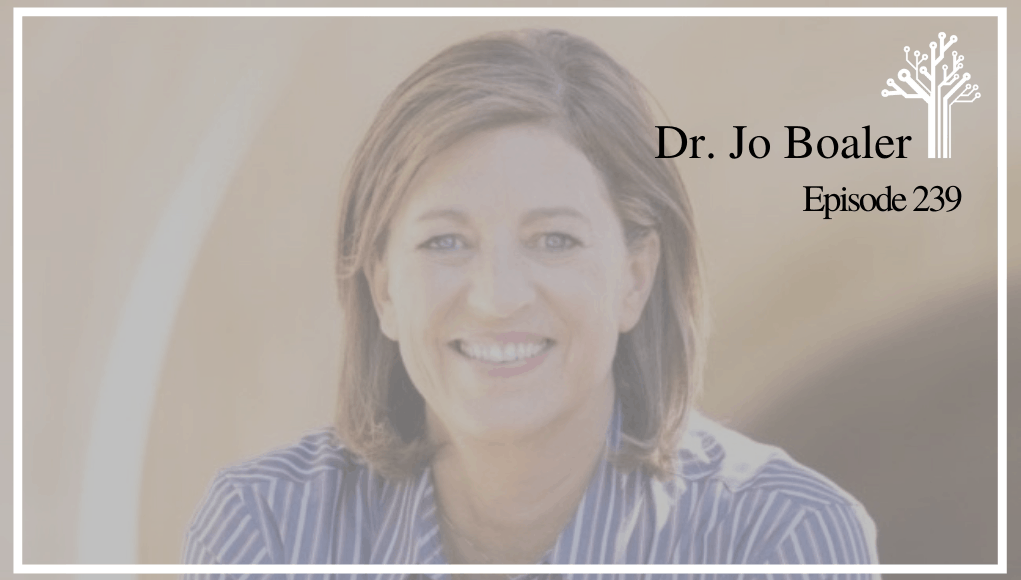
Key Takeaways: [1:13] Dr. Boaler speaks about where she grew up and her experiences with math early on. [2:46] After studying at the University of Liverpool, how did Dr. Boaler come to teach secondary maths in London? And was it a good experience? [5:08] Dr. Boaler speaks about her experience earning her Ph.D. at King’s College in London. [8:18] Why did Dr. Boaler decide to teach mathematics at Stanford University? [9:40] In 2000, Dr. Boaler was awarded an NSF grant and had the chance to do another long study about teaching maths. Dr. Boaler shares what she learned from this experience. [11:00] Dr. Boaler shares the key takeaways from her course, “How to learn math.” [12:55] Dr. Boaler describes the mission of YouCubed. [13:47] With the work they do at YouCubed, is there more uptake at the elementary level than the secondary? [14:17] How many books has Dr. Boaler written so far? [14:25] Dr. Boaler shares what her newest book, Limitless Mind: Learn, Lead, and Live Without Barriers, covers that her older books did not. [16:52] Why supporting a growth mindset is so important, especially with learning math. [18:11] Dr. Boaler summarizes her findings around the importance of struggle and mistakes. [20:44] Dr. Boaler explains what she means when she says, ‘engaging with a lens of multiplicity.’ [22:08] Dr. Boaler speaks about creative, flexible thinking. [23:32] Dr. Boaler shares her vision for collaborative learning. [25:49] Dr. Boaler shares the backstory of her op-ed with Steven Levitt, “Modern high school math should be about data science — not Algebra 2.” [30:21] Dr. Boaler shares some of her excitement around data science and why she believes it is so vitally important. [33:00] Dr. Boaler addresses some of the political challenges as well as some of the talent development challenges in supporting teachers in this change. [34:12] What goes into the master schedule now regarding math? [35:40] How do we support the current group of math teachers with these changes?
Mentioned in This Episode: Stanford University Limitless Mind: Learn, Lead, and Live Without Barriers, by Jo Boaler YouCubed.org University of Chicago Steven Levitt Elastic: Unlocking Your Brain’s Ability to Embrace Change, by Leonard Mlodinow “Modern high school math should be about data science — not Algebra 2,” by Jo Boaler and Steven D. Levitt YouCubed — Data Science Freakonomics Podcast — “America’s Math Curriculum Doesn’t Add Up (Ep. 391)” Concord Consortium Getting Smart Podcast Ep. 238 — “Chad Dorsey on Modeling and Data Science in STEM Education”
For more see- Podcast: Chad Dorsey on Modeling and Data Science in STEM Education
- Swap Algebra 2 for Data Science, Get a 1-Point Bump in GDP
- Bad Bargain: Why We Still Ask Kids to Factor Polynomials and How We Fix It
Stay in-the-know with innovations in learning by signing up for the weekly Smart Update.
Transcript
This transcript has not been edited for spelling accuracy.
We’re listening to the Getting Smart podcast. Where we unpack what is new and innovative in education. I’m your host Jessica and today we’re going to talk about limitless learning and learning math that really matters with Dr. Joe Bowler. Dr. Bowler is a professor of mathematics education at Stanford University and the author of 14
books. The newest book is called Limitless Mind, Learn, Lead and Live Without Barriers and it shares the benefits of a growth mindset, collaboration and learning from mistakes with a general audience. Based on lessons from research in the US and the UK, Dr. Bowler formed Ucubed.org.
It gives teachers, parents and students the resources they need to excite students about mathematics. They are now used in about half of American schools. Recently, Dr. Bowler has joined the University of Chicago economist Stephen Levitt in a campaign to add more data science to high school curriculum.
Let’s listen in as she talks with Tom. All right, Dr. Joe Bowler, welcome to the Getting Smart podcast. Thank you for having me. I’m looking forward to chatting. Where did you grow up, Joe?
I grew up in the center of England near a town called Birmingham, which is known as the second capital of the country. That’s why I’m an ardent West Bromage Albion supporter and I watch their games every week still. Did you grow up, were you a math geek in secondary school?
Well, I had a lot of different experiences with maths, which I think led to my wanting to be a professor and research it. I had some really bad maths experiences and I had some really great maths experiences. I can still remember vividly the time one of my teachers, I was probably about 16, said, ask if you have any questions.
At some point, I raised my hand and I said, oh, I don’t really understand this. He looked at me and said, you don’t understand that. That was the last time I ever asked a question. Yeah, too much for a growth mindset, right? Yeah, never again did I ask him a question.
So anyway, experiences like that. I also had a great maths teacher when I was about 17 and she was the one who kept me in maths. Yeah, it can be as simple as one teacher that really gives you a picture of what it can be, right?
Absolutely. And one teacher that can end it for you also, I know so many people have that experience. So after Liverpool, how did you come to teach secondary maths in London? Well I moved from Liverpool to London University to take a teaching credential. So I lived in London.
For that credential, I did my student teaching in London and then I stayed in London to start my teaching career. What did you teach and was that a generally good experience? Yeah, it was really interesting actually. So the school I taught in, it was in Camden Town, people who visit London may know Camden
and there were about 200 different languages spoken at the school, many, many different cultural backgrounds from students as you might expect in the middle of London. And I taught maths and it’s an 11 to 18 school and I taught across that age range. But when I arrived at the school, I remember clearly my very first lesson at the school, the kids were in tracks and I had the bottom track and the students had just been…
As is typical, right? We put the newest teacher in the most challenging track. Yep. And the students had just been put into tracks and they were about 14 and I remember so clearly I looked at them on that very first day and the very first question I had was, why should
we bother? I really sympathized because they were on a path to low achievement. That was the way it was set out for them. So that year, my first year in the school, I worked with the rest of the department and shared with them the evidence about detracking and how bad tracky was for students.
And so the following year, we had detracked maths and we got rid of the tracking and from that point onwards, the students were all heterogeneously grouped. That seems like a big win for a first year faculty. Yeah, well, I think I was fortunate to have receptive other teachers in a school that’s really committed to equity and diversity.
I think maths was one of the only subjects that had students in track. So I don’t think anybody could go in and shift a maths department in the way I did. But I was fortunate in having a maths department that really listened and they were on board. You did your PhD at King’s College and won an award for your dissertation. What did you study?
So for my PhD, it was at the time and there was a lot of argument about maths approaches. And a lot of people were saying this stand and lecture approach isn’t very good. We should engage kids more actively. But there was really no research at that time. So I thought, well, why don’t I look into those two different approaches to teaching?
And at the time in England, there were six schools who decided they were going to teach through a project based approach. And so I got in touch with a couple of them and went and visited them. And one of the schools agreed that I follow students over three years at the school and really study what happened.
So that was my PhD. I followed two sets of students, one in a very typical, traditional, traditionally taught school and the other in this project based school. And I observed the students for hundreds of hours. So I also gave them various different assessments.
I interviewed them. I interviewed teachers. So it’s a very in depth case study of what was happening in these two schools. Would you learn from that? Well, it was interesting because in the project based school, it was a very open,
non-disciplinarian school. And the students were given lots of responsibility. They were told, you know, this is your project. You work on it in any way you want. There was a lot of kids who were off to, well, they seemed off to us.
They were kind of joking and laughing and seemed pretty chaotic. And I remember in the early stages thinking, ooh, am I going to find out about this maths approach when it’s so kind of chaotic? But anyway. Over time, what I saw was these students doing really, really well.
And they ended up at the end of the three years. They even scored at significantly high levels on the national exam, which was nothing like what they were doing in the classroom. And I also, at one point, I thought, what did I ask the students? How much time they’re really focused in their lessons?
And I asked both sets of students the same question. And what was really interesting to me was the average grade. The average came back from the two schools and it was identical. And this made me realize these kids are sitting in this traditional school in silence, working through worksheets for an hour.
But who knows what they’re really thinking and doing. And they were very honest. They said, we can’t just sit and do that. And we’re not really working for at least 20 minutes of each lesson. Important early observations.
Yeah. And the students at the Project Bay School, they did significantly better on state tests, but they did really well on more applied assessments, much better than the other kids. And I was even able to go back about six years later and find the both sets of students as adults and find out how the maths
approach had impacted them long term. So, Joe, this may be an obvious question, but you joined the Stanford faculty about 20 years ago. Maybe obvious, but why Stanford? What was your interest in maths education at Stanford?
I was at King’s College at the time. I was just finishing my PhD. I loved King’s College and I love my work and my colleagues. And I was presenting the results of my PhD actually in Athens, in Greece. And there were two faculty there from Stanford, the Dean of the
Education School and a chair of the search committee they had for a new person in maths ed. And they both came up to me and said, oh, you must apply to this position at Stanford. And I said, no, it’s OK.
I’m very happy to do what I’m doing. Thank you. And I returned to England, went back to my work. They started writing to me and email me. They eventually sent me picture books of California with these beautiful photographs and said, just come and visit.
So I said, OK, I guess I could do that. There’s no harm in going to visit and interview. And I did that. And of course, they had me hooked from that point and I ended up saying yes. And well, it is a spectacular campus and the weather is lovely every day.
Yeah, exactly. In 2000, you were awarded an NSF grant, a Presidential Early Career Award. And you had a chance to do another long study about teaching maths. It sounds like somewhat similar to your dissertation work. Is that true?
When you tell us about that and what you learned. Yeah, that is true. Yeah. People are criticising educational research for not really following up on studies and just doing lots of different ones.
And I thought, well, it’s definitely worthwhile looking at this in a wholly different context in American schools. And let’s see what we find out here. So I again found different schools that taught sort of the traditional way and schools that didn’t schools that taught kids to be more actively involved
in maths. And again, I followed students this time for four years through high school with a team of doctoral students, so bigger study. And the results were pretty similar to those in England, the kids who learn more actively, achieved at higher levels. They liked maths more.
They stayed in their plans to stay in maths longer. They really developed a very different relationship with mathematics that I see now as a very important relationship for anybody to have, including adults in the workplace. You captured some of those findings in what was probably the first math MOOC in 2013 called How to Learn Math.
And you had tens of thousands of people sign up for that. What would you say were the headline arguments of that course? Well, it was an interesting time. I’d come back to Stanford, I actually left Stanford, went back to England for a few years and came back to Stanford.
And it was around the time I’d come back to Stanford and as well as all of the research and education, I’d read Carol Dweck’s book about mindset and met with Carol Dweck and, you know, explored the ideas a bit further and realized it was just really important information for maths teachers. And it was around the time when MOOCs were just beginning.
It was the Revolution in online classes. And I’d been helping the people at Udacity a little bit and they got me really interested in MOOCs. So I thought, well, I’ll just share this new information for maths teachers. Who knows if anyone will take it.
It was kind of an experiment on my part. And we put out the online class that summer with no advertising other than Stanford, send it out in emails. And 30,000 maths teachers took it that first summer. It was really amazing.
And they were all interacting with each other because that was the nice thing. The online classes I teach connect people in the classes with each other. And that was the start of something really big and really the start of Ucubed because when the course was finished, a lot of teachers said, can we have more? We didn’t want the course to finish.
Can we can you keep giving us more information? So that was when we decided to start our website. It’s ucubed.org. What would you describe the mission of Ucubed? The mission of Ucubed and its YOU cubed, so U to more dimensions.
The mission of Ucubed is to share research evidence with teachers and parents and students, but to do so in a really accessible way. So it’s not a site with lots of research papers. We take the evidence and we translate that evidence into lessons for kids and videos and all sorts of different things.
Our lessons in what we call our week of inspirational maths, which is a whole series of free K-12 lessons with videos. Those lessons are used in about half of schools across the US now. So we’re very happy with how excited teachers are to actually teach differently. Is there more uptake at the elementary level than secondary?
Actually, the middle school teachers are fantastic, very excited. A lot of uptake in middle school. So I would say K-8 is very, very strong. And then we have high school teachers who absolutely love the materials and use them. But there’s less high school traction.
I think high school teachers are a little bit more fixed in the approach that they’ve always loved themselves. Well, you’ve written a number of books, I think more than a dozen at this point. Is that true? Yeah.
Yeah. Yeah. Your newest lessons learned in a great new book called Limitless Mind, Learn, Lead and Live Without Barriers. So first of all, I love the title and
maybe give us the purpose of another book on math. What do you think you were able to do in this book that your prior books didn’t cover? Well, I had a book that actually became very successful called Mathematical Mindsets that was sharing the ideas for maths teachers.
And the overwhelming the overwhelming feedback I had from teachers reading that book was you must get this out to other people, to parents and to teachers of other subjects. Everybody needs to know this evidence about how we learn. So Limitless Mind was really my attempt to get the ideas out much more broadly.
So although I use a lot of maths examples because I can’t help myself, it’s really intended for all teachers and all teachers of all subjects and administrators and lots of different people. And in fact, the people who’ve been most moved by the book so far, who’ve emailed me and said, you know, this is incredible.
I wish I’d known this earlier in my life. Have been not teachers at all, but adults who work in different organizations. And so, yeah, that was I’ve been really wanting to have a lot of different people understand. And I also heard with my Mathematical Mindset book, administrators would say to me, you know, we don’t want to read a book with maths
in the title. So it was, you know, an attempt to get the ideas out to a really broad public. And in the book, I draw from lots of teachers who’ve made changes. And they’re really inspirational stories. In preparation for the book, my team and I interviewed about 62 different people
who have already started making the changes that I talk about in the book. And the stories they tell about what happened to themselves in some cases, and in others to students are really inspirational. It was very enjoyable for me to be able to write those stories down for people. Well, we our team loved the fact that that growth mindset is so central to the book.
And I think you do a nice job of making clear that growth mindset is really important to success in math, but also in life, that embracing the struggle. Exactly. Learning how to learn is key, not only the math, but to life. Yeah. And the mindset crew have some really interesting data that shows that what you believe about your own health will change how physically fit you are.
So it’s really extensive. They also have data that I put in the book that shows that when students went through a mindset intervention, they became less aggressive. And they’d actually been harboring these ideas about other people like there are bad people and good people and people don’t change.
So when they learned that actually anybody can change at any time, it calls them to view other people differently and think, oh, maybe that person could be different. And so mindset really is very important for lots of things about our lives. Yes, for learning, definitely. But also for our own thinking, just about how we move around the world and how we
view other people. You do a nice job of discussing the importance of struggle and mistakes. Maybe you can summarize your findings there. So the neuroscience on this is very interesting because it shows that the very best times for our brains are when we’re struggling and making mistakes.
That’s when there is the most brain activity. And in fact, it’s a much better for your brain to struggle and make mistakes than it is to get work correct. So this is not something that’s very well known in education in the US. And I think teachers are generally trained to have their students get most of the
work correct. And if they do struggle, teachers are likely to jump in and save students and break the work down and make it easier. So students can complete it. But that isn’t the best brain workout.
I also know that many students in our education system are afraid of making mistakes and think that if they make a mistake, it means they haven’t got the right kind of brain. So in our teaching, I’ve been teaching summer in the summers. I’ve been teaching middle school students for a few years and we share with them.
We want you to make mistakes. We want you to struggle. And I say, I’m giving you this really difficult work. I want it to be a struggle for you. And sometimes they look at me and say, oh, you know, this is so hard.
And I say to them that feeling, that feeling of it being so hard, that is your brain working out. That’s why it feels like that. And what I find is it’s very liberating for students and they start to persist longer on problems and not give up so easily.
No, I really appreciate that, Joe. And we’re going to talk about that in a minute when we dive in the data science, but one of the big headlines for me around secondary schools is that we give kids small, compartmentalized, bite-sized problems with right and wrong answers and they’re going into a world that’s full of novelty and complexity.
And so I think just adding complexity to the tasks, both in duration and type, is so, so important. So I really appreciate this point. Yeah. And of course, they are the most interesting tasks.
Nobody’s really interested by those short textbook questions where you just feel like you’re performing and answering questions you haven’t asked yourself. So, yeah, those are the best tasks in so many ways. Joe, you talk about engaging with a lens of multiplicity. What does that mean?
Well, this also comes from neuroscience, where we now know that the best, most powerful brains are those that are interconnected. We have these lots of different pathways in the brain. And when we work on a maths problem, this is true for other subjects, too, there are five different pathways involved.
And two of them are visual pathways, thinking visually is really important. But what’s also important is to have these pathways communicate with each other. So when we work in a dry way, repeating the same kind of approach in any content area, it only stimulates part of the brain. So in maths, we are very guilty of having kids work on numbers all the time.
But in English, probably students are working with words all the time. And in either case, engaging students in different ways is what creates these brain connections. And in maths, for example, you can learn maths through numbers, but you can also learn it through visuals or through writing and through movement and building.
And so there are many different ways of learning mathematical ideas. And when students engage in different ways, that causes the brain to start talking to these pathways, start communicating with each other. Related to that, you talk about creative, flexible thinking. Yeah. Well, I love a book I’ve read recently, actually, also talks about
the same thing it’s called Elastic. And I like the way he puts it in the book. It’s written by a physicist and he talks about how really there’s two very different forms of knowledge and one form of knowledge is this sort of rational, algorithmic, formulaic knowledge, which is highly valued
in our school system. And it’s important. But what he talks about it being a low level God and the Zeus of human thinking is this sort of creative, flexible thinking. And I think I would add to that, that the algorithmic kind of rational
thinking that we value, particularly in maths classrooms, can be performed by a computer better than any human being on the planet. But that creative, flexible thinking, they’re pretty much at ground zero with getting computers to engage in that kind of thinking. And the human brain is ideally suited to that kind of thinking.
So it’s not as though it’s not that we need to just replace one with the other, but the balance, we’re really out of balance. And there’s way too much of this teaching kids to think in ways that a computer can do better and not inviting them to think in ways that they really need to be thinking.
One common thread for the last 20 years of your work, it strikes me as collaboration, the idea that engaging not just individual students, but engaging project teams and groups of students. You seem to have a vision of a math learning that is quite collaborative. Yeah.
Yeah. Is that fair? Yes, definitely. I definitely find that the best learning for students is what they do together. And when students work collaboratively.
So when you connect with somebody else’s idea, that requires a higher level of understanding as well as developing one. And we want students in all subjects to be connecting with each other’s ideas. I taught a class of undergrads this past summer at Stanford. So we had a hundred incoming undergrads.
They all came to me for a class in calculus. And I taught them, of course, to work together in groups and to work on calculus together in engaging projects. And what was so interesting is so many of the students didn’t know how to work with someone else and talked about how they hated working
with other people in maths. And so we really had work to do over the summer. And one of the things that shifted hugely for the students and they all talked about it at the end of the course was I learned to work with other people. And it was really a fantastic experience.
So I just thought it was interesting that here we have these super high achieving students who have never learned that in school. Right. Certainly not in math. I’m afraid that most math instruction in America is still quite individual. The tasks are individual.
The assessments are individual. Yet the workplace, nobody’s going to sit there working individually on a math problem and those kids. I mean, I have parents come to me and say, oh, my student can work out the problem in their head.
Why should they talk to somebody else about it? Why should they explain it? Well, if you talk to employers out there in the workplace, they’re not interested in people who can do maths in their head. They want people who can communicate with other people mathematically.
All right, Joe, under the punchline, the real reason I called was this recent op-ed that you wrote with economist Stephen Levitt. I just stood up and cheered when I read this op-ed. And then you did a terrific pre-economics podcast with Steve. The op-ed was called Modern High School Maths.
Should be about data science, not algebra two. Thank you. It’s very exciting. What’s the backstory? Yeah, so this was very interesting for me.
I got a call out of the blue from Steve Levitt, not an educator, not a mathematician, so not my normal kind of person. And he said, you know, would you join us in trying to change high school maths? And I was, oh, yes, definitely. I’m all in on that.
Um, but so this is something really interesting. It was the 1800s when the sequence we had teaching in high schools was created of kids doing a year of algebra and a year of geometry and another year of algebra. The 1800s and it hasn’t changed since then. Obviously, the world has changed quite dramatically since then.
And so the argument is the most important mathematics students need to leave school with right now is being able to work with, analyze and handle data. We’re at this amazing point in time. I love the statistic that 90% of the world’s data right now was created in the last two years. So we know this is where the world has changed.
And all the companies have hundreds of data scientists. Now I was talking to somebody at Airbnb at the weekend and they have a team of 300 data scientists and that’s not atypical. So, and then of course it’s not just about work is data science, but being able to understand things like elections and finances.
There’s so much that’s about data. And the rest of the world has been teaching data for a long time when I was teaching maths myself in London in the nineties. Data methods were about a quarter of the curriculum I was teaching. But here in the US, it’s been algebra geometry for decades.
So we are making the argument that let’s stop teaching this. So we know that the algebra geometry sequence has been designed as a sort of basis for calculus. But we also know that most the majority of students in the US end their maths courses after algebra two. Not surprisingly, because algebra two is a horrible course.
And so that raises the question, why are we putting kids through this maths as a basis for calculus if they’re not going to calculus? And interestingly, LA Unified got a grant a few years ago and developed a high school course in data science and they offered it as an alternative to algebra two. It was agreed by the University of California system that they would credit that as
an equivalent of algebra two. And they’ve had already thousands of students go through that course. So I think it’s very exciting. And I probably what I’m most excited about is this. I’ve been working as have many others to try and change high school maths for decades.
And nothing has shifted it. But this this movement with so many important people involved really gives me hope that we may actually change what kids are doing in these high school maths classrooms. And I said to Steve Levin, his crew, you know, if we’re going to change high school maths, we really need to get mathematicians on board because they’re very important in making
those decisions. So in February at Stanford, I offered a host a meeting and I invited my favorite mathematicians, the more open minded ones. So we’re having this amazing meeting. And so Conrad Wolfram is flying over from London and Steve Strogatz is coming.
Rachel Levy, all sorts of amazing mathematicians. And we’re going as well as Steve Levitt and his group. And we’re going to sit around and figure this out. Like how can we give students a 21st century mathematics program instead of what we have right now in high schools?
That is just so exciting. It’s so true that every field has become computational. So this is not just about math. It’s if you’re going to be a realtor or a lawyer or if you’re going into the military, if you’re going into social science, if you’re going to be a nonprofit leader,
almost every field is dealing with big complicated problems. And the right the question is, it’s a problem finding issue. What problem do we need to solve? And then what data can we find about that problem? How might we analyze that data?
What inferences can we draw from that? The other thing I’m excited about data science is it’s not the same as statistics because it has these really core principles around teaching it. So statistics can still be taught as a set of methods. But with data science, we’re really circulating three core principles, one of which is
the kids should be using real data, not silly textbook problems, but data from their own community, which will help them realize that they can solve problems in their community and that they play a role in their community. So that’s one, I think it’s really important. The second is data science is collaborative.
You don’t sit on your own. Nobody sits doing a big data science question on their own. And the third one is it’s really much more open. Because there isn’t one answer to any of these data science questions. As you say, it’s about working out what the questions are and finding data.
And there are many ways, even when you have the data, there’s many ways to attack those problems and work on them. So for all those reasons, I think data science could be really exciting for kids. The other thing to voice up is calculus. Voice up is calculus is the only AP of the suite of AP classes.
There’s about 38 AP courses, I think. It’s the only one that you really have to be advanced in your grade level to get to it. That’s the way they’ve structured high school. That if you’re not kind of ahead, you won’t ever even get to calculus. And that has set up this whole system of tracking and racial inequalities and
parents who pay for their kids to race to calculus. And it’s a very inequitable pathway. And I see data science as something that could be wholly different, that any student could take that doesn’t decide who’s in and who’s out, but is open to all kids. And we’ll really go forward equitably, which is very exciting.
So this is all very exciting, but it opens up many different questions. There’s a political set of questions of how we engineer this, how we untie the Gordian knot of secondary maths and how we change high school graduation requirements both in districts and states. So maybe a word on the political challenge and then a word on the talent development
challenge of how we support teachers in this change. Well, I am actually on a very small framework committee right now, five of us who are rewriting the maths framework for California. And so maths is in the Common Core Standards, sorry, data science is in the Common Core Standards, but it’s largely ignored by textbooks and teachers sort of
don’t know how to teach it often. So we’re going to really centralize it in the new California framework. And with that comes other changes like tests we’ll need to align and resources for teachers. Well, just the master schedule, right? We, as you said at the outset, we’re stuck in this sandwich of algebra one,
geometry, algebra two. And that’s a part of tradition, but it’s also sort of ensconced in graduation requirements and how people think about college entrance requirements. So do we need integrated math or what do we actually replace? What goes in the master schedule now?
How do we? So yes, the integrated pathway would be ideal to develop that approach. Let’s stop even thinking about these boundaries and teach everything together. I see that as being a harder push because we have schools that are very innovative and will say, I’ll teach you data science course and they’ll develop them.
And, but I still think it might be an important one. So that’s going to be a key question for these mathematicians sitting together. The other thing, of course, is colleges tend to signal that they want calculus. And the other pathway I’m on at the moment is talking to senior people at Stanford. I’ve already spoken to the provost and the head of undergrads and the head of admissions
to recognize that there are other mathematical pathways that are important. And I’m hoping that Stanford is going to make a statement about that and that when they make a statement about it, that perhaps other universities will also sign on to that. That’s exciting. What about the talent development question?
How who teaches data science? How do we help the math teachers? Yeah, we’re kind of working on that. I first of all, I think that math teachers are ideally suited to teach course in data science. There may be some new learning they need, but teachers are great learners and they love to learn.
And there’s a lot of resources around that. I am myself working on a new online class to help teachers learn how to teach data science, which I hope will come out next summer in the summer. But yeah, I think there will be some training we need. So the course in LA Unified, they developed a lovely course with the faculty from UCLA
and our training teachers to teach that course. And we’re looking to maybe take that course further out and have training packages around it. So yeah, I think teachers will, most teachers will need new training for this. But why don’t we invest in that? That’s a really important investment for the future, I think.
Yeah, it is. It’s exciting. It is. We’re asking teachers to teach a new subject and in teaching a new way. So I appreciate the initial efforts. It does feel like a big relatively long-term change, both the political and talent, but it’s exciting beginnings.
It is exciting. And I think we have, we can get there. I’m confident. It does seem analogous to writing across the curriculum. We, in many schools, we’ve made that critical that literacy is not just the work of the English teacher, but that everybody needs to be on board for reading with comprehension and writing with clarity.
And I think data science is a great entree to integrating maths across the curriculum. Yeah, I agree. I agree. It’s really quantitative literacy, if you like. And it doesn’t just sit in maths. I mean, the problems that students will work on in data science really go into social science and science.
Right. You talked about community connected. That’s going to happen in science and social studies, right? Yeah, absolutely. Yeah. This is such exciting progress, Joe. How, for people that want to know more, where would you send them?
So ucube.org has a lot of what I’ve talked about, both in terms of mindset and maths change. And we have a new section on ucube that with a header called data science. And if you go there, you can find the podcast that you talked about, the Freakinomics podcast and the op ed and also some really nice resources. So we’ve put up some tasks. One of them we partnered with the New York Times.
They produce a graph every week and ask the question, what’s going on in this graph? And they’re really interesting data visualizations. So we’ve used one of those on the on our website. It’s actually a data visualization that shows the most popular pop records every summer. So I think kids will find it really interesting.
And then we also link to the Concord Consortium that has some beautiful free data science activities and their own software that’s free and easy to use. They do. We just had them on the podcast last week. So we really appreciate their work. Yeah. So lots of resources are under that data science tab on uCubed.
But generally, uCubed has pretty much everything I’ve talked about today, I think. Dr. Joe Bowler, we so appreciate your contribution the last 20 years. And it feels like you’re just getting started on what might be your life’s most important work. I hope so. I am excited about it.
Thanks so much for joining us. Thank you. We appreciate Dr. Bowler’s 20 year campaign to make math education more applied, more collaborative, and quite frankly, more fun. We are encouraged by her recent advocacy for data science. Thank you, Dr. Bowler.
For more on all things innovations and learning, be sure to sign up for our weekly smart update and visit our blog at gettingsmart.com for podcasts, blogs, white papers and infographics to support your work and your learning. We’ll include links to the blog and a sign up for our smart update in the show notes and on the post for this podcast. That’s it for today, listeners. Thank you for tuning in for the Getting Smart podcast. This is Jessica signing off.




0 Comments
Leave a Comment
Your email address will not be published. All fields are required.