


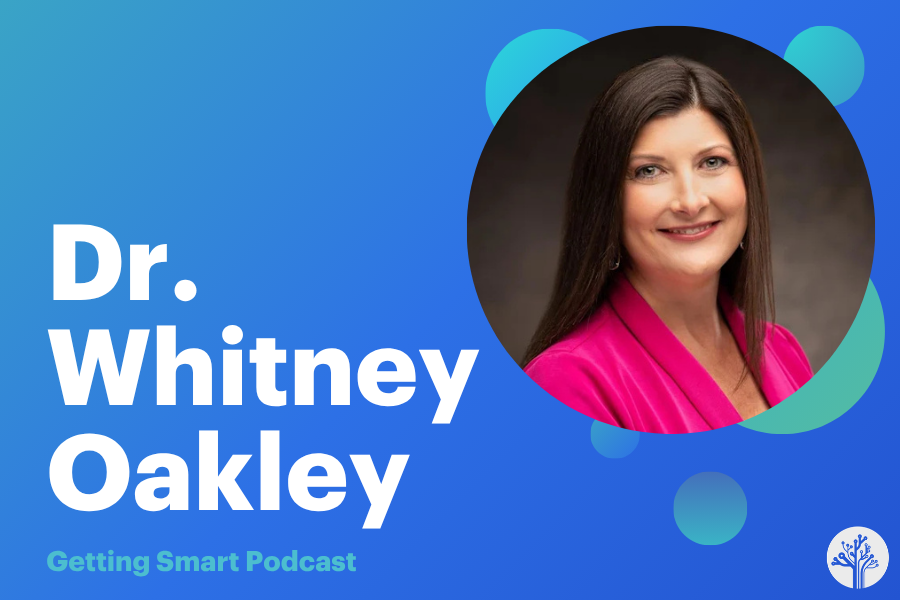
Dr. Whitney Oakley on the Guilford Guarantee
Key Points
-
Districts can build a scalable career-connected promise by aligning advising, scheduling, data-sharing, employer partnerships, and family communication around student outcomes.
-
Listening to students, families, and employers early and often helps create clearer pathways so more graduates leave with a real plan, not just a diploma.
Shownotes





In this episode of the Getting Smart Podcast, Shawnee Caruthers sits down with Dr. Whitney Oakley, superintendent of Guilford County Schools, to explore the Guilford Guarantee—a bold district commitment that every graduate leaves high school with college credit, an industry-recognized credential, or a meaningful work-based learning experience. The conversation highlights what it takes to build real-world learning at scale, from family and student listening to employer partnerships, advising systems, and cross-sector alignment. Dr. Oakley shares how Guilford County is turning a promise into a sustainable strategy for equity, access, and future-ready pathways for all learners.
Outline
- (00:00) Introduction
- (04:45) The Guilford Guarantee
- (12:29) Aligning the System
- (19:05) Community Listening & Industry Partners
- (22:53) Sustaining the Promise
Introduction
Shawnee Carruthers: You’re listening to the Getting Smart podcast. I’m Shawnee Carruthers, and I’m so glad you’re here. This one’s personal for me. I spent years as a director of career and technical education, and I was part of building and supporting Real World Learning in Kansas City, a regional collaborative development partnership with school systems across Missouri and Kansas and the Ewing Marion Kauffman Foundation.
It was built on a simple but bold conviction. A diploma alone just isn’t enough anymore, and school systems can do something about it. So when I heard about what was happening in Guilford County, North Carolina, I paid attention. Dr. Whitney Oakley is the superintendent of Guilford County Schools, the third-largest district in North Carolina, serving over 66,000 students.
What’s remarkable about Dr. Oakley is that she didn’t come from the outside. She’s a product of this very community, a GCS kid herself from kindergarten through high school, who came back as a teacher, earned her doctorate in educational leadership from UNC Greensboro, and never left. Now she’s leading the Guilford Guarantee, a district-wide promise that every single graduate leaves with college credit, an industry credential or a real work-based learning experience at no cost to families.
She built it by listening to over 8,000 community members and forging partnerships with employers like HondaJet, Toyota and Cone Health. Dr. Oakley, welcome to the Getting Smart podcast.
Dr. Whitney Oakley: Thank you.
Shawnee Carruthers: Yes. We’re so glad that you were able to join us. We’re super excited. We really believe in Real World Learning, and we talk a lot about it.
And so the Guilford Guarantee is something that we want to dig into and make sure that our listeners are acutely aware of. But first, I want to start with just your story because I think it is so engaging and exciting. You grew up in Guilford County Schools, and you came back as a teacher, and now you are leading the district, and I think you have for maybe the last three years or so.
How does that shape the way that you lead? And honestly, how does it feel to be the one making promises to kids who look a lot like the kid you used to be?
Dr. Whitney Oakley: Mm-hmm. Well, I mean, I think everyone cares deeply, right, about their community and their job, but I also think that public education has to be a part of the solution.
And so I just think because we have relationships here, while it’s a big district, it’s never too big that you can’t pick up the phone and call somebody if you need something or if you want advice or help with something. So I mean, to me, it’s personal because it’s home, and I feel like public education has a commitment to give back to our community and that we should solve problems together.
And so it’s the people that keep you going when the days are hard. But I do think that there’s a real sense of responsibility to get this right because it’s a community that I care personally very much about.
Shawnee Carruthers: Yeah, and the work that you’re doing now is really building on that real work-based learning, that real-world learning.
And as someone who is a product of it, I do wonder, when did you know that you wanted to stay in your community and give back through education by being a teacher, and then continuing to move forward?
Dr. Whitney Oakley: I always wanted to be a teacher. From my first day of kindergarten, I knew that that’s what I wanted to do.
There was not a single doubt. The other leadership journeys that I’ve just been fortunate to have have to do with impact, I think. But I was perfectly happy in the classroom. I was perfectly happy leading a school. So I never … this was never the end-game plan. But I always knew that public education was where I was meant to be and where I was meant to do my work.
I don’t think there’s any other job where you get to have the kind of impact that a teacher in a classroom can have every single day.
Shawnee Carruthers: Yeah, and that knowing that you have is, I know, the same knowing that you want for the young people within your community, which is kind of the origin story of the Guilford Guarantee.
And it’s a bold district-wide commitment, and I would love for you to take us back to the beginning. Where did the idea come from, and what made you say, “We are doing this for every student, not just some, but all students”?
Dr. Whitney Oakley: Mm-hmm.
The Guilford Guarantee
Dr. Whitney Oakley: It took about a year. We were just listening to people, really, and then there’s some research that came out that kind of crystallized it for us.
But mostly listening to parents and kids. Some of the national research said that the class of 2024-2025, 70% nationwide, got their high school diploma but didn’t know what they were going to do next. And so we just started thinking about what we can do better than our competition, what can set us apart as a school district, and that’s really where we landed on the Guilford Guarantee.
We can align systems so that kids leave us with more than a diploma. They leave us with a plan for their future. And the plans don’t have to look the same, but we can’t leave it to chance. We owe it to our kids and their families and our community for students to leave us knowing what their options are and making sure that we’re taking advantage of all of the opportunity that we can while we have them in high school.
So this idea around earning college credits, around having meaningful workplace experience or an industry-recognized credential really sets them up for their future. And that’s what families told us. They said, “We didn’t know what the options were until it was too late,” or, “No one even told us what this pathway led to,” or, “No one said you’re naturally gifted at this. Have you considered an internship in that field?” So it was really like this aha moment of how we can do better as a system to equip students to have a plan after they cross the stage.
Shawnee Carruthers: And what you’re saying is really resonating. We talk a lot at Getting Smart around pathways, and it sounds like you believe, like I do, there are just too many adults in the system for students to leave any system without having a really clear plan.
Yeah. And it seems like through this guarantee, you’ve really put these structures in place, and you’ve had these conversations with families. And so I do wonder, when you’re talking to the families, how do you get them to maybe sometimes change their mind? Because there are some families I know who are super open to this sort of idea, and there are probably families as well who are a little hesitant and don’t really know how to engage with you in that conversation, or maybe they had a different vision for their young person than what maybe you all have in your schools.
And so how do you really have those really open conversations where parents feel really heard?
Dr. Whitney Oakley: Yeah. Yeah. We’re still listening. I really … I think that school systems are so complex that even things like course registration, parents feel like they’re not a part of it and they want to be, but they don’t know how to be a part of it.
And so we’re not there yet, by the way. We’re still building the system. We’re just probably a year in on how we make all of this work. But we have a parent advisory council with open Q&A. And that’s kind of how we heard from families that they wanted to know more sooner, and that they felt like they were left out of registration processes and things like that.
They didn’t know that we were already giving students this aptitude assessment to see what their natural gifts are. There was just not much intentionality around it. But students were figuring it out. So students are already increasing the industry credentials that they’re getting by 300% over a three-year period.
Crazy numbers. Families saved more than $2 million by kids taking college credits while they’re in high school. So just figuring out how to do it at scale is where the real work is.
Shawnee Carruthers: Yeah, and I’m glad that you said that because the strategy that you’ve been using, your Better Together strategy on feedback, not only from your 8,000 community stakeholders, which is crazy impressive, and your families as well.
When you’re dealing with, you just explained the parent component, but I know the other side of that are the community stakeholders and the industry leaders, et cetera, the people who are going to be receiving these young people. So how do you actually do your Better Together strategy well when you’re talking to those stakeholders, and how do you make sure that listening doesn’t just become a box to check?
Dr. Whitney Oakley: Oh, well, because they get to ask whatever they want. It’s not like a scripted … You know, we usually share some data, and then we just open it up. Yeah. And we gather the data. We listen for trends. We also talk to kids, right? So they will tell you the truth about what’s working and what’s not working.
They’ve helped us do things like figure out the registration process on their side. I had a junior say to me a couple weeks ago, she said, “I wish someone had shown me the Common App,” the college application Common App, “when I was a freshman, because then I would’ve known I needed to be in 10 clubs or have this …” She said, “If somebody would just show me.” So next year, every ninth grader is going to walk through the Common App. It’s little things like that, that if we just listen to the system end users, which in this case is our students, they will tell us what’s broken, and they will tell us how to fix it. And so, for me, listening in a genuine way keeps it from checking a box.
You then take what you heard, and you do something about it.
Shawnee Carruthers: Yeah, and it’s clear. I was able to get onto your website to learn more about the great things you all were doing, and I saw the amazing student stories that you all shared. And one that really stood out to me was Darius Chukwumeka, who stayed within your system.
Dr. Whitney Oakley: Oh, yeah.
Shawnee Carruthers: He was like a really amazing running back. And I know he was sharing his struggles around the four different coaches and whatnot, and how he could play football anywhere, but he stayed. He stayed because of the guarantee. He stayed because of the academics. And that’s really saying something when you have a high-level athlete who focuses more on the academics than maybe the sport.
And so that listening is happening, but how have you all just kind of changed that around so that academics becomes the star versus maybe all the extracurriculars that can sometimes overshadow the importance of the academics?
Dr. Whitney Oakley: Well, I think the Guilford Guarantee strategy itself is about the future.
It’s about what do you see yourself as, and how can we put the right supports around you in order to help you get there? And so you can do all the other extracurricular things too, but what’s your plan for the future, and how do we prioritize that, and how do we talk to you about it early?
So that’s the other thing is, you know, we start talking to kids very intentionally about different careers in elementary school. And then we show them what they look like and have some real hands-on practice in middle school, and then they actually experience it in high school. And so I just think the intentionality about starting soon, but not locking them in …
And by no means do we want to lock students into something that they might change their mind about. Of course they might change their mind. That’s totally fine. But they do need to know what’s out there, and we need to do a really solid job of making sure it’s our responsibility that they know what their options are earlier than we had been in the past.
Shawnee Carruthers: Yeah, and it sounds like, as you say, you’re really building it all the way from elementary to high school.
Yeah. Whereas a lot of systems start in high school and then kind of start to backward design. So you have the students rowing in the same direction, but how do you get maybe the educators and the rest of the system rowing in that direction? Because a promise like this only works when everybody’s kind of on the same page, whether it’s around curriculum or counseling or building leaders or whatever that looks like. So how did you get the system there, and then maybe what kind of broke down along the way that you didn’t see coming?
Aligning the System
Dr. Whitney Oakley: Well, I mean, you know, with more than 9,000 employees, it’s going to take a while to bring everybody along for sure.
But what we did this year was we didn’t force anybody to do anything. We just got the message clear and right, and we did it with every group over and over again, and we let them ask questions. We talked about why it matters, why the Guilford Guarantee matters. We aligned our evaluation system, started with central office, did not start with schools.
Like, how do you see your role in making this work? So even our technology services department is talking about what their role is in the Guilford Guarantee. Mm-hmm. So all across the board. But I would say that we’re … that was, that’s all we did. So we just shared the vision, listened to feedback with group after group after group.
And so that’s kind of helped us move into next year. So we now know what the metrics are, like what we’re measuring, what’s the percentage of high school juniors who have already met the Guilford Guarantee, who hasn’t and why not? So we didn’t put those metrics in place this year on purpose because we were building understanding of the why.
And so often people in large organizations move too fast or leave out a group in terms of understanding the why. And so we wanted to spend a year doing that so that we can put the accelerator … you know, we can move forward. But really, we just wanted to build common understanding, talk about the importance of what we owe kids so that we’re all on the same page.
And so we just spent a whole year doing that. Some of the challenges, for sure, I think counselors feel a burden, I think, because a lot of this is focused in the work of which students get access to which classes and how, and our counselor ratio to students is already so high. So we’ve been thinking about high-quality advising and how we can have teams of people support the work because we’re certainly not getting any additional revenue.
So we have to think about how we share the responsibility. I think aligning schedules, like removing some of the barriers. So registering for college classes and high school classes doesn’t happen at the same time, so how can we align those systems? So we’ve had to navigate some barriers with our community college, transportation for students to get to the community college.
So we’ve hit some barriers along the way. We just work through them. We didn’t have a data-sharing agreement before, so counselors were literally having to hand-schedule kids on paper and wait for one transcript at a time to be taken. That’s crazy. So just finding out what’s in the way and taking the time to move it out of the way has been a challenge.
But it’s exactly the right thing to do, and we probably should have done it a long time ago.
Shawnee Carruthers: But it also, I think, creates the trusted brand that you all are building. You know, I’ve really been thinking about this word guarantee. And this might show my age a little bit, but I think of that Good Housekeeping Seal of Approval. It’s a guarantee … it’s trusted.
Dr. Whitney Oakley: Yeah. Yeah.
Shawnee Carruthers: And that’s what …
Dr. Whitney Oakley: That makes …
Shawnee Carruthers: Sense. Yeah, and that’s what I’m hearing and seeing based on everything you’re sharing and everything that I’ve read, is that … and you just said it … this is what students deserve.
Dr. Whitney Oakley: Mm-hmm.
Shawnee Carruthers: This is the guarantee that you’re making.
And when you’re able to create a trusted brand like that, then other brands are willing to come alongside you, and ensure that same kind of guarantee. And so some of those other brands that you’ve been able to kind of adopt maybe as partners are HondaJet, Toyota and Cone Health, and they’re not donors. They’re real and true partners. And so what does that mean to build that kind of relationship with those outside entities to build that brand of trust? And then what do those employers get out of it?
Dr. Whitney Oakley: Yeah. Well, alongside all the listening that was happening, these business leaders were coming up to me and saying, “How can we get your kids to come work here?”
So there’s such a talent pipeline shortage that business and industry is looking to K-12 to fix the problem. And so it just makes sense, right? If you want to have our kids come work for you, then help us get them the right credentials. Help us host the internship. Sign on with us so that we can do a good job.
Toyota’s a … there are lots of examples. And what’s kind of a side effect is there’s now this fear of missing out. So JetZero’s coming to the table, and they want to have an internship partnership and use our aviation program so that kids can go right into jobs there.
And so I think being good partners with business and industry is part of this job, but doing it in a way that’s intentional and at scale. It can’t just be one little program with 12 slots. It has to be something that’s wide enough for all kids to have access to, and they have to have some skin in the game.
So if they’re not going to … I mean, you know, Toyota is going to do a six-12 pathway where students leave with the credential to go right into the battery plant with a high-wage job. That’s a really good example of how to guarantee that that partnership can see kids all the way into employment.
And so we have to be careful that we’re not putting them into low-wage employment opportunities. They have to have a pathway and a future to be those high-wage, high-demand careers. So, yeah, I mean, I think it’s important, and it’s helpful to them for us to get it right too.
Shawnee Carruthers: And you said that so easily, but it’s such a hard thing to do to get a partner to dive into middle school …
Dr. Whitney Oakley: Mm-hmm.
Shawnee Carruthers: And make a six-year commitment versus that four-year commitment of high school. And when you create that atmosphere of FOMO, that fear of missing out, then you know that you definitely are doing something right. So that’s amazing. But one of the things that you referenced was this notion of all, and I know that your doctoral work is focused on equity and social justice.
And GCS serves a very diverse student population that’s I think around 70% students of color. How is the guarantee intentionally designed so that students who need it most are actually the ones truly getting access to it?
Community Listening & Industry Partners
Dr. Whitney Oakley: Yeah, I mean, I think this concept of all really matters. And, you know, just a job is not enough. We have to think about a future, and that’s why we have to think about how we can grow into careers over time. You know, $18, $20 an hour sounds like a lot when you’re 16, but you know that that’s not a feasible condition to live in beyond that.
So really thinking systemically about how we prepare students to have career mobility really, really matters, and making sure that we’re not locking them in to low-wage income. So I think that the guarantee itself is really this promise that we’ll make sure kids know what their natural gifts are.
I think that’s another cool part, is we start that in seventh grade, and then we revisit it again in 10th grade and say, “Does this make sense? Are we on the right class path with your coursework, and how can we involve families?” And so, to me, it has the potential to disrupt generational poverty if we can get it right, if we can think systemically about what their pathway looks like and what it is and how we help them stay on it.
Shawnee Carruthers: Yeah, and that notion of helping kids know who they are, and I know you all do that through YouScience …
Dr. Whitney Oakley: Mm-hmm.
Shawnee Carruthers: Which is a phenomenal platform for kids to understand why they matter and why their gifts matter. And also by looking at this whole-child kind of model, you were able to lead the district or the system from being a low-performing system, having that low-performing designation, while also launching these really major strategic changes at the same time.
Sometimes when that work is happening, it’s just so siloed to just fixing the academics, but you recognize that it takes a real kind of system overhaul in order for that work to truly happen. So how did you manage resistance and keep people moving forward when the pressure is so high?
Dr. Whitney Oakley: Well, I think the academic pressure is high everywhere right now, just, I mean, in the post-COVID world, and the competition with private and charter schools. So for us, we just looked at what we thought we could be the best at, and we knew that high-quality instructional materials and professional learning for teachers would get us there with the academics, so we just stuck to it.
We’re 10 years in. We don’t just jump and do the next shiny program or intervention. We’ve stuck with core instruction and strong interventions for kids that need it. And so we’ve really just followed the research on the academic side and stuck with it. And then there’s this concept of what happens after graduation and how can we tighten our systems and structures and processes and align everything behind the Guilford Guarantee.
So both things can be true, but you have to be disciplined enough to focus on one thing, not 27 things, measure it, and help people understand how they see themselves in the work and why it’s important for the future of our kids. And so it’s kind of … it sounds simple, but it’s really just the discipline to decide what we’re going to be about and to go do it.
Shawnee Carruthers: And I know this is still pretty new.
You all are still kind of in these infancy stages, but I do wonder, how do you know that the guarantee is working, or how will you know that the guarantee’s working? Beyond graduation, what other data are you watching most? And I guess, how do you expect the community to shift as a result?
Sustaining the Promise
Dr. Whitney Oakley: I mean, my hope is that we become part of this talent pipeline, honestly, in terms of the impact on the community.
We’re going to measure how many kids graduate with one of the three things, either the college credit, the workplace experience or the industry-recognized credential, and hold ourselves accountable for that. There is now opportunity to gather information for how students do at the community college because we have the data-sharing agreement.
Did they pursue an associate’s? Did they … you know, what happened there? We’ll also know how much money we’re saving families in tuition by having kids take college classes while they’re in high school. So those are some of the initial ways that we’re going to hold ourselves accountable and share data publicly.
But to me, we’ll see it when we have the alignment of all the systems together, when kids don’t have barriers in the way of pursuing what they want to pursue. The student stories at graduation are better than any data point we’re ever going to have.
Shawnee Carruthers: Absolutely. And for those who are listening, you know, they may say, “Oh, that sounds amazing, but we could do it maybe for two or three years, and then the funding runs out, and then here’s something else that we kind of got excited about that we can no longer sustain.”
And so as we think about these different career-connected initiatives, they often thrive on grant funding and then can quietly disappear. So how are you all building something that lasts both financially and structurally?
Dr. Whitney Oakley: So right now the financial commitment has really been in partnership with philanthropic partners.
Shift Ed has stepped up to do the YouScience assessment and has been a really strong partner in that work. The rest is just realigning how we’re resourced. We didn’t buy anything. We asked the transit authorities to help with transportation, so we’re not adding a financial burden to the system. We’re just aligning the system with the Guilford Guarantee.
So because you’re right, it can’t be the end of a grant and then we stop. This is the work. This is the business, so it’s going to be part of how we operate moving forward. And we’ve been careful that we’re aligning and building a system in partnership with the community college in a way that’s sustainable and not dependent on a one-time gift or a one-time grant or something that expires in three years.
Shawnee Carruthers: Yeah. And it’s already super impressive, it sounds, because it is now just the culture. It’s not an initiative, it’s now the culture. But even though it is amazing, and so much room for it to grow, and I’m interested to hear what it becomes over time, I’m also interested in where does it fall short for you?
What is the version of this guarantee that kind of keeps you up at night because you just haven’t figured it out yet?
Dr. Whitney Oakley: Well, I mean, we typically graduate between 4,500 and 5,000 seniors, and we’re just now getting these systems aligned. So, what about everybody else? What about the kids from the 2024-2025 graduating class that didn’t have a plan?
You know, getting it to scale is going to be what requires a lot of fortitude, and I think we’re going to do it. I don’t have a doubt that we’re going to get there and guarantee it for all of our students. But scaling anything to 121 schools is a heavy lift, and so that’s the part we have to get right.
Shawnee Carruthers: Well, I truly appreciate this conversation. You all are doing some, like you said, some really heavy lifting. But I know it will pay off in the end as you all continue to learn and grow alongside your students. As someone who has sat in rooms like what you all are doing, trying to figure out how to build something like this, what you’re building in your county, it just gives me real hope for the future of education and the future of work for young people.
The guarantee is proof that when a school system decides to make a promise, a guarantee, put their stamp on it and actually build an infrastructure around it, remarkable things truly can happen for kids. And so for those who are listening in, if today’s conversation sparked something for you, I want to encourage you to do three things.
First, share this episode with a superintendent, a school board member or a community partner in your network who needs to hear it. Second, visit … Dr. Oakley, what’s your website that they should visit?
Dr. Whitney Oakley: Gcsnc.com
Shawnee Carruthers: To learn more about the Guilford Guarantee and see what a district-wide commitment to career-connected learning really looks like in practice.
And then third, ask yourself, what would a guarantee like this look like in your own community? Because the kids in your ZIP code, like Dr. Oakley said, they deserve it. They deserve the same promise. Thank you so much for listening to the Getting Smart podcast. Dr. Oakley, thank you so much for joining us, and until next time, see you soon.
Guest Bio
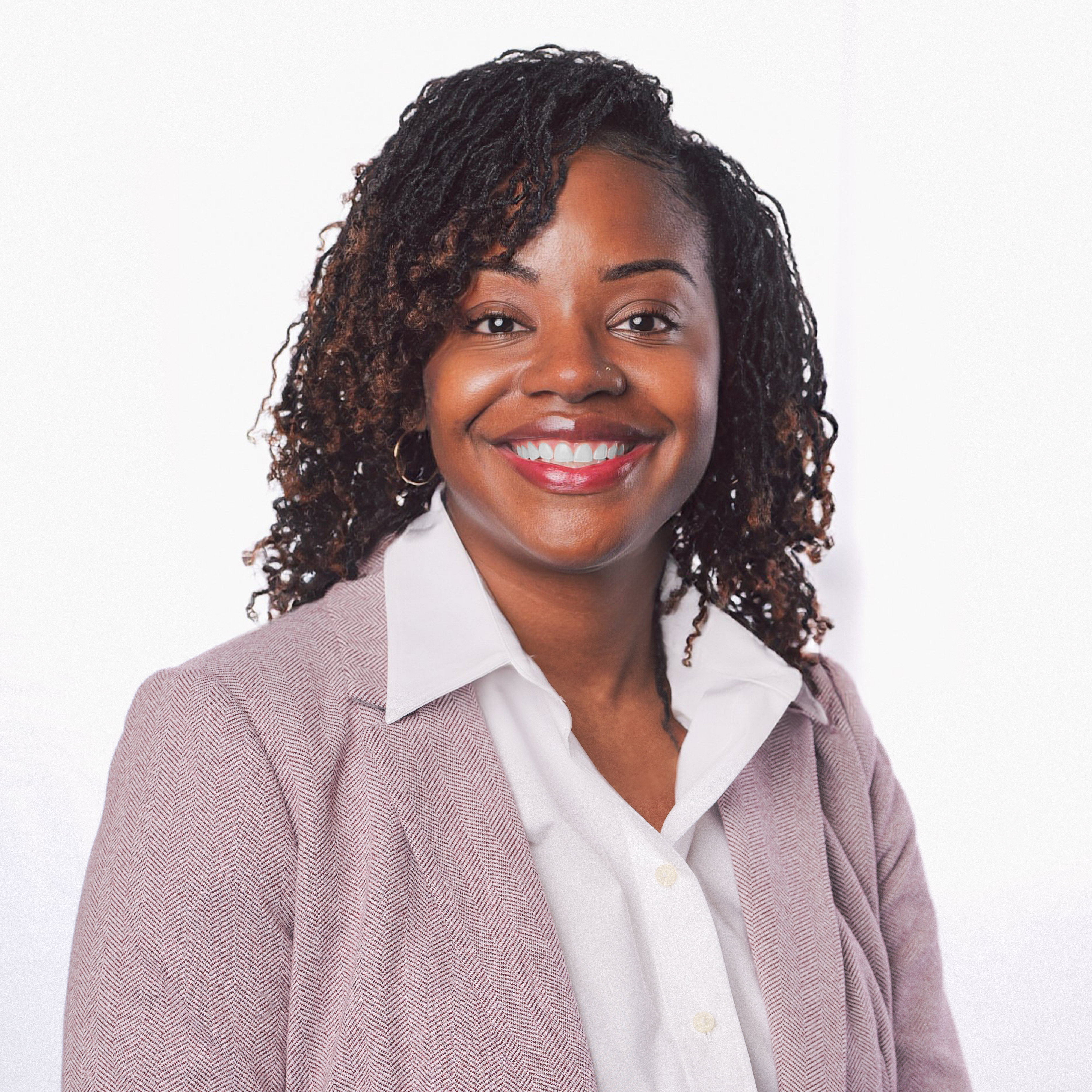
Dr. Whitney Oakley
Dr. Whitney Oakley is the Superintendent of Guilford County Schools (GCS), the third-largest school district in North Carolina, serving over 66,000 students. She is GCS’s first “homegrown” superintendent, having attended GCS schools herself from kindergarten through high school. A teacher by training with over two decades of experience, Dr. Oakley holds a Doctorate in Educational Leadership from UNC Greensboro. Her leadership has been recognized nationally, including the Advancing Excellence and Equity in Urban Education Curriculum Leadership Award in 2023.
Since assuming the top role, Dr. Oakley launched the “Better Together” strategic direction and focused intensely on student outcomes, leading initiatives that saw GCS shed its “low-performing” designation. Her signature workforce readiness initiative is the Guilford Guarantee, a comprehensive promise ensuring every graduate has the opportunity to earn college credit, an industry credential, or a work-based learning experience at no cost. She emphasizes community engagement—listening to over 8,000 stakeholders—and forging durable, cross-sector partnerships with employers to build a future talent pipeline right in Guilford County.
Links

0 Comments
Leave a Comment
Your email address will not be published. All fields are required.