


Why the Experience of Experience Matters: Designing learning through experiences that actually have an impact
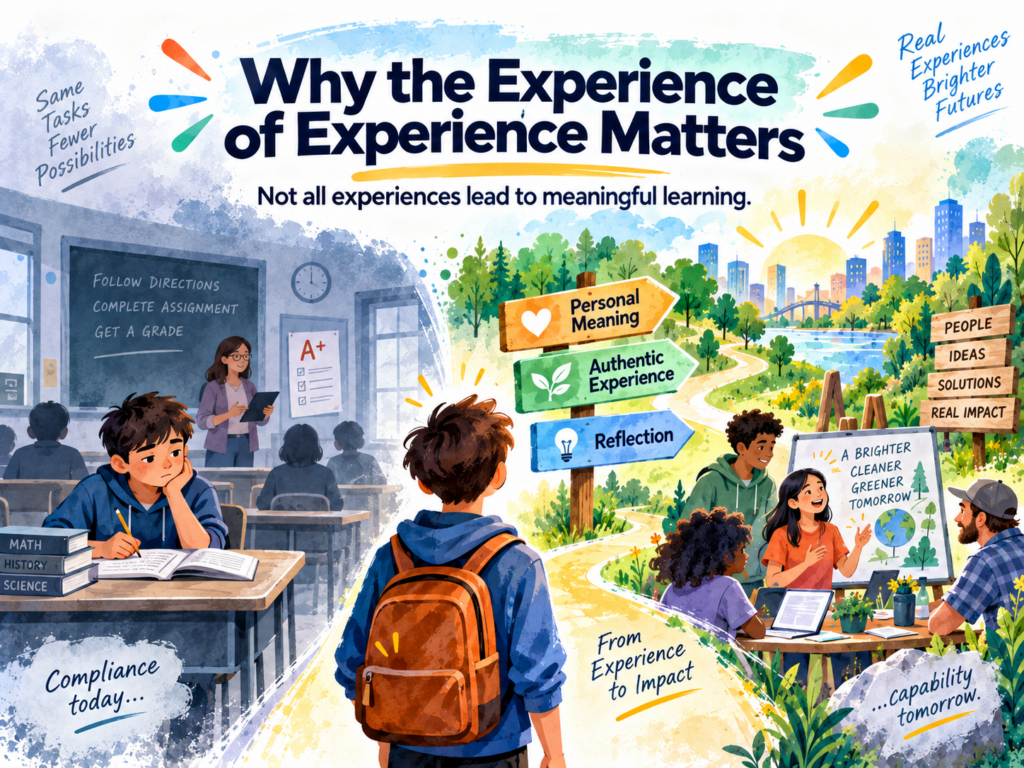
Not all experiences result in impactful and valuable learning. So what makes the difference? The degree to which it is personally meaningful, authentic, and situated.
By Chris Unger
I have taught a doctoral course on “The Power of Experiential Learning” for several years, to educators who have spent 10, 20, even 30 years in schools. Most arrive expecting to sharpen a familiar idea. Many leave saying some version of: I thought I knew what experiential learning was, but I really didn’t.
For the first three weeks, there are no readings – which surprises them. Instead, I ask them to draw from their experience: identify three learning experiences that were of great value and impact and three that were not. Then name the characteristics that made the difference between the first set and the next, and then discuss what they identified in small groups.
Two things happen. Participants learn a great deal about one another through the stories they share. Then they start naming what actually mattered:
- the opportunity to immerse oneself into a topic that was personally relevant and of value;
- the opportunity to try, practice and fail in authentic activities of the domain, learning as you go;
- detailed and constructive feedback from someone who can provide such informed feedback; and
- a relationship with a mentor, teacher, or peer (the kind that research consistently links to stronger engagement and achievement);
All in a social context that is supportive and has personal meaning.
But here is the rub. Across all of these 100+ conversations with more than 300 educators, participants repeatedly identified those experiences of little value and little impact to be (drumroll) school and professional-development experiences. And it’s not just my rooms: a 2024 Gallup survey of over 4,000 12-to-27-year-olds found that fewer than two in ten students strongly agree that what they’re learning in class feels important, interesting, challenging, or connected to what they’re good at. Say what? School and professional development? Whoa. Isn’t that where we should be having experiences that are of great value and impact. I think the answer is yes. But in reality, the answer is … no.
Which leads us to an uncomfortable finding: if school and professional development are made up of experiences, why do so many people point to school and professional development experiences as of little value and impact? And what kinds of experiences truly lead individuals to see, think, and act differently in a domain?
Kolb’s Learning from Experience Cycle
For many, when educators reference experiential learning they often turn to Kolb. And Kolb is a great place to start. You experience something. Observe important patterns. Reflect on what you have learned from that experience. Integrate that learning into your perspective. Then go back at it with another experience, observation, reflection, and then experience again. In particular, he highlights the value of concrete experience and then the need for reflection to learn from the experience. And he foregrounds both the cyclical and iterative cycle of experiences with reflection that can, over time, deepen learning in a domain. Which is all well and good. But then he doesn’t get much into what “kinds of” of experiences and “kinds of” reflection makes the difference in the value and impact of that learning. Which I think is an important question. Since not all “experiences” and “reflection” lead to meaningful, valuable, and impactful learning
Kolb’s central claim is that people do not learn simply by having experiences. They learn by transforming experience—moving deliberately among experience, reflection, conceptual understanding, and action. In his view, meaningful learning is an ongoing, recursive process rather than a one-time event or the passive acquisition of information. In short, a continuous spiral.
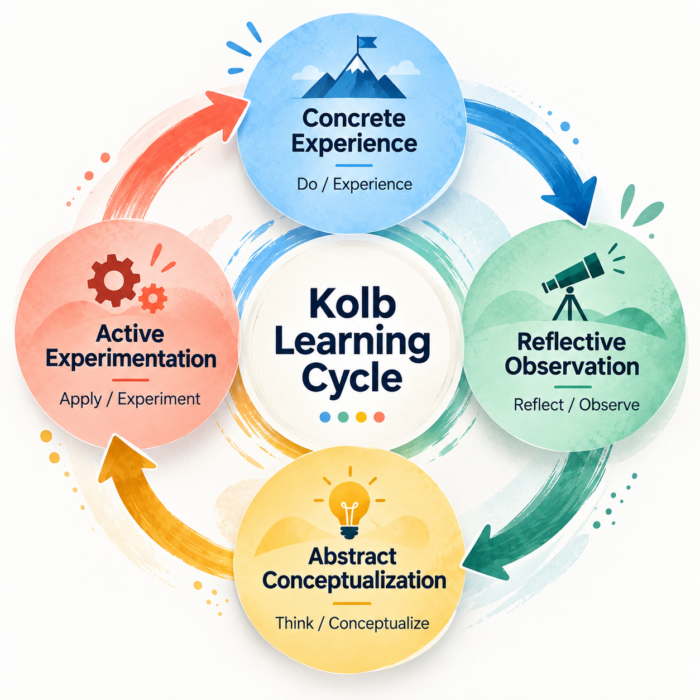
| Learning mode | What the learner does | Useful instructional moves |
| Concrete Experience (CE) | Has or encounters an experience; feels, observes, participates, or becomes immersed in a situation | Fieldwork, simulations, demonstrations, cases, role-play, lived problems, artifacts, interviews |
| Reflective Observation (RO) | Pauses to look back, notice patterns, consider multiple perspectives, and ask what happened | Debriefing, discussion, observation protocols, journals, peer feedback |
| Abstract Conceptualization (AC) | Builds or revises concepts, explanations, models, principles, and hypotheses | Readings, mini-lectures, theory-building, concept maps, analysis of evidence |
| Active Experimentation (AE) | Tests an idea, makes a decision, tries a revised approach, and sees what happens | Prototyping, practice, application tasks, design challenges, action plans, performance feedback |
What Makes the Difference
Apart from the value of this cycle, what has not been given enough attention when we consider our students’ “experience” of learning is as follows:
- The significance of the learners’ relationship to the learning experience
- The significance of the “kind” of experience the learner is engaged in, and
- The significance of the “kind” of reflection the learner is engaged in.
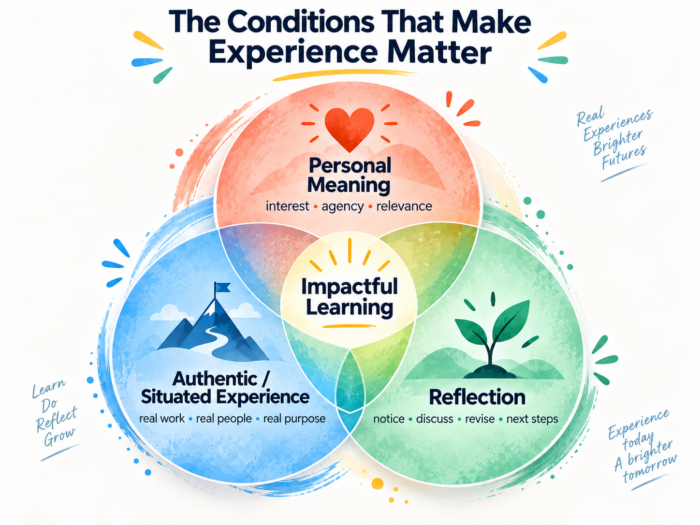
The significance of learners’ relationship to the learning experience.
One of the attributes that more often than not is not fully taken into account is learners’ intrinsic interest in the topic, content, and activities of the learning. Again and again, when we look across classrooms and scripted curriculum, students are engaged in activities, topics, and experiences that students have little to no interest in – and yet we assume they should and will. As I have detailed elsewhere (see Igniting the Flame), learners who are not intrinsically invested in the activity are not going to engage their minds in the activity which results in deeper learning. Faced with the laborious task of listening to someone else, reading, or performing an activity simply because they are supposed to is deeply different than students who want to engage in the activity, which more often than not involves “creating, making, or doing” something of intrinsic interest. The research and theory speak directly to this. Yet we expect learning to happen as a result of compliance, not intrinsic interest. Which is a huge mistake but remains the go to expectation in schools. Rather, we should start with learners’ intrinsic interests and/or find meaningful ways to engage students’ intrinsic interests in a topic and/or activity. Not to do so results in what we have in most schools today: apathy, disengagement, and disinterest.
For most schools, as currently organized, this is hard to design, as much of our curriculum and school architecture prescribes by coverage of topics in siloed subject matter rather than the skills or competencies learners could gain through their choice of topics, authentic activities, and the intrinsic interests of students.
The significance of the “kind” of experience the learner is engaged in.
Beyond simply being powered by students’ intrinsic interests, the kinds of experiences students are engaged significantly impacts the outcomes of learning. Lave and Wenger’s research on situated learning pushed my thinking the most in this area way back in 1991, with their seminal book of the same title. Learning, they argued, happens in the doing (activity and practice) in a field in authentic, knowledge and practice-rich contexts — specifically, in working alongside others on authentic problems and tasks with expert practitioners. In their fieldwork, for example, they discuss how young women in rural Peru learn to be midwives by first observing and then working along experienced midwives, starting a young age. First, observing what the midwives do. Then helping the midwives in initially simple but authentic ways. Fetching water, the helping with a free hand, then gradually taking on more responsibility with in the moment coaching as they get older until they become midwives themselves. People learn by joining a community of practitioners who are already thinking and acting in a domain — the model behind every apprenticeship, from blacksmithing to today’s best career-connected programs. Lave and Wenger call this legitimate peripheral participation: newcomers begin at the edge of real work and move toward fuller participation over time.
If apprenticeship really is among the most powerful forms of learning then, that raises an uncomfortable question for schools. A student taught to write a five-paragraph essay for a teacher, for example, may or may not be learning how to write an op-ed for the local paper, a proposal to a local civic group, or a speech to the school board. Cognitive apprenticeship – in which experts model their thinking, learners engage in meaningful tasks with coaching, explain their reasoning, and gradually take on more responsibility as support fades – offers a concrete design model for closing that gap.
For example, several weeks after much of Iowa was hit by a huge windstorm (a particularly powerful derecho on August 10, 2020) with significant damage to buildings and half of the trees uprooted and strewn across the city, a high school sophomore at Iowa BIG asked her advisor a very simple question: what are they going to do with all these trees? And he answered, simply: I don’t know. And then, Why do you ask? She had an idea. Why doesn’t the city gather all of the fallen trees strewn across many of the city’s streets and create a public event in a local park where chainsaw artists could make art out of the fallen trees, raising both monies for themselves and to plant new trees.
Mark, her advisor, didn’t say, well, let’s study what we could do. Or simply do some paper or internet-based research on the idea. Mark saw the opportunity for Leah to follow an idea and see how she could make it happen. So he said: That’s a great idea. Then, Why don’t we call the Mayor and see what he thinks.
The mayor loved the idea, and several months later, Leah – with support – had worked with the Department of Public Works to the gather the trees, solicited chainsaw artists’ involvement in the project, and pursued marketing for the event with some of her friends, raising over $25,000 both for the artists and a non-profit that planted trees.
No one assigned her that project. It grew out of a real problem and genuine interest, supported by a network of adults who were willing to help her pursue her idea. What did she gain? Confidence, communication, project-management, and a taste for civic action which propelled her into civic engagement studies in college. For her, this was a game changer. No canned curriculum. No school-only activity. Focused on meaningful skills and competencies she could apply and use beyond this point in time.
Real work. A real problem. And a real interest to do something in the world. The trifecta!
The significance of the “kind” of reflection the learner is engaged in.
In school, reflection often means: pull out your notebook and write a paragraph about what you just read or did. Or turn to your peer or peers and talk about it. When I ask my doctoral students when they actually reflect, they rarely say “when I write a paragraph.” They talk about walking the dog, doing the dishes, or — especially — talking with someone who was there. Midway through the course, after weeks of small-group conversation connecting readings to their own experience, some tell me they wish I had joined those discussions sooner. My answer: if I had, you’d have spent more time wondering what I thought. The conversations you’ve been having with one another are the reflection.
That reframes things. Reflection can be active, social, and iterative — listening to someone else’s account, noticing a different interpretation, revising a claim, deciding what to try next — rather than a compliance task tacked on after the “real” work ends. Donald Schön’s distinction between reflection in action and reflection on action is useful here: practitioners don’t just look back afterward, they notice surprises while they’re still working, test a response, and adjust before the task is done. Boud, Keogh, and Walker make a related point: reflection is what turns an experience into learning in the first place — the deliberate return to what happened, how you interpreted it, what you assumed, and what it means for what you do next.
The strongest schools in the RPC study build this in rather than leave it to chance. At STEM School Chattanooga, students file a prototype report every week tying that week’s work to the school’s three core tenets; one student described the reports as busywork until she looked back at a full year of them and could see her own collaboration and critical thinking sharpen project by project. Cedar Falls CAPS runs students through structured reflection cycles at set intervals across the semester, not just at the end. Gibson Ek’s students reflect quarterly, in exhibitions where they have to show growth across their competencies to people other than a teacher, and Da Vinci Design builds the same habit into a twice-yearly Presentation of Learning. None of this is a paragraph in a notebook. It’s structured, recurring, and tied to a real skill — reflection with somewhere to go.
The Problem
Most schools, as currently designed, are not set up to engage students in real-world, authentic, interest-driven activity with active coaching by mentors — and that’s not just my read from the room. A six-year study of thirty of the country’s most innovative high schools found that deeper, more authentic learning was the exception rather than the rule, even in schools trying hard to build it. This makes it very difficult for educators to engage learners in such. Forty-five minute periods with students rotating in and out of classrooms divided by siloed disciplines and the expectation of covering prescribed curriculum makes it hard for educators to creatively and expertly engage youth in real-world, authentic activities. The schools who are able to do this do so in a significantly different school designs, with longer periods to immerse oneself in activities, the opportunity to apprentice or intern outside the school building, and an infrastructure that supports such activities. While we may have specific knowledge, skills, and competencies we want our students to gain while they are with us, current school designs foreground coverage rather than the design of experiences fueled by student interest with the engine of learning being authentic, meaningful, and situated experiences.
A young person can read a driver’s manual, memorize the rules of the road, and pass a written test. That knowledge matters — but almost no one would say it means the learner can actually drive. Driving takes time behind the wheel: pressing the gas, braking, turning, watching traffic, eventually developing the instinct to anticipate what other drivers will do. And everyone who has coached a teenager in an empty parking lot early on a Sunday morning how to drive, then out onto streets with real traffic, and hoped for the best when you got onto the highway, knows the difference between someone “knowing about” driving and “being able to drive”.
Most schooling still spends its time on the driver’s manual. Students receive information and are asked to recall it — through quizzes, papers, sometimes a project — and we quietly assume that this adds up to the capacity to use that knowledge in real, complex, unfamiliar, consequential situations. It doesn’t, automatically. Transfer is difficult: learners do not reliably recognize when a concept from one setting applies in another; they need repeated chances to use knowledge in varied contexts and get informed feedback on what’s changing. In practice that means transfer isn’t just exposure to a concept — it requires recognizing where a new situation resembles ones you’ve seen before, and adapting what you know to fit it. That is not an argument against reading, direct instruction, practice, or assessment — students need concepts, vocabulary, models, and feedback. It is an argument that when the goal is genuine capability — communicating, solving problems, collaborating, exercising judgment, doing a piece of real work — knowledge transmission alone will not get students there. Situated-cognition research has long argued that knowledge is closely bound to the activities, contexts, and cultures in which it develops and is used. Pull knowledge and the application of skills out of a real-world, authentic setting that gave it meaning, and what’s left isn’t really the knowledge no less one’s ability to act in the discipline anymore — it’s a shadow of it. Students don’t learn how to use the knowledge gained or develop the skills and competencies that will empower them going forward.
The Experience Continuum
One way to design learning deliberately is to think of it as a continuum, from experiences that mainly communicate knowledge to experiences in which learners take on real, domain-specific work with genuine purposes, audiences, and consequences. Getting Smart has proposed a version of this with their experience taxonomy and here is another way to think about it.. 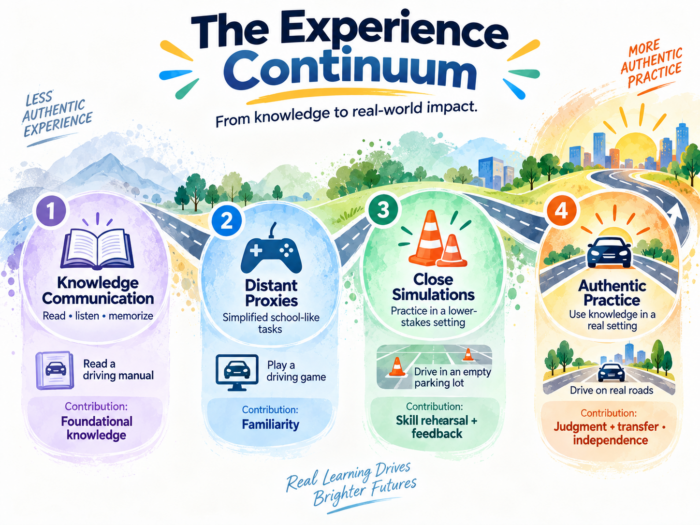
| Experience category | What students primarily do | Driving analogy | What it can contribute |
| Knowledge communication | Read, listen, memorize, explain, practice recall | Read a driving manual and memorize road rules | Foundational concepts, vocabulary, declarative knowledge |
| Distant proxies | Complete simplified, school-like tasks that loosely resemble real activity | Play a driving video game | Familiarity, limited application, some engagement |
| Close simulations | Practice a realistic task in a supported, lower-stakes environment | Drive in an empty parking lot with an instructor | Skill rehearsal, confidence, feedback, preparation for complexity |
| Authentic practice | Use knowledge and skills in a real setting or for a real purpose, with real people and consequences | Drive on real roads with increasing independence | Judgment, transfer, identity, usable competence |
These are not a rigid hierarchy, and not every lesson needs to become an internship. Everything is an experience — a movie, a dinner conversation, a book — but not every experience is transformative. John Dewey made this point nearly a century ago: experience is not automatically educative. Its value depends on the conditions surrounding it and on whether it connects productively to what came before and what comes next. Knowledge transmission and close simulations are legitimate building blocks; they simply cannot substitute for authentic practice when the goal is real capability. A strong learning environment moves students among all four categories deliberately, rather than settling for the first two as an endpoint. And, in the best of all worlds, aims for the opportunity to engage students in authentic work.
When an Experience Is “Faux”
I sometimes use the informal phrase “faux experience” for classroom tasks that borrow the surface features of real work — the language of “project” or “research” or “community problem” — without the purpose, audience, or consequences that make work genuinely meaningful: an essay only the teacher will read, a “business plan” with no possible client or implementation, a mock debate reciting preassigned positions, a lab designed only to reproduce the expected result. The distinction tracks what researchers have called authentic intellectual work — work that requires construction of knowledge, disciplined inquiry, and value beyond school, rather than the reproduction of information for a grade.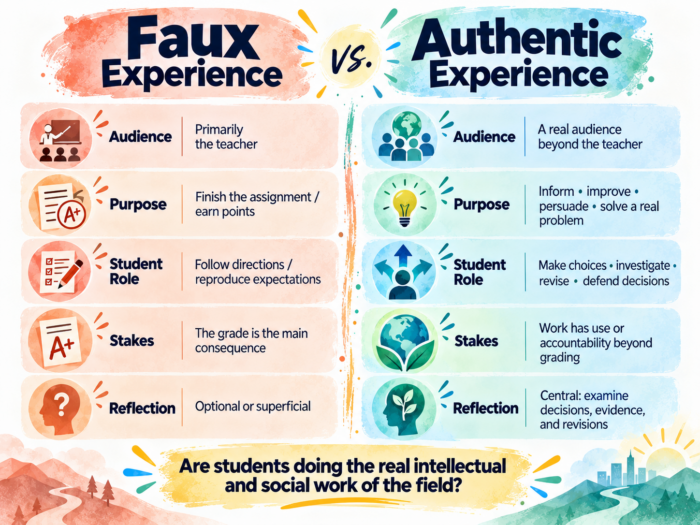
Faux vs. Authentic Experiences
| Dimension | Faux experience | More authentic experience |
| Audience | Primarily the teacher | A real or credibly situated audience beyond the teacher |
| Purpose | Finish the assignment, earn points | Inform, improve, persuade, create, or solve a real problem |
| Student role | Follow directions, reproduce expectations | Make choices, investigate, revise, defend decisions |
| Stakes | The grade is the main consequence | Work has a use, response, or accountability beyond grading |
| Reflection | Optional or superficial | Central: students examine decisions, evidence, and revisions |
Asking students to write a letter “as if” advising a city council can be a useful rehearsal — but it’s closer to faux if the council is imaginary and the letter is only graded. It becomes more authentic when students research an actual local issue, contact a real official or organization, and revise based on real feedback. None of this means simulations, rehearsal, or scaffolding are bad — they’re often necessary, especially when the real thing would be unsafe or premature. The test is simple: are students doing the core intellectual and social work of a field, or a school-shaped imitation of it?
What Do We Mean by “Authentic”?
A project isn’t automatically authentic because students worked in groups, built something, or used the vocabulary of design thinking. Authenticity gets stronger as student work does more of the following: addresses a real question, need, or audience; requires disciplinary knowledge rather than a real-world decoration; involves real constraints or consequences beyond a grade; includes feedback from people who use or are affected by the work; requires revision and defense of decisions; and produces something public — a recommendation, a prototype, a performance. A systematic review of authentic-learning research finds that definitions vary across studies, but effective designs share meaningful connections to real-world contexts, expert performance, and sustained collaboration and reflection. A complementary design account names the same features as elements to build in deliberately — authentic context, authentic task, access to expert performance, multiple roles and perspectives, collaboration, reflection, and assessment integrated into the work itself, rather than bolted on afterward.
This is why one internship can be transformative while another, with little mentorship or real responsibility, amounts to exposure without much learning. The outcome evidence backs this up, with a caveat that matters: a meta-analysis of 66 studies found project-based learning produces real gains in academic achievement, thinking skills, and student attitudes compared to traditional instruction — but the size of the effect depends heavily on how well it’s designed and implemented. Which is really the point of this whole piece: it’s not the label “project” or “authentic” doing the work, it’s the design.
What It Looks Like in the Field
The America Succeeds Research Practice Collaborative (RPC) spent 16 months examining how schools across the country intentionally build durable skills — interviewing more than 200 students, educators, and industry partners across public, charter, and private settings. Its case studies are illustrative, not proof of a single “right” model, but they show what this looks like in practice.
At Gibson Ek High School, one student’s internship with a sustainability organization didn’t involve just reading about the problem or even just shadowing in the organization — she produced communication materials the non-profit actually needed and eventually used in its public campaigns. Another senior, with an entirely different interest, upon learning that veterinary students had an unusually high rate of suicide amongst students, ended up interviewing several undergraduates and eventually publishing her work with a university professor, something far beyond what most high school students engage in. Neither experience started polished. And both were driven by real interest and the potential for real impact. And both required building real skills and competencies with people who depended on the quality of their work — a different focus than simply working to get an A.
The CAPS model, seen at Monett GO CAPS and Cedar Falls CAPS, also immerses students in real-world experiences with real-world stakes, organizing their students’ learning around client projects, professional shadowing, and internships with local employers. The assignment stops being “complete this for a grade.” Students must understand a client’s actual need, manage ambiguity, communicate professionally, and revise when a first approach falls short — which makes durable skills concrete rather than a rubric category. Communication means explaining an idea to someone who doesn’t already understand it; adaptability means responding when a partner changes expectations or a first attempt doesn’t work.
And at One Stone, their learner experiences start with student-led design work in which learners identify a real problem, prototype a solution, and revise it in response to critique from people outside the classroom. Design work like this makes an underappreciated feature of adult life visible to students — that quality emerges through iteration, not a single submission. NAF Academies, Building 21, Da Vinci Design, and STEM School Chattanooga round out the picture with employer-connected career academies, structured internship pathways, and professional critique panels where students present real work to practitioners for real feedback. Different students find their way in through different doors; the common thread is real work, real people, and a path toward greater responsibility.
One caution: authentic experience isn’t automatically equitable just because it happens outside a classroom. If access depends on a family’s connections, unpaid time, transportation, or an adult who happens to make an introduction, these opportunities can widen gaps as easily as close them. The schools doing this well treat preparation, transportation, mentor training, and structured reflection as part of the design — not logistics bolted on around it.
The Design Challenge
The central question for educators isn’t “how do we add more experiences” – students are already engaged in a variety of experiences all day. The question is: how can I engage students in learning experiences that have significant value and impact?
That question can guide real design conversations. Before calling something experiential learning, ask: Does the work have a purpose beyond completing the task? Will students use real disciplinary knowledge, not just decorate an activity with it? Who besides the teacher will see, use, or respond to the work? Where will students get feedback to continuously improve? How will they reflect — alone and with others — on what happened and what’s next?
The most promising schools don’t treat authentic learning as an enrichment track for a few students or a special event at the end of a course or a capstone at the end of high school. They build a progression: students gain knowledge, watch expert practice, rehearse with support, take on increasingly complex and real work, get feedback, reflect, and gradually earn more independence. Grounded in what they are intrinsically engaged in. That progression – not any single signature program – is what separates schools where students learn about a subject from schools where students learn to do something with what they know. “Cool Schools” is what I like to call them. Are you now a “cool school”?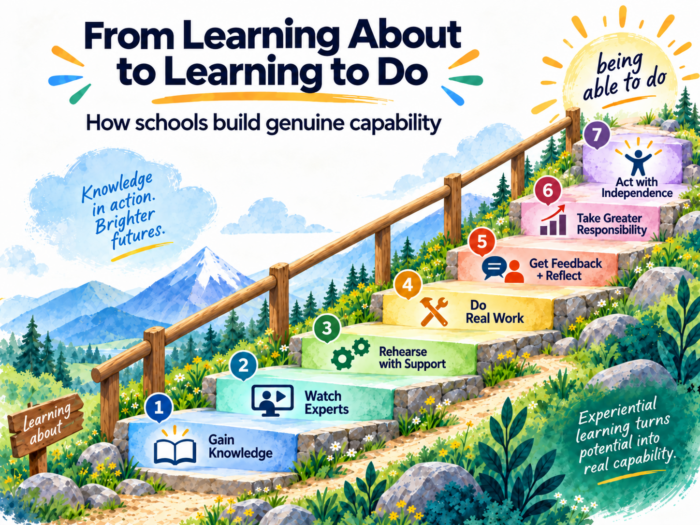
That is why the experience of experience matters. Students do not gain the knowledge and skills they need simply because they are active. They develop the knowledge and skills we want them to have when learning asks them to use that knowledge and employ those skills in intrinsically motivated, meaningful ways — not just academic knowledge, but the cognitive, interpersonal, and intrapersonal capabilities that let someone actually use what they know – in authentic contexts, with ongoing, constructive feedback and personal reflection, and growing independence. This is the ambitious and most important thing we could and should be thinking about when we think about what we are affording our youth today.
0 Comments
Leave a Comment
Your email address will not be published. All fields are required.