

Probable and Possible: Why the Era of Probabilistic Computing Requires Real World Learning with an Entrepreneurial Mindset
Key Points
-
As probabilistic/agentic AI handles more routine expert tasks, schools should prioritize real-world learning that builds judgment, agency, and decision-making under uncertainty—not just deterministic “right answer” work.
-
Frameworks like KEEN (curiosity, connections, creating value) give districts and higher ed a practical way to design learning experiences that counter “AI shortcutting” by emphasizing iteration, struggle, and value creation.

The 40 year Information Age took deterministic computing to scale in financial and engineering systems. The rules-based, if-then systems powered search engines and supply chains. ChatGPT brought generative AI to the consumer market in 2022 with an autocompleter, trained on the entire internet, that finished sentences based on probability.
Atlassian CEO Mike Cannon-Brookes described the Information Age as “turning filing cabinets into databases.” He argued that we have now entered a new era where the “filing cabinet can do work”. Intelligent, probabilistic, agentic systems can execute tasks (better, cheaper and faster than experts) while expanding (perhaps exploding) the possibility frontier.
The transition from deterministic computing (where A + B always equals C) to probabilistic computing (where A + B yields a distribution of likely outcomes) is more than a technical shift—it is a psychological one. Probabilistic computing increases what’s possible by moving beyond the rigid, “yes-or-no” logic of traditional computers to embrace uncertainty and likelihood.
Probabilistic systems mimic human intuition by assessing “best-guess” scenarios. In autonomous vehicles, probabilistic systems calculate the likelihood that a blurry shape is a pedestrian versus a mailbox and take action. In healthcare, AI can evaluate multiple potential conditions simultaneously, providing a confidence score rather than a single diagnosis.
Probabilistic systems tunnel through complex data landscapes to find the best solution faster. More efficient computers (like brains), probabilistic computing trades precision for power and yields a landscape of weighted bets.
The Age of AI requires an entrepreneurial mindset to navigate uncertainty, manage risk, find opportunity in noise, and imagine new possibilities. The speed of model updates requires adaptability and the resilience to unlearn and relearn constantly.
“The world is going to go to the people who take agency for themselves,” said Sal Khan. He defines “entrepreneurial mindset” in broad terms. “It doesn’t mean every student must launch a company. It means students should learn to assemble resources, teach themselves, experiment and find ways to contribute value to the market.”
Why AI Demands An Entrepreneurial Mindset
Twenty years ago, the Kern Family Foundation launched the Kern Entrepreneurial Engineering Network (KEEN) to encourage an entrepreneurial mindset–curiosity, connections, and creating value–among undergraduate engineering students.
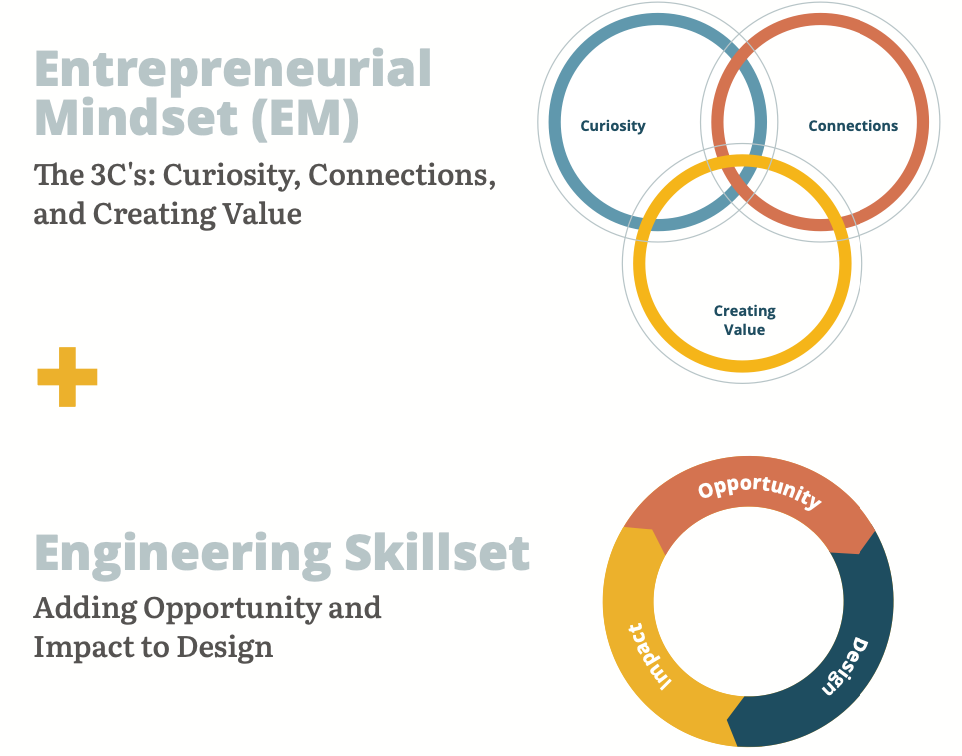
KEEN Program Director Doug Meton explains, “An entrepreneurial mindset amplifies the technical skills they learn, equipping them to recognize and identify opportunities, assess and focus their impact, and pursue and create value in any context.”
A KEEN forum at Dayton University in February explored the intersection of entrepreneurial mindset and AI (EMxAI). Faculty described how AI enhances opportunity recognition, solution design and impact delivery.
The subject of offloading and shortcutting with AI was a common concern–and best addressed by encouraging an entrepreneurial mindset. Melton explains, “Students become engineers not primarily through acquiring knowledge or producing artifacts, but through the quality of struggle they engage with over time: wrestling with concepts, iterating through failure, building mental models, and developing judgment about how to create value for others.”
Curiosity and Value Creation
Opportunity Recognition is the most provocative part of the KEEN framework. It suggests a new earlier starting point (i.e., finding work worth doing) with huge educational implications (i.e., occasionally giving learners time/space for problem finding and the opportunity to see work through to value creation).
Two recent logic models make the case for curiosity and value creation. First, Sangeet Paul Choudary says the historical value chain is:
Curiosity => Knowledge => Curation => Judgment.
Education has long been focused on knowledge transmission (and the professional services industry has packaged knowledge-as-a-service). His new book Reshuffle makes the case that “In an AI-abundant world where knowledge is cheap, curiosity, curation, and judgment – signalled well – becomes insanely valuable.”
Second, a new paper from researchers with MIT, WashU, and UCLA explores what happens when machines can do the vast majority of tasks in the economy. They conclude, “We are moving from an era where our worth was defined by our capacity to build and discover, to an era where our survival depends on our capacity to steer, understand, and stand behind the meaning of what is created.”
While educators are worried about ‘cheating’ on the production function (of small easily assessable problems/prompts), the world of work has quickly refocused upstream on curiosity, opportunity recognition, problem finding, context engineering, and agent orchestration, and downstream on curation, validation, judgment, and impact delivery.
Why AI Demands Real World Learning
On the subject of offloading, Charles Fadel presented Technologies Smarter, Humans “Dumber”? The new paper by Dirk Van Damme concludes that “technological progress consistently produces both cognitive gains and losses: while technologies expand abstraction, efficiency, and access to knowledge, they simultaneously weaken embodied, contextual, and internally sustained capacities that education has traditionally cultivated.”
The paper argues that the central educational challenge is not whether to adopt new technologies, but how to rebalance learning to preserve attention, understanding, judgment, and autonomy in increasingly automated knowledge environments. Fadel introduced this idea of rebalancing around a “modern emphasis” in his 2024 book Education for the Age of AI (and in this podcast.)
After introducing a five-layer framework, the paper suggests that rather than preserving outdated routines, education needs to “shift emphasis upward —towards conceptual and structural understanding—so that learners grasp the principles, models, and systems that underpin automated outputs.
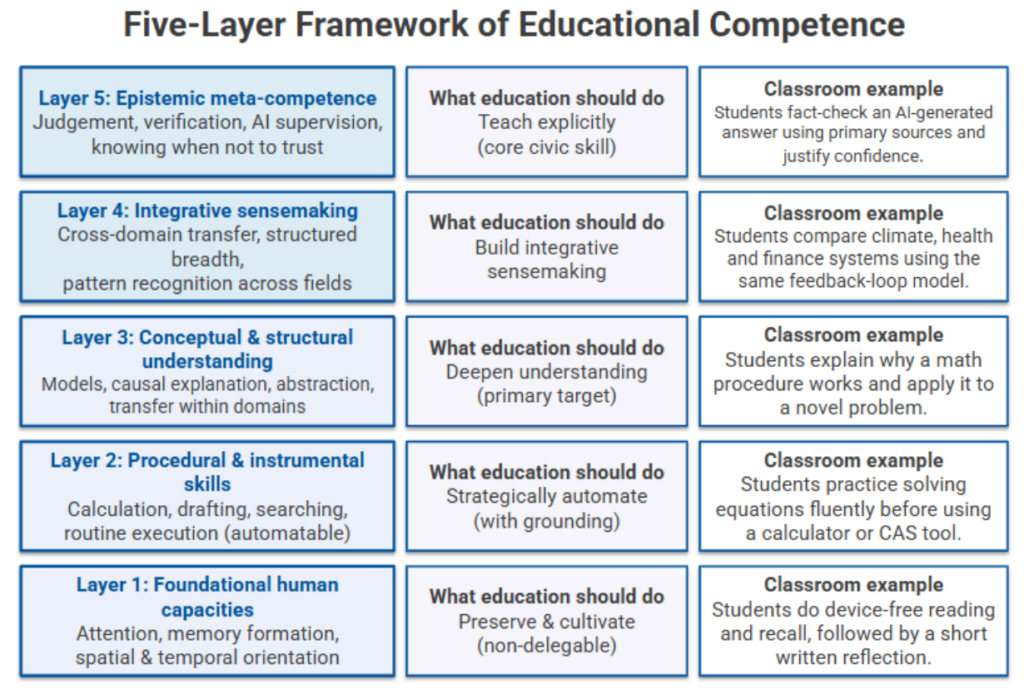
In the Age of AI, argues Van Damme, epistemic meta-competence (i.e., judgement/discernment, adaptability) is a core capability: “The central divide is no longer between those who use advanced tools and those who do not, but between those who can critically orchestrate them and those who must defer to them.”
In a recent blog, Dutch psychologist Paul Kirschner makes the distinction between cognitive offloading and outsourcing. “With offloading, you still think, and the artifact (tool) supports you. With outsourcing, the system thinks, and you consume the result. That distinction matters…There’s therefore a crucial difference between using AI to support thinking and using it to substitute for thinking…Offloading supports cognition. Outsourcing replaces it.”
Adopting tech into work and learning trades experiential, embodied and intuitive forms of knowledge for abstraction, codification, and automation. Van Damme notes that “While this enables scale and precision, it also weakens tacit knowledge—forms of knowing that are acquired through practice, immersion, and social interaction rather than explicit instruction.” (And, he notes, tacit knowledge is key to innovation and entrepreneurship.)
Here is the real world learning punchline: “Because tacit knowledge develops through doing rather than through abstract explanation, schools and universities should deliberately balance digital instruction with rich opportunities for physical engagement, iterative creation, and real-world participation.”
Agentic Mindset
Psychologist Albert Bandura developed his ideas on the agentic mindset (or human agency) over several decades starting with his seminal 1977 paper, Self-Efficacy: Toward a Unifying Theory of Behavioral Change. As the world entered the digital age, Bandura expanded his theory to explain how humans navigate increasingly complex and uncertain systems. His 2006 paper Toward a Psychology of Human Agency is a manual for understanding the agentic mindset in the 21st century.
Agentic mindset focuses on the internal belief: “I have the power to change this system.” Building on Bandura’s work, the KEEN use of entrepreneurial mindset focuses on more specifically on identifying opportunities and creating value.
Beginning in the last few months of 2025, a renewed interest in agentic mindset emerged with the explosion of Agentic AI—systems that don’t just answer questions but take actions. For humans, an agentic mindset is the necessary “human counterpart” to these autonomous tools.
Alive With Possibility
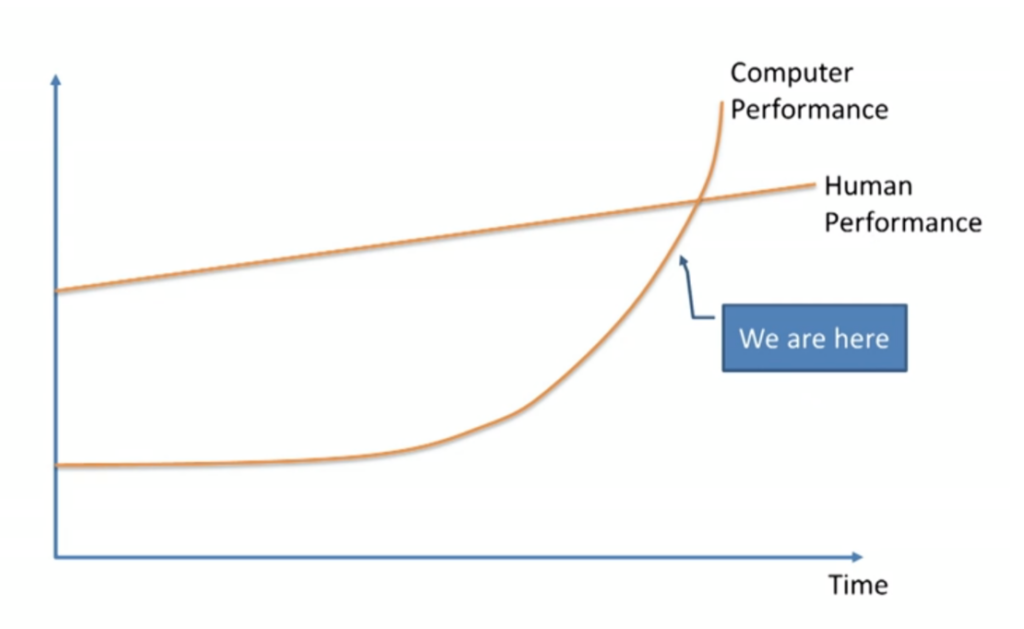
Ten years ago, Tim Urban foreshadowed the challenge of living on an exponential curve of computer intelligence. Urban explained that humans intuitively predict the future based on the recent past (a linear, or “straight line” approach). However, technological progress is exponential, meaning we consistently underestimate the speed of change, especially regarding artificial intelligence.
On “riding up an exponential”, Ethan Mollick said, “Starting in late 2025, we entered a new era thanks to AI agents like Claude Code, OpenAI’s Codex, and OpenClaw. These are AI systems that you can just give work to, sometimes hours of human work, and get back reasonable and useful results in minutes. This is an era of managing AIs, rather than working with them.”
An entrepreneurial mindset now requires an exponential sense of possibility. Mollick explains, “This new approach to AI is the outcome of the rapid exponential improvement in AI abilities. That means you can’t understand where we are, and where we might be going, without understanding the increasing capability of AI.”
“Practical agents, jagged exponential improvement, and the ability to radically experiment with the nature of work combine to form a sort of rolling and unpredictable environment for AI advances. As AI capability crosses thresholds, it unlocks radical new use cases that change people’s views, sometimes overnight, about what AI can do. At the same time, organizations experimenting with AI will figure out how to make it work for them, leading to sudden announcements about new strategies or large-scale shifts in which kinds of employees companies value most.”
Last year, there was some chatter about the improvement slowing down out but the December and February releases demonstrate that the curve remains exponential (and AI likely crossed the line of human capability in Urban’s graph) With recursive self-improvement on the roadmap, the exponential curve just gets steeper.
In trying to explain riding this exponential, SmarterX CEO Paul Roetzer said “an innovation growth mindset is essential.” And, “That means challenging people to think much bigger about what they can do.”
Opportunity recognition requires an exponential sense of possiblity about what we can do as agumented learners and value creators. Venture capitalist Reid Hoffman often argues that the most important mindset for the AI era is a sense of possibility. His argument appears across speeches, interviews, his books Impromptu and Superagency, and his Possible podcast.
Our book Difference Making was subtitled “Students, Schools and Communities Alive With Possiblity.” Six years later, that sentiment of inviting high school and college learners into value creation seems more important than ever. Only now, we can make the invitation with a supercharged sense of possibility knowing that the opportunities for difference making improve every month.
The Age of AI requires an entrepreneurial mindset with an exponential sense of possibility. It’s best developed and demonstrated through real world learning–community-connected opportunities to step into value creation.



0 Comments
Leave a Comment
Your email address will not be published. All fields are required.