


Town Hall Recap: Building a Growth Mindset Culture

The Getting Smart team recently hosted our October 2022 Town Hall, this one focused on all things Growth Mindset and building a culture of yet. Led by Getting Smart team members Victoria Andrews and Shawnee Caruthers, this event highlighted self-talk, the power of yet, the importance of feedback and much more as we tried to lay the groundwork for building a positive culture in your school building.
How do we truly allow students and parents to step into their own space?
Shawnee Caruthers
An example of this in action is praising the effort over accomplishment. Child: “I got an A on this assignment”, Parent: “Wow, you must have put a lot of effort into that” rather than “Wow, you are so smart.”
Various member of the audience chimed in throughout the event to share experiences and insights with the group about implementing a growth mindset culture. Matt Piercy shared, “from time to time I call students “yetis.” Younger ages find it pretty funny.”
Terry Schmalz shared that “Our work on growth mindset really changed the way our learners approached their learning.”
Josh Reppun shared, “I love the idea that when we empower kids to tackle complex problems that cannot be solved in “just one go,” we support the development of a growth mindset. Complexity means you gotta be you as you work through whatever it is.”
Passion is about the individual but if we encourage young adults to think about a purpose level, the collective, then the growth mindset ties into what’s good for the world also.
Nate McClennen
The Getting Smart team is thrilled to work with a number of great organizations and partners on embedding growth mindset. To find out more about our speaking engagements, workshops and partnership opportunities – visit this page.
Transcript
This transcript has not been edited for spelling accuracy.
This episode of the Getty Smart podcast is part of our new Pathways campaign. What is something you used to think that you’ve changed your mind about? It’s time for us to do that with all things learning. Previous Getty Smart campaigns have laid the groundwork of networks, place, purpose, and innovation. Our latest effort, the new Pathways campaign, will serve as a catalyst for an unbundling education
to allow for new learning models that are sustained by supporting guidance and embedded in scalable systems. In partnership with ASA, the Bill and Melinda Gates Foundation, Stand Together and the Walton Foundation, the new Pathways campaign will question education status quo and propose new methods of giving students a chance to experience success in what’s next. Find out more at www.gettingsmart.com backslash new pathways.
This episode of the Getty Smart podcast is a rebroadcasting of our recent Town Hall, all about growth mindset and school culture. Led by Getty Smart team members Victoria Andrews and Shawnee Carruthers, this event focused on self-talk, the power of yet, the importance of feedback, and much more, as we tried to lay the groundwork for building a positive culture in your school building.
If you haven’t been to a Getty Smart Town Hall yet, be sure to check out which ones are coming up next at www.gettingsmart.com. Alright, hope you enjoy. Alright everyone, thank you for being here. Welcome to the Town Hall. Today, if you weren’t aware, we’re going to be talking about how to build a growth mindset culture. But first, I would like to just introduce ourselves, Victoria and I, along with other Getty Smart team members are on,
but we will be serving as your facilitators today. Victoria is the director of learning design with Here, Getting Smart, and I am the director of advocacy, and hi, I’m Shawnee. Growth mindset isn’t a one-time exercise. It’s something that we consistently have to talk about and that we consistently have to model, especially as we think about for ourselves. So in this Venn diagram, it shows you the three kind of groups, especially in an educational setting that we kind of want to wrestle with and talk through today.
So first, it’s ourself and whatever that self is in this space, so it could be as a teacher or as the principal or instructional coach, whatever that is, the growth mindset work has to start with us. And so often we know this, but we don’t always do the work to really unpack it. And to truly build a strong growth mindset culture, we first have to create an atmosphere of trust and equity. Nothing can be done until those things happen.
And we’ll go into that in just a little more just a second, but students and staff have to be encouraged to believe that through effort, talent, and belief can be developed. But they have to have strategies. They have to have mentoring. They have to have support. Growth mindset, fixed mindset, this notion isn’t just about those 9-12 graders or K-12 students. It’s about everyone in the building really exhibiting what does a culture look like for this work.
And so once we have done the work for ourselves through self-examination, reflection, journaling, whatever inventories that have to be done, really just like paying attention, really creating like a diverse network for us to step into so that we can understand how other people interact with each other, then we can do the work with students. And students need the same kind of professional development. Victoria and I just did some professional developments with students in the group of Kansas City.
It was so fun, but it was one of those rarities where students really got to interact with the same concept that the other staff members were interacting with. And so that was truly powerful because they were hearing the same message. So then everyone within the building are now able to hold each other accountable. And so that’s really important for students to be a part of that growth mindset culture building as well, that it’s just not like laid on them, but they also have a hand in building it.
But really trying to figure out how do we embed that into the school culture? How do we embed that into assessments so that we talk about assessments should really measure like what a student knows, but then we give everyone the same test. But using that growth mindset culture, then we’re truly allowing learning to be personalized so that students can feel successful. So their growth mindset can continue to grow and that they can consistently shift from being in a fixed place to a growth mindset place.
And then parents. Now, if you have children or if you interact with children at all, you know that we have certain expectations about what our child is going to do or be or who the children in our classroom are in our settings and our programs, kind of what they’re going to be. And then free will kicks in and free will is annoying, but it happens.
And so how do we, how do we tackle that? How do we truly allow students and children to step into their own space to live authentically in a way that matters to them without kind of laying our expectations on them? Because when we lay our expectations on them, that’s when they kind of dig in deep into that fixed mindset and really can’t break out of that mode to even get to the growth mindset. Within this, this, these, all of these circles, that’s where my set lies because we have to work with all of these groups to do the work. So in order for that to happen, we have to create this growth culture.
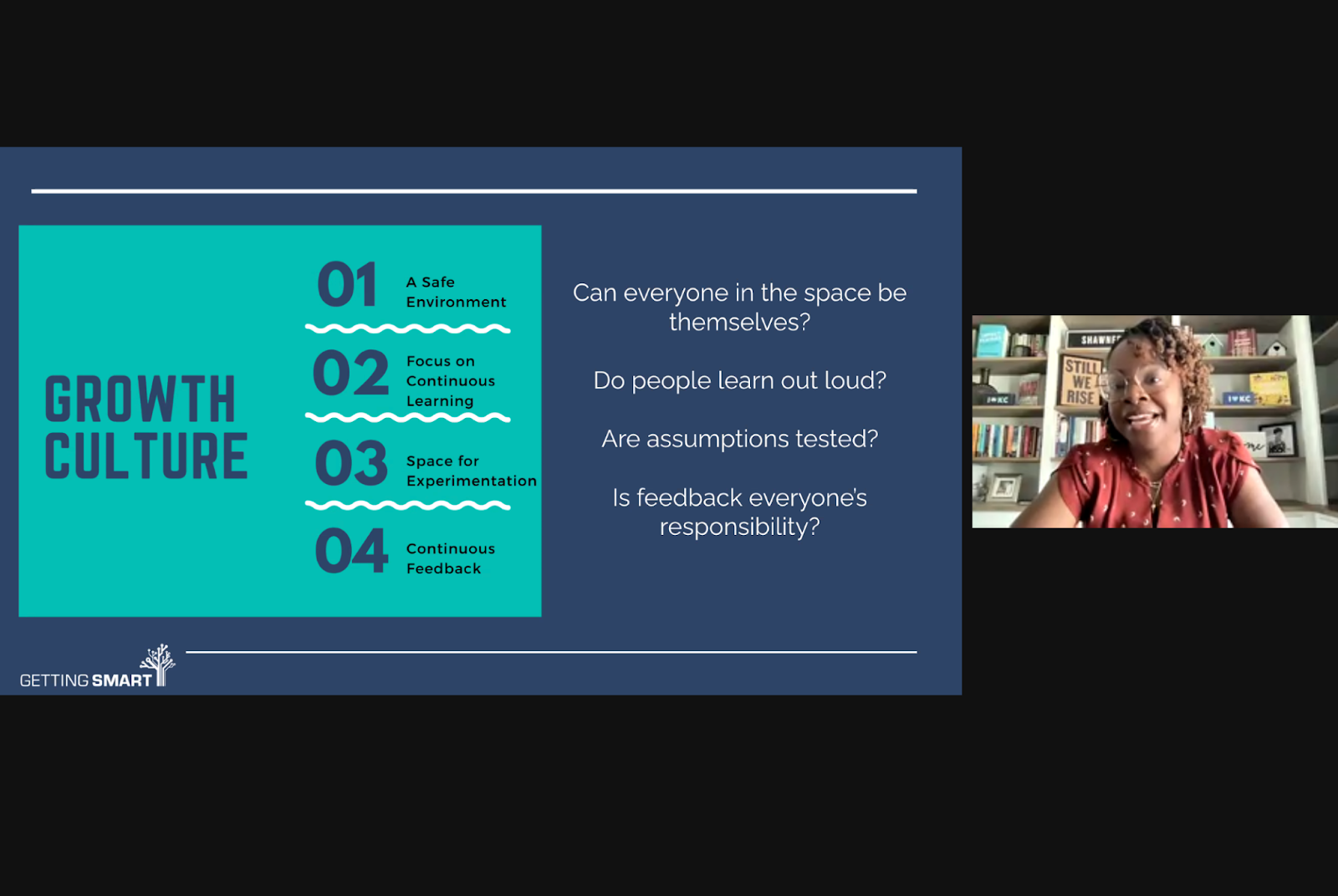
One, like we were saying in the last slide, there has to be a safe environment and we don’t just mean physically. We mean, can everyone in the space be themselves? Have we created a sense of belonging? Have we done the identity work that has to be done? Is the, is the environment safe for me to truly show up, take risk, make mistakes without being penalized?
Is there a focus on continuous learning, meaning do people learn out loud or are we just kind of each doing our thing because we don’t want to be penalized when we quote unquote fail? But are we learning in a space where we can be vulnerable and where we can truly be transparent? Are we testing our assumptions, meaning is there a space for experimentation? Or are we just saying, well, this is the way we’ve always done it. So this is the way that it’s always going to be done.
How do we create that space? And then as you all are thinking, I want you all to think about what is the last thing that was changed within your space? Was it effective? Was it not effective? What, what was the last thing that you personally rethought?
We talk about Adams Grant rethinking all the time, his book. What is the last thing that you rethought? What was the last assumption that you challenged for yourself in order to move from having like a very fixed concrete mindset to something that was one of growth? And then lastly, what is that continuous feedback? And Victoria will talk about this a little bit later on, but feedback doesn’t just lie with the person at the top.
In this space that you’re working in, as we think about the growth culture, feedback is everyone’s responsibility. But is it currently in your space? If not, how do you pivot to that so that everyone is praising everyone is leaning in? Everyone is talking about the power of yet that Victoria is going to speak about. So how do we create this as a whole culture and not just in silos?
So as we think about mindset towards learners and learning, it’s exactly like we were saying that intelligence is not fixed. It can change. I’ll say that one more time. Intelligence is not fixed. It can change.
And it can also grow stronger with effort. So we have to ask ourselves, what do we believe intelligence really means? What do we believe for ourselves, for our own children, and then for our students? And sometimes we grapple with that. I remember when I was a career and technical educator.
And so, you know, I believe for the students in my building that, hey, college and career readiness for everybody, everybody can do what they want to do and be on their own paths. But then if I’m sending a different message to my own son at home, like you got to go to college, then we’re not believing the same things about intelligence. We’re not believing that things can get stronger with effort and people can choose their own paths and intelligences and fix. So what consistent message are we putting out there? And are we presenting skills as learnable?
If we aren’t, then we’re continuing to say that intelligence is fixed instead of something that can get stronger with time, with effort, with skill building. How do you praise the effort and not the grade? Which again, I know Victoria will talk a little bit more. And then how are we showing the value of learning in our spaces and not just teaching what needs to be done? The godmother of growth mindset, Carol DeWack says that in demonstrating mindset, that in predicting success, what matters is a person’s belief that they can succeed and prevail.
And we talked about this a lot when we were doing the growth mindset, especially with the students. And they had some very interesting insights about this particular notion that a person’s belief is what they need in order to succeed and prevail. And we’ll ask you all kind of how you all think about that as well. But just kind of hold this in your mind for a moment. And because we want to get your thoughts as belief enough, or sometimes as it requires a little bit more.
And then how do we teach self-talk? Because we know that sometimes we are the meanest to ourselves. And we show a cartoon that we’re like a person, an adult sitting on a counselor’s couch. And we’ll say, if I stop all the negative self-talk, what else am I going to have to say to myself? Because sometimes we internalize so much that we can’t get to a space to clear our mind to talk about the positive things in order to move us to a growth mindset.
So our growth mindset, this form of growth mindset plus some positive self-talk, plus some strategies and beliefs that we need to layer in is what changes behavior. We can’t have one without the others. We can’t say, oh, well, I have a growth mindset. That’s it. But I’m still talking super negative to myself. And I’m not leaning on my network. I’m not learning. I’m not doing all of the things.
I’m not believing that I can do things. And then I’m wondering, like, why my behavior can’t change. So we definitely have to have this whole formula in order to create not only change in our behavior, but in our students and then ultimately in the culture that we’re trying to grow within our spaces. Before we jump into the power of yet, we’ve got, we know that this growth mindset, this is something that’s a pretty familiar topic to everybody that’s here. And if not, then I highly encourage you to just take some time and get into Dr. Dweck’s work.
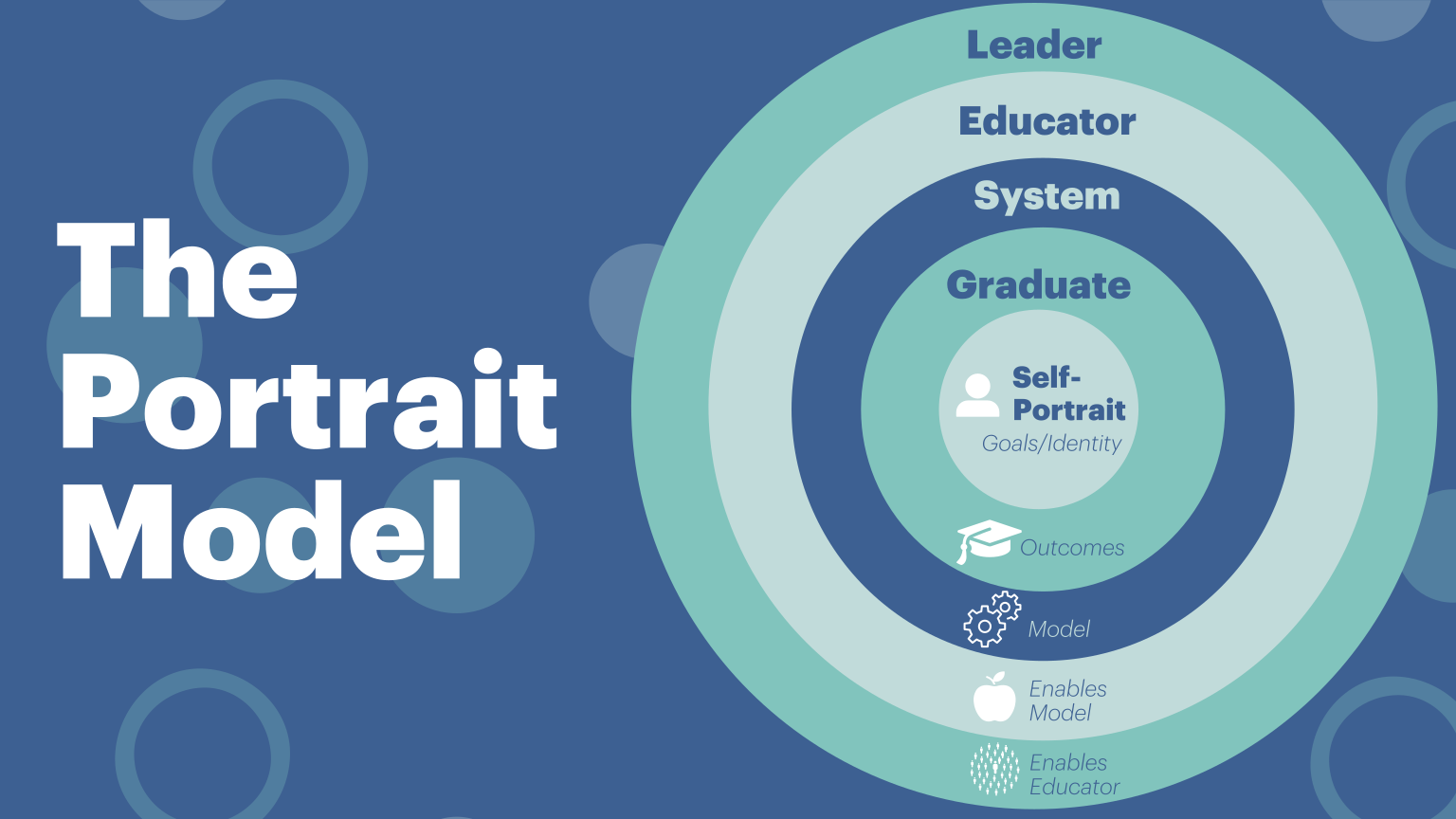
But we also have some, we want to utilize just the genius that’s in the chat as well. So before we dive into the power of yet, I want to just go and look at Mason’s comment in the chat that says, like, what have you guys done to help build your growth mindset culture where, whether it’s within your home, whether it’s on a campus, what are some things that you’ve already done? I’m going to call on somebody because there is a, we have here at Getting Smart, Rebecca, who has done tremendous work with districts all across the country on growth mindset. And it’s super instrumental, especially when looking at diving into Portrait of a Graduate and starting schools. So Rebecca, do you mind sharing some of the work that you’ve done with growth mindset and the toolkit that you’ve used and just some of the practices that you’ve seen that have been successful?
So I would just note that the culture piece that we do for mindset work is super important for students to embrace productive struggle and truly understand what it feels to have new learning and to achieve hard work. Just also noting that it’s also really important to set the culture for change that your system might be making. Thanks, Rebecca, for sharing. Like you said, that inter talk was huge, especially when we spoke with the students at Scion. We did a quick informal survey with a lot of the students afterwards and there were so many that admitted that they just had negative self-talk.
And it wasn’t until they just slowed down and through some of the work that we did during that day that they came to realize that they were more capable, or even that they would shut themselves down and close off opportunities from themselves just based solely upon what they were saying to themselves, not based upon anybody else’s conversation. And so just even the take for students to take that step to even acknowledge like, hey, what I’m saying to myself before I even say those words out loud has is can be hugely detrimental to what I’m doing or what class I don’t take or what sport I don’t participate in, or what college I can even consider or a skill. Maybe I’ve told myself I’m not a public speaker because my voice sounds a certain way or I feel a certain way and for students to just take hold of that and just take that very first step in self acknowledgment was huge. And so we’re going to go dive back into the power of yet and just again going into some of that inner talk that Rebecca was mentioning as well as the productive struggle.
So we had a one of our and during one of our sessions we had a student who was a star, I believe basketball player. And so, or was it soccer soccer star soccer player, and she like that’s what she’s known for that’s her go to sport she was a junior. And as a junior, and anybody that’s familiar with high school sports, you don’t start a new sport. Go into your junior year, like you’ve been on if you’re top notch. That’s definitely not the year you want to start because if you start thinking about college applications and creating videos highlight reels and things of that nature, that whole world. But she said that she was going to try a sport she had never played before, which was tennis, and so many of her and for her to even share that out loud out loud with her classmates, her voice was shaking. She was nervous. You could just see her leg, all of the symptoms manifesting themselves in her body of I’m trying something that I feel, you know, just totally uncomfortable with.
But the amount of encouragement that she received in that session from her classmates was just, just remarkable. Johnny and I both had goosebumps I’m getting them again just thinking about it, because her classmates were pouring into her saying, you know if you’re strong at this for it you’ve got you know you’re an athlete. So you can do just because you’re it’s unfamiliar. So there, they started to say, you’re not good at that yet. So yet is such a small word but it’s so powerful, because it doesn’t, it’s not the period of a no, it is the comma, it is the pause, it could be even the semi colon for my, my super grima, grammatical people out there. But for example, I don’t like this yet leaves room for change. I’m not good at this yet gives, gives space for improvement. And sometimes we don’t even need that from other people we need that for ourselves of how we view ourselves so this goes back again to that inner talk that Rebecca was talking about and how students can manage through productive struggle when they start to look at things through the power in the lens of yet at the conclusion of that training about three weeks later. The principal emailed us, and they are still just embracing so much of growth mindset and the work that they allowed us to share in it, and said that, you know, the volleyball team was getting ready to play a game against their rivals who they always lose to, but even going into the girls were saying we haven’t
done it yet. And so the principal even took note of that and it’s like that mindset of them even going into it was different than how it’s been in the past. So such a small word but it’s so impactful. So we’re going to chat briefly about feedback. And so feedback, especially praise can shape one’s inner voice, aligning our beliefs with practice the feedback we give others and ourselves sets the tone for how others, how we see learning, and for how others see themselves as others. And so I saw in the chat. Somebody mentioned just focusing on the effort and shifting the focus from effort in the process, instead of just the product. And of course, in the school setting it can be so easy to do that because that’s something that you can do if we all take a test. We grade it real quick I can see who has the B to see the D and the F, but I don’t see the process I don’t see the effort. And so what I say to a student or to a colleague that is trying something new, whether it’s technology or a new practice, the feedback that I give them says a lot about how I view learning. If I’m just focused on the output, I’m just focused on what the end result is, then I’m not even going to acknowledge the amount of time the energy the effort the mental stamina that was taken
to accomplish, just even the D for some students or for a colleague for them to even try to utilize a new tech tool. So instead of just focusing on that end result, the feedback that we give is so so crucial. The growth mindset believes that you can grow but it does not tell you how. And that’s the beauty of it. It allows so much space for for growth and autonomy as the learner. And what is so so impactful about the growth mindset is that it’s something that it’s a tool, how you approach life and the different challenges. It’s something that you can just continuously focus on continually stretch. It’s like a rubber band. If you can continue to stretch it, it’ll eventually it’ll get where you needed to get and that’s what we hope the growth mindset and all the tools that are associated can do, especially as when we think about culture, and we think about all that campuses and different ecosystems have been through in the last couple of years. We have to have just the mindset that things can change and that they most importantly need to change. And we have to be open and receptive to that because when we have that very fixed mindset, we’re limiting ourselves we’re limiting the learners that are in our building, they’re impacted by that how we approach them, how we look at vision, and how we are able to create stories all of that is just stifled. But when we apply that growth mindset, you know, not to sound cliche but it is truly limitless. We also don’t want to be so pie in the sky, and not acknowledge that there are a lot of other contributing factors that can impact the success of students and learners and growth.
And that was something that we even talked about with our students. So we’re going to open up the chat and hopefully have some other people engage in conversation with us. Yeah, Victoria I’m going to start with Aaron, Aaron Shoren and because I know he’s been doing some some really great growth mindset work so Aaron if you wouldn’t mind sharing that would be great. Yeah, thank you. I have had the privilege of getting to build out a summer entrepreneurship program in Hawaii, rooted in Hawaiian culture and partnering with Hawaiian cultural practitioners. That is also tied to lean startup and entrepreneurship. And the second we realized we were not a Y Combinator for teenagers and that we had youth that wanted to solve cultural and social problems. We figured out our identity and a core part of that is rooted in decolonizing how these students think about learning and getting them to, you know, cliche Lee unschool themselves and a core part of that is growth mindset and, you know, one of the tenants of lean startup is about minimum
viable products and getting prototypes and ideas out into the world to get data back. And the sooner learners see the impact of their growth mindset of getting work out into the world and partnering with real subject matter experts, the more celebration there is for that learning, the faster they get there and the faster they gain confidence in a sense of belonging as stakeholders and so now the Tokai has been this kind of laboratory space where we take youth programs free from across the state of Hawaii, and we put them in teams, and we put them in diverse technically skilled teams diverse socio economic and racial teams and the power of that is, you know, getting them to see what happens when a coder and a writer and a project manager come together and then just throw adults at them every step of the way. You know, my work now at unruler UNR ULR is all about documentation and storytelling and so when I jumped onto this call shiny and you were talking about, you know, teachers mirroring and modeling vulnerability, like, I took this job at unruler to have a platform and a way of allowing learning communities to document and share out their work and so, you know, it’s these two beautiful hats I wear one in technology and the other in a physical program to. Yeah, no thank you story telling is such an important component of increasing or improving growth mindset not only for the person before a whole community. So thank you for sharing.
Josh. Good morning from Honolulu. Aaron. So awesome to see you. I just wanted to chime in real quick two things one is, I’ve been a witness to what Aaron is talking about about Nalukai Academy. You have to see it sometimes to believe it, or you can catch videos but it is a remarkable process when kids turn their attention to the immediate problems of their own and then get rolling and trying to produce solutions that that are are positive in every respect that they don’t have potential negative consequences in some other context. And when you see that unfolding it’s it’s really a marvelous thing. You can see the growth mindset, literally happening in front of you. And the second thing is that I had the privilege of moderating a panel at Hawaii business magazines leadership conference this last summer.
And one of the things in that panel was a young woman named Trinity a sing, who is one of Aaron’s Nalukai graduates. And in that moment, as she held around against, you know, the superintendent of education and these other people who are in the panel, you could also see the growth mindset I, my recommendation to everybody on the call is, you got to catch Nate’s interview with Aaron and Trinity and the getting smart podcast that is an awesome podcast baby my number one podcast that 2022 it’s worth it if you really want to think about growth mindset. Thanks, Josh. Appreciate that shout out. It’s truly appreciate the support. I’m going to call on Bob he’ll my new favorite friend who posted in the chat about my homes and Andy read because very perfectly today is Chiefs Thursday. So, Bob I live in Kansas City so you know, but say more about the UB you and why that’s so critical. You don’t know football or you hate football, or you hate the Chiefs or whatever. Patrick my home since he even arrived here has become one of the most exciting sports figures across the landscape of America.
And one of the things that Andy read encouraged, and I think my homes gets credit for it. But I think it was really Andy read who said you be you. You want to throw it sidearm. You want to scramble. You want to throw it down the field. You want to dink it off. It doesn’t matter you be you and then Patrick suffused that through all of the other people, and he’ll go along the bench during a time of crisis say, and say, just you be you. We got this we got this. It’s the, it’s the yet piece that was already shared, kind of writ large with the football. Okay, this game over yet. We’re not done yet.
You see you, you do your piece, and it’s it’s done not so much to put people in their places, it’s to free them to be in any place they can be. It was very stimulating that you guys stimuli that I didn’t bring that to this session today. Well, thank you for that. And it is gosh, it is a three letter word that is extremely, extremely powerful. And when we were working with the students. We had them each write just on a piece of paper. What was there yet like what was something that they weren’t good at yet and just their introspection was so powerful. And we truly encourage you all to do the same. Some of them may have said I’m not going to tennis yet, or I’m not good at not gossiping yet or I’m not good at loving myself yet. Victoria. What did that exercise do for you and what can exercises do for everyone.
And was it Aaron that just shared with us. It was exactly what he said that freedom of just like acknowledging that I’m not quite there there’s a level of vulnerability. So often we all live in our own silo cage of fear. And so we think that whatever we’re going through or whatever our struggle is is unique to us, which you just feel like you’re not alone. And so you’re when you get when you share your yet my yet may not be the same as yours. But and this each I was very. Most of the students didn’t have the same yet. I will say there was a little, there was a wave of not being successful in math classes yet, but for the most part when you hear another person struggle, you see that I can if they have an issue or they have something that I can do the same as well. And shifting just a little bit. I know that Matt shared something earlier in the chat about what to do when structures and traditional systems of management are in place and how do you revolutionize things.
And that was something that even the students brought up there was she was a very, she just reflected and said, you know, as a, she was speaking from her perspective and she said as a black woman, and she was a senior in high school she said, I feel like there’s a ceiling of what I can do and what where I can go and how far I can just excel. And so she said, you know, while I’m I get growth mindset, but also I know that there are other things in place and that was along the line of Matt as well. Or what he shared in the chat that there are like we’re again this is not behind the sky band A for every whoa that’s out there. And even in that, there is still a piece of yet. So when we think about like structural structural or systematic changes. What can I do from my place what can I do from my space my my little part in the cog sometimes, and does it get defeating absolutely.
But also that yet in thinking back even to the poem about change is incremental. And so we think about the tallest tree if we think about just even like the deepest ocean it wasn’t it didn’t become that overnight. And so, while changes, small and incremental, knowing that change does happen. And there’s a keyword that, and Matt if you want to share more you can about those that are over structures or those that are over any kind of like institutional organization, not seeing themselves as a manager, but more about a leader, and a leader helps to a true leader is a servant and somebody that helps to build lanes for people to work autonomously, but contribute to the organization. And so that leader has to have the growth mindset otherwise they are just a manager, and just managing people people can manage.
They don’t need you to manage people need you to lead, and they need to get behind some things so that you can lead. Yeah, thank you for that insight. And we often talk about the individual, but sometimes and I’m going to come to you in just a second. When we can do things that are bigger than ourselves. It’s where we can truly have probably the biggest growth mindset and in just in eternally yesterday we were just talking about I think it was either Adam grand or a set code and or someone was talking about this notion of passion versus purpose and impact and what all of that looks like. So Nate, as we think about passion which can sometimes be temporary so that our growth mindset can fluctuate when we’re really relying on things that we’re passionate about. So it can be fixed or just kind of depending on the moment, but then when we dig into purpose, which is probably the most like the highest that you can probably be in a growth mindset. How, how can those things be really important concepts for students to understand.
Hmm. That’s super interesting so linking those two is important. So we’ve heard a lot about passion projects. I’ve spent some time trying to implement passion projects and schools and things like that. I think my own personal belief and just reading about purpose is that passions about the individual about what you want to do and where you want to grow and that certainly connects to growth mindset. But if we can encourage young people and adults to think about a purpose level, which is not only the individual, but the collective as well so the individual plus other. And then I think the growth mindset ties into what’s good for the world as well. So I think there’s a really interesting connection there that’s important is that if everybody in the world just worked on passion projects and didn’t have purpose. They could have a growth mindset, but only based on self, rather than self plus other and I think purpose is a good connection to help people move in that direction.
Okay, thank you. And as we think about purpose and I see Bob’s comment in the chat, because the celebrations and praise is so instrumental so critical. Because we need that we need to kind of sometimes use that to keep going so Rebecca do you want to talk about what Bob’s comment about the arc of the celebrations around along the arc of growth. Yeah, I’d love to. I think that you know you’ve already highlighted the fact of when praise is given about things being done quickly, and easily we know how damaging that is not only to the student that’s receiving it but all the others that hear it because we’re still saying we don’t recognize productive struggle as growth. So I love that you, you call that out Bob. I think it’s really important for students to also be asked questions about how they feel after achieving those I want them to start having their own words to what they feel as a chief that tough work.
So, in addition to that celebration. My practice was to have that one on one conferring with students who had set challenging goals for themselves, as they achieve them, having them write down or at least acknowledge or spend time talking about how that felt to reach that goal and achieve it. I’m going to celebrate it too, but I wanted them to have that language and start seeing that and if it wasn’t there, how I could start and insert inserting kind of sentence frames for them to start seeing that, and like talking about how they had talked themselves through those pieces that they do that work this time that they could then take into the next time. So I love that arc of growth piece, because sometimes we think about celebrations as kind of like, yeah, and that’s great. But really I think having them understand their own language and voice in their head that’s happening during that piece is really that long term goal that we want for them.
One of the things that sometimes we we think about and I just want to talk about a little bit more with this group is sometimes when you change your mind about something that can be perceived as having a fixed mindset. So, if you say, oh, I’m not good at baseball, then does that mean that I have a fixed mindset or is that just truly mean that that’s maybe not my ministry. What does it mean when you change your mind. Does that mean that you’re no longer exhibiting growth mindset or does that mean you’re just kind of sitting and fix I’m curious as to what you all think, open in the floor for anyone to respond. Yeah, I think that’s okay, because you know, I think it’s okay to help students understand that, you know what, and say, you know what, this isn’t my ministry either, like, you know, calculus, not my ministry, writing, I like, I can do that. You know, calculus, not yet, maybe never.
And that’s okay. And I think to help them understand that. So we look at other things that might be good. You know, I’m a director of student I have 19 students, and they’re, they have neurodiversity. So it’s about accepting who we are. Thank you, I appreciate that such insightful comments. Matt, thank you for saying we don’t know unless we try. That’s right. We got to try. But as we talk as we think about those right circumstances to grow, we have to be able to create them. And sometimes we can do that for ourselves. But I’m curious as to what happens when we can’t when we don’t have control of our circumstances and we’re still expected to exhibit a growth mindset. How do we do that, especially as we think about kids who are dealing with trauma and dealing with all of the things that might be outside of their control. But we’re saying but we want you to think about yet, you know, you’re not there yet they’re like, but I need to eat, like, I’m struggling I’m homeless. So how, how do you build that in when the circumstances around them might feel so bleak.
Victor, I’ll start with you and then if others want to jump in. First of all, I think acknowledging it that just, it’s not enough sometimes that that yet is not enough. There are systems at play, especially if we think about just what our students have experienced and not just our students but our staff as well on campuses in the last three years. It’s, it’s a challenge. And I think some not being dismissive of it is painful. So, like standing in that students truth and demonstrating a level of empathy and understanding of where that student is like sometimes a student showing up to class is the most that they could do. Because it, the number of hurdles they had to catch several buses and they missed breakfast and they had an argument with their dad or they had to sleep in a car and so there’s so many doctors that are out of their own realm of control.
And so just honoring that and I don’t, I don’t, I felt like honors not that proper word for that but just truly acknowledging that and then helping the student to see also that yeah there are some things that are at play that are impacting you as you’re on your grow as you’re on your your road for growth mindset. I think piggybacking off of that Shawnee like authenticity is so crucial in this and the more authentic and the more safe your classroom or your program feel the less it feels like BS when you talk about growth mindset to a teenager or to an adult. And it’s so vital to create that level of trust and vulnerability by modeling it and and showing them that you’re side by side and being honest when you don’t know what you’re doing and creating this co creative experience in your classroom, whether it’s in PBL or whatever based learning we want to talk about I think like it’s so vital to have that authenticity and honesty with your students. Yeah, thank you. And it’s a little easier to have it when students are headed down a journey that feels totally there’s when that was prescribed for them. So Tom as we think about new pathways which for if everyone maybe doesn’t know that’s the conversation we’re having right now with quote unquote the world.
But as we think about like really creating intentional pathways for students in order to choose what matters to them so that they don’t sit in these places that don’t really work for them which is causing a fixed mindset. Tom, how are pathways related to the growth mindset work. I think the not yet mindset the not yet culture is really key here connect a bunch of the great comments that have been made by developing a purpose mindset, helping young people appreciate the needs, not only that they have but that their community has and then creating opportunities for them to do work that’s important to them and their community. I think it’s one of the greatest gifts that we can give to young people. But as we do that we we help them cultivate a sense of what quality work looks like what delivering value to a community looks like.
And I think of the, the two birds program at one stone which is a student led marketing organization and groups of students develop campaigns and marketing programs for community organizations and in Boise and inevitably what happens is they develop a campaign or logo and they share it with a client and the client says well that’s not what I was looking for at least not yet. And so, not yet feedback. The first time you get it is really devastating for young people, and it goes all the way back to some of the things of Victorian. And I think that at the outset that the most important thing in a growth mindset and in a purpose mindset is a sense of safety and belonging that you can only receive a not yet feedback aimed at a purposeful project.
And that’s a place where you feel known and respected and valued and that you can accept that not yet feedback and and try again that’s really the application of a growth mindset and a purpose mindset and so inviting young people to develop a sense of purpose to do work that matters to them and their and to create the safety for them to receive the. Yeah, that’s good. I appreciate the effort but it’s not yet value for my community. That that is such a valuable experience and and so challenging to create to create those experiences environments where kids can receive not yet feedback and feel supported in in renewed efforts to deliver value to a committee I think that experience is really at the heart of the pathways that we want to help create for young people. I would also just make the link to competency based learning or mastery based learning that this really comes to helping learners internalize and own a set of outcomes a set of competencies and to have an internal knowledge of what quality looks like and so that they can self assess and say you know what that was good but it’s not yet.
What it needs to be or that they can provide feedback to other students on on writing or speaking or project and say. Here’s how it’s good but it’s not yet. The standard of quality that we expect of of each other so I think that’s the link of growth mindset. Good competency based learning. Yeah, thank you. And as I know we’re winding down but I do want to make some space for Tamra’s comment because it’s so tied to a point that I was going to make or a question I was going to ask so Tamra I invite you to come off me if you like otherwise we can I’ll go ahead and start to surface and if you want to join in please I’m sorry but Tamra was talking about how she’s always thinking about how we put timer age requirement on students how we force them to kind of learn the things that when we say that they should be learning it but not necessarily at a time that may be right for them.
So Tamra says she would like to see a situation where we encourage just stepping back when we need it and to be to begin building those knowledge blocks but all of that is really hard when we live in a society that’s so mired and productivity and speed versus really taking the time to really learn the work for just for the sake of learning instead of for the the sake of producing. So Tamra, if you want to come off me and say more please feel free. I’m looking for you. Thank you. Yes, I am. I wouldn’t look a little bit further into, you know, I hear the English.
When they refer to maths, you know, with the plural, like you do this math progress to the next math progress to the next math and I just wish that we did something like that. I don’t know if they have sort of a grade level thing or if you are moving forward as you achieve and master, you know, one certain thing you move to the next but that’s what I would like to see and I’m thinking you know as adults. For instance, I didn’t start college until I was 25 because it you know it was it was the right time for me. And when our kids are younger it’s like okay well you should have finished high school by 18, maybe not. I mean if you literally are in a situation where you’re struggling to find food you’re living in your car and yet we’re expecting somehow that they’re still coming to class and learning. You know, maybe a six months or three months or one year break, and then where you are you come back and then you know you just continue.
I just this this, you know, we have to do this by certain age thing is just so crippling to some of these kids and some of these situations if you can move forward at a certain age, fine. And then the idea that you know we’re passing kids to the next grade, because it’s more, we don’t want to hurt their feelings we don’t want to make them feel like you know they’re out of their age group if we kind of just drop that entire idea. I think I would highlight to Tamaroon you talked about the mindset work and age. It’s really about the systems that we’re in to and what they’re ready for because if you are in a system that’s still very much associating success with kind of that like you said just moving students through and grade based cohorts move through and there’s not an acknowledgement that time is not the great divider of what a success. That can be tough and sometimes you have to really change that culture first and I love that you call that out. One of my favorite ironic conversations is with competency based learning and mindset work.
I see systems that start kids with a with an age cut off for five years old for a kinder. So I know that it’s a systemic problem and it’s a challenge and I love that you highlighted it we know how important mindset work is to setting the stage for really strong change. Thank you. Thank you all again for taking the time and for joining us for another Getting Smart Town Hall and we will see you next time. Thanks for joining us for the new learning models that are sustained by support and guidance and embedded in scalable systems. The new pathways campaign will showcase how learners can shine as difference makers and learning curators when opportunities are intentional, equitable and personalized. Find out more about new pathways at GettingSmart.com backslash new pathways. Thanks to ASA, the Bill and Melinda Gates Foundation, Stand Together and the Walton Foundation for their support in this campaign. Thanks for tuning in to the Getting Smart Podcast today. We want this podcast to be actionable and insightful and a great way to learn about what’s next in learning.
In order to stay on the cutting edge, we need people in the field to tell us what they’re hearing, what they’re wanting and what they’re needing to learn more about. Got a topic or a guest in mind? Send your recommendations to me, Mason at GettingSmart.com and if you like what you’re hearing, don’t forget to leave a review on Apple Podcasts or subscribe wherever you listen. Feel free to share the podcast on social media using the hashtag GSPodcasts.


0 Comments
Leave a Comment
Your email address will not be published. All fields are required.