

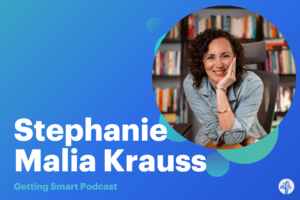
Stephanie Malia Krauss on Helping Kids (and Ourselves) Thrive in a Changing World
Key Points
-
Design for human needs, not just efficiency. Later start times, real food, movement, and regulation supports aren’t “extras”—they’re foundational to learning, behavior, and well-being.
-
Belonging and love are measurable learning supports. Connection, loving care, and contribution improve performance and resilience—and should be intentionally built into classrooms and programs.
Shownotes





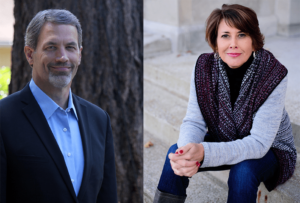
Stephanie Malia Krauss returns to the Getting Smart Podcast for a conversation with Tom Vander Ark about her new book, How We Thrive: Caring for Kids and Ourselves in a Changing World. Together they explore why so many adults and young people feel overwhelmed and depleted—and what it looks like to “rehumanize” school and home by protecting the essentials that help humans thrive. Rebecca Midles recently reviewed this book on the Getting Smart blog.
The podcast discussion walks through body, mind, heart, and spirit essentials—from food, sleep, movement, and nervous system regulation to play, wonder, flow, connection, belonging, and contribution—offering practical, research-backed insights for educators, leaders, and parents navigating modern life.
Outline
- (00:00) Introduction
- (02:02) The Journey Through Three Books
- (11:30) Body Essentials: Food, Sleep & Movement
- (21:38) Mind Essentials: Play, Wonder & Flow
- (29:32) Heart Essentials: Connection, Love & Belonging
- (35:18) Spirit Essentials: Celebration & Contribution
Introduction
Tom Vander Ark: How We Thrive: Caring for Kids and Ourselves in a Changing World. It’s a new book by Stephanie Malia Krauss, a three-peat visitor on the Getting Smart podcast. I’m Tom Vander Ark, and welcome, Stephanie.
Stephanie Malia Krauss: Hi, my friend. I am so glad to be here.
Tom Vander Ark: I woke up this morning, and I looked over at my nightstand and I saw Making It, this great book by Stephanie Malia Krauss. I think that was your first big book about 5 years ago. Is that right?
Stephanie Malia Krauss: It is. It was a book about what kids needed to be ready for the future, as you know, but it came out at the height of the pandemic, when the future felt very uncertain. So it was very well-intended and tricky timing.
Tom Vander Ark: It was. Well, it’s funny because we had 2 books that came out during the pandemic. What a strange time. But anyway, Making It is a real classic in the “what do kids need to be future-ready?” genre. So it was pretty specific to learning goals in a new age.
Then your next book was Whole Child, Whole Life. It was really an illumination of what I would call whole-child education. The timing there was very good as people began to try to take seriously broader learning goals. Your new book seems to even open the aperture wider to say, how do we now live in this crazy time?
Is that a fair look at the progression?
The Journey Through Three Books
Stephanie Malia Krauss: It’s perfect. And just to pull back the curtain and give a little bit of the storyline of how that happened: Here I am—Making It was written years after running this innovative high school on a technical college campus, a little bit ahead of my time. Probably a lot of the things that now get supported, we felt pretty pioneering and alone in trying back then.
But as a school leader, I was so conflicted between the difference of what it meant to complete a high school degree and what these kids really needed to be ready. So I go to national work. I’m a part of conversations that we are both at, and others are, with the research and what readiness really requires.
I write the book really as kind of this love letter back to the front lines to say, “Hey, here’s really what readiness requires.” Our households are homeschool, and nobody knows what’s going to happen. And so as I’m doing this Zoom basement book tour, people would regularly—I would speak virtually, and they would chat me and say, “This is really interesting, what kids need to be ready for the future, but I am afraid my kids are going to burn out or give up before they get there. What do they need right now? What do they need to be well?”
And that was where Whole Child, Whole Life came from, because I realized, as a parent of young children at the time, that was the question that I had as well. It was kind of this balance of our job being to prepare and care for kids, and young people needing to be both ready and well. If they’re only ready but they’re not OK, that’s not a good life. And if they’re only OK but they’re not ready for an unfair world, that’s also not a good life.
Anyway, so How We Thrive—why did it keep getting broader and broader? From the basement to an actual in-person book tour, I started polling people every single time that I would talk to them. So I’d be in front of a group of teachers or in front of a group of youth workers, and the questions were always the same: How are your kids? How are your families? And how are you?
And across communities throughout the country—and really across the globe—every single community, every single one, no matter where they were, no matter what their composition was, the center would have these word clouds form on the screen, and the center was always the same. It was: We’re overwhelmed, we’re overloaded, we’re stressed, and we’re tired.
And so How We Thrive was really written in service to all of these adults who are trying so hard to care for kids and themselves through work and through raising their families, and they’re just so depleted—and so am I.
And so what I have learned is our normal is not natural. There is a real modern mismatch between how we are made to learn and to live and to thrive, and how we’re living. And so yes, I ended up, through How We Thrive, moving all the way to: OK, how do we human? How do we human in this time? And then, oh my gosh, how do we rehumanize all these spaces where we’re spending time?
Tom Vander Ark: I love that. Thank you for the background. That explains the outline of the book. You go through sort of keys for body, mind, heart, and spirit. So it is kind of a comprehensive guide to how to be a human. And I love that the book works on multiple levels as both how to be a thriving human, but also is very specific to parents and teachers and those that are guiding the development of young people in it.
I think you were intentional about making it work on both of those levels, right?
Stephanie Malia Krauss: Yeah, that’s right. Making It was really, “Hey, we have to upgrade our understanding of the workforce and higher ed,” and there’s a mismatch there. This is what kids need. And then Whole Child, Whole Life was, “Here’s everything kids need across their lifetime, but what is good for kids is also good for you.”
And then How We Thrive is really collective care. Like, we are wayfinding in the dangerous weather of modern life together, and we have to be taking care of ourselves better as we are taking care of kids. It’s got to be simultaneous work.
Tom Vander Ark: Stephanie, do you know Rebecca Winthrop and her book, The Disconnected Teen? Big, big book of last year, and there’s a lot that I appreciate about her book. She centered it on being disconnected and why kids are disconnected. It feels like you centered that in a broader problem statement: that it’s not just kids, but it’s all of us that are feeling that over-tapped, overworked, overstimulated, overwrought. Is that fair?
Stephanie Malia Krauss: Absolutely. And this really goes back to that surveying. I’ve now surveyed tens of thousands of adults who are actively working with or raising kids, and every single one of us is saying, “I feel depleted. I feel exhausted. I feel overwhelmed.”
And what we see is that the bigger forces at play—you just mentioned them—from time scarcity (we are so overscheduled, we are so tight with the time and resources we have, and it feels like there’s never enough), to toxic productivity (feeling overworked), to the addictive tech that’s taking our attention and focus (being overstimulated), and then just the existential dread, the overwrought—that sort of catastrophic anxiety that we live with, either as a very quiet buzz or quite loud in our lives, depending on the moment and the news cycle.
Those forces mean that if you were going to be having a hard time, it’s harder. But if you were going to be OK, it’s still hard.
And one of the things that I’ve been tracking with the conversations—and it’s not so much with Rebecca’s book, but there are other conversations where folks are going in and saying, “The kids are not OK. Here’s what we need to take away. The kids are not OK. We need to take away their phones.”
My younger kid has said, “But you told us to be on them. You told us to log on and to be online, and now you’re telling us we’re broken and bad and you’re taking them away.”
And so I think that what I tried to do in this book is—let’s take that example—like, you should probably take my smartphone away too. But it is also useful, and I’ve given my kids the password to my own Facebook because the algorithms get me too.
I wanted to focus less on what do we take away and more on what do we give back and protect. When we look across human history—and you’ll appreciate this, you and I have dedicated our careers to looking toward the future—this book is a look back to the future. It’s actually going back millennia of human history and realizing that we are born with a natural set of capacities that are kind of our personal superpowers. And across time and incredible challenge, people have tapped into those to endure challenge and also to enjoy life.
But modern—the dangerous weather we just talked about—makes it very, very hard for any of us at any age or stage of life to actually get that. Adults are not getting the sleep they need. Neither are kids. Adults are not getting the space to find flow and focus. Neither are kids. We are all in this together.
Tom Vander Ark: This is a really comprehensive guide, and I’m thinking of strolling through the outline and just inviting you to share a surprising observation—something that was new or interesting to you—in each of these categories. We don’t have to hit them all, but it might prove to be an interesting way to just quickly sample the comprehensive guide to humaning.
So in the body section, you start with eat. What did you learn about just eating well and inviting kids to eat well?
Body Essentials: Food, Sleep & Movement
Stephanie Malia Krauss: Oh, Tom. As I researched food and nutrition, I was telling fellow parents while we were at baseball games—I was writing that section during baseball season—and other friends I was talking to, “Gosh, maybe I should just write a book on food.” There is so much that we don’t know, and also so much misinformation.
But I think at its core, when we think about our capacity to eat and how the food that we put in our body not only nourishes us but also enables us to learn and work, and the relationship that that has, the primary sort of over-and-over-again theme was: fresh, not fake. As much as you can, fresh, not fake.
One of the wonderful things—because I’m always thinking about people who don’t have financial resources to spend on organic and other things—was that frozen foods, which can often be quite affordable, are picked at the height of ripeness, and they can actually be healthier for us than fresh food.
But the thing that was really concerning was that there have been studies that have had researchers from all different countries looking at the ultra-processed ingredients that are so common in our foods. And outside of them extending shelf stability, these researchers have not found a single benefit to any of these lab-produced ingredients.
And so the key is: when we’re pulling foods together, we need to be looking at the ingredients. And if it’s hard to pronounce or sounds like it was produced in a lab, that’s going to be your ultra-processed ingredient.
And maybe in this next generation of kids, we’ll have some brilliant scientists who figure out how to extend shelf life and preserve our foods in a cost-efficient way, in a way that doesn’t harm us, but we’re not there yet.
And so when we think about schools, the big lesson for me through this book was, gosh, the way that we thrive is by figuring out a way to protect and prioritize these essentials.
So when we think about school, rehumanizing school means really taking on the fact that most school meal programs have requirements for things like sugar and sodium, but not for level of processing of ingredients. And so what I learned was that big manufacturers like Sysco, when rules change at the federal policy level, they simply went into the labs and they tinkered with the formulas.
And I’ll give you kind of the best example of that: One of my sons is allergic to gluten. He can’t eat anything in his school cafeteria because the food producer Sysco injects so much of the food with wheat as a filler just to have kids feel more full, because the other ingredients so often aren’t actually fresh, real foods.
So there are—for food especially—there’s one organization that I’m just kind of obsessed with. It’s called the Chef Ann Foundation. If you haven’t heard of them, here’s why I love them: They have this toolkit called the Lunchbox, and their whole focus is: It actually is possible, within the bureaucracy and our crazy limitations and complexity of school food, to have scratch cooking. But we understand that it’s hard to get there. So here are recipes. Here are ingredient lists. Here are the vendors that we use. So you can go to the Lunchbox and get these very practical small adjustments to make to get there.
And the other thing that I’ll just point out when it comes to schools is what Mara Fleishman, the CEO of Chef Ann Foundation, would say: We put money where we value it.
And so I was, for example, at a high school parent advisory committee meeting yesterday, and in our high school, we don’t even have a cafeteria. It’s the auditorium, it’s the cafeteria, it’s the multipurpose room. And the kids get these 15- to 20-minute blocks where food isn’t valued.
You look at—I watched videos of other countries and the lunch programs they have. Some of them are eating for like an hour or an hour and a half. And yes, it can—OK, I will stop there. I could keep going, but wow, does it make a difference.
Tom Vander Ark: I appreciate that. The next chapter’s on sleep—really great research there. Big message is start school later if you can.
Stephanie Malia Krauss: That’s right. 8:30 or later, especially for tweens and teens.
Tom Vander Ark: I want to acknowledge that I just wrote a long blog on school transportation and reminded myself of why schools start so early—at least why high schools have started so early. It’s so you can do 3 bus schedules, 3 bus cycles. And so this is an example of a gnarly problem for administrators trying to invest money in the classroom instead of in new buses.
And so starting school later is not a simple solution for some systems trying to be efficient. But it is just another signal of the sort of industrial complex that we’ve created around schooling that’s challenging.
Stephanie Malia Krauss: Yeah, absolutely. I mean, I think this really highlights—and I’ll be much more brief than I was with food—from a rehumanizing school perspective, just like we have Chef Ann Foundation and the Lunchbox for food, we have the Start School Later Coalition that has gone into states and districts that have decided to start school later for their middle and high schools in particular.
Kids, when they hit adolescence, their internal biological clock shifts, and so it’s harder to fall asleep before 10 or 11, and harder to wake up at 6. When we ask them to wake up at 6, it’s like asking us to wake up at 4. Which, I know you’re an early riser, but that feels really painful to me.
But from a school perspective, we do see examples of states and districts who have engaged their families, the transportation company, the sports—athletics is huge for this—parents who are working, and they have worked through the issues because it is, for them ethically, there is an ethical conflict to continue to put kids in genuine harm’s way by having them be so sleep-deprived.
For us, what was really revealing and convicting is that we sleep for over a third of our life. So if we live to be 100, 30 years of our lives, we’re asleep. And no one really educates us on the science of sleep.
So a part of How We Thrive—and my own transformation process writing this particular book and getting to talk to food scientists or sleep scientists, really outside of the education and youth development space—is, God, why don’t we know more about something we spend a third of our life doing? And then the profound impact, again, that, like food, good sleep has on learning and academic achievement and productivity, and the things that this modern life is endorsing and saying is most important.
Tom Vander Ark: And I super appreciate the stories from your own life and family on this front. The fifth chapter’s on movement. It’s fantastic. I love the goals, the research behind it. I am a true believer.
Let’s move on to the next one: regulation. That one I learned a lot. You pack a lot of new science into that that I think is super valuable for parents and teachers.
Stephanie Malia Krauss: Yeah. I think the biggest learning for me, and something I will take into any school that I’m working with from now on, is what we often see as a discipline issue is oftentimes dysregulation, and that behavior is communication.
And if we go at a dysregulated young person with anger, with frustration, with punitive consequences, all that does is make them more dysregulated. When we’re dysregulated, we’re living in the back of our brain, and it’s the front that’s responsible for learning and good behavior.
So that chapter, for folks who check out How We Thrive, is another one, like sleep, to say: Gosh, as humans and as people who care for kids, we really should be trained on the science of regulation and the nervous system. Here’s what we should know.
Tom Vander Ark: The next section’s on the mind, and the first one is on play. And I love this. This was useful for me because I’m not prone to making it a priority, but I’ve been hanging out with my 6-year-old granddaughter, and she’s really good at play. And it’s just been so fun to lean into that and encourage it.
You do a nice job of describing all the ways that we can do that.
Shorts Content
Mind Essentials: Play, Wonder & Flow
Stephanie Malia Krauss: Yeah, so I really relied on the research of Stuart Brown, who founded the Institute of Play, for this chapter and others. But I was really struck by the fact that we use, as humans, play to prepare ourselves for the future. Play is also an incredible primer for learning and a helper for healing at any age or stage of life.
So in the chapter, I talk about your 6-year-old granddaughter. We are encouraging play all the time, and yet we get more and more kind of disembodied, even though if we look back in history at hunter-gatherer societies, until kids reached adulthood, they played for more than a third of their day because it was real-life learning.
So we look at your and I’s shared history in the competency-based education and project-based learning movement: play is a vehicle for skill development, for kind of microdosing ourselves on fear and risk and other things.
But I end that chapter telling the story of an older couple I saw at the beach and watching how much they were struggling physically to get to the ocean. And then once they got in the ocean, they started playing. They were a playful older couple, and when they came out, it was as though they were totally transformed. They moved better. Their whole disposition had changed.
So the big conviction for me, honestly, Tom, in that chapter was: productivity eclipses our need for play. And I am so vulnerable to not playing or not being playful in my own life, and preventing my kids from doing it because they’ve got to get certain things done.
Tom Vander Ark: Remember back in your first book you talked about the importance of curiosity and creativity. I think if we’re serious about those things, we have to invite more play because that’s really where and how students can express curiosity and creativity.
Alongside that would be chapter 8, wonder. This is a spectacular chapter. I appreciate the way that you describe why it’s important and all the different ways that we as humans can experience wonder.
Stephanie Malia Krauss: Yeah, this was a great chapter to write because I was volunteering at a sleepaway camp for a week while I did it, because I’m really convinced so much of what we need—so much rehumanizing—happens in very classic “get out in the woods” sleepaway camps, even though that’s not for everybody. But it’s a really good rehuman.
So I was surrounded by moments of awe and wonder while I was writing it. And what was so striking about wonder: wonder is radical curiosity. And you and my shared friends, Greg Bear and Ryan Zook, they talk about how important wonder is for learning.
And often we don’t invite curiosity because it feels like curiosity takes more time. Like, “Oh God, you’ve got more questions. We’ve got to get through all of this content”—back to being over-tapped. We don’t have the time to take to wonder.
And yet when we go back to our oldest ancestors, wonder is what both kept us alive—“Oh, I’m curious about this thing that’s happening. Should I go there? Should I not?”—but also, on the thriving side, wonder is what pulls us together.
So Dacher Keltner, a scientist in California out of Berkeley, writes a lot about wonder, and he talks about this as goosebumps, “whoas,” and sighs and tears. And what I thought was so cool—and we can move on after this—is that “whoa” is a universal sound that people make the exact same, “whoa,” no matter what culture or context they’re in.
Tom Vander Ark: Thanks for mentioning Dacher Keltner’s work. On this front, we’re fans as well. The next chapter is on flow, and the one after that’s on create. And I love the connection between those two. Say a word about flow and create.
Stephanie Malia Krauss: As I did with Whole Child, Whole Life, one of my kids wrote the foreword to How We Thrive—my younger son. And flow was the essential he chose to focus on in that foreword.
I talk about not only flow, but faux flow as well in that chapter. Flow is a sense of being so absorbed in an activity that we lose track of time. It’s kind of the “Oh, I got in my groove,” or “I was in the zone.”
And what evolutionary biologists think is that that is to help us practice: when we are able to experience the pleasure of being immersed in something, we want to keep coming back. So a pianist is going to keep practicing for the pleasure of having their fingers run up and down the keyboard to play a piece.
The problem is that with our fractured attention, it is increasingly hard to find flow because it is about getting a million things done in a mediocre way instead of one thing done in a quality way.
I think the most striking fact from researching that came out of Johann Hari’s book, Stolen Focus, where he cited some research out of Oregon that said: If you’re focused and you’re in a state of flow and somebody interrupts you, it will take at least 23 minutes, if ever, to be able to reach that flow state again.
And so that couples with creativity, because both of these are kind of a basis for how do we learn and work, but they also bring pleasure to our lives.
So I open up the creativity chapter talking about my nephew, who’s touring with Broadway productions. He’s touring with The Wizard of Oz right now. He’s the Tin Man. It’s incredible.
We have creatives who—art is their gift—but we’re all born to be creative. And creativity is, on the one hand, singing and dancing—my nephew. But creativity is also what we do in our work, which is just our capacity to come up with a novel idea or something new.
And God, we’ve not needed—like, we need creativity more than ever right now, even when it’s hard to come by.
So those mind essentials really are a nested set: play to wonder to flow to creativity. And together they also reflect the deep science of learning.
Tom Vander Ark: All right, the next section is on heart, and the 3 headings are connect, love, and belong. It feels like this is also an important development in the science of learning. And it feels like you’re ahead of the curve, but the recognition of the importance of connecting, of love, of relationships, of a sense of belonging has really gathered global momentum post-pandemic, don’t you think?
Heart Essentials: Connection, Love & Belonging
Stephanie Malia Krauss: I do. And there’s so much burgeoning research on belonging and the benefits that that has in the classroom.
You know what I’ll say to these 3: These 3—where you had mind essentials as a nested set—these 3 are really deeply integrated, and it’s impossible to disentangle them.
But connection: I always have thought about connection as social health and social wealth. So who are the connections that we need that are really anchors and feeding us in a healthy way?
In that chapter, I talk about the rising rates of loneliness. And we could spend a whole episode on the real risks of AI and tech companions coming in to solve that, when really we’re craving human-to-human connection, and just the complexity of human connection and our need for it, and loneliness.
It was really interesting with both loneliness and belonging to understand the biology of what it means for us to be social. This is what kept us alive. Other animals had speed and stealth, strength, and we had our capacity to be social, to stick together. And as a band—it’s why we call them bands, right?—that was how we stayed alive.
So loneliness and the absence of belonging is estrangement or exclusion. They set off biological alarms—flares in our body—just like our ancestors. It’s a signal that we’re far from home. Get back with the group in order to be OK. And so all of our resources in our bodies then go to staying alive rather than the more safely situated pieces of learning and focusing.
The one thing I’ll just mention here for further contemplation for education folks who listen to the podcast is that every young person I’ve ever talked to—and frankly every adult—when they look at the people who have changed their lives, it’s someone who loved them. But we don’t have good research on professional love.
So in that chapter, I really relied on being Native Hawaiian and the concept of aloha to say: You don’t have to say “I love you” to your students, but let’s unpack what it looks like to operate with loving kindness and loving care.
We are in human care work, and we do have a responsibility to behave in a loving, caring way because we’re doing life together.
Tom Vander Ark: Let me interrupt with some late-breaking social science on that.
I’m on the advisory board of the National CAPS Network. This is profession-based learning where students—usually juniors and seniors in high school around the country—are doing career-connected learning, and they recently surveyed thousands of alumni. And the No. 1 answer about what they most appreciated about that program was love.
Surprising, but what they were talking about was this sense of connection, this sense of belonging, of being invited into professional settings by people that expressed a sense of love about what they did, about the chance to connect, to build a relationship, to invite young people into these experiences.
And so it was just a surprising affirmation of what you just said: that connection, love, belonging—these are important and that they can and should be expressed in both learning and professional settings.
Stephanie Malia Krauss: And I think what’s important for folks to understand is: In the love chapter, I follow the research of a woman, Stephanie Cacioppo. Her husband, John Cacioppo, who’s passed away, was the preeminent researcher on loneliness. So he was Dr. Loneliness, and she was Dr. Love.
But her studies using fMRI machines—so really monitoring the brain—found that when individuals she was studying felt an expression and the emotion of love, their learning and performance improved, sometimes exponentially.
So we think sometimes about these social pieces as being soft, but the science behind them is profoundly hard.
Connection is health and wealth. It’s going to largely determine the social aspects of learning, but also our ability to seek out new opportunities.
Love is really about attachment and affection. And when we feel securely attached and when we feel affection, it’s like our bodies light up and say, “Oh, I feel so good,” and we’re optimally primed to do well and perform well.
And then belonging is feeling welcome and wanted. And when that happens, we can just be ourselves in the classroom or the workplace. And so of course we’re going to do better because we know we’re OK to be who we are.
Tom Vander Ark: Yeah. The last section’s on spirit, and you call out celebration, contribution, and belief as being 3 important elements. So I absolutely love this section.
We were talking about pandemic books. One of my pandemic books was Difference-Making Schools: Alive With Possibility, and it was all about the power of contribution—inviting students to contribute to work that matters to them and to their communities. So say a little bit about the spirit work.
Spirit Essentials: Celebration & Contribution
Stephanie Malia Krauss: Yeah. I’m going to focus, I think, on contribution here because there’s—and in the same way that we’ve been talking about belonging—there’s been a lot of conversation about purpose.
So for contribution, I spoke to a number of people in programs like 4-H and others. But 2 of the researchers I spoke to: One was Andrew Fuligni, who’s a co-director at the UCLA Center for the Developing Adolescent, and then Tony Burrow, who’s at Cornell. And both of them study purpose and contribution.
And I really appreciated Andrew’s perspective that there’s big purpose makers and sort of passion of “I’m going to take on this cause,” or “I’m going to do this big civic project.” But really, everyday contributions—even like holding the door for someone and the connection that you have with them, or helping out at home—they make us, they give us a role or a job.
And when we feel like we have a sense of responsibility and people are counting on us, it enlivens us. It’s not just accountability, but in fact, some of the camp directors I spoke to said the single most important part about camp is that kids know that they’re a part of keeping the community what it is and caring for the community.
And so I just loved the idea that we need to feel like we’re useful. And that’s OK. We’re meant to. And that it doesn’t have to be some big world-changing thing, although it can. The everyday contributions—and similarly everyday celebrations—can really have a profound impact.
And then on the belief side: The very last essential—you might remember in Whole Child, Whole Life—I took on spiritual development, which is tricky, especially for books that go into schools. But the reality is we’re wired as spiritual beings. We’re asking ourselves, “Am I a part of something bigger?”
And so belief really breaks into belief in something bigger—faith—and belief in something better—hope. And what was powerful there is that this is a time where we need a level of belief in bigger and better more than ever before.
So those essentials sort of remind us that we’re beings who are meant to not just be doing and functioning, but also experiencing the kind of pleasure and purpose of what it means to be alive.
Tom Vander Ark: Well, faith, hope, and love is a good benediction. Stephanie, we’ve been talking to Stephanie Malia Krauss about her new book, How We Thrive: Caring for Kids and Ourselves in a Changing World. Where can people learn more about the book?
Stephanie Malia Krauss: To learn more about the book, if you are listening to this episode after April 1, 2026, just head over to rehuman.com. And if you want to find out more about me, you can find me at rehuman.com, or you can go over to stephaniemaliakrauss.com.
But How We Thrive is available wherever you buy books, and so you just head over to your favorite spot to get it.
Tom Vander Ark: Stephanie, it’s been such a treat on this journey with you—to learn with you, learn from you. Thanks for joining.
Stephanie Malia Krauss: Thanks, Tom, and for the thought partnership over the years. It’s always nice to take moments to reflect with you on the journey that we’ve been on.
Tom Vander Ark: Check out Rebecca Mieliwocki’s beautiful reflections on How We Thrive. Thanks to our producer, Mason Pashia, and the whole Getting Smart team who makes this possible every week. Until next week, keep learning, keep leading, and keep innovating for equity.
Guest Bio
Stephanie Malia Krauss
Stephanie Malia Krauss is an educator, social worker, and sought-after speaker who has dedicated her career to helping young people thrive now and in the future. As the founder of First Quarter Strategies, she collaborates with national organizations, philanthropies, universities, and government agencies to develop strategies that support children and their families.
Krauss is the author of the bestselling book, Whole Child, Whole Life: 10 Ways to Help Kids Live, Learn, and Thrive and Making It: What Today’s Kids Need for Tomorrow’s World. Her work has been featured on NPR, PBS NewsHour, and US News. She holds graduate degrees in education and social work and various national leadership roles. You can find Stephanie at www.stephaniemaliakrauss.com.
Links

0 Comments
Leave a Comment
Your email address will not be published. All fields are required.