


Podcast: Greg Shaw on Reprogramming the American Dream
In this episode, you are welcome to join Tom Vander Ark and Greg Shaw for a discussion around reprogramming the American dream.
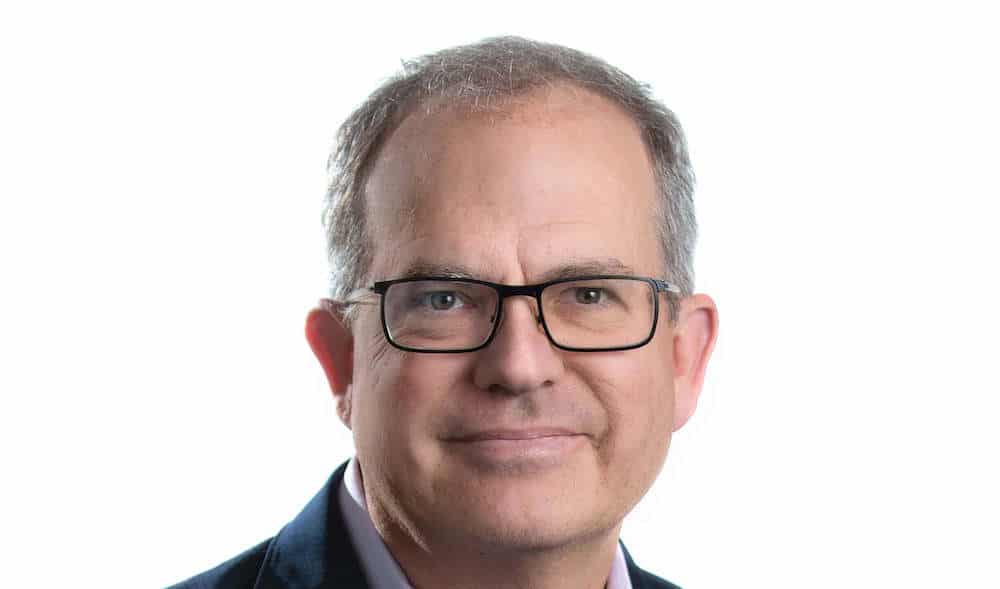
Greg Shaw is a writer from Bellevue, Washington. He has supported the policy and communication needs of Microsoft and the Gates Foundation for more than 25 years. Three years ago, Greg worked with Satya Nadella on Hit Refresh, a book on the remaking of Microsoft as a leader in cloud computing and artificial intelligence. For the last two years, Greg has been working alongside Kevin Scott on their newest book, Reprogramming the American Dream, which takes a look at the future landscape of AI and how it can be realistically used to promote equitable growth.
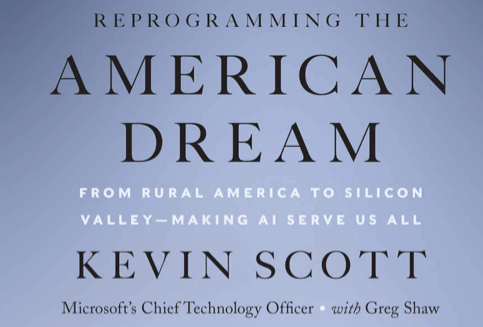
In Greg’s conversation with Tom, he discusses the challenges of producing beneficial AI that serves society equitably (from rural America to Silicon Valley); how he sees the future of AI as an open platform for creativity and productivity for anyone, anywhere; the need for local conversations around AI; and what his newest book with co-author, Kevin Scott, hopes to accomplish and add to the conversation.
Key Takeaways: [1:39] Greg speaks about what his life has been like during the COVID-19 pandemic. [3:40] Greg tells listeners about his co-author for his book, Reprogramming the American Dream, Kevin Scott, and how they came up with the idea for the book. [6:04] Greg shares why he believes it was important for Kevin to tell his story in their newest book. [8:53] Tom shares what he likes about the book. [9:39] Greg speaks about what he and Kevin hoped the book would accomplish and what communities it would impact. [10:31] Tom shares more of what he appreciates about the book. [11:35] Greg gives his thoughts on the different ways he thinks AI needs to be on the public agenda. [14:14] What Greg thinks is different about AI between now and five years ago. [15:25] Does Greg envision AI as a set of open tools in the future? [17:20] Jessica shares an important resource with listeners: the Getting Through microsite. [18:00] Tom further explains the capabilities of AI and how the entire supply chain of every industry is rapidly being altered. [18:51] Greg shares more about the way that he and Kevin addressed how they think the U.S. will share the wealth and benefits that come with AI in their new book. [21:25] Greg speaks about how he’s seeing AI becoming an open platform for creativity and productivity beginning to happen. [25:25] Does Greg think that this current crisis will bring more awareness to the lack of access to certain technologies in rural areas and schools? [27:51] Greg speaks on the topic of preventing potential negative consequences of AI. [29:44] Greg touches on the need for local conversations and who should be leading these sorts of conversations. [32:30] What is Greg going to work on next? What other areas is he curious about?
Mentioned in This Episode: GettingSmart.com/GettingThrough The Gates Foundation Hit Refresh: The Quest to Rediscover Microsoft’s Soul and Imagine a Better Future for Everyone, by Satya Nadella, Greg Shaw, and Jill Tracie Nichols Reprogramming the American Dream: From Rural America to Silicon Valley―Making AI Serve Us All, by Greg Shaw and Kevin Scott Kevin Scott (CTO of Microsoft) Hillbilly Elegy: A Memoir of a Family and Culture in Crisis, by J.D. Vance AI4All AI4K12 Geneva Conventions Greg Shaw on LinkedIn Greg Shaw on Twitter
For more see:- Hit Refresh: How a Growth Mindset Culture Tripled Microsoft’s Value
- The Backstory Behind The Microsoft Refresh (2018 podcast with Greg Shaw)
Stay in-the-know with innovations in learning by signing up for the weekly Smart Update.
Transcript
This transcript has not been edited for spelling accuracy.
You’re listening to the Getting Smart podcast where we unpack what is new and innovative in education. I’m your host Jessica and today we’re listening into a discussion around reprogramming the American dream. Greg Shaw is a writer from Bellevue, Washington.
He has supported the policy and communication needs of Microsoft and the Gates Foundation for more than 25 years. Three years ago, Shaw worked with Sasha Nadella on Hit Refresh, his book on the remaking of Microsoft as a leader in cloud computing and artificial intelligence. For the last two years, Shaw has been working with Kevin Scott on a new book, reprogramming
the American dream from rural America to Silicon Valley, making AI serve us all. Greg joins us today to discuss the challenges of producing beneficial AI that serves society equitably, including rural America. Let’s listen in to his recent conversation with Tom. Hey, Greg Shaw, welcome back to the Getting Smart podcast.
Hey, thanks for having me back, Tom. It’s always good to talk with you. It is and you’re pretty close by. Are you in Bellevue today? I’m in Bellevue in the Clyde Hill neighborhood of Bellevue, sitting in a daylight rambler
with a nice collared shirt on top and pajama bottoms on bottom. I have a nice shirt on and I have my Lululemon running pants on. I intend to hit the beach as soon as we finish. That’s sort of the new outfit, I think. What’s your life like during COVID?
What do you think about this crazy pandemic we’re living through? You and I come from our time at Gates Foundation and you in school systems. Frankly, I feel pretty fortunate. I sit in a comfortable house. I have food.
I’m not ill. I think of the great advantages that I have compared. I’ve got a niece who’s working as a nurse at Mass General and I worry about her. We’re doing the right thing by staying home. I started writing poetry.
In addition to my day job, I’m finding some things that I really enjoy doing. Right. I don’t want to have a rosy answer to your question, but frankly… Yeah. This is a really paradoxical time where for many of us who are going about our business
as we normally would, you and I spend a lot of time writing and we can do that anywhere. Then we all have relatives that are dramatically affected either losing their jobs or working under really dangerous situations. It’s a really strange time. I guess I just want to acknowledge that at the outset.
We’re going to talk about the rise of artificial intelligence today. At the end, I think we’ll come back and talk about some of the parallels with the time that we’re living. I called because you just released a great new book. It’s called Reprogramming the American Dream from Rural America to Silicon Valley, Making
AI Serve Us All. I was immediately drawn to a great title. I have so appreciated your work as a writer for the last 30 years. I knew this was going to be a terrific book. I think we ought to dive in by talking about Kevin Scott.
Who’s Kevin? Kevin Scott is the CTO, the chief technology officer for Microsoft. I immediately took to him. He came to Microsoft in the acquisition that Microsoft had of LinkedIn, the merger of the two companies.
Kevin had been the head of engineering at LinkedIn. I really took to him because he has a southern accent and he has the warmth of a southerner. As you know, I grew up in the Red River Valley of Texas and Oklahoma. I do have some nostalgia for the South. We got to talking.
I had just finished the Satya Nadella book, Hit Refresh. He had the idea of a book that he wanted to do about AI. The more we talked about it, he’s from rural central Virginia, very close to the North Carolina border. We got to thinking about our family and friends and their general lack of understanding of
where data and compute power and artificial intelligence and things like quantum and virtual reality, mixed reality is going. We decided to write a book together that was focused not on Silicon Valley or New York or Seattle, but on places that we knew from growing up. That was the origin of the book.
I appreciated that you added a little bit more about Kevin’s backstory. There’s a lot of that in the first half of the book. Say a little bit more about why you think that’s important. Why for him it was important to tell his story? I think it’s a couple of things.
He begins the book and I’m co-author, so I work with him on it. We talk about storytelling is a southern thing. You sit on the porch and you tell stories. The story that’s being told of AI is not really the story that he thinks is the story that should be adopted.
On the one hand, it’s a story of AI is going to decimate everything, put everybody out of work. On the other hand, we’re going to create artificial intelligence that allows us to sit on the beach and not have to do anything, but still enjoy the fruits of capitalism. The truth is neither of those things.
The book is not political. It’s a technological book. The forward is written by JD Vance who wrote Hillbilly Allergy, which came out in 2017, and became a little bit of the term empathy really came out of that book, explaining Trump voters and some of these rural and Rust Belt voters who were fed up.
These book is very different, but we do share the idea that these are also disenfranchised communities. What is the story that they should be hearing and thinking about? The book is really a journey into his community in rural central Virginia, looking at some businesses that are run by old high school friends of his, agriculture and healthcare
and small manufacturing, and kind of playing forward. How are they already using technology? What will technology and data and artificial intelligence mean for some of these non-silicon valley startups? I appreciate the introduction really captures that sense of paradox.
Kevin says there’s two prevailing stories about AI for low-end middle-income workers, this grim tale of increasing job destruction, and then this idyllic productivity and convenience, as you mentioned Greg. And then he goes on to say he really wanted to tell a more nuanced, more complicated, more hopeful story.
I appreciate the way the book is, honestly and candidly, in a general audience language, tries to lay out both the promise, to spill a bit of the hype, but also to lay out some of the real concerns and why it’s so important that this has to be linked to public policy. Yeah, we agreed at the beginning that we didn’t particularly care how the digerati, as we call them, the people who write about technology and Silicon Valley in New York.
We didn’t particularly care what the reviews of this would say. What we really cared about was what would people in our communities say? I gave my dad, who’s an old oil and gas guy in Oklahoma, a proof of the book. And he said, I think for the first time I understand what AI is and what it would mean in my industry and how it could be helpful.
So to me, that review was far more important than what somebody at Wired Magazine might think. So I also appreciate the way that you guys identify the inflection point. Toby Orrd called it a precipice in his new book that came out last week. You call it an inflection point when there’s sort of an opportunity for a couple different stories that could happen here.
I mean, things could either get dramatically better for a lot of people or they could get worse. And so a thesis here is that AI should be on the public agenda, like climate change, like health and wellness, and particularly pandemics and public education. I think that’s an interesting conclusion for the CTO of Microsoft to come to.
I mean, what’s he really suggesting here? Is that a new legislative regime? In what ways do you think AI needs to be in the public agenda? There are a number of reasons for them. And I’m not necessarily saying one is more important than the other,
but we wanted to kind of outline what the public implications are. On the one hand, you have the incredible force of the Chinese economy. They have a very aggressive stated 10-year plan for global leadership in artificial intelligence. And so even from a competitive and defense perspective, it’s clearly a priority. Secondly, if AI, some people say, well, data will be the new oil
or it’s the fourth industrial revolution. There’s all kinds of metaphors about what’s coming. I think what Kevin and I most wanted to write about is that that opportunity is shared equitably. In other words, there is a scenario where those with the capital to fund AI, to realize that is only in the hands of a few and it doesn’t need to be that way.
And so when we go back to those communities, whether it was in Virginia or Iowa or Wyoming, we ride Oregon, we ride about a lot of these different rural areas. We see both the need for and the opportunity for people of every skill level, of every color of color, blue, white, and no color, to be able to harness these technologies. And then the inflection point that you talk about is just the confluence that we’re seeing now
of phenomenal compute power with enormous data centers and new approaches to chips, more and more data that’s being generated and reasoned over for AI reasons. You have a risk of the technology becoming so powerful in the public understanding and the public’s participation in that being so far behind that it creates a gap. I mean, didn’t that happen five years ago?
That’s already happened and it feels like that gap is widening to me. I think that’s pretty good. You guys have a sense of urgency about it? I think what’s different now versus five years ago is what people refer to as the democratization of AI. There was a sense five years ago where kind of like in the dark ages,
the ability to create a book was all held in the hands of a monastery where they could kind of put the, they could sort of publish only a few books. And the same was true with AI. You sort of had to go to the big companies on bended knee and ask for an AI application. But AI is truly becoming so democratized that any of us,
the hardware, the algorithms are all there. Are you really describing a future with open tools? Yes, absolutely. In the intro, you talk about AI must become a platform that any individual or business can use to enhance their creativity and productivity.
So you envision that as a set of open tools? Absolutely. And it’s already happening. And so we write about the sod farmers in central Virginia. In the area where Kevin is from, this was an economy largely built around tobacco for centuries.
And tobacco, of course, went away. They decided to become sod farmers. And what they have now are GPS systems that are becoming more precise in terms of how they cultivate the land. We have drones now that will fly over a field and look for hot spots.
Where is the moisture not getting to? Where do we see either effects of pesticides or effects of pests? And so when you really play that out, these are the Bass brothers that I’m describing in rural central Virginia. They have the ability now, and in fact, one of their sons has gone to study computer science
at a nearby university. He is going to train AI systems on how to survey his father’s sod farm and make it more productive. So that’s where AI is going, is that anyone anywhere will be able to create an application very narrow and very specific to their needs. Hey listeners, it’s your host Jessica.
I wanted to just take a quick break to share an important resource with you. Recently, our team launched the Getting Through Micro-Site to support educators, leaders, and families on the path forward during this unprecedented and uncertain time. There’s something there for everyone, whether you’re just getting started with your transition to distance learning or you’ve had plans in place for a while and now have the opportunity to
share your work and guidance with others. We hope this gives you a place for your voice and an opportunity to learn. We know we will get through this together. Check it out at GettingSmart.com slash Getting Through. Okay, now back to the show.
Now just, I mean specifically that application, what we’re talking about here for folks that might not appreciate AI on a side farm, you can add drone photography that powers pinpoint watering and fertilization so that you dramatically cut down on the use of water and pesticides. It can change the supply chain.
It can change logistics. It can change customer relationships. And even the modeling of the seed. So really the entire supply chain of every industry is rapidly being altered and it’s producing tremendous benefits.
But I do worry that AI by its nature is an aggregating force that aggregates benefit and wealth and it strikes me that that might be the most difficult public policy issue that we face, particularly in America. I feel like Europe is always ahead of us on privacy and these collective policies, Asia, parts of Asia are further ahead of us for different reasons, but I feel like
the United States is going to have a particularly difficult time dealing with how we share the wealth and benefits that are created by AI. Yeah. You could say a little more about the ways that you guys tried to grapple with that in the book. Yeah.
And again, I’m not endorsing any of the different ideas that are out there, but really just trying to understand some of the different proposals. I think one of the most interesting ones is the notion of data as labor or the data labor movement as Glen Wilde and Eric Posner have talked about it, which is the notion that AI doesn’t just happen. AI learns from people. AI learns from you and I and our data.
And so shouldn’t we be compensated for that? I mean, if our work is being turned into an asset, if my left-handedness can be studied and interpreted and then later sold to car companies or to tool manufacturers or whatever, I taught the machine. I taught the algorithm or I contributed to it. And I’m doing that in every facet of my life. Is there an income stream for people who are
training the machine? A universal basic income is something that has Andrew Yang when he was running for president proposed this and it ends up getting a lot of discussion in a certain circle. Well, Greg, it’s a current topic because some would argue that the Recovery Act that was just passed is sort of a backdoor to UBI. It is. Yeah. It’s interesting you say that. I had thought about that. I haven’t read much about it,
but I agree with you. I am super optimistic about the benefits of AI and the efforts that we see to extend those to high school kids. There’s an Oakland nonprofit called AI for All that’s now helped create 12 community ecosystems where universities are helping low-income learners connect with the power of machine learning and apply it to local community problems. There’s groups. I’m an advisor to AI for K-12, which is trying to push out a set of
expectations that every kid should know about AI. So we’re slowly seeing the benefits of machine learning technology spread even to high school kids. And I’m excited that increasingly young people, even in high school and college, can get involved in putting machine learning to work. So your notion of AI becoming an open platform for creativity and productivity feels like it’s beginning to happen. It’s beginning to happen, particularly in urban, more urban areas.
Our book, Reprogramming the American Dream, is really looking at rural areas where I was saddened to see the pace of change. I know that there are bright spots, but we visited a community in rural Iowa where I talked to some students who really wanted to be able to take some, even some basic computer science or some basic digital programs in their high school. But it was only offered as one course, your senior year, which
doesn’t set you up for success to apply to a university to study computer science. In Wyoming, I talked to high school students who, for generations, they walk across the stage and into a job in oil and gas that pays $60,000 a year without… Or it did a couple weeks ago before the crash. Yes. Coming from Oklahoma, I can tell you it’ll come back. It’ll continue to ebb and flow.
We, Microsoft and other companies, have enormous data centers in places like Wyoming where there are needs for people with, even with some basic digital skills, ability to set up and rack servers and that sort of thing. But it’s not being taught. Yet that is a job of the future. It’s a job with a lot more upside, but they have trouble finding people. Lastly, in Virginia where we, Microsoft, has the largest data center, I interviewed people there when
the data center opened. They really could not figure out how to hire local people into that data center because the high school had no digital programs and the community college had really no digital and computer science types of programs. So they had to really construct from scratch a system for… If your desire was to stay in that area and work in a data center, you really had to have an educational system that would support that.
Greg, just current events. I guess I’ve been struck in the last month that we’re not as far along as I had thought. It could be because I spent all my time in some of the world’s best schools and assumed we were a little farther along in terms of one-to-one programs with take-home technology and access to computer science. I’m afraid this crisis has laid bare the inequities in America, particularly in rural schools. The book does
a nice job of laying that out. I guess, are you hopeful that their crisis will help make this more of a priority? Well, I hope so. I mean, the added difficulty in rural areas is not only the skills or the access to the technology, but the broadband. There’s quite a lack of equity and access to broadband. So the idea of a Zoom call or a Teams call is almost impossible for a lot of these students. From a healthcare perspective or an education perspective,
if you’re at the end of a dirt road someplace, there’s three or four kids sitting at home, the official reports that come out often show broadband being available in certain areas. But the truth is it’s really not broadband as we would recognize it. Maybe there’s one square mile of a rural area that has true broadband, but it trickles off quite quickly. You know, I am hopeful because if it’s possible to be hopeful as a result of this crisis, I think
it has brought into stark contrast how important remote or virtual, I think we’ll end up losing the word virtual because it will just become the way meetings and the way teaching and things happen. But it has brought into stark contrast the inequities that certain communities have. I want to shift gears and talk a little bit about preventing negative consequences. Your book does a nice job of laying out the work in front of us to prevent many of the negative
consequences. Those include the surveillance state and autonomous weapons and forms of discrimination. Any reflections on those chapters where you deal with the negative consequences? Some have called for a digital Geneva convention to modernize laws to catch up with how fast this technology is moving. It does need to be a global modernization. You have to harmonize those laws from country to country. The original Geneva convention did a lot of that
as have other regulatory and law conventions. But this notion of a digital Geneva convention that looks across privacy and security and surveillance and warfare and all of those thorny issues is sorely needed. It certainly is. You’ve spent some time as a public journalist trying to leave community conversations. It feels like we need a lot more of that. Of community conversations at a local level but also new ways to have international cooperation around laws so that
these things evolve thoughtfully. Any thoughts on the local conversation? The need for that? Who should be leading those conversations? What topics do you think we should be taking on? I think in every community there is an opportunity for business and academia and government. We were talking earlier about faith communities to come together. Maybe even doing it in a phased approach where you really begin with understanding the technology, understanding to some degree how
it works and how it doesn’t work. What’s practical today versus what we think might be practical in coming years? Take for example, there’s often a view that the ability for a robot, an AI enabled robot to take anyone’s job is just around the corner. Stanford University has what they call their 100 year study of AI in which they’re really following on a quite sophisticated level. Where are we in reaching what’s known as artificial general intelligence when a computer
would be as capable as a human? They can’t see that for 100 years. In computer science, 100 years basically is proxy for never. Will we get there? Yes, there continues to be progress. But if the local conversation were to be about human level artificial intelligence, it would be a wasted discussion. What would be much more useful would be what’s in front of us today? How do we want to deploy if this is an agricultural community? How do we make sure that
we’re able to compete with various regions of the world that may be investing more quickly than us in AI? Or if this is a textile area or a manufacturing area, is our education system, is our investment in economic development sufficient to make us competitive? Greg, this is a great timely contribution, another one for you. We appreciate the topic and the rural angle makes it really unique. Do you have a sense of what you’re going to work on next?
New thoughts, areas that you’re curious about? Well, there are a couple of things that I’m really interested in that I’m working on right now. One is a publisher has asked me to look into the role of empathy during this COVID crisis. How is leadership and business employing empathy to get through this? And so I’m learning a lot about the meaning of empathy and how businesses, which you don’t always associate with empathy and business. So kind of learning about
that. Also working on a book that looks at ecosystems across the country for startups and entrepreneurs. We typically think of those startups as being in Silicon Valley or Seattle or New York or something like that. But I’ve been going around the country, was in Kansas City, as we talked about earlier, Oklahoma City, Tulsa, really learning about these very promising communities that are investing in and making progress on creating an entrepreneurial startup
community. That’s a terrific topic. It’s exciting to see that happening in a lot of cities around the country. Greg, as always, pleasure to chat. Thanks for this new book, reprogramming the American dream from rural America to Silicon Valley, making AI serve all of us. Where can people find you online, Greg? Where can you find me? You can find me on LinkedIn. I’m Gregory M. Shaw on Twitter. So yeah, let me know what you think when folks read it. I’d love
to hear from you. And Tom, as always, really appreciate you having me on. Thanks, Greg. A big thanks to Greg for joining us for today’s episode. We appreciate his three decades of service in helping to shape and explain the path forward. His new book will help ensure that rural America isn’t a forgotten part of the innovation economy. To learn more about Greg and the book he co-wrote with Sasha, listen to episode 145. We’ve got it linked in the show notes and on the blog.
And of course, before you go, make sure you hit subscribe and leave us a rating. That’s it for today, listeners. Thanks for tuning in for the Getting Smart podcast. This is Jessica signing off.



0 Comments
Leave a Comment
Your email address will not be published. All fields are required.