

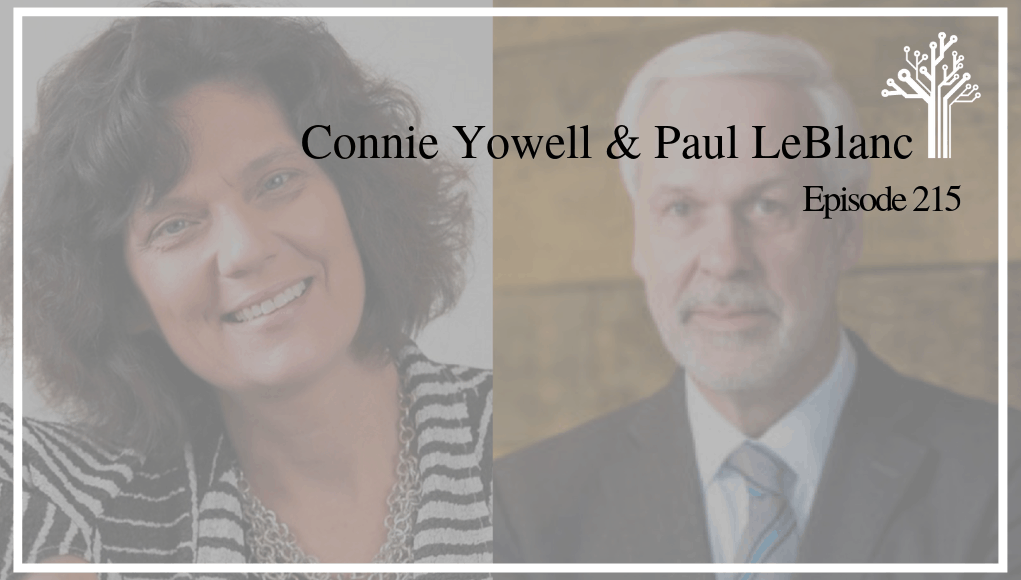
Podcast: Connie Yowell & Paul LeBlanc on Extending Access to Higher Ed from Chicago to Rwanda
Key Takeaways:
[1:42] Connie speaks about how she originally became interested in the public policy of youth development. [2:43] What gave Connie hope that philanthropy was a path to better policy and better systems for youth development?[3:28] Paul speaks about his past formal education. [5:24] Early on in his career, how did Paul get from his graduate studies to leading a liberal arts school? [8:07] Paul speaks about when he took over SNHU in 2003 and their growing online presence. [9:17] Did Paul have a sense 16 years ago that SNHU could be a real innovator and leader in the online space? [11:10] Connie speaks about some of her early insights into digital credentials and out-of-school learning experiences.[14:28] Connie explains how and why LRNG came to be. [16:12] When did Paul start to get the sense that some learning could be organized differently than traditional courses and that we could begin to use badges and micro-credentials for shorter bursts of learning? [19:43] Connie and Paul speak about the merging of their two organizations (SNHU and LRNG) 6 months ago, and how they’ve figured out how they fit together organizationally and conceptually. [22:38] How does LRNG fit in with SNHU? What does the roadmap look like for rolling out new badges for SNHU? [23:38] Connie gives some examples of what these badges look like and what kinds of experiences make them up. [24:50] Paul speaks about the benefits of badges and the implementing of badges at SNHU. [29:06] Connie speaks about how they’re trying to support the work of the Museum of Contemporary Art’s Youth Design Workshops. [32:32] Peter explains how SNHU is serving refugees and speaks about their global education initiative. [37:03] What did Connie learn during her experience traveling to Africa with the team? [39:07] Peter gives his closing thoughts on what the merging of SNHU and LRNG will be like several years in the future.
Mentioned in This Episode: Connie Yowell (LinkedIn) Paul LeBlanc (LinkedIn) LRNG Southern New Hampshire University (SNHU) SNHU + LRNG One Summer Chicago Youth Design Workshops by MCA Chicago
For more see:- Accessible, Affordable, Achievable Higher Ed for Working Adults (2017 podcast with Paul LeBlanc)
- New Merger Brings Learning and Workforce Solution for Cities Across the U.S.
- Rethinking the College Pipeline: Leading University Gains Youth Badging Platform
- LRNG and Institute for the Future: Helping Youth Get #FutureFit
Transcript
This transcript has not been edited for spelling accuracy.
We’re listening to the Get In This Moment podcast. Where we unpack what is new and innovative in education. I’m your host Caroline and today we’re talking with Connie Yowell and Paula Blanc. In the most interesting deal of 2018, Southern New Hampshire University, the leading online university, and LRNG, a leading out of school learning platform, merged.
Connie Yowell, CEO of LRNG, and now an EVP of SNHU, saw the merger as an opportunity to establish meaningful pathways to the middle class youth that need it most. She’s referring to the anywhere, anytime community connected learning that contributes toward a college degree as the result of a merger. Paula Blanc leads what has become one of the largest and most innovative universities in
the world. As SNHU president, LeBlanc saw LRNG as an opportunity to extend access to underserved youth in new ways. Since the merger 10 months ago, SNHU and LRNG have launched pilot programs in Chicago and Birmingham.
They’ve mapped over 30 LRNG badges that count for SNHU credit. SNHU is actively serving refugees in five countries. Paul and Connie recently returned from a trip to Africa to review programs and consider additional service opportunities. Let’s listen in as Tom talks to Connie and Paul about how they came into their leadership
roles, how and why the merger happened, and where they’ll go from here. Connie Yowell and Paul LeBlanc, welcome to the Getting Smart podcast. Great to be with you, Tom. Yeah, thank you, Tom. Hey, Connie, a long time ago you did a PhD at Stanford, and I’m curious how you got
interested in the public policy of youth development. Well, that’s an interesting question, Tom. I haven’t been asked that in a super long time. Thank you for that. I have always been interested in the intersection of what good, healthy development looks like
and the context in which our young people grow up. So I really felt like at the interset that we have a disconnect between what young people need in order to grow and learn in healthy ways and the way our organizations and institutions are designed and organized, and felt that the tip of the spear into changing that was policy.
So I’ve always sort of organized my career around deep understanding of developmental psychology and sociocultural psychology and policy. There’s some typical policy things like hanging out at the Department of Education. You shifted to philanthropy. What gave you hope that philanthropy was a path to better policy and better systems for
youth development? I had no idea what I was getting into when I stepped into the MacArthur Foundation. Two things I’d say about philanthropy, one was it’s an extraordinary opportunity to sit at the table where large strategic decisions are made, funded, and experimented with. And my colleagues at MacArthur were brilliant and so really wanted to be in the context
of those colleagues as well as thinking about the kinds of questions they were trying to solve. Paul, I don’t recall this. I was just doing a little bit of research and you did a PhD in rhetoric, composition, and tech at UMass Amherst.
And I’m surprised those three things combined way back when when… So was UMass. Is that what that was, something that you constructed? It was. In fact, years later I was back visiting the English department at UMass and the sort of
senior faculty member was a department chair then I think was a maritime wearing a corduroy jacket and patches on the elbow. Paul, when you did a computer programming language to fulfill one of your two foreign language requirements, we thought that was innovative. After you left, we decided you would be the last person to do so.
I’m not sure how to take that. Yeah, so I was working in the areas of composition, rhetoric, and using with my students some of the first PCs that were on the UMass campus. Did Seymour Papert have anything to do with this? No, one of the Olsons did because from a deck and they were on somebody was on the board
and you may remember the digital had an ill-fated attempt to do personal computers that they’re called the deck rainbow. And I think they had a ton of these laying around in a warehouse so they gifted a bunch of them to the UMass English department. So I was a graduate student at TA teaching writing and they said, no, the full-time faculty
have anything to do with the damn thing. So they said, okay, you’re going to figure out how to use these computers to teach writing and composition. And I just kind of watched remarkable things happen in that laboratory and really loved the technology.
So kind of redirected my interest and ended up looking at this new emerging technology and how it would change literacy behaviors, how it would actually change the way people write and think and communicate. So that sounds like the Pala Blanc we know and love, that level of curiosity around human learning and new technologies.
But at a relatively early age, you had the opportunity to lead a small liberal arts school. So how did you get from your graduate studies to leading a liberal arts school? I’ve been a faculty member at Springfield College and I was doing a lot of work with technology in that space. And again, at a time, remember Apple note cards and hyper media and multimedia and everyone
was talking about this stuff. And in 1992, the Wall Street Journal did an article that predicted the demise of the traditional publishers and they all went into a panic and they all, in 1992, rushed to create new media units. So it was hard court new media and there was a little brown new media and Houghton Mifflin
that knew of my work and my research. I was doing a lot of writing at the time, asked if I would come and spend a year helping them sort out how they should think about this emerging new literacy. That was my research, right? So they made me an offer that I couldn’t refuse.
I took a leave of absence for a year. They said hire the two brightest young people you can find, spend nine months, go everywhere, anywhere you want to go, talk to anybody you want to talk to. But at the end of the nine months, come back and tell us how we should think about this. And it was extraordinary.
We went to Boeing and Intel and Apple and Maricopa Community College and Dartmouth and you know, we’re just talking to everybody and looking how they were using this new emerging technology. And at the end of that process, we came back and said, our thesis is that information will be increasingly abundant and increasingly free and that’s not where you will be able
to create value. You need to build tools. And we had a whole thesis about this. I still remember we used the example of company antireports and investment newsletters, which were essentially tools that helped investors sift through more information they could ever
read on their own. And then they said, would you stay and build it? So I extended my leave another year and stayed to do a tech startup for them and I extended a third year in Springfield College, who was my employer at the time. So that’s it.
We’re done. Like you got to either come back or not. So I agreed to come back. And when I did, I was nominated for the presidency at a little mobile college in Vermont. And I went to my president at the time who was my mentor, Bill Bramme, former Tuskegee
Airman. And I said, Bill, I’m 37 years old. They’re not going to hire me to be a college president. But I’d love to go through the process. I might learn something.
And he said, sure, go ahead. The off chance you get it, that sort of reflects well on us and through some unfortunate set of circumstances from all, but they hired me. So yeah, that was my first presidency. Wow, that’s a great story.
I didn’t know that a couple of years. So you were there about seven years. And then when you took over Southern New Hampshire in about 2003, it was a tiny little place, although they did have a growing online presence. Is that right?
Yeah, they had in 1995, the US Navy said we were a preferred provider to the US Navy. So we had physical presence on naval bases, Roosevelt Roads in Puerto Rico and Brunswick Naval Air Station up in Maine. And they basically said, look at every time we put a sailor onto a ship, he or she inherently becomes a college dropout.
They can’t come to class the next day. They’re at sea. So we’ve been looking at this new fangled distance education stuff. If you want to keep your preferred provider status, you need to start giving us some offerings. You need to start figuring that out.
So the US Navy dragged us into the realm of online learning. Thank God. So by the time I arrived in 2003, eight years later, we did have a little 18 person operation kind of tucked away in an underskip corner of campus, doing modest work, but doing good work, early work, and we were able to build off that.
Can you think back to 13 years ago, did you have a sense that the university could be a real innovator and leader in the online space? I did. I mean, it was 16 years ago. And I always say, I teach, I often teach a seminar for Judy McLaughlin at Harvard for
new college presidents. And I always say, when you take on a presidency, it’s like getting dealt a set of cards and a poker game. And you’re going to be really hard-nosed about the cards you’ve been dealt. I know outside, to the outside world, you sing the praises of everything, but realistically,
you’ve got good cards, great cards, and bad cards. And when I looked at that time, Southern Hampshire University in 2003, I thought, you know, I could see the demographics of New England. The one thing in our industry you know is how many babies were born, you know, 10 years ago, 12 years ago.
And I knew that the demographic curve was against us in terms of our traditional offerings. I saw a pretty, you know, strong, if small, online program. I saw, we all saw the enormous growth of the for-profits in the online space and the way that most not-for-profits look down their nose at online learning. And I was working in technology and Clay Christian was a friend and I was convinced that while
it wasn’t always as good as face-to-face, it was going to get a lot better, a lot faster. And we bet on that disruptive curve and we really set out to build ourselves to compete against the dominant players back then. And that was Kaplan and Phoenix and ITT. And the idea was to borrow from them the best operational practices because they were really
good at a lot of stuff and they were much better at the idea of customer service or phrase we still can’t use a non-profit higher ed. But we wanted to stay true to the value, you know, academic values of quality and rigor, et cetera. So we set out to build an operation that could compete against them because they were the
dominant players in that space. So Connie, it’s interesting to note that around the same time you were… We were both in philanthropy, but you were really charting a different path. You, instead of trying sort of traditional school reform angles, you were working in the out-of-school space and you had some insights around badging as a strategy for organizing and communicating,
organizing learning experiences and communicating capabilities. Maybe you could talk about those early insights and why out of school and then the early leadership and digital credentials. Yeah, sure. And it’s as Paul and I have gotten to know each other, it has felt like we’ve been on
parallel but very similar paths, which has just been wonderful. So when I was a director of education at the MacArthur Foundation, we decided that what we really wanted to understand was how young people learn, civically engage and socialize differently with the new digital tools that were coming out. And we started, remember this 2003, 2004.
So this was pre-iPhone, pre-Facebook. This was sort of Friendster and MySpace time. And so in order to really understand the learner separate from a student, which is somebody who is behaving in a particular set of ways inside an educational institution, we wanted to be with them where they were engaging the digital tools in a way that fit
for them, not that met an institutional need, because we really knew that at the end of the day, in the 21st century, we were going to need to redesign our institutions to more directly meet the needs of the learner, as opposed to having our learners have to adapt to those institutions. So we spent 10 years and a good chunk of MacArthur dollars really doing deep ethnographic
understandings of what young people do with digital media and the tools are available to them, and then backed out of that into, well, if this is what learning looks like, then we have to really rethink what our libraries and our museums and our schools also look like. And so we started down the path of doing institutional design work, which was quite extraordinary and creating real sort of wonderful models of what the future of learning can
look like, and then realized where we’re going to get blocked immediately is around assessment, and that if we can’t figure out new forms of demonstrating evidence of learning, then we’re never going to really be able to activate these visions of what the future of learning can look like. And that led us to really thinking hard with the Mozilla Foundation about what an open standard for a badge could look like, a new credential for learning that would
be able to encompass and hold multiple forms and kinds of evidence of learning and still be rigorous, incredible. And so that it was that whole progression of what’s the future of learning from the perspective of the learner, what’s the future of our institutions, and then what are the kinds of tools we’re going to need to enable those institutions to transform. And that’s how we got to the badge.
So, Connie, if we fast forward a few years, you formed an organization called LRNG to extend these out of school learning experiences and badging capabilities nationally. When did that launch five years ago? We launched in 2015. So I spun out of MacArthur in 2015, and part of the impetus was actually related to the badge work, which was to say, we created this open standard, Mozilla did a phenomenal job, created an alternative credential that carried the evidence
of learning. And I should have known this from my policy days and from lots of educational design work that in the education world, we tend to gravitate to the bright shiny object. And the issue for me with that is the badge alone. In doing that, we had actually separated learning from assessment, which is the opposite of good educational design. So, and I got really terrified that we were in fact at the cusp of creating an even greater equity gap as opposed to closing it.
And so, spun out of MacArthur to help to create an infrastructure that could more tightly connect learning experiences on the LRNG platform, we call them playlists, but that can connect where and how and what learning looks like with the badge and with the alternative credential. So that was part of the motivation for spinning out of MacArthur in 2015 was, oh my, we can’t just have the badge free floating out there, we actually have to have it sit in a context in which learning has meaning.
So Paul, for 125 years, we’ve organized both secondary and post-secondary learning around courses. When did you first begin to get the sense that some learning could be organized differently and that we could begin to use badges and microcredentials for shorter bursts of learning? When did you first spot that and LRNG as a big participant in that category? Well, you know, we knew Connie’s work indirectly, I guess in some ways it was directly,
in that we were watching Mozilla and the badges movement take hold. And I think that’s when the idea of microcredentials in many ways entered into the higher ed discourse. What are these? Are they valuable? How do you define them with the complexities? And Connie really, I think, remains a leading thinker around that question. And then in 2015, I did a sabbatical and I had to work for Ted Mitchell, who was then the Under Secretary of Education at the US Department of
Education. And I really was working for him to design what became known as the Equip Program. And the Equip Program kind of more formally recognized or attempted because I think it’s largely failed, but for trying to formally recognize sub-degree forms of learning and try to sort out a way to bring them into the Title IV ecosystem. So the one that was most often described, of course, are coding boot camps. So coding boot camps, as you know, typically $15,000,
six months, big jump in earnings. But out of the range, out of the reach of many poor perspective students, so Equip was an attempt to figure out how do we get these programs that are not full blown degree programs into the hands of students who would have some of the most dramatic benefits from completion. So Equip was an attempt to design that. Then somewhere around two years later, back in my regular job, my innovation team comes back and says, we have stumbled across this kind
of remarkable organization called LRNG. And they’re doing a lot of the things we’re talking about, because by that point, and really again, from Equip and from paying attention to badging, we start to articulate a thesis about the future of higher ed, which envisions an ecosystem in which we see a greater range of credentials. So we still think degrees will be important, but a much greater range of credentials in a coherent framework that allows scaffolding and curated
learning pathways, and also a greater range of providers. So again, just as degrees will remain important, so will institutions of higher education, but there’ll be many other players in that learning ecosystem. So by the time LRNG came on our radar screen, and we got to know Connie’s work, it felt like our path had been leading there for a while. And it was sort of a finally moment, like finally we found it, we found a thought partner who gets it. And I think when Connie and I
finally met, so our teams have been back and forth, our innovation team had spent time in Chicago with Connie and finally arranged that we would meet at ASU GSB. And I think by the end of that one hour conversation, we’re like, we got to figure out how to work together. So it was that sense of immediate, this is somebody who gets it for us. And I like to think Connie felt the same way, I should be here today. So you guys merged about six months ago, was announced at the end of
of October. One of the first priorities was to try to fit, figure out how you guys fit together, like organizationally, but also conceptually, I think one of the things you’ve been up to is trying to map the badges that Connie’s team offers to the credits that Paul’s team has offered. Maybe you could both talk about that integration exercise and particularly the mapping competencies. Yeah. And let me start first just by exploring a little bit more of the context in which we came
to that, because it’s relevant. And it was important for us as we were thinking about sort of the future of the open badge. So when I was doing a lot of the funding at MacArthur, Tom, as you know, we funded a lot of the supply of badges so that we had a sort of a thousand flowers blooming in terms of there being a lot of organizations and nonprofit organizations creating badges, which was absolutely critical and wonderful. What we didn’t have enough of was a
currency for the badge and really having established demand for the badge. So prior to our merger with SNHU, I found myself in the position of going from university to university from dean to dean to say, can you give credit or equivalency for some of these badges in addition to moving from company to company and realized, wow, I’m not going to scale this for 20 years at the rate that we’re going. And this is just too hard for non-innovative universities to take on systematically. And then
in the conversation with Paul and with the leadership team at SNHU, their whole stance towards innovation and towards scale is we’re here to do the hard work. We’re here to do the grind, the really hard intricate work of what it takes to actually scale in the current context in which our regulatory system exists. And so we have spent the last six months going deep with SNHU as an extraordinary person who leads all the accreditation work, Kim Bogle and a whole set of others to say,
let’s do the really rigorous analysis of how our badges can relate to college credit and work with the deans in the university, work with the academic shop, work with the entire infrastructure of SNHU to do a full analysis, which has been an extraordinary process over the last six months. I’ve never seen a university be able to mobilize and take on a challenge like this and own it across the university in the way that SNHU has in the last six months. So what’s the net net of how does your
program now fit with Southern New Hampshire? How many badges actually roll into credit and what does the roadmap look like? Sure. So we’re in a pilot phase and I just want to say that. So we are doing this, we’re working in a set of pilot cities over the course of the next year. We’re rolling this out in just Chicago to make sure we’ve got the kinks done. And we decided that we would start with a set of 30 badges and take those through the rigorous process inside SNHU
so that one, we have a template so that we now can do this much more quickly now that we’ve got a systematic way of managing this. So you’ll see in terms of product roadmap, you’ll see us increasing the number of badges that are the equivalent of college credit going forward. So this summer, we’re rolling out 30 badges that count for college credit. Which is… Give us some examples of what kinds of experiences would result in what kind of badges and what type of credit. Sure, thanks, Tom.
So one of the things we’re super excited about is what I used to always say at MacArthur was we want learning to count wherever and whenever it can happen. That’s sort of part of our Holy Grail. So what we decided to pilot this summer is that we partner with Chicago Summer Youth Employment Program. One summer, Chicago is probably is one of the most extraordinary summer youth employment programs in the country. And so there are a set of badges that we have been offering to young
people who go through one summer, Chicago related to collaboration, critical thinking, problem solving, all of the career readiness kinds of things that we know that our employers need so badly. So those are the badges that we sent through SNHU’s internal system for credit. So we’ve got, as I said, about 30 of those going forward this summer that we are piloting with one summer, Chicago. And part of the pilot is then making sure that we have the tech infrastructure completely set up that allows those
badges to then be transcripted and to have the entire system work seamlessly for our young people. Paul, maybe you can reflect on this merger and specifically a badging kind of a strategy as a really different way to think about dual enrollment and a new way for a university, really a global university to reach out to under-served communities. Yeah, I mean, I think, you know, we did a, we showed at South by Southwest a wonderful little
video in which we interviewed some of our current students in Los Angeles County. And there was a theme that emerged and I think everyone in the audience was quite struck by it, which are young people who repeatedly said, I love learning, I hate school. And I think about, so school as it’s been constituted for so many of our young learners, in particular those who are under-served, which means that they’re often in underperforming schools or schools that don’t
serve them well in one way or another. And what I love about LRNG and it’s approach to badging is it’s first about engagement and engagement around the passions of young people. And I think before we can persuade young people to commit themselves to the kind of learning that leads to further education or pathways into work, we have to sort of touch that, that sort of fuse of I love learning. And so the badging here begins with, in many instances, will begin with badges
that don’t bear college credits, but that engage and re-engage students. And then LRNG and Connie’s whole notion of how badging unlocks opportunity is really compelling. Because for a poor kid, the payoff, the deferred payoff of two or four years of education, that could, that seems like forever. And if we can start thinking about non-credit badging, leading to credit-bearing badging, unlocking opportunities for first jobs, we’re very comfortable with the notion that
our first success may be engaging a kid, our second success may be completing a badge or badges that get some of their first job, and that we may not see them again for a while. It may be a year of that work before a supervisor taps them on the shoulder and says, hey, Tom, you really could at what you do. We love your work. We’d love to promote you to be an assistant manager, a supervisor, or a team lead. But you need a post-secondary degree. It’s kind of a requirement of that.
Now all of a sudden they have an incentive, right? When you talk about, when sort of researchers talk about resiliency, they talk about three things that are really critical. This is new to me from a colleague at the Aspen Institute. He said that, you know, his belief is that what people need, what young people need are, someone to believe in them, a passion, almost any passion, in one good year. So in that scenario, it just gave you of someone who, you know,
discovers their passion for learning again, finds out what they’re really good at. Now they’re in work. They have that one good year. Now there’s a supervisor who says, you’re really great. I believe in you. I need you to do this next thing. They have incredible resiliency now and incentive to continue their education. And it really fits this model that we’ve been thinking a lot about regarding a kind of learning ecosystem that is much more fully integrated into work and that can as easily
accommodate a badge, a non-credit badge, a credit bearing badge, a micro-credential, a full-blown associate’s degree, a pathway to a bachelor’s degree. And I want to pick up on something Connie said earlier because really when we think about that model, when we think about that ecosystem, we’re really talking about the ability to give students just the right learning at just the right time in just the right way, at just the right size. And that’s what LNG is helping us figure out.
That’s a very different model than most universities or colleges think about when they think about delivering education. Right. No, as I said earlier, we’re stuck in the courses model and what you just said is kind of a radically different approach to designing, extending, capturing, learning experiences. Connie, both of you are really interested in new outreach strategies, new motivational strategies, how to leverage the celebrity culture for learning. And a recent
example of that is your collaboration with the Museum of Contemporary Art and designer Virgil Abloh and the Youth Design Campaign. Why don’t you talk about how you’re trying to support that work? Sure. MCA, Museum of Contemporary Art in Chicago, has, on June 1st, they launched an exhibition with Virgil Abloh, who I will confess, I had to call my son, who’s 19 to say, who’s Virgil Abloh? And do we want to do this work? And he came back to me and said, only the hottest designer in
streetwear in the world, then you’d be an idiot not to. So I took that as good advice. And so we jumped in deep. So we really believe that consistent with what Paul was just describing, that really clicking into young people’s or to the learner’s passion, what they’re interested in, has got to be the way into lifelong learning. And so, and it turns out that for a lot of this next generation of young folks, they’re learning what they’re interested in through social media. That’s,
they’re looking at, they’re looking at fashion and music, and they’re following the celebrities that do that work. And so part of what we really want to do is be able to tap into that kind of attention and have it trigger learning. And so in the conversation in the work with MCA, we have this celebrity fashion designer, Virgil Abloh, who’s from Chicago, with an exhibition of the great work that he’s done in fashion and architecture and in design. And the MCA has been excited about
launching a design challenge. So Virgil Abloh’s idea was he just wanted to challenge the young people in Chicago to take something broken and make it beautiful. And he put that challenge out on Instagram, which is exactly where the young people are. Now it’s up to LRNG to be able to then breadcrumb and make the connections from that initial trigger and interest into opportunities for learning. And so we have built a set of playlists that connect to that start with how to participate
in the challenge. And we use a local designer, a young man named Christopher Kite, who’s fantastic, to be sort of the video face and champion and ambassador to young people in Chicago around starting with the Virgil Abloh challenge, but then really moving into thinking about what is design? How do I become a designer? How do I think about the graphic design, all of the skills and competencies that go into fashion actually are the main skills and competencies that go into a
whole set of other careers. So we can take that initial trigger and the great work of the Museum of Contemporary Art, partner with them, and then start creating pathways into both college and career for our young people. And that’s a little bit of what we’re trying to do in Chicago. And as Paul said, we can badge for participation. And then we can start moving those young people into pathways with badges that count for college credit very seamlessly now.
Paul, the last time we were together at MIT, you talked about the fact that Southern New Hampshire University is serving refugees in, I think, six countries now. Extraordinary stories. It sounds like you and Connie just returned from Africa. Maybe you can give us an update on your global education initiative. Sure. It’s five countries, Tom. So we have been
working Rwanda for a fair number of years now and expanded in the last 18 months to Kenya, to Malawi, to South Africa, and to Lebanon. And I think the next round of expansion will be additional site in Kenya and perhaps a site in Haiti. So we’re already scouting the next locations. I think it was extraordinary. You know, one of our trustees, we had, we attended two commencement ceremonies, one in the Zaleka refugee camp in Malawi, which is the poorest nation in the world.
And we did one in South Africa in Cape Town. So as you probably know, two-thirds of the world’s refugees are now 70 million. The number has climbed again. Two-thirds are not in camps. So they’re in various urban areas, typically. And in Cape Town, we work with a partner there in the city. So we did graduations in Malawi in Cape Town, and they were incredibly moving. The students were incredibly impressive. The narrative around displaced people
is often, for obvious reasons, one of victimhood. They’ve gone through terrible, terrible experiences most often. And I think it’s easy in that narrative to lose sight of this incredible resiliency, the wealth of talent in South Africa after the graduation that evening at a local gallery. The team arranged a kind of celebration of their music, poetry, art, jewelry making. And it was just a great reminder of the absolute richness of this population we serve.
And then again, this sort of incredible resiliency. And one of our trustees, you know, we had a number of trustees and staff along, turned to me and said, this may be my single proudest day as a trustee at Southern Hampshire University. I could regale you with kind of incredible stories. Remy, a young man who his parents were murdered in Burundi during the political fighting who fled with his older brother, fled South, made their way
to Malawi to the Zileka camp, taught himself coding on a crappy phone with intermittent cell, you know, Wi-Fi connections and has since opened up a coding school where he has more demand and capacity. And he’s got young people on the Zileka camp writing mobile apps for Android. And we saw this in a sort of mud of building with, you know, old blackboards and second-hand laptops and servers that he maintains. And so, you know, later that night, two of our trustees
announced that we would build a new SNHU building at the camp. And another trustee pledged to pay for the high-speed internet connection that could just change everything. And I said, you know, Remy, what does that mean? He goes, it’s magic. I can serve scores of people. He has more people wanting to get into his programs than he can maintain. And so, we had days filled with such inspiration. It was sort of emotionally draining, to be honest with you. And the other
thing I would say is that the GEM team, our global education movement team, led by an amazing movement, Christina Russell, is really working hard at thinking about all the ways that we are required to work differently in order to serve a challenged population in a very challenging setting. And I think a lot of the innovations to be worked out there will actually make their way back into what we do here within the United States. And in fact, Connie and Christina and some of our
other colleagues are getting together soon to talk about the learnings that they can bring from each other. So, just as Connie’s team can learn from the work we’re doing there and think about compromised neighborhoods and underserved neighborhoods in U.S. cities, Christina’s team can learn from Connie and her colleagues and think about things as well as degrees, the micro credentials and badging we might do that can make a difference for a displaced person who has an
opportunity, for example, to get a job within NGO, within the camp. That changes everything. I mean, literally changes everything. So, very inspiring stuff. Yeah, it is inspiring work. Connie, what did you see? What did you learn? Oh, my. It’s almost, it’s hard to capture all of it, Tom. I’ll start just by saying one quick thing, which is I am now a huge fan of nonprofit mergers. So, part of what was extraordinary
about going to Africa with a team, and I’ve lived in Africa, I’ve worked in Africa before, different stages of my life, is that in spinning out of MacArthur and really pushing on a startup, it’s been heads down and sort of solving tactical and small operational challenges that hit you as a CEO every day, all the time. And being able to go on this trip and have colleagues that are so deep in trying to figure out solutions to these problems, and really understanding the shared
problems we’re actually trying to solve across context of poverty, was just so important both in terms of giving us a perspective on the work we’re doing in the United States, but also giving us a stronger perspective on what it means to be part of a global educational landscape and movement, and know that the work we’re doing on the south side of Chicago is actually going to impact work that’s happening in Malawi and vice versa. And so I’m eager for us to continue those
conversations and really begin to think hard about how do we think about this intersection of learning and work for the future, for the folks that were, for whose lives we’re trying to change. Because at the end of the day, it is both that they are earning degrees, and that they are learning in ways that give them a whole new identity about themselves as a learner, but it also is someone who’s empowered and now self-directed to change the things that are happening in their lives.
But we are also then taking on the need to make sure that they have jobs. And so Christina is doing that in wonderful ways across these refugee camps, and we’re beginning to do that work in our cities as well. And so it’s that intersection that I think we’re going to be working on most closely. So Paul, closing thoughts. I’m wondering if this new merger works really well. What are you better at two or three years from now?
Well, I think we will have moved the dial, or moved for the long-divorative building out this ecosystem, which I described to you earlier. I think we will understand microcredentials and sub-degree offerings much better. As I said earlier, I think Connie is probably the leading expert on this and really helping us learn across the institution. I think we will understand much better how this next generation of young learners wants to learn. What are the alternatives? We
still largely design learning for the way you, Connie, and I learned. And it’s hubris to think that that’s how this next generation of digital natives will want to learn, growing up in a very different world than the one in which we grew up. So I think we will understand how to serve those students, those populations much better. I think it’s profound the possibilities here. And I’ll also say that Connie and I have talked a lot about this, that I think this process
has gone extremely well, but that’s not to say that mergers aren’t hard. Two different cultures, people are used to working different systems. You’ve got to build relationships. We’re doing this at a distance. LRNG is still based in Chicago, so we have people on planes a lot. So you have to build relationships, which allows you a foundation of trust, which allows you to have the kinds of conversations Connie just described during the time in Africa. So I think all of that has gone
extremely well, but I also think it’s hard work. And anyone who’s gone through this, when I say something like that, says, yes, of course, we could have told you that. So I think it’s very much the norm and it’s been very productive in a very short amount of time. It’s been exciting to watch and think about. We really appreciate how both organizations have come together to extend learning experiences to young people and increasingly be able to put credit and credentials behind those
learning experiences to create access to employment pathways. It’s been exciting. We appreciate your work. Connie and Paul, thanks for being on the Getting Smart podcast. Thank you, Tom. It’s really been great to be with you as always. Yeah, it’s been a pleasure. Thank you. Isn’t that an interesting story? It’s exciting to think about the ways that badge learning opportunities like a summer job in Chicago or a temporary role in Rwanda can add up to college credit and give young people affordable
access to degrees and family wage employment. Getting Smart’s been able to work with LRNG for several years and we’ve enjoyed being along for the ride as SNHU and LRNG courted and eventually merged. To learn more about SNHU, listen to podcast 122 all the way back in 2017 when Tom first had Paula Blanc on the podcast. For the Getting Smart podcast, this is Caroline signing off.


0 Comments
Leave a Comment
Your email address will not be published. All fields are required.