

Defining Your Philosophy of Education for the AI Age
Key Points
-
Educators should not treat AI as a neutral tool. If a system has memory and contextual awareness, teachers need to actively shape what it assumes about their pedagogy, assessment beliefs, and classroom culture.
-
A structured “context audit” can help teachers surface outdated or inaccurate assumptions in AI systems and improve the quality and alignment of future lesson plans, communications, and classroom materials.

Do you ever wonder what your co-workers really think about you?
What are the assumptions they make about your beliefs, habits, and personal life? Do they understand what your job is and all the things you do to accomplish the tasks assigned to you?
When I worked at the Buck Institute for Education I had a colleague who openly referred to me as her work spouse. There was never any romantic interest between us. We were both happily married. But we traveled so often together that she became comfortable stealing food off my plate.
Despite that high level of familiarity, I often wondered what she really thought of me, especially since I was nominally her boss.
My current role as a writer and “thought leader” keeps me unusually distant from the daily realities of schools. My work today is largely solitary and digital.
There is only one co-worker I interact with for hours each day. This co-worker cajoles me, supports me, pricks me with criticism, calls out my bad habits, and mercilessly identifies my errors large and small. Occasionally, I get a compliment. Perhaps you know my co-worker. It goes by the name of ChatGPT.
I learned in late May that ChatGPT Plus (paid accounts) can now automatically search my past chats and files to pull in relevant context for more helpful responses. I suspect this functionality will become increasingly important.
At that same time, I discovered via an AI newsletter (The Rundown) of a way to find out what my co-worker (ChatGPT) “thinks” about me. I adopted the abbreviated label of “context audit” for this process.
In this blog I will share details of what I learned about ChatGPT’s assumptions via a context audit and explain why I think this process should become an integral part of AI literacy for teachers.
Why a Chatbot Needs to Know Your Philosophy of Education
The more educators rely on AI systems with memory and contextual awareness, the more important it becomes to intentionally shape the assumptions those systems make about teaching and learning.
Fifteen years ago in Costa Rica, I prompted my audience of 75 teacher leaders with a slide that encouraged them to ask clarifying questions about my presentation. One stout gentleman stood up and said, “¿Cuál es su filosofía educativa?” (What is your educational philosophy?)
I was caught off guard because no one had ever asked me that question. I was concerned that if the audience was going to ask clarifying questions of that depth, I would be spending my entire week in San Jose mired in philosophical debate.
This is what I mean when I use the term “philosophy of education:” A teacher’s set of core beliefs about what education is for, how students learn best, and what good teaching should look like. In practice, it guides choices about classroom methods, the teacher’s role, student participation, and how learning should be assessed.
Upon reflection, I think all American educators need to be able to answer that question. So, too, should the AIs we rely on to generate our newsletters, emails, study guides, lesson plans, assessments, and curriculum. If they don’t know the philosophical underpinnings of how we teach, then how can they generate accurate content?
Without an explicit understanding of your philosophy of education, the content you ask AIs to create may not reflect your core beliefs about teaching and learning.
For professional reasons, I have instructed ChatGPT to use everything it knows about my work to improve its output. I have zero illusions about data privacy; I worked in Washington DC for years and my career included lengthy projects in a dozen countries, including China and Russia. There is nothing in my life that isn’t captured in multiple databases.
In a prior blog, I provided educators with detailed advice on how to control (as much as possible) which information is retained by the AIs they choose to work with. I won’t repeat that here.
I will, however, detail the process of setting up a context audit. For teachers, the focus of this audit should be the well-defined elements of their philosophy of education.
Creating Your Context Audit
I do not need ChatGPT to be my friend or companion. I feel no inclination to share personal issues with an AI nor seek advice. I have a rich, rewarding social life anchored by a happy, healthy family.
Despite three years of daily use, I was unconvinced that ChatGPT really understood my narrative style and what my goals were for my job as a freelance ed-tech writer.
I used a variation of the context audit process to determine if my suspicion was correct. Upon completing the culminating interview with the bot, I learned that it was operating under a fundamentally incorrect assumption.
Consider two teachers asking AI to generate a lesson on climate change. One believes learning occurs primarily through direct instruction and repeated practice. Another believes students learn best through inquiry, collaboration, and investigation. The lesson plans generated for those teachers should look radically different. But that only happens if the AI understands the philosophy under which each teacher operates.
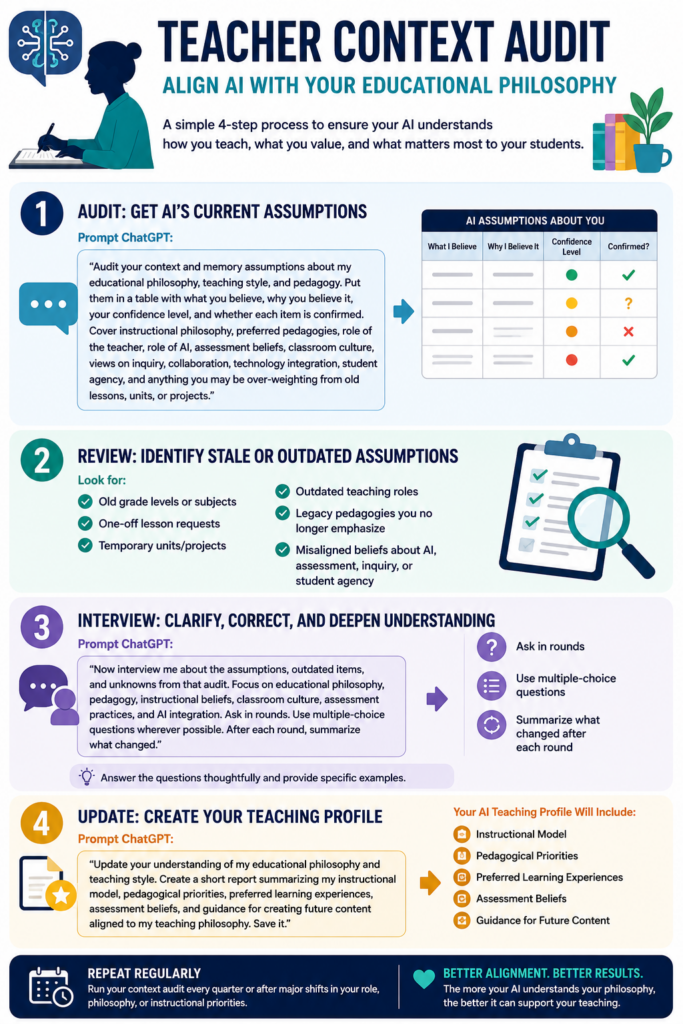
Now your turn. Use this process and prompt sequence on your favorite AI to generate a context audit. Keep in mind that if you want to derive full benefit from the experience, it will take around 45 minutes.
- Prompt ChatGPT: “Audit your context and memory assumptions about my educational philosophy, teaching style, and pedagogy. Put them in a table with what you believe, why you believe it, your confidence level, and whether each item is confirmed. Cover instructional philosophy, preferred pedagogies, role of the teacher, role of AI, assessment beliefs, classroom culture, views on inquiry, collaboration, technology integration, student agency, and anything you may be over-weighting from old lessons, units, or projects.”
- The user reviews the audit for stale instructional assumptions. You should look for old grade levels or subjects; one-off lesson requests; temporary units/projects; outdated teaching roles; legacy pedagogies you no longer emphasize; misaligned beliefs about AI, assessment, inquiry, or student agency.
- Prompt ChatGPT a second time: “Now interview me about the assumptions, outdated items, and unknowns from that audit. Focus on educational philosophy, pedagogy, instructional beliefs, classroom culture, assessment practices, and AI integration. Ask in rounds. Use multiple-choice questions wherever possible. After each round, summarize what changed.”
- The user answers the interview questions and then prompts the AI: “Update your understanding of my educational philosophy and teaching style. Create a short report summarizing my instructional model, pedagogical priorities, preferred learning experiences, assessment beliefs, and guidance for creating future content aligned to my teaching philosophy. Save it.”
As a final step, ask the AI to turn the resultant report into a reusable skill.
If you are a typical K-12 teacher, you are surely exhausted in these last few weeks of the school year. It will take most of June to recover. After the July 4th celebrations are over and your extended family has returned home, you will begin to plan for the upcoming school year.
In August, you will begin to prepare your classroom. Why wouldn’t you also prepare the AI that will be your constant work companion (dare I say “work spouse?”) for the next school year?
Final Thoughts
A few minutes after I finished my first context audit, I immediately put on my tennis shoes and went for a contemplative walk. I had so much to think about because ChatGPT proved to be a relentless interlocutor.
I will not turn to this AI looking for solace or emotional comfort, but I now feel comfortable engaging with it during a detailed conversation about my work habits and professional goals. We have also made clear my educational philosophy, which surely shapes my writing.
If I were in the classroom, I would commit to a quarterly context audit to ensure that the AI systems supporting my work were not operating under misguided assumptions.
The context audit turned into a profound experience for me. For a brief moment, the exchange almost felt like evidence of theory-of-mind behavior, or at least a sophisticated simulation of it. It asked, “What topic do I think is central to your future that you think is actually a distraction?” It took me a moment to realize that it was asking me to identify what I thought was the AI’s most important misconception of what I am about.
I realized the AI had misunderstood the purpose of my professional stories. My earlier roles as teacher, P21 CEO, and Buck Institute leader are not remnants of an old career. They are narrative tools I use to translate complex ideas into practical guidance educators can apply.
As you can tell, my new work spouse asks tough questions, just the way my old work spouse did. But this one, at least, doesn’t eat my french fries.




0 Comments
Leave a Comment
Your email address will not be published. All fields are required.