

Caroline Hill on Black Next-Story Month and equityXdesign
Key Points
-
Acknowledging racism and inequality were designed acknowledges there was intent AND acknowledges the possibility for change.
-
Wellness and mindfulness practices are core to the leadership styles needed today.
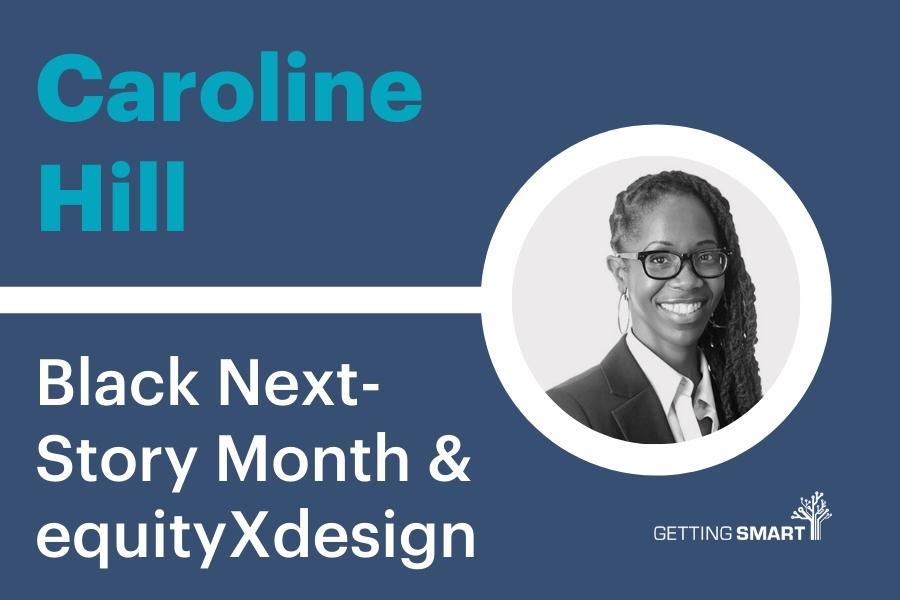
On this episode of the Getting Smart Podcast Tom Vander Ark is joined by Caroline Hill, a Washington DC based education entrepreneur and founder of 228 Accelerator. Caroline also is the creator of the equityXdesign framework, a way of building on design thinking and other design processes to ensure human-centered and equitable practices.
Let’s listen in as Tom and Caroline discuss the importance of mindfulness and wellness for leaders, what drives innovation, reimagining black history month, redesigning oppressive systems and much more.
Links:
- 4.0 Schools
- 228 Accelerator
- equityXdesign Paper
- Black Next-Story Month
- Somatic Breathing
- Ken Kay and Yong Zhao on Portrait of a Graduate
School leaders and teachers are designers of relationships.
Caroline Hill
[Wellness was considered] a marginal nice to have. It’s integral at this point. You’re asking leaders to do super human action. How do we make sure that they are healed and healthy as they do it.
Caroline Hill
One-Two-One
One voice that helped shape your thinking
- Caroline’s parents. Instilled the power of education
Two insights for edleaders
- The importance of starting with empathy and relationship.
- Equity doesn’t just happen, we must be intentional.
One additional insight
- Remember that the systems can and need to be redesigned.
Transcript
This transcript has not been edited for spelling accuracy.
Racism and inequality are products of design. Caroline, you make that bold and insightful statement on your website. Can they be redesigned? You know, Tom, one, thank you for starting with that. I think they, and I believe and know that they can be redesigned.
And I think that there’s incredible agency and power thinking about the systems that we have inherited as being designed, because one, that means there was intention, there was plan, there was a blueprint. But it also puts us in the position of being the ones who can redesign it. But having, but with the historical knowledge and the ingenuity and the spirit of innovation, that is, it just creates a space of hope and excitement, frankly, that some of these systems that, you know, we’ve inherited that seem like they are so incalcitrant and ossified, not just in our schools, but in our society can change.
So absolutely, they can be redesigned. It requires intention, will, and courage. And I’m so excited to talk to you about that today. You’re listening to the Getting Smart Podcast. I’m Tom Banderick, and I have the pleasure of being joined by Caroline Hill.
She’s a Washington, DC based education entrepreneur. She’s the founder of the 228 Accelerator. She is the chair of the 4.0 Schools Board, where I am also a director. I think we met 12 years ago when she was the founding principal at an extraordinary school in Washington, DC, called EL Haynes. We met again at CityBridge co-hosting some new school leaders.
Caroline, it’s such a treat to have you with us today. It’s so great, Tom. This is a long time coming, so I’m so excited for this conversation. Caroline, I mentioned 4.0 Schools. What is it that you appreciate about what they do at 4.0?
So I’m so honored to, one, be of service to 4.0 and at 4.0. And I think the mission is very clear, like, to define and create the future of school. And I think at this moment, as our country is emerging from a pandemic and a racial reckoning, the question that I have the top of mind to think about when I’m ever talking to school leaders and whenever I’m talking to teachers is like, how do we want our society to look and function? And then what has to be true of schools, curriculum, education, teacher learning, student learning to get us there. So 4.0 is this beautiful, innovative space where the boundaries of the way school has been thought up.
We can challenge those boundaries, right? We can push on the lines and realize, like, oh, that’s not rigid. What if I made it micro? What if I made it macro? What if I put it on a device, you know?
And that’s super exciting, especially in this particular moment. It is, and it’s who can challenge those boundaries and how to challenge them that is super innovative. I mean, 4.0 has really done a beautiful job of bringing diverse voices to the table, people that haven’t historically had an opportunity to have a school design opportunity. And then I guess what’s been transformational for me is just their iterative approach to innovation, the idea that you can try out, you can pilot an innovation after school today, right? Then launch a summer program, then launch a micro program.
But the idea of trying things small and fast has just fundamentally changed the way I think about innovation and learning. You know, it has for me too, and I don’t get the chance to talk about this often, but 4.0 is integral in the creation story of the 228 accelerator. Like when I was a principal, they had this program called Community Catalysts. And I had been playing around with the ideas around, like, you know, race and equity and innovation didn’t quite know how they intersected, but knew that we were inheriting legacy systems around our relationships in the same way we were inheriting legacy systems around the way schooling is done, whether it’s the back of the remodel.
And it’s like, we’re inheriting those systems at the same time. So I knew that there was some sort of intersection and 4.0 said, go out and try something. And I was like, and literally that push to try something, you know, was the first kernel that emerged into the equity by design paper. Because I didn’t quite know at the time how they intersected the way the systems were playing out in the modern era. And without that bias to action and also that, you know, that framework of we do to learn, I probably wouldn’t be sitting here talking to you about what we’re talking about.
So, you know, 4.0 is incredible, an incredible launchpad of new innovative ideas by just giving that push. Caroline, I serve on a lot of boards. I’ve served on 30 or 40 boards in the last decade. You are my favorite board chair of all time. And it’s because you do this magical thing of being super outcome focused and super relational. And somehow you do both of those. I’ve been with board chairs that are really good at relationships and terrible at running meetings towards a defined end.
And I’ve seen the opposite, but I don’t know, can you reflect on your leadership journey and how you became good at both of those things of helping a group focus on a new outcome and relationships? I guess they’re linked, aren’t they? They are linked. I think sometimes, you know, we’ve seen what happens when you over index on one or over index on the other. And I’ve had some really great leaders who have been models for me about how to do that. You know, my mentor principal was a woman named Maria Tecapa, who was the longest standing principal in Washington, D.C.
And to watch her move is like, oh, like one, you can hold both. And, you know, it’s one of those, you know, this won’t be a surprise to you, like the art and science of leadership. And especially if you want to move people from where they are to where they think they can’t go, have to be able to create a trusting environment. And I would say one modeling, but also, you know, leaning into like, I guess my own practice of pushing myself like, oh, gosh, where are those spaces in myself that I didn’t think I could go? And, you know, saying a student for myself like always go into those places and realizing like, huh, what were the enabling conditions that allowed me to do that?
Like, I don’t know if you know this, but I’m an inspiring yogi. I practice the 26 and two Hatha yoga postures. And like, I can do things now that I couldn’t do six years ago. But when I think about the enabling conditions, there was a teacher there saying, okay, just think about it. You can do it.
Maybe not today. Maybe not tomorrow. But like, there was always the expectation that you could do it in the support around. So it wasn’t, it wasn’t like you can’t do it. So I think like one remaining a student, but also having great mentors, leaders and mentors have allowed me to hold that, hold that those two ideals without over indexing on one or the other.
Let’s stay on that leadership topic for a minute. Would you argue that that leaders need some kind of a wellness practice, if not a mindfulness practice? Is that, is that a new insight for you? You know, Tom, it’s, I have the pleasure and the honor right now of working with a learning network in Philadelphia. And every Friday we meet for an hour and we’ve been doing that and supporting some of the equity centered innovations happening in the learning network.
And we always open with somatic breathing, right? Deep breathing. And they say, I kid you not, this, that’s the first time this entire week that I felt together that I feel clear in my head. And I think that attention to the health of the body is so important when you’re thinking about the people who have to rebuild the system. Like, in a lot of ways, school leaders are being asked to rebuild the system.
You don’t have all the pieces that you had before the pandemic. You don’t have all the pieces you had before, you know, we saw the racial reckoning happening on our phones, but hey, rebuild the system. And the question is like, how can they do that? And I’m beginning to understand more and more like the wellness and the healing part that has been thought about as like marginal, nice to have. I think it’s, I think it’s integral at this point.
You’re asking people, you’re asking leaders to do superhuman, you know, action. So like, how do we make sure that they are together and in healed and healthy as they do it? It feels like an important lesson from the pandemic, right? We saw so many teachers and leaders really burn out, just become incapacitated from working so hard from zooming in and out from macro issues to micro issues, long days, contract tracing at night. And, but I just, I so appreciate your leadership on wellness because I think at it really, you have to take care of yourself and create environments where teachers and other staff members can take care of themselves if we want to create healthy learning spaces for young people.
Yeah. And, and, and if we want to be resilient against the next wave of, I mean, I don’t, some of the readings that I said, they’re like pandemics aren’t going anywhere. Right. So it’s how do we build resilient students, resilient families, resilient communities? And are there different ways of learning or different knowledge or different knowings that we need to think about integrating into what’s already there? Caroline, the 228 accelerator site is the only redesign capacity that I know of that hits the issue of the wealth gap head on. I was surprised to see it there.
And I want to dive into why, why you name that. And I guess in part, I was struck by seeing it because I’m personally pretty freaked out by the triple ratchet of inequality that I see occurring right now between the pandemic and climate change and automation brought on by exponential technology. I’ve recently come to be really concerned about that. But you state that the wealth gap is, is an important fact that we need to come to terms with before we start creating learning environments and experiences. Why is that? Well, I think that sometimes it’s, I think one, the, that fact is so startling, it gives people pause, right? Because you’re like that long. And then you look at the discrepancies, it’s like you have black Americans and white Americans, 228 years, but you’re like, but wait a minute, you’ve had some black Americans who have been on this land just as long as white Americans.
So what is happening between that relationship? I think that one, it’s provocative, right? So that’s like, hey, even though we’ve had courageous leaders in our country fight for justice, even though we’ve had, you know, some really ambitious legislation, there’s some things that we are still working with that are playing out in our schools. So I think one, it’s important to call attention to that. Even though we’ve started thousands of new schools launched by well intentioned people trying to attack gaps, right? Education. I mean, yeah. And, and, Tom, it kind of highlights what, you know, what we started with about the systems being designed, like we have inherited, you know, legacy systems of education. We’ve also inherited legacy systems of interacting, right? And we get a lot of instruction from our cultural codes about who we are, who we aspire to be, how we should behave, where should we go to school, who we marry, and all of those are, we’re passed down.
And I think that in a lot of ways, like if we continue on the path, one, we’re not able to animate, you know, the, the, the language in our founding documents, right? We won’t be we the people. We won’t be able to form a more perfect union. So the question is like with the same rigor and vigor that we’re attacking the legacy systems of the faculty model and trying to poke around the, you know, like maybe we should, you know, think about new instructional models. There’s also an opportunity to think about what are, what are the ways that the human beings on this land need to interact so that we do form a more perfect union. And then how do we teach that in school? Right. Because I think we sometimes miss out on the opportunity that children one learn about who they are and how they’re, and how they should behave at home. And then there’s like this 12 or 15 year span of socialization, where you get a lot of implicit messages and explicit messages about who you are and what that means. And now I think that there’s an opportunity here as our, I’m going to say this euphemistically as our country is trying to reinvent itself, right? To say like, how should our society look and function? How do we form a more perfect union?
What instruction and assessment and progressions could we start to tinker with so that we can emerge as a people and also as a community that where the wealth gap is not something that exists anymore. Right. That’s just an indicator of how we interact. There are lots of other indicators, right? But I think that there’s an opportunity we have right now if we’re courageous to say like, yeah, these systems are racism, we’ve learned them. They’re in all of us. It’s a curriculum, right? And so it was like, what is the other curriculum? Right. And let’s let’s figure out how we can teach it, assess it, you know, demonstrate mastery. And I think that’s what I’m most excited about the accelerator because like, I think we’re onto something to figure out what the curriculum is. Yeah.
Caroline, it seems like the 228 accelerator and the related projects are about catalyzing a new generation of school designers that put equity at the at the center. Is that fair? Yes. What is and you published this beautiful framework called equity by design. Can you describe that? Yeah. So, you know, when I was a school leader, I had this chance, after I was a school leader, I had this chance to lead a design challenge around solving problems of chronic absenteeism and truancy with the mayor’s office and one in Washington, DC. And one of the realities that was like so blaring to me was when I think about chronic absenteeism and truancy, like, I’m not the expert in that experience, right? I’ve never been truan in my lifetime.
I had 100% attendance almost in high school. So I am not the one to one understand the truancy experience, define the truancy experience or even unpack stories or solutions to it. And once I had that admission to myself, like this is an area of expertise that I know nothing about, it allowed me and the team to say, let’s get the students who experienced truancy in the room, right? Let’s listen to them. And that became the kernel that emerged as the framework. It’s like, who are the most marginalized? How do we get them in the room? Like, how does someone like me seed power to them? Like, even though I have my degrees, I’ve never been truan before, right? And the idea of the framework is like design at the margins, seed power. In order to do that, I have to start with myself, make the systems invisible, and then those actions kind of sum up into this beautiful idea of like, then we can speak a future that doesn’t exist because you have those who have the most power and those who have the least power working together to create situations where like the the oppression and the dehumanization don’t exist. So the framework offers school leaders a pathway to say, hey, this is how you start.
Work in progress. This is how you start. And the courses that we teach take them on this journey from one understanding their own power as designers, because we often think about the folks over in the West Coast who get to wear cool glasses and bunch of people. And so we’re not going to use shoes as the designers, but it’s like, no, school leaders and teachers are designers of relationships. So how can you have that lens when you’re designing curriculum, like when you’re looking at your relationships with parents, and then going forward and then scaling those ideas throughout the entire school organization. Let’s, well, first of all, it sounds like there’s a lot of design thinking incorporated into that because it sounds like the process starts with empathy, right? About identifying a community and understanding how they’re experiencing a condition. Yeah, there’s definitely a lot of design thinking, you know, and we like to say so eloquently like it, the equity by design framework has the the power of design thinking, but like the moral consciousness of equity work and it’s like how do those come together and give us a pathway for redesigning our relationships and then our organizations and our systems. I love that.
I want to dive into what kids should know and be able to do and what that has to do with equity. We had an interesting dialogue on a recent podcast with Ken Kay came and talk about portrait of a graduate. He really values problem solving as along with collaboration and creativity and he’d like to see every school have a comprehensive outcome framework and then young Zao said no kids have a jagged profile. They should have a chance to be who they are to become who they want to be and they should be cultivated in in their own learning journey and I see some merit to to both of those. The equity impulse would be, you know, for the last 20 years we’ve talked about all kids high expectations.
How do you think about that tension between a comprehensive outcome framework and equity high expectations for all against a broad outcome framework and a really individualized personalized approach that that values a jagged profile. How can communities embrace those ideas? Yeah, I think that it’s so interesting that you asked I’ve been thinking about and meditating on like the preamble right and it’s like, huh. You know those words, I think allow us to say, and this is, I’m not cheating, but a both and approach like that what’s non negotiable is a more practical approach. It’s a more perfect union. What’s non negotiable is we the people. Now how we get there is going to be different. Right. Because the work that, you know, I was talking to a couple of leaders a couple of a couple weeks ago and I said, you know, in order for us to animate equity, I’m not saying that you have work and I don’t have work to do.
Like there are all things I mean everybody who’s been on this land has worked to do has learning to do is different. So I think like it’s a both and like my jagged profile of how I need to emerge as a better American is different than yours, but we both have profiles. Right. And I think like sometimes the equity conversations and equity narratives become skewed to you have work to do and I don’t. But I think if we’re thinking about like we all have work to do, it’s just different work. We have like high expectations that you stay engaged, but we’re all on our individual pathways to this this higher idea that unifies us. You know, another specific issue here is that, you know, 20 years ago I led the all kids college ready movement which sort of became all kids should go to college and, you know, for 20 years we’ve been pushing almost all kids towards four year institutions as a well intention equity approach and that’s resulted in a student loan disaster.
A lot of young people that leave college with debt but out of degree and simultaneously we’ve seen all these really interesting productive new pathways forming and so I’m pondering ways that we can create new goal state new aspiration statements that value multiple pathways that may or may not include traditional college and do that with equity in mind. Any idea how we sort of reframe what the goal of high school is and how we express with equity aspirations for college and careers. Yeah, so it’s so interesting. Like these are incredibly exciting things to talk about now, because you know I have. I’m a professor at Penn GSE and like so we’re like been playing around with this flex model and like virtual learning and now it’s like so you can’t really charge all that money. If kids are at home. Right, so you can’t be like it’s just doesn’t necessarily like why you charge me this money if you know so I think that there these really interesting permutations of what after high school looks like right.
I don’t know if we have the courage right now to really start to poke around those edges. But to your to your point in your question, like, I, you know, I have nieces and nephews right now that are five and six and my old my older sisters should I don’t know if they’re going to go to college like we went to college I was like no I don’t think they are. I said but they will need a four year incubation period after high school and before they have to go to the adult world, like I don’t know what that’s called where they’re not in their parents house. Right, and that they get a chance to interact with different people like right now we put a very expensive price tag on that four year incubation period. So I am really excited about thinking about like the accumulation of credentialing that can you know that are accessible to all people at lower cost, high quality in ways to store and share those credentials and saying like, and adolescents
literally need space to incubate before they enter the workforce. I don’t I mean if I enter the workforce at 18. You know, you’re just not, you’re not ready. Right, it’s like you’re not you’re an egg that almost has hatched so I think it could be really interesting to think about what those intentional incubation periods look like where young, late adolescents early adults have a have a way in a space to figure out who they are in low risk of environment.
Right, when you’re out in the world, it’s a high risk environment and the mistakes that you make have huge, huge costs but I think what makes college beautiful is like you can play around and try on different suits for four years. And I think we still need to figure out how to do that and give that privilege to more people. It strikes me Caroline that as education leaders we need to become better conversation host to host community conversations about these new emerging opportunities and we need to be vigilant about equity in a, you know, maybe a new fresh and more agile way than we have been in the past those feel like skills of being conversation hosts and agreement crafters that we don’t typically teach to emerging education leaders is that fair. I think that’s fair I think there’s an opportunity that you know one of the, one of the design features of the community in the courses we want was like you know we need spaces to practice, you know, difficult, difficult conversations but civil right together, right that’s a skill.
And I wonder if we if our intent is to have a generation of students who can do that, like, that’s a standard that we can teach and assess but you literally have to be in community with different people. And I think that’s one of the design challenges because we’ve designed many of our communities to be all like our like you like ourselves. Right so it’s like what I get super excited about time, especially with the equity question is like if we have a lot of communities that are homogenous right, racially homogenous socio economics data I mean like that they are pretty much you know if you look at standard demographics, the same like, how do we use technology to create spaces where they can be in community to practice these standards, right to practice disagreeing. Right civilly, like I understand what you’re saying I disagree. Okay, I don’t have to think you’re a bad person. Right. We just don’t like I can I don’t have to degrade your humanity, but by disagreeing with you and I think that the app that opportunity is super exciting at this point because we have the technology to do it.
Caroline how would you describe the learning that results from the equity by design framework. Do you have pictures in your head of what the powerful learning experiences might be that would emerge from that framework. Yeah, so one of the things that when you when you first asked that question two seconds ago. I would love to see school leaders across the country challenge the boundary of zip code. Right. To say like, like our schools are in these zip codes but we live in one city, or we live in one state, what would a networks of leaders that like literally across zip codes across neighborhoods look like, how can they get their students to work together to build things together for to you know to make a more perfect union to establish justice to ensure domestic tranquility, because that that work does not happen in silos. Right. So I would love to see, you know, school leaders you know empowering this idea of speaking the future by literally saying
these these lines that have been put in place to keep us separate I’m going to intentionally challenge it call the school leader up in the other neighborhoods a hey I got an idea. Like, let’s do something together not a service project right like let’s let’s have like an essay contest or whatever like instructional tech like what would it mean for them to learn together, those teachers to teach together to normal practices and to learn together and expand, sometimes what I think become provincial boundaries on like who we think we are, and see, you know, everybody as your people. Right. And I think once we get to that point, you know, the whole country becomes a system that is just a matter of saying like oh I have a friend in Phoenix and we call them up and we have a class and I’m in DC and that’s, we couldn’t do that 20 years ago. Right. And I think that’s speaking the future that doesn’t exist. Caroline. I’m here in Phoenix. I’ve been visiting schools and I’ve noted that many of the existing and even new schools here reflect the communities that they’re in there some schools that are full of brown kids and some schools that are full of black kids and some schools that are full of white kids.
Is that okay? Is there should we be more intentional about creating diverse and integrated learning environments despite the fact that many of the communities being served are segregated historically segregated? Yeah, that’s a really, really good question. So I think that one of the ways I think intention and will is important. Right. I think that without that intention and will the force of the past pulls us back. But I also think it’s important to think about where we’re going and I think just putting kids with different bodies in a classroom isn’t, it’s not incorrect. It’s just insufficient. It’s not going to get us to where we want to go. So I think it’s really, really important at this particular moment to say like if school leaders or even conversations that we have is like, so what I saw on my phone in 2020, I don’t ever want to see again. What instruction gets us there? And I think that sometimes that’s a whole bunch of cover like we might not get to the standards progression for another five years. But like having the conversation like what instruct what do kids need to know and be able to do.
So what we saw last year we never see again or or the kids in school never have to see that again. Right. And I mean one of the things that I chuckle is like I don’t know if you can learn to be an anti racist being in community with people who aren’t like you and literally think it’s a design requirement to be in community with people who pushed you. So I think figuring out ways to do that. And I think you know that is you know it’s a hotbed topic right now in the country. And, and you know I was talking with some leaders yesterday and it’s like the task I gave them was like tell the story of America to a four year old and use words of force, you know, use, use less than 20 words and you and and you can only use four letter words. How would you do it? And they were like this is so hard because you then leave because the story is so hard to tell you end up leaving out pieces and when you have to integrate other pieces is like it’s hard. It’s a very complicated story. So I think figuring out ways like I said one acknowledging what teachers are being what teachers need to do is hard.
Because it’s hard doesn’t mean we don’t do it. It’s like, how do we do it and creating the spaces for communities to create that response together. I think it’s so important right now. Caroline it’s black history month this month but on the 228 accelerator site you’ve been talking about black next story month what is that. Yeah, you know Tom, you know I. That is so very, you know, important and just hits hits my heart in a really special way right now because I, you know, gets to this idea of speaking the future like, what is the next story. What is the next story for a body that looks like mine on this land what is the next story for a body that looks like yours on this land and how do we make sure we’re not running the same daggle to rerun because it’s like, like my dad is 78 I always mentioned him and he said to me you know when when the white
was a black story month I went to UVA and I was like, I was in tears and he said you were not supposed to see this. It’s too hard. Too many people died for you to see this I’m just like, why are we seeing this now it’s 2022 so the spirit of black story month is saying like one, let’s let’s say, let’s also we need a new story in this country. Where are the people who are willing to write it together. Right in dreams I like and see what we can’t quite see yet. But know that we cannot get there.
We can’t get there alone so the idea of black story month is saying like you know, when I’m with I’m honest like so much of my life has been shaped by the forces of white supremacy, right. In male supremacy and heteronormativity, because I show up as a black queer woman. So it’s like, if those forces weren’t there. What human like what is my relationship with myself. And I think like black next story month says like, let’s assume and challenge this idea that these systems have to be in place, and that they are stable.
Like, what how can we start to move together to challenge their stability, and then how freer are we, all of us. When those systems aren’t in place anymore and that’s the spirit of black next story month is like, and of course I’m an educator. And I think like every I use the lens of when I was an engineer I use the lens of fluid flow through a pipe. As an educator I use the lens of like curriculum. Everything’s curriculum right so the idea is like how do we write a new story. What are the skills required. How do we credential those skills. And what’s the progression as a human grows and develops. So I love the idea behind black next story month. I’ll go back to the opening comment that I read on your site racism and equity are products of design that can be redesigned so yes to recognize history but the real question is, how do we design something
different and better for all of us. Caroline I want to close with a segment called one to one. I would love to know one person one voice that has really helped shape your thinking about your life’s work. Oh gosh. Oh gosh one person. I want to take them as a unit my parents.
My parents were like my dad still living my mom passed away about 20 years ago. Incredible like they were. They instilled the power like one of education. And like they stand this long and they were the first in their families to go to college. And we’re the first in our family to experience education not in the gym for a South like that’s so serious. So when I see my my parents, you know, all the things that they did for us to say like, OK, now you can you are a bit more freer than we were.
And your job is to make sure you create that for somebody else. They were probably the single most people like I would I would even honor right now it’s so funny to like when we graduated like my, my all three of my sisters went to UVA right we all went to UVA. And when we finished my parents said OK, thank you you did what we told you to do now go forth in the world and do what you want to do. So I just forever indebted to the sacrifices they made because without them I couldn’t be sitting here right now. Caroline there’s two insights for leaders that have gleaned from our conversation one is starting with empathy really starting with being in relationship and.
Trying to understand where other people are coming from and to it’s really about putting equity at the center about being really intentional about the work ahead. Do you have another insight for leaders that you would add. I think to remember that the systems are can be redesigned and the education system is asking us right now to redesign them to think about how we animate all of the virtues of our founding documents because that’s the purpose of public school. Caroline’s been a treat to you on the podcast where can people learn more about you and your work. Yeah so check us out on Twitter at 228 accelerator our website is easy www.228accelerator.com check out our newest experience called the X design experience helping all of us as America move from accountability.
To reconciliation and I think that’s how you can find us out and I look forward to being continue to be in conversation. Make sure your leadership at 228 on the 4.0 board all the other places that you show up. You know that the getting smart team really deeply appreciates you and your work. Thanks for being here. Thanks so much Tom for the opportunity and thanks to our producer and full or at Mason Pasha and to the rest of you keep learning keep innovating for equity and we’ll see you next week.
Thanks for tuning into the getting smart podcast today. We want this podcast to be actionable and insightful and a great way to learn about what’s next in learning. In order to stay on the cutting edge we need people in the field to tell us what they’re hearing what they’re wanting and what they’re needing to learn more about. Got a topic or a guest in mind send your recommendations to me Mason and getting smart.com and if you like what you’re hearing don’t forget to leave a review and Apple podcasts or subscribe wherever you listen. Feel free to share the podcast on social media using the hashtag GS podcasts.
Thanks so much.



0 Comments
Leave a Comment
Your email address will not be published. All fields are required.