

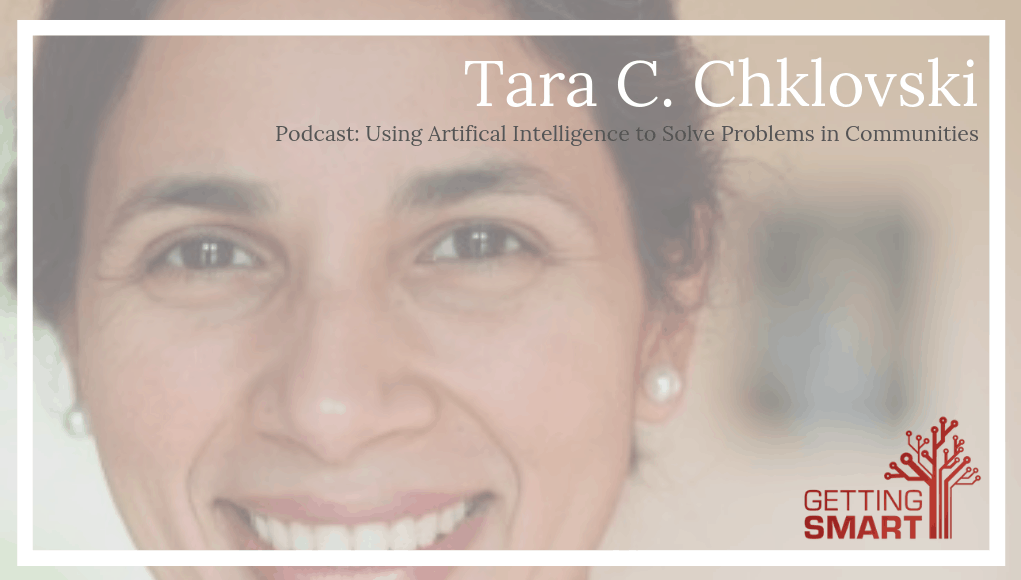
Podcast: Using Artificial Intelligence to Solve Problems in Communities
For more, see:
- AI Family Challenge Introduces Artificial Intelligence, Encourages Problem Solving
- How to Introduce Your School to STEM: The 5 Important Factors for Success
- New Legislation to Tackle the Digital Divide
 This post is a part of the Getting Smart Future of Work Campaign. The future of work will bring new challenges and cause us to shift how we think about jobs and employability — so what does this mean for teaching and learning? In our exploration of the #FutureOfWork, sponsored by eduInnovation and powered by Getting Smart, we dive into what’s happening, what’s coming and how schools might prepare. For more, follow #futureofwork and visit our Future of Work page.
Stay in-the-know with innovations in learning by signing up for the weekly Smart Update.
Tara Chklovski is the Founder and CEO of Iridescent. You can find her on Twitter at @TaraChk or through email at [email protected]. Feature image courtesy of https://iridescentlearning.org/.Transcript
This transcript has not been edited for spelling accuracy.
We’re listening to the Getting Smart podcast where we unpack what is new and innovative in education. We’re your host Jessica and Caroline and today’s episode is a little extra special. For starters, Caroline’s back in the podcast studio. Thank you. I promise I didn’t kick her out. It’s just been quite a busy travel season for our team, but I’m super happy that we have her back. What really makes today’s episode special though is that
this will be our 200th episode of the podcast. Can I get a golf clap? Thank you, Caroline. Super exciting for sure, Jess. What’s more fun is that this little podcast of ours started as a conversation mid-meeting with our full team about four years ago. Tom mentioned we should do a podcast and a couple of weeks later, we add one. It’s grown and evolved so much since then and we have a ton of fun bringing you all the updates and interviews from the field. That’s
right. It’s fun to think about what’s come from that spur of the moment idea. Okay, now that we’ve celebrated, let’s get to it for this week’s episode where you’ll hear from Tara Chiklowski. Tara grew up in a small town outside of Delhi, India. Inspired by a tinkering father, Tara wanted to be an aerospace engineer. After a master’s degree at Boston University, Tara launched into a PhD at USC. But the poll to help more girls experience powerful
science, engineering, and technology education drew her away. In 2006, she launched the nonprofit Iridescent to create and deliver powerful STEM learning to empower underrepresented young people in everywhere. Iridescent’s newest initiative, the AI Family Challenge, invites families to learn about artificial intelligence and use it to solve a problem in their community. Over 7,500 people from 13 countries participated in the first year of the program. Let’s listen in to a conversation
that is sure to be inspiring. Tara Chiklowski, welcome to the Getting Smart Podcast. Nice to be there, Tom. Thanks for inviting me. You grew up outside of Delhi, right? Yeah, in a small town called Merritt. It’s 40 miles north of Delhi. And was your STEM inspiration at school or at home? It was mostly at home. I have to credit my dad for inspiring me to think about engineering. And he was a pilot in the Indian Air Force and really sparked a love for flying in me and for anything
that would fly. So since I was eight years old, I wanted to work at this company called Air Environment in Southern California that made environmentally friendly beautiful airplanes. They made the first human powered airplane, the first solar powered airplane. And that has been a lifelong inspiration. And so that really shaped the choices I made. But on a daily basis, my dad would routinely bring in lots of experiences or opportunities for me to mess around with
mechanical things, engines, we used to fix car engines. My grandfather had a workshop. And so I was surrounded by things that move. And so it was a core part of my daily life and was very comfortable with it. And that’s something I realized that you become interested in something when you are comfortable with it and when you see yourself becoming good at it. And that was a key lesson. Did you study engineering at Steven and Deli? I actually studied physics. I did honors
bachelor’s course in physics. And then I came to Boston University. I did a master’s in aerospace engineering. And then I came to Southern California USC and was doing a PhD in aerospace engineering, studying the physics of bird flight, seabirds. What prompted you to launch what has become really an international campaign to get children, especially girls involved in STEM? I think I really wanted to work at their environment. And I think at that time, it was
we were undergoing the Iraq war. And somehow, whatever I didn’t imagine as a girl was not as idealistic. And it really made me sort of step back and question, what are some big problems in the world? And what do I have to offer that is uniquely mine? And the two answers were that education is a very, very powerful lever, especially for the large number of billions of people that do not have access for no fault of their own, but just pure luck that they happen
to be born in a particular particular place. And, and then my own strength, I really love motivating people to do things that they didn’t think they were capable of. And so keeping those two together, there’s a story of basically what is a human being capable of and what is their potential? And if they had the right opportunities, maybe that potential is really unlocked. And technology is one incredible lever like that. And so the idea was that I wanted to start a global
program that would offer underrepresented communities, underserved communities, and give them the most powerful cutting edge tools of the time for them to realize that they have agency in the world, that they can make a change in the world. And they don’t have to become a technologist or an engineer or a scientist, but at least if they have a sense of empowerment and agency, then that’s success for us. So how do you go about launching a global campaign and a new nonprofit?
How does, how did that happen? How did you raise money and get started? Oh, that was 13 years ago. And I mean, I’m sure you’re familiar with it. It’s a very common story. I think it’s friends and families and my husband for sure, he fully supported what I did. And so I actually did not take a pay for the first seven years. And I think the first three years are the hardest because every sort of foundation wants to see three years of operation before they’re
willing to give you a grant. And I just thought that was incredibly unfair. But now I think it’s actually, it’s actually a good thing because it is trial by fire and it really forces you to think hard about what, what, what is working and what the public wants, right? So I think the first three years was just tremendous amount of hard work and testing, testing the program. And what I found was I did a lot of research on what are some effective large skill
interventions. And the one thing that kept coming up was parents are a child’s first teacher. And there are very few programs that have embraced parents as a key element of their strategy. And so we launched basically a family science program where low income families were invited to come after school in the evening during dinner time and to work closely with engineers and just learn about how the world works through hands-on design challenges. And, and we, everybody thought that
that wouldn’t work, even principals thought, oh yeah, our parents are not engaged, they’re not going to come. And we’ve, we’ve been still running, we’re running till date and we reached about 120,000 children and parents all over the world. And I think what we found was, universally parents want a better education for their child and they want to spend unbroken time with their child getting to know them better. And so if you offer something as
simple as dinner, you’ve opened up time for them. And so, so yeah, so I think that has been a core element of our, of our strategy and, and, and keeping an eye to scale because there was one early researcher who kept saying, try to get your program right to work in one school first and then think about scale. And I just felt that that probably wasn’t the right way to go about it. And so right away, I started to run programs in the Bay Area, in New York, in, in different locations,
trying to see what would break. And every time something would break, we would adjust the training or whatever the model. And then very quickly, we put all our curriculum and training online onto an online website in 2009, I think. And we saw participants from nine countries come and use the curriculum and be part of it. And so all of that really helped us understand for users that have the desire to learn, this kind of a global platform is very compelling. And so we feel a
need there. And that’s how we’ve grown into today. And now we’re in 115 countries. Wow, that’s really exciting. Was that early program called Technovation? So we have two programs. Technovation is one of our programs. The first one was really the Family Science model, which we have now repurposed into the AI Family Challenge. But yeah, Technovation we launched in 2009. And that was a competition where middle middle and high school girls found
a problem in their community, learned how to create a mobile app and launch a startup. And yeah, we put the content, the curriculum online. We were one of the first MOOCs, we published it on Mozilla’s peer to peer university. This is before MOOCs were even a word. And we were so surprised to see what the reception was. People really wanted to be part of a global competition and learn how to create an app. This was before sort of the mobile industry took off. So
and we’re seeing sort of the same thing now with AI. So yeah, tell me about the AI Family Challenge. Yeah, so we’ve collected a lot of data over the years and we are very sort of hard-nosed about trying to understand if you’re having an impact. And so the five week Family Science program, clearly the parents really enjoy spending time with their children. But when we started to look at whether there was any resilient effects, it wasn’t as clear. And when we compared the data
to say Technovation, which is about a hundred hour program, there was quite a bit of a difference. And so we began to have a hypothesis that dosage really plays a role. And so then the question was what is the minimum dosage that results in any kind of resilient change in attitudes, problem solving behaviors, persistence, curiosity, things like that. And so that was one sort of piece. And then the second part was that AI is really in all of the devices that we use. People
don’t really know about these, how these devices work. And again, to going back to our mission of unlocking potential and empowering people, we do want to sort of explain to them, okay, this is how your world is working. And you have a role to play in improving them. If some, if you are at the receiving end of an algorithm that is actually making a biased decision, you have a role to play in providing feedback and potentially even making it better. And so opening up the black box
is a big part of sort of an increasing knowledge is a big part of that, that message of empowerment. And so we launched the AI family challenge really targeting low income groups and families, because adults need to learn about these as well. And the idea was that as a family, you find a problem in your community. And you learn about machine learning. And you create a machine learning model that solves that problem. And so we had about 7500 children and parents go through a 15 week
program across 13 countries last year. And we just announced the six finalists, and they’ll be coming and presenting at the AI World Championship in a few months. When did you begin to realize that AI was really everywhere and was having profound implications in the world? I think similar to you sort of in 2016 is when we started to hear some rumbles. And then AAAI, the Association of Advancement of AI reached out to us to see if we would do a series of videos of
some of the AI researchers at their conference to sort of share with the public what is the cutting edge. So that was in 2017. And we started to get a little bit deeper. And then I just kept hearing more and more. And I felt that this is something that is very important. And if we do not grab it by the horns right away, we would be left behind. And it was a pretty hard transition because AI is not like an easy topic to understand. So the whole team had to sort of get comfortable with the
technical aspects of this. We had to build a completely new network of AI experts who could help guide us with the curriculum. We had to really create like a 15 week curriculum from scratch, and then create the educator resources, training materials, and then deploy it internationally in the course of a year. So about two years of prep work that resulted in the launch of the program last year. And now we are in a place where we have one year of implementation under our belt,
a lot of data on what worked, what didn’t work, and a whole set of community partners that are willing to do this again this coming year. That’s exciting. Is it realistic for young adults and their parents to learn enough about AI in 15 weeks to actually deploy simple models and solve real community problems? Totally. I think it really depends on the platform. And so that’s why we did quite a bit of work trying to understand what is a reasonable platform. And so we’re using this
one called machine learning for kids that works on, builds on IBM’s Watson sort of capabilities, but it’s a block based visual interface that connects to scratch X. And so we definitely rely on experts like Dale Lane who has created machine learning for kids. And it gives you a pretty clear sense of how a machine learning model image classifier gets trained or text recognition system gets trained. And you can see some of what the finalists have created. For instance,
one of the teams is from Palestine. It’s a girl and her family. She actually created a model to analyze children’s drawings and to try to understand whether the child was experiencing any kind of violence at home. And the model actually can predict quite accurately whether there’s some sadness in the drawing or not. So things like that. I mean, it’s very, very impressive to see what the families have come up with. And we actually did not know what to expect. So we are thrilled.
Tara, what kind of advice would you have for educators that are listening? How can they learn more and get involved? In what ways would you recommend that educators begin to incorporate AI into education? I think, I mean, as a start, I mean, we do have a completely open online curriculum. I think the very first thing is just sort of the nervousness that you may have that, oh, I don’t know anything about AI. And getting started with anything is
like especially something technical is very, very hard. And so I think just making it, making that first step fun and less threatening. So maybe finding another colleague and over like coffee and cake or something, like just go through one of the technical exercises. And so I think that is a gentle entry point. And then you realize, oh, it’s not so scary, right? So what some of the videos, I mean, Google has an amazing set of videos around machine learning. And, and I mean,
every company now has all of these very easy ways. So that can get you slowly warmed up, thinking about it. And then I think the harder part is actually deploying it in your classroom. But not everything has to happen right away. I think the first thing is just for you to get excited and inspired. So it sounds like schools and families could get involved in your program as really an afterschool or a kind of a club activity? Yep, definitely. I think that’s one.
And then we do have educators using the content in the class, because it is project based. It really forces children to get out of their sort of classrooms and go into the community and try to identify meaningful problems. So I think that problem identification piece is something that even most adults don’t sort of go through. So it’s a very valuable experience. And then there is the AI component, but that is really just the tool, right? I think the end result is that the students
are extremely empowered. And that is valuable for any learning experience. Tara, in a few weeks, you’re going to be participating in the AI for Good Summit that the UN is hosting. Can you tell me about that? Yeah, so the UN is hosting the AI for Good Summit in May, last week of May. And we are chairing the education track. And we were invited to kind of think of what are some key areas for
progress, for quick wins. And so some of them are, for example, one is how can you increase AI literacy and awareness in the community, thinking of what children and adults, how can we use, work with reporters more closely to be mindful of how we demystify AI and how do we speak about AI events in the media, how can we empower parents to better guide their children in the use of AI powered games and devices? What is the impact of these tools on teenagers’ brains? So these are
different tracks. And we would love to invite anybody who actually would be interested in presenting some of their work or wants to be part of the working group. So Tom, I can share a link for submitting proposals. And we would love to invite you to participate. That’s great. Tara, where can people find you online? Yes, totally. My email I can give, but the website is iridescentlearning.org. I’m also on
Twitter. But email is the best. So it’s Tara at iridescentlearning.org. Awesome. Wow, we really appreciate your work. It’s exciting that iridescent is leading a global campaign and introducing thousands of young people, especially young girls, into all the possibilities associated with using AI for good. We appreciate your work. Thank you. Likewise. I mean, I think it’s a huge village effort, right? And that’s something that
is sort of reinforced to me on a daily basis. We just have the curriculum and the mentors, but we kind of need the educators on the ground to partner with us and the parents on the ground to sort of bring it to the children. So it’s definitely all of us working together. Thanks for being on the Getting Smart podcast. Thanks, Tom. A big thanks to Tara for joining us on the podcast. Her vision is truly inspiring.
I agree, Caroline. And for more on spreading equitable access to computer science, make sure you listen to episode 190 with Amon Milner from Olin College of Engineering. We’ve got it linked in the show notes as well as this week’s blog featured on GettingSmart.com. Thanks for tuning in this week, listeners. Make sure you take a second to rate and review the show. And if you’re not already, hit subscribe so you don’t miss out on any future episodes.
For the Getting Smart podcast, this is Caroline and Jessica signing off.



0 Comments
Leave a Comment
Your email address will not be published. All fields are required.