


When to Innovate, When to Implement, and When to Improve: A Framework for Strategic Schools

While partnering with systems in Virginia, Kansas City, and Michigan, we’ve observed that strategic organizations succeed by matching the right approach to the right challenge. As we explored in How Can We Build Strategic Organizations: The Power of When, high-performing schools avoid the trap of using a single toolkit for every problem. Sometimes we know what needs to happen and the work is making it happen well. Sometimes we don’t know yet, and the work is figuring it out. And sometimes we know enough to act but need to keep learning our way toward something better.
High performing schools master three distinct approaches:
- Directional. A Strategic Direction guided by clear priorities articulated by specific goals and accomplished via projects with appropriate Finance models to support the change initiative.
- Operational. A focused Research and Development program addresses adaptive challenges, while established Implementation protocols support technical challenges – with clear Success Metrics for both approaches.
- Relational. A thoughtful and adaptive approach to Leading Change through trust, clarity, and focus.
The definitions of improvement science and implementation science are well-established in the literature, but more murky in practice. Many individuals have been trained in both – whether through organizations such as NIRN (National Implementation Research Network) or through the Carnegie Foundation for the Advancement of Teaching and Learning’s Continuous Improvement Model work. NIRN embeds continuous improvement model tools like Plan, Do, Study, Act into implementation science.
Consistent approaches to innovation are less ubiquitous in the education sector (unlike industry or health sectors), but as an increasing number of schools and districts adopt personalized, competency-based practices, real-world learning, and other innovative approaches, developing a process and science of innovation is critical. Implementation Science and Continuous Improvement models are essential parts of scaling the work.
Yet, the innovation systems are less well-defined and have lower adoption rates than implementation or continuous improvement. Leaders can become remarkably good at implementing what is already known while having few structures for figuring out what to do when the answer isn’t known. The latter requires a different kind of organizational muscle: curiosity, experimentation, permission to learn, and a way to make sense of what the system is discovering. Our goal at Getting Smart has been to simplify the process, language and approaches to make it easier for schools and systems to use all three approaches simultaneously with an Innovation Culture.
In order to do this, we need clarity around these parallel systems.
Implementation Science
Implementation science is a process that supports the roll-out of established, evidence-based practices in a system. Examples might include MTSS, the science of reading, a math program, a social studies curriculum, etc. Implementation science focuses on technical challenges where a solution is known and documented. High-quality implementation is critical in schools and systems. Implementation is often more structured and directed because the organization has made a decision about what it believes should be adopted. That structure can be an asset when the solution is known, but it can also become overly compliance-oriented if the system loses sight of the people and context in which the practice is being implemented.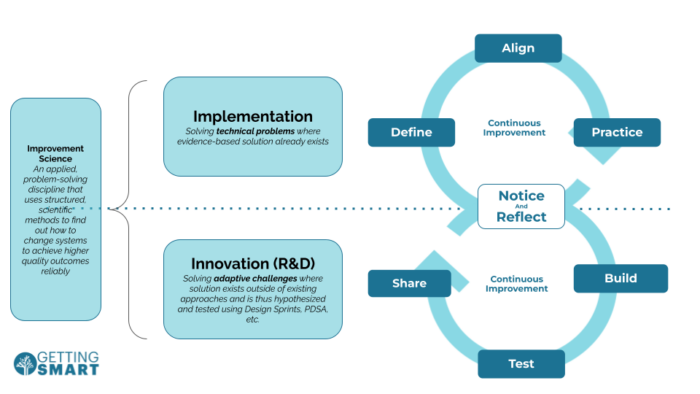
Innovation
Innovation is useful for adaptive challenges, those outside of the normal solution, with less well-established and known solutions. We simplify this to say innovation practices are used when the solution is unknown. Examples include questions around meaningful assessment, co-designed projects, student engagement, and personalized learning, etc. These approaches and practices certainly have shown efficacy and data support in some settings, but often are dependent on system-wide context, culture changes, and even classroom conditions that make implementation science less effective. While we use a simple Design Sprint format of Notice, Build, Test, Share, Reflect model, organizations like IDEO and the Stanford d.school have built significant resources to support the work of innovation when a solution is less known. The language is less important than the correct mindset for the correct challenge. Innovation is often ground-up, with educators or individual staff members or teams driving the process. That doesn’t mean innovation belongs only to the people closest to the classroom. Leaders have an important role in creating the conditions for experimentation, protecting early ideas long enough to learn from them, and deciding when something is ready to travel.
Improvement Science
This leaves Improvement Science as the third tool a school or system must use effectively to support change. Improvement science is documented in PDSA cycles, Action Research, and Inquiry Cycles, among others. Improvement science works across both Implementation and Innovation approaches as a rapid cycle testing to evaluate whether something is working. In an implementation, PDSA may be used to see if an adopted curriculum is proving to be effective in a particular context and allows for rapid adjustments to the implementation as needed to best serve students. In a research and development setting, where innovation tools are appropriate, a Design Sprint would be used to build a solution – and during the testing phase, a continuous improvement model would be used to rapidly assess whether the innovative idea is working to improve student outcomes.
This is where the three approaches become less like separate lanes and more like a system of learning. Innovation helps us discover what might work. Implementation helps us bring what we know into practice. Improvement helps us learn whether either is producing the intended result in this particular context.
Strategic schools and systems who clearly define these three approaches reduce confusion and build clarity around which tools are used for which challenges. Implementation for technical challenges, Innovation for adaptive challenges, and Improvement for getting better faster along the way in both approaches.
Our simplified model connects innovation and implementation through noticing. The first move is to pay attention to what the system is telling us. Is this a challenge where a known solution needs to be implemented well, or are we still learning what the solution needs to be? That distinction helps determine which tools to bring forward.
The point isn’t to label a problem once and move on. The approach may change as we learn. A challenge can begin as an innovation question, move into implementation once a promising approach emerges, and continue to require improvement work as it meets the realities of a particular school or community. A system that defines and articulates the process for all three of these approaches simplifies the process for stakeholders.
- Notice high school students struggling with attendance; consider implementing a Communities in Schools model using an implementation process.
- Notice disengaged middle school math students, consider starting with a design sprint to better understand the challenge and test early prototypes.
- Want to get better in both of these scenarios? Run high-quality continuous improvement cycles.
If your school or system is heavily focused on implementation rather than innovation, a shift towards agency and ground-up solution making is warranted. If your school or system is focused solely on innovation, training in implementation may be warranted to scale innovations that begin to show efficacy or already have known solutions.
As an education sector, we often complicate our systems. Schools don’t need more processes for the sake of having more processes. They need greater clarity about the kind of challenge in front of them and the kind of learning that challenge requires. Sometimes that means implementing what we know. Sometimes it means creating what we don’t know yet. And always, it means paying attention to what we are learning along the way.
The goal isn’t three more initiatives. It is a system that knows when to implement, when to innovate, and when to improve and has the capacity to do all three well.
Building a clear and well-defined Strategic Organization with implementation, innovation, and continuous improvement processes improves outcomes for all students.

Nate McClennen


0 Comments
Leave a Comment
Your email address will not be published. All fields are required.