

Coalition Before Consensus: How Trust and Shared Ownership Sustain Transformation

Every multi-year transformation effort passes through a stretch that textbooks and strategic plans never quite account for.
The old approach has been disrupted, but the new one hasn’t yet produced enough data to defend itself. Teachers are working harder than ever without feeling effective. A new mandate arrives, pointing somewhere that feels entirely off-course. Then, a board member forwards an analytical article questioning whether this kind of innovation works at all. And sent with no explanatory text and three question marks in the subject line.
At some point, someone asks out loud if the whole thing was a mistake.
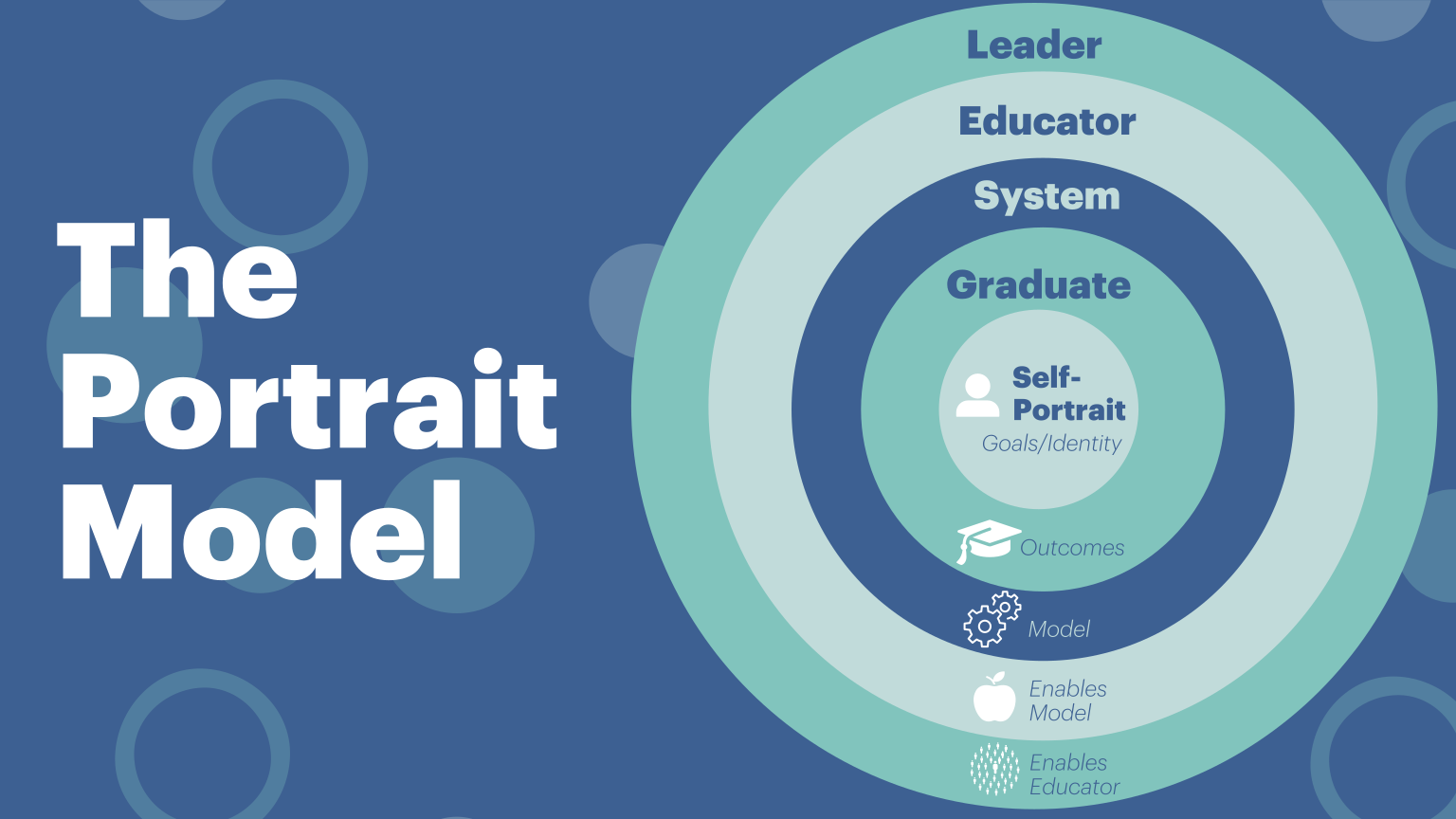
The districts that sustain momentum are rarely the ones that avoid these moments. They are the ones who spend years building relationships before they need to rely on them. When system transformation gets tough, the leaders who navigate it successfully do something disciplined, relational, and foundational. We think this is important, and that’s why it sits within the Strategy section of the framework.
Coalition Is Not Consensus
One distinction that recurs in conversations with successful district leaders is that coalition is not consensus.
Consensus asks everyone to agree before anything starts. Coalition forms when enough people understand what is being built, believe it is worth trying, and feel some ownership over what happens next.
Most significant changes begin long before confidence is widespread. They begin with cautious curiosity, uneven beliefs, and a handful of people willing to take a first step before outcomes are obvious.
Before there is evidence, there are usually only relationships.
Much of what follows comes from leaders we work alongside through Michigan’s Future Learning Council, a statewide network of school and district leaders committed to this work. Certain patterns become easier to notice when leaders have a trusted space to learn alongside one another.
Starting With The Willing
Rebecca Hutchinson has spent two decades at Concord Community Schools in rural Michigan, first as a teacher, then a principal, and now superintendent. She did not arrive with a rigid transformation plan. She arrived with a question: What would it take to make this a place where both students and adults could actually thrive?
When staffing challenges intensified, and teacher exhaustion became harder to ignore, pressure mounted for a swift districtwide solution. At the same time, Hutchinson could see that the one-classroom, one-teacher model was isolating adults and limiting what was possible for students.
She resisted the urge to launch something everywhere all at once. Instead, when she proposed team-based teaching, she offered a simple invitation: “I’ll take the willing.”
Most leaders know this moment. The meeting ends. A few people linger afterward. Someone lowers their voice and says, “I think this could work.” Those are the people worth calling the next morning.
At Concord, those early adopters became a learning community. They surfaced challenges, tested assumptions, and helped reveal what would need to change if the model were ever going to spread. One team developed a reading intervention approach that resulted in students making nearly two years of growth in foundational reading within a single year.
The model didn’t spread because it was mandated. It spread because people could see it working.
The High-Leverage Work of Listening
On any given Tuesday, Kelly Coffin, superintendent of Farmington Public Schools, might be walking a building with principals, sitting with students at lunch, or stopping to talk with staff in a hallway.
“I listen for what I hear,” she says, “but I also listen for what I’m not hearing.”
She pays attention to what might be called quiet disengagement. The teacher who has stopped asking questions. The parent who no longer pushes back or the principal who used to share concerns freely but has become noticeably reserved. She knows that silence is not always agreement.
To bridge this gap, Coffin sends weekly notes to staff. These are not polished district communications, but personal reflections and small observations about what she is noticing and wondering about.
She was unsure at first whether people would care. Over time, she discovered that consistency builds trust long before leaders need to draw upon it. Genuine, sustained vulnerability creates a different kind of credibility than certainty ever does. None of this looks particularly efficient on a calendar, yet schools rarely move faster than the quality of the relationships inside them.
Bringing Students Into The Design
Students are often treated as recipients of change rather than participants in it.
At Liberty High School’s EDGE microschool in suburban Kansas City, the leadership team ran student focus groups before the model ever launched. They discovered that while students were open to rethinking the daily schedule, they were far less comfortable with changing how transcripts worked. That real-time feedback shaped the final design.
When EDGE opened, one senior described something she had not felt since elementary school: wanting to learn for its own sake. Scarlet Langhorst, a senior who joined EDGE as a freshman, described what the transition felt like from the inside:
“In a lot of traditional classrooms, there’s a set due date, and a teacher is holding your hand through the entire thing. In EDGE, you have a lot more time to work independently, and it’s a blessing, but it takes a little bit to get used to.”
Ownership is often hard before it is liberating. When students become active participants in shaping an experience, they naturally become its most credible advocates.
Testing Readiness Before The Stakes Are High
Some leaders test ideas through pilots; others test readiness through questions. Some do both.
When someone brings Coffin a new idea in Farmington, she often asks what it would take to go one step further, and then she watches. Who leans in immediately? Who needs time? Who says yes in a meeting but schedules a follow-up conversation a day later? Most ideas look sturdy in a planning session, but the real test is seeing if the system can actually hold the weight of daily school realities.
At Lake City Area Schools, Tim Hejnal and Meghan Utech took a different approach to testing readiness. Before redesigning how students progressed through learning, they chose to slow down and sit with the learning standards long enough to build shared meaning.
Teachers spent months unpacking standards together, wrestling with questions they assumed had already been answered. What does proficiency really mean? What does it look like when a student is almost there?
“You have to become an expert in what you’re trying to do,” Utech said. “Then you can confidently make decisions and not just jump on the next new thing you hear about.”
There wasn’t a flashy launch event, just educators spending hours building the shared understanding that would eventually support everything else.
Coalition Produces Results
The payoff of this discipline, relational work, is something durable: a system in which the transformation belongs to the community rather than just to the leaders who championed it.
Coffin describes noticing a shift in Farmington when people across the district began asking, “Here’s what we’re thinking. What do you think?” rather than, “What do you want us to do?”
At Concord, visiting educators do not encounter a rehearsed success story. Instead, they see second graders and high school students explaining their learning paths with the confidence of people who understand their role in the system.
Ownership is difficult to measure, but once you see it, it is impossible to miss. The strongest coalitions never feel managed. They feel shared.
Share Your Story
We work alongside district leaders across the country through networks, fellowships, and coaching partnerships focused on system transformation.
If you are a district leader navigating the messy middle of change, we want to hear from you. What does building a coalition look like in your community? Share your story with us or let us know how your team is navigating these dynamics.

Rebecca Midles




0 Comments
Leave a Comment
Your email address will not be published. All fields are required.