


Schools Are Testing the Past: How Assessment Must Evolve for Writing, Speaking, and Listening in the AI Age
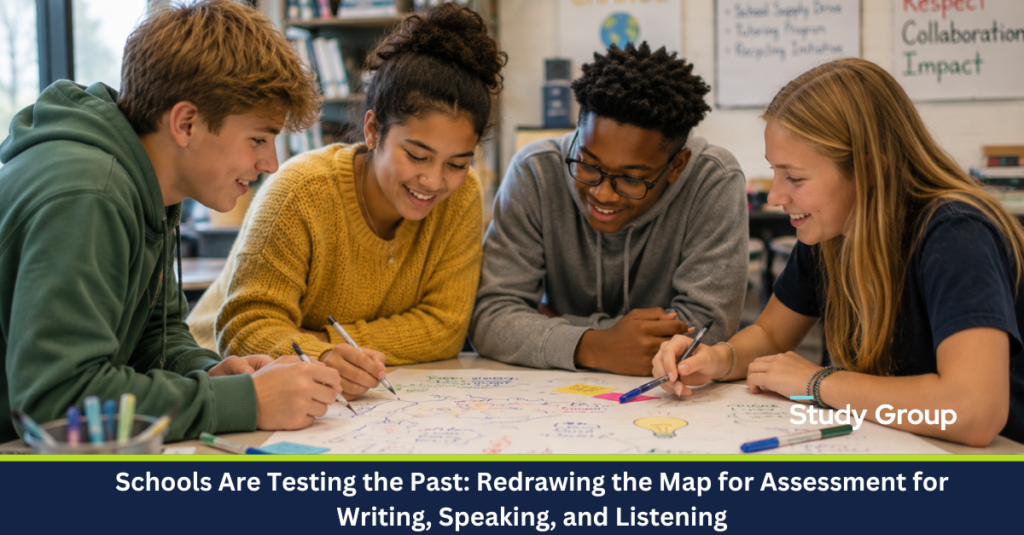
Our son Robert took the annual Arizona state writing test. The browser was locked. The tabs were closed. The phone was away. No notes, no search, no chatbot.
Then he enters the world the test claims to prepare him for. There, writing rarely begins with one person and a blank page. A memo may begin with research and an AI prompt, move through edits and fact-checking, and end with human review; a meeting becomes a transcript, summary, and action list.
What counts as work is changing. Assessment systems have been slow to absorb a simple reality: a test can be perfectly secure and still obsolete. The problem is not that students use AI, but that tests behave as if nobody does.
The debate has centered on cheating: Can a chatbot write the essay? Should a school ban AI?
Misconduct, however, is not the whole measurement problem. The deeper question is what the task is supposed to measure—what assessment specialists call the construct. Communication does not stand still. Constructs are maps of human capability; when the terrain changes, the map must be redrawn.
AI is more than an extravagant spell-checker. It is changing authorship and the evidence of competence. Tool-free tasks still show what students can do alone; systems that stop there confuse isolation with authenticity. A construct preserved by purity can still be lost to relevance.
In a recent ITC keynote, assessment scholar Xiaoming (Madeline) Xi argued that “what we measure must adapt to learners’ AI-augmented realities.” The target is technology-mediated communicative capacity: knowing when to work independently and when to prompt, co-create, verify, revise, or refuse. Across millions of Claude conversations, writing emerged as one of AI’s most common uses.
Traditional tests treat the finished paragraph as primary evidence: Is the claim clear, the reasoning coherent, the grammar correct? But these days polished prose reveals less about how it was made.
The more meaningful evidence lies upstream: Did the student define audience and purpose, compare alternatives, verify claims, detect hallucinations, sharpen the argument, or reject the output?
The writer becomes editor, and fact-checker. Voice is what she preserves against the machine’s gravity toward frictionless, agreeable sameness.
Listening has moved too. Speech is recorded, transcribed, summarized, searched, and converted into tasks. Good listeners must hear tone, hesitation, irony, emphasis, and what remains unsaid—then catch transcripts that miss the point, summaries that flatten disagreement, and follow-ups that turn ambiguity into confidence.
Speaking remains stubbornly human: live delivery depends on timing, credibility, responsiveness, and reading the room. Yet research, rehearsal, translation, slides, and captions are increasingly mediated. Testing delivery alone can miss preparation, adaptation, and accountability.
AI has not erased human competence; it has moved it. Assessment must detect what fluency conceals: weak argument, fabricated source, distorted summary, false certainty, poor audience fit, or plausible nonsense.
Schools need three kinds of evidence: what students can do alone, what they can do with AI, and whether they can use it responsibly and skeptically—the hardest competence to fake.
The 2026 AI Literacy Framework from the European Commission and OECD treats AI literacy not as tool use but as the capacity to engage with, create with, manage, and shape AI while weighing its risks and benefits. It moves beyond consumption toward agency.
Assessment of AI-enhanced competencies should follow a ladder of learner readiness. Foundational learners need protected space to build vocabulary, comprehension, reasoning, and spontaneous expression without outsourcing the struggle. Intermediate learners can use AI for bounded critique: counterclaims, comparisons, revisions. Advanced assessments can measure what Xi calls leveraging AI to solve complex problems: verification, audience adaptation, rhetorical refinement, and authentic stance.
The architecture should be dual-track: AI-restricted tasks to measure independent performance, and AI-inclusive tasks to measure judgment under realistic conditions. A student might draft alone, ask a model for the strongest counterargument, verify its evidence, and explain which revisions she accepted. Another might compare a lecture with its automated transcript and identify what the record lost.
In such tasks, process is part of performance. Assessment should examine goals, prompts, drafts, source checks, and decisions to accept, modify, or reject. College Board guidelines embody this logic: AP Seminar uses brief conversations to surface students’ decisions; AP Research traces the work in a Process and Reflection Portfolio. The aim: access to thinking the final product conceals.
Three risks follow. Cognitive surrender (which Steven Shaw and Gideon Nave distinguish from cognitive offloading) begins when students adopt the machine’s answer and confidence without forming an independent view; the result can be comprehension debt: more language produced than understood. Second, students differ in terms of fluency with tools and the “dialect of prompts.” The third is homogenization: reward sterilized polish, and schools may train students to sound like robots.
These dangers argue for careful design, not denial. Classroom and low-stakes assessments can be laboratories; high-stakes systems controlling credits, admission, or certification should move only when evidence shows new tasks measure skill rather than privilege.
What remains irreducibly human? A machine can draft the sentence, summarize the meeting, or generate the slides. It cannot assume responsibility for meaning, stand behind a claim, answer for an omission, empathize with an audience, or repair a damaged relationship. Judgment cannot be outsourced.
This is the accountable human remainder: ownership of purpose, accuracy, voice, and consequence.
Return to our son drafting in the locked browser. The old exam asks: Can you do this alone? Sometimes we need that answer. But the world asks more: Can you use a tool without being used by it? Preserve accuracy, purpose, audience, and voice when fluency is instant? Remain accountable for words partly shaped by a machine?
The future belongs neither to nostalgic prohibition nor technological surrender. AI can widen the construct of communication or hollow it out; design decides which. A school that refuses the new questions protects not rigor but an illusion—and measures the past.




0 Comments
Leave a Comment
Your email address will not be published. All fields are required.