

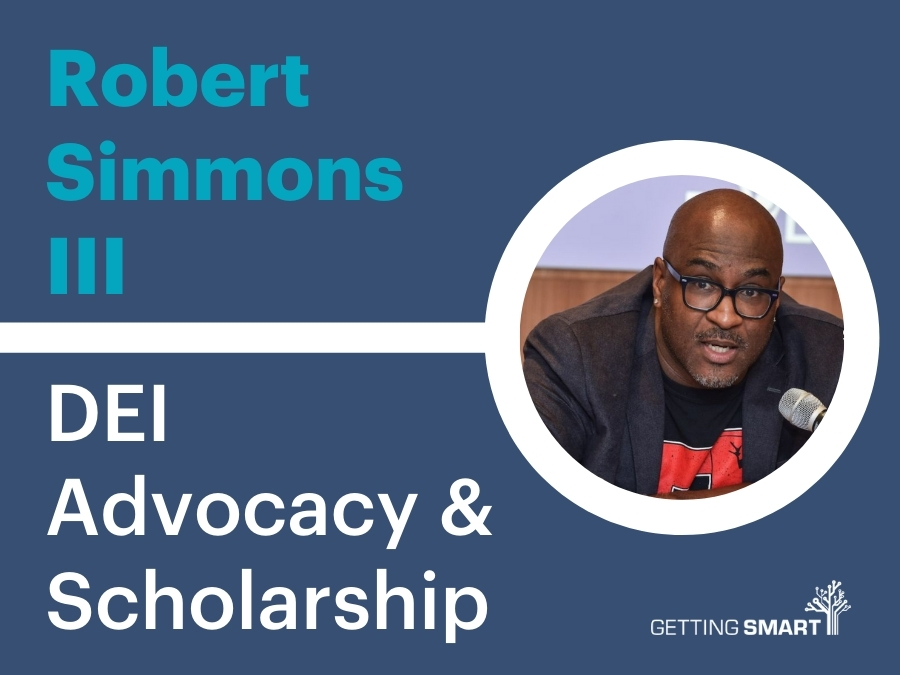
Robert Simmons III on Diversity, Equity and Inclusion Advocacy and Scholarship
Key Points
-
Self-efficacy and agency are essential for all young people, but especially for young black boys.
-
You cannot solve issues of race without dealing with issues of capitalism.
This episode of the Getting Smart Podcast is sponsored by the Getting Smart newsletter: Smart Update.
On this episode of the Getting Smart Podcast, Tom Vander Ark is joined by Robert Simmons III. Robert is an scholar and activist on diversity, equity and inclusion. Robert serves as a Scholar in Residence and a Scholar of Antiracist of Antiracist Praxis in the School of Education at American University and as a member of the Diversity Scholars Network at the National Center for Institutional Diversity at the University of Michigan.
To be afraid to talk about race with young people is problematic because young people are old enough to experience racism.
Robert Simmons III
Let’s listen in as they discuss new social contracts, longtime DEI advocacy, compounding crises, food programs and much more.
Resources:
Transcript
This transcript has not been edited for spelling accuracy.
Hey there. Before we get to the conversation, we wanted to tell you about the Getting Smart Smart Update. Do you love hearing about new innovations in learning? Every week we send out a newsletter blast to thousands of leaders in the field that highlights what we’re thinking about, what we’re excited about, and of course, the most
innovative things in education. If you’re not on the list yet, then we’d love to have you. Sign up for the newsletter at www.gettingsmart.com. All right, let’s jump in. You’re listening to the Getting Smart Podcast.
I’m Tom Vanderek, and today I’m joined by Robert Simmons III. Dr. Simmons is a scholar and advocate for diversity, equity, and inclusion. He’s a scholar in residence and scholar of anti-racist practice at the School of Education at American University, where my friend Sylvia Burwell is president at Great Institution in Washington, D.C.
Robert, thanks so much for joining us. Yeah, happy to be here and join the podcast. Listen to multiple episodes. So enjoy the guests that you have on and just looking forward to having a conversation. Dr. Simmons, you for decades have been a real advocate for equity.
I’d love to back story. Like, how and why did it become your life’s work? Yeah, I mean, I think that if it wasn’t my life’s work, I feel like my mother and grandmother and my uncle in particular would not let me in the house. My mother and father were at Spellman and Morehouse, and I have a signed first edition
copy of Coretta Scott King’s autobiography that she signed from the time that they worked with her after Dr. King’s death. And also, you know, it’s kind of the counter narrative to what you see, in particular with black men being incarcerated by my father at a Morehouse degree, but also spent the majority of my life incarcerated.
So I feel I felt compelled and continue to feel compelled because of that to not only write a new narrative for how people talk and think about young people of color, but also just standing on the shoulders of my mother and my uncle in particular for the ways in which they viewed the world and how it influenced my growing up and my current work. That’s beautiful.
In some ways, you were born into the work. Correct. Born into the work, my mother is a librarian, been a librarian for maybe 25 years. So always have on my book nerd shirt. And I, you know, probably buy a book or two a week just because I love to read books and
being around books calms me. And so I think that for me, my mother’s influence in my life, not just as a mom, but as a role model as someone who is willing to tell me about myself at moments is something that I will deeply respect and love about her. But specifically education, how did you make that decision?
I always wanted to be a teacher. There was no going back and forth. I went to college as a senior in high school. We had to do a service project. And my service project was at an elementary school in Detroit.
And we organized a fundraiser playing basketball with the kids. And I was in a third grade classroom tutoring. And I left that experience and went to college and knew that I wanted to be a teacher. Like I’m one of the folks that, you know, went in and that’s what I wanted to do. Always knew about the school of education, figured out what I needed to do to get in
and become a teacher. And that was, that was my hook. And I think for me, it was also this understanding that one of the greatest acts of social justice and the way to facilitate social change is through teaching. And like, you know, teaching it in and of itself is a revolutionary act.
In particular, when I think about the legacy of black folks not being able to, being taught to read as slaves and like it was, it was viewed as a crime for white people, any people to teach slaves to read. So for me, it was always like, well, hey, like, you know, I want to participate in that act of revolution.
So I’m going to go teach young people and went back to my own neighborhood to teach. And my first teaching job was at Jamison Elementary School, right off of McGraw in Detroit. That was born and raised in Ann Arbor down down the street. So there you go. Yeah.
Appreciate the area. How did you find Hamlin or how did Hamlin University find you? Yeah, it actually found me. I was a teacher and, you know, was going to enroll in the PhD program at the University of Michigan and had to move for family reasons.
And as I moved, I knew I couldn’t stay at the University of Michigan. So I had to figure something out. I missed the deadline to go to University of Minnesota. And so one of my good friends who was in Minnesota, a new, a professor at the University of Michigan and said, oh, you should talk to him about what you want to do.
And he said, hey, listen, Hamlin in the liberal arts world, Hamlin is like a big deal. Like it is an important institution. Don’t feel like if you go to Hamlin that people won’t know. You should really think about their doctoral program. And there’s this guy there named Paul Gorski.
And he is going to be the next big thing in educational equity work. And I said, Paul Gorski, who was this guy? Never heard of him and went there. And true enough, Paul wrote the first article that critiqued Ruby Payne. And so Paul Gorski was my advisor, was my mentor, is now a friend, and was my dissertation
chair. And my friends’ mentor at Michigan led me right by going to Hamlin. And I honestly went to Hamlin because of Paul Gorski. I did not go because of the institution, but I learned further into the work that great scholars like Walter Enlow, Vivian Johnson were there.
And that you didn’t have to be at a research one to do great scholarship and to impact educational research. So I’m grateful for my education at Hamlin, the friends that I built. And I’m still close to Vivian, Paul, and Walter all these years later. It’s very well known in the upper Midwest as a great head school.
What some will remember, they were quite active 20 and 30 years ago in the small schools movement in both urban and rural, creating great schools centered on social justice. So it’s a great place. And I know you contributed to that culture. Oh, yeah, it was a great, great time.
You know, I enjoyed it. Still talk to some of my classmates there, my cohort, a couple times a year. So, you know, don’t get back to Minnesota in the winter, but I willingly go back to Minnesota in the spring and the summer because it’s beautiful in Minnesota in the summer. In the show notes, we’re going to make a linked education evolving our friend Ted Goldery,
early leader in choice schools and Doug and the Thomas that started Minnesota, New Country, some great micro school pioneers, teacher powered schools, schools that really before it was cool took social justice seriously. Robert, this is a really hard, maybe an unfair question. I know it’s hard to generalize, but how do you think the last two years have been for
black boys in America? Yeah, I mean, you know, I think that being a black boy in America, I reflect on my own childhood, but also as a dad of a 10 year old and a four year old. Like, so I understand black boyhood at this point through the lens of my 10 year old in particular, right?
Where he remembers when Trayvon Martin happened and George Zimmerman was acquitted and just how I cried. He’s old enough to remember that, right? Not with great detail, but at 10, you know, he’s old enough for us to go down to Freedom Plaza in DC the day after the major protests and see the writing on the wall and we took
pictures. We talked about its importance to black boys and why it was important for him to be an advocate for himself, but also understand the history and the legacy of the ways in which black people and communities of color in general in the United States have experienced our democracy, right?
And that it hasn’t always been positive for many communities and how they’ve experienced our democracy. We talked a lot about Tulsa. I think that, you know, I actually let him watch the murder of George Floyd and the television coverage of Breonna Taylor because I felt like it was important.
And as one of my colleagues at University of Illinois, Chicago, David Stovall always says is that, you know, to be afraid to talk about race with young people is problematic because young people are old enough to experience racism. So they’re old enough at any age to at least have a conversation about race and racism because they experience it anyway.
And so for me, we’ve had some very open and honest conversations about it, you know, and it’s helped that, you know, he’s has a great relationship with my mother. And this summer for the first time in two years, he went to Detroit. You know, he’s been going to see my mother in Detroit since he was, I don’t know, three or four.
And she continued that education because of her legacy as a alum of Spelman, but also her time as a librarian. She continues that education with him. And so I think that for me, you know, I learned through him, I think in general, black boys that I’ve talked to have their two or three ways that folks have responded, right?
I think some are numb to it all because they experience marginalization and police brutality and other forms of violence, hunger, et cetera, on a regular basis. So the George Floyd, Breonna Taylor stuff and the protest wasn’t new to them, right? Then you have other young black boys who were totally surprised by it for whatever reason.
Then you have those who in the middle who were surprised at the protest, but not the violence, but then, you know, are old enough to articulate to me as young people. Yeah, but like, nothing is going to change because we’ve been here before with Rodney King, with Malice Green being, you know, you’re from Ann Arbor. I’m sure you remember the Malice Green murder by Walter Butson and that whole crew of Starsky
and Hutch that were the police that roamed freely over 12th and Claremont in Detroit, who recognize that we’ve been here before, right? And I think for someone in my age, where I’m almost 50 at this point, like, this isn’t new, right? I guess that this brave young black girl who was 17, I believe at the time, caught on
camera the experience of George, of the brother in Minnesota. And when George Floyd was murdered, you could just see it live on camera, right? You didn’t see Rodney King live, right? It wasn’t, it was a videotape. Malice Green, you only knew about it if you lived in Detroit.
And I told someone recently on a panel discussion about, they said, well, how come they didn’t burn down Detroit in, you know, in 93 or 94 when Malice Green was murdered? And I said, have you ever been to 12th and Claremont where that part of Detroit is? I said, having grown up there and not too far from the social uprising in 67 and all that, I said, there’s nothing there to burn down.
Like, they literally burnt down the city in the 60s. Like it’s not an exaggeration. And parts of the city have not recovered. So, you know, I think that black boys have experienced it differently. And I do think that, you know, black boys who identify as gay or trans or insane, gender
loving, they’ve also experienced it differently. And I have challenged numerous spaces around the ways in which we celebrate hyper black masculinity in some barber shops is deeply problematic for the ways in which we challenge ourselves in particular as black people and say, do all black lives matter the same? Do black trans lives matter the same as black cisgendered heterosexual male lives?
To me, they do. But is that the way in which we express our commitment to the justice conditions of black boys in America? I’m not sure. So the dialogue about police violence has surfaced systemic racism in America.
And maybe one positive sign is that we’re at least able to have more conversations like this than we were a few years ago. But Robert, here’s, I guess, what worries me about the moment that we chair is this triple ratchet of inequity. When I think about this winter take all economy that we’re in, you know, life with smart
machines that’s driving crazy wealth to the top tenth of 1%, the climate change and the global pandemic. When you put those three together, they’re ratcheting up inequality and the rich got a lot richer in the last two years. And historically marginalized communities got screwed even more so.
And so I guess I’m worried that there’s these built in ratchets that are expanding inequity, even though we may be in polite company able to more frequently discuss it, the structure or the structures of our society are expanding inequity in a in really, really dangerous ways. And we’d love to have you just reflect on, you know, what’s the new social contract that helps deal with that?
And then let’s dive into what role education can play as a part of that solution set. So how do we fix this, Robert? One of my intellectual mentors from afar, activist mentors from afar, I’ve never met. But the way that she lives her life and articulates a commitment to justice is Angela Davis, right? Angela Davis always talks about you cannot solve issues of race in America without
dealing with capitalism. Like, and again, I’m not saying this is someone who’s a Marxist or a socialist, any of those things. All I’m saying is that if you follow Angela Davis’s brilliance, right, and you think about the ways in which capitalism is structured, in order for capitalism to work, you need unemployment
and poverty, you need winners and losers. That’s just the nature of the beast. It just so happens that capitalism intersecting with systemic and institutional racism means that white people, a subset of white people, like not all white people, right? Let’s be clear.
A subset of white folks are predisposed to access to this institutional wealth while because of you have the capitalism, institutional systemic racism, as a part of this equation, people of color are then therefore less likely to have positive outcomes in education, healthcare, poverty, I mean, disproportionately experiencing challenges around food sovereignty for indigenous brothers and sisters, incarceration, so on and so forth.
So I think that it all works together and you have to tackle the economic system. And I think that again, shout out to my colleagues who are education economists and I learned today that there’s actually an agricultural economists world, which I never knew about from this guy at Duke on a conference call we had. We really need to unpack the ways in which people have access to a living wage,
not just the social safety net that the government provides, right? And again, I’m not suggesting that people don’t need snap, wick, child tax credit, any of that. What I am saying is that in order for communities to achieve generational wealth, there also has to be a pathway for them to have access to self-determination, the tools of self-determination, being able to provide for yourself,
having your own banks, being able to grow your own food, owning your own grocery stores. And there is a generation, I don’t want to be doom and gloom, there is a generation of young people who are taking this on and shout out to a young brother who I would love to see on a podcast named Rafael Wright and he’s trying to launch the only black-owned grocery store in Detroit at this point and it’s been on CNN and I am biased because he is one of my former middle school
students and whenever I see him on the news, I always text him and say like, this does not mean that I don’t get a discount in the store. So let’s be clear, regardless of how famous you are, I still get a discount as your middle school teacher for three years and your middle school basketball coach. So let’s be clear. So there is a group of young people taking this on that I think are really moving the needle and I think that at some point, old fogies like myself need to figure
out how to do this intergenerational conversation to share lessons of what we’ve learned but also think about what can we learn as an older generation from a younger generation of social justice warriors and activists and communities. Yeah, I appreciate that. It’s the way we think about capitalism. It’s the way we’ve structured our democracy which prioritizes access through wealth right and so we’ve got a tax code that benefits wealthy people and wealthy corporations and so
it’s not just the capitalist system, it’s the way we’ve structured democracy, access to voting, access to tax privileges that are a critical part of this. So I appreciate that. Let’s sort of shift education and just think on behalf of the education leaders, teachers, teacher leaders that are listening, what’s our role and how can we with be activists and help raise activists that… Yeah, I mean teaching is a form of activism right so whenever I hear teachers talking about oh my
god like all of this like teachers are becoming activists like teaching is a form of activism right like it just is right. It is a revolutionary act so I think that teachers working with young people to raise their level of critical thinking and critical consciousness is so important right and I just find that for me helping them connect the dots and deal with the nuance of the work is really critical and I remember talking to someone who was at my son came home
one day and he says dad did you know that I am no longer celebrating Columbus Day and I said oh all right well what are you what’s going on here like he didn’t discover America he says dad are you serious and I’m playing along and he said you can’t discover something when people are already there and then Columbus killed half the people there. I said yeah that sounds like genocide to me he said exactly dad I said where’d you get this from? He said well my teacher started
talking about Indigenous Peoples Day and I was like yo that’s a revolutionary act not because the teacher wanted the kids to believe X, Y, and Z about Columbus but the teacher created a statement of fact people were already here when Columbus got here. Columbus’s presence and this whole colonization all of this other stuff and led to genocide which led to death which led to Indigenous brothers and sisters being put in these schools these reform schools and all this other stuff right
and it’s not unique to America like they did it in Australia with the Maori and all these other things right but to the American experiment it then led to chattel slavery which does make the formation of our democracy unique from other ways in which slavery and those types of things are manifested and so for me you know that moment with my son was testament to the power of teachers whether I agreed with him or not which I did but whether I agreed with him or not the fact that he
was critically thinking about how our democracy was formed and what role did Columbus play and why should we call it Indigenous Peoples Day was so important and the last thing I think for teachers and school leaders and school staff is that you know the ways in which we reimagine school going forward are so important right and it’s been one of my biggest frustration points recently is that and again I was naive optimistic maybe I thought coming out of the pandemic I mean we’re
not out of it but coming into this part of the pandemic I should say phase whatever 2.0 3.0 whatever version we’re on is I thought we would reimagine education like I thought there would be a greater proclivity to consider outdoor education to consider a three-day four-day school week think about a 45-15 schedule think about cross-listing courses at different schools and figure it out if your school only has three AP courses or four AP courses this school has 10 let’s figure out how
to have kids cross-register like they’re going to a university hadn’t happened right and instead what I’m finding is that educators remain marginalized because of the system students and their families remain marginalized because of the system and I think that you’re beginning to see a significant exit of bus drivers of teachers at a rate higher than I believe we can actually replace them with qualified educators in a given year so I think we’re going to have to manage
not even summer learning loss but just a lack of critical engagement by trained professionals and I think that you know some people will say well Robert we can just take people who are retired and put them in classrooms I don’t believe in that because it’s the deep professionalizing of teaching right and teaching is a profession it’s like becoming a barber it’s like being a plumber it’s like being a doctor like you have to go to school because to learn the art and the science of it so
I think that there is a need for folks in higher ed to step in to figure out how we can we be supportive to work with folks in K-12 both as learners and thought partners I guess another tough question when you think about education and the opportunity to improve DEI I’m wondering if you can reflect on on the relative importance of structural change versus cultural change versus curriculum change
I mean is the answer you have to do all of those things yeah I mean I think you have to try to do them all at the same time right I think you can and I always equate equated to you know you can have the greatest curriculum but the worst teacher and the curriculum won’t matter you can have the greatest curriculum and a great teacher but the structures of the schooling process may not allow their greatness and their brilliance to be reflected onto those children right and so I think that
it’s problematic when you don’t try to do all of those things if I had my choice I think teachers are brilliant I just do I think teachers are some of the most creative I mean who signs up to a profession to educate 40 young people with all sorts of other things going on some of them don’t even want to be in school but yet you get a reama paper per semester and in my days a dry erase marker a piece of chalk and like you’re supposed to educate this group of young
people with the textbook that may be five years outdated who signs up to do that like you’re either a bit crazy or you’re just deeply committed to the revolution right so committed that you’re willing to make that sacrifice and figure it out and great teachers will figure out a bad curriculum but great teachers cannot exist in a system that is flawed that dehumanizes their brilliance but also dehumanizes the young people that they serve so if I had my choice it’s going to be the culture
and the systems pieces because I can hire great brilliant teachers who again and I’m guilty of this and I’ll own this for my days as a teacher look like the curriculum didn’t make sense on tuesday which are asking me to do I’m not doing that because I know my students so I’m going to do what’s in the best interest of my kids you can test them on it if you want but this is going to be the thing that’s going to keep this group of uh in my case black kids on the east side of
Detroit alive but also ensure that they can be contributing citizens um to the east side of Detroit or wherever they go um in our country and so I’ll take culture and systems change curriculum I can get to that if I had to choose um but those are the two of the three that um I really am hopeful that uh we can figure out quickly Robert you’ve been a a long time advocate of service learning why why is that important you know for me again as someone who believes that
learning can’t just happen in a textbook I think that integrating um the actual course content with ways in which young people can contribute to their community is super important the best learning happens in context you can’t learn about the biology of soil without farming um it like it just doesn’t make sense and so for me service learning was just a natural pathway to merge my commitment to community organizing and community with some of the best practices in
education right teaching and learning theory curriculum design and things like that to bring the two of them together um and you know I accidentally got into service learning like it was an accident because I was doing this project to build an urban farm when I was a first year professor at a school in Detroit and I needed a grant so I called up a colleague and said hey here’s what I’m trying to do I don’t have enough money in my budget what do you think they said oh
you should call Michigan campus compact and apply for a grant and it’s called service learning which you’re trying to do and I was like what like this isn’t this just what we should be doing like this is what I was doing as a teacher this seems like good teaching right but again as Gloria Latsen Billings always says culturally relevant pedagogy is just good teaching right so to me service learning is just good teaching right it’s just what you should do and so from there wrote a lot
did a lot of research did a lot of grants on service learning did a lot with promoting the role of service years in education launched the leading men program which is now housed at the literacy lab in Washington DC which is a pathway for black and latino men to get into the education profession so I’ve seen real impact in the work and you know I’ve enjoyed my time learning from one of my great colleagues at Penn State University Nicole Webster she was one of the folks that I
learned from about the roles the ways in which you can center race and racism and urban education and service learning and so you know I think I’ve had great mentors and partners in advancing my knowledge because I wasn’t trained in service learning like it was an accident so I learned it as an academic that what I was doing was actually part of an academic discipline called service learning I was like oh is it really all right well like what do I need to do what do I need to read
who do I need to talk to and so went to all sorts of conferences met Andy Furco and all these other great leaders that were doing all sorts of amazing things in the field so it was a great journey speaking of recruiting and developing a great diverse talent thanks for serving as a fill up word member of the Latinx education collaborative why is that work that our friend brother Edgar is leading why is that important to you yeah shout out to the big homie Edgar Palacios
you know got a lot of love and respect I mean for me my dissertation was on the journey of black teachers I grew up in a part of Detroit that was near the southwest side of Detroit which was largely where Latino brothers and sisters live so I had friends who were from that community also grew up in that part of Detroit on the border with Dearborn so had friends of mine who were Arab, Caudian, Palestinian etc and so for me I had a great appreciation for the ways in
which people of color worked and educated folks in their community and so have always been focused as an academic on the plight of black teachers but over time have begun to appreciate because of how I grew up the ways in which other communities of color are represented in the teaching profession and when Edgar asked if I would join the board I said sure you know and I’m willing to be helpful and I learned about Latino teachers and Latinx teachers because I took a year off from teaching
in Detroit and was a teacher in San Diego I found this this before the internet I guess there was the internet I just didn’t use it like that but it was in a classified ad in the Detroit free press for a job at the international school of San Diego when I was an undergrad my Latin American politics professor was a guy named Thomas Castreva he found enough money for this you know poor little kid from Detroit to go to Peru and I was there looking at Tupac Amaro because I was a Tupac fan
I was like oh great and I ended up teaching in San Diego signed up for a year was there for six months because they had a hurricane and was just like mmm martial law isn’t my thing so like I’m gonna go back to Detroit for now and keep teaching so I also learned a lot from my Dominican colleagues about the value obviously on an international level but nonetheless the value of young people seeing people who look like them in schools but also the impact that it had on your adult
colleagues because I was not Dominican right so for me I learned about Dominican culture and the ways in which young folks experience life in San Diego in particular from my Dominican colleagues and so I think that for me to have Black and Latinx teachers in the same building as racial demographic shift communities become more segregated but then you have gentrification happening I think it’s important to stand in solidarity with Edgar and Latinx educators
across America so shout out to Edgar Palacio shout out to Edgar and thanks for your work on hunger this gets back to some of the structural issues that we got to work on but you’ve done great work with no kids hungry what what speaks to your heart about that work yeah I mean I just think for me you know food is a form of social justice right food access in particular in many communities food sovereignty is super important I think the work of the no kid hungry campaign and share our strength
allows me to integrate my passion for working in communities with a deeper understanding of of the food ecosystem in our country I think that for educators in particular it is a misunderstood part of our training about the role of food lunch snap at all these other things and I think for me again service learning is what brought me into understanding food because I did work with urban farms and urban gardening and when I was a CEO of a network of charter schools in DC
we launched a hydroponic garden and a workforce development program but I also am known for crashing and burning the food contract that we had and the vendor was pissed they threatened to take us to court but I said you’re giving this group of young people crap food and then you wonder why we may have behavior problems with the group of people who are young people who are already two or three times marginalized we’re going to find a vendor who’s going to provide us healthy meals
healthy food every day that means they’re cooking it at 5 a.m. they’re delivering breakfast to us at 7 a.m. that means it’s more likely to be fresh made right and I saw the kitchen and so anyway for me the work at share our strength and no kid hungry just speaks to all those things that are super important and the last piece is my grandmother was a cook a professional cook she worked at Sanders in Detroit she had this roll recipe that people used to come from all over the city of
Detroit to get I had no idea who these people were why they were at our house but they were coming for her roles my uncle and my mother have tried to replicate it but it is unreplicable like because she never wrote down the recipe and we’ve tried to figure it out through kind of stories things that we could find but I grew up in a family where food was important where soul food wasn’t just about all the calories and perhaps a little too much salt but soul was about nourishing
the soul of black folks in a world that often dehumanize them and marginalize them in a variety of ways so food speaks to my heart speaks to my soul but also speaks to the legacy that my grandmother handed down to me hey Robert we appreciate the work that you’re doing both inside and outside the classroom we’ve talked about education today but you we work with a wide range of organizations on diversity equity and inclusion if people want to learn more about that work where would you send
them I would send them to the American University website they can find me there they can also find me on Twitter you are on Twitter brother yeah I’m on Twitter I’m active on Twitter at Robert underscore Simmons three they can also go to my website Robert W Simmons dot com and I you know have a blog there and my random musings from Twitter show up on my feed and the last thing I do want to say is shout out to brother that passed away Michael Williams I believe is his last name
I only knew him as Omar I actually never knew his real name but I think that the ways in which Omar as a character on the wire problematized the nuance of black masculinity as a gay black man as someone who robbed drug dealers it really spoke to so many people so just want to send shout out and prayers to him and his family at his passing at his Brooklyn apartment in New York City and check out Robert’s Twitter for more on that he’s got some great videos and and tributes
Robert W Simmons dot com and at Robert underscore Simmons three Dr Simmons we appreciate you and your journey and your contributions and and your time today for being on the podcast I appreciate it keep going with the podcast I listen to it as often as I can I enjoy the guest and appreciate you as one of the folks in education who have led the way over your career so much respect for the legacy that you are leaving for others to follow behind hey keep learning and keep innovating for equity
see you next week thanks for tuning in to the Getting Smart podcast today we want this podcast to be actionable insightful and a great way to learn about what’s next in learning in order to stay on the cutting edge we need people in the field to tell us what they’re hearing what they’re wanting and what they’re needing to learn more about got a topic or a guest in mind send your recommendations to me
mason at gettingsmart.com and if you like what you’re hearing don’t forget to leave a review in Apple podcasts or subscribe wherever you listen feel free to share the podcast on social media using the hashtag GS Podcasts thanks so much




0 Comments
Leave a Comment
Your email address will not be published. All fields are required.