


Richard Carranza on how AI and Arts are Transforming Education
Shownotes





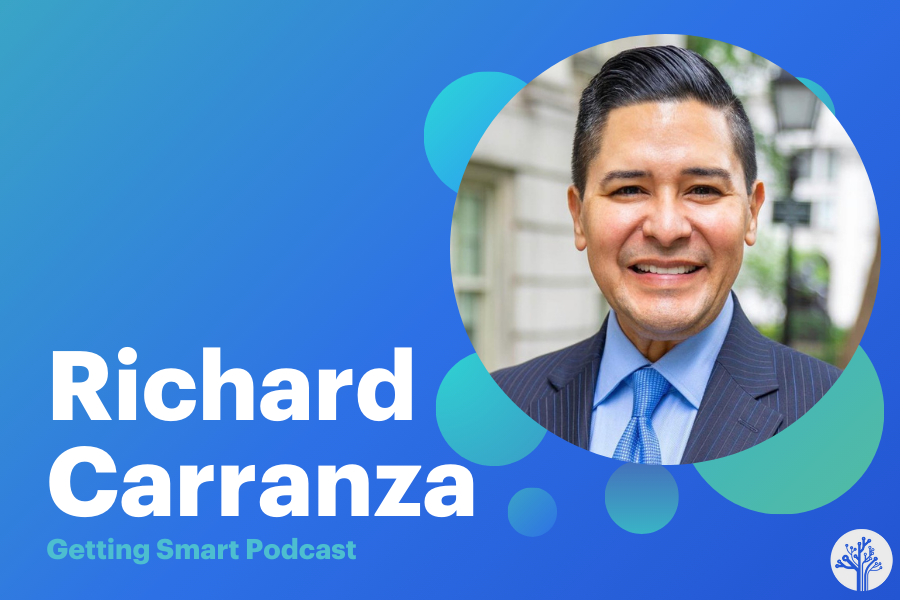
In the latest episode of the Getting Smart Podcast, Tom Vander Ark sits down with education leader Richard Carranza, Chief Strategy and Global Development Officer at IXL. Together, they explore transformative topics like the growing role of AI in education, the enduring importance of arts in identity development, and how personalized learning tools are shaping classrooms of the future. Carranza emphasizes that while AI offers powerful opportunities for efficiency and innovation, it will never replace the need for passionate, well-trained educators. The conversation delves into the challenges system leaders face, including budget constraints, changing learning environments, and preparing students for a future defined by tools and careers that have yet to emerge. Listen in to gain insights on how to lead with equity, embrace technology, and create transformative learning experiences.
Outline
- (00:00) Introduction
- (03:30) The Importance of Arts in Education
- (05:50) AI in Education: Tools Not Replacements
- (08:10) Leading Systems in the Age of AI
- (14:10) IXL’s Approach to AI and EdTech
- (27:32) Looking Forward: Advice for Education Leaders
Introduction
Tom Vander Ark: How do we transform public education for the age of AI? You’re listening to the Getting Smart Podcast. I’m Tom Vander Ark, and we are pleased to have education legend Richard Carranza, the Chief Strategy and Global Development Officer from IXL, with us today. Richard, what a treat.
Richard Carranza: Tom, right back at you. It’s a treat to be on with you, and thank you for the opportunity to talk a little bit of shop.
Tom Vander Ark: There are only a couple of education legends working today who have led some of America’s largest and best school systems. But, Richard, you were a chancellor in New York City. You were in San Francisco. You led the Houston Independent School District. But I was reminded on an old podcast, Richard, that you started as a teacher in Tucson. Is that right?
Richard Carranza: Yeah, that’s right. I was born and raised in Tucson, Arizona, and I started my career as a bilingual social studies and government teacher in Tucson. Later, I added mariachi teacher to my roles in Tucson as well. But yeah, my chops—I cut my teeth as a classroom teacher for over a decade in Tucson, Arizona.
Tom Vander Ark: I love that. I see that guitar back there, so I imagine you still play a little bit.
Richard Carranza: I still play a lot. You know, after stepping out of the chancellor’s role, I was amazed at how many weekends I had available to start playing again. So, yeah.
Tom Vander Ark: When I heard that you were a mariachi teacher, it brought me immediately back to one of my favorite school visits in the Rio Grande, where schools showed the most hospitality that I’ve ever experienced, and that always included mariachi. And so now I know that, and that was probably in 2001 or 2002. And now I know they weren’t the first that—
Richard Carranza: Yeah. Yeah. Mariachi has been a movement—kind of an underground movement—that’s now really getting its proper due. But yeah, you know, you go anywhere in the country, and you will find youth mariachi programs embedded within curricula, embedded within school systems. And, you know, people think of all the usual suspects: California, Texas, Arizona, and New Mexico. But I’ll tell you, there are mariachi programs in North Carolina. There are mariachi programs in Utah. There are mariachi programs in Illinois. So it’s really everywhere. And it’s another way of engaging our students, which I think is always interesting.
Tom Vander Ark: It is. Richard, I wanted to talk about this notion of leading public systems in the age of AI.
Richard Carranza: Yeah.
The Importance of Arts in Education
Tom Vander Ark: I have this sense that the performing arts—music and theater, even visual arts—might just be more important than ever because they’re such powerful learning experiences. They often combine an individual learning curve with a collective learning curve. So you’re learning as an individual, as a musician, and you’re learning as part of a group. These are team-based, compressed, emotional, identity-shaping projects that can be super valuable in terms of skill-building but also in terms of identity development. I assume that you think the arts are more important than ever.
Richard Carranza: I agree with you 100%. You know, you and I both have led school systems, and we’ve interviewed probably thousands of people for positions. Never once have we interviewed somebody, brought them in, sat them down, given them a test, and then based on the person that scores the highest on the test, said, “You’re hired.” No. We want people who can work in teams. We want people who are going to be good team members. We want people who are going to be creative thinkers. We want people who can take a vision and then make that vision theirs. We want people who can communicate to the community or to their stakeholders what it is that we’re trying to do. Every single one of those things that I’ve just mentioned happens in the fine arts. It happens in the arts. Much like we talk about what happens in sports, where they learn how to play on a team and you have a role and you have to carry out your role, you have to prepare. The same thing happens in the arts. So I think that the arts are not adjacent to the core curriculum. Arts are actually part of what we should consider the core curriculum because those are the skills we want our students to have when they leave us and go on to bigger and better things—post-secondary education. That’s what we want them to be prepared to do. So I think it’s an integral part of what core learning is for students.
Tom Vander Ark: Richard, two or three years into this age of AI, we suddenly have this global intelligence—this new level of expertise—available to about 4 billion of us now. And this year also includes some new creation ability where people are able to create in audio, visual, and even video.
AI in Education: Tools Not Replacements
Tom Vander Ark: How do you think about these new creation tools and what they mean, not just for artists but for human expression?
Richard Carranza: I want to be really, really clear. First and foremost, I’m a big fan of the new technology, but I want to be very clear: we will never—whether it’s AI, whether it’s computers, whether it’s the internet (remember, I’m old enough to remember when you had to dial in and then get that little sound and then you connected)—none of those things will ever replace, including AI, a caring, well-trained, passionate educator in a classroom with students. Why? Because we are in a people business. That’s what we do. We educate. We don’t educate widgets. We serve souls. So in order to do that, we’re in a people business. And that’s why you need to have well-educated, well-positioned adults who work with young minds and help shape how they develop themselves. AI is a tool. And as a tool, we need to harness the power of AI to help those dedicated, passionate educators do their job perhaps more efficiently, more strategically, and make it doable in this rapidly changing world where there are so many things that our educators have to grapple with. I think that’s the promise, but that’s also the power of utilizing AI in helping us to educate, but not ever thinking about replacing what a teacher does in a classroom.
Leading Systems in the Age of AI
Tom Vander Ark: Thank you. That was a beautiful answer. Let’s think about the role of system leaders, Richard. You spoke eloquently about the need for some new priorities—maybe some new learning goals, or at least, as Charles Fadel would say, a modern emphasis. And if that’s true in this age of AI, it means that education leaders have to be crafting new community agreements.
How do you think about that role of engaging community conversations and crafting new agreements to move systems forward? Is that harder than ever? Do these new tools help at all in terms of agreement crafting on the path forward?
Richard Carranza: Yeah. So, Tom, I appreciate you talking about agreements and crafting what those agreements are for our communities because the knee-jerk reaction could be, “We’re going to ban everything. We’re just going to keep the status quo, we’re going to ban everything, and then we’ll let people figure it out. Once they’ve figured it out, then we will see what we take and what we don’t take.” That, sure, that’s an approach. However, it’s moving so quickly, and it’s moving so fast. And we, as adults within the educational system, have to recognize that the very students—the very constituents—that we serve, the students, are in many cases light-years ahead of where we are. They’re using this in a native fashion. They’re native-born technology utilizers. So how we craft the agreements within which we utilize this technology, I think, is so incredibly important.
And then you add to that another layer of perhaps students and their communities that don’t necessarily speak English as their first language. What are we doing to bring that community into the conversation around AI? I was recently with a group of our colleagues—superintendents, some of them still in the seat, some of them that have left the seat—and the question of AI was one of the conversation points that we had. And we all came to the agreement that AI is not going to replace people’s jobs. What’s going to replace people’s jobs is those individuals that know how to harness AI and do the job. That’s who’s going to have the employment opportunities in the future. Not that AI is going to take your job, but how you harness AI is going to help you stay in a job or perhaps redefine, reimagine what that job looks like.
So if you take that then into the school system and into our classrooms, how are we positioning ourselves to prepare our students to have the skill set to harness AI and harness AI for a future that has yet to be defined? The only way to do that is by having a conversation and having community agreements about it. How are we going to do that as we educate students for a future that perhaps we don’t even know what that looks like yet?
Tom Vander Ark: It made me think of another analogy, Richard. This year, it feels like we’ve moved from prompt engineering to context engineering, where the focus is now not just on a single prompt but the data set that you introduce into your conversation with AI. It made me think that education leaders—system leaders in particular—are context engineers. They’re the ones that are really thinking about the context that they have taken on. You know, in your case, that was moving from New York City to Houston to San Francisco and just understanding how importantly different each of those contexts are and then doing the work of leadership within that context. Maybe that’s another analogy: ed leaders are context engineers.
Richard Carranza: We’re definitely context engineers, and the context matters, Tom. And let me tell you why I think context matters. So when I was superintendent in San Francisco—and again, San Francisco, the hub of the tech industry, the developers of AI in a real sense—I remember having conversations with CEOs of the tech companies. And what they would say to me is, “Look, for every innovative idea you have, you just have to accept the fact you’re going to fail. Of 10 opportunities, you’re going to fail nine times. But failure is a good thing because you learn from that failed attempt. And that’s how we get innovative products.”
And I remember thinking about that and thinking, “Wow, I’ve never thought about it that way.” But the reason I’ve never thought about it that way is because, as educators, we don’t often have the privilege. We don’t have the ability. We don’t have the leeway to fail. Why? Because we have children that we’re trying to teach, that we’re trying to move forward. So we don’t have the flexibility to fail nine out of 10 times because those nine out of 10 times, there are children in front of us that we’re responsible for educating, and we can’t afford to fail those students.
So how do we ride that very fine line of being innovative, of accepting new technology, accepting new ways of instructing or the pedagogy involved with educating children, but understanding we don’t have the ability to fail nine out of 10 times because we have kids right now that next year go to the next grade, and they have to be able to perform? Because when they graduate and get that diploma, that diploma has to stand for something. So that’s the line I think that we’re talking about in terms of how do you get innovation but then have that innovation within a bounded, I would say, a bounded experience so that we’re not failing children but we’re actually preparing them for a future that we don’t even know what that’s going to look like.
IXL’s Approach to AI and EdTech
Tom Vander Ark: Richard, about five years ago, you joined the IXL team as Chief of Strategy. I guess five years ago, I thought of IXL as a pretty good personalized math program. But it was more than that five years ago, and it really has exploded into a global powerhouse. Why did you decide to join the IXL team?
Richard Carranza: Yeah, so IXL has been one of those very quiet secrets for a long time. And again, five years ago when I joined IXL, it’s a very different IXL even in those short five years. But it’s more than just math. It’s English language arts, it’s social studies, it’s science. When you add to that, we have over 100 languages now that can serve students in over 100 different languages. And one of the things that I really have appreciated about IXL is that IXL in and of itself is not just IXL; it’s the IXL family of products.
So Rosetta Stone is part of IXL. Wyzant, which provides tutoring, is part of the IXL family. We have Dictionary.com. We have Carson Dellosa, which is one of the largest print distributors in the world. That’s part of the IXL family. So IXL has become more than just a supplemental math program. You can literally now educate students—not replacing the teacher, but helping the teacher.
And let me give you an example of that. People wouldn’t think of IXL as an assessment company. We’re an assessment company, and we’ve launched something called IXL Level Up Diagnostics. So imagine this: as a teacher, you can give an assessment—a diagnostic assessment—which is no more than 15 minutes at the beginning of the school year. Based on that diagnostic assessment, it’s going to tell you as a teacher or as a principal, or even as a superintendent, what are the specific discrete skills that your students have already mastered, are on the verge of mastering for their grade level, or are challenge or stretch goals for their students. And then it’s not going to just tell you where your students are; it’s going to give you a skill plan by which, if your students engage, they’re going to get better on those discrete skills. And as they get better, it’s adaptive. So it will give you a new set of discrete skills that the students are working on. And you don’t have to wait until the end of the school year to understand whether your students have made progress. You’re going to have, in real time, the ability to know where your students are. Where is Tom right now when it comes to decoding? Where is Tom right now when it comes to numeracy and algebraic thinking? And Tom also has a skill plan that Tom can work on 24/7 without being in the classroom—can actually take his or her tablet home and continue to work on those skills in a fun, interactive way. Well, the teacher knows exactly where Tom is.
So it’s really facilitating 24/7 learning for students. And if Tom happens to speak another language rather than English, it can give Tom support in that native language while helping Tom acquire the skills in English, thanks to Rosetta Stone, which helps us provide that kind of support. So again, I could go on and on, but that’s exciting for me—to be able to give teachers and administrators not only a roadmap of where students are but where they can go and have a real actionable plan to help them get there.
Tom Vander Ark: It sounds like you’ve introduced some analytics to support that at a system level. So not only assessment at a student level, but analytics that can really understand the progress of a class, a group, a school, or a system.
Richard Carranza: Yeah.
Tom Vander Ark: Exciting.
Richard Carranza: Yes to all of that. And I think what makes it so great is that because it’s one platform, it’s a fluid experience. You don’t have to log out from one system to log into another system. It’s a fluid experience. And again, for a teacher that’s trying to educate—and we talk a lot about the differentiated classroom—that’s beautiful. But if you have 15, 20 different learning modes, 15, 20 different learning levels, then that fluid experience is allowing teachers to provide the best experience for their students in a classroom.
Tom Vander Ark: So, Richard, are some of these new products fully integrated, and some operate independently with their own brand? Or are you trying to integrate all of them into a single platform?
Richard Carranza: Yeah, so they’re all integrated. And, you know, some of the products, for example, like Rosetta Stone—Rosetta Stone is still Rosetta Stone. But what’s powerful is that because it’s part of the IXL family, the ability to integrate Rosetta Stone into what IXL is doing around those individual skill plans is a fluid and very simple experience. Again, and I talk about logging out, logging in, having different sign-ins—it becomes part of an integrated experience. And then when you figure, well, we have an after-school program—well, let’s get some Wyzant so we get some tutoring around where students are and where they need extra help—we can integrate that as well. So it becomes really a one-stop shop for educators, parents, and students to be able to get the help that they need when they need it on demand.
Tom Vander Ark: We’re talking to Richard Carranza, one of America’s great public school superintendents. He now leads strategy at IXL. What does AI mean for IXL and the path forward? It must be an interesting challenge to both integrate it into existing products with a big footprint, but you’re also pushing into publishing at a time where publishing is changing really quickly. So we just would love to talk about AI and the path forward for IXL.
Richard Carranza: Yeah, I think what’s so important about IXL’s approach with AI is that the indisputable cornerstone of what we believe is that we will never be a replacement for that well-educated, passionate, caring teacher that I spoke about a little earlier. But AI can do wonders for learning and teaching, right? It can do a lot of things, but I think the fundamental question that schools need to ask themselves is, what is the end goal? Why are we going to use AI?
Richard Carranza: So if you think about that, it can be very helpful in creating quizzes, which IXL can now do. It’s very interesting in customizing lesson plans, which IXL does. It’s very helpful in automating grading, which IXL does. But it also allows teachers, even in very specific and important tasks like developing goals as part of an Individualized Education Plan (IEP). IXL can be used as part of that to help identify, personalize, and systematize, if you will, the specific learning needs for the very specific student within the goals that are identified in an IEP.
All of that is using AI within a very bounded environment to meet the needs of what students need. But I think one of the things that I’m really excited about that IXL has done is we’ve created something called a Spark Studio. And the Spark Studio offers teachers an entire suite of AI-powered tools that are specifically designed to help teachers support their daily tasks. And again, it’s not AI for students per se, but it’s AI to help teachers use the power of AI in creating better lesson plans, fun activities, worksheets, translated materials. Again, it helps teachers make their productivity such that they can use their real time, their personal time, in helping and teaching specific students in specific ways. I think that’s a really good use of AI in supporting the craft of teaching and the profession of teaching, while allowing teachers to have really high-quality materials and activities to continue the learning in a 24/7 kind of way.
Tom Vander Ark: Richard, I had a challenging 2024 because the Hoover Institute asked me to write a 40-year retrospective on edtech. And for 30 years, I’ve been a tech optimist and advocate. Anyway, after spending six months in this deep dive into the history and effectiveness of edtech, I had to conclude that it didn’t work as well as we hoped. I think there are a number of reasons for that. It doesn’t appear that we’ve seen a big boost, particularly in basic skills measured in traditional ways, and that edtech hasn’t been as effective as hoped. My top-line conclusion was that it really comes down to deployment.
Richard Carranza: Mm-hmm.
Tom Vander Ark: A lot of licenses were sold, but it turns out that the tools weren’t always used effectively and in the sort of dosage that was recommended. And as you’ve said a couple of times, it really does come down to good teachers and good instruction. What’s your take on that history of, at least at scale, limited contribution to student learning? And is AI, in the ways that you described, going to help us do better going forward?
Richard Carranza: Yeah. Tom, I feel really honored to be having this conversation with you because you are undisputedly one of the intellectual and practical experts around educational technology and how we’ve used it and, in some cases, misused it and, in some cases, not used it. I think it comes back to the fundamental question of what’s your end goal. Why are you engaging with an educational technology solution? What are you trying to accomplish? And I find that even in systems that I’ve led as a superintendent or in schools that I’ve led as a principal, we haven’t necessarily taken the time to identify that. What is it that we want, and how is this going to help us? That is so critically important to then determining, do you have the right partner? Do you have the right approach? What are you trying to accomplish?
Now, that being said—and we’ve known each other for a long time, so you know I speak in analogies—I think education technology in and of itself, just kind of the macro term educational technology, if you equate that to a car, a vehicle, and if you don’t know what you want or what you need or what you have the capacity to actually use in an effective way, it’s akin to, “I’ve just gotten my driver’s license. I’m a brand-new 16-year-old. I just got my driver’s license, have never driven anywhere outside of really my immediate area. And guess what? I just bought a Lamborghini.” And that Lamborghini can go 150 miles an hour with just a tap of the gas. But do I really need that Lamborghini to go around the corner to the Walmart and run an errand for my mom? Probably not. But I’ve bought the Lamborghini, so now what am I going to do with it? I’m going to park it outside, and when I park it outside, we have a hailstorm, and all of a sudden that very expensive paint job has a whole bunch of dents in it because we had a hailstorm. Probably didn’t think that one through. And now I have my Lamborghini, but guess what? I have to help move my family from one apartment to the next apartment, and I’ve got no trunk space to put the couch. Right? So would it have been better to have a truck or the Lamborghini?
My point is, if we don’t ask ourselves the questions—the fundamental questions—upfront, “What do I need? Why do I need it? And what do I hope to accomplish?” I might have saved a whole lot of money and not bought the Lamborghini and bought a really nice F-150 to help me move the couch from where I’m living now to where I’m going to live. Right? Does that mean that’s what you’re going to need the rest of your career? No. But it’s, what do you need and why do you need it? And then how are you going to implement that? I think that analogy, for me—because I’m a simple guy that tries to solve very not simplistic issues—is really critical around educational technology. And I think, as you have found, when we haven’t asked those questions and then focused on the implementation with fidelity around the solution that’s going to help us solve the problems that we’ve identified right up front, then that’s why I think you see the disconnect between educational technology and a solution and what you’re trying to solve for. You might have been trying to solve for an issue that really didn’t exist or solving for an issue that wasn’t the real issue you were trying to solve for.
Shorts Content
Looking Forward: Advice for Education Leaders
Tom Vander Ark: Richard, we’re nearing the end of 2025, and about 20,000 system leaders are starting to think about the 2026-2027 school year. What advice do you have for them? What could be different and better next school year? What should they be thinking about? What are one or two things that you’d invite them to do to make next year better than this year?
Richard Carranza: Yeah, so I think the fact that you and I are having this conversation, hopefully it’ll resonate with some of our colleagues that are still sitting in the seat and making those decisions. But there are two or three things that are irrefutably true as we go into the next school year.
Number one, there’s not going to be more money. There’s just not.
Number two, every school system leader that I know of is grappling with attendance or children attending or not attending their schools. So we’re talking about declining enrollments.
And number three, there is a real sense out there that how we’re engaging students and communities perhaps is changing—it’s evolving. And some people are talking about cell phones and cell phone bans, and some folks are talking about AI and how do we include AI.
So if you think of those three drivers that are out there, I think the question you need to ask yourself is, how do I do more with less resources? And again, I’m going to talk about IXL. So if you’re investing in an assessment system, and then after you know where the students are, you have to think about, “Oh, now I need to help support what we do about the fact that students are either on grade level or not on grade level or perhaps already on grade level. How do I provide enrichment opportunities for them? And what about my special populations—my students with disabilities and their IEPs, my students that are learning English? How do I support my multilingual learners?”
So being able to find the ability to have an assessment that gives you where they are, and then a skill plan that tells you what to do about where they are, and then an ability to check in without having to get three or four different systems, I think is really smart because you’re maximizing your dollars—your very limited dollars—and getting the information that you need to act on. So I think that’s a really—it seems like a very straightforward, easy thing to think about, but school systems are ecosystems, and you kind of have legacy systems, legacy relationships. It’s now the time to really think about that and think about how do you find kind of a one-stop, a one place where you can get as much bang for your very limited dollars as possible, and then also be able to go to your community and say, “Here’s my accountability. This is how we know where students are, and students are moving forward.”
The other thing I think we need to think about—and this is where AI really comes into play—is how do we create new classroom environments. And I’m using classroom in the globalized sense. Where do—and I’m going to define a classroom as a place where learning takes place. Now that can be in the four walls of a classroom, that can be within the boundary of a school. But I think that as we think about these new and different learning environments, we have to think beyond the classroom, beyond the schoolhouse, and think about the community as a classroom and the community as a school.
And how do we harness these AI opportunities—this technological opportunity—to really give students the tools to explore the world around them? And, you know, I can think back about when I first started teaching. You know what’s really different from when I first started teaching, aside from, you know, I was younger and probably a lot healthier? It’s this—our cell phone. So students actually walk around all day long now, with very few exceptions, with a computer that has tremendous capability, right? That can take pictures, that can take video, that can connect with students in other cities, in other countries, and make sense of this world all around them. That’s the exciting opportunity, I think, as we start thinking about this next school year—how do we expand the boundaries of what a classroom looks like and truly include the world as part of the classroom? And how do we empower our students to understand and have a filter for what’s good, what may not be good for them—physically, mentally, social-emotionally—and then how do we help them make sense of this thing we call the global classroom? I think those are the things that I would encourage my colleagues, as they think about the next immediate future, to really be thinking about.
Tom Vander Ark: That’s a beautiful picture. At Getting Smart, we love the idea of place-based learning. My colleague Nate McClennen talks about this triangle of diving into place to understand the economy, the ecology, and the culture. And that doesn’t have to be an expensive field trip. It means walking outside and noticing where you are and using these powerful new tools as learning devices. So I love that sentiment. You earlier mentioned the idea of getting really focused on a new set of priorities, being clear about your goals. You talked about the importance of great teaching, so prioritizing teaching talent and giving them the gift of focus. You talked about making a few tough decisions in this upcoming budget cycle because you’re probably dealing with a smaller budget. So getting clear about what your priorities as a system are. Embracing real-world learning, community-based learning. So I love that advice.
Richard, as we close this out, you’ve had an extraordinary career—first leading public systems and now in edtech. I wonder if there are a couple of people that come to mind that have prompted your thinking, supported your growth, that you want to recognize.
Richard Carranza: Wow, what an opportunity. The list is long, and the list is very, very personal to me. I think I’ve had some incredible examples in leadership and mentors. Carlos Garcia comes to mind. Stan Paz comes to mind. Darlene Robles, Maria Ott—you know, just incredible people that I’ve seen lead from an equity perspective and been great people. But I’ve also had some really great people that I’ve followed and learned a lot from. And, Tom, I’ve got to tell you—and this isn’t self-serving—I’m telling you, Tom Vander Ark has been one of those people that I’ve always followed and really listened to and read what you’ve written.
I have to be very, very transparent. Paul Mishkin, who is the founder and CEO of IXL Learning—one of the reasons I came to work for IXL after I left New York City was obviously a great organization, but it’s Paul’s vision. He’s, right now as we speak, probably 20 years ahead, thinking about where we’re going.
Tom Vander Ark: Richard, you’ve been a leader in the Council of the Great City Schools for a lot of years. I appreciate your commitment to that organization, and what it signaled to me is just your commitment to learning together with other superintendents. So I appreciate your leadership there.
Richard Carranza: I really appreciate that, Tom. Yeah, great organization. But, you know, anybody that’s sitting in the seat right now—whether it’s in the classroom seat, the schoolhouse seat, the superintendent seat, the board seat, or the parent seat at the kitchen table helping students figure out what they’re learning—it’s never been a more challenging time, but also, I think, never been a more opportunistic time to really redefine what learning is, what we should be learning, and how we should be learning, and really bring the technology to bear to help us do that.
Tom Vander Ark: That’s a super closing thought. It’s easy to doom-scroll on the crazy, infuriating, frustrating, scary stuff that we’re living through, and yet there’s just never been anything like the opportunity that’s right in front of young people every day.
We’ve been talking to Richard Carranza. He is Chief of Strategy and Global Development at IXL. Where can people find out more about your work there?
Richard Carranza: Yeah, really simple: IXL.com. Anybody can log on and see what IXL is up to now. And then it’s very easy to find me on LinkedIn, but it’s also easy to find me at [email protected]. I’m happy to connect people with folks that can help them figure out where they’re going next.
Tom Vander Ark: Thanks to Richard Carranza. Thanks to Mason Pashia, our producer, and the whole Getting Smart team that makes this possible every week. Until next week, keep learning, keep leading, and keep innovating for equity.
Richard Carranza: Thank you, Tom. What a treasure to be able to spend some time with you, my friend. You look good. You sound good. And I hope we get to connect again soon.
Guest Bio
Richard Carranza
Richard Carranza is the Chief of Strategy and Global Development at IXL Learning. Richard has more than three decades of experience serving at nearly every level of education, including Chancellor of the NYC Department of Education, superintendent of the Houston Independent and the San Francisco Unified School Districts, and chairman of the Board of Directors for the Council of the Great City Schools. In his current role, Richard utilizes his extensive background to help IXL meet the evolving needs of educators and identify where the company can make an even greater impact.
Links



0 Comments
Leave a Comment
Your email address will not be published. All fields are required.