

The Future of Learning with Dr. Pamela Moran, Byron Sanders and Dr. Ed Hess
- SEL
- Design Thinking
- Digital Literacy
- Creative/Academic Foundations
- Dr. Pamela Moran
- Virginia School Consortium for Learning (VaSCL)
- Byron Sanders
- Ed Hess
- Big Thought
- Getting Started with High School Redesign
- Hyper–Learning: How to Adapt to the Speed of Change, by Ed Hess
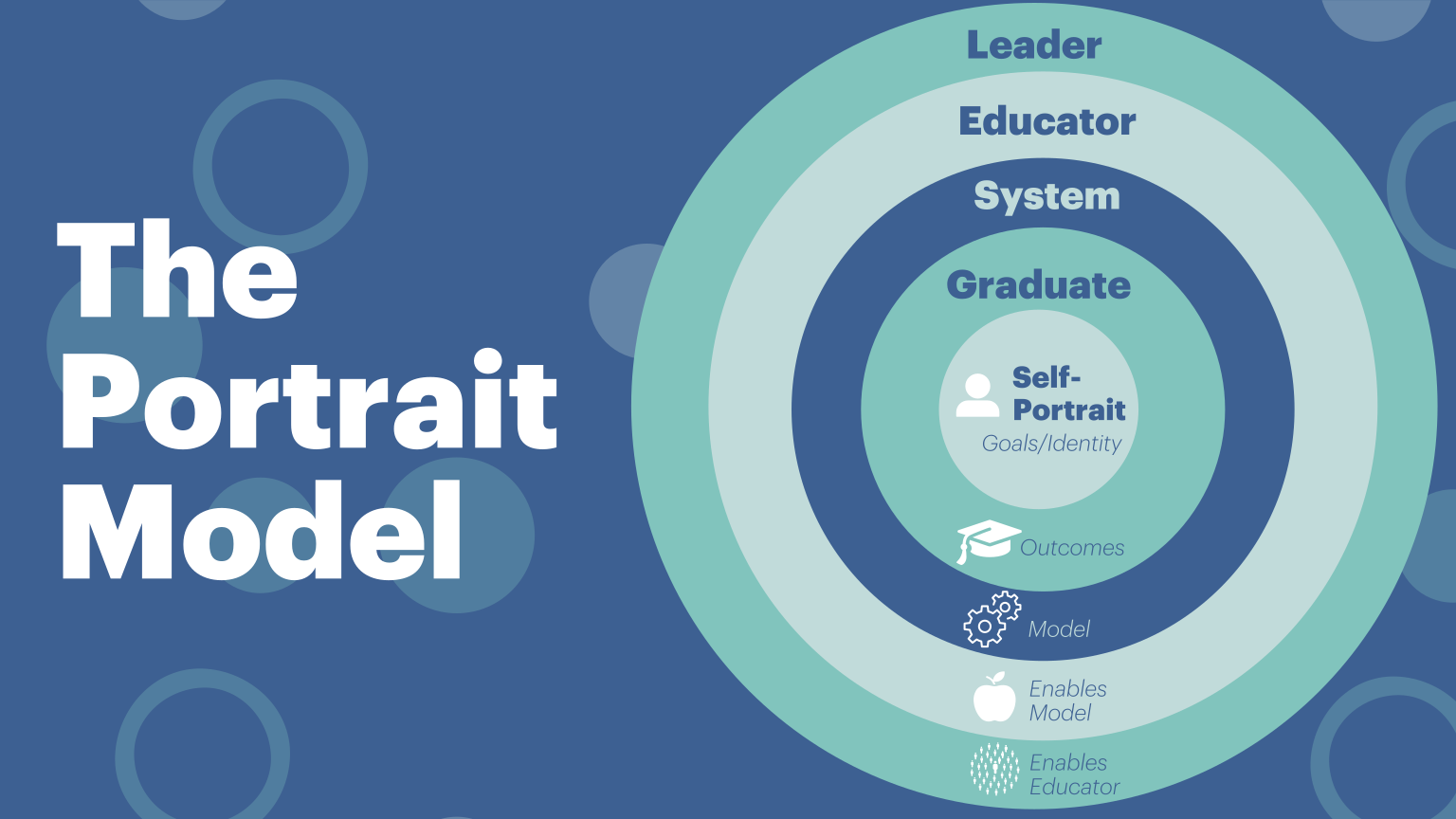
- Portrait of a Graduate
- Difference Making at the Heart of Learning: Students, Schools, and Communities Alive With Possibility, by Tom Vander Ark and Emily Liebtag
- Journeyman Ink: DaVerse Lounge
- Creative Solutions
- We Are Crew: A Teamwork Approach to School Culture, by EL Education
- EL Education
- Valor Public Schools
- Getting Smart Podcast Ep. 236: “Listening to Kids and Designing from Scratch for Timeless Learning with Pam Moran”
- Getting Smart Podcast Ep. 254: “Byron Sanders on Closing the Opportunity Gap in Dallas”
- Getting Smart Podcast Ep. 283: “Ed Hess on Adapting to the Speed of Change”
- GettingSmart.com/InventionOpportunity
Transcript
This transcript has not been edited for spelling accuracy.
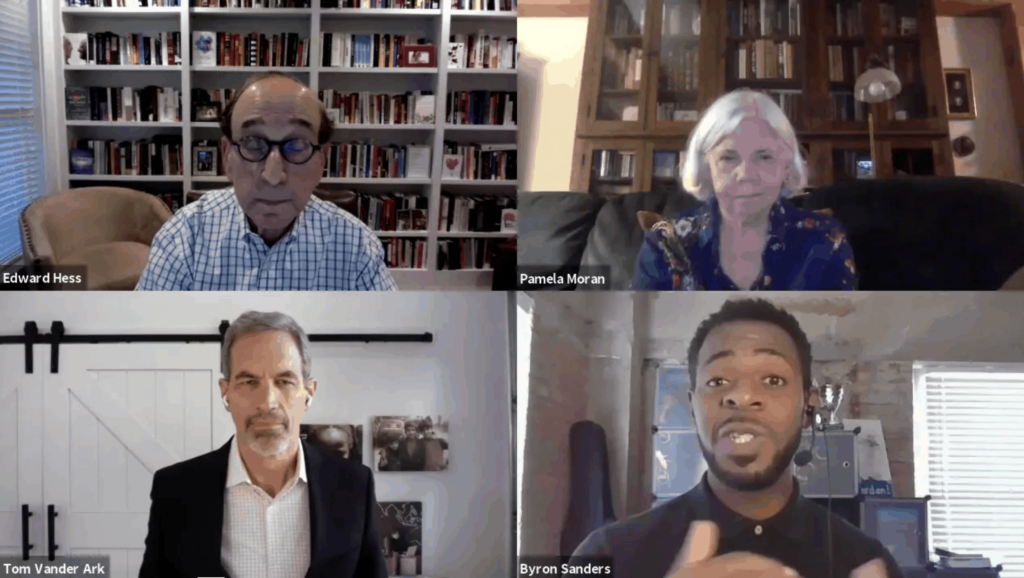
You’re listening to the Getting Smart podcast where we unpack what is new and innovative in education. I’m your host Jessica and today I’m excited to bring you a powerhouse panel of Ed leaders that are discussing the future of learning. Today you’ll hear from Dr. Pamela Moran, Byron Sanders and Ed Hess. Here’s a little bit of background about each of them before we get into the interview. Dr. Pamela Moran is recognized nationally as a leading
advocate for contemporary education. She currently serves as executive director of the Virginia School Consortium for Learning and routinely consults with higher education, nonprofits and school districts. Byron Sanders is the president and CEO of Big Thought, an organization that serves 150,000 students at more than 400 locations with creative enrichment. Their work is about closing the opportunity gap and building agency, hope and creativity.
Ed Hess has spent more than 20 years in the business world as a senior executive at Warburg, Paribas, Becker, Voucher and Company, the Robert M. Bass Group and Arthur Anderson. He is the author of 13 books and over 150 practitioner articles and over 60 Darden cases, dealing with innovation and learning cultures, systems and processes. Let’s listen in as Tom speaks with these esteemed guests about the invention opportunities in learning.
Hey, welcome to the Getting Smart Podcast. Today we have three friends of mine, Pam Moran, who leads a consortium of schools in Virginia. Dr. Ed Hess from UVA Darden Business School and our good friend Byron Sanders who runs Big Thought in Dallas. Welcome to the podcast, guys. Hello. So good to be here. Great to be here. Today we’re going to talk about high schools. What I think are probably the most absolutely part of our education system. While talking to
the doctor, Hess, a few weeks ago when we reviewed his new book called Hyper Learning, I said at the end of the podcast, Ed, we should really do another podcast and talk about what a hyper learning high school might look like. Ed, your book suggests that we should, as humans, learn to do stuff that computers aren’t very good at. And that means that we should excel cognitively, behaviorally, emotionally in ways that technology can. That seems to set a new
stage for how we should think about education. So I would love to have you sort of describe this new setting that we’re in and this notion that we should take into account the fact that we’re now all working with smarter machines regardless of what our profession is. So describe that set and maybe the implications for us as educators. Sure. We’re already in the digital age. What’s coming over really the next five to 10 years and acceleration of the digital age, which is
best research shows that in 10 years we’ll automate somewhere between 25 and 47 percent of the jobs in the United States. And the thing that’s mission critical for education is that people are going to have work if they can add value in ways that technology can’t add. And that’s basically three buckets. Think differently than the technology. Creatively, imaginatively, innovatively, higher order, critical thinking, making decisions when there’s not a lot of data.
But most importantly for everybody, no matter what level of education they are, the ability to go into the unknown and figure it out, because things are going to continuously change at such a rapid pace that we can’t rely on things that we learned years ago. And what’s going to become really important is how to skills. And I’ll come back to that. The second big area that’s going to be uniquely human, at least for the near future, is emotionally connecting and
relating to other human beings. So anything involved in the service skills, the service skills, being able to know how to do that, to be able to, if you will, how to also manage your own emotions. And all of this brings together the fact that these tasks that are going to be uniquely human all involve other human beings. All right? All of the thinking work is going to be done in small teens. So being able to collaborate effectively, to be able to build caring, trusting relationships,
there should be a theme here. Our ultimate uniqueness is going to be emotional. That’s going to be our ultimate uniqueness. Notice I didn’t say content. All right? Content is going to be, is going to have a purpose. But content’s not the end game anymore, because technology is going to know more content than we will ever know, be able to recall it much faster and perfectly. All right? We have to, we basically, what we have to do is change, in effect, overcome the way we think,
and continually update what we believe the rules are, what we believe the content is, to update our mental models. And that’s some of the big how, how to skills. In the digital age, we basically have got to also, in order to do this and behave the way, we got to learn how to manage ourselves, how to manage our mind, how to manage our emotions, how to manage our ego, how to manage how we think, all of that gets down to how we listen, how we relate and connect to
people. So in a large way, what’s going on is there’s going to be a human transformation, all right? As well as a work transformation, as well as a systems type of transformation. So soft skills are going to be critical, how to skills, behavioral and emotional is going to be as important as cognitively. And the critical thing, and I’ll make, try to, I’m trying to make it short. The most critical thing is, is that we’ve got to accept the science of, let’s say adult learning,
all right? Because once, what we’ve got to do is understand it’s the same science once we get to high school. It’s, we’ve got to understand that we’re suboptimal learners, all right? We basically are wired to see confirmation of what we’ve been told or learned or think we know, affirmation of our ego and to keep the cohesiveness of our stories. In the world we’re going into, we’ve got to train people to seek novelty, exploration and discovery, to go basically seek disconfirming,
to continually learn and ask questions and what if and why not, and to embrace differences and to be able to collaborate as human beings in a caring, trusting way. And that raises the biggest challenge in our society. Survival of the fittest culture has got to go into trash can. The otherness culture has got to come out. We have got to become a country that’s basically based on human dignity, economic dignity, social dignity, etc. And you can put justice after those dignity
words if you wish for the interim part. That’s what the school system, high school system has got to prepare people for, to go out in that world and live in a world that their parents and their teachers didn’t grow up in. And so how are we going to give them the experiences to behave, to go out in the world and behave in a way that they can find meaning and purpose with each other? You’ve laid out a big contrast for us between what exists and what’s coming.
Byron, when you think about that set, how should we redefine the purpose of high school or the goals for high school? First of all, Ed, Dr. Hess, look, man. My brother Ed is how I’m going to refer to you from here on out because everything you’re saying speaks to my whole existence right now, sir. Fantastic. Fantastic. So, Tom, frame the question again. I’m still coming down off the high, honestly. I got to give you a response. We go ahead.
How do we think about the purpose of high school? Yes. How do we take that set that Ed just gave for us and turn that into, you know, today we define high school as a set of graduation requirements. You have to pass these classes with some grade. Is there a better way to think about the goals for high school? 100% think that this is a time where we should be redefining the purpose of education period. High school being, you know, the tail end of that from the K-12 system. But
honestly, we should be thinking 3 to 23 when we’re thinking about our entire pipeline. And the redefinition of high school is so critical because I think really we’re just catching up even for the world that we have lived in thus far. We haven’t even talked about everything that Ed just talked about on the horizon. So, what I would say is the recalibration of the currency, of the things that we just heard about. One of the things that we’re doing at Big Thought,
it’s actually named in our strategic plan, is we’re trying to recalibrate society’s value of the currency of creativity. Too many of the things that we have said are nice have always been critical. But just because of how we’ve been as an industrial society and how we have quite frankly structured our caste systems on social status and all of that, we have not properly attributed the actual value that people have been bringing. And so,
if we can bring those things into line and redefine high school and stop saying, hey, what we want to do is go and get you ready to go get a job. Because what we need to do is to prepare you for a world that we can’t even imagine. We need to be preparing creators. And that’s the difference between what we’re saying when we’re trying to get graduates versus creating creators. We have this entire archetype. It’s called the creator archetype and there’s five different
domains. But social emotional learning, by the way, social emotional foundations, that’s actually the biggest anchor. Then you have digital fluency, you got artistic and academic foundations, you have civics and service and then design thinking. But all of that comes together to say, to what end, what we’re trying to do is create an entire archetype of a person who can step into a murky frontier that we’ve never seen before and be able to thrive. If we start talking about
high school like that, that means now, if that’s the goal, we got a whole bunch of things we have to recalibrate in how we’re structured in the concept and experiences we’re creating for young people. Also, stop thinking about high school as just the building and we think about that entire day that young people are living through. Yeah. Yeah, I totally appreciate that. I’m glad you brought up creativity. It underscores Ed’s conversation about walking into complexity and being a creative
problem solver. If we really took that seriously, that means you got to change everything. Right? Pam, the state of Virginia a few years ago adopted a portrait profile of a graduate and when you were superintendent of Alvomar, you all set a graduate profile. Are those a pretty good step in this direction or would you go even farther in sort of redefining the goals? I think it’s a step, Tom, but I think that there’s so much work to do and when Ed has been such a
wonderful mentor to me for one thing, I would just say that the Darden School in general has been a place that has offered its expertise and opportunities for educators in Alvomar around a lot of different areas of focus when I was superintendent. But Ed really emerged for me as the person who was moving the dial to something that I coined when we wrote Timeless Learning with Ira and with Chad that we started calling zero based design. And what I really think is that the entire mechanized
structure of high school as it’s known in this country, if it’s not blown up, that what we will continue to do is to tinker around the edges of change and we’ll create some pockets of really cool things going on, but the substantive change that would benefit every high school student at this point in the way that we label high school would not be there for most kids. And what I have found is that there are examples of really interesting work where high
schools have sprung up. Oftentimes, I don’t want to say necessarily charters, but lab schools are one off programs like for us, it was Murray High School and Alvomar or our teams program where you would say there are elements of Ed’s work embedded in there, but it’s not systemic. And that for me is the biggest challenge is first and foremost, I think I would throw out the title high school and try to come up with something that was a better approximation
of what we wanted to accomplish there. The other thing that I would be getting rid of is time as the singular variable that controls pretty much everything that goes on in the life of a child 14 to 18. I also add and Tom, your work together, hyper learning and thinking about place based learning, how do you take down the walls and say that you don’t go to high school to learn? High school may be a place where people meet up in order to find learning opportunities all over
the community in the world. You’re speaking Byron’s language there. Yeah, and so you know, that’s the community as the classroom. That’s it. When I started to focus on particularly even evolving some of my thinking after leaving Alvomar, I started thinking about that the work that needs to happen in high school today, which I see much of what Ed’s has in learning at the speed of change, hyper learning as being about social emotional learning as a bucket that includes things like
empathy, includes things like kids learning to work together and looking at things like new literacies that we have a very narrow definition of what it means to be literate. How do kids start to really branch into data literacy, media literacy, new literacies beyond just the way we define it right now? I also think dispositions. You know, if our kids don’t have dispositions that are social cultural, that are curious, that are resilient ways of thinking about who they are as human beings,
that we miss the boat there. And then I think those technical pieces and I’ve actually started to think of creative production as a technical skill. Too often we define creativity as almost like the way we define giftedness. Either you’re an artist or you’re not. You’re a higher level math student who can do math at any level or you’re not. What I think we have to be able to do is to redefine the technical skill sets as being ones that all kids and any kid can learn and learn to do well.
But here’s what I think the key thing is to get to what Ed’s talking about. And he and I’ve had conversations about how long the U.S. educational system has before it becomes a failing institution. We can’t continue to define curriculum or assessment or pedagogy or the resource use, our time, our space, our culture, our community in the ways that currently it’s defined in high schools. And that’s why I think that what you really have to be able to do is to take apart the
system as we know it and build it anew. And I think that what Ed’s putting out there, somebody could do that and it would be a game changer in terms of a model for the rest of the country as a high school. You’ve put me in the in between like I show up on this screen between Pam and Ed and I feel like the energy here, it’s like I found my tribe. Thank you. Thank you. I knew you’d get along. Ed, as we spoke a couple of weeks ago, you know my new book is
called Difference Making and it’s students’ radical proposition that high school ought to be a place where you figure out who you are and what you’re good at, what you care about, and where and how you’re going to act on the world, how you’re going to make a difference. And that difference making is the new superpower. Does that make any sense to try to describe that somehow as part of their new core purpose of high school? Yes, absolutely, absolutely. And you
and I on that point, I think get to the same end result. We use different words, but the substance is the same because the essence of being a hyper learner, you cannot excel at lifelong learning and it doesn’t have to be discovering some new way of building something. We’re talking about learning for you’re taking yourself where you are and continually improving. You don’t have to be a nuclear engineer. We’re not talking about producing a world of nuclear engineers. And the reason that
I resonate with what you said so much, Tom, is that the foundation to hyper learning is inner peace, is individual inner peace, quiet ego, quiet mind, calm body, and a positive emotional state. And we have to train human in that you can go back 2,500 years to the ancient eastern and western philosophies and come forward to neuroscience. There is a science of how to do this so that we send people out in the world and they have a story about who they want to be and what it means to
be successful in a community, a communitarian world, not a cutthroat survival, the fittest world. And how do I want to behave today? How do I want to behave today? And how do I control what’s going on inside of me and learn how to do that? That’s all learnable and it takes practice. And you practice in school with your classmates and you help each other. And all of a sudden you’re talking about a completely different dynamic. And so I think we have huge overlap on that. So I want to use that
as a pivot to the second section of our dialogue around the kinds of learning experiences that are really going to benefit students because Byron, I think we just decided that you got to start with yoga and meditation. So that’s a different way to start high school, right? Yeah, man. Yeah. Tell me about some of the experiences that you think would be valuable for many high school students. Yeah, counterintuitively, right? Usually what you hear whenever you ask this question is you go get a
really cool internship somewhere or you might or you get an AP class. That’s actually the more you know, usual answer. We think differently in our world here at Big Thought. We think that the ones that give you the most momentum moving forward are things like a partnership with an organization called Journeyman Inc. that we do. It’s called Diverse Lounge. Diverse Lounge actually shows up. Big Thought conducts the clubs that take place on middle schools and campuses,
and high school campuses over the course of the month. And young people come and whether they’re doing poetry, they’re learning to write poetry. Love it. And they’re learning to then talk about that poetry and say that poetry aloud. So there’s actually a literacy component that’s part of it, of course, right? You know, tax align, teaks align here in Texas. But also you’re learning how to be a human. You’re learning the depth of your humanity. And then what happens is five or six
times a year, we have this Friday night event in this part of Dallas. This is kind of the place where clubbing happens, bars and all that stuff, but that’s not where bringing your children. We actually go to this place called Life in Deep Elm. And 500, 300, you know, kids come here from all over the region, and they get on stage, and there’s a band with drumming and jazz musicians and all that stuff behind them. And they read the things that they’ve been working on over the course of
those months. We’ve had some amazing stuff. People have come out on stage, people have talked about children have talked about their own postpartum depression, people have talked about their immigrant story. They’ve talked about their mother. There’s this one kid who wrote a piece in Spanish, and you know, only the people who spoke Spanish knew what it was, and everybody’s laughing, and then he translated it. And it was about passing gas. It was, you know, they get up there and they
talk about everything. But it’s a place of healing, affirmation, and a deeper exploration of self. And that’s exactly what it is talking about. And the youth who come and engage in this do better. They do better in school. They do better in all the things that we say we care about. That’s one example. There’s another where we have, it’s called creative solutions. We’re actually working with young people from the juvenile justice system. And people who have been written off quite frankly.
And we, you know, many of the listeners probably know about adverse childhood experiences. The ones that we’re working with on average have had 14 distinct traumatic events that happened over the course of their lives. And many people have said, you know what, damaged goods, right? Maybe this lost cause, that could not be more wrong. And these young people come with us seven weeks. What are they doing? They are working artists over the course of those seven weeks. And we’re
not asking for the artist, don’t send us your artists, right? Don’t send us who you think are artists. Just give us young people and we don’t have any, we have the fewer screens. We’ll take all kinds of offenses. Doesn’t matter. But the stories that come out of this and the gains and the leap forward that a lot of our young people see over that period of time, it’s because there’s a trauma-informed response to the trauma that they have, that they’ve gone through and they’re getting
all of these assets that they can move toward healing. And it affects everything in their life for years to come. So when we talk about what kind of experiences we can create, that should be where high school hangs their hat. And it shouldn’t be just in out-of-school time spaces. We need to move this into the cake. Get it out of the icing. Hey, Pam, what, are you going to follow that? Like what kind of experiences?
Being in the room with people that think like Byron and Ed and you, Tom, is always a treat for me. I’ve often said, I just like to be the person that sits on the couch and listens. But one of the things that I think about that Ed said is that people have to learn to quiet their egos. And at some level, you know, my business partner and I talk about high school a lot and that high school seems to either create people with big egos or to create people with damaged egos. And a lot of
that happens as a result of grading systems, sorting and selecting who the cool kids are, who isn’t, the caste system that plays out. And I’m referring, I just want to pitch this to you guys and ask what would need to change if what we wanted to do was to move towards kids who have quiet, who understand the concept of quiet egos and why that is an important disposition to have success in life. I’ve kind of moved away from that idea that I’ve been saying to people
of recent that college career and workforce readiness as outcomes are kind of a low bar for what we want for our kids by the time they are in that high school to graduation age. But what would you do to create a high school environment where kids learn to do the kinds of things that you’re talking about to quiet their egos? What would need to change? May I throw out an idea, Pam? Change the definition of smart. All right. You know, at least when I
was growing up in high school and graduate school and multiple graduate schools and even the business world, all right? I mean, the fact is, you know, knowing more than somebody else and knowing it faster, you were smart and then you identified in yourselves being smart. And then, you know, I go back to my concept of new smart, you know, I’m defined not by what I know or how much I know, but by the quality of my thinking, listening, relating and collaborating. In other words,
you got to have a quiet ego in order to be a lifelong learner or a hyper learner. Because if you don’t have a quiet ego, you’re going to be a crappy lister. You’re going to be closed-minded. You’re going to be defensive when somebody basically disagrees with you. You’re going to have divisiveness. And it seems to me that listening to the three of you, and this is such a great joy for me because y’all are, I’m not an expert in your field. And I’m learning. It’s what seems
to me that we’re talking about the high school of the future is going to be, if you will, the biggest size class is going to be four or five people. All right? Because people are people basically, basically the times things we’re talking about, people learn it by doing things, by having conversations and making meaning in their own mind and making meaning with classmates and making meanings with instructors and teachers. I mean, that’s all sort of small team type of stuff. And because it’s
journaling on a daily basis and think about the art stuff and the creativity stuff, that’s, y’all all know this. That’s all experiential and people go at their own path. And so, maybe there’s a new way of quote grading. What we’re looking for is personal improvement. And basically, my biggest competition in your new high school is not Tom, not Pam, not Myron. It’s me. I know where I’m starting off. And now, how do I basically improve my skills?
And if I improve my skills, I get a good grade. If you still give good grades. I love that. In addition to project teams, Ed, I think the other structure where this kind of learning happens is in an advisory system, where you meet with a small group of students and a mentor or an advisor that you have a sustained relationship over multiple years. And that in that small setting is where you can really begin to understand who you are,
how you relate to other people in the world. You can begin to get feedback on how am I doing and who am I becoming and what do I really care about. Ed, I think about EL education. They just released a new book called We Are Crew. And it’s the best description of a high school advisory system that’s been produced. They have a lot of videos and online content, ELeducation.org. But also think about our friends in Nashville, Valar Public Schools. They open every morning with
circle time. They call it Compass, where they learn to talk to each other. They learn to quiet their mind. They use strategies of mindfulness. They learn social-emotional skills. It’s where an advisor helps them reflect on their social growth as well as their academic growth. So making that advisory structure and relationship central to the secondary and post-secondary experience, I think, is part of the answer. I agree with you. I agree with you 120 percent. Because I’ve experienced
that and in fact, we’re doing some work here on, if you will, sort of hyper-learning skills for, we’ll call it the workforce people that people are not in the high-level jobs, preparing them for the digital age. And we’re going to use that type of model, that advisor, small, but in small groups that where you… So I completely agree with you, Tom, that is a mission critical process to help people go through.
And I want to add in to that, Pam, to your question and Ed and Tom are talking about here. We oftentimes treat youth and children like they’re a different type of organism from the rest of us. Like they’re not human. Because what I think most of us would prefer, and I think when people thrive, matter of fact, we even treat it as a luxury, executive coaching. Think about what that looks like and how that feels. And who is your competition in that,
to your point? It’s of course you, right? You do the baseline. You identify the things that you need to fix and you actually have a facilitator as opposed to someone who’s the sage on the stage, who’s chalking and talking and telling you exactly what you need to be doing, when you need to be doing it, right? It’s a process to engage in thinking. And I’m excited about the opportunity for those things to show up because it’s not rocket science, but it takes a collective
massive effort of will to undo the structures that we currently have so that we can get to a different place. And I wanted to spend a little bit of time on the stakes and what we’re really facing here. And not everybody will bear the brunt of this changing economy the same. And when we’re talking about race and those class distinctions to the point that you were bringing up, the stakes are so high for communities of color. When you think about this, McKinsey’s report on
the effect of automation on black communities and communities of color is really scary, honestly, when you think about it. And I think to the tune of 4.6 million people are going to be automated out of a job within the next 10 years or so in the black community. And that’s about 10% higher than white peers in some cities. The Latino community, 46% of working people in the Latino community in some cities are at risk of automation over the next 5 to 10 years. There’s an existential
crisis. And when those communities don’t have opportunities to work and to earn, it affects everybody. It starts there, but that’s when you get a failed state, right? That’s when you get a failed society. So the stakes are high for us to start to adjust how we’re preparing people for that, preparing people that world so it’s not just the first job, but the job that comes after that and after that and after that. Yeah, but Subharn, I want to go off script a little bit and dig into this
because it’s super important. So you and I know a lot of equity advocates that would say yes, and as a result, we got to double down on AP. We got to make sure that our black males are getting through algebra 2 because that’s the barrier to getting them into college and college in this economy is what makes a difference. So there are people that would double down on the failed system that we inherited with good intent because they want the best for the
kids that are least well served in the system today. So structurally that we need a new set of agreements, particularly in communities that are underserved today that help reimagine a new education system, sort of a new diploma, a new transcript that describes a new set of skills. Any thoughts on that agreement? Craft team? Absolutely. We have to be able to walk in Chugam at the same time. There’s an immediate set of I think triage that needs to happen.
Stat for the black and brown communities right now, I’d also challenge us and say, you know, how are we doing at that? Are we really playing the game out there in making these changes to reach our black and brown communities the way that we need to? That’s why to the point that you just brought up a little bit earlier, we can’t do this without policy remedies. Because as long as states from common courts who, you know, states that want to
kind of go with their own are saying standard, you know, 3.2 is the thing that we need to be focusing on, that’s what we’re going to focus on. That’s just period point blank. So if we want to change the game, we’re going to have to bring in stakeholders who allegedly are the ones with the consumers of what the K-12 system is producing. And they need to raise their voice about the things that they’re actually saying are critical to their world. So when I say we need to change the currency
of creativity and emotional intelligence, it’s not just within our school systems. We need our workforce to start to speak the same story and sing the same tune. Because when we start to see that, then that’s when our legislators will start to pay attention. That’s when our state boards of education will start to pay attention. And that’s when we’ll get this critical mass of the collective will that we’re going to need in order to blow up the system the way Pam was saying we needed to a
little bit earlier on. Byron, can I make a yes and comment to your comment? I think what’s at stake is our democracy. I think the reason I said yes and everything you said, all right, it’s what’s at stake. What you were talking about is you are more than correct. But fundamentally, our democracy is at stake. Because if we don’t, within five to 10 years, people with money in this country are going to have the ability to embed technology in their bodies, which is going to
basically allow them, there’s going to be a class in our society that can be technosapiens. Right? Within 10 years or less, people are going to have a neural net. People are going to be able to basically accelerate their ability to, if you will, integrate into all of the various technologies and what’s going on in the world. We have an achievement gap, an opportunity gap now that’s huge. What’s going to happen within five to 10 years is it’s going to be exponentially huge if we don’t
do something very, very soon. If we get to that point, we’re talking about difference. We as a country, all right? We as a country, this is an existential country question, in addition to an existential individual question or racial question, etc. I’m not downplaying the racial issues. Please understand, by no means am I doing it, because it is a serious, serious problem. I’m all with you, but I’m just saying it’s even bigger. The reason I’m making this point is that, okay, I’m right now
talking to the fat cats, all right? The people up here that control the system, all right? The fact is, is the system is at stake and you’ve got to basically be engaged in changing the system because you can’t keep it the way it is. Well, you know, it’s interesting to me because I always have loved Michael Higgett, president of Ireland, who used to talk about that cultural capital and economic capital are very closely integrated from his perspective in terms of how you define the wealth
of a nation. And that one of the things that I really believe is that our schools have been very much based on an economic capital model where we do create haves and have nots. We have created caste systems. And we’ve sent this really mixed message to people that if you work hard and you do this and you do that, you can bootstrap your way up the system. And then we find out, well, the data really do not support that that happens for people. But how we define who we want to be
as a culture and build capital in that area to me comes from a lot of the competencies or skill sets and that you’ve really developed out as part of the hyper learning package. And again, I will tie to something that Byron, you alluded to earlier and Tom, I know you’ve been really exploring this in terms of the difference makers. And that is we have a lot of things, even things that we would consider good, like project based learning or maker work, or two examples that schools can
implement and never have kids think about how does what I’m doing have the potential to influence my own sense of worth, my classroom, my school, my community, the nation, and even the world. And so it was interesting to me, there’s an academy in Lexington, Kentucky, and Tom, you may have been there, the steam academy that’s a Fayette county and UK collaborative. But I had a student there that did an interview with me. And when I asked her what really jumped out about her
education, she said, Well, when I went into ninth grade, the teacher had that 20% of the work week for us in school should be about something that we wanted to do that would contribute somewhere in the community. And she said, But I’ve redefined community for this teacher. She said, What I said to the teacher is that Lexington’s not my community. I was a my parents work from Burundi. I was born in a refugee camp. As a result of civil war, I want to do something for Burundi.
And this kid ended up because the teacher said yes to this, this kid ended up forming a nonprofit foundation called backpack payback to be able to provide supplies and to go to Burundi to her parents home village, which is now okay, and help build out schools there. Now this kid is a non-discret kid. This is not a kid that’s a magic kid that’s going to, you know, be the movie that about the kid that goes to Harvard. She’s a kid that would have been invisible if she had not
landed in that environment. But what really made a difference for her was a teacher who had an expectation that kids would think about somebody other than themselves, which I think is related to the quieting the ego piece that I brought up. And I don’t think you can really wait to high school to start that. I think that this is something that has to be a systemic reinvention of what we think matters in terms of what our kids learn and what they take with them into life. And so,
you know, it seems like an insurmountable challenge to move that rock, that boulder, but I do think that there are people that are out there doing it. And it’s when they start to network, if we could ever get that critical mass of people networking around this, that we could maybe start to change philosophy, policy, professional expectations and practices and get to a different place. My worry is what Ed says to me and was saying to me when I was a superintendent,
Pam, we don’t have that much time. That’s the thing. Byron, I want to give you a chance. We’ve walked into the existential threat of our time. And if we come back from that just a bit to a bit more pedestrian question, I’m wondering if this conversation has helped you sort of rethink the high school format. Like, what could that, how could we organize the high school experience in ways that really
honor the community as a classroom? Do you have closing thoughts on how we could rethink the format in a more community connected way? So there’s this really interesting project that we’ve been working on for the past two years or so, but it’s tied to something we started doing back in 2014. We actually built this ecosystem. You all may be familiar with the city of learning ecosystem. Chicago had it first.
Dallas has one. It’s actually really, really good. We started it initially just with the idea of closing the summer slide. Just seeing if we can stunt the summer slide for kids of color from low income communities. And data that we have over the past three years shows that that’s actually starting to happen by multiple different measures, which is pretty astounding. And to the tunes of tens of thousands of kids, I think our last year of data was about 69,000 kids total.
It was pretty impressive. But the thing that it actually has done is teed us up for what I think is the real value of this ecosystem that we built. The reason why it matters that each one of these young people now has an individual account with identified credentialed experiences that are now being micro-credentialed and saying these are the explicit things aligned with this creator archetype that we were talking about, that has now become the taxonomy for being able to label things
and make very clear things that we might have looked back on 20 years from now and be like, why did I get to be a good public speaker? Oh yeah, my mom made me do theater five years in a row at this camp and I just got comfortable speaking in front of people. So if we start to make those things clear that these are the actual skills I’m starting to build. And I would say going into the soft skills domain, I learned how to be a collaborator
in this space. I learned how to be a design thinker in this space. We can now put together an entire portfolio that adds value to the traditional eight to three period during a young person’s life and we can give equal currency to both of those stages, making a holistic argument for this is a youth development pathway from third grade all the way up to graduation. So in that way, to the point that you just brought up, the YMCA, the Boys and Girls Club, that theater
centered down the street becomes as important as my math class as Texas history, which we have to take here twice, as that that algebra two class that I have, and you get a total picture. I say all of that because Pam, you’re right, it’s going to take a lot for us to just break this whole thing and build it up anew. But there’s some things that we can do in the interim time while we’re still working through the system that we have that can create this new definition of what
class looks like and when class takes place. So if we do that right, Tom, I think we have an opportunity to tell a different story that can maybe make the case for how we then need to break it. Yeah, I love that. I was thinking about buildings and structures when I asked the question, but you made me think that this phone could be the new format that it could be I could have an outcome framework on here and high school becomes this community embedded scavenger hunt where I’m
with an advisor, I’m curating a set of experiences that help me develop and demonstrate that’s an important set of skills and that I’m building a portfolio of evidence behind that. Right. And that is a dynamic connected right sequence of experiences that help me figure out who I am and how I am going to express that. That’s it. And Tom, in that way, it doesn’t have to be connected to grade or even age
because every young person is at a different level depending on whoever that young person is. So, Pam, if you if you don’t mind how old was the student who did that amazing project 14 14 and 14. Yeah, you know, many people what oftentimes happens and I think we’ve gotten to this by PSA theory of you know, child development, we we like to block and chunk things as human beings,
right? It just fits. There’s there’s some truth to to developmental stages, but that stuff is not as concrete as I think we’ve given it credit for for years and years and years. So if we’re talking about embracing youth agency, I think we need to take the the the roof off the thing and allow young people that flexibility to be all that they actually can be when they want to be it. And our job is to encourage them to lean more into that efficacy
sooner than later because we ask too often what do you want to be when you grow up instead of recognizing the power that they have right now. Yeah, and go back take us out with some closing thoughts on high school. I want to go back to Ed because one of the things that that I think that I learned from Ed is to not look at school as a place where a kid would accrue. I did biology. I did AP biology.
I went to college and I became a biology major. But to really think about that maybe those things are not important at all. Maybe we should be supplanting that or that should be something that is a connecting point, but it’s not the end game. And so Ed, you know, you’ve thought a lot about this idea of what it would take to actually start to create an environment for teenagers that doesn’t look like anything that we have right now. And I wonder if you might
riff a little bit on some of your thinking about what you perceive on the outside looking in to schools that you think we really should be considering. That’s what I’m interested in this moment. A couple of ideas that I think that there is a reservoir of advisors out there that could add tremendous value, all right, in people, retired people who have been generative all their lives, want to stay generative, you could go into high schools and be advisors, be work on projects with
people from all walks of life. I think the second thing to think about is that if you want to have a big policy change, I think that every, let’s say, high school graduate should spend everybody. There’s no exceptions. Two years of public service. And in order to build this community aspect, maybe you can start out if you want to put it after college, but requiring some type of giving back to the community, and we had this, we have some of this going on in the education field, but if you
think about the technology playing such a role, there’s lots of kids, all right, that are basically going to go off and do their technology thing, you know, whether you want to call them geeks or whatever, they’re not going to go the traditional routes. But these kids would be great instructors spending a couple of, you know, having a team and going into a school and teaching young kids, okay, how do you basically use this machine and get the fun stuff? How do we want to go, yeah, oh,
you like, you like soccer? Okay, this is how we’re going to go play soccer virtually with another team and, you know, wherever. And somehow enhance and bring, bring, bring into the system by people who are committed to and not tied to a certain way of delivery, a certain way of learning, a certain way of grading, and it is only one way to do it, to go in and have this type of interaction and chemistry with people, because so, so much of this is, so, so much of this is,
is, and we’re seeing this, I’m seeing this in the, the whole retraining of the workforce area. How do, how do we basically, we have, we have really millions and millions of workers, all right. If you, if you’re talking about the best research says 47% of the jobs in the U.S. are going to be automated within the next 10 years, all right, 47%, all right, that’s 100, over 100 million people. What are we, what in, excuse me, hello, we’re going to do. We need to be in, see, but that can be part
of high school. In other words, high schools can not only be working with high school students, but the same sort of people can be working for people out in the workforce or people that are already not. And, and so there’s a, I think this box thing of ages here to here can work only with these people this way, has got to be blown up. I’m going to wrap with that sentiment that I think we’ve concluded that we have to blow up the model. We, I think we agreed on the basis for some new
goals for high school, that it has to be worked that matters to both young people and their community. And that that work has to be connected to and, and in part in the community. Ed and Pam and Byron, thank you so much for spirited, inspiring, challenging, sometimes confusing dialogue about the future of the American high school. Thank you. Yeah, man. Absolutely. All the best. A big thanks to our guests for joining us today. We left this conversation feeling inspired, and we
hope that you did too. We’ve done additional podcasts with each of these guests, and you can find links to them in the show notes. This episode is part of our exploration of the invention opportunity to help inform and deliver new agreements, new practices and new tools, getting smart and edgy innovation, our exploring invention opportunities and learning. And you can follow along with our journey at gettingsmart.com slash invention opportunity. And for more on all
things innovations and learning, be sure to check out our blog, gettingsmart.com. Lastly, don’t forget to hit subscribe so you don’t miss out on any future episodes. That’s it for today, listeners. For the Getting Smart podcast, this is Jessica signing off.

0 Comments
Leave a Comment
Your email address will not be published. All fields are required.