


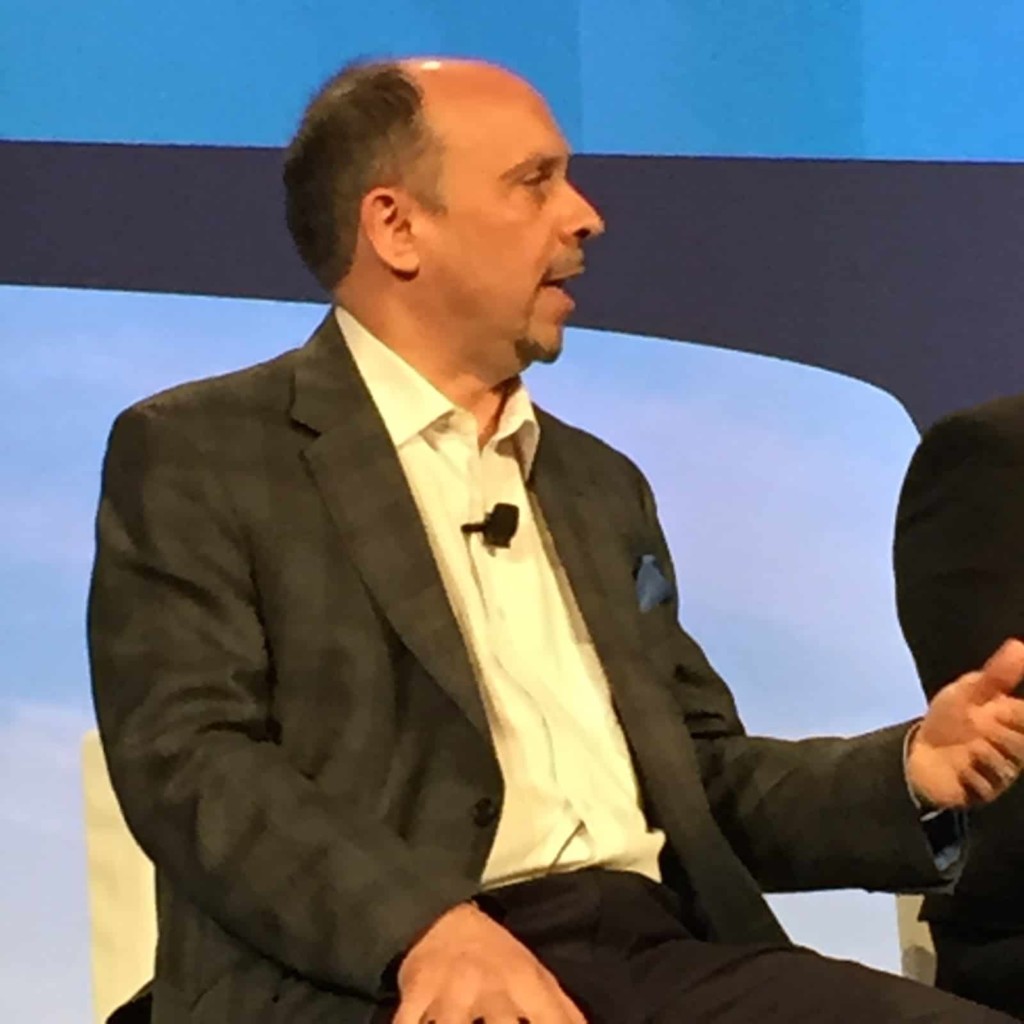
Jamie Merisotis on Human Work in the Age of Smart Machines
 Key Takeaways:
[:10] About today’s episode with Jamie Merisotis.
[:43] Tom welcomes Jamie Merisotis to the podcast.
[1:07] Jamie has been in the postsecondary policy space for about 30 years. At a young age, he ran a national commission on financing a postsecondary. He shares about how he landed this job and what the experience was like.
[3:26] How this commission helped springboard Jamie into co-founding the Institute for Higher Education Policy in 1993.
[4:40] In 2008, Jamie joined the Lumina Foundation as the President and CEO. He shares why he was interested in this opportunity.
[6:58] Jamie speaks about the work they’re doing at Lumina Foundation with policy advocacy, new learning models, competency-based learning, and impact investing. Jamie elaborates on impact investing as an emerging strategy.
[8:59] Jamie highlights some of the major changes he has seen in education since publishing his last book, America Needs Talent: Attracting, Educating & Deploying the 21st-Century Workforce, as well the key observations that led to his newest book, Human Work in the Age of Smart Machines.
[13:05] The second chapter in Human Work in the Age of Smart Machines makes the case for the work that only humans can do which blends traits such as compassion, empathy, and ethics; developed skills for problem-solving, and integrative skills. Would Jamie agree that this could also be the summary of a new outcomes framework for learning institutions?
[15:53] A core insight from Jamie’s book is that the new paradigm of human work is learning, earning, and serving. He elaborates on what this means and why it is important.
[18:10] Jamie’s book challenges the traditional academic disdain for the workplace. It reads, “Our education system does not do a good job of developing skills that human work requires, in large part because we’re often divorced from the settings where human work is actually performed.” Jamie elaborates on this and shares his thoughts on how we can better integrate work and learning.
[22:35] The importance of shifting to a model of teaching and learning about the skills and traits that are uniquely human.
[25:05] How a transparent system of credentialing could be a part of how learning institutions and work environments connect. Jamie also speaks about how we can get better at credentialing in general (and, in particular, for the skills that matter the most).
[27:01] Jamie points to the Europass system as a comprehensive and dynamic system. Should we be aiming for this in America?
[28:28] The importance of keeping equity in the forefront to build credentialing systems that work for everybody.
[31:12] Jamie closes out with a few thoughts on revolutionizing democratic society. He describes the connection between his view of human work and the contribution that it can make to strengthening a democratic society.
[34:33] Tom thanks Jamie for his new book and for imparting his wisdom on the podcast!
Mentioned in This Episode:
Key Takeaways:
[:10] About today’s episode with Jamie Merisotis.
[:43] Tom welcomes Jamie Merisotis to the podcast.
[1:07] Jamie has been in the postsecondary policy space for about 30 years. At a young age, he ran a national commission on financing a postsecondary. He shares about how he landed this job and what the experience was like.
[3:26] How this commission helped springboard Jamie into co-founding the Institute for Higher Education Policy in 1993.
[4:40] In 2008, Jamie joined the Lumina Foundation as the President and CEO. He shares why he was interested in this opportunity.
[6:58] Jamie speaks about the work they’re doing at Lumina Foundation with policy advocacy, new learning models, competency-based learning, and impact investing. Jamie elaborates on impact investing as an emerging strategy.
[8:59] Jamie highlights some of the major changes he has seen in education since publishing his last book, America Needs Talent: Attracting, Educating & Deploying the 21st-Century Workforce, as well the key observations that led to his newest book, Human Work in the Age of Smart Machines.
[13:05] The second chapter in Human Work in the Age of Smart Machines makes the case for the work that only humans can do which blends traits such as compassion, empathy, and ethics; developed skills for problem-solving, and integrative skills. Would Jamie agree that this could also be the summary of a new outcomes framework for learning institutions?
[15:53] A core insight from Jamie’s book is that the new paradigm of human work is learning, earning, and serving. He elaborates on what this means and why it is important.
[18:10] Jamie’s book challenges the traditional academic disdain for the workplace. It reads, “Our education system does not do a good job of developing skills that human work requires, in large part because we’re often divorced from the settings where human work is actually performed.” Jamie elaborates on this and shares his thoughts on how we can better integrate work and learning.
[22:35] The importance of shifting to a model of teaching and learning about the skills and traits that are uniquely human.
[25:05] How a transparent system of credentialing could be a part of how learning institutions and work environments connect. Jamie also speaks about how we can get better at credentialing in general (and, in particular, for the skills that matter the most).
[27:01] Jamie points to the Europass system as a comprehensive and dynamic system. Should we be aiming for this in America?
[28:28] The importance of keeping equity in the forefront to build credentialing systems that work for everybody.
[31:12] Jamie closes out with a few thoughts on revolutionizing democratic society. He describes the connection between his view of human work and the contribution that it can make to strengthening a democratic society.
[34:33] Tom thanks Jamie for his new book and for imparting his wisdom on the podcast!
Mentioned in This Episode:
- Jamie Merisotis
- Lumina Foundation
- Human Work in the Age of Smart Machines, by Jamie Merisotis
- Difference Making at the Heart of Learning: Students, Schools, and Communities Alive With Possibility, by Tom Vander Ark and Emily Liebtag
- Institute for Higher Education Policy (IHEP)
- America Needs Talent: Attracting, Educating & Deploying the 21st–Century Workforce, by Jamie Merisotis
- Getting Smart Podcast Ep. 273: “Conrad Wolfram on Computational Thinking”
- The Math(s) Fix: An Education Blueprint for the AI Age, by Conrad Wolfram
- Cobots
- CEW Georgetown — Center on Education and the Workforce
- World Values Survey (WVS Database)
- Getting Smart Podcast Ep. 229: “Eric Williams on Empowering Students to Make a Contribution”
Transcript
This transcript has not been edited for spelling accuracy.
You’re listening to the Getting Smart podcast where we unpack what is new and innovative in education. I’m your host Jessica and this week, Tom sits down with CEO of Lumina Foundation, Jamie Marisotis to discuss his new book, Human Work in the Age of Smart Machines. In this book, Jamie makes the case that the question is not what is the future of work,
it is what is the work of the future. He also impacts a new paradigm of work, one that consists of learning, earning and serving. These are long-standing Getting Smart tenants that we have followed in our Future of Work series and in the new book by Tom Banderarch and Dr. Emily Leabtag titled Difference Making at the Heart of Learning.
Let’s listen in to learn more. Jamie Marisotis, welcome to the Getting Smart podcast. Thanks very much, great to be with you. Hey, good to be with you Jamie. Congrats on the new book, Human Work in the Age of Smart Machines.
Thank you so much. It’s an exciting time, interesting time to be talking about human work when many of us are working remotely like this. It is, Jamie. In doing our research, I realized for the first time that you’ve been in the post-secondary
policy space really for 30 years. You got a very early start. As a young man, you ran a national commission on financing post-secondary. How did you land that job? So, you know, my career pathway has always been in the space of post-high school learning.
I’m a first-generation college student, first-generation graduate. I used to tell people all the time, Tom, that I’m a walking advertisement for every financial aid and support program you could ever think of. I managed to get my first job out of college in part just because I wanted to work in public policy in the Washington office of the College Board.
And I realized in doing the research that I was doing there that, in fact, there was millions of people like me who had had the experience of being first-generation, no one to help you guide the path. I felt like I was lucky. I had good fortune, good mentors.
My parents didn’t know what college was except that we were going. I realized at that moment that my path in life was to make luck, not the strategy, but actually have a plan. And so I ended up working as a policy analyst and consulting for a few years. And then in the early 90s, the Bipartisan Federal Commission was created and it was
appointed by the President and Congressional Leadership. And I ended up as the executive director because I had expertise in the space. I was still in my late 20s, as you point out. And we had the good fortune of being bipartisan and actually issuing our report just as a new president was being inaugurated.
So it was a Bush-era commission whose report came out as President Clinton was being inaugurated. And the commission’s claim to fame was that we were the place that helped popularize the idea of direct student loans. Although it took all the way to President Obama before that actually became a reality, it shows you that government moves slowly.
But I’ve always been on the side of improving access and success, particularly for students of color, for low-income students and for students like myself who were the first in their family to go. And that commission really springboarded you into founding or co-founding the Institute for Higher Education Policy, which has still gone strong and a real contributor to excellence
and equity. It’s a policy and action shop. You must be proud of that contribution they continue to make. Extremely proud and impressed with the leadership that Michelle Cooper, who’s been the CEO now for more than a decade, has shown.
It was at the time that I created it in 1993 with Colleen O’Brien, it basically was a new idea to have such a narrowly focused think tank, this idea of, as you point out, a research and action shop that was focused on the space of post-high school learning and particularly access and success for students. Today it’s more common, but I’m really proud of the fact that the organization continues
to focus on equity. I think it’s one of the leaders when it comes to issues related to racial equity in this country and is very much focused on putting both new ideas and helping to create the momentum for the change that’s necessary in order to achieve the ideas that come out of the research. In 2008, you had the chance to join the Newish Lumina Foundation.
They’d been around for a few years, but were kind of a new generation philanthropy. What was interesting to you about that opportunity? I always thought that I was going to spend my career, honestly, in the space of DC public policy. It never occurred to me that I would work in philanthropy, but one of the opportunities
that Lumina presented, and I feel very fortunate that I’ve been able to do this now for my 13th year, is that I recognize that philanthropy has these advantages that you don’t necessarily have in other contexts. I’ve always been focused on system change and wanting to achieve change at scale. Well, philanthropy’s got this capacity to take risks.
I’d argue, and I’ve argued with my team that we have a responsibility to take risks that others can’t because we have independent assets and because we’re not directly accountable to voters or shareholders the way government or public companies might be. Sometimes I think philanthropy needs to exercise more of that risk taking, but I saw it as an opportunity to take risk to help actually catalyze the country towards this big national
goal that Lumina has set out of 60% of Americans having a high quality degree certificate or other credential by 2025. That turned out to be a good reason. You can also in philanthropy act with a long view in ways, again, that are different than government and business.
We also don’t even have to think about things like annual budget cycles. So in your experience in philanthropy, you know this, that in fact you can play a longer game because you’ve got that capacity. I was also intrigued by the opportunity at Lumina because not only was it focused on an issue area that was my life’s passion post-high school learning, but they had already demonstrated
this capacity to deal with change at scale. In other words, we know that foundations have resources that are really dwarfed by the budget of governments or by the market valuations of large companies, but there’s real power in convening and using the bully pulpit. I saw it as an opportunity that as I said, I’m very fortunate to have taken advantage
of. I want to pick up on the idea of risk taking. Jamie, I’ve been critical of sort of modern American philanthropy while generous. I don’t think the sector’s taken enough risk because it really is the social space where you have risk capital where we ought to be trying new things.
I appreciate the efforts you’ve made at Lumina not only to do policy advocacy, but to focus on new learning models. You’ve been a leader in competency-based learning, but Lumina has also been a leader in impact investing really for a decade. You’ve been carving out new space there and showing the sector what’s possible.
I appreciate that focus. Anything else you want to add on impact investing as an emerging strategy? Really that in philanthropy, we have lots of tools in the toolbox. We are grant makers. As I said, we are conveners.
We’ve got this capacity to use our bully pulpits in interesting ways, but we have endowments and we have the capacity to leverage private capital in ways that maybe others won’t because we can take first risk because we aren’t primarily interested in making a profit. From our vantage point, we’ve seen it as a net add to our mission, to our social mission. In the Lumina’s case, we’re one of the only private foundations still that does direct
equity investing in individual companies. In our case, it’s mostly in startups and companies that are moving up through series A or so. We tend not to go much higher in the chain than that. Our efforts are really about helping to build companies that can actually achieve large-scale impact.
I’m really proud of the work that we’ve done. We’ve now got a portfolio of about 15 companies and we feel very good about that work. Jamie, in 2015, you published a book called American Eats Talent. In some respects, like Getting Smart, a book I published a couple years before just argued that the world needs to get smarter, that we need to skill up both in this country and
around the globe. It was a good but pretty standard argument. The tone of your new book is really different. I’d love to have you just headline forming a few of the changes that you’ve seen since publishing your last book.
What are the key observations that really led to your new book, Human Work and the Age of Smart Machines? It’s a very good observation because American Eats Talent was really about this idea that we had to change the learning enterprise in ways that will, with a rising demand for talent, actually help us get there.
In American Eats Talent, I said ultimately what we have to do is ensure that talent, which is knowledge, skills and abilities that are honed by education and experience, not only helps individuals but helps all of us as a society. We’ve got to do a better job with that. That includes higher education, it includes immigration, it includes lots of different
strategies, urban policy, etc. As we talked about earlier, I spent my life at this intersection of learning and work and trying to make it better, trying to serve more people and certainly serve more diverse, equitable populations, generally improving the system of learning for individuals and society.
I think those of us who are in the education sphere are increasingly being asked this question, Tom, which is for what? What is education for? I set out to try to explore that question and came back with the answer, which is simply that we have to prepare people for human work, which is the work that only humans can do.
We know that work is changing in really unprecedented ways. Technology, AI is taking over many of the tasks that people used to do. I’m not as fixated as others are on this idea of the robot zombie apocalypse and the robots are going to get our jobs. I’m much more interested in the changing nature of the tasks associated with work and what
those tasks are that require our unique human abilities. In other words, the things that only humans can do. What I concluded is that we’re different than machined in many ways, but I think the most important is that for us as humans, work matters. People work not only because it helps them economically.
We obviously need to make money, but that it offers them social mobility and personal satisfaction and dignity and meaning and purpose. The book really explores that idea, gets into these concepts around how human work will really change and what we need to develop when it comes to human work and also how we will prepare individuals and society for what I think is a rapidly changing world of work
probably accelerated by the events of 2020. I do appreciate the sense of humility that you took into chapter one. The future work, people like me can make broad pronouncements about it and I do appreciate that you took time to describe. The future work is varied for the seven, almost eight billion people that share this planet
and it’s easy to take a privileged view of future work. Thanks for that nuanced and thoughtful approach. The second chapter does a really nice job of making the case for the work that only humans can do. You said that it blends traits such as compassion, empathy and ethics and our developed skills
for problem solving and integrative skills. That sounds like a summary of a new outcome framework for learning institutions. Is that fair? I think that is fair. I will say that part of me got as I was working on the book and in the years leading up to
it got increasingly frustrated with the conversation about the future of work as opposed to what I say in the book is the work of the future. It sounds like a semantic game but my concern about the future of work is that those events that I was participating in, those convenings, those conversations were increasingly questioning whether or not humans will be working and questioning the idea of work itself.
My view is humans want to work. It brings shape and meaning to our lives. It’s not just about a job. The big issue here is that machines are better at things like repetition and speed and patterns, things that can be reduced to an algorithm.
But machines can’t understand subtlety and nuance and they don’t know how to interact with people. It’s being unpredictable. The more interaction with humans, the less likely it can be done by machine. I don’t think work is going away but it’s being transformed into this work of the future,
the work that only humans can do. The kinds of things that we need to be focusing on, I think in terms of the learning paradigm, is developing our human traits and capabilities. Our human traits like compassion and empathy and ethical decision making. Again, these are things that machines can’t do, can’t possess.
We need to combine that with developing our human capabilities, our critical analysis ability, our communication ability, our ability to collaborate, to be creative, to develop our knowledge skills in nonlinear pathways. All of those things, I think, are what need to go into rethinking the system of learning. What I say in the book is developing a large scale continuous system for deploying quality
learning that’s going to prepare people for human work and life in this new age. Nicely put, I appreciate that combination of traits and capabilities that you laid out. Jamie, the core insight of the book, in my view, is it’s kind of summarized in this simple but powerful statement that the new paradigm of human work is learning, earning, and serving.
Talk about that. So the way I tend to think about work is this. We have often assumed, and sometimes we’ve conflated the ideas of work and a job. Look, people need a job because a job does something very important, which is that it provides you with financial resources to help you live your life.
And for you to be successful in life, you need resources in order to be able to do that. But here I’m talking about something different, which is this idea that work and the things that make us uniquely human are things that we get satisfaction from, things that we value. And when you combine learning, which is a process that must be continuous over the course of lifetime, earning, which is a requirement for us to be able to do the work that I was
doing and serving others that magnifies and I think enhances learning, it’s this virtuous cycle of earning, learning, and serving others that I think is really important. So we can think in very concrete ways about how this plays out. People like you and I have talked about work-integrated learning models for a while, but we should be talking about learning-integrated work models and even service-integrated work models because
humans want to learn, they want to earn, and they want to serve over the course of their lifetime. And it is this ongoing, continuous cycle of learning, earning, and serving that I think makes us uniquely humans and allows us to be human workers in this technology-mediated era that we live in.
My ultimate aim here is for us to think about how we can prepare the human workers for this work that humans can only do and actually set out to actually create an integrated ecosystem of human work that allows that to be developed. Your book sort of takes on, it challenges the traditional academic disdain for the workplace. It says our education system does not do a good job of developing skills that human work
requires in large part because they’re often divorced from the settings which humans work, where human work is actually performed. So how do you see those really coming together to better integrate work and learning? So part of the issue I think we’ve got to do is sort of make sense of what’s happening in the world now as a great illustration of that.
So if you look at COVID, if you look at the awakening around racial injustice that we’ve seen in this country, we have to understand that these ideas of learning and working coming together and that concept of serving others as being integral to who we are as humans really comes together in this moment where we’ve seen these disparate impacts of COVID-19. What’s happened not only to people’s jobs, but also the disparate impact that we’ve seen by
race and income. So if we look about how we do those things like developing our human attributes, those traits and capabilities that I was talking about, we’ve got to actually think about how we can actually integrate learning and work in new ways. And that means that we’ve got to be developing our work environments that take into account the diversity of the people who are working and understand and respect the viewpoints that they bring to the table. This is not sort of bringing
one perspective, but bringing a variety of perspectives to the learning model that’s really important. We’ve got to think about how the fact that many of the people who have lost jobs in this era are not going to get those jobs back and that we’ve got to prepare them for this human work era where employers, where the learning enterprise, the learning institutions, and frankly the nonprofit sector, including philanthropy, are going to have to organize themselves around this
new way of thinking when it comes to preparing people for learning and work. And I also would say that at the end of the day, we’ve got to recognize that the era that we’re in, we’re not going to go back to normal. Normal is not something that I think we should want to achieve because normal wasn’t so great for an awful lot of people in the old model. And so employers are going to have to embrace the diversity of their employees and their customers and their communities.
They’re going to need to define the knowledge, skills, and abilities of their workers, those diverse workers that I was talking about, and ensure that they can develop their talents throughout their careers. And I think the people like us, the people who work on the education side of the equation need to question the assumptions around the current systems. We’ve got to put the learner worker, you know, we used to call them students, but really they are learner workers. They are
people who are going to be doing learning and working and serving others over the course of their entire lifetime. Put them in the center and ensure the success of all students. We’ll need to make sure that the learning that they get in our learning institutions is clear, it’s transparent, so that everybody understands it. We need to develop their capacities, not just in sort of content areas, things like STEM, but also those human traits and capabilities. So this is both
the challenge and the opportunity, I think, laid bare by COVID and racial injustice in the current environment. But it’s an opportunity in my view, I’m optimistic, as you saw in the book at the end of the day, that we can actually solve these problems because I think we will have no choice. I don’t think we will stand for the idea that machines will be doing things that we as humans know we can do better, but we must figure out how to work with the machines, let the machines do
the things that they are faster and more capable of doing and develop our human traits and capabilities so that we can do the work that makes us successful in our communities and successful as individuals. I appreciate that. A good example, we had Conrad Wolfram on the podcast last month talking about the math fix, and he said it’s time to let the machines do the calculating. What we need people to do are to learn how to solve big complicated problems. So setting up problems and then learning
how to use smart tools to interrogate complex systems, that’s the sort of complex problem solving that we should be teaching. Those skills are more important than long division or factoring polynomials. It’s really the algebraic reasoning and math modeling. I think that’s an example of what you’re describing of shifting to the skills that are uniquely human. That’s exactly right. You can think about an array of kinds of jobs that people will be doing or kinds of work that
people will be doing in the future that reflects this. It is that if the machines are able to do things that they really are better at, we’ve got to be doing the kinds of things that we are better. I opened the book with this example of this guy who worked on the assembly line at Cummins Engine Company who was doing what lots of assembly line workers did 20 years ago, which is putting engines into RAM pickup trucks. But over time, the machines developed more and more of these
capabilities. What Joel Lewis, his name, ended up doing was developing his abilities to understand that the machines and technology designed the systems and their robots at Cummins, they call them co-bots, collaborative robots. They are essentially in an interesting way the peers of the human workers. Part of what he does is design the systems that run the co-bots. In a way, he’s a trainer of the robots. This is where this idea of bringing technology and people together in one place
is there’s a net plus for us as humans. It’s the work that only we can do. You’ve got that and you’ve got all kinds of jobs, things like teaching, social worker, your next minister isn’t going to be a machine, it’s going to be a human. We need to be developing a whole array of these human traits and capabilities and developing over the course of our lifetimes. That’s the human work of the future. Jamie, in terms of bringing work and learning together, you suggest that credentials,
a transparent system of credentialing can be part of how learning institutions and work environments connect. How do we get better at credentialing in general and particularly around the skills that matter most? Here, I think we’ve got two problems. One is that the credentials themselves right now are not very transparent. In other words, what’s behind them is not very well understood. We’ve got lots of examples of credentials that seem to do well in labor markets,
but then in other cases don’t do well at all. Yet, some of the credentials that don’t do well in labor markets do prepare people for other types of things in life that allow them to be successful. Part of what we need to figure out is what do people know and what can they do with a certificate, a certification, a license, a degree, whatever it may be? Then how do we create a system, an interoperable system of those credentials that allow people, again, over the course of their
lifetime, to develop this interconnected network of these credentials that gives them a chance to ratchet their way up in their lifetime of work. I think it’s really important for us to focus on those issues and make sure that the credentials have meaning, that what’s behind them is clear to the worker, to the employer, even to the government. Then, we actually make sure that over the course of a lifetime, people can develop a series of these credentials that connect to each other
so that they can efficiently develop their human work capabilities and be true learners, earners, and servers over the course of their lifetime. Tim, you pointed the EuroPASS system as an example of a pretty comprehensive, relatively dynamic system. Is that what we should be shooting for in America? Yeah, it’s a great example of where countries that have literally had historic rivalries, wars,
and things like that were able to overcome those things in the European context and actually create this common market for linking credentials, the learning enterprise with work through efforts like the EuroPASS. What we need is more of that. As I’ve said to people, if France and Germany can figure out how to create a system that works across borders, we should be able to figure out one where Indiana and Illinois can do the same. Yet, in many cases, we have these stovepipes
driven by the sort of distinctions, the artificial distinctions that we have, state lines, school districts, university systems, etc., that I don’t think make sense in the modern world. Math in Kentucky is math in Maine. What we should better be able to do is to understand how the math that you learn connects to the credentials that you’re getting and how those credentials ultimately lead to a successful human work life. I appreciate that. I’m a big fan of credentialing,
but it’s clear that credentialing and licensure system can grow stale and can be used to actually block entrance into a particular occupation. So if these definitions are kept dynamic and that we keep equity in the forefront, I think we can build credentialing systems that work for everybody. I think you try to describe that in the book. I think your observation, though, is worth underscoring here, which is that the risk of the rapidly changing nature of learning and work that we’re seeing
is that we’re going to further disadvantage populations that have had historic disadvantages, particularly African Americans, so Latinx population, and Native Americans in ways that will further exacerbate these inequities and injustices. So we’ve got to design these systems to actually take those perspectives, those vantage points, into account. And here, I think these questions about equity and quality in the learning enterprise are really, really important for us to better
understand. If you think about the ways in which we’ve gotten to where we are, we’ve had unfair policies and actions and beliefs over hundreds of years that were specifically designed to disadvantage these communities of color. So the only way to get out of that box is to design these learning systems with their full engagement and being able to develop these learning systems that have the right combination of the academic, the financial, and the social supports that are necessary
is really important. We also need to make sure that as we design those systems that we actually make sure that the learning represents both quality and equity as co-equals in the equation. By that, I mean that we cannot see them as opposing forces in the system. This is an old saw that in fact has further disadvantaged these populations that if you increase equity, you reduce quality. But what we know about quality standards and quality learning is that a key component of
quality is where the knowledge is coming from and how it’s being imparted. And so quality and equity, it seems to me, are interconnected without quality. I don’t think you can have equity. And without equity, I think this idea of quality is really a hollow echo of what the system should be. Jamie, let’s close out with a few thoughts on revolutionizing democratic society. This is a really important topic that you deal with in your closing chapter, chapter six.
Maybe to start with, just describe what’s the connection between your view of human work and the contribution that it can make to strengthening democratic society? It’s interesting. The reaction that I’ve gotten to the book from the early reviewers is that this is the most surprising and in some ways enlightening part of the book because it’s different. Here, I think, look, we live in an area where there has been this incredible rise in authoritarianism
and anti-democratic tendencies around the world. And one of the things that we know about authoritarianism is that it prefers conformity, authoritarian stoke fear, fear of change, people who want to be afraid of the other. And so part of what I think we’ve seen in this environment of increasing authoritarianism is a threat to liberal democracy and the diversity of ideas, of expressions and beliefs that I think democracies are designed to protect. So when people lose opportunity or they never had
it, this tends to spike. One of the things that we know from research, and there’s actually very recent research from the Georgetown Center on Education and the Workforce that points this out, is that we live in a world of these information bubbles that tends to reinforce these anti-democratic tendencies. So there’s false information out there now about COVID. That false information has mostly impacted people with lower levels of education. We know that people who have lower levels of
education tend to find authoritarian leaders alluring because they think that they can actually do something to create change. There’s actually something called the World Value Survey that a quarter of people with a high school credential or less in the United States says military rule would be a good way to govern our country. And so the best way to push back against all of this is to develop a human work ecosystem where people actually develop their human traits and abilities
to cultivate that critical thinking, that ethical decision making, that analytic reasoning, all the things that we talked about earlier that are democracy enhancing traits in a lot more people. Ultimately, this is about engaging in active citizenship and the free expression of ideas and combating that in the human work ecosystem with people who’ve developed those ideas through structured learning enterprises. So human work, as we talked about earlier,
it offers meaning and purpose and a chance for individual and shared prosperity. The best way to do that is to make sure that it happens in a democratic context and make sure that we allow people to learn freely and without fear of what government or others might do. Jamie, I appreciate the first five chapters of human work in the age of smart machines, but I think this last one is such an important contribution. Thanks for your new book.
Everybody should get a copy of it. It would make a terrific book for a faculty in a school district or in a college. I think anybody that’s got a book study at work or with friends would enjoy the book. Jamie, it’s a great contribution and we appreciate you joining us on the Getting Smart podcast. Great to be with you and thank you for all the great work that you do. A big thanks to Jamie for joining us on this week’s episode. We greatly appreciate his dedication to post-secondary
success and keeping the things that really matter at the core of work and learning. For more on how to start doing meaningful work in school, check out episode 249 with Eric Williams from Luton County Public Schools. Tom’s newest book, co-authored by Dr. Emily Leetag, is now available for purchase. Difference making at the heart of learning explores new learning priorities centered around making a difference and a framework based on the 25 most important issues of our time. We know that
students learn more when they feel a sense of purpose. With adults to help guide them, they’ll be ready to make a difference and shape the world to come. We’ve got a link in the show notes so you can learn more about the book and we’ll have more episodes to explore difference making this month. That’s it for today listeners but before you go, don’t forget to rate and review the podcast and as always thanks for tuning in for the Getting Smart podcast. This is Jessica signing off.

0 Comments
Leave a Comment
Your email address will not be published. All fields are required.