

Nadine Levitt on Learning Through Music
Key Points
-
Asking learners to engage with learning through music is a great way to give them ownership of content.
-
Music is about pattern recognition, synthesis and so much more.
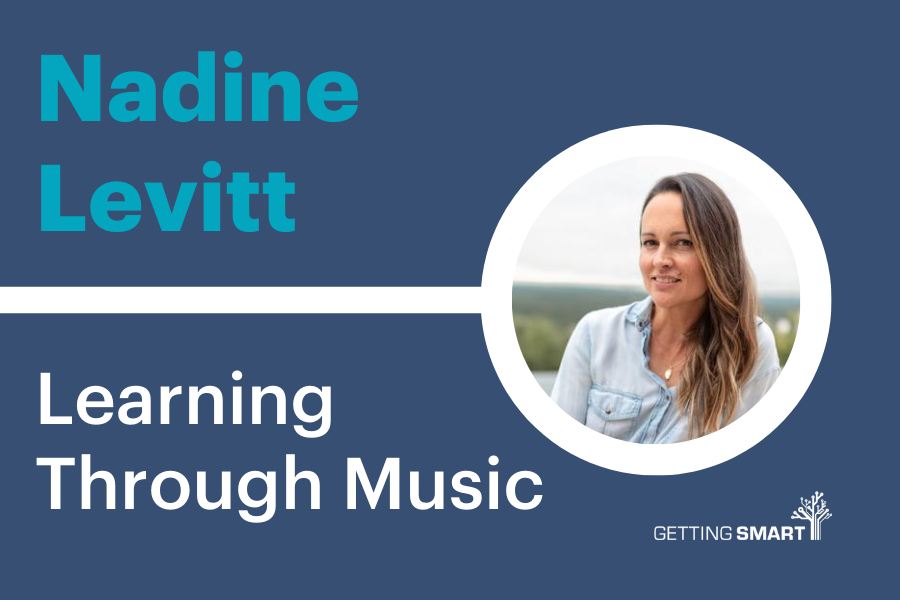
On this episode of the Getting Smart Podcast Shawnee Caruthers is joined by Nadine Levitt, founder of WURRLYedu and PD Reimagined. She is also the creator of the My Mama Says book series and writer of numerous blogs and education resources.
Nadine has a varied combination of experiences – from lawyer, to opera singer to education advocate and we are thrilled to have her on the podcast.
We don’t teach math to be a mathematician or science to be a scientist or english to be a writer […] why are we only teaching music to be a musician?
Nadine Levitt
Links
Transcript
This transcript has not been edited for spelling accuracy.
You’re listening to the Getting Smart podcast. I’m Shani Carruthers and today we’re joined by Nadine Levitt, founder of Whirly EDU, the creator of my mama says book series and writer of numerous blogs and edgy resources. Nadine has a very combination of experiences from lawyer to opera singer to education advocate and we are so thrilled to have her on the podcast today.
Nadine, thank you so much for joining us. Thank you so much for having me. Yeah, absolutely. You are doing a lot of interesting things and some of those things involve those opera and law components that we talked about.
So what do opera, law and education have in common? Other than my career trajectory. Interestingly, I think it has sort of placed me in a really unique place, which is because I come from sort of law and business. And then I also come from the creative industries having been a touring opera singer.
Now I’m putting all those things together to have a very different viewpoint to education. And I think it’s I was asked a little while ago by someone, what is what are my best set in the whole world? And what was interesting is at first I was like very hesitant to answer the question. Like what kind of a question is that?
And then I’m very sort of I like to be humble and I’m a Kiwi after all. And and then I realized, well, I can answer it in a pretty honest way because I think what I do differently to everybody else is I bring my perspective to education and I bring that business and law side and I bring the creative side to how I solve problems in education. And you can see that in everything that we do from a world that you to my mama says to
even PD reimagined. So all of those pull on all of those different viewpoints in order to problem solve. And we see it very holistically. And I say holistically as in like W H O L E. As in whole child, social, emotional learning, those kind of components.
Well, when you think of being holistic, music is thought of as a way to kind of aid in some of those holistic journeys. What is your first musical memory? Hmm. My first musical memory is probably one of those German lullabies that my mom used to
sing for me. But we quickly also we were so immersed in music and just an every day very relatable approachable way. So we would go to dinner parties and my my family would always reach for any instrument available.
It would be, you know, some sometimes it would be spoons. It would be guitars, a piano. It didn’t matter in that these particular family friends of ours, they were Greek and we would jam every night after dinner. And that was just something I grew up with.
And then I guess the first formal sort of not street musician, but formal show that I went to, I was maybe eight or 10 and my parents took me to see an opera singer called Dame Joan Sutherland. And I just remember seeing her sing and out of her mouth was this liquid gold. And I just remember holding on and tugging on my mom’s arm and saying, mom, I want to
do that like this. And she was like, yes, dear, yes, dear. So what was it about that liquid gold that just really struck you to for you to know, like, this is who I am. This is what I want to do.
It was a feeling more than anything, you know, the goosebumps that you get sometimes with music, because music or music, I think makes us feel something. But it has this ability and propensity to, you know, draw tears or give us goosebumps or connect and people in some way. And for me, in that moment, there was this admiration and it made me, it
transported me to a different place emotionally. And I’ll just never forget it. And I was, I just, and I think one of the reasons I wanted to do that was because I wanted to be a part of making other people feel that. And you’ve now transitioned that into Whirly EDU.
So what is Whirly EDU? So Whirly EDU is an edtech music platform. It’s for music and the arts, really, but it’s it’s centered around a philosophy that the best education is inspired and experiential. So we have a learning process of inspire, practice, record, reflect.
And all of our lesson plans follow this pedagogy and all of our and then we support it with recording tools for students. And we have the largest popular music catalog out of any tech platform available, all fully licensed. And and then we have videos by Grammy Award winning artists teaching kids
how to place certain things. But it comes from a pretty different viewpoint in the sense that it really bothers me when I when I talk to people and I all over the world, I’ll say, who here loves music? And everyone’s like, yeah, I love music.
I love music. I say, who here loves music education? And all the hands go down and they’re like, you mean like eight minutes of Glockenspiel and I’m like, no, no, no, no, no, no. Like if if we can’t take these kids that are super excited about a subject
and sharing music outside of the classroom and talking about it and we can’t teach them something, then we’re doing it wrong. So my take on this was and I also noticed another pattern, which was that we don’t teach math to be a mathematician or science to be a scientist or English to be a writer.
Why are we teaching music to be a musician from the outset? It sets us up for failure. I really think that I think if we see that not every while every kid is going to love music in some capacity, that’s where we should start. Because I think people when fear is involved and you start to be scared
to look silly or like you can’t do it or something like that. It really inhibits that growth. Whereas if you say, OK, let’s look at the music that you already love and let’s make you a music reviewer and let’s really dig deep into the musical concepts of like, why do you connect with that song?
Is it melody? So let’s talk about what melody is. Is it harmony? Let’s talk about what harmony is. How do the two interrelate or rhythm or any of those other musical concepts?
So we kind of approach it from a very student led place where start where they’re already passionate and then grow from there. Then you can do, you know, the obviously ukulele or instrumental stuff where you are playing. We also have an amazing partnership with 1500 Sound Academy, which I’m
very excited about, where we bring career technical education to all the way down to middle school and high school. But it’s basically a place where kids, you know, a normal and traditional trajectory in education, you go through school and at the end of school, you decide what do you really want to do?
And unfortunately, not everyone can afford at that point to like try a little bit of this or try a little bit of that. And so I think there is an equity issue there. And I think a lot of schools have now taken it upon themselves to take some of that onus and let kids try on these different careers at a much
earlier age. And so people have access to that for free and they can do like sound engineering, recording and mixing or songwriting or artist branding or music business, because there are so many careers and music and it’s not just performer. Yeah, no, absolutely.
And how can I guess how can music education be better integrated into schools to increase learning? Because you were saying that, you know, having to necessarily be trained to be a musician in order to really appreciate what music can bring to the learning process. Yeah, I think again, it’s like, let’s look at it in a holistic way and say why?
What does music add to all of this? And it adds a couple of different things. One is it really helps with rote learning. And I’ll go back to that in a minute. But it also really, because it makes us feel things like it makes us, you know,
you walk into a room, it sets a scene. So you could easily add it to sort of as people are coming into your classroom, play music, welcome them. I hate school bells. So I think there’s so much anxiety that school bells induce.
And so having like music, welcome kids is a really nice way to incorporate music. And it’s also a great way to teach social and emotional skills. But you have to purposefully sort of be signposting it. But an example of like the rote learning is, I mean, I don’t know if you do this. I still I still have to sing the alphabet for some reason.
I’m a full grown adult and yet I still have to sing it. And we do something similar with instead of kids in kindergarten, for example, here, I’m going to play you something. Instead of you learning the definition of what’s the difference between what’s living and what’s not living as a thing.
And by definition and then having to rote learn it that way, we do something slightly different, which is to say, OK, let’s create a song that you then learn and then you perform and let’s leave gaps in it. And the song goes something like this. What I teach.
I can tell you what’s living. I can tell you what’s not. I’ll tell you two things in case you forgot. That’s cool. I live in they eat, breathe and grow.
What they sense in response. So you see there, we left a little gap for where the students can say this is living, right? So cats are living, they eat, breathe and grow. And so and then we do the same thing with non-living. And so this is a great way for kids to rote learn certain pieces of it.
And then when you record yourself and watch the video back, you’re actually learning it multiple times because your awareness, your self awareness is so shocked by what you see on screen. Because you never sound what you like, what you think you sound like or look like what you think you look like.
And so it actually builds a carbon copy of the same memory and it has much deeper learning. So. Yeah. And it’s something that you kind of dance to and say all day long,
which continues to increase it. And I’m glad that our listeners couldn’t see me dancing to that. But it was so useful. So I can just imagine what benefit that has for students. What surprising skills has songwriting taught you?
Well, I think music is really just about self expression. And I think songwriting is the epitome of that. So it’s about how do you express yourself through music and how do you release certain things? I think I’ve become a better observer through songwriting
because you start to look at how things can inspire songs. And you start to watch people around you. You start to think about how they might apply to your own life. So I think I’ve become a better observer and and I think I really enjoy diving a little deeper when I hear a song now as to why
somebody wrote something. Yeah. And I can see how that could be useful across English classes and how that could be a really great way to integrate music in that core content as well.
Yeah. I think it’s it empowers student voices. Right. If you say to if you I love it as an end cap too. End cap to a lesson where you say, OK, you’ve learned about actually
I’ve got a really good example of this or something that we’ve actually done, which is there’s a lot of kids in middle school might be learning about space travel and and space. And rather than just reading articles, maybe watching videos and so forth, you can still do all that.
But give the kids a reason for watching and say at the very beginning of the module, all right, so we’re going to create music videos about space travel, but it has to be factually accurate. We’re going to have about you can choose any backing track and and you can you know, get as creative as you want.
But now they’re picking out and you can say that it needs to have at least 10 facts in it. So then they have to think about how are they going to what facts are they going to share? First of all, and they’re going to have some ownership in that.
And then they’re going to think about creatively, like, how do we share those those facts? And so again, they’re learning that those facts multiple time from much, much deeper learning. If you’re just watching videos, if you’re just reading articles, the
retention will never be as long as if you take that later and create something with it and have that ownership, you’ll retain that knowledge for much, much longer. Yeah, we’re talking about core content, but I just want to circle back for a second to SEL and how songwriting or just getting the thoughts
down on the page in a musical way can also help with social emotional learning. Totally. I think all music and interestingly is social and emotional learning and all of our lessons signpost us in the moment so that instead of just saying,
hey, we’re going to learn the song, which if you’re not really thinking that you’re going to be a performer, you sort of switch off at that point. Whereas if I say, we’re just going to learn the song, but this is just problem solving 101. What do we do when we problem solve?
We break it down into bite sized chunks. We recognize patterns. We create a schedule for ourselves as to when we want to finish it by and we check in with ourselves and adjust accordingly. Or it’s a great place to say, what emotions do you think are being reflected
in the song? Or let’s, in terms of one thing that I love to do is I love to give students ask them to write down all the emotions that they feel in the given week or month or year and put them and then find a song per song. Sorry.
And then find a song per emotion. And the idea there really is that you’re creating a bit of a remote control for yourself and see how you can adjust from one emotion to another using music. And I’ve seen it with my own kids. They really, when they’re really frustrated or really angry and I say, okay, you know,
why don’t you have a little time in your room just to sort of calm down? Then they play music and they come out a totally different person. It’s a really, really great way to release some of those emotions. Yeah. Well, speaking of parenting, what advice would you give to parents giving your
edu advocacy experience? I think the biggest advice actually it relates to emotions. I think that emotional understanding or emotional intelligence is sort of this foundational skill that’s going to set your kids up for success in every aspect of life. Academically, relationships that they’re going to form, it’s going to affect their
responsible decision making, their own self confidence, self awareness. So the earlier that we can start to label emotions and say, I’m feeling these different emotions and not just the loudest one that they’re feeling because emotions never come alone. They come in groups, right?
And so the quicker we can have kids identify all the emotions that they’re feeling and become well versed in identifying and acknowledging them and processing them in a natural and healthy way. I think we’re really setting them up for success. And it’s not easy as a parent to model it all the time because I mean, this is my whole
life’s work and I still lose it at times. But it’s highly frustrating when you’re asking your kids to, you think you’ve done everything right. You’ve got their buy-in, you’ve got a plan and then you check in on them and they’re not following the plan.
They’re still playing or they’re not doing whatever it is that you’re trying to get them to school or whatever it is. And in those moments rather than being hard on yourself if you do lose it, just see it as a learning experience where you can say a learning opportunity and say, okay, how do I pick myself up when I have fallen?
And you can explain, like, I wasn’t as calm as I would have liked to have been in that situation and I’m working on that. And here’s what I’m going to do in order to calm down. I’m going to take a deep breath or what do you think I should do in order to calm down because I’m feeling really, I’m feeling these really loud emotions right now.
So that’s probably my biggest advice to parents. Yeah, I’m glad you referenced that kids aren’t the only one who struggle and have some hard times as adults. You know, we do as well. And especially as teachers, especially these last few years, there have been lots of struggles
and hard times, which was the basis of the program you mentioned earlier, the PD reimagined. So that you put that together to address the teaching shortage. What is PD reimagined and how is that set up to help teachers? Well, I think interestingly, teachers, they do such an important job. And I was really, really scared at the number of teachers that were starting to think about
leaving the profession. And actually, it happened to my own teacher. So behind every really successful person, whether it’s in sport, music, business, anything, there lies a teacher that was highly influential in forming who they were. And for me, that happened as well.
And there was this amazing teacher who really taught me that following my curiosity was a great thing and that asking questions was a great thing. And that the fact that I was different is also like a superpower. It’s not something that I shouldn’t listen to the people who say otherwise. He saw something in me before I saw it in me.
And he taught me how to speak English, really, and taught me to believe in myself. So later, when I found out that he had left the profession because he was just exhausted and just couldn’t anymore, it made me super, super sad. And the reason it made me sad was that so many kids could benefit from his wisdom and his guidance.
And if he just had more support, would he still be here? And so with PD Reimagined, what we really do is we want teachers to feel honored and celebrated and valued. And we give monthly gift boxes that are sort of thematically linked to their learning. All of the learning, though, is not about how they can help kids.
Teachers already naturally are those givers. And they naturally… It’s interesting, even in PD Reimagined, when we remind them over and over again, like, put your own oxygen mask on first, we want this to be about you. And they just find it very, very difficult to think me first.
And so this program is very much about how can inspiration shift mindsets, refuel you in that inspiration so that you can then inspire your students. And so we bring in inspirational speakers who come in and virtually present to everyone once a month, and they have these gift boxes, and then they work on what’s one strategy that I can commit to for myself.
And it might be as simple as taking three deep breaths in between classes, or I’m going to listen to a three-minute meditation in the morning, or I’m going… Everything’s three minutes or less. I’m going to hold a plank next time I’m really frustrated. Or there’s lots of different things that have an affirmation, sort of start your day with
affirmations, or have a folder where you keep all your thank you cards and sort of put them all together so that you can refuel. So there are lots of things that you can do. It’s sort of these three-minute or less tools, and they come up with them themselves. We certainly have suggestions, but they come up with those, and they share them as a group
and are there for each other as a group. Excellent. It sounds like a really great resource. I liken it a little bit, honestly, to the military and the sense that when you’re in the military, it’s also an extremely important job.
It’s very difficult, both mentally, physically, and it’s all consuming. So when you’re in it, it’s all consuming. Then it’s pretty low pay for the… It’s a similar pay to teachers. Great benefits like teachers, but what they have that I don’t think teachers feel that
they have is this honor, this huge honor attached to service. You literally feel the entire country having gratitude for the fact that you’re serving your country. I think that same gratitude really should be felt for all teachers. So the same way that we thank a veteran or thank an active person in the military, we
would say when we meet a teacher, thank you so much, pretending to our future thinkers. Thank you, because it’s not an easy job. That’s a big part and we’ll be running some social campaigns and working with corporates to sort of say, how can we bring that real honor and value into teaching so that it’s not just that it’s something that we do quietly, it’s something that we do loudly, so they
really hear it. Yeah, absolutely. And like you said, they deserve to be honored. And so this is a great platform for that to happen for them. We’ll keep the inspiration going and we’ll we do a one to one.
And so I’m just really interested in hearing, like for example, what is one person or who is one person that has shaped your work or thinking or who inspires you? It’s so hard to get this down to one person because there’s so many different people. So I’m going to cheat a little bit because there’s different people in different parts of my life. Obviously, I’d be remiss not to say my mom and dad.
Have been really influential. I’ve already talked about my teacher who was highly, highly influential. More recently, I’ve got a bit of a crush on Brunet Brown. So like she’s just everything she says is just incredible. And then as a pretty constant for the last 15 years or so has been my husband.
So. Sounds like a really strong list. And what are what are two insights for leaders that you want to make sure that our listeners remember? Well, I think the two things that kind of came out of this conversation were firstly,
start with why, why do we do whatever we’re doing when when we’re putting a lesson together or when we’re teaching a subject, think about what we want to achieve and how it relates to the real world. So that’s one piece. And then the second piece is thinking about how
holistically emotions and social emotional learning can tie into any other subject because it can. But you have to purposefully do it. You have to be signposting it for your students and saying, this is what we’re doing right now. And just remembering that the holistically is the one that starts with the W. Yes. Remind everyone.
Well, we talked a lot about music. So what song should our listeners flip on today? All right, I’m going to do a bit of a flashback because it just has so much. So many happy memories for me. But hopefully everyone knows of I’m really dating myself now.
Joyride by Roxette. From the 80s. Why that song? Because I think it brings so much joy and fun to your day. And it’s silly.
You know, the 80s were all about kind of silliness and goofiness, and it didn’t matter what you looked like or what you were like. It didn’t feel as sort of as self-conscious as it is often today. So I just think it’s a it’s a great, fun way to kind of an anthem that makes you feel like you’re kind of an anthem that makes you feel happy and like you can just be yourself. Yeah, no, absolutely.
I’m going to turn it on as soon as we’re we’re finished here. And where can our listeners go to learn more about what you do? So they can go to Wurley, which is W, W, W dot Wurley. So W, U, R, R, L, Y, E, D, U dot com for the music education. And then they can go to my mama says.
And it’s M, A, M, A. So my mama says dot com. And that’s got some bunch of free resources all about emotions and all the toys and things that you can look at there on emotions. And if you contact me through there, we have tons of teacher resources that we can give you for free. And then lastly, if you are interested in learning more about PD Reimagined or Applying for the coming year, it is free to be a part of this.
So you can apply at PD and then reimagined.com. So PD, reimagined.com. And I can give you all those links that you can put in the show notes to. Yeah, absolutely. Well, Nadine, thank you so much for joining us today and sharing your thoughts about everything and why music education is so important and how it really helps us in all that we do.
So we appreciate all the information shared and thanks for joining us. Thanks for tuning into the Getting Smart Podcasts today. We want this podcast to be actionable and insightful and a great way to learn about what’s next in learning. In order to stay on the cutting edge, we need people in the field to tell us what they’re hearing, what they’re wanting and what they’re needing to learn more about. Got a topic or a guest in mind?
Send your recommendations to me, Mason at GettingSmart.com. And if you like what you’re hearing, don’t forget to leave a review in Apple Podcasts or subscribe wherever you listen. Feel free to share the podcast on social media using the hashtag GS Podcasts. Thanks so much.


Rajat Dhameja, MD, MHA
Thought provoking article. Very true that while we don't teach math, science and english to be a mathematician, scientist and writer respectively, why do we only teach music to become a musician. Learning through music could tap into a whole new dimension of human potential.