

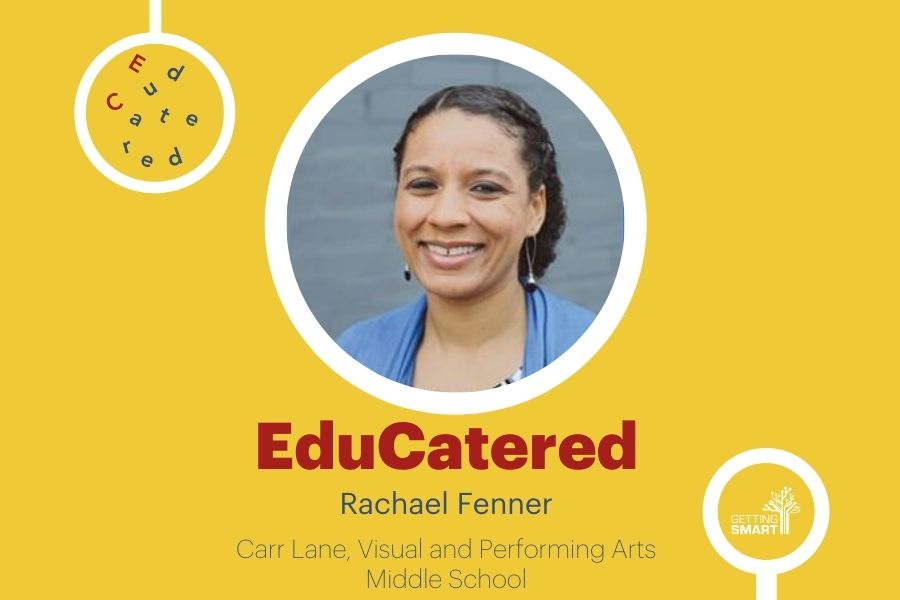
EduCatered: Rachael Fenner
Key Points
-
Being a good listener is one of the most important things an educator can do.
-
Knowing the history and culture of your place is essential to finding belonging and community.
We are thrilled to bring you a new podcast from Getting Smart called EduCatered: A Podcast That’s Catered to Educators. Subscribe here!
At Getting Smart, food, education, and innovation are at the heart of our recipe. This podcast mixes it all together to get to know teachers that are doing the work and making a difference.
We start with the appetizer: what makes these educators unique. Then to the main course, stories and experiences that have helped to shape their practice. Finally, dessert, some tips for what you can do next — creating a future of learning that works for everyone.
On this episode of EduCatered we’re joined by Rachael Fenner, a Reading Specialist and Teacher at Carr Lane, a Visual and Performing Arts Middle school in St. Louis. Rachael is fond of walking her dog Mocha, reading young adult fiction and you know our favorite… cooking.
Shawnee and Rachael talk about a range of topics – from the difficulties of middle school, to the importance of knowing the context of where you live. Let’s dig in!
Book Recommendations:
- The Broken Heart of America by Walter Johnson
- Stamped From the Beginning by Ibram X Kendi
On Diversity
My mom’s a white American and my dad is a black American, so sometimes I feel like I embody diversity a little bit, or embody the tensions […] working towards racial conciliation is really important to me.
Rachael Fenner
On Education
I appreciate that education takes a proactive stance. [It] gets on the front end of issues and tries to provide kids with skills and resources they need to get ahead.
Rachael Fenner
On Leadership
It’s important to listen and really hear what people are telling you. Try to view leadership as being a servant. Try to empower them.
Rachael Fenner
Transcript
This transcript has not been edited for spelling accuracy.
Hey, come on in. Welcome to Educator, a podcast that’s catered to educators. I’m your host, Shani, and getting smart food, education, and innovation are at the heart of our recipe. This podcast mixes it all together to get to know teachers that are doing the work and making a difference. We start with the appetizer. What makes these educators unique? Then to the main course, stories and experiences that have helped to shape their practice. Finally, dessert, some
tips for what you can do next, creating a future of learning that works for everyone. Let’s dig in. Hey, everyone. Thanks for joining us today. I am so thrilled to be joined by Rachel Finner, a reading specialist and teacher at Car Lane, a visual and performing arts middle school in St. Louis, Missouri. Rachel is fine walking her dog Mocha, reading young adult fiction, and, you know, our favorite, eating and cooking. Rachel, thanks so much for joining us today on
Educator. Of course. It’s nice to be here. It’s so nice to have you. I’m really excited about the things you’re interested in, of course, the cooking being one of them, but your love of reading, young adult fiction, and your dog. What are some of the kind of books that you’ve read in the past that you really enjoy? That’s a good question. There’s so many of them. I’ve really loved Jason Reynolds. He’s an author, kind of a newer author that’s out there. So pretty much anything he writes
I read. I just really like the kind of more realistic young adult fiction that really focuses on, you know, the African American urban experience that kids go through. And I just really enjoy reading his work. He’s funny and it’s great. Yes, absolutely. He is a getting smart favorite. We absolutely love his writing as well. So great pick. Speaking of cooking, if you were to contribute a recipe to a cookbook, what would it be? So hard for me to narrow it down, but
my mom used to always make taco pie for us growing up and I loved it. It’s so good. It’s you use crescent rolls as kind of like the pie crust, I guess you open them up and then you put the filling inside and close it and then bake it. So she used to just put, you know, meat and cheese. But sometimes I throw in the bell pepper onion or something like that, but it’s so good. It’s cheesy. It’s warm. There’s bread. It’s amazing. It literally just sounded like you created a recipe
for education. Like here’s the base. Here’s the things we fill it with. Here’s the topping. And then like I add this part and someone else may add something different. So great metaphor. I’ve never had that. But I’m going to try to sound yummy. When I, you know, when you think about all of the different things that make up who we are and who our students are, we talk a lot around like diversity and equity and things of that nature. So what is your diversity? So whenever somebody
asks about diversity, I’m always like, Oh, what do people mean by that? But I think usually people are referring to race. So I, so I’m biracial. My mom is white American. My dad’s black American. And so sometimes I feel like I embody diversity a little bit or like kind of feel the tensions between different races a lot when I’m kind of feel caught in the middle. But I think because of my background, kind of working towards racial racial reconciliation is really important to me. And so
you know, it’s important to me that I live in a diverse area and work in a diverse school or area. And the church that I go to is one of the core values is racial reconciliation, which I’ve learned a lot from being in that church. And so those are some ways that I really try to be diverse and celebrate diversity. And, you know, but I know diversity goes beyond that too. You know, being diverse really just means being different. So there’s, you know,
economic status, preferences, interests. So I try to always, you know, with my students, encourage and celebrate that middle school is a hard time to be different. But I try to to celebrate that with them and try to help them celebrate the ways that they’re different from other people too, so that they can embrace that as they grow up. Yeah, and it’s great that you walked in their shoes and you do celebrate all of the differences that students are in your
right. Middle school is an absolutely rough time. So for them to have you as a champion is, I’m sure, very critical to their daily lives. And as you think about education, why education? Why did you choose education? I’ve always loved children working with children. That’s always what I’ve wanted to do. I thought about going to social work route. But I kind of, I guess, fell into education mom was a teacher. She just retired a couple years ago. My grandmother was a teacher too.
So I tried to deny it for a long time like, no, I’m not going to do that. I’m not going to be a teacher like them. But I just couldn’t, I couldn’t resist. I think I appreciated that education kind of takes a proactive stance, you know, as opposed to social work, which both things are needed and very good. But I appreciated that education was kind of like trying to get on the front of issues and provide students with with skills and resources that they need to help them
be successful adults later on. So yeah, I think part of it’s in my blood and part of it’s just what I love. So you definitely couldn’t run from it no matter how hard you tried. So it sounds like you landed in the right place. And when you when you think about how education takes that proactive stance, one of the things that we think about is creating that sense of belonging for students. So how does fostering belonging contribute to your practice of teaching?
I think fostering belonging is one of the most important things you can do as an educator. I mean, students won’t really, learning is all about taking risks and trying new things and working hard and failing sometimes. And if you don’t feel a sense of belonging while you’re doing that, it makes it a lot harder to do. And so I try really hard with the students that I work with. You know, I do a lot of pull out groups. And so we’ll create a group name and, you know, we do
group point. So it’s as a group that we have to work together so that everybody is a part of the group accountable to each other and celebrate each other. And I just think that’s really crucial to the educators’ role is to making sure that all students feel like they belong. Yeah. And I like when you said that sometimes obviously failing is part of the process, but sometimes when you fail alone, it feels a little lonely. So fostering that group collaboration
is definitely key. And it sounds like one of the ways that you lead in your classroom and beyond. But when you think of the way of how do you lead, how would you describe your leadership? So one thing I’ve learned from people who have led me is that it’s really important to listen when you lead and to listen and really hear what people are telling you. And so, you know, I try to view leadership as being a servant. So you’re really serving the people that you’re leading
and trying to empower them with the skills that they already have so that they can kind of be their best self in whatever role that they have. And so to do that, you have to know the people that you’re leading, you have to listen to their concerns and where their desires for growth are and kind of I try to start there when I can and build on those things because, yeah, it’s just important to know the people that you’re leading so that they will follow you and you guys can be
on the same page in terms of where you’re headed. Now that servant leadership just doesn’t come naturally to everybody. I don’t know if that was something that you kind of always had within you or something you learned within your journey through education. So is that something that you had to learn or is it something that you kind of changed your mind about recently? Yeah, I mean, it’s definitely something I learned. I don’t naturally do that. I think I learned it when I
was in the role where I was working with teachers. I learned a lot through that role from the people who came before me and a lot of failure on my own, you know, trial and error. So yeah, it’s definitely not something that I naturally have within me. I think it’s easy to, you know, kind of you have a goal and you want to get there and you want to do whatever it takes to get there. Sometimes you don’t pause to really think about the people you’re leading and what their needs are
to and how you can serve them so that they can, you know, be a part of the progress in the journey as well. Yeah, it’s, you definitely understand the need to pivot based on the circumstances that you’re in. We have read Adam Grant’s book, Think Again, and so just that notion of rethinking some of our deeply held beliefs. What is something that you’ve changed your mind about recently? So it’s funny, I think about a conversation I had with another coworker in my district.
This was before COVID and I remember her saying that school was just going, you know, becoming more and more technology driven and this is the way of the future and, you know, even in our school district, we’re going to go there and at the time we weren’t, you know, what they call one-to-one technology. So all of our students didn’t have devices at the time and I was like, no, I don’t think that’s going to happen. Like we don’t have the resources for that. That’s
not some, you know, that’s not really, you know, technology is there. But so, you know, obviously with COVID coming and we had to be virtual for a while and I think I’ve really changed my mind in terms of what education looks like with all of these, with all of the technology that’s available to us and just how that can be integrated into construction and everything that you do in a way that’s really beneficial and in a way that really enhances education versus kind of what I was doing
at the start of my teaching career 14 years ago. So. Well, say if you’ve been teaching for 40 or teaching for four, everybody had to change how they thought about education within these last few years. So what is something that you wish more educators would rethink? So for me, when I when I went back to school to get my reading specialist certification, I took a class that was really eye-opening for me and I feel like it’s really made a major shift in my teaching. And it
was a class about behavior, student behavior. And basically, the, I guess, the theme of the class or the main takeaway was that all behavior is really a form of communication. And so, you know, when students are misbehaving in the classroom or you’re seeing behaviors that you don’t really want to see, it’s really easy to kind of jump to conclusions and judgments and make assumptions about why students are acting the way they are. And then your response to them is usually based on your
assumptions. Whereas this class really, like, taught us to step back and look at why, you know, what’s causing the behaviors, why are they acting this way? What are they trying to communicate you know, usually they’re trying to get something or avoid something. And so what is that? And, you know, how can you as a teacher in your response help them to meet whatever need they’re trying to meet by the behavior in a positive way? And I was just like, I mean, it sounds, I feel like
when I say it is like, of course, but it just was kind of not the way that I operated and not the way I see a lot of educators operating sometimes, but it’s really like, just mind-blowing to me. Like, yeah, instead of making assumptions about students, I can actually help them to learn how to behave in ways that are more productive, but also help them meet, you know, the needs that they have. Yeah, sounds like it was your aha moment. Yes, definitely. Well, it sounds like a lot of your
practice is built around listening, being empathetic, observing, being really open to other ideas. And I’m sure that bleeds into like who you’re listening to in your community and the things that you’re reading and maybe listening to on podcasts. Who is one voice in your community that you would recommend at other educators checkout? I kind of have two, if that’s okay, it’ll be similar. Thanks. So the one, the first one is a book that I read recently. It’s called The Broken Heart of
America by Walter Johnson. Walter Johnson. It’s a newer book. I think it came out in 2020, but it’s about the history, really, I guess, the history of St. Louis. So it’s focused on St. Louis, you know, which is where I teach and live. And it really focuses on race, the history of race in St. Louis from like Native American removal and Lewis Park up to the present day, Ferguson. And I, there were a lot of things that I learned. It’s a very heavy big book. There are a lot of
things I learned in that book about St. Louis that I had never learned before, especially since I’m not originally from St. Louis. But even I think people who are from St. Louis, there are a lot of things I didn’t know. And I felt like reading that book helped me understand the educational system in St. Louis public schools a little bit better, at least the context of it and kind of what’s brought us to our present day. It really helped me a lot. And so there’s a similar book
that is kind of more nationally geared. That is by Ibra Max Kendi, Sam from the beginning. So there’s the young adult version with Jason Reynolds, my favorite. I mean, I think there’s a kids version too, but it’s a similar, similar topic where it’s looking at kind of the history of race in our country. And again, in that book, there are a lot of things I never learned in school. There are a lot of things that aren’t taught in school. And I think it would, it helps educators to learn those
things, not just to share them with students, but to understand the context that they’re teaching in, in a better way. So those would be two that I would definitely recommend really for anybody, but it’s helped me as a teacher to understand the context that I’m working in a lot better. Yeah, no, I appreciate you sharing that. As you were talking about that, it just really made me think about the importance of really understanding the community in which you’re serving and not
just on the outside, but really digging into the historical aspects of why, you know, the school districts or the communities are the way that they are. And so just to really have a well-rounded view. So thank you for sharing those. Well, Rachel, we really, really appreciate you being here today. Thank you for talking to us about your teaching practice. Thank you for joining us for Educator. Yes, this was great. I enjoyed it. Thank you.
Thanks for tuning in today. We hope you found this conversation inspiring, illuminating and actionable. We love getting to talk with our wide range of guests about what makes us unique, alike and connected. Know someone who will make a great guest on the podcast? Email mason at gettingsmart.com and don’t forget to subscribe wherever you get your podcasts. It really helps to get more people around the table. Bon appetit.



0 Comments
Leave a Comment
Your email address will not be published. All fields are required.