


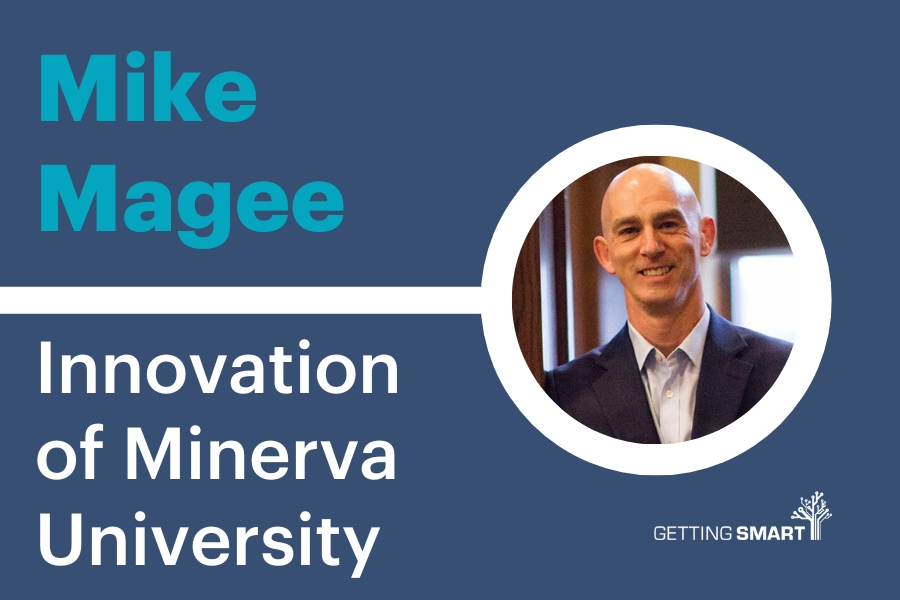
Mike Magee on The Innovation of Minerva University
Key Points
-
12% of Minerva University graduates have since created their own companies.
This episode of the Getting Smart Podcast is a part of our New Pathways campaign. In partnership with American Student Assistance® (ASA), the Bill & Melinda Gates Foundation, Stand Together and the Walton Foundation, the New Pathways campaign will question education’s status quo and propose new methods of giving students a chance to experience success in what’s next.
On this episode of the Getting Smart Podcast, Tom Vander Ark is joined by Dr. Mike Magee, the president of Minerva University. Previously, Mike spent time largely in edpolicy at Rhode Island School of Design, Rhode Island Mayoral Academies, and Chiefs for Change.
Minerva University is a 10-year-old independent, non-profit, accredited institution of higher education. It was formed in partnership with a venture-backed startup called the Minerva Project and incubated at Keck Graduate Institute.
When you have talented, creative people… you let them loose.
Mike Magee
Links:
- Mike Magee About
- Mike Magee Twitter
- Minerva University
- Minerva Project
- Ben Nelson
- Forum Platform
- Minerva University Sustainability Minor
- Seabound Carbon Capture
- Master of Science in Decision Analysis
Some of Mike’s Favorite Poems:
Transcript
This transcript has not been edited for spelling accuracy.
This episode of the Getty Smart podcast is part of our new Pathways campaign. What is something you used to think that you’ve changed your mind about? It’s time for us to do that with all things learning. Previous Getty Smart campaigns have laid the groundwork of networks, place, purpose, and innovation. Our latest effort, the new Pathways campaign, will serve as a catalyst for an unbundling education
to allow for new learning models that are sustained by supporting guidance and embedded in scalable systems. In partnership with ASA, the Bill and Melinda Gates Foundation, Stand Together and the Walton Foundation, the new Pathways campaign will question education status quo and propose new methods of giving students a chance to experience success in what’s next. Find out more at www.gettysmart.com.
Backslash, New Pathways. Mike, why is Minerva important? Well, I think Minerva University is one answer to the question of if you were going to develop the future generation of global leaders and problem solvers and entrepreneurs in every region of the world, what would you build if you could build it from scratch?
And, you know, since I became president in April, I’ve certainly gained a deeper appreciation for the fact that Minerva is really a combination of four very interesting innovations. An innovation in global cultural immersion. We have students from 80 countries who live not on a college campus in the U.S., although we’re a U.S. accredited university, but rather in seven cities around the world over their four years of undergraduate education. A second innovation in interdisciplinary learning, not only because we insist that students take classes across various disciplines,
but because we really teach students how to apply knowledge and skills from one discipline like the arts to another like computational sciences and vice versa. Third, an innovation in active virtual learning. We have a virtual platform designed specifically for us to support small seminars online and a pedagogy around active learning that I think is based in the science and very strong. And then lastly, all three of those innovations are really brought to bear on the project-based learning and experiential learning that our students do in the cities they live in around the world. So, you know, I say that this is what I would design if I were trying to support the next generation of global leaders and entrepreneurs,
because I really believe that the most intractable problems we’re facing in the world, whether it’s this pandemic or the next pandemic, the climate crisis, other public health issues, geopolitical conflicts, they all have one thing in common, which is they require deep levels of global cultural understanding and interdisciplinary approaches to problem solving. So that’s, you know, that’s my answer for why I think Minerva is a really important innovation in the field right now. You’re listening to the Getting Smart podcast. I’m Tom Vanderick and I have the pleasure of being joined by Dr. Mike McGee. He’s the president of Minerva University. It’s a 10-year-old, nonprofit, independent, accredited institution.
It was formed in an interesting partnership with a venture-backed startup called the Minerva Project, which was launched in July of 2011, started by a friend of ours named Ben Nelson. Mike, you may not know the backstory here, but I was leading a venture fund, the first education venture run back in 2010, and Ben called me and he said, hey, I have this idea for this new university. It’s going to be the best university in the world and use the best technology. We had dinner in the Mission District where he laid this thing out and I thought it was a wonderful vision, but I thought he was crazy for trying. It’s so exciting that you’ve made the 10-year mark and that you have joined Minerva to lead the university. How much visibility did you have to the early years of Minerva?
I think Minerva came on my radar around 2015, right around the time that I joined Chiefs for Change to lead that nonprofit effort. My original vantage point on Minerva was that it was very affordable relative to other selective US universities. I had aspirations to have Chiefs for Change do more federal policy work around higher education and was interested in any and all affordability models. It’s true, Minerva University costs less than half of other US selective universities largely because it has simply refused to participate in the arms race to turn college campuses into country clubs and developed a different value proposition for talented students around the world. But once I started to investigate on the affordability side, of course, I learned more about the university when the Intentional University book came out in 2017.
I read that and got increasingly interested. It captured me in one particular way, which is that it was a fascinating example of how to bring young people together in a school community across every conceivable line of difference. And as you know, Tom, that’s something that I’ve been passionate about my whole career. So the opportunity to take ideas that I had been working on for a very long time in the US context and think about what they might look like and what they might achieve in a global context was really appealing to me. I want to ask you about my my sense is that there’s a handful of really core innovations that make Minerva different, special and important.
But first one, I was really impressed by the outcome framework. It was obvious that Ben Nelson and the founding to Dr. Coslin were really intentional about naming and framing describing the key competencies that would lead to developing the skills for global leadership. Is that outcome framework still an important part of the life of the university? It is. And I think the academic team and the student life team for that matter have continued to hone that framework as we’ve gotten all of the inputs of student experience over the years. One other interesting aspect of that that I think is an important innovation is we’ve tried to align those competencies to assessments and admissions. So the university made a decision at the outset to not use the SAT, for instance, as an assessment measure of who we should accept into Minerva.
And I think we put a much heavier weight on things like creative thinking and critical thinking in the way that we assess applicants than most universities do. And we don’t necessarily have it perfect, but we really tried to design on the assessment and admissions side with the outcomes in mind. And I think every university should be doing that. Let’s just acknowledge how unusual it is for a university to have an outcome framework. That’s a novel concept, one that’s become core in K-12 but is still unusual in higher ed.
On the learning model, there’s a couple important innovations. I think at the heart of the Minerva learning model is really that that’s a cratic seminar. I think it still runs on the Minerva project platform called Forum, but it’s a super engaging. Everybody’s included. There’s no back row. Is that still key to the program? It very much is. And you’re right. We like to say that on our virtual learning platform, everyone’s in the front row.
If anyone were to audit one of those seminars, as I’ve done, you would never see a kid off camera. You would never see a student unprepared. What you’d see instead is highly engaging and collaborative dialogue between students and their peers and students and their professor. And a pedagogy, I think, that is proven to help students to not just retain knowledge but build skills. I’ve been so impressed with it. I came in having not witnessed it live. But I have to say, as the new president, it’s actually even better than I thought it was.
It’s an aspect of our model that we are certainly going to retain and continue to improve over time. You had about a decade of use before the pandemic. And so I think your transition as a university was probably easier than others with this core technology at heart. Yes. I think it’s very interesting to look back on in hindsight. And of course, I was not there at the time. But I would say a couple of things about how the university community experienced the pandemic.
One is from a logistical and operational standpoint, as you might imagine, it was very complex for us. We had students all over the world from more than 50 countries and had to figure out how to get most of them safely home and how to allow some of them to stay in the country where they had been living and learning because they couldn’t go home. So that was certainly very challenging and very stressful for our team. At the same time, as you suggest, the virtual learning experience for our students was quite seamless.
And they were throughout the pandemic able to continue to learn with their peers, with their professors, virtually uninterrupted. And I think it’s, as all of us found out during the pandemic, powerful to not only have the access to high speed internet and the technology that allows you to learn online, but to have a pedagogy that is designed for effective online learning. That was the piece, as I experienced it, for instance, in the USK 12 market that was missing from almost everyone’s capacity when the pandemic began. Let me jump to your admissions. You referenced this, but you have a merit-based, need-blind application.
A couple of years ago, I think you were the most selective university on the planet. I don’t know if that’s still the case, but you get thousands of applications every year. And are you still a merit-based, need-blind school? We are. And last time I checked, I think we were the most highly selective university in the world. I, you know, a couple of thoughts about that. One, I think as a university, we want to be unapologetic about what we’re trying to do.
And we genuinely are trying to develop the world’s future leaders and successful entrepreneurs and solvers of the world’s most complex problems. And we are trying to attract the most talented young people in the world. I think what we don’t want to do is do that in a cookie-cutter way or in an inequitable way. And so we’re very motivated to remain need-blind, as you might imagine. That’s a big challenge for any university. Yeah, Mike, I’ve often said it’s a great idea and a terrible business model. How do you support that?
Well, up to this point, we’ve been doing it by raising year-over-year philanthropy, and that’s not a sustainable approach, as you know, to this goal that we have. So part of my job as president is not only to make sure that we have a viable business model for the university, but to inspire philanthropy around the world to really care about this innovation and the outcomes that we’re achieving enough to help make us sustainable. So, you know, as I mentioned before, we got on. I’m traveling around the world pretty much nonstop these days, and that’s part of the reason why. But I do think our commitment to equitable access is a central commitment of the university that we want to maintain.
Do your students still travel around in a covert? They do, and I think that’s an important part of the model that we will keep in place as well. So at the moment, our classes are about 150 to 175 students. You come in as first-year students in a cohort of that size, and then you travel the world with that cohort. We think it’s a very important social support network for our students, because what we’re asking them to do, traveling to Berlin and Buenos Aires and Hyderabad, London, San Francisco, Seoul, Taipei, is quite rigorous.
And what we’ve found is that that kind of Dunbar’s number of 150 or so people provides them with quite a bit of comfort and quite a bit of peer support as they take on this challenge. Is there some degree of place-based learning in each location that complements this sort of Socratic seminar? Are they doing projects that are relevant to the city that they’re in? They are. I think it’s one of the things that I always try to be clear about with Minerva.
We have a very important virtual learning component of a four-year undergraduate degree, but it’s only one aspect of the learning that goes on for our students. We have a very thoughtful, fully articulated project-based and experiential learning curriculum that’s integrated with what our students are learning in their small virtual seminars. And we also have an internship component that is critical to what we do and that’s supported by partners in all the cities where our students are living and learning.
So it all is designed to fit together. And the projects, among other things, with surprising regularity led to our alumni founding companies. We’ve had, despite the fact that our alumni are all in their early to mid-20s, 12% of them have founded their own companies. And that’s an aspect of the pathways that we’ve created that I want to, you know, if anything, double down on. One of my favorite alumni stories, and I’ve been gathering lots of them since I became president,
is the story of two of our alumni, Ruzha Wen and Alicia Fredrickson, who founded a company called Seabound. Seabound produces carbon capture equipment for big tanker ships. And they’ve attracted quite a bit of venture capital. They have agreements with some of the biggest shipping companies in the world. What I love about that story is Ruzha is from China, Alicia is from Sweden, in no other place in the world except at Minerva University,
which they have ever even met. And they bring different skill sets to this company that they’ve created. And the company itself has a very ethical orientation to the world. You know, they’re really motivated to be part of the climate solution. So, you know, I want to have exponentially more alumni stories like that.
And I think we’re designed for that goal and outcomes. That’s exciting. You’re going to need an IP capture program and a really good alumni giving program. That’s exciting threshold. I have so many of your graduates, not just joining startups, but starting impact organizations.
I’d love to talk about a couple of the new innovations at Minerva that you’ve announced early in your tenure. You have a sustainability minor that we’re really excited about. Why launch that and what does it include? Yeah, so, you know, a couple of reasons we’ve launched it. One is, I think we’ve tried over the last handful of months to really think about,
okay, what does our model lend itself to? Not just in terms of study, but in terms of project-based learning and alumni outcomes. And as I mentioned, you know, there are certain problems that are so complex and so global in nature that they require these deep levels of cultural understanding and interdisciplinary approaches to problem solving. And certainly the climate crisis is one of those.
And so we wanted to try to formalize a course of study for any of our students, regardless of what their major is, that would allow them to intentionally think in these ways about the climate crisis, sustainability in all of its forms, and what kind of solutions are available in part by leveraging the Minerva University community itself. We also have an interdisciplinary group of faculty who are really excited about designing this. And so, you know, I’m a big believer in terms of organizational management that when you’ve got talented creative people, you let them loose.
And our faculty involved in the sustainability space really kind of took this ball and ran with it. But there’s another component of this that we’re quite excited about, which is that we’ve also designed a sustainability lab that will allow our faculty and students to collaborate on research, on projects, and potentially the incubation of new companies. And the lab, which is modeled on a lab that we already have, an artificial intelligence lab that we have based in Tokyo, supported by SoftBank and the Masa-san Foundation, is part of a growth strategy that involves not just adding undergraduate students
or even graduate students to our student population, but really thinking about the cities where our students live and learn. And the question of how can we not just have students come through here, but how can we build a vibrant ecosystem of programs and learning opportunities and experiences in this city in partnership with stakeholders in this city. And sustainability, I think, in this moment really lends itself to that type of approach to growth, and I’m really excited about that. I love the idea of a minor in sustainability. I think everybody ought to have a minor in sustainability.
I’d love to see high schools create the equivalent of integrating sustainability across the curriculum. I should have mentioned, Tom, that I think the group that’s most excited about this is our students. That’s great. I am also excited about your, you have a new master’s degree. It’s a Master’s in Science and Decision Analysis. I love this topic and appreciate your multi-disciplinary approach to it. Is this a fully online program? How does it work and who’s it for?
So it’s mostly online, but we have started to design low-residency opportunities in our rotation cities for our master’s students and the students in the Masters of Decision Analysis and the certificate program that we’ve developed recently will have those opportunities soon. I think that this is just one more good example of a program at Minerva that I wish had been around when I needed it. It really does support, I would say, especially early-stage leaders, to understand how to leverage data to make good strategic decisions. I see it as one component of what we might build in the graduate space as a suite of programs around global leadership.
We’re thinking a lot about our graduate school relative to our plans for growth and about where we might have unique value and some strategic advantage in a very crowded graduate education space. And I think there’s three areas where we might have something truly unique to offer. One is in this global leadership space, again, with a real interdisciplinary approach to education. Two, in sustainability.
And lastly, in education design, where I think many, many people would have an interest in learning about the design of schools and programs and learning opportunities from the folks who designed Minerva University. But as you mentioned, the Masters in Decision Analysis is our very first graduate program. It’s growing, it grew quite a bit this year, so I’m very excited about that. I’d love to have you say a few more words on the multi-dimensional approach to this.
This isn’t just a finance degree or a quant approach. You’re really also building in behavioral economics, psychology, right? This is a comprehensive look at how people and organizations make decisions. Absolutely. Yeah, so it’s not just from an economic standpoint, as you mentioned, how to look at data to make good decisions around budget, for instance.
It’s really about how do you use the entire wealth of information that you have at your disposal as a leader to create the organization both culturally and economically that you want to see emerge in the world. Again, I think about when I started my first nonprofit organization, just how paltry my understanding was of not just management, but organizational psychology and strategic forecasting. I think this is a very comprehensive and interdisciplinary approach that, again, for early stage leaders is just so, so valuable. Is it fair to say that this program is informed by machine learning, the implications of teams working with smart machines to make better decisions?
Absolutely, yeah. And it’s aligned in that sense quite well with who we are as a university currently by a fairly significant margin. The plurality, the largest plurality of our majors are in computational sciences. And I also think that over time, we are going to be able to align some of our programs so that they mutually reinforce each other. So, for instance, to have a master’s or decision analysis as well as a artificial intelligence lab that graduate students can potentially begin to participate in,
I think could have some real benefit to fully supporting our students in the way we really aspire to. Do you have certificate program, shorter programs, and do you anticipate adding more? Yeah, we just launched a certificate program for decision analysis. So, I’m excited to see how that goes, what we hear from students who complete that program about how valuable they felt it was. And I think that certificates can and should be a part of how we continue to design going forward.
I mean, as you know better than most time, the whole world of stackable credentials is very aligned to my thinking about what the future should look like. We all exist in regulatory environments that we don’t have complete control over, of course. And there’s a lot on the policy side that I would say needs to change. But I’m very interested in giving more and more talented students access to the kind of learning we do within the Minerva University community. Mike, I want to wrap up just by spending a couple of minutes reflecting on your interesting career and the wonderfully diverse experiences that you bring to this new job.
I was reminded that you taught English for a number of years at RISD at the Rhode Island School of Design. So, that’s an interesting place to teach English. Probably not a better institution of higher ed to have the opportunity to think differently about what higher ed could be. What would you take from that experience? Well, I got my PhD at Penn and then started my career as a professor at Haverford.
And then, as you mentioned, in short order, I came to RISD and taught there for about seven years. It was a wonderful experience. I loved the students at RISD. I loved the creative energy of that entire community. And one of the things I would say I learned is that, you know, I would say most students, certainly creative students, want to think in interdisciplinary ways about whatever their particular passions and curiosities happen to be.
And when you give them the opportunity to do that, what they produce is quite extraordinary. RISD also, when I was there, which was roughly from 2000 to 2007, was already a very international community and is more so now. And I think in the world that we all live in now, that’s powerful and important. And I, you know, the more I lead in our space, the more I think that the U.S. sometimes suffers from not orienting itself in a more global way. One of the statistics that I like to point out to people is that in the K-12 space in the U.S., about 16 million of our students are Latino and Asian American students.
And that is almost entirely the result of the Immigration and Naturalization Act in 1965, and even more so the Refugee Act of 1980. And what it means is that to a very significant degree, the U.S. student population is already global. And yet I don’t think we tend to think about it that way or to think globally. So, you know, RISD taught me something about that at that early stage in my career. And, you know, the other thing I would say I saw there and have always seen in higher ed is that I taught things like poetry and philosophy.
And students in the STEM fields actually wanted to know something about, you know, those fields in the humanities. Mike, you and I met as you were forming an entrepreneurial venture in the nonprofit space called the Rhode Island Merrill Academies. It was a new way to think about school, a new governance model. That must have been a great experience in kind of a scaling social impact, you know, using a new vehicle. It really was. I mean, I felt very lucky that I got that opportunity.
The current governor of Rhode Island, Governor Dan McKee and I, and a group of very talented people founded that nonprofit organization. And we built out a set of statewide, brand new, regional, racially and economically diverse schools that truthfully couldn’t have been built without changing state law, which we were able to do. And again, it was my first attempt to really build a school community that would bring students together from across many lines of racial and economic difference, which had been, you know, an interest of mine since I began my own public school career in integrated North Carolina public schools. And you had another seven years. I see there’s a seven year trend where you do these seven year tours of duty.
So I hope we get at least seven years of you at Minerva. Yeah, at least that the chiefs for change was a, I think a terrific opportunity for you to think nationally about education. And education policy and systems leadership. You really helped grow that organization and size and impact, but that must have been another important developmental step that helped you think at scale about education leadership. Yeah, it was such a such an important learning experience for me, Tom.
I mean, I got to learn at the feet of, I think some of the best education leaders in the country leading some of the most complex and challenging school systems in the country, a very, very diverse group of leaders who were, you know, really generous with their time and in telling me everything about their own leadership philosophies and what they were facing. It also was a deep dive for me into federal education policy. And I felt like I just learned so much about the structure of federal education law and how it impacts the options that we have and the decisions that we make. And then of course, you know, I had this vantage point throughout the pandemic on the struggles and heroic efforts of school systems around the country. I think I gained a much deeper appreciation during that time, for instance, of the role that housing plays in education in the US.
And the impact of very under resourced communities doing their level best to educate children in highly inequitable circumstances. So I felt like we were able to do some real good supporting those leaders. Chiefs for Change continues to do that. I’m really proud of what we built there. We’ve been talking to Mike McGee. He’s the president of Minerva University. As Mike said at the outset, Minerva is an important place in America and in the world at a time when America has grown skeptical of higher education and the value proposition of higher education.
And I think Minerva is more important than ever as a model of an intentionally university, one that delivers a tremendous amount of value and serves as a great example of high engagement with tremendous academic gain from talented young people. So Mike, we appreciate you and we appreciate Minerva. Is it fair to say that you’d encourage talented young people to give Minerva a look? Absolutely. I mean, it is the university, Tom, that I wish were around when I was 17. And I think it’s the right university for, you know, thousands upon thousands of talented U.S. students.
So we’re in the application season. I’d highly encourage everyone to give it a look. All right, Minerva.edu. Is that the best place to go, Mike? Minerva.edu. Thanks to Mike McGee for joining us today. Thanks to Mason Pasha for making this all possible. Thanks to the whole Getting Smart team. And until next week, keep leading, keep learning and keep innovating for equity.
Got a topic or a guest in mind? Send your recommendations to me, Mason at GettingSmart.com. And if you like what you’re hearing, don’t forget to leave a review in Apple Podcasts or subscribe wherever you listen. Feel free to share the podcast on social media using the hashtag GSPodcasts. Thanks so much.





0 Comments
Leave a Comment
Your email address will not be published. All fields are required.