

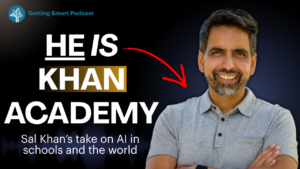
Mark Benigni and Barbara Haeffner on Education As The Great Equalizer
Key Points
-
Your senior population can really have a positive impact on your young people and vise versa.
-
It’s so important to keep an open mind and open doors for partnerships within the community.
-
Every student needs and deserves an advocate.
This episode of the Getting Smart podcast is a part of our New Pathways campaign. Find out more here.
On this episode of the Getting Smart Podcast, Tom Vander Ark is joined by Dr. Mark Benigni, the award-winning superintendent of Meriden Public Schools and the co-author of the forthcoming book The Great Equalizer: Six Strategies to Make Public Education Work in America. We’re also joined by Barbara Haeffner, Assistant Superintendent of Teaching and Innovation at Meriden Public Schools and co-author.
Together, they discuss Mark’s legacy in Meriden and the book’s strategies for reimagining and building a better public education.
Links
- Book Link
- Mark Benigni LinkedIn
- Mark Benigni Twitter
- Barbara Haeffner LinkedIn
- New Pathways Campaign
- Meriden Portrait of a Graduate
- Tools For Building a Climate
Transcript
This transcript has not been edited for spelling accuracy.
This episode of the Getty Smart podcast is part of our new Pathways campaign. What is something you used to think that you’ve changed your mind about? It’s time for us to do that with all things learning. Previous Getty Smart campaigns have laid the groundwork of networks, place, purpose, and innovation. Our latest effort, the new Pathways campaign, will serve as a catalyst for an unbundling education
to allow for new learning models that are sustained by supporting guidance and embedded in scalable systems. In partnership with ASA, the Bill and Melinda Gates Foundation, Stand Together and the Walton Foundation, the new Pathways campaign will question education status quo and propose new methods of giving students a chance to experience success in what’s next. Find out more at www.gettysmart.com.
Backslash, New Pathways. Music Mark, is education really the great equalizer? Without question. It’s definitely the great equalizer. It’s been the great equalizer for me, and I believe so many families and young folks have benefited from public education in America.
You’re listening to Getty Smart podcast, and I’m Tom Vander Erk, and today I’m joined by Dr. Mark Benini, the award-winning superintendent of the Meriden Public Schools. Mark’s been superintendent there for 12 years. He’s the co-author with our other guest, Barbara Hefner, who’s the assistant superintendent. Together they wrote the great equalizer, six strategies for making public education work in America. Mark and Barbara, it’s so great to see you.
Great to see you. Thanks for having us on. Barbara, was the idea of the great equalizer, is that Mark’s idea, is that one that resonates with you as well? So it’s an idea that actually we’ve been talking about for quite a long time, and we’ve both talked about the impact that public education has had on both of our lives, and we see the impact that it has on our students and families.
Well, coming up with a title, we kind of talked about it back and forth, but there was probably equal effort on both ends, but truly something that we both believe in that can help students and families in Meriden, but throughout the country. You guys are famous nationally, and there’s a lot of us that really appreciate your work. You have a big fan club that includes all of us here at Getting Smart.
Mark and Barbara, what we really appreciate about you is that you are learning leaders, that you’re always trying to understand how to better serve your community, and then you share what you’re learning so broadly and freely. We really appreciate the way you’ve committed to sharing everything that you build and learn regionally and nationally. I think this book is just the latest example of that.
Thanks, Tom. We were so glad to sit down and actually think, well, what have we done here in Meriden? How have we worked with folks to get success for students? That’s what it’s all about, and sitting down and really capturing, it’s really six simple ways that we’ve moved the needle. I’ve always said, like, education is the great equalizer.
It’s how you’re going to get ahead in life. And then as we were talking about the book, I probably said it three or four times, and Barbara probably said, maybe that’s the title then. But it really is meaningful for me, and I think it starts with my parents. My parents married very young, not a dime in their pocket, but a dream.
They believe both my mom was a good student in high school without means to continue education. My dad, we still at times would joke. He has since passed and said, hey, we want to see that diploma. Did you actually get it? But they both knew that school mattered for me and my brothers. And my older brother is a superintendent of schools in Connecticut as well,
and my younger brother runs a regional YMCA. So for us, it was the only chance to get ahead. And I think they had bigger dreams for us than maybe we had for ourselves. And I just, I know it’s worked for me, and I want to make sure that public education in this country continues to meet the needs of all learners.
And more than that, I worry. I want public education, and you and I have had these discussions to be willing to try new things, think outside the box, take a risk, own failures, and then obviously celebrate those successes. And I think some of the things we’ve done here in Meriden,
some of the things we’ve tried other districts can learn from. And we say all the time, every conference we go to, what’s the great idea we stole from someone else? Yeah. Mark, in researching today’s conversation,
I was reminded that you were a mayor in Meriden 20 years ago. What a cool experience that you had started as a school administrator and then did a stint as mayor in the town that you’re now superintendent. We may want to make that part of the preparation path. Right, it gives you, you have a really unique perspective on your community now, don’t you?
I definitely would say it was helpful. I learned a lot through that mayoral experience. And again, it’s about working with people. It’s about trying new things. It’s about getting folks behind initiatives to believe,
to care deeply about their community, and those things transition, whether you’re the mayor or whether you’re the superintendent of schools. But I kind of won on a flute, to be honest, Tom. I think folks voted against the other candidate,
and I was their only other option. But folks had said during the campaign, they said, he can’t win. He only knows children. Like he works with kids, he coaches, he teaches, he tutors.
And what we quickly found out, if parents trust you with their most precious asset, their children, they’ll trust you with their vote. And I had the honor of serving four terms as mayor, but education never left my blood. Even as mayor, my greatest concern was education and public safety.
What are we doing for our students? And that’s where I really learned that there was a great resource out there. And we touch upon it a little in our book. Like our senior population can really have such a positive impact on our students. And our students can really enlighten their lives as well.
So some of the learning definitely came from having the opportunity to serve as mayor. But we learn every day, and that’s what makes work fun. Barbara, I love that you started the book with this idea of building partnerships with all stakeholders. And, you know, we’ve been, we’ve been talking about that, but you really bring that to life in, in Meridin.
You take that seriously, your partnership with parents, your partnership with the business community. That really is the foundation, isn’t it? It really is. And, you know, it starts internally with us, partnerships with our union members.
So with our teachers union, with our administrators union. And one of the things that’s probably very unique to Meridin is when Mark became superintendent, the union leadership was invited to our central office meetings once a month. And that has really fostered a proactive relationship with both unions for us to be innovative, to bring ideas together, to problem solve,
and look to see what’s in the best interest of all groups, and most importantly, our students. We have an FSL team in Meridin that really reaches out to our families. And again, forming that liaison with families to be a supportive person who can either go out to their house, encourage them to come to the school, or provide resources that they may need.
And then we’ve also really looked at partnerships that are nontraditional partnerships for public school. And Mark will always share if there’s a philanthropic group that has a mission and a vision that’s similar to what we’re doing and they’d like to work with us, we’ll welcome them and have them work alongside of us, learning from us, and we’re learning from them, and reaping some wonderful benefits for our students and teachers.
We should remind folks that Secretary Cardona was really mentored by our guests, Mark and Barbara. He grew up and learned the ropes, and I think I became a disciple of partnership, working with the two of you, and we see and hear that in his work and leadership today, right? Definitely. We enjoyed working with Miguel for years when I became superintendent. He was a principal of one of our elementary schools.
We brought him up to central office to work on teacher evaluation, and that was a tricky thing at the time, like, war students, test scores going to be a part of it. So I think that gave him a chance to navigate working with different groups as well. Then he became later assistant superintendent and just a joy to work with someone who I think believes that public education is the great equalizer.
I think that’s how he lived his life. I think he would say it made all the difference for him, and it’s going to make the difference for his own children who are here in our school system. So it was great to work together and share ideas back and forth with one another. We always are cheering from him here from Meriden, and know that he has a huge job to do.
Early in your tenure, the two of you really made leveraging technology a priority. I’ve been a leader in blended and personalized learning for the last 12 years, and as I alluded to at the beginning, you’ve been happy to share with the developments. You run summer programs that share your leadership in blended and personalized learning. That’s really been a priority for you, and this is in chapter two.
You’re really recommending that schools everywhere should continue to try to leverage technology to personalize learning. Is that the essence? Yeah, that’s the essence, and I would say too, and then let Barb jump in. I think, first of all, I don’t think anyone will question the need for devices, access, single sign on, high quality digital content again. If you’re questioning that, you’ve missed the last two years in some way.
The other thing that I think is kind of unique, and whenever I get a chance to talk to folks about it, I want to share that you have to hire the right CTO. That person needs to understand technology, but also be invested in education as well. It’s not a separate position, and I think you need to include that individual in all of the high level discussions in the district. They need to be part of that core central office leadership team for it to work.
This is Barb’s strong suit, so I don’t want to take too much of this chapter from her. I think the key in any district is realizing the value of technology. Early on, as a district, we recognized the value of technology, and we integrated the technology into all of the core areas. It never was an add-on or something in addition. It was really part of the work that we were doing.
We had a very supportive, and we continued to have a very supportive board of education. So getting devices into the hands of all of our students, getting our teachers devices so they could take them home with you. The training and professional development that happens along the way really put us actually at a very good point with the pandemic hit because we had a lot of those early hurdles that other districts experienced already accomplished. Today, we continue to move ahead. We have partnerships with colleges, and we have actually all of our eight elementary schools
working on the language of coding, which is very exciting for us right now. I’m glad Barb said that because we’re never done, Tom. So what’s the new initiative? The other thing that I think we’re starting to all recognize is the benefits of game-based learning and virtual reality, really putting opportunities in the hands of our students from afar. And definitely game-based learning certainly has moved well beyond the Oregon Trail, which I loved as a youngster.
But I think we’re starting to see some of the benefits of those opportunities as well. And it always is, what are we trying next? And I think that keeps staff and students and families excited. And not everything we try works, but it’s okay. Like if you really created that comfortable environment, you just own it and say, Oh, that didn’t go the way we expected it to. But what’s what’s our next thing we’re going to try?
Barbara, I love the way in chapter three that you you talked about embracing whole child and embracing equity. You’ve really made big strides in the last five years on on this front. But what is a whole child approach have to do with equity? So I would say it’s looking at our learners needs from all aspects and knowing that it’s just not their academic success, but it’s also their social emotional excess.
And also knowing that everyone’s starting point is different and students need different supports along the way in order for them in order to be successful. One of the things that we’ve been able to use in our district to help guide us with this work is our climate suite of tools and are getting to know you survey. All of our students in the district utilize both of those tools to share information to getting to know, know you survey will share students likes dislikes areas of interest areas where they feel successful and teachers can use that information when they’re working with students to help best meet their needs to support their interest areas. And then in the end, engage them in the academic content that we’re willing or we’re working to have them be successful with. Chapter four is really an extension of this idea supporting the learners who need us most.
When people talk about personalized and competency based learning it often focuses on the idea of individual pacing but really the most important element is is providing the time and support that the kids that need us most really need and I loved how you brought that to light in chapter four So save more about that mark of what does it mean to you to really meet the needs of kids that need you most. So and I think I’m always reminded of a story and in memory of my dad. So was eighth grade and I was in middle school and you know I was put in the general math class, rather than the algebra class which we all know that the algebra class was deciding who would be in the top group and who wouldn’t. And I was devastated. I’m like how could this be I’ve always been in the top group so I go to the office I call my dad in tears. I first call my mom who then tells me to call my dad so I call my dad who leaves his factory job to come to the school and now I’m sitting on that bench waiting for him petrified because I don’t know what he’s going to like how dare you pull me out of work for this.
And he came in and I’ll never forget this day and I think it really it’s the advocate that everyone needs. My dad looked at the principal and said my son will be an algebra and you’re going to make it work and I’m not leaving so you call who you need to call because I’m not leaving here till he’s an algebra and and that story sits with me and then after he said that to the print he looked to me and said and you better not damn make a fool out of me. But but like I had someone who cared enough knew that was my wishes and wants to be there to support me to make sure it happened and I look and see so many students who don’t have that. We need to be the ones as educators to be there for those students we need to be the ones to push them that’s why we’re not going to give zeros and write students off we’re not going to have barriers to advance placement courses and early college experiences. That’s why we’re going to analyze all of our data by subgroups.
That’s why we’re going to read a design special education so we’re not putting kids on buses to commute an hour each way when we can do it better right here in the community. That’s why we’re going to partner with the Boys and Girls Club the YMCA is to expand the day for those learners who need it. So I think some of this book just came from my own my own life and learnings and and then I’m saying geez you know my own life impacted it. Barbara will share a story her life impacted it and it’s really made us who we are today as leaders in this district. And I think my own parents let me dream big like so they both like I said my mom was a high school graduate had always done well my dad.
We think graduated high school we still have never seen the diploma but they knew that education mattered and that learning mattered and I don’t think they cared what we did they wanted us to be happy. But they recognize that learning needed to continue so I think that’s really been what’s made us believe in public education and want to be sure and my own children. Brio’s in 10th grade here in district and Blake’s in ninth grade and they’re excelling in our schools and I say all the time it needs to be good enough for them it needs to be good enough for for all kids. Barb I love how in this chapter on supporting those who need us most you make the case that if we create school environments that work best for English language learners for neurodiverse learners it works better for everybody. Is that your take.
Absolutely. You know if school is engaging students are interested students want to come every day. We can help everyone in society. You know we the more we can have students in school working with them helping them develop skills and we have so many opportunities for now for students in our schools whether it’s pursuing career pathways or college ready experiences but we can really give them an opportunity to really be on a path to success whatever that may be for each student and we do a lot of work with our English language learners here and seeing great success in the district. The next chapter mark you alluded to this idea of challenging all learners. So we love this idea and we just launched a new pathways campaign here to highlight the way that systems like Meridan are helping learners experience success and what’s next. Both in post secondary success and and in work environments while they’re in high school and that really I think takes a commitment as you say in this chapter to challenge all learners. Mark maybe you can say more about how you’re doing that and how you’d advise people to really invite all learners to step into challenging learning experiences. So I would say definitely eliminate all those barriers to access I touched upon that so collapse those academic levels have open enrollment no pre recs that are blocking students from the highest level courses.
Look at your data by subgroups make sure that there’s a great representation across the district and then I would say give students opportunities to do what they love. So we have what we call a Meridan personalized learning experiences PLE’s they design a learning objective they work with a teacher mentor and they receive credit for what what their experiences are and the positive aspects of the program. I also say look can’t look at school as just six hours a day 180 days a year. So what are we doing to keep the arts alive. What are the opportunities through the arts to really expand the learning environment. What what type of athletic and intramural programs do you have available for your students. What are you doing to build that college and career culture. We do a hashtag why apply to college has tagged I applied hashtag accepted campaign. And then we celebrate with a you know a wonderful day where students walk across the stage with either their what college they’re attending if they’re going to a branch of the military if they started competitive employment and we have them all walk across the stage and it’s a big celebration and in the audience are our juniors
sharing them on because next year they’ll be the ones walking across the stage as well. The other thing we did here in Meridan that I think was helpful as we worked actually with the bar foundation on creating a community driven portrait of a graduate and really what are the competencies that students need long long so it’s more than just a smarter balance assessment score or an SAT score. What are some of those skills and traits that students need to be successful later in life. Barbade I’d love to have you say a little bit more about that portrait of a graduate and the ways in which you’re trying to bring that to life and Meridan. Sure well actually on the portrait is being shared with the community next week and we have a big event in Meridan known as our Daffodil Festival. So we will have students and staff at the Daffodil Festival sharing the work that has been done. Community members have been on the committee as well as students and Meridan public school staff. So it has been shared within these groups formally next year it will be rolled out in both high school.
They’re putting it in part of the school day. It would be an advisory will be the first rollout. We have some school assemblies that are going to be happening and really looking for buying from the community. We’ve heard from so many community stakeholders about what they need from our graduates that this is a living document that will allow us to have our students be prepared and ready for their next step in their career when they move on. So Tom we’ll have to have you come back and visit Meridan and see all the Daffodils and come to the Daffodil Fest one weekend. I would love to see that and I love the way that this book sort of is living out the cycle that you’ve created because we just went back to partnerships right. It goes back to partnerships after you celebrate success you go back to building partnerships on what’s next. This book looks like a real labor of love for you guys and we love all the special features that are inside it the stories and every chapter has tools and takeaways and discussion points.
We so we love all those special features was that that must have been Barb’s idea. Or maybe it was Lois’s idea who also Lois layman who had worked in the district for many years still works part time with us doing some grant work does a tremendous job also co-authored with us. But we did want it to be we didn’t want it to just be OK tell your story or you know take the 25 presentations or the 10 articles that we recently authored and put that in a book we really wanted to be you know useful or helpful or open up a discussion like some of our best times at work is when we had these great discussions and we may agree to disagree on some items but that’s where like the innovation. Comes from and that’s for all of us that’s what inspires us that makes us enjoy coming to work. We want to open up some of those opportunities for others. And I’ll add the other thing is we really feel like these are strategies that anyone can implement. We’re not a district that receives an exorbitant amount of funding. So these are strategies if you’re on a shoestring budget that you can easily replicate and have success in your district.
So Barb’s being gentle with that. We’re the second lowest funded district in the state of Connecticut for pupil expenditures. But that’s why the private foundations have been so critical to our success and I can’t thank them enough and I know other superintendents have said to me that group works with charter schools or that group works with magnet schools. I don’t care who the group works with if they want to work with us and support our students. We’re going to open the door and we’re going to share what we’re doing well here and some of the funders who’ve traditionally worked with private schools have really found they want to invest in public schools. We just need to give more reason to invest here. Let’s close with a couple of quick questions. First one for both of you. What are you excited about when you look at the path forward. What one thing that you think is an area of opportunity. Barb will start with you. So I’m excited about the role of technology in education. It’s been an area that I’ve been very involved in most of my career and I feel like the work and effort and headway that we’ve tried to make an education educational technology. The pandemic has really allowed us to explode that venue.
And I think we’re going to see some changes that are here to stay for the long term and have a positive impact in education. Mark what are you excited about these days. I’m most excited that I think we’ve seen that you truly can learn anytime and anywhere and I think it’s offering unique opportunities for all of us and I think we’ve seen that with our students of course. But we’ve also seen this with our staff. So why are we having them come in for PD when we could let them be much more self selective on their own professional learning day. And why do we care whether they’re doing it at their comfort or their home or in our school building. And I think we’ve seen it with parents. We will never go back to in person parent teacher conferences. They’ll always be available. But we’ve had the best attendance because some of our parents were having to take time off of work. Drive a half an hour to get there for a 10 minute meeting. That they could do on their phone and get all the information they need. So I’m excited that I think we all can embrace this concept of anytime anywhere and we’ve all seen benefits from it.
This book is just chock full of insights for school and system leaders. But Barb what one key insight would you like to leave leaders with today. I would say these strategies can make an impact on any student a positive impact on any student things that are very doable and really can change the trajectory of a student’s life and the opportunities that they’re afforded. That’s cheating. You’re going to say you have to do the whole playbook. You can pick your strategy. Probably partnerships. I mean partnerships with families where families feel comfortable coming into school discussing issues with the school supporting families and supporting their students.
Yeah. You guys have made that clear that that is where it all starts. Mark what what would you add for a system head who’s who’s thinking about next steps. Create a climate that’s supportive of innovation and calculated risk taking. Make sure there’s a way that you’re getting the feedback from all of your stakeholders students staff and parents because that feedback should drive your work. We have our climate survey but we also have other vehicles that we’ve been able to bring groups together and then I would say to everyone is look at this is a tough job. An American public education is in a very awkward uncomfortable position right now. I think we’re all fighting to make sure that we have enough quality staff celebrate success celebrate success because there’s plenty of them. And when I say celebrate I mean celebrate your student success your staff success and make sure the community is aware of the great work you’re doing in your district.
I love that Barb one insight for a high school student. Take advantage of the many opportunities that are offered at your high school even if it’s something you may not be interested in you may find that you have a new interest or passion. I’m in a new area to pursue. Mark. Challenge yourself take those high level classes even though it may be a little bit more work and you might have some work at night and on the weekends it’s OK. You’ll enjoy the challenge and you’ll be better prepared for your next life’s pursuit. Today we’ve been joined by Mark Bernini and Barbara Hefner the co-authors of the Great Equalizer six strategies to make public education work in America. Barb and Mark what a joy what a treat to have you with us today. Thank you.
Thank you. Thank you so much. Great to see you. Where where can folks learn more about the book where can they get it. It is on Amazon and it’s also available on Barnes and Noble and Roman and Littlefield. All right. And find Mark Bernini on Twitter. He’s always got good things to say.
Thanks for being with us and thanks special thanks to our poet laureate and producer Mason Pasha and the whole getting smart team. In the meantime keep learning keep innovating for equity. We’ll see you next week. Thank you for listening to the Getting Smart podcast. The new Pathways campaign serves as a catalyst for unbundling education to allow for new learning models that are sustained by support and guidance and embedded in scalable systems. The new Pathways campaign will showcase how learners can shine as difference makers and learning curators when opportunities are intentional equitable and personalized. Find out more about new pathways and getting smart dot com backslash new pathways. Thanks to ASA the Bill and Melinda Gates Foundation stand together and the Walton Foundation for their support in this campaign.


0 Comments
Leave a Comment
Your email address will not be published. All fields are required.