


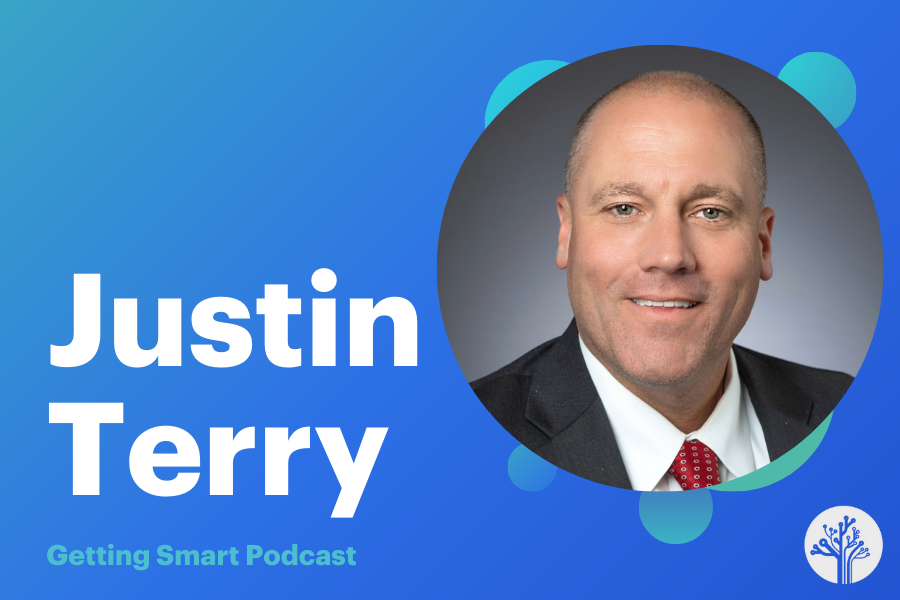
Justin Terry on The Opportunity Center and Lifelong Learning
Key Points
-
Forney ISD’s OC model demonstrates how schools can serve as multipurpose community hubs, integrating learning, entrepreneurship, and public spaces.
-
By embedding entrepreneurial and real-world skills at all grade levels, Forney ISD prepares students for success in dynamic, modern industries.
Shownotes





On this episode of the Getting Smart Podcast, Victoria Andrews sits down with Dr. Justin Terry, Superintendent of Forney ISD, to discuss the groundbreaking Opportunity Center (OC) in Forney, Texas. Dr. Terry shares the vision behind this 350,000-square-foot, future-ready facility that integrates career, college, and community into one dynamic space. From entrepreneurial opportunities for students and community members to creating a vibrant third space that serves all ages, this conversation highlights how innovative design and collaboration can transform education and community engagement. Tune in to learn how Forney ISD is redefining learning and maximizing impact for its rapidly growing district.
Outline
- (00:00) Introduction: The Opportunity Center
- (02:43) Designing the OC: Vision and Process
- (10:10) Creating a Third Space: Community Integration
- (24:01) Entrepreneurship and Future-Ready Skills
- (28:07) Advice for Educational Leaders
Introduction: The Opportunity Center
Victoria Andrews: Hi, I’m Victoria Andrews, and you’re listening to the Getting Smart Podcast. We often talk about community and how to create spaces that are inclusive, allow for growth, and center learning for all. With a slogan that says they serve young people from ages three to 103, a phenomenal example of this in action is the Opportunity Center.
Better known as the OC in Forney, Texas, which is about 30 to 45 minutes outside of Dallas, this district is being led by Dr. Justin Terry and his amazing team. Dr. Terry has served Forney ISD for more than a decade and is the superintendent with over 20,000 students. He has a strong dedication to fostering a positive school climate, promoting open communication with his community, and driving educational innovation. All of these traits and many more earned him the title of Texas Superintendent of the Year in 2024.
The OC is a 350,000-square-foot, multi-use, future-ready community center that supports over 20 businesses and experiences. I’m so thrilled because I was able to visit this phenomenal place just a couple of weeks ago. I just had to have Dr. Terry here so we could learn more and hear from him firsthand about what it takes to create a facility of this nature for his community. So, so great to have you here, Dr. Terry.
Justin Terry: Thanks so much, Victoria. Thanks for having me today.
Victoria Andrews: So, we’re going to start off—what were you like in high school, and how did you end up in education? Then we can get to the good stuff about the OC and what you’re doing out there in Forney.
Justin Terry: I actually grew up in an educator’s household—a coach and teacher. So, obviously, I was really attracted to athletics, and I was very involved in that perspective. I don’t know, let’s just say… I think good assistant principals—and I think I was a pretty good assistant principal—are good because they had experience with maybe some behaviors in class that were a little bit challenging for teachers. So, we’ll leave it there and just let it go from there. Is that okay?
Victoria Andrews: Totally acceptable. I also was a great assistant, according to the staff I worked with, for a high school. A lot of the student behaviors that visited my office were very familiar to me when I was in the classroom, so there was a lot of connection there. Education is the family business for my family too, so I totally understand.
Designing the OC: Vision and Process
Victoria Andrews: So, can you talk a little bit, Dr. Terry, about the OC? It’s just, like I said, a phenomenal facility, and it’s very unique for so many reasons. Can you talk to us about the design process of working with architects as well as your community to bring that vision to life?
Justin Terry: Sure. You know, this was kind of a crazy thought about 15 years ago that I had—what if we could actually take learning, let’s say, on the second floor and then put the experience in place on the first floor, really bringing community into the learning process on a daily basis?
What we’re trying to produce is really future great citizens and a great workforce. So, that one small idea really blossomed with a great team over this timeframe. The OC has now been open for, I guess, this is our third year that we’re fully open.
We had a great community and school board that gave us the direction to build a college and career center. Those are very common in a lot of places, and we wanted to do that. But I think, with the work of our team internally, our staff, and our architects at Gallagher Construction, we actually took that and added some components that we think were real value adds for our community.
So, we focus in this 350,000-square-foot facility that I’m sitting in on really three Cs: career, college, and community. How do you take every square foot and have it operationalized for all three of those purposes at any point in time, seven days a week, 7:00 a.m. till 10:00 p.m.? We’re educating not just high school kids in college and career but also, like you said, every one of our community members to improve and better their opportunities in life—from three to 103.
It was a great process. I wish I could give you a really clean design process that we went through. It was messy, ugly, but it was really a great team that came together to put it together. It’s operational right now in a really fun space.
Victoria Andrews: Did you have a lot of tension? Because I’m very fortunate at Getting Smart to be able to visit a lot of schools across the country. Some of them are cookie-cutter, and some of them are really doing amazing things with a very antiquated building. What were those conversations like with the architects to actualize what the OC is right now?
Justin Terry: Yeah, we treat them as just part of our team. They’re really no different than our assistant superintendents or whoever’s working in the room. Really, what we were trying to do was something that had never been done before, and that was to bring community into the space.
Just a quick layout of our facility—if you haven’t had a chance to see the OC—it’s a three-story facility. We basically have a mall on the bottom where we rent space out to local businesses, run a lot of businesses ourselves, or even purchase franchises as a school district to operate based on the needs of the kids. Then we have two stories of classrooms above that. In the center of it all is a 7,900-seat arena, making us the largest event space on the east side of the Metroplex.
The building does a lot. When you try to figure out how to design a space in a way that functions in a multipurpose aspect but is also future-proof for what the needs may be, it took a lot of heads in the room and a lot of work—and a lot of paper thrown in the trash. But, like I said, it turned out to be a very functional space. We’ve had to work on every space separately and look at it in a way that could be compartmentalized.
Safety is always a priority. If you’re going to bring the public into schools—which is needed; we need our community and parents to engage in the learning process—you also have to create a really safe environment. Everything can be compartmentalized and credentialed based on the time of day or the event. Whether it’s during a school day, we just had 2,000 people downstairs while there were 2,000 kids upstairs, and both events were functioning great in a very safe way. It was an extended process of getting every space right with intent to what our design needed to be.
Victoria Andrews: And what that looks like for our listeners—it looks like a lot of modular bleachers, a lot of modular tables, but also it doesn’t feel like everything is permanent. It also doesn’t feel like everything is just haphazardly put together either. It feels almost like a sports stadium, like you said, with a mall on the bottom and a school on the top.
When I visited and was able to walk around, it felt like you still had natural light. It felt very open and super pleasing to the eye. It was just mind-blowing to see how you all worked together. It’s so good to hear you say that it took so many voices at the table. It couldn’t just be you and your team, but the architects were working alongside you, as well as getting feedback from the community, because, like you said, it is a community center, and you wanted to invite them into that space. What were some of those community conversations like?
Justin Terry: Yeah, so we brought about 100 members of our community together to really give us direction and vision for what they wanted for our kids in the future. Like I said, I think a lot of times when you bring communities or educators together, we tend to think of our own experiences. The traditional is often what we go to first because it’s easy and very recognizable, right?
We heard what they wanted, but we also looked at what our community might need. We’re a bedroom community with really fast growth. I think you said we were at 18,000 students—today, we’re actually at 20,000, so you may need to update that. We grow about 1,000 to 2,000 kids a year, just 20 miles east of the Metroplex in Dallas.
We’re changing a lot, but we’re a bedroom community. At the time, we needed things like retail—we didn’t have much. We don’t have a public library. We don’t really have a place where the community can come together. We don’t have rec centers or things like that. So, we tried to take the community feedback about a college and career center and marry it with some of the things our community needed in general.
For example, we don’t have a public library here, but we do have The Mix. It’s a great place to come and co-work. It’s a coworking space where you can come and remote work if you don’t want to drive into Dallas. It has open Wi-Fi. We have a lot of businesses that are retail-friendly. We even tried to serve the athletic side of our community in our design.
It wasn’t just about what we needed for education but also what we needed for our community and how we could put those together to serve everyone. When we’re talking about tax dollars, that’s really maximizing them in a way that we don’t think has been done before in one space.
Creating a Third Space: Community Integration
Victoria Andrews: When I think about this, I often also talk about the disappearance of third spaces for young people and families. Naturally, the OC is a third space, just based on the number of hours it’s open. Typically, schools are like, “Hey, we’re going to open up at 6:00 a.m., and we’re done at 4:30 p.m. unless there’s a spring play or a track meet.” But that’s not the case for the OC.
If families want to grab dinner, they can do that. There are different businesses on the property. There’s even an escape room at the OC. If someone is hosting a baby shower or a bridal shower, those opportunities are there. Like you said, it’s just a place where people can hang out. If I don’t want to drive into Dallas, it’s a coworking space too. You never know who you’re going to pass by in that space.
I love that it’s not just for adults but also for students. If I’m going to my automotive class, I could walk by someone who is actually working in the open area as well. There’s that opportunity for social capital to be built, as well as, like you said, maximizing community dollars and taking advantage of everyone’s voice so that everyone feels super welcomed. I can’t rave enough about it—I truly enjoyed my time there. Were there any places that you and your team visited as inspiration while building this facility?
Justin Terry: I hate to admit it, but we didn’t do a lot of visits. We explored a lot online. I hate to admit what some of the inspiration was, but we had a good time with it. I don’t know if you’ve been to Las Vegas, but there’s a place right outside the strip called the Container Park. That was an inspiration behind what we were trying to accomplish.
The concept there is that you have to incubate in the Container Park and be successful to grow into the strip. We wanted the ability for workforce development and economic development to incubate here, whether it’s one of our students who grows into a business in the future—we’ve hired some of them, and they’re now working for us and running our businesses here—or whether it’s a small business that starts here and expands.
Another inspiration was the Wharf at Orange Beach. It’s a pretty cool two-story strip mall. We tried to understand how and why people came to those types of spaces. You said it’s a place where you just want to be, and that’s what we were trying to create. We didn’t look at schools necessarily. We were trying to create places where people want to be.
It’s so hard to get people off their couch right now, right?
Victoria Andrews: Yeah, the comfort is there. I can have food delivered. I can watch what I want to watch when I want to watch it. Everything is at my fingertips.
Justin Terry: Exactly. But we’re so isolated because of it sometimes—between our cell phones and the couch, what else do you need?
Victoria Andrews: What do I need? Yeah.
Justin Terry: That’s what we were trying to create with the community. What can you create that will get people out of their house these days? We played around with this idea of a mall, and malls are dying, right? In education, how do we get kids to school? How do we get parents to engage with us?
It’s really about creating some sort of value that will make them come and engage with us. What are you doing on a Friday night? “I’m at the OC.” What are you doing on a Saturday? “I’m at an event at the OC.” Just going to hang out and do some work at the OC. Those were the concepts we were trying to design around.
A lot of what we’ve discovered is not necessarily retail—that’s the dying part of the mall—but this mix of what we’re calling “edutainment,” this entertainment mix of learning and entertainment together. We’re starting to find our niche there. It’s a fun space.
Victoria Andrews: You are the second person I’ve heard use the term “edutainment.” Here in Texas, there’s an organization that partners literacy support with rappers. They don’t necessarily seek out teachers or those with an education background, but they also look for people with education and entertainment experience. It’s interesting to hear that approach and mindset, recognizing that this is the challenge. Like you said, everything is at our fingertips, so how do we draw people out of their comfort zone, and why? What is the value add? It seems like you all are figuring that out really well at the OC.
When you were talking, I heard that you’re embedding entrepreneurial opportunities for young people, for your students. Can you talk a little bit about that?
Justin Terry: Sure. I think a lot of college and career centers really focus on career pathways, and they’re very specific—which we are too. We have health science pathways, veterinarian pathways, cosmetology pathways, auto tech, and so on. All of our college and career centers, just like our teachers here, do an incredible job of preparing our students for certifications, credentials, or whatever it may be.
But what we also wanted to do was run a parallel path for every kid, no matter the career pathway they’re choosing, that focused on entrepreneurial skills. What we were trying to do on the first floor was pair our learning with real-world experience. For example, we have a student-run cosmetology studio called The Beauty Bar right next to Oats Studio, which is a rented facility—a high-end salon. The two spaces intermingle, allowing students to learn from professionals.
In that space, there’s a massive reception area. Our goal for that bottom floor was that our kids aren’t just learning how to be great stylists or veterinarians, but they’re also learning how to run a business. They’re gaining skills like business finance, stocking, customer service, marketing, communication, inventory management, and reordering supplies.
We can rotate students through different roles to teach those skill sets on the first floor, whether it’s in the cosmetology area or one of our other businesses, like a women’s clothing boutique we have on-site. We try to instill that entrepreneurial pathway in all of our kids. Many people call them “future-ready skills,” and that’s what we call them here. It’s a huge focus of what we’re trying to accomplish—not just the career pathway but also the entrepreneurial mindset.
Victoria Andrews: It’s not just the building that’s future-proof or future-ready, but you’re embedding those skills in your students and the families that are visiting the OC. I love that. Can you share a little bit about a program that allows the community to access some of those entrepreneurial opportunities too? The Engage program?
Justin Terry: Like I said, most schools are open from 8:00 a.m. to 4:00 p.m., and then they close. We have millions of square feet that just sit empty. A really intentional design element of what we’re doing is that we’re literally open seven days a week, and the public can come in and out anytime they want. That’s to integrate the learning process with the community.
Any program we offer our kids—whether it’s auto tech, cosmetology, or something else—we offer to our community a year later. We started that concept before the OC opened. We wanted to expand that to include everyone. What about senior adults? What about people who just want to continue learning—not necessarily for job promotion but for personal growth?
We created the Engage program, which is for everyone. Anybody who wants to offer a learning opportunity can propose it, and we’ll promote it for them. Anyone in our community can sign up for that. Most of the instructors are teachers, which is a side benefit because it gives them a little extra money on the side. It’s amazing to see the passions, skill sets, and talents that our teachers and community members have. It creates this ecosystem of learning together, and it’s a pretty amazing feeling.
Victoria Andrews: I love that—the idea of lifelong learning. It’s not just a catchphrase on a bulletin board or a website, but you’re truly extending the opportunity to the entire community. Whether it’s holiday cookie baking or something else, people can share their passions and find others who are interested. Again, it’s about allowing people’s paths to cross in ways they might not have otherwise.
For example, I love plants. If I wanted to do a propagation class, I could do that, and there might be other plant enthusiasts who would join.
Justin Terry: Exactly. You can share your knowledge with someone else. The other day, they were making cornhole boards in a DIY class out of the construction trades program. We’ve also had candle-making classes. Someone randomly said, “Hey, I can make candles, and I’d like to share that skill.” It’s great for the holidays.
Victoria Andrews: In those entrepreneurial opportunities, you’re not just starting them in high school, are you? You’re extending them to students in middle and elementary school. What does that look like for the district?
Justin Terry: We have a mandatory fifth course that we offer here in Forney called IRL, which stands for “In Real Life.” We put future-ready and entrepreneurial skill sets into that course. For example, our eighth graders are learning business finance, while our kindergartners are starting with personal finance. It vertically scales up as they progress.
The same goes for communication skills, critical thinking, de-escalation, and other components we know our kids need. We’ve put those into a curriculum and course that all of our students in Forney take, right alongside reading, writing, and arithmetic.
We’ve also taken it to another level. This year, we opened our first fifth through eighth-grade Entrepreneurship Academy as part of our exploration into micro-schooling. We’ve implemented five micro-schools under one roof, and one of those is the entrepreneurship program for fifth through eighth graders.
These students can intern in the businesses at the OC because they’re on-site. They’re designing and developing business proposals that they can present to a committee. If approved, they can run small kiosks throughout the building. In the meantime, if they have a product they want to propose, they can sell it at Pine and Ivy, one of our on-site businesses. They learn about overhead, profit, and other business concepts.
Victoria Andrews: And knowing that—I think I was reading not too long ago—Gen Alpha, which includes fifth through eighth graders, has about 60% of its members already thinking about what business they can own or run. They don’t have to wait until they’re in an entrepreneurship class in college because you’re exposing them to that as early as kindergarten. You’re giving them the opportunity to fail, fail fast, and fail forward, but also providing a safety net. They’re taking these classes with people who care about them and are invested in them.
Even if they start a business as a fifth grader, it might take different iterations by the time they’re in eighth grade. I just appreciate that too. At Getting Smart, we’re huge fans of early exposure to entrepreneurial skills. Not everyone is going to be an entrepreneur, but having those skills—being agile, learning teamwork, collaborating, understanding feedback from consumers, and deciding whether to act on it—is invaluable. Seeing that you’re exposing students to those skills at such an early age is something we applaud. We’re huge fans of that.
I’d love to learn more about the curriculum. Did you build that in-house, or did you go outside? What did that look like for the district?
Justin Terry: We built all of our curriculum in-house. For now, we’re actually partnering with Katie Martin and Learner-Centered Collaborative, doing some really cool work to pull in even younger grade levels into a more experiential process than we’ve had in the past. We’re really excited about how we’re redesigning things right now.
Like you said, entrepreneurship is an isolated group, but when you talk to companies like Google, they’re searching for intrapreneurial skill sets. We’re trying to figure out how to integrate those skills because Gen Alpha is growing up on YouTube, and they’re making money, right?
Victoria Andrews: They’re streaming on Twitch, creating content—it’s all there.
Justin Terry: Exactly. Their minds are already there. The question is, how do you let their minds not only explore that but also put it into play and experience it? That’s our goal. If they have a great idea, anyone from kindergarten through 12th grade can propose it to us, and we’ll put it into play at the OC.
Shorts Content
Entrepreneurship and Future-Ready Skills
Victoria Andrews: We’ve been talking for a good while here, Dr. Terry, and you’ve yet to bring up test scores. We’re in public education, and what I hear is that what’s important to Forney and its community is collaboration, community, and exposure to different options. Students can choose college or career paths because they’re being exposed to both and can make their own decisions. What else is of value or very important to Forney?
Justin Terry: The first thing I’d say is that we’re extremely innovative here. It’s part of our culture, but it’s driven by the fact that innovation really runs through our veins. You mentioned accountability systems, and I think there are two ways to innovate.
One is thinking outside the box—blowing everything up and trying new things. The challenge with that is that while it may feel good at the time, if you fail, innovation stops.
The question for us was, how can innovation continue always? How can we create something in the bureaucratic system of public education that allows us to be dynamic, fluid, and innovative? That’s why we don’t allow anyone in Forney to say “innovation outside the box.” We innovate in the box because you still have to be successful with test scores. If you’re not, all that innovation gets pulled back. You have to understand there’s a budget and resources that are out of your control.
We focus a lot on those types of things when we innovate. More than anything, what we’re about is people first in Forney ISD. That’s our driving value. In public education—or any education, in my opinion—our biggest asset is our people. It’s about how we can leverage their talents and passions to make each other better. That’s a huge passion of what we do every day.
Victoria Andrews: I love to hear that. As we begin to wrap up, what have you learned from the students and the community about creating an environment like this? How has it impacted their motivation, confidence, or sense of purpose.
Justin Terry: A lot of our change philosophy revolves around Michael Fullan’s book Motion Leadership. I’m not sure if you’ve read it, but it’s a small read—81 pages, I think. It’s about action-oriented change.
What we’ve learned is that many times in education, we create these great strategic plans that take three years to build and then three more years to implement. By the time we get the first thing in play, we have to start over because there’s a new strategic plan.
Sometimes, you have to learn about implementation during implementation. We’ve learned that it’s okay to fail a little bit and understand how to twist, turn, and pivot. Sometimes, it’s okay not to get full buy-in before you put something into action because behaviors drive beliefs. Once you’re actually in the environment—like when you walked the OC—you see it, feel it, and experience it. Those environments create change in our mindset and behaviors.
We’ve learned that we can do much more than we give ourselves credit for in education. You can innovate a lot within the bureaucratic system we live in. You just have to find a way to stretch the box a little bit. More than anything, we’ve learned that we just have to try because it’s good for kids.
Victoria Andrews: Oh, I love that you said that—it’s just good for the students. Otherwise, we’re just doing passion projects that look cool on paper because we want a monument to ourselves when we leave. Like you said, at the end of the day, is this the right thing for young people?
Justin Terry: It’s got to be.
Advice for Educational Leaders
Victoria Andrews: As we wrap up, Dr. Terry, what advice would you give to listeners who want to invest in innovative facilities but have no clue where to start?
Justin Terry: Have an understanding of what you’re trying to accomplish. I don’t think you need a three-page manual on your strategic plan or vision, but you should have some core components of what you’re trying to achieve.
For us, it was very simple: career, college, and community. We wanted to create multipurpose, flexible spaces that were future-proof so we could adapt to the needs of our kids and community in the future.
Then, just try it. You’ve got to take one step forward before you can start to run. There’s a lot of support out there. We’re an open book, and I hope others are too. The only way we can make our communities and kids better is if we break down walls and collaborate.
That would be my advice: understand where you want to go and take the first step.
Victoria Andrews: Oh, goodness. Thank you for sharing that, Dr. Terry. I can hear Forney’s values throughout this conversation—being community-centered, student-focused, and breaking down silos. Whether it’s within your community or learning from places outside education, it’s about trying. What I’m hearing you say is to take that first step and be willing to learn from it.
I’m so glad I was able to visit the OC and encourage anyone in Forney or nearby to do the same. It’s truly a welcoming environment with a vibrancy you can feel when walking around. For anyone listening who’s contemplating trying something new and different, I hope this conversation gives you the nudge you need to take that first step.
Thank you for joining me today, Dr. Terry. I deeply appreciate you, your staff, and your board for all they’re doing for young people.
Justin Terry: Thank you so much, Victoria, and thanks for having me. If there’s anything we can do to help others, feel free to reach out to us at ForneyISD.net. We’d love to open our doors to you.
Guest Bio
Justin Terry
As the Superintendent of Forney ISD for the last 7 years, Dr. Justin Terry brings over 24 years of experience to the field of education as a teacher, coach, and administrator. His leadership has been recognized with significant honors, including being named a 2022 NSPRA Superintendent to Watch, awarded the 2024 Region 10 Superintendent of the Year, serving on the Fast Growth Schools Coalition board, and holding appointments on both the Texas Teacher Vacancy Task Force and the Industry Based Certifications Committee. He received his Bachelor’s in Mathematics and Kinesiology from East Texas Baptist University, his Master’s in Educational Leadership and Policy Study from the University of Texas in Arlington, and his Doctorate of Education from Texas A&M Commerce.
Links





0 Comments
Leave a Comment
Your email address will not be published. All fields are required.