

Experiencing Success In What’s Next: The Six Pillars of New Pathways
Key Points
-
Pathways are not just for high school.
-
Learning can happen anywhere at any time.
At Getting Smart, we often frame challenges according to the idea that we are all solutionaries. We often ask, “How might we…” in the face of new challenges in order to reimagine what’s next in learning. This mindset led us to think about how personalized pathways may be the key to launching learners into new and individualized journeys:
- How might we create an ecosystem where learning doesn’t just happen at school?
- How might we rethink the ways students show their genius?
- How might we connect learners to the future of work and learning?
- How might we combine accelerated skill development with project-based and work-based learning?
- How might we create safe places that equip learners to fully express themselves with confidence?
- How might pathways lead to networks supporting and creating strong foundations for new and equitable learning models?
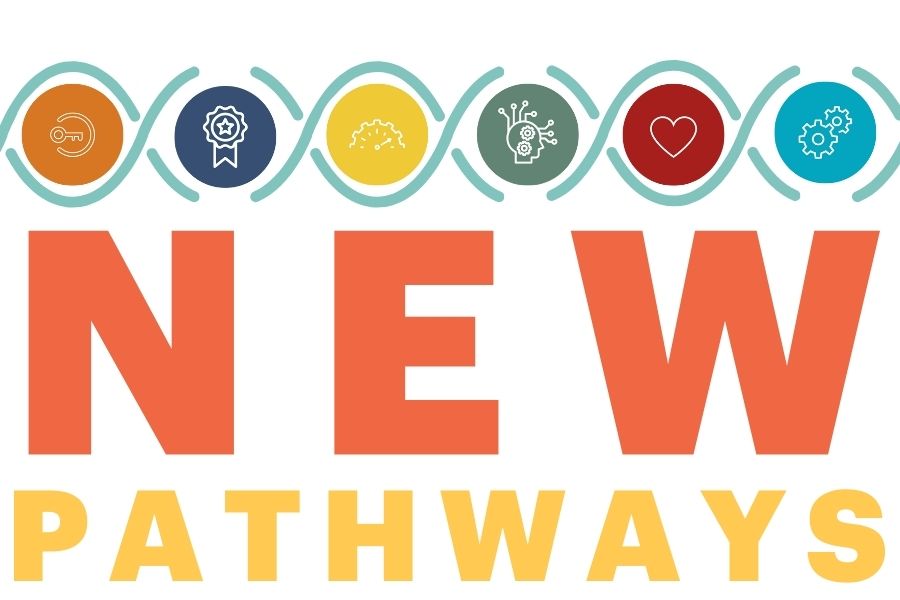
Thus, our New Pathways campaign had been born. Comprised of the six pillars: Unbundled Learning, Credentialed Learning, Accelerated Pathways, New Learning Models, Support and Guidance, and Policies and Systems and steered by our guiding principles of: Intentionality, Equity, Curation and Purpose, the goal of New Pathways is to help learners experience success in what’s next.
Unbundled Learning allows for permissionless learning and increases student agency. Learners choose when and where learning experiences happen and are provided with the resources and support they need to achieve the greatest impact. Through unbundled learning, the school building no longer serves as the primary space for learning, but becomes one space in a portfolio of many.
Credentialed Learning doesn’t rely on the traditional measurements of success for learners. Recognizing that one way to determine competency no longer serves most learners, credentialed learning measures human development and invites learner voice and choice into every aspect of the learning journey. Credentialed learning makes learning curated, portable, personalized and accessible.
Accelerated Pathways brings to light the experiences that learners can have before graduation. Learners no longer have to wait “until they become an adult” to have real world learning experiences. Accelerated Pathways allows learners to gain college credit, become an apprentice, attend boot camps and more to experience success instead of just imagining it. Accelerated Pathways connects learners to the future of work with right now experiences.
New Learning Models answers the question, “How do we teach learners more than just skills?” Through new learning models, structures are created to allow learners to have options. Whether a microschool, a school within a school or a school focused on one specific pathway, new learning models focus on how to improve the learning experience for all.
Support and Guidance is the how for all of the new pathways. Learners have the potential and the knowledge to determine what’s best for them, but resources, tools and mentors are needed along the way. Strong advisory systems increase the potential in all learners, helps learners to understand their identity and where they belong and creates a space for them to feel safe and vulnerable.
Policies and Systems create the foundation for new pathways to scale. Utilizing networks, systems and policies to shift the traditional ways of learning, this pillar plays an integral role in shaping accessible and equitable experiences for all learners. Strong policies and systems are necessary to unbundle learning so that it’s not the same for all, personalize learning with the learner leading the way and create sustainable systems to scale the process and impact policies.
Many learners are navigating high school (and beyond) without a sense of who they are, what they’re good at, or what change they want to see in the world. When a journey to personalized pathways for learners is realized, the future of education and learning is not within reach for some, but it’s within reach for all learners.
Are you ready to journey with us on this New Pathway? You can engage with this ongoing campaign using #NewPathways or submit contributions to Editor.
Transcript
This transcript has not been edited for spelling accuracy.
This episode of the Getty Smart podcast is part of our new Pathways campaign. What is something you used to think that you’ve changed your mind about? It’s time for us to do that with all things learning. Previous Getty Smart campaigns have laid the groundwork of networks, place, purpose, and innovation. Our latest effort, the new Pathways campaign, will serve as a catalyst for an unbundling education
to allow for new learning models that are sustained by supporting guidance and embedded in scalable systems. In partnership with ASA, the Bill and Melinda Gates Foundation, Stand Together and the Walton Foundation, the new Pathways campaign will question education status quo and propose new methods of giving students a chance to experience success in what’s next. Find out more at www.gettysmart.com.
Backslash, New Pathways. Getty Smart Hello everyone. Welcome to another Getty Smart Town Hall. We are so excited that you all are here today to talk new pathways. And if you’ve never been to one of our Town Halls before, I promise you are in for a treat
because we are so, so excited about our new Pathways campaign that we are kicking off with you all. So just a little Town Hall protocol. We really, really want your input. We want this to be a super organic, authentic conversation. So if there’s something that you want to say, just raise your Zoom hand to speak and we will call on you. And we really need you to share generously and respectfully.
You all are always so good about sharing lots of resources and thoughts in the chats and being super collaborative. And we don’t want that to stop today. So if you hear something that really stands out to you or if you have a great aha moment, we encourage you to put it on Twitter using the hashtag GSTownHall. And then like I said, share your thoughts in the chat.
We also will post a recap blog with the links mentioned on the event. So you may see a lot of links that are dropped into the chat. Please don’t feel like you need to go in and capture them all. We will make sure that you have access to those via the recap blog that we drop on GettingSmart.com. And then lastly, we will include a brief FAQ for the questions that we don’t have time for to answer in the recap blog.
So again, we want you to have fun. We want you to talk. We want you to share. We want you to listen and we want to just have a really good time. So here we go. We will kick it off with what is a Getting Smart Town Hall? Well, in essence, it’s just a place for us to share and to collaborate and to design and to innovate and think about the future together. We want to think about what’s next and learning.
So during our time together, we will help to build a collective momentum and understanding which will better enable us all to empower every single learner to thrive and act with purpose, which is our goal in everything that we do is to really have an impact so that students can be better. New Pathways, but we’re very excited. One that you all are all here. And we’re super excited to have the ASA team join us, who is one of the principal funders for the New Pathways campaign. And Julia Lambers is here from American Student Assistance as well as other members from ASA.
Julie, we just want to take the time to one greet you and before we get started, how are you today? Wonderful. Thank you for having us. We’re excited to be here with you. Excited to get working on this really important effort. Absolutely. And Jean, we want to acknowledge that you’re here as well and the rest of the team. So thank you ASA and everyone else for joining us.
As we think about the new pathways campaign, we really wanted to think about it holistically and we wanted it to be really grounded in equity and equity. In order to do so, we set up some design principles or thought of some design principles that were really important. Things that we want to be really ground truth and as Nate would say for students. And so we want the pathways to be really intentional for students. We want them to be equitable. We want them to be curated by students. So not something that we just hand to them and say, here you go.
But something where they’re really a part of the process and they own it and really the students are on the process and as they don’t, we’re part of it. And then lastly, we want it to be impactful for what they experience in high school, beyond high school. And we also want to have a space and know how to be impactful. Yeah, let me let me just underscore a couple of those. We think these are really important concepts when it comes to thinking about new pathways intentional meaning that it’s, there’s an intentionality to the learner a sequence of learner experiences that links them to opportunity that links them to possible futures.
And doing that for all kids doing that equitably in ways that we just haven’t in the past. By curated we we mean personalized or co authored co design that learners really not only have the opportunity to step into a career pathway but within a pathway to really to customize their, their journey to some extent and then the last one is impactful and by that we mean it towards contribution that it’s, it’s an opportunity for them to make a difference it’s it’s not only towards gainful employment but but citizenship so these are our pathways not, not just for a high wage job but towards broader sense of contribution. Absolutely. And Tom, I just want to touch on curated for a second because sometimes curated means as adults, we create the systems and put them in place and then we ask for student feedback. That’s not what you mean when you talk about curation. Yeah, my last blog on these personalized pathways I highlighted a half a dozen schools around the country that are doing this, some like big picture and doing it.
Since Tony and I first visited in the 90s. Some that are just beginning to but it’s allowing learners to imagine possible futures and then really construct or co construct those are the advisor. A personalized pathway that incorporates community connected learning, Johnny you’re leading the other real world learning in Kansas City and many of those learner pathways include client connect projects and internships that where learners have real choice about how and where they connect with the community towards a possible future. Yeah, and all of that builds these durable skills and Stephanie out I’ll invite you to unmute for a second from America’s disease because I know you all do a lot in the durable skills. When we put these sort of design principles in place Stephanie. How does that what does that do for a student’s ability to really exercise the way that they learn and the durable skills that they’re gaining. Thanks, Shawnee. Well for those who are unfamiliar durable skills is our new term for how you use what you know and how you show up in the world and it’s our belief that those collection of skills are really at the heart of student agency.
And so they put them in the driver’s seat to be able to curate their own pathway to move towards impact and find something that is both meaningful for them but also contributes to their community in the greater world. Thank you Stephanie for that addition so with all of that in mind. It was really important that we come up with these six pillars of what what does it mean to to hold up these new pathways and so for today’s purposes we’re going to talk through each one and we’re going to give some great examples and we’re going to invite you to give examples and we just want to create a clear understanding of what do we think about when we say new pathways so when we think about new pathways we think of the six pillars of unbundled learning credentialed learning accelerated pathways new learning models supporting guidance and policies and systems. So we start with unbundled learning and when we think about unbundled learner we have to really unbundled learning we our goal is to rethink what we used to think so we used to think that learning had to happen in the school building the pandemic and students and everyone and everything has shown us that that was really never true that unbundled that
could happen anywhere at any time anytime that a student needs it anywhere student needs it and so Greg over at caps you all are a really really great example of how you unbundled learning what does that look like for your students. Yeah thanks Shawnee great to be with everyone here. Yeah you know it is unbundled learning we try to mix experiences both inside and out of the classroom if you will and and I like what you said earlier about recognizing what experiences they’re bringing to the table and trying to leverage those and also provide them another set of experiences. Some of them are academic within the classroom but more and more we’re trying to find these experiences outside the classroom where as Stephanie mentioned these skills are really been learned in the past like just a curricular activity so turning school into an extra curricular activity by engaging gauging these other elements in our case mostly businesses and other industry elements to give those experiences. Nate you’ve been thinking a lot about unbundled learning for our team but what does unbundled mean and is it the opposite of being on an intentional pathway like so what does unbundled mean for you and then how does unbundled become a coherent pathway. Yeah super interesting I think it’s there’s a grain size question that I think about a lot with unbundled learning is that what grain size do we need to unbundled learning into so first we’re just speaking about all the ecosystem of learning around and outside of schools and then there’s a secondary grain size around what are the skills that are within all those experiences and so when we can unbundled to not only the larger
ecosystem but then also the skills themselves then we have a way to reassemble those into viable pathways employer matches etc etc. Tom you and I are just on a call we’re talking about how do we unbundled the college transcript or the high school transcript into a viable set of skills and how difficult that work is but how necessary it is if we really want to create really strong pathways so. So unbundled could be new opportunities for credentialed learning and then that credentialed learning could drop into a learner wallet or like. Green light credentials that that makes it transferable so unlocked opportunity. We’ll come back and talk about ways that that we can string those.
Unbundled opportunities back into pathways but I appreciate the connection to credentialing. Yeah, it could be Julie if if there’s new forms of learning that you saw developed over the last three years that you know both inside and outside of school that are new opportunities that you’re excited about it. I think we may get to some of these sort of new models a little bit later on Tom but you know I think the things that we are looking at as a are how do we provide opportunities directly to students so understanding that they are. Consuming information in in new ways and what is the best opportunity for them to build skills develop credentials understand more about themselves in their own personal interests directly to them until we do a lot of work directly through digital but also how are we best utilizing out of school time providers and partners that are are working with students beyond classroom hours to really ensure that they a week or two. We are meeting kids where they are and not sort of sticking to the traditional systems that were built, you know, last reformed and whenever it was 1925.
That look at the fact that learning only happens between 8am and 3pm. We know that’s not how the world works. That’s not how kids want to learn or how quite frankly most of them have been learning for the past few years, even beyond that. And so how do we do something differently. It’s really important to continue to push on that. Thanks Julie. And Julie and once I also want to make sure that I give space to for you all to talk about ASA and how what is your relationship to the pathways. Yeah, so we’re really excited to be working with getting smart on this initiative and I see my boss Jean Eddie has jumped on as well and she was trying to sneak in between between meetings so glad that she could join us.
So ASA is a national nonprofit. We’re based in Boston, but we focus on helping kids really starting in middle school, understand careers more deliberately and make plans and and be able to build a path towards post secondary education success. So really helping kids starting in middle school understand their their cell themselves and their own career identity a little bit better, providing opportunities for kids to test and try through a variety of things while in high school, and then being very deliberate and how that aligns to a post secondary education path, and a diversity of post secondary education path increasingly. So we have funded a number of initiatives over the last few years, in addition to doing a lot of digital work directly to students, things like 13th year programs I think Tom highlighted one of them in Springfield and his last blog work with the Commonwealth of Massachusetts to build their innovation pathways programs, working in Delaware around their pathway initiative, really trying to think about how do we make the high school experience an opportunity for kids to to test and try something before they move on to post secondary education, that it’s not just about academic learning that there’s opportunity for embedded career readiness in there as well, and really being deliberate in rethinking that high school model. So really excited to be on this journey with with Tom and the getting smart team and excited to see what comes of it.
I want to give Jean space to talk about middle schools I know Jean the insight that pathways really have to start in middle schools was important to you early in your tenure at ASA. Why, why did middle school matter to pathways. I think it middle school and all of the research we were able to do but more over the secondary research we were able to tap talks about middle schoolers as prime time when they are curious open to new ideas, and not so influenced by what their friends say. They’re willing to go exploring the willing to try some things. So to tap into that and be able to help them figure those things out things that make their heart saying, but also things that can connect to what they really are good at will allow them to make really good choices even courses in high school. So many times when students are thinking about what’s next after high school they realize that they should have taken some courses in high school. This allows them to really tap into those things and have a long term plan. It’s not to figure out what am I going to be when I grow up in middle school, but moreover, what are the things that excite me and interest me so that I could do more of it.
Yeah, we really appreciate that Jean. You made me think of our friends in Cajun Valley and San Diego where this starts in kindergarten, where they have immersive possible future units of study that result in reflection of strengths, interests and value so it’s really identity formation beginning to understand who you are and what your superpowers are and where and how you want to use those in the world. So we love your focus on middle grades. Pathways are not just for high school. Pathways are not just for high school and I love when Jean say really makes your heart sing and sometimes we don’t always measure that correctly. And so that’s when we get to credentialed learning, which is the second pillar of pathways. There’s really more than one way to show student competency. It’s not just a paper and pen test and then all of a sudden you either know it or you don’t. There are hundreds and hundreds of ways and the new pathways campaign around credentialed learning really, really takes a stab at doing that a little bit differently. Tom, you want to say more about the credentialed learning.
The credentialed learning is is really creating a new language for capturing and communicating human potential. For 150 years we relied on a list of courses and grades as a way to describe human potential and it’s just, it’s a pretty crummy communication system and so this, this category is really about reinventing a way for people to describe who they are and what they’re good at. And where they want to make a difference in the world. So it’s digital credentials. It’s, it’s learner wallets, it’s portfolios, it’s ways that people can share who they’re becoming with. And it goes back to those design principles of putting all of the power back into the hands of the students, how they want to show up how they want to show their genius, they want to carry their records, etc. Yeah, we, Shawnee we made tonight, we’re just talking about this on a prior call and we love the idea of a, of a learner record that’s curated. It includes verifiable skill assertions right so it’s not.
It’s much more reliable in many ways than grades or courses, but you can take portions of that and edit them and then permission them. That record out to interested parties that might be scholarship organizations or colleges or employers so that you’re creating a view like you would a resume and sending that out but it’s it’s a resume that includes verifiable information so that it’s trustworthy and so it’s really a much better resume and we’re excited about this emergence we’re excited that our friends at at XQ are working on this and they with the Carnegie Foundation have vowed to kill the Carnegie unit and to replace it with a new system of credentialing. We’re excited that this year we last month in fact we had hundreds of learners in your hometown of Kansas City, earning credentials for valuable experiences experiences valued by by their community so this is really not just digital credentials this is a new way to communicate human potential. And our friends over at green light, they’re doing some really really great work in this area as well right.
We’re excited about the early learner records in green light is that real success across hundreds of high schools in Texas, unlocking opportunity in both college and scholarships and and employment. We’re excited about the work territory and is doing in higher education. We just talked to to IBM this morning, and they’ve been a leader in digital credentialing for a decade and they and others are working on new record systems work confident that in the second half of this decade. Every high school and college learner in America will be able to curate their own digital portable record that will help them describe who they are and what they can do and will help unlock opportunity for more students. Absolutely accelerated pathways is another pillar and sorry I think you sorry I thought of one.
Accelerate pathways is another pillar that we focus on the new pathway campaign. It’s it’s all about learners not needing to have the same experiences at the same time because learning doesn’t have to happen on the schedule. And there are multiple ways to get there whether we’re looking at early college or we’re looking at technical training and apprenticeships do a Roman earn and learn ladders. The students come to learning in a different way and it looks different for every student, but that doesn’t make it wrong. It just makes it different right time you want to share a little bit more. Well, I had the good fortune to help stand up the early college initiative 20 years ago and it was early early on it was very successful in the way it compressed time, and that many students could make six years of progress and to and leave high school with an associate
degree. That initiative has continued to grow as have other pathway opportunities, I be and and AP, and then our friends at IBM and the New York Department of Education added work experience to it and called it P tech. So we’re very excited about these accelerated opportunities that bring dual enrollment into high school. The big step in the next five years is to make that a less jarring transition because right now it still feels like a bunch of high school courses and then you jump into a bunch of college courses and it’s pretty still pretty disconnected pedagogically and thematically and we think there’s opportunities to make these smoother pathways. The other area shiny that you know well as the new career and technical education pathways that are accelerated sprints to valuable credentials, as well as earn and learn ladders where you, you starting in high school are getting paid for an apprenticeship and learning
and and and begin that earn and learn ladder early on and so we’re we’re excited about all the acceleration opportunities and hope to see by the end of this decade that all learners have really good access into a variety of accelerated pathways to degrees and credentials. Yeah, and more and more students and I invite anyone who wants to speak on this as well to unmute but more and more students are are going that way and really recognizing that just because you take one route doesn’t mean the other one isn’t as good or it’s not a one one size fits better than the other is kind of just whatever is personalized best for that student and you mentioned the career and technical aspect, which in some cases in historically are in the past had a stigma to it but as people are becoming more familiar with what that really can do for students and the credentials that they can earn and the the high levels of technology that are involved in high levels of learning. People are really seeing all of these different pathways as a viable option so next we want to talk about the new learning models. It’s new learning models. It’s, it’s really, you know, something that is important. It just means that one size doesn’t fit all in one size fits one, but we need to expand our definition of what learning looks like and that could be a micro school that can be kind of anything you want to try out that works best for students.
I’ll throw it to you first Julie. What are your thoughts around the new learning models pillar of the pathways campaign. So really excited about this for seeing some really interesting new models pop up throughout the country that I think we need to raise up and and learn more about so that they can be replicated I guess one of the questions I had for for Tom and for you, Shani as we’re thinking about them is one of the things that constantly comes up in some of these new learning models. Is how we’re prioritizing issues of equity, because a lot of the models that are popping up might have entrance requirements or things that are barriers to access because education attainment has been reached much earlier in students career. So how are we ensuring equity in some of these learning models and really prioritizing that I think is is a big area of concern but something that you know sort of exciting to look at. Yeah, we’re seeing a lot of good things happening as people think much more holistically about experiences are from a student perspective, carrying less like who is going to fund it from a Department of Labor Department of Education, CTE, you know, general add to that.
And so we’re seeing a lot of funds but really looking at it from a student perspective. How does a student get all of the skills that they need to be successful and in education and then ultimately the workforce and putting that lens on it. We I think we’re seeing some good things popping up throughout the country so you know good work happening in Delaware in this space. They’ve had a really real focus on that for a number of years, and have built out some pathway models at the state level. And really good examples, although on a small scale since it’s the state of Delaware, still some good learnings happening there that I think we can we can emulate. Yeah, and before we wait, I want to. Yeah, sorry Tom, go ahead. Well, I want to highlight some of the excuse schools are one of our favorites is Purdue Polytech in Indianapolis so we love that.
It’s a new architecture for high school that combines skill sprints and projects. So kids are doing individual competency based personalized skill sprints and they’re engaging in community connected projects so every learner and every faculty member as a individualized schedule so that’s a great example of a new architecture for high school built around a set of competencies. Now Tony you’re working on a new book on on mastery based or competency based learning any new models that you’re excited about that you want to highlight here. There are no new models Tom ones. In fact, you’ve already highlighted her successfully. I think the challenge is what we’re seeing is innovation at the margins. And we still as we know have the big bears in the room of the state testing and and college admissions. We at the mastery transcript consortium as you know are trying to tackle a new kind of transcript.
But beyond that, I think the pressure is going to have to come from business. I’ve been talking with Tim Taylor at America succeeds. He and other business folks are really beginning to see the light that education has to move towards a competency based or efficiency based approach. So I think the more we can develop collaborations with business I notice that’s been a cornerstone of the success of the CAPS program is having business cheerleaders in local communities. So that’s my insight at the moment. Appreciate that and Josh you you highlight a lot of new models so Aloha over there in Hawaii what what do you want to add about new models and why is it such a focus for you. Thanks Tom. For me the highlights come as a result of hosting my podcast the what school could be podcast and I’m just to give you a very quick example. Tom, as a result of this work I became aware of something called the pineapple Academy here in Honolulu.
As it turns out this was a coven pivot on the part of several teachers at one particular elementary school public school, and they realized that there were many parents who were actually not trying to avoid having their kids be back in school in person, but they were actually becoming quite intrigued with a blended learning model. And so as a result of that pineapple Academy long story short is a consortium of 25 schools now that are all pitching in to create a blended learning model, and it’s kind of hub and spoke it’s a non school that’s the hub. So I’m stoked by this because it’s not avoidance it’s actually locking in on a different way for parents and their kids to engage with this thing we call school so yeah. Last week I wrote about a lot of schools that popped up during the pandemic are really pods and micro schools that that are a cooperative that sit on top of an online school. I think we’re going to see continued growth in that category of really personalized schools that add a lot of flexibility for families so I think this is a category where we’re going to see renewed interest for the the the whole of this decade.
And in many cases it’s going to be around helping learners create personalized pathways. Yeah, which will require what our next pillar is support lots of support and lots of guidance and we mentioned that in the beginning when we’re talking about you know when we’re talking to the poems but learners can’t do this on their own. They can certainly do it, but they need the support and the guidance to kind of you know navigate their way through it really it does take a village and so we grew good and strong advisory systems to help learners explore the careers but also build their social capital. We need to help them to really reach their potential we need to help them increase their sense of agency and belonging, and we need to link all of this back to pathways and so that’s what support and guidance is and I know Tony or Julie you all have some some good thoughts around support and guidance systems as well so really interested in getting your feedback Julie I’ll start with you.
I don’t necessarily know if we’ve seen a lot new in the support and guidance space. I think what we are looking to figure out is what are the opportunities to help kids navigate differently. We’ve gone either through through high school or into post secondary education, and the reality is that counselors, teachers, parents, students don’t have the resources they need and in order to do that well at the moment. It just doesn’t exist right there is a growing field of post secondary education credentials and pathways that are sometimes hard to decipher understand understand the value of how do you effectively navigate to that and so what we are seeing as students are still defaulting to what they know because it’s an unknown entity but even though it may not necessarily be the right fit for them. So how do we disrupt that a little bit and bring sort of both more awareness and better understanding of value of those post secondary credentials so that there is better counseling and navigation. I think there’s a lot of room to go in that space, and we’re not quite there yet, but we certainly see is a huge area of need.
Our vision is that every learner as Nate said every learner’s got a pathway coach and we hope it’s an advisor and an algorithm that work together to give personalized and localized pathway advice so this feels like there’s both structural staffing and structures as well as systems opportunities in both high school and college. And speaking of systems and policies and networks, everything has to work together which is like kind of the building block for new pathways. The goal here is to create this foundation where everything is on bundle there’s all the support and guidance. But now we have to make it scalable. And that’s where we have to really focus on the policies the systems the networks in order for that to happen because learning is better together. So this is all around how do we really bring pathways to scale, whether no matter what the platform is or the network it can be around technical assistance or curriculum networks or diploma networks, etc. We need we need these systems in place in order for pathways to thrive. So Tom, I’ll let you say a little bit more on this but how do we really take this campaign and show people how to bring pathways to scale.
Yeah, this is definitely better together, Johnny. This is, we think Kansas City is a great example of 30 systems working together to build community agreements that unlock opportunities for you so we think that’s a terrific example so regional networks. We talked about P tax earlier. There’s probably 300 p tax around the world that that work together to support the new learning model so we think school networks are super important. And the last category that I’d love to have Judy or Jean, Julie way in on it just state policy really matters in this category of how pathways are initiated and then how high school connects to college so Julie, any state policies in particular that you want to highlight. Yeah, I mean there are a network of states that are doing it fairly well a lot of them spurred by the new schools for for youth grants a number of years ago. Massachusetts has a pretty good pathways program. I believe Tennessee has has done some really good work. Delaware as I mentioned earlier again really well coordinated.
One of the things that we tend to forget when we’re talking about high school education is the role that I think someone mentioned earlier that business needs to play and all of this, and what how are we ensuring that they are an active solution provider in a lot of this work and are not just sort of sitting at the edges pointing at a problem that they want everybody to be able to actively engage in ensuring that there are work based learning experiences ensuring that they are informing, you know, curriculum development or that will align with their industry needs or providing mentorship and so you know so kids can build social capital. And so we’re really making sure that all of those pieces align. The state partners tend to do that fairly well and being able to use their bully pulpits to pull in the necessary players. So we may need to make sure that that that is happening across this. As we think about the new pathways campaign and the pillars we want to know from your perspective and we invite you to unmute or you can raise your hand and we’ll call in you whatever works best for you. But we want to think about these four questions. One, what does success look like when new pathways are fully implemented? Where are you focus like in your work? What’s missing from the conversation that you haven’t heard but you wish you had?
How do learners truly own their pathways? And then how do we create pathway buy in for parents, which is one of our most important stakeholders. So I’ll leave this question set for just a moment and then I’ll take them down just so we can just be in full community with each other. But just curious and feel free to unmute to answer any of these that you would like. But does anyone have any kind of burning answers for any of these? And again, please feel free to unmute. Johnny, I was thinking about this learner’s own their own pathway and it seems like there’s so many barriers to that because everything is out of their control. So we talked a little bit about green light as a way to document, but that’s not necessarily choosing the pathway. So within schools and districts, there are pathways that a student can choose so I can see that within the school. But then when we talk about the out of school, traditional school, so the ecosystem of learning around, that’s a harder thing to navigate. And so I’m thinking a little bit about Chicago cities of learning where there’s a whole ecosystem that’s available in one place for students to navigate and earn badges and figure out other opportunities for learning outside of their normal traditional school.
So in order for learners to own their pathway, it seems that we need to have a frictionless and seamless way for them to see opportunity and then put that opportunity back together in a way that makes sense for them and connected to careers, etc. Yeah, thank you, Nate is in has anyone started that work of just kind of just bundling those experiences allowing students to learn in different places. As anyone doing that kind of work that you would like to speak to. This is, this is Josh and Honolulu again. I just want to jump in really quick here because this I’m looking at these four awesome questions and thinking, do I know anyone who’s actually checked all four boxes at this point. And I love the mental exercise of going through that and thinking it through.
There is a charter school, our charter schools here in Hawaii are publicly funded, but not fully. So they do have to raise money to cover the difference. There is one here that’s four years old now called dream house Academy, and they are fully focused on two pillars one is identity, and the other is leadership. So, you know, completely fulfilling the exploration of your identity while you’re on a pathway to leadership and it feels like they’ve checked all four of these boxes, and they’ve been a middle school up to this point, but they’re very exciting moment is coming up here in the next 18 months they’ve actually secured I think it was a $23 million public municipal bond that’s going to allow them it’s the first time it’s ever been done in Hawaii to use that kind of funding to build a high school but the high school is actually going to be a five story building, and the high school and the high school and the high school and the high school and the high school and the high school and the high school and the high school and the high school and the high school and the high school and the high school and the high school and the high school and the high school and the high school and the high school and the high school and the high school and the high school and the high school and the high school and the high school and the high school and the high school and the high school and the high school and the high school and the high school and the high school and the high school and the high school and the high school and the high school and the high school and the high school and the high school and the high school and the high school and the high school and the high school and the high school and the high school and the high school and the high school and the high school and the high school and the high school and the high school and the high school and the high school and the high school and the high school and the high school and the high school and the high
school and the high school and the high school and you’re on a good modifying. I wonder if you could comment on. about a niche pathway, you know, a really focused pathway, how to help learners make a good decision about that pathway, how to help parents get comfortable with that pathway, what would you learn at Energy about sort of owning a discrete pathway like that? Some of the things that we learned
were that our biggest advocates and advertisers were our parents. So we would get our parents in any and every way possible. And then once they bought in, they just spread it like gospel to other parents so they could understand. And then we made sure that the freshman year, even the other students were instrumental in recruiting other students. So when we had tours, they were student led, but also that freshman year, exposing students to why you may not have an internship as a
freshman. Here are seniors that have internships in the energy industry. Here are different field trips to Halliburton, here are field trips to solar panel farms, so they could see that their learning was different. And then that also just they took that back home to their parents and shared that as well. So those two key pieces that parent buy in is huge. And then also that student buy in because sometimes we have, you know, students that just attended school because that’s where
mom and dad signed me up for. But then they that energy grew once they knew they were there and they saw all of the different things that they were exposed to. Victoria, I thought I was in a medical pathway until my dad got me a job as an orderly and I decided about three hours into it that I hated it. I didn’t want to spend my life in hospitals. What happened? What happens when a learner after a work experience as a sophomore or a junior decides they don’t want to be on the energy
path? Is that a downside to having a high school that has a single focus? How do you how do you deal with that? I didn’t think so because even as a dean, I did still work with students for college and life after high school. And so while they may not have been focused on energy and engineering, we were like, oh, how can you use the engineering process that you’ve learned that design process and what you want to do in the medical field. And honestly, it encouraged
us because when we saw that there were certain students that weren’t into that one particular path, it’s like, okay, how can we connect energy to medicine? How we can connect energy into human resources? So it even required us to expand the internship opportunities we have for students. So at first, we just use it as a learning opportunity because it’s a hard sell. My dad also was very, he was pro-engineering until he couldn’t even have a choice because I wasn’t going
to do this. Oh, I hear that as a as a being trained as an engineer for my initial career. In closing, I wonder if Gene or Julie, one of the big questions you think about in Pathway, what do you hope we provide answers to as we work together on this campaign? Maybe I’ll jump in and then Gene can close it out. I guess one of the questions I had, and maybe this is a good question for Victoria, is one of the challenges we see, particularly when
we talk about starting these conversations much earlier, is students or parents that sort of shy away from this idea of I’m going to pick a path for my child in sixth grade. So how do we shape the conversation that this is about broadening opportunity, not about narrowing to a very specific skill set that you’re going to have to live with for the rest of your life? So I think that sort of when it comes to parents, that is, I feel like a challenge that we need to figure out how to
change the narrative on that this is really about broadening opportunity, not limiting students because we know that if kids don’t make these choices or don’t see these opportunities, they start to foreclose options and that’s certainly not what we want to be doing. Julie, that seems super important as we introduced, you know, non-traditional pathways into the options for young people, right? So Gene, what would you add to that?
I would follow on to exactly what you’re talking about, Tom, and that is that parents, I think, need a way or we need to find a way to show them that all pathways are viable, worthwhile, successful, and that you don’t have to have a college degree in order to have a wonderful, fulfilling career. And I think that is the biggest mountain to climb when we talk about how do you expose young people but also their parents to pathways because they still think
that many of us believe that a college degree is, you know, that’s how you fulfill the American Dream and I think there are many ways to do that. How do we open up that conversation so that more and more people see the legitimacy of other pathways? Yeah, I love that. Gene, a bunch of us at getting smart jumped right to the career, what do they call it? There’s a career accelerator, a middle school career lab in Cohn Valley that’s sponsored not only by the school district but
San Diego Workforce Partnership and it’s a two-generation model as Nate described in chat where parents and young people can go in and have immersive experiences around possible futures and then think about the pathway that connects you with that possible future and for many of the adults that bring young people to the career center, it’s the first time anyone has ever asked them what’s your possible future and how might we help connect you with opportunity and so Nate,
that might be part of the answer is more two-generation, three-generation opportunity because we’re all going to have to be on this earn and learn ladder reconsidering possible futures and upgrading skills. Michelle Reese came on a few months ago and talked about long life learning and reminded us that we’re all going to be on this journey so more two and three-generation learning, Nate. Yeah, well I just want to thank everyone for the conversation, Marques saw your
comment and you’re correct it is all about identity and impact and purpose and by using that sort of terminology we make the conversation more accessible so thank you for those thoughts and thank you for everyone for joining us today and we want you to be great contributors on this journey with us and so if you would like to contribute pathways related content please send it to editor at gettingsmart.com please also engage with us on social media using the hashtag
new pathways hashtag and please retweet generously and most importantly start thinking about implementing new pathways in your district or community or whatever your touchpoint is over these next couple of years so again thank you for joining us we will continue to engage please continue to to be in community with us as we have these new pathways conversation to help students experience what’s next. Thank you for listening to the Getting Smart podcast. The new
pathways campaign serves as a catalyst for an unbundling education to allow for new learning models that are sustained by support and guidance and embedded in scalable systems. The new pathways campaign will showcase how learners can shine as difference makers and learning curators when opportunities are intentional, equitable and personalized. Find out more about new pathways at gettingsmart.com backslash new pathways. Thanks to ASA the Bill and Melinda Gates Foundation
stand together and the Walton Foundation for their support in this campaign.
0 Comments
Leave a Comment
Your email address will not be published. All fields are required.