


Erin Jones on Stories and Strategies for Racial Healing
Key Points
-
You have to understand your own story before you can fully understand another person.
-
We need to do a lot of work changing how we prepare teachers. We need to add relationship building and hosting conversations to the curriculum.
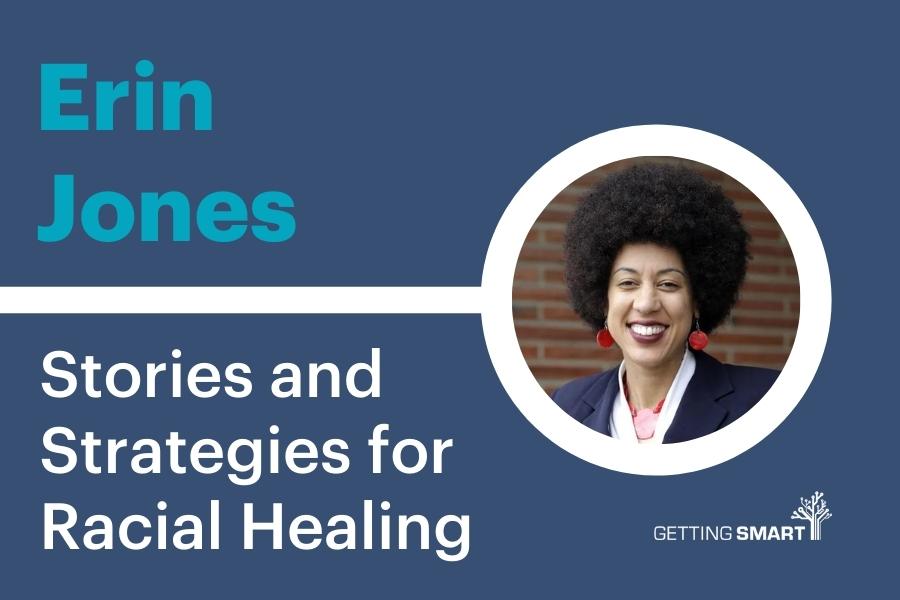
On this episode of the Getting Smart Podcast, Tom Vander Ark is joined by Erin Jones, educator, leader, athlete and author of the great book Bridges to Heal US: Stories and Strategies for Racial Healing.
Let’s listen in as Erin reads us an original poem and they discuss athletic leadership, community conversations, the problem with establishing norms and much more.
Links:
- Bridges to Heal US: Stories and Strategies for Racial Healing
- Poetry Unbound: Rita Dove — Eurydice, Turning
- You Are Now the Host by Tom Vander Ark
- Bridges to Heal Workbook
- Afro Educator on Tik Tok
- Bridges to Heal US TED Talk
- Passion for Change TED Talk
- Bridges TED Talk
Erin opened the conversation with an original poem titled “Sisterhood”, check it out below.
Sisterhood
by Erin Jones
I want to be the me I didn’t have as a girl.
I want you to love your hair and your skin and your curves and your height (or lack thereof).
I want you to know you are smart enough and pretty enough and strong enough.
I want you to know it’s ok to not fit in (because the girls who say they do are really just pretending).
I want to be the me I didn’t have as a young adult.
I want you to know you don’t need a man.
I want you to know you don’t have to know where you will be 20 years from now.
I want you to know mistakes are part of the journey.
I want to be the me I didn’t have as an executive.
I want you to know your voice matters.
I want you to know you belong there.
I want you to embrace opportunities to learn from other great women.
I want to be the me I didn’t have as a politician.
I want you to know you can be your full self, even if they say it will lose you your election,
I want you to be the author of your own story.
I want you to maintain your integrity, because you’ll have to live with yourself afterwards, win or lose.
I want to be the me I didn’t have so you can be the you you’re meant to be.
One-Two-One
1 person who has shaped your thinking
2 insights for edleaders
- The importance of your own story.
- We must hold community conversations and form new agreements.
1 additional insight for edleaders
- We have to lead by example. We can not ask people to do things that we are not willing to do ourselves.
BONUS: 1 Insight for young people
- You are worthy because you are.
- You will always fail to be someone else’s best self, but never if you try to be yourself.
Transcript
This transcript has not been edited for spelling accuracy.
Erin, would you share Sister Hood? Yes, this is a poem that I wrote two years ago, right after George Floyd was murdered. And I wrote it for the young people who were in my life. Sister Hood, I want to be the me I didn’t have as a girl.
I want you to love your hair and your skin and your curves and your height or lack thereof. I want you to know you are smart enough and pretty enough and strong enough. I want you to know it’s okay to not fit in
because the girls who say they do are really just pretending. I want to be the me I didn’t have as a young adult. I want you to know you don’t need a man. I want you to know you don’t have to know
where you will be 20 years from now. I want you to know mistakes are part of the journey. I want to be the me I didn’t have as an executive. I want you to know your voice matters. I want you to know you belong there.
I want you to embrace opportunities to learn from other great women. I want to be the me I didn’t have as a politician. I want you to know you can be your full self even if they say it will lose you the election.
I want you to be the author of your own story. I want you to maintain your integrity because you’ll have to live with yourself afterwards, win or lose. I want to be the me I didn’t have
so you can be the you you’re meant to be. You’re listening to the Getting Smart Podcast. I’m Tom Van Derik and I have the pleasure of being joined today by Aaron Jones. Aaron is an educator, leader, athlete
and author of a great recent book called Bridges to Heal Us Stories and Strategies for Racial Healing. Aaron, it’s so great to have you here. I am so glad to be with you, especially after all this time we’ve been doing this.
I love sisterhood. I so appreciate that. And it’s National Poetry Month. So what a cool way to start. What a great thing.
I love poetry and I don’t know if you know this but I was a literature major in college. So I am a huge literature buff. My husband and I met as English major. So we both love poetry.
Well, let’s do a short list. Who would you recommend that people read this month during Poetry Month? You know, I absolutely love Langston Hughes. Langston Hughes has been my favorite poet probably
since I was in 10th grade. I loved the way his poetry sounded like music. Like I could imagine trumpets and trombones and playing in the background and drums. And so I love Langston Hughes.
I love Maya Angelou. Those are my two favorite, favorite poets. And I love that Maya Angelou got to read, I think at Obama’s first election, didn’t she? Yes.
This week, Perega Tumma featured, I read a dove poem on his podcast. I’m a big read a dove fan. So she’d be high on my list. So we saw each other in Nashville.
You gave a great speech to a roomful of America’s superintendents. Thank you for that. That was fun. And I love that it was not so much a speech
that you and I got to have a dialogue. I think that made it even more fun than just talking at people. It was awesome. And Erin, I could just tell
that race relations policies related to race are a fresh, challenging subject because the room, you had wrapped attention. And you’re a beautiful storyteller, but I know the topic that we spent time on
was a really great interest to that group. Yeah. And I think, in particular right now, because it’s such a hard thing to talk about. And there are so many,
most of those people were superintendents and they’re walking into board meetings where people are yelling at them for even uprace and racial justice. And so I think what draws people to the conversation now
is man, is there a way to even talk about this now without having people scream at us? And I think that’s why people are really eager to be in spaces right now with people like me talking about race.
I wanna come back to that, Erin. And I love the premise of your book that one, we have to be in conversation with each other. And two, that stories can be a bridge to new ways of understanding.
But since then, I heard that you got a little basketball in. Did you make it to the NCAA finals? So I did. And in fact, this is such a crazy story. I have never been to a final forever in my life.
Even though I played basketball for 40 years, I’ve never attended, I’ve never really been connected beyond playing in college and playing in leagues afterwards, but not really to the NCAA, especially Division I,
just not really a connection. And then about nine months ago, I got a call from a local division two coach here in Olympia who said, hey, we’re doing work in the NCAA on race. And as I’m talking to other coaches,
I think you’re the one, I think you’re the one that needs to be talking to coaches. Could I connect you to the president of the Women’s Basketball Association? I said, sure.
And I didn’t hear anything back and didn’t hear anything back. And I learned subsequently that they have a conference every year on the backside of the Final Four, which I also didn’t know.
I didn’t know that there was a conference for coaches, which makes sense, but I didn’t know that existed. And I knew there was a keynote speaker and I knew that there was training. And so there were these little whispers
that I was hearing about, hey, Erin, maybe you could do a keynote or do some training. And it was in Minneapolis, which is where I was born 50 years ago and where of course George Floyd was murdered.
And so at that, look at this confluence. Like I may be speaking at the Final Four. Well, I never got a call back. And I thought about like beating down the door of the Women’s Basketball Executive Director.
But then I said, you know, this is work that I’m meant to have. It’ll come to me. So in January, I get a call out of the blue from the head of the WBCA,
which is the Women’s Basketball Couches Association. And she said, well, we have our conference already planned for this year, but we want you to be our keynote next year in Dallas it’s a bigger conference anyway,
because COVID will be, should be lesser, have a lesser impact. And so it’s going to be a really big stage for you. Would you be interested in keynoting? Like how would you say no to that?
But I also know because I’m a ball player and I like to practice, I said, could I come to this year’s conference just to see what I’m getting into? Because I really don’t know,
I don’t know what the conference looks like. So they invited me on a discounted ticket to come attend their conference this year and then get discounted tickets to the Final Four. So I had the opportunity to hang out
with some of the biggest coaches in America. That, I mean, that in itself, just the energy. We walked into the hotel the first night in Minneapolis and my husband, who’s a big ex football player, he’s six, two, three, 50, I’m six feet tall.
He said, honey, I think this is the first time that we’re average size. I think this is the first time ever that we’re like average size. And we just literally stood in the lobby
and just stood and watched all these giants. I mean, the average height was probably about six, one, six, two, the average height. It just the energy there with all these athletes and it just was incredible.
He had such a blast too, just to be around all these amazing coaches. And so I did get to attend the conference and then I got to go to games at night, which was amazing.
The UCLA coach sat behind me. So just to be around like really big time coaches, I sat about 10 rows behind a former, a current WNBA player who was a former South Carolina star. So it just was an incredible, incredible as a ball player,
like the best experience I could have had. Oh, that’s awesome. I’m so glad you got to see that. Both tournaments were really super exciting this year. It was great to see the energy
and great to see the crowds. All right, let’s get back to the book. Bridges to heal, bridges to heal us. When did you start writing it? Two years ago, was it?
I actually started March 20th of 2021. So I literally wrote this book about, I started writing about a year ago. I had been talking about this stuff and doing training for about 13 years explicitly
on racial justice and racial equity, but it was really watching the events of George Floyd and then Black Lives Matter and then anti-critical race theory. Like it just started, I watched this snowball effect happen.
I watched people go out in March and all this energy around racial justice, even in conservative spaces. And then I watched the backlash to it happen. And I watched people in my own personal family
and in my church community really respond to discussions about race in ways that I had not expected. And I think it was out of the pain, particularly of watching my church community that is really diverse,
not know how to talk to one another about this. That is what propelled me to write the book is watching people that I had known for over 20 years, really not know how to speak kindly to one another about these things and on social media,
just erupting and people posting things that were just really harmful. I realized I need to take all of the stories and strategies that I’ve been teaching people in school spaces. I need to take that and get it onto paper
to help people outside of school spaces. Well, both in school spaces and outside of school spaces think about these things in a more healthy and productive way. Erin, the book is a personal journey.
There’s a collection of personal stories in here as well as some thoughtful tips for community and school leaders. I would love to have you reflect on, I guess one of the key messages for me
is that understanding your own story is really a precondition to being able to create productive relationships, but talk about coming to terms with your own story and beginning learning how to articulate your own story
and how that becomes part of building bridges. So first of all, for those who are, you’re just listening and you can’t really, you can’t see us. I am a biracial, black presenting woman who was adopted by white people as a baby.
So I started in a white household in a very white community right outside of Minneapolis as a little girl. And if you know anything about Scandinavian folks, there’s a lot of storytelling,
but not personal storytelling. There’s a lot of stories that are told about whether it’s fairy tales or even great, great grandma who moved from this place to that place, but nothing really personal.
There are not personal stories told. And in fact, the message that I got as a little girl in lots of spaces was you don’t tell personal stuff about you. In particular, when you’re on the job and both my parents are teachers, my uncle’s a teacher,
my cousins are teachers, there’s your work that you do at school and then there’s your personal life. And you don’t, those two should not intersect. You don’t talk about your personal story
in the context of your work as a math teacher, English teacher, a French teacher, whatever you teach. So that’s how I was raised. And I came to the United States after living in Europe. My parents moved from Minnesota to Europe when I was five.
I attended school in Europe, my entire K-12 experience. When I came back to America for college, I began volunteering in a black school. And what I learned there is the students could care less about me without knowing my story.
They didn’t care if I had expertise in English or French or math. They wanted to know who are you? Because number one, you don’t sound like us. So I didn’t sound like the black students I was teaching.
I didn’t look like them in a lot of ways. I didn’t dress like them. I still dressed very European. And so my students had lots of questions for me. And what I realized in teaching in urban centers
is students needed that personal connection. And I had not taken a lot of time to figure out who am I? Outside of being a really good student, I knew I was a really good student. I was a really good athlete.
I had not done the work to think about what is my actual identity? What’s the identity that I bring into the space? And I learned the more I really unpacked that and figured out, wow, these are some of the cultural norms
that I bring from my very Scandinavian home. From my very year, once I unpacked that, I was able to now make connections to, oh my gosh, in Europe we think about time really differently than people do here.
And white Americans think about time different than the black students that I was with. But I realized that if I didn’t unpack my own story to figure out what are the ways that my parents have taught me to move through the world,
if I didn’t unpack that, my natural reaction was the way that I have been raised is the right way and the way these kids do things is the wrong way. And so it’s my job to project that and to teach them to live the way that,
because I have the right way. But once I understood my own story, I realized, oh my gosh, my way is just a different way. And I was able to make connections back to Europe. As an athlete, we traveled from one country to the next.
So every Friday we were, every other Friday, we were in a different country, starting when I was in fifth grade. There are different ways that Belgians do things than Dutch do things.
There are different ways that the French do things and the Swiss. And I suddenly was able to make this connection, oh my gosh, now that I understand the way that I do things, it’s not about making a Belgian Dutch.
It’s about how do I show up to Belgian people and learn how to speak their language a little bit enough and understand their culture. So when I’m in their space, I can communicate with them in ways that make sense.
And I was able to take all of that and apply it into the classroom. Once I understood my language and I began to get fluent in the language of my students and their community, we were able to now build bridges.
That meant I was sometimes using their language and their cultural norms. And sometimes I was teaching them my language and my cultural norms, but it was never about one is better than the other.
Or one is worse than the other. And that’s where the bridge gets built. That getting curious, learning my own stuff, but then getting curious about the stories of other people and finding where do we connect
and where do we both need to learn a new language to build that bridge to connection. Aaron, you suggest that leaders, particularly education leaders, have some work to do themselves
to develop the skills, the attitudes, the behaviors to be able to engage in community conversation. Talk about the work that Ed leaders didn’t need to do themselves before they begin to host a community conversation.
So my experience has been, and again, I was raised by two whites, working class to middle class people from Northern Minnesota. What I learned, even watching my parents move through spaces and after coming to America
and then looking back at my parents and at other people around me, I realized something really profound that for a lot of especially middle class white people, particularly those with college degrees
who’ve been quote unquote successful in this country, they’ve never had to interrogate their culture because it’s worked for them. It’s the air that they’re breathing every day. It’s the water that they swim in.
And so they have never had to think about what are the rules of the game? What is my culture? Because their culture is everywhere. And so they haven’t ever had to think about it.
And so what I found with Ed leaders, whether building principals or school district administrators or business leaders, if you actually want to serve all people well, you need to know what’s the area of breathing
because the reality is actually I use a fish. You need to know the water you’re swimming in because now there are turtles in the water. And the reality is for a turtle, the turtle can’t just live in water.
The turtle needs to get on land at some point, right? Frogs can live in water a lot, but they also have to get on land. And if you’re not aware of that and you just think everybody should be swimming in water,
everyone just needs to get used to water, you could actually be killing other animals without realizing it. That’s the analogy that has made sense for me over time, that if we really want to embrace
and allow diversity to thrive in our school spaces, I’ll use school because that’s the context that you and I spend most of our time in. We need to realize that we’ve got to have different climates and different environments for people to exist in.
And the fish need to get used to being out of water at times. But if you’re not aware of what the water is and how the water could be harmful to other people, you’re just going to ask turtles to get used to the water. And we’re killing, we’re killing people.
We’re killing people from different cultural backgrounds. We’re killing people from different linguistic backgrounds, not because we’re bad people as leaders, but because we’re not aware of the water that we’re swimming in. We’re not aware of how to create different environments
so that everyone can thrive. And that they’re not trying to, what I find is that black and brown people and sometimes poor white people who’ve grown up and living in poverty are having to do all this manipulation
to survive in the water, but they’re not able to thrive. So they can survive, but the exhaustion that comes with having to contort oneself to be able to survive in water. And then you get out onto land at the end of the day and it’s, oh my gosh, I’ve invested so much energy.
I now don’t have energy for my family. And for those things outside of the school space that I need to be able to do, that’s why it’s important for leaders. You’ve got to understand what’s the water that you swim in?
What are the rules that are innate to the water that you haven’t ever had to think about? Aaron, the pandemic for me and a lot of other education leaders was a reminder of how important creating spaces of safety and belonging, places where students can develop an attachment,
where they feel known and respected. How do you do that? What’s your top tips for education leaders to create places where kids feel known, respected, safe? I talk a lot about brave spaces, not safe spaces.
I actually don’t think it’s possible to create spaces that are safe for everyone. And here’s what I mean by that. I think I want students, I think safety means that you may not speak up about certain things
if you’re in a certain environment. Brave means I’m going to try things and fail, and it’s OK to fail. That’s the difference for me between safety and brave or courageous is I want to create spaces in my classroom,
whether it’s on Zoom or in a physical classroom, where students know they belong absolutely. And we’re all going to fail as part of this endeavor. I think safe sometimes means that we don’t shoot for the stars. We shoot for whatever the lowest bar is.
And that’s not what I want for students, and it’s not what I want for staff as an administrator. I want people to know that you can shoot for the stars, and if you just hit the moon, that’s actually pretty awesome too. And it means we all have to be courageous.
And so as a leader, whether that means I’m leading a classroom of students or whether I’m leading a group of staff members, I have to be willing to model failure. I have to be willing to model trying hard things and falling down
and getting back up, not shaming, blaming, and guilting either myself or other people who are also falling down and trying new things and getting back up. But I think there’s that, and then there’s the belonging piece that is a little bit different from that.
Creating spaces and belonging is really hard, because I think in education, we have not spent a lot of time in teacher prep talking about how to build relationships with people. I think that is a huge failure in teacher preparation and in administrative programs.
I don’t think we talk enough, and we often don’t talk at all. We assume that people know how to build relationships. I don’t think the average person actually knows how to build relationships with people and create sense of belonging. And so I do a lot of work on how do you build relationships.
My husband and I were youth pastors for a long time, and I think both being a youth pastor and being an athletic coach helped me learn how to build relationships with lots of different kinds of people. Most people don’t have that exposure, and so they’re coming into classrooms and into school spaces and school districts
with the assumption that all humans can just build relationships. Our natural human way of being is to build relationships with people that are like us. And so the challenge is we often create classrooms where students who were like, we were students thrive. You know, if you were a good student, then you create spaces where as long as students
turn in their homework on time and they show up on time and their parents are involved, they’re going to be really great. But for those students that were not like you as a student, those students that maybe are on the spectrum, maybe they don’t turn in homework because they’re taking care of brothers and sisters
at home when they get home. Maybe they have to have a job. Maybe they’re dyslexic or dysgraphic. If you didn’t grow up with that and you’ve never been changed, how do I build a relationship with a student on the autism spectrum?
How do I build a relationship with a kid who’s neurodiverse? How do I build a relationship with a student who’s a recent immigrant, who’s English, maybe they can communicate verbally right now, but they don’t have the academic vocabulary. How do I create spaces for those young people to be brave?
That’s, I think, where we have incredible opportunity for growth right now. And I wish I really believed we need to be doing that work in Teacher Ed before people get into classrooms. And so when I think about where’s the context that needs to change the most, I think it’s how we’re even preparing people to go into classrooms,
how we’re preparing people to lead in buildings. I teach in a lot of Edmund programs. There are no courses about how do you actually build a relationship with your staff? Who are not like you? We’ve got, this is all about education, it’s really all about the human connection.
The other class I’d love to add to Edmund programs is hosting conversations. I think that’s a new part of the job. I don’t think you can be a teacher leader, a school leader, a system leader without being a conversation host. Right, so just teaching people how to invite people into a conversation,
how to create a space where you can have a dialogue, where you have the potential to create a set of agreements. How we’re going to be together, right? Yeah, yeah, I talk a lot about that and a lot about, you know, a lot of teacher leaders talk about norms.
And I push against the idea of norms because I think what has been normalized is again, back to that kind of middle class white people who’ve been successful in America. And so I like to talk about community agreements and really getting people to wrestle with. Like how can we show up from one another here to be our best selves today? And really having those conversations often, like not just,
I think what happens is we start the year and we have this set of norms on the wall and we just go back to that all year and we don’t talk about, like what has changed about us as a community where we may need to go back and adapt and adjust our community agreements and really keeping that as an ongoing conversation. Erin, your book has a, your book, Bridges to Heal Us.
It has a lot of really cool tips for community leaders, education leaders. You talk a little bit about equity walkthroughs and look for, but just pick one of those tools and talk about it. And how would you do an equity walkthrough? So I actually have a companion workbook, which is right here,
and this just came out in January. And it has actually some sample walkthrough tools. So I have like a tool that a principal and teachers could use and literally walk through the building and look for what’s on your walls, what’s in your front office.
If I were a parent and a child coming to your building for the first time, what would I see in the front office? If I don’t speak English, would I see other languages up? Would I see images of children who look like my child? Would I be able to imagine when as I walk through the halls of your building
that my child could feel welcome here? What are the little symbols that you have around when I walk into math classrooms? Is it all old white men on the walls? Or do you have examples of all the different ways that mathematics shows up in the professional world?
So I have tools like that. I also have several tools that I have created over time that really help school systems think about, how are we talking about equity and HR? How are we talking about equity in terms of how we’re training and supporting
teachers as they come up through the system, whether mentoring or do we have some sort of formal mentor process for teachers? How do we decide curriculum? I have a decision making tool that is around as I’m making decisions for either my classroom or the school building, who’s engaged in those conversations?
Who’s missing from the table? Who may be negatively impacted by that decision? And how do we make sure we’re inviting voices to the table that may not be on our leadership team? So where are there opportunities to engage family or community in making decisions?
And then after we’ve made a decision, how do we communicate that decision back out to community? And how do we allow people to give input? Because I think some of the worst decisions that are made are made by people with really good intention.
Who have not thought about the consequences for that decision? And once it’s made, it’s in stone. And we never go back to figure out, how could we adapt and adjust this decision to make sure it’s not having such a negative impact on this particular community?
Erin, I want to start to close with a segment called One to One. It sounds like a form of a zone defense, but what’s one person that has helped you understand this work? Wow. Oh my gosh, there are so many people.
One person. What’s the short list? I think Dr. Thelma Jackson was doing this work. What’s really funny is we live about three miles from each other right now. But when I first started teaching in Washington state, she was the school
improvement consultant for Jason Lee Middle School, where I started my first teaching job. Then I moved from there to teach French immersion at Stuart Middle School, and she became the school improvement consultant for Stuart Middle School. And she was doing this work. And so flash forward years, I would end up winning the milk and teacher of the
year and being invited to work at the state superintendent’s office. And I would take over school improvement. And she became one of my committee members at the state level on this work. And so I have watched Thelma. Thelma now is, I think, 72 years old.
And I’ve gotten to watch Thelma for almost 20 years now, 25 years now, really do this work. And what’s really awesome is Thelma and I are actually putting together an equity conference for Thurston County. So we get to do this work now.
After all these years, we get to sit as partners on a team to put together a conference and just to have like two different generations together with very different experiences, be able to talk about this stuff. We don’t do the work exactly the same, but our heart for the work is the same. And I think we’re a great team.
That’s beautiful. Um, all right. The next category, two tips for Ed leaders. What I heard today was you got to do, you got to do your own work first. You got to understand your story.
You got to build skills to number two, host community conversations and build community agreements. Do you, do you buy that? Would you add one to that? Absolutely.
I think the thing I would add is, and it’s kind of, you’ve kind of already said this, you have to do your own work. I think what’s most important in leadership right now is we have to lead by example. We cannot ask our people to do things we’re not willing to do. And so I lead with vulnerability.
I lead by sharing. If I want people to do the hard work, I have to model the hard work myself. So I always lead by sharing. It’s part of the reason I share my personal stories that are hard to tell, because I can’t ask Ed leaders to share hard stories if I’m not willing to do them.
But the same goes for the level of passion and commitment. I can’t ask Ed leaders to be passionate and committed at a level that I’m not willing to model. And so here’s another thing that I do and this, I just believe in this. I teach two classes a week for free.
I teach a group of teachers on equity and I teach a group of middle and high school students every week for free for an hour on zoom. I can’t. Expect people to listen to me if I’m not actually actively doing the work. And so one of the reasons I think I’m really good at what I do is that I’m
keeping my hand in the work. I can’t talk about quality instructional practice if I’m not still practicing it. And I think that’s a place sometimes that in Ed leadership, you can get so far removed from the classroom, so far removed from actual instruction and teaching and connecting to young people and connecting to staff that you can miss
opportunities to really serve people and understand what they actually need. Beautiful. All right. Let’s close with one, one insight for a young person. Maybe it’s a six foot tall, beautiful young lady in, in high school, but an
insight for a young person. I think, you know, I had the opportunity to talk to some young people last week and one of the things that I’ve been saying to every group of young people that I meet now is you are worthy because you are. You are worthy because you are not because of what you’ve done, not because
of what you will do, not because of how many likes you have on Facebook or Instagram. You are worthy because you are. And you are in the body with the skills and talents you have. That is exactly the body and the skills and talents you were meant to have.
And so embrace that love who you are. You will always fail at being someone else’s best self. So strive to be your own best self. And it’s one of the reasons that I wear my hair natural now. You know, I fought that I wear my hair straight, like all the other white women
around me until I was 40. I wish I had embraced my hair at 17 and 18, but I wear it proudly this way, this way, everywhere I go, because I want young women who are 13, 14, 15 to see me and to say, oh, wait, I can be pretty like that too. Like I can be pretty like me.
And so I would tell a young, especially tall woman, like, stand straight and tall, embrace your height. And if you’re four foot 11, don’t try to be tall. Just embrace that too. Beautiful things come in little packages too.
And so I would say be the best version of you and you is absolutely enough. I love that. We’re talking to Erin Jones. She’s the author of Bridges to Heal Us Stories and Strategies for Racial Healing. Erin, where can they find out more about you and your work and where could
they get that workbook? So all the books are on Amazon right now. And what’s really beautiful is I’m getting 70% of the revenue from that, which is exciting because Amazon has not always been that way. So go to Amazon there.
I also have three TEDx talks. So if you just Google Erin Jones, TEDx, I have three talks. One, they’re all appropriate for students. So if you have children or you have young people that you’re working with, they’re great talks for children, but they’re also great for adults.
So that is a great place to find me. I’m also on Instagram, Twitter, Facebook, TikTok. Afro educator on TikTok. So you can find me on most social media platforms as well. Check it out, folks.
Erin Jones is what a treat. Thanks for being with us. Thank you for having me. And thanks to our music making, bread making, poet, laureate, creative director and producer, Mason Pasha and the whole Getting Smart team for making this possible.
I’m Tom Vanderick. I’ll see you next week. In the meantime, keep leading, keep learning, keep innovating for equity. Thanks for tuning in to the Getting Smart podcast today. We want this podcast to be actionable and insightful and a great way to learn about
what’s next in learning. In order to stay on the cutting edge, we need people in the field to tell us what they’re hearing, what they’re wanting and what they’re needing to learn more about. Got a topic or a guest in mind? Send your recommendations to me, Mason at GettingSmart.com.
And if you like what you’re hearing, don’t forget to leave a review in Apple podcasts or subscribe wherever you listen. Feel free to share the podcast on social media using the hashtag GS Podcasts. Thanks so much.



0 Comments
Leave a Comment
Your email address will not be published. All fields are required.