

Elliot Haspel on the Importance of Universal Childcare
Key Points
-
Universal childcare must be treated as a public good, ensuring equitable access for all families regardless of income or location.
-
Policies should support both public and private childcare providers to offer families flexible, culturally responsive options.
Shownotes





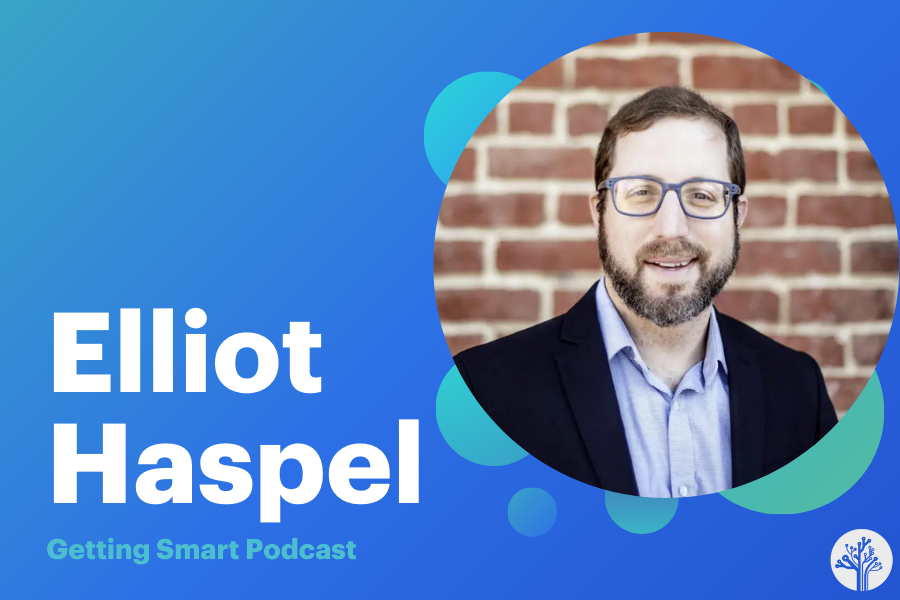
In this episode of the Getting Smart Podcast, we sit down with Elliot Haspel, a nationally recognized child and family policy expert and author of Crawling Behind: America’s Childcare Crisis and How to Fix It and Raising a Nation: 10 Reasons Why Every American Has a Stake in Childcare for All. Together, we explore why universal childcare is not just a family issue but a societal one, rooted in brain science, economic sustainability, and the moral imperative to support children and caregivers. Elliot shares actionable insights on how policymakers, educators, and community leaders can create a mixed-delivery childcare system that prioritizes accessibility, equity, and quality. This episode is a must-listen for anyone invested in the future of education, equity, and the well-being of families. Tune in to learn how we can collectively reimagine childcare as a public right.
Outline
- (00:12) Introduction: Early Childhood Education and Personal Background
- (11:11) Why Childcare Matters for Everyone
- (18:32) Hope and Progress in Childcare Policy
- (27:25) Building Public Will and Expanding the Constituency
- (38:17) Integrating Childcare into Society and Development
- (43:01) Childcare as a Right: Final Thoughts and Call to Action
Introduction: Early Childhood Education and Personal Background
Jordan Luster: You are listening to the Getting Smart podcast, and I’m Jordan, at Getting Smart. I spend a lot of my time with education leaders who are building new models—from micro schools to personalized learning environments—and thinking about what it takes to create a sustainable and equitable system for kids and families.
Today, I’m coming in with this professional lens, but I’m also coming in as a mom of a 6-year-old, as a former first- and third-grade teacher, and as someone who spent a lot of time babysitting, nannying, and working in daycares throughout college.
So, I’m super excited today to talk about early childhood education. I bring that policy curiosity but also the lived experience of being in the thick of things. And that’s why I’m super excited to talk with our guest, Elliot Haspel, today. Elliot is a nationally recognized child and family policy expert.
I was just joking with him prior to this call that I’ve been kind of stalking and doing a lot of digging into his work because, once you start to hear about a lot of the challenges and this crisis around early childhood education, you kind of get sucked in.
So, I am excited to share a little bit about his work that bridges these worlds of early childhood education and education policy. He’s the author of Crawling Behind: America’s Childcare Crisis and How to Fix It and his newest book, Raising a Nation: 10 Reasons Why Every American Has a Stake in Childcare for All.
It takes the case even further, and it really just shows that this is an issue for everyone. It dives into what it’ll take to build a system that truly works for families, kids, and everyone. So, I’m happy to have you, Elliot. You and I have similar backgrounds when it comes to Teach For America and starting that journey.
I’d love to hear if you could share a story from your teaching days that kind of led you into early childhood education or made you realize how critical the early years are for learning.
Elliot Haspel: Yeah, absolutely. And thank you so much for having me. As you mentioned, I taught fourth grade in a public school outside of Phoenix, and it was a really transformative experience for me. I do remember a story—there’s a student I had, and we were doing the diagnostic testing at the beginning of the year. You’re supposed to start at the grade level, and then if they can read that sentence, you move up. If they can’t read that, you go back down. I remember going back—he was having trouble with the first fourth-grade sentence. We went down to the third grade, then the second grade, and we eventually got down to the kindergarten level. The sentence was, “The dog is big,” and he couldn’t read it.
I remember that afternoon, after school ended, going to the office and looking through his file. I saw how he was passed through kindergarten, first grade, second grade, and third grade. No one had ever flagged that he clearly had learning difficulties in literacy. That didn’t start when he entered kindergarten, right? We know enough about early childhood development to know that the foundations for things like literacy really start at birth. If a child is experiencing difficulties, early intervention—even when they’re 1, 2, 3, or 4—can be really, really important. That story hammered home to me that we can’t, even in elementary school, miss opportunities to give students what they need by intervening earlier.
Jordan Luster: Yeah. No, I think that’s why my heart kind of lives in early literacy in first grade. I’m such an advocate for the science of reading, phonics instruction, and structured literacy approaches because of that. But you hit the nail on the head—it starts early. I appreciate your perspective coming in here and really thinking about some of the books that you’ve written and how you have carefully defined who caregivers are. Teachers are caregivers, right? I want you to talk a little bit about that. I know in your latest book, it’s dedicated to “the caregivers in all your wild diversity,” which I love.
Can you explain that a little bit more deeply and share who the caregivers are when you’re speaking about caregivers?
Elliot Haspel: Yeah.
Why Childcare Matters for Everyone
Elliot Haspel: Yeah, it is absolutely an everyone problem for many reasons. A couple of things that I find particularly compelling are, for one, it really works as social infrastructure for our communities. Childcare programs help parents of young children create friendships and stay rooted in their communities. I’ve heard far too many stories of parents who are engaged, involved in their child’s school, volunteering in the PTO, or active in their local faith community, and then they have a young child and realize, “We cannot stay here.” They can’t afford childcare, so they have to move—not because they want to, but because there’s a relative or someone who can provide cheaper care elsewhere.
I also talk about public health and safety. There are many communities where they can’t keep their police, fire, or medical services staffed very well because of childcare breakdowns. People are dropping out of the labor force as a result. You can even talk about the strength of our national security. Interestingly, the best-funded public childcare system in the country is the military childcare system. The military spends $2 billion on childcare for military families versus about $8 billion for the entire rest of the country. The reason is simple: military families have kids, and they need someone to care for them. It’s interesting that in this one area, we don’t have trouble making the leap that this is something the government needs to participate in.
You can look at any of these angles, and then there’s certainly the educational angle. Brain development does not start at age five. Kids don’t just suddenly show up in kindergarten and start learning. The brain develops like a house—the foundation for early literacy, early numeracy, executive functioning, and socio-emotional skills is all being built starting at birth. For all of these reasons, it really matters.
It’s interesting because, in some ways, I don’t think people have trouble making the leap of why we need strong public schools. Even if you don’t have kids or your kids are grown, people understand that we’re in deep trouble if we don’t have public schools. But they don’t make that leap for the early years or for childcare because we’ve pretended that one is separate from the other. In fact, in some cases, we pit them against each other: “That’s education, and that’s babysitting. That doesn’t matter.” I think we need to talk more explicitly about the ways in which care shapes all of the outcomes we care about as a society.
The last thing I’ll say is that I’ve talked to many families who say, “I would have another child if it wasn’t for the cost of childcare.” That’s stark. When having the number of children you want becomes a luxury that’s only affordable to affluent families, it’s not the sign of a healthy society. It’s not the sign of a healthy school system either. If you want enough kids coming up, and we’re already having trouble with enrollment issues in many areas, you definitely want strong childcare.
Jordan Luster: I do a lot of work with microschools, small schools, and independent schools. I think right now in the K-12 space, sustainability is a huge challenge for many school leaders. I know that early care centers have been this financial lifeline and funding stream for many independent schools. It’s been a way for them to offer a need for the community because we know that quality childcare is scarce. It’s also a way to maintain and sustain this K-12 system or K-8 or K-5, whatever the school is.
I think what I’m interested in is, if I’m a leader and I open up a childcare center, this is a pipeline for enrollment, like you said. It’s also becoming an additional funding stream—a guaranteed one.
Elliot Haspel: Yeah. I think there’s a tension there, right? It depends on how it’s deployed and in what ecosystem. We’ve seen this a lot around issues of pre-K expansion. Pre-K is a form of childcare—it’s one form of childcare. I could blindfold someone and take them to a pre-K classroom and a really high-quality 4-year-old classroom in a childcare center, and it would be pretty hard to tell the difference.
Let’s say that at the outset. But what’s interesting is there’s been this ongoing fight about whether we expand pre-K just through public schools or include community-based providers as well. Different states have come to different answers. California, most notably, expanded their transitional kindergarten only through schools. It’s been a big challenge for other childcare providers because many of them cross-subsidize their younger children using the 4-year-olds due to the way the ratios and economics work.
Then you get into the question of wanting a pluralistic, inclusive system with all sorts of different options. If you’re just using schools, that can actually work to the detriment of some families who are never going to feel comfortable sending their child into what seems like a school-like setting until the child is of kindergarten age. They might much prefer a family childcare home or the person down the street who’s licensed and takes a small number of children into their home. They might want that. They might want a relative. There are lots of different things.
This has been a fight that’s played out in a couple of different states, and different states have landed in different places. I do think there can be some danger if the reason we’re expanding these childcare programs is because we really want a pipeline of kids or we want to make sure the ranks of teachers aren’t declining too much. That can be challenging. I think we want to put it in its proper place, which is an ecosystem of really high-quality, affordable options because that’s what parents want. I’ll tell you, there’s no survey of parents I’ve ever seen where 79% of them say they want one kind of care and education when their kids are young. It varies wildly, and it’s dynamic. It changes by the age of the kid. It changes by the circumstances of the family. One size will not—and never will—fit all when it comes to the early years.
Jordan Luster: Yeah, and I think it’s the same thing that’s happening right now in K-12 systems, where they’re trying to undo a lot of what’s been done by providing more personalized options and more choice for families, as well as the just-right learning environments for all kids. I like that you gave some examples of what it might look like to bundle that into the existing system or what it looks like to create its own ecosystem. Honestly, I’d bet my money on creating a new ecosystem and infrastructure that the K-12 system can then model. So, what gives you hope in overcoming that culture and mindset shift?
Hope and Progress in Childcare Policy
Elliot Haspel: Yeah, absolutely. A couple of things give me hope. One is that we have a younger generation of politicians starting to come in on both sides of the political aisle who I think are going to be leaders in this. You can look at everyone from Katie Britt, the senator from Alabama—a mother of school-aged children—to Andy Kim, the senator from New Jersey. He’s a 43-year-old dad, and he’s talking about this stuff. Jimmy Gomez was on the floor of the House of Representatives wearing his baby a couple of years back. That gives me some hope. I think this generation of politicians coming up understands more viscerally that things like early care and education are now part and parcel of what it means to be a parent in modern America, which is just a little different than some of our politicians who are maybe of a different era, let’s say.
The other thing is that states have been doing some really interesting things. Actually, just this morning, New Mexico announced that they’re going to be the first state in the country to start enacting universal childcare. That means they’re going to make it available to every resident of that state without an income means test—for free. It doesn’t mean that it’s going to be solved overnight, but New Mexico has identified a dedicated funding source and is using that to basically say, “This is a public good. This isn’t something that should be pay-to-play. This isn’t something where you should have to jump through a bunch of hoops to get aid.” Much like our public schools, you should just be able to access it, and it should be free for you regardless of whether or not you could afford it. That’s exciting. That is new. That discussion was nowhere five years ago.
You’re even seeing some bipartisan action. Texas, for example, put $100 million of state money into their childcare system in their last legislative session. That’s new. So, I do have some hope. The other thing is that I think people broadly understand more and more these issues of brain science and how children learn, as well as the ecosystem of influences on child development.
What I would say is that there are two dangers. One is this continued artificial schism between education and care—the idea that these are separate things, that one is something the government should have a role to play in and the other is just an individual thing that we don’t value very much. That’s one danger. The other danger is if we talk about care just in terms of what it means for parents being able to work and miss the bigger impacts. It’s interesting. I will say, over the past 10 to 15 years, we’ve actually seen the child kind of get taken out of childcare a little bit.
In 2005, the conversation was all about brain science. There had been some big reports that had just come out. It was the “Decade of the Brain.” We were sort of like, “Wow, it’s amazing what’s going on in the brains of young children.” That has really been replaced as the dominant narrative around childcare and even early care and education recently with this idea that it’s about parents being able to work. It’s about labor force participation rates. It’s about the economy—all of which are valid. But there’s no rights claim there. There’s no moral argument around that.
Whereas if we talk about and assert that care, early care and education, and childcare through the school age should be a right—just like public education is a right—I think we get a whole lot further.
Jordan Luster: You warned us about those two traps: treating care and education like they’re separate systems and framing childcare as a labor force issue. I’m wondering, though, what does it look like to shift policies and program design?
Elliot Haspel: Absolutely. I think a really concrete example is when you think about pre-K. Pre-K, which is care and education for 4-year-olds, sometimes 3-year-olds, raises the question of how you deliver it. We’ve seen places around the country come to two answers to that question. One set of answers is to do it through the schools. California is probably the most important example of this. They’ve expanded what they call transitional kindergarten. It’s basically pre-K, but it is only through the schools. So, the school districts take the money, administer it, and run it. It’s literally just tacking on a grade to the schools.
Other places, like Boston and other states, have taken more of what’s called a mixed-delivery approach to pre-K. What that means is that you can be a childcare center and have a pre-K classroom that is taking that money and running it. Boston is a pioneer of this idea. You can be a licensed family childcare home—not even a standalone facility, just someone taking a small number of children into your home—and be a pre-K provider. That breaks down the walls. It’s not saying, “This is early education, and that’s childcare.” It’s saying, “This is a particular funding stream. We have some set of expectations about what we expect to happen as a result of giving you this money, but we’re not going to segment out pre-K as just something that is attached to schools.”
The negative effect of the California model, and we’ve seen this in other places that do school-only pre-K, is that it puts negative downward pressure on childcare providers. Many of them balance their budgets with the 4-year-olds. When you pull all the 4-year-olds out of childcare programs, it makes it even harder for them to operate sustainably. We’ve even seen a decline in infant and toddler slots and a decline in childcare provision. I think that’s a really concrete way we can say that depending on how you look at it, it’s going to lead you down one of two policy paths.
Jordan Luster: I want to dig into that funding part a little bit more. Given that we work with a lot of leaders who are building newer, innovative educational models, I’m wondering: What’s a single thing that maybe a microschool leader, school leader, or district leader could do to advocate locally for those public dollars? How can they integrate this into the K-12 system without losing people in the weeds? What are steps toward that type of advocacy?
Elliot Haspel: I think being able to say, “We need a mixed-delivery system,” is actually really powerful coming from school leaders. Part of the challenge when you do the school-only model that we talked about is that not every family wants to send their child to a setting that looks like a public school. They may not feel like they’re ready for it. They may have an experience in their past that makes them feel like their child is too young. It can be more difficult for those school-based settings to meet cultural or language needs sometimes, or to meet hours needs if it’s a family working nontraditional hours.
There’s a way, I think, that if school leaders can stand up and say, “Look, yes, it’s helpful to have this stream of money coming in,” it can make a difference. We’ve sometimes seen, when ballot initiatives and other policies come up before policymakers, strange tensions between the schools and the childcare providers. Anyone who wants to look at what’s going on with unions in New York City, for example, will see this. It’s really weird. You get unions pitted against each other because some of them represent the public school teachers running pre-K in the public schools, and some of them represent the community-based providers. They’re not all funded the same. It’s a mess.
To be able to say, “Look, even if I’m not going to get quite as many dollars as I might otherwise get, it’s actually better for all of us to have a mixed-delivery system,” is powerful. More children are going to arrive in school more ready to learn. More families in my community are going to have the type of care they need. I think that can be powerful and potentially recreate some bonds of solidarity. Ultimately, we all want the same thing. We all want kids and families to have what they need. We all want educators to be set up for success. But because of the way we’ve carved it up in America, you can create these schisms and divisions that are unhelpful.
Jordan Luster: Yeah, it is an interesting conundrum. I often wonder myself: Are we going to see things kind of fall apart before they’re able to come together? I kind of thought that’s what would happen during the pandemic. I think we all had that really big piece of hope, like, “Okay, this is the time to build the system back up from the ground up.” I’m interested to know, because I know you’ve been doing this work for a while, where do you feel like we’ve come since then? I know that was around the time you wrote your first book, and now you have this next book. Where have you seen things shift, and do you still hold that hope, given where we were and where we are now?
Shorts Content
Building Public Will and Expanding the Constituency
Elliot Haspel: I’m sort of an inverted optimist, so I do hold the hope. We’ve seen a few things change since the pandemic. There’s absolutely been more attention paid to childcare writ large. The pandemic really shone a bright light on just how important childcare is for our society, our economy, and families. Researchers have found that the number of mentions of childcare policy in the media has significantly increased—and durably increased—since the pandemic. Some of what’s being talked about is different too. There’s more conversation going on around funding and things like that. So that’s positive.
We’ve seen states make big strides in childcare provision as well—some states, at least. That’s been encouraging. I think the challenge is: Is what we’re seeing going to translate into wholesale systemic change, or is it going to turn out to be less sustainable in the face of budget pressures? These pressures are coming both from the budget bills that have been passed and from our changing demographics. Especially for schools, this is relevant. This ties into that pre-K conversation. One reason why schools really like pre-K is that it gives them a whole other set of students in an era where we are seeing vastly declining enrollments in public schools. This is due somewhat to the shift to other kinds of schooling, but also just due to the declining birth rate. We’re seeing lots and lots of closures, and that’s not going to get any better. That is not projected to get any better. It’s projected to get worse.
We’ve seen a few states take steps back—not necessarily states you would expect. Oregon is an interesting example. In their last legislative session, their state legislature cut about $20 million from their state pre-K program. They didn’t want to, but they did because they were facing a pretty significant budget hole, and that wasn’t protected. That’s one of the things I call for: We need dedicated funding streams that are protected, that have a way of not rising or falling with a given budget cycle or projection.
I think that remains to be seen. But I do think we’ve called the question on whether childcare matters and whether we should be talking about it as a significant matter of public policy. That was not where it was 10 years ago. This conversation in 2015 was very different. There was some stuff going on around pre-K, but the childcare conversation was pretty dormant.
Jordan Luster: Yeah, I feel like now that there are more women in the workforce, and we’re seeing a lot of shared responsibilities between parents at home, and we see dads showing up in ways that maybe the previous generation didn’t do as much, it feels like the stakes are higher for men too—especially with the economy and the way things are. Dual-income households are almost needed at this point if you want to continue to have children. That goes back to this lower birth rate conversation and why people are choosing to wait longer.
I think it’s interesting now that it’s becoming a little bit more of a popular issue, and it’s gaining increased attention because it’s now a shared issue. I love the fact that your book points to this not being just an issue for women or lower-income families. This is an everyone issue. I want to talk about that a little bit more. For listeners who haven’t picked it up yet, what is maybe one sentence or the thesis of Raising a Nation?
Elliot Haspel: In a sentence: Childcare is and should be treated as an American value, and it should be treated as a right. That is a significant mindset shift.
In a sentence: Childcare is and should be treated as an American value, and it should be treated as a right. That is a significant mindset shift. Even to your point, right? It’s 2025, and I think close to 70% of children under the age of six have all of their available parents in the workforce. This is an issue that crosses every line of difference you can imagine. It crosses income, geography, partisan ideology, race—everything. And yet, we are seeing bits and pieces of victory and bits and pieces of failure, and it’s all generally still pretty bad out there.
My contention is that part of the reason for this is that we’ve not convinced the country that this is actually something that belongs in that pantheon of public goods that we put taxpayer dollars behind, make available to everyone, and make free at the point of service. Schools, parks, libraries, roads, fire departments, police departments—these are things that we say, “Even if you could pay for them, we’re not asking you to do that on the front end. We’re asking you to do it with taxes on the back end because of what it means.” It’s the connective tissue that lets our society run.
One challenge that childcare has is that the actual direct constituency—parents of young children—is dwarfed in the electorate by non-parents. Even if you take this up through parents of children under the age of 18, they are still outnumbered. That’s going to increase as we have a continually aging electorate. It’s interesting. I’ve heard this issue compared to things like marriage equality or other important cultural conversations and debates. Those issues don’t have money attached to them, per se. It’s not like smoking bans, which don’t really have a giant budget. Childcare is expensive. It should be expensive. It’s an investment, and you get it back, but the outlay of money is significant. It’s in the billions. If we’re going to do this nationally, it’s in the hundreds of billions, which is fine. We spend $800 billion on K-12 education. There are times when we are willing to spend that money.
But I bring that up to say, if we’re going to get the public will to say, “We need to fund this at an appropriate rate,” which is going to mean finding revenue and probably having some hard conversations about taxes, we have got to expand the constituency. Right now, childcare polls very well in a vacuum, but it’s not particularly a salient issue, meaning it doesn’t move voter behavior very much—particularly voters who don’t have kids. The book is basically a toolkit that is trying to help people who care about childcare be able to help anyone, regardless of whether they have kids or their ideology, see that they need to be investing and pressuring politicians to invest in a good childcare system.
Jordan Luster: That was such a great synopsis. It’s interesting when you brought up the case around needing additional revenue and how that brings a conversation around taxes. This is a huge policy issue, and I think there are so many things that need to happen first before we can see certain policy shifts. You talked about this economic case being morally impoverished. I want you to share how you approach conversations with those who don’t have stakes in this and those who are, you know, like, “Well, I don’t have kids, and if you choose to have kids, then you should be able to…” Can we talk about it? Because that’s what we’re up against.
Elliot Haspel: No, absolutely. Obviously, it depends on the person. Part of this is that you have to speak to your audience because everyone’s different, and everyone’s values are different. Often, I will approach that conversation in one of two ways. One is to ask, “Do you realize how many choices parents have that are constrained by childcare?” People tend to agree that families should be able to raise their kids the way they want, stay in the communities they care about, and have strong marriages and strong community roots. If we want that, childcare really matters. Do you realize that having children is becoming a luxury good in this country, where only the rich can afford to have large families? That’s one set of conversations.
The other is particularly for people who are stuck at that first level of, “You had a kid, so you should deal with them yourself.” I’ll ask them, “What’s the next sentence in that logic?” Okay, you don’t have kids, or your kids are grown. You still pay taxes for the schools in your neighborhood. Why? The answer is going to be something along the lines of, “Well, we need to have an educated workforce. We need to have a strong economy. Our property values are tied to the quality of the schools.” Well, guess what? If you want an educated workforce, you need to have good childcare from birth through school age. If you want a strong economy, childcare matters because parents do need to work. Your property values are also tied to things like childcare. You can walk them through an analogous logic.
I don’t think many people have trouble with that logic—the idea that we need schools even though they don’t have kids. Most people have never sat and thought that much about childcare in this more philosophical sense of, “How do we position it in society?” Usually, it’s just a one-liner, and then they move on. I’ve written about this before. It’s interesting. Schools—we all went to school. We all know what school is. We all have memories of school. Not all of us went to childcare as young children. If we did, we probably don’t remember it very much, if at all, because it was when we were very young.
Yet, many boomers didn’t engage in childcare when they were parents because it was a different era. They don’t really know what it is. But when you sit down and talk people through it, even just for a couple of minutes, I actually find that most people come around pretty quickly.
The other thing I’ll add is that it also depends on whether you’re just focusing on childcare as a licensed center or talking about this kind of plurality of options. This idea that we’re also going to support family members who are providing care is important. I think that’s actually a really important addition to the conversation because it can break down a lot of reflexive barriers. People have in their minds some schema around what we’re talking about—taking young children away from their parents or their mothers—which is obviously not what’s happening. But we have to get past that heuristic.
Integrating Childcare into Society and Development
Jordan Luster: Yeah, I keep going back to this thought, and this is something that one of my colleagues and I have been thinking about—just how do we weave in bringing children back into our lives and not just a subset of our lives? How do we weave childcare into our everyday lives in society? What does it look like to create policy around requiring that of developers and requiring that of employers, the same way there are protections around maternal care? Although those protections should be expanded at a federal level, what does that look like?
I live in Atlanta. We continue to see these huge outdoor mixed-use shopping and living spaces with a big green space in the middle. What does it look like to require developers to include affordable childcare facilities within that? Or what does it look like for a corporation that’s building a huge development? How do we require them to embed that within their development and then offer that as a service?
Elliot Haspel: Yeah, you know, it’s a great point. I mean, I think my magic wand is called taxes, right? It is interesting because we don’t ask employers to provide elementary school or the third grade to their employees. What we say is, “We’re going to tax you, and we’re going to use all of your tax dollars and roll them in with everyone else’s tax dollars to provide it through the government for free.” That doesn’t mean that the government has to run everything. That’s really important. People get caught up on this idea that government-funded means government-run. A good example of this is Medicare. You can go to a private medical clinic and get your care from your doctor there, and they’re getting reimbursed through the government, but it’s not a government-run clinic like the VA. You can do that for childcare.
I think the developer thing is interesting. By the way, a few places do that. Boston is another example. They require developers to pay a fee or include childcare in their developments. But I think this comes back to the question of whether we can assert childcare as a right. It’s interesting because in Georgia, Colorado, and every other state in the country, there’s a right to public education in the state constitution. Every government is obligated to provide a system of free public schools. Are those public schools all excellent and equitable? Absolutely not. Are they all free? Yes. Does anyone have to be on a waitlist for their local public school? No. On those fronts, we have a system that, while imperfect, is at least accessible.
Should public school teachers be paid much more? Sure. But at least they’re getting a decent salary with benefits. The market is not going to solve this problem. It cannot, it will not, and it will never solve childcare. It’s had 50 years to try, so we can say that with pretty good certainty. The corporations are never going to solve childcare either. They don’t have the capacity to provide enough care. Amazon and McDonald’s aren’t providing childcare for all of their frontline employees. Even the ones that do have onsite centers are pretty limited in scope. That’s not to say those can’t be part of a publicly funded system. In other countries, they are. Onsite childcare is part of a publicly funded system.
But it all comes down to what the system should look like. I think that’s the question we need to really push on. In my view, this should be a fully publicly funded, mixed-delivery system. Private providers, family members—everyone should be included. It should be a system that is a right for everyone and free at the point of service. That is just a fundamentally different place and vision than where we often talk about childcare in this country. When we talk about a mental flip, that’s what we’re going to have to make.
New Mexico, as we just said, is going to make childcare universal and free for everyone. I think the promise might be outstripping the reality a little bit, but as a framing, as a narrative, as a way of saying, “We are now going to stop means-testing this,” it’s powerful. The richest New Mexican is going to have access to this for free at the point of service. We’re going to pay for it all through tax dollars and other revenues. That’s really exciting and the result of a decade-plus of dogged organizing and advocacy by folks on the ground and leadership with the governor there.
This goes back to your hope question. We’re hearing a little bit more of the language and framing that I think is needed than we were hearing even a year or two ago. We need to capture that momentum and run with it in some ways.
Childcare as a Right: Final Thoughts and Call to Action
Jordan Luster: Yes, it definitely gives me hope, especially what New Mexico is doing. I think you really hit the nail on the head with this idea of childcare as a right, kind of bringing us back to where we started. This isn’t separate from education. Early childhood is education. It is a part of education that we need, and we need to start looking at early childhood care as education. We’ve already discussed the academic outcomes and the implications around the workforce and the economy, but this is a right. We’re talking about children here, and we’re also talking about caregivers too.
I’m excited to really dive into your book a little bit further. I’m excited to share it with our audience. If there’s one thing you could leave the audience with as just a charge, as a step forward, what would that be?
Elliot Haspel: I think it’s what we talked about, right? My charge is to start talking about childcare as a right. Early care, childcare, and school-age care—it’s all part of the same system. I don’t think we should create artificial divisions. Start talking about it as a right and see what happens. Why is it that for the first five years of life and outside the school year and the school day, we leave parents largely on their own, but from the time a child hits kindergarten through the time they’re 18, we provide them free education and care for at least seven hours a day, 180 days a year?
Yes, we know the historical reasons for this, but why do we still do that? Does that still make any sense? If not, why do we accept it? Let’s do something about it because we don’t have to have this system. We can choose to change it.
Jordan Luster: Yes, I love that. Be the change that you want to see because this isn’t just someone else’s issue—it’s all of our issue. I appreciate that, and I appreciate your time today. We will include a link to your book in our show notes and recap, and I encourage everyone listening to check it out and bring some of these ideas into your own conversations. We’re approaching the holiday season—stir things up at the table.
Elliot Haspel: Right.
Jordan Luster: As always, thank you again for listening to the Getting Smart podcast. It’s been a pleasure.
Elliot Haspel: Thanks, Jordan.
Guest Bio
Elliot Haspel is a nationally-recognized child and family policy expert and commentator, with specialties in child care as well as the linkage between early childhood and climate change. He is the author of Crawling Behind: America’s Childcare Crisis and How to Fix It (Black Rose, 2019) and the forthcoming Raising a Nation: 10 Reasons Every American Has a Stake in Child Care for All (Oxford University Press, 2025).
Elliot has appeared on television as an analyst, including on The PBS NewsHour with Judy Woodruff, and his writings have appeared in a wide variety of top publications such as The New York Times, The Washington Post, and The Atlantic. Elliot is regularly sought out by journalists, and has been quoted in such mediums as NPR, Bloomberg, and TIME Magazine. He also writes a monthly column for the web magazine Early Learning Nation. He has been the keynote speaker at numerous early childhood events and has been asked to both join and moderate major panel discussions. In 2021, Elliot testified before the U.S. House of Representatives on the care economy.
Links




0 Comments
Leave a Comment
Your email address will not be published. All fields are required.