

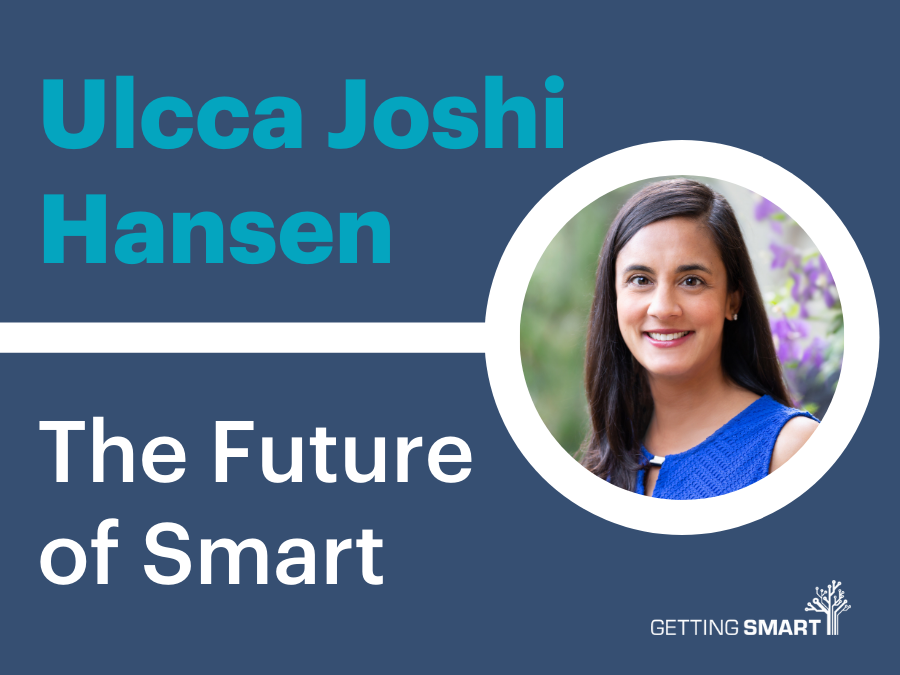
Dr. Ulcca Joshi Hansen on The Future of Smart
Key Points
-
The culture we live in is harming us. We have to make a shift to back to our personhood that allows us to feel whole.
-
This is the moment for communities to engage in conversation about whether or not schools are actually serving young people and valuing them effectively.
-
School is the start of a journey, not the end of a journey.
This episode of the Getting Smart Podcast is sponsored by our recent publication Designing Microschools: Why Small Learning Environments is a Big Idea.
On this episode of the Getting Smart Podcast, Rebecca Midles is joined by Dr. Ulcca Joshi Hansen, the Chief Program Officer at Grantmakers for Education. She is also the author of The Future of Smart: How Our Education System Needs to Change to Help All Young People Thrive.
Ulcca has a career built upon learner-centered and inclusive education policies and her new book looks for ways to incorporate those human-centered approaches alongside social justice and large-scale education reform.
Let’s listen in as they discuss identity, definitions of indigenous, codification of learning and more.
“For the story I’m telling, which begins in Europe before mass global colonization, I use the term Indigenous to refer to ways of being and organizing human life before the arrival of outside religious, political and economic forces—that is, life organized by intuitive, local values.”
Dr. Ulcca Joshi Hansen
More Quotes from the Book and Podcast:
- “Though I live in the United States, my perspective on education is shaped as much by placelessness as by American-ness”
- “So often in education we focus on the ‘what we are doing’ not the ‘how we are doing’”
- “The how is valuable in and of itself […] every moment matters”
- “The culture we live in is harming us. We have to make a shift to back to our personhood that allows us to feel whole.”
Transcript
This transcript has not been edited for spelling accuracy.
Hey there! The Getting Smart team recently released a new resource, Designing Micro Schools, Why Launching Small Learning Environments, is a big idea. You can download it at www.gettingsmart.com. Also, if you’re interested in further exploring micro schools, our strategic solutions and school design projects are tailored to support you from ideation to scaling. Email Jessica at www.gettingsmart.com if you’re interested in learning more about how we might work together.
Alright, let’s get to the podcast. Music You’re listening to the Getting Smart podcast. I’m Rebecca Middles and today I’m joined by Dr. Okelash Joshi Hansen, the Chief Program Officer at Grandmakers for Education and recently the author of The Future of Smart, How Our Education System Needs to Change to Help All Young People Thrive.
Okelah has a career built upon learner-centered and inclusive education policies, and her new book looks for ways to incorporate those human-centered approaches alongside social justice and large-scale education reform. Okelah, thanks so much for joining us today. I have been fortunate enough to know you and your work over the years, and I’m excited about this book release. In the book, you go into detail about your own identity journey.
Can you share a bit about that with us? Particularly Resnit is the line, Though I live in the United States, my perspective on education is shaped as much by placelessness as by American-ness. Yes, absolutely. So, you know, when I think about my life’s work, a large part of it is about questioning systems that we’re stuck in and trying to imagine new ways to organize how we work and live together,
and a large part of that has to do with my own family’s story. My parents are both Tanzanian by birth, but my family is Indian by origin. And so, within the last two or three generations in my family, there’s just been a lot of displacement and movement. My dad is one of ten. His siblings live all over the world. I was born in the U.S., but I grew up in Tanzania before coming back to the U.S. at school age,
and I spent a lot of time studying abroad, traveling, living with family and friends, and I think I grew up kind of seeing and looking for patterns and ways of being that were consistent across cultures in some ways because I was a bit of a global nomad, and I think that really informs the book. It informs my perspectives on this moment in education in the U.S. where I think we are grappling with really big existential questions, right,
around what is the purpose of education? Who are our children? In what ways do we want the system to be different to enable us to kind of live together and individually in more sustainable ways? So, you know, the book has been an interesting journey for me because there was the theory and the ideas, and then kind of learning to just get a better insight and better sense of how my own journey had sort of informed the constructs that I’m sort of trying to explore inside of the book.
I can see how this connects strongly to your definition of indigenous. I myself, I’m grateful for my learning journey that allowed me to live and work within indigenous communities, and I was particularly struck by the way you took the care to describe the definition and context for this term. Some of what you have shared, I’m going to read to, and then maybe you can share more about this. For the story I’m telling, which begins in Europe before mass global colonization,
I use the term indigenous to refer to ways of being and organizing human life before the arrival of outside religious, political and economic forces. That is life organized by intuitive and local values. Can you share more? I wrestled with the term indigenous and I had some strong reactions from people when I first gave it, gave the book to folks to read, because I don’t want to feel as though I’m co-opting that term or somehow minimizing the ways in which in the US, we think about and talk about indigenous peoples as people who were kind of colonized and suffered greatly as a result.
But this notion of who human beings are, what our natural connections are to the earth, to place, to each other, those things to me are common across cultures and societies and communities. I think they were true of people who lived in Europe as much as Africa and North and South America. In the book, and I talk about this in the author’s note up front, is when I talk about human centered, liberatory education, when I talk about holistic, indigenous worldviews, I’m trying to get us to step back and again go back to this notion of values,
this question of who are we in our essence before all of these kind of external forces shape and pull us individually and collectively. I love that. I wish I could say that was my favorite piece, but I have many. So I appreciate, I just wanted to kick off with that. I really appreciate you sharing. You can see how that relates to your journey and I can certainly see how it embeds in yourself in what you share in the book. The first few chapters of your book, you do a beautiful job of laying out the trajectory of education, and you pull in astute observations about the impulse to categorize and divide school based learning into discrete subjects and assess all students against the same narrow criteria.
You mentioned healing centered. Is that the same as human centered? And if not, how do they differ? It’s a really great question. I don’t think they’re the same. When I think about human centered, and I think about that term, right, it really is about trying to make the focus of education of the work that we do inside of it, to be about starting with who we are as human beings, our spirits, our minds, our bodies, our emotions, all of that. So that a human centered approach to education is really centering, centering the human being, centering the person. I use healing centered in part because I’m trying in the book and you would have seen this in the introduction.
What I explore in the first part of the book is the rise of this world view, this dominant world view, and I very intentionally chose not to use white supremacy culture. I called it sort of modern Western supremacy culture, the ascent of this way of being in the world and viewing the world and beginning to understand ourselves as people as somehow highly individualistic, disconnected from the world around us, disconnected from nature, kind of broken down into the smallest bits of kind of information and data that we could collect, right? It was the ascent of a Cartesian Newtonian worldview. And my argument is that there is something extremely valuable and important about that worldview and what it allowed us access to. And when it became the dominant way of seeing ourselves, understanding ourselves, understanding the world, it traumatized us.
It continues to traumatize us because I think it separates us from kind of the essence of who we are, who we are again individually and collectively. And so when I talk about human centered, right, and human centered education as being intentional about healing, it’s kind of making the case that the cultural stew that we all live inside of is damaging us. And so we want to move back to an approach to education and a way of viewing that journey of kind of learning and growing into our personhood in a way that really honors who we are and allows us to be whole, as opposed to what I think we’re seeing happening in the world around us right now, which is feeling disconnected, torn apart, divided. And I think it’s why I spent so much time in the front part of the book, trying to kind of lay out the distinction between these two worldviews and the ways that those two worldviews went on to inform education. I really appreciate you explain that even more cultural stew that’s going to stay with me for a while. I like that.
So let’s talk, I mean, so you did, you know, you did spend the right amount of time, I think, and really setting that stage and talking about, you know, the flow and the history of the education system as we know it. I think it’s, it’s not, I noted that that it takes that long, even in a book to really lay the foundation to understand and frame this appropriately. I appreciate you calling that out in Chapter seven, which you think about you had to get to Chapter seven to be able to talk about that new path forward after laying that out. You share phased models and the role that incremental change can play. I think you, you know, accelerated approaches you refer to as elite frog and you do some great metaphors that people can connect to. But that discussion of incremental change and how that lays the foundation, we could all spend more time with. And I agree strongly with the idea that you share about attending to the how in service of transforming systems.
Can you share more and have you always had this insight or did it formulate around a significant learning experience that you’ve had in your journey? I’ll take the last part of that question first. You know, I, I grew up, my parents would say I was raised in India, because they’re sort of Indian and we’re sort of cultural. But there is something about a lot of Eastern traditions that put a focus on both process and outcome, right, that that part of what’s important is the what you are doing in a moment and being present and sort of living into that moment. So I feel like for me that’s been a, it’s been a very consistent part of my life, this, this sort of intentionality around attending to the how. Certainly, you know, as I’ve gotten older, as I’ve become a parent, as I’ve kind of deepened my own meditation and kind of mindfulness practices. That’s deepened, but I would say even as a kid, I was, I was always kind of curious, not just about the, what we did and where we ended up, but what was it that we did along the way.
And I, you know, I think about equity, I think about racial dialogue, I think about education. So often we focus on the what we are doing, as opposed to the how we are being. And so when I say, you know, in the book that the how we come to this, the how we navigate the process of change, that’s super important, because again, it goes back to these two world views. In one worldview, what’s most important is that you get to the end. And if you do damage, if you do harm, if you impose, that’s okay, because the ends kind of justify the means. And this other worldview, I think is much more ecological and sort of understands that there is both harm and benefit caused to the whole, based on sort of individual actions along along the way. And so, you know, we might get to the point where we can, we can go through the motions of human centered education. But we all know the difference between a place where we go, and they have certain structures or they talk about certain things, but we can feel it in our gut.
But it’s not a way of being that is deeply embedded in there. And so I think as we think about this transformational journey, we really do have to attend to and it’s why I kind of break apart these three parts of the change process, there’s going to be this, this transformational change, which is the mindset, the world, the values, there is this relational change, which to me is the heart of it, which is how are we changing our relationship with the work of education. How are we changing our relationship to ourselves. And then that work, how are we changing our relationships with the young people in the communities that we’re working with, and then their structural. And I think very often it’s tempting to jump straight to the structural work and say let’s put this policy in place or let’s adopt this new program or this approach. And again, if we care about the how, then we’re going to be very intentional starting with mindset shifting how we are and then I think I’ve been with that for a while I thought about so many things as you were sharing that having walked schools with you and recognizing right away about what you talked about with that feeling and making space for how it seems like you’re also saying it also is making space for reflection.
Like when we were talking about the how we do things we’re being met a cognitive about our process and who’s at the table who’s not at the table. Are we on the journey at the right pace, are we reading the room and the people that were serving correctly. I made me want to pull out another quote from your book. This process usually begins with a small group of early adopters who with enough time and the right resources, quietly build the foundation for something world changing. Initial investment and infrastructure that can seem incremental are what ultimately enables the field to leapfrog. And I like how you capture what you’re just saying like really taking the time to lay that foundation which is the how as well really sets the stage to read and be able to see if you can accelerate or leapfrog and when that timing is right. I don’t know that we talk about that enough.
I don’t think so either. And yet it’s all around us right when you think about the world when we think about ecology when we think about biology when we think about how systems change. It isn’t linear. It’s not sort of incremental. It’s not equal increments right in terms of the pace of change that there is this. I talk about sort of this fallow period right that we would see where there are things happening but they’re sort of happening under the underground or you know under the earth. And then you sort of wake up one day and all of the things that you had tended to that you might not be seeing in the first instance, all of that sort of comes up and you can see it and I think this process of change is going to be a little bit like that, which is we’re going to be doing the internal work that may not be sexy. It may not be the stuff you know I work right now with funders right it may not be the things that funders are going to be able to quantify and go to their board with and say you we did 100 things or 100 schools or 10,000 kids, and it’s deeply important work and so there is this both and that I talk about a lot in the book right that the last thing I want anyone to walk away with in this book is that somehow we have to chuck everything that we’re doing in our effort to improve the current system for all the young people who are inside of it, and that instead we go in this direction.
What I do think we need to do is to be very intentional about the distinction between improving our existing system in ways that allow the kind of north star and our ultimate goal to be this human centered educational system, while also kind of investing in the long term work and the kind of setting the stage for the folks who are already there and have been doing this work and have a sense of what it is that we need a systems level to kind of begin to build up those infrastructure so that when people ask the question, but what does that look like, or what does this look like at scale, you’ve got something to show them. Right, and that makes it easier for people to kind of go in a different direction. Yeah, and you also will it’s you talk more about this in your five projects and the places that systems can move through. I also just hear you talking about what we believe to be best for humans and personalizing their approach is best for organizations.
And when we treat them like it’s just a recipe that you have to follow that you’re not really recognizing what’s already in place and what those strengths are, and the different nuances of the organization, you’re losing that piece and you’re not attending to the how. So, agree strongly. Well, and we also just have to remember right, we have to remember that the how is valuable in and of itself. So, it means as an educator right as a parent we watch our kids struggle with doing something. And in these schools right failure is not we don’t conceive of it kids don’t conceive that in the same way that they often do in our more conventional schools, because, okay, you tried something but that journey that process that whatever you got out of it was valuable. And so if we can sort of, if we can keep holding on to that, then I think we can, you know, be a little bit less impatient, somehow feeling like, oh, this is a waste of time because we’re not getting where we needed to go.
You’re like, well, we are getting where we need to go. It’s this kind of every moment matters. Right. And that’s learning learning is the process. Of the five general areas that you do share to help make the change. The first one is so commonly missed. And I think we’ve were kind of going there right now in this conversation I think this is particularly important for larger scale efforts. When you talked about transparency and creating visuals and understanding of what it is.
You talk about five different stages, and I would encourage people to read about all of these but if we could focus on the first one I think that’s one that doesn’t get a lot of time that codifying of learning could you share a little bit more about that. So part two of the book I share kind of my own experience living inside of a school right that was trying to go from a more conventional approach to one that was more human centered. And I spent about two years at that school with the educators with the leader. Amazing people trying to do amazing work. And in the second part of the book I offer up this framework that puts a visual against sort of what is conventional education look like what does it look like when we sort of reform and bolt on solutions onto the conventional system and then what is human centered look like. And the graphic itself.
It is much more complex. It’s rich. It’s multi layered it’s multi faceted. And one of the one of the insights I had from my time at that at that school was that you need architecture you need scaffolding to allow people to do complex work well. And I think we somehow think that if we create scaffolding if we create models if we create programs were somehow you know short changing the process of creating something. I argue that human centered education is so complex that for every single school or every single community to kind of build its own from scratch is going to take more time than most of us have because it’s really hard to take the time and be intentional around what’s the purpose how do we think about young people in their development and what do we know about how learning happens. How do we make choices about the what we teach and how we do it and how we assess it. So when I talk about codifying models. And I give some examples right I talk about Montessori I talk about Steiner Waldorf I talk about the big picture learning model expeditionary learning. These are all.
You know people took the time to actually have an articulation of what this model was about to really think about how they put these complex pieces together in a way that provided a blueprint for the adults, the young people in those learning environments their families their communities to kind of see something and then begin to sort of understand what their place inside of that structure and that and that process of learning can be. And I think if we if we really want to advance team and centered education. I think it’s worth funders communities policymakers to invest the time to take some of the amazing models that are out there and to say to the folks inside those models. Can you step back and can you help kind of draw the blueprint for other people to be able to take it and take it into their own context, and they’ll make it their own right they will change it they’ll make different choices about content they might think a little bit differently about the different elements of it. And you don’t have to start from scratch and so you can actually spend the time, you know, looking at the young people in front of you looking at the community that you’re in and sort of tweaking something that that already exists.
I’m not sure if I’m making sense there but I think a lot of it goes back to the idea of, you know, moving from being a novice to being a master. We know that the example I always use this is learning to drive a stick shift right it’s really hard at first because you’re trying to do the clutch and do the pedals and the brakes and you’re trying to do the steering wheel and trying to figure out where you’re going. So it’s like 15 things you’re trying to hold in your head all at the same time. And mastery is that process of those things becoming chunked, and you being able to do them almost without having to think as much about the individual pieces so that you can become a school driver. And for human centered laboratory models and approaches, I think codifying these models allows adults to one be prepared inside of those models right so that they can get a sense of, here’s the theory here’s how it plays out in practice here’s what, you know, here’s what this kind of
learning journey looks like. So I can so we can sort of condensed the amount of time. It takes them to kind of become masters of this really complex work and be able to get to use their mental energy their emotional energy and the capacity to see the young people in front of them, and to actually be attending to what those young people are doing instead of trying to hold 15 or 20 discrete elements of a model in their heads at the same time. Yeah, that makes so much sense and you also talk about suggest so that our listeners can know you also go into organizing learning outcomes into age band competencies you can see how that fits into what you just shared, and establishing new ways to track and access and assess and creating new accountability systems which feel free to expand on that more I know that’s a hot topic right now, and supporting transitions to post secondary pathways. Any of those that you would want to add a little bit more for our listeners I know they need to get the book and they need to read it themselves but what else would you highlight.
So in terms of organizing outcomes, I think this is actually really important, because I think it is important to think about age bands very intentionally, because I think if we’re talking about kids between birth and about eight or nine. It’s probably true that there are more foundational skills and capabilities. People need to develop during that kind of age band and being very intentional about what those look like being very intentional about ensuring that young people get them all regardless of the order regardless of where it is that they’re learning some of these skills is really helpful. You know, and then as we think about secondary, again, thinking about the types of competencies that young people need, but knowing that it might look different so it’s one of the reasons I really love the picture learning and the way that they think about the competencies right so I think that’s a really important part of the story.
I think that’s a really important part of the story. I think that’s a really important part of the story. I think that’s a really important part of the story. I think that’s a really important part of the story. I think that’s a really important part of the story for saying that, but that for some students, you know, financial literacy or investing might be the ways.
Right, might be the way that they’re going to access those competencies. So I think taking the time to organize by age bands. It makes it clear. I think it lets everybody feel more comfortable that somehow we’re not saying that young people don’t need to learn multiplication facts or don’t need to learn how to read or how to write. It allows us as human beings, I think, to kind of say, okay, like we can get around this.
We can work with this even though it’s different. And once we have it, then we can think differently about how we find new ways to let young people develop those competencies wherever they do. And I think the pandemic has been fascinating in this regard. We’re having a lot of conversations now about should we be talking about learning loss? You know, has it been lost learning or was it actually super valuable in ways that I couldn’t know that my older son binged watch Grey’s Anatomy twice, but decided he wanted to be a surgeon.
And so he got on YouTube and taught himself to dissect a fetal pig and he ordered one and he like cut it open on the back table outside. He bought a suture kit, you know, learn to kind of suture. He learned a lot. Right. And even if you don’t take that as an example, kids, you know, learned about the world.
They saw an amazing kind of example of what happens when you have scientists around the world racing to get a vaccine in 12 months. They learned a lot about the inequities that kind of surround them in the form of health disparities. So, you know, us being able to at this moment step back and go, you know, what did actually happen for young people? How were they learning? What were they learning?
And is that okay? Right. And to kind of take that mindset, that mentality, that it wasn’t about whether they were in school or not. It was about were they able to engage in their lives with their communities, with their families in new and different ways where they were learning different types of competencies and skills and knowledge. And then the last thing I’ll just say is around the different accountability system.
And again, I think the pandemic opened up a door here that I think is really important. I don’t care what anyone says. We now have at least two, if not three years of standardized testing data that really should not be used for anything other than to look at it and maybe get a directional sense of what happened. But really, we don’t need the data to tell us that, right? There’s a lot that didn’t happen.
We know what happened. That kids are coming back to school all over the place. But we should not legitimately use that data for our accountability systems and we built our accountability systems in a way that makes them actually not work without that data. So this is the moment for communities to be engaging in a conversation about how do we know if the schools that we are sending our young people back to are actually serving them, are allowing them to belong, are allowing them to be seen, are valuing what they bring with them. This is the moment for communities to say we need a stop gap.
And if we need a stop gap, then we might as well think about how we build that in a way that lets us five years from now say, you know what, we actually have ways of holding schools accountable and understanding what’s going on inside of them that provide us the type of information we all say we wanted, which was not just the number of kids passing a standardized test, but really having a sense of how well kids are being served across the range of dimensions that we all think are important. On that note, I like the fact the irony of learning loss captures both of those pieces that you highlighted, because the learning loss tag has been decided on, I would like to say even antiquated now, assessment data. Of where we were really talking about teacher centered pacing of content delivery, when we said learning loss, not necessarily about what learners were losing, but how they were now off the pace of what we had as a teacher paced structure. Most of the teachers I know never could follow that.
They were always differentiating and pre assessing for learners when they came in. So I don’t want to put this on them. But as a system, we were using that in even our framing of the conversation, which you so aptly called out by calling the attention to the accountability systems. I’d love to see that change and this leads into my last question for you. What is your best hope for the future of education?
I like that, that we as adults, and shift our mindsets in ways that allow young people to kind of maintain who I think they know they are, before they’re stuck inside the education system that we put in, which is knowing that they are competent, that they are capable, that they have something to contribute to the world. Right. And they go into schools, and they lose that bit by bit, piece by piece. And I guess my best hope for our education system is that we really take seriously the idea that, you know, we have this precious period of time with them between birth and 1820 25, right, where we get to as communities, kind of hold space for them to kind of unfold into who they are. As kind of individual people, and that’s the start of their journey. Right. It’s not the end of their journey when they leave school, but that we’re able to kind of create an education system that provides them that foundation of a sense of self, a sense of purpose, a sense of, you know, being valuable and having a chance to understand where their unique foundation of capabilities and interests and passions, kind of line up with something in the world that kind of sparks their heart. Right. So that, that would be my best hope, which, you know, is only a small thing. So, so I’m sure we can do that by next year. But I mean, it’s what I, it’s what I want from my children. I think it’s what every parent would say they want for their children, except as parents, right, it’s hard to get around the fear that if we don’t play the game that we’ve been told we have to play, we’re doing a disservice for them. And I just, I think the world, and we’ve seen it over the last couple years, the world is so different.
And who young people need to be in the face of that. It’s just, it’s time for us to really step back and take seriously the proposition that our education system is not going to prepare them. And so we’ve got to change the game. I’m smiling, you can’t see that if you’re listening, but I just, I love the fact that this aligns to something that I believe is, I think the promise we make to every young learner as they enter a door, metaphorically, or physically into our learning system is that they leave us with agency. And I believe that agency is truly, you know, you arrive at that when you know yourself, like you said, when you know who you are, what you’re passionate about, and that you look at the future as excitement, as you lead forth that you know you have the ability to find those tools, you’re not going to make choices based on fear or what you don’t know. And that’s going to lead to a competent, happy person, which I think will make a better neighbor, a better partner, a better parent. So your, your hope is a nice capture for what I believe this book is trying to do. So thank you so much for making the space and time to gather and write this book. I look forward to the impact in the field.
And most importantly, for our young people that will benefit from others reading this and helping make those transformations. Thank you so much.



0 Comments
Leave a Comment
Your email address will not be published. All fields are required.