

Tell Story: Tyson Yunkaporta on Deep Time, Creolization, and Education
Key Points
-
Indigenous leadership offers practical governance protocols for schools seeking to hold complexity, contradiction, and community dialogue more productively.
-
Schools are always teaching culture, so leaders must become more intentional about whose culture is centered and how relational ways of knowing are honored.
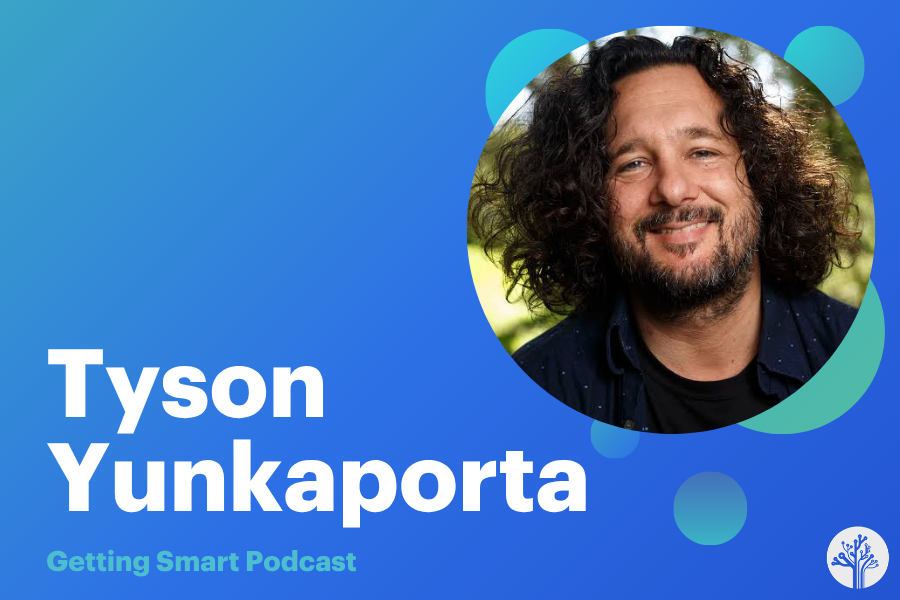
In this episode of the Getting Smart Podcast, Mason Pashia and Jason Cummins sit down with Tyson Yunkaporta for a thought-provoking conversation on Indigenous knowledge, relational learning, and the role of schools as spaces for dialogue, contradiction, and meaning-making. Together, they explore how language shapes worldview, why Indigenous leadership brings vital governance protocols to education, and how schools can move beyond reinforcing boundaries to becoming places where relationships, complexity, and shared understanding can grow.
Outline
- (00:00) Introduction
- (06:54) Language, Knowledge & Relational Thinking
- (11:24) Creolization & Indigenous Agency
- (18:59) Schools as Sites of Conflict & Culture
- (24:41) Good Protocols & Indigenous Leadership
- (31:42) Why Do This Work & Deep Time
Introductions
Mason Pashia: You’re listening to the Getting Smart podcast. I’m Mason Pashia. A few years ago, I read the book Sand Talk by Tyson Yunkaporta, and I found myself captivated by the framing, the approach and specifically the interrogation of the Western education system.
Later, Tyson continued to find me through different means. I’m a big fan of Emergence Magazine, and so I read a few essays in there, “The Time Traveler’s Wife’s Husband,” and a few others from place to place and culture to culture.
And so I’m really excited to talk to Tyson today on a number of fronts. Really excited to have my co-host, Dr. Jason Cummins, join me today. Jason, good to see you.
Jason Cummins: Yeah, I’m glad to be here, and thank you for joining us. For our listeners, my name is Jason Cummins, or my real name is Awaji Ogaja.
I’m a member of the Apsáalooke Nation, the Crow Tribe in south-central Montana, and I’m a A’ зо жia. So it’s a Sore Lip clan. So that’s where we’re from. And we get that name ’cause we’re always in the mountains with the cold wind and it chaps lips. So … Sore Lip. And I’m just really excited to have our guest here with us and pass it to you, and we’ll allow you to introduce yourself in the way you see fit.
Tyson Yunkaporta: My name’s Tyson Yunkaporta. My real name, as you just said, is Kawappa. We call that our bush name. So yeah, I belong to the Apalech clan right up in Cape York.
The … where the lands of the Wuth and Kugu peoples. Yeah. They … and I always hesitate to say nation.
Jason Cummins: Yeah. Mm.
Tyson Yunkaporta: Like First Nations? ‘Cause I don’t feel like we’re First Nations. I feel like we’re last nations. That the whole system, like the whole sort of global order, you know … yeah … of … nations and the kind of move toward an interdependence and a global order.
Like, that only started just over a century ago. And we’re kind of the last on board just as it’s failing and all coming apart. Yeah. And going into this multipolarity of weird anarcho-capitalist sort of regions. Yeah. And autocrats, and we’re just, “Oh, yeah, we’re … no, we were First Nation.” So we’re getting that nation status and taking on the bad border work of the Westphalian weirdness.
And like … oh … we’re building walls around our territories and our identities and everything else and, yeah, and just fighting over the scraps. Yeah. And that just like, as with all the other nations, it creates corruption and, you know … yeah … terrible things going on in our communities, and competition and all the rest.
And I sit in the old law, which is anti-competition and no boss above all. You know … mm … a sharing economy and no bosses. Nobody can tell anybody what to do. But you’re in a web of relations and, yeah, that you can’t exist without, so you’re beholden to that as well, which sort of prevents your excesses.
And my web of relations extends all around the continent from ancestral to adoptive to just the people you become culturally affiliated over time with, knowledge exchange and our traditional embassy practices of sort of multi-tribal gatherings, yeah, and even extending up into Asia where we used to be connected to the Silk Road long before Europeans came here. Yeah. And so, yeah, I guess I’m a child of … yeah, I’m a child of that interdependent kind of voyaging, trading, exchanging and, yeah, increasing knowledge together through this pluriverse of trans-knowledging, you know … yeah.
Multi-nation interdependent governance over long distances. And that now extends out to Turtle Island too. So Turtle Clan and Crane Clan, and even some Moose Clan people look after me when I’m there, which is really cool. Yeah, so …
Mason Pashia: That was a very deft maneuvering of the micro to the macrocosmic and back and forth.
Tyson Yunkaporta: It comes to knowledge production and governance and all the rest, when it’s sitting within those frames of good border work …
Jason Cummins: Yeah …
Tyson Yunkaporta: where borders are supposed to be places of increase of relations …
Jason Cummins: Mm-hmm.
Tyson Yunkaporta: you know, and of, yeah, establishing those interdependent relationships and marrying each other and adopting each other across and making that good … doing that kin-making, that precedes all good meaning-making and making protocols and, you know … yeah … norms of access to facilitate those flows for actual proper supply chains and all the rest.
That’s where the governance is, for sure. And that’s about pluriversality and trans-knowledging, which is what education should be all about.
Jason Cummins: Yeah, I was reading San- oh, I take it back. I was listening to Sand Talk. I didn’t read it. But he did a great job narrating, by the way, and I picked up on a lot of the … over here we call it Indian humor.
Tyson Yunkaporta: Yo.
Jason Cummins: I picked up on the humor. I don’t know if some of our readers might have, but we can probably talk about that later, but maybe …
Tyson Yunkaporta: Yeah, for sure. And it’s absolutely essential. It’s those little twists, that sort of bitter irony that … mm, yeah. And just sort of getting to the core of the spirit of something, like what’s behind the words of people. And then finding that in yourself too, like, you know … “I’m saying this but what do I really think? I’ll probably be honest.”
Jason Cummins: When you were smoking … we say smudging over here … but you were smoking out the ghosts of a poor lady who only had a couple of houses.
Tyson Yunkaporta: Yo. That’s right.
Oh, yeah. The smoking ceremonies we do for real estate auctions now. It’s … yeah. Well, at least we’re included. Incredible. It’s all-inclusive now. Yeah. Yeah.
Jason Cummins: But I was, I was …
Tyson Yunkaporta: reading that … we do the same thing performing culture in schools often. Yeah.
Jason Cummins: I wanted to ask because you had mentioned about relationships in Sand Talk and it was just a brief … it’s probably in my mind brief … but it really helped me understand some of my relationships with the world because a lot of times when you try to explain Indigenous connections to non-Indigenous people, it’s hard.
But when you said they’re three-dimensional … mm-hmm … I thought it was just so helpful. And how did you come up with that kind of thinking or to conceive of and explain it in a better way where these relationships we do have are three-dimensional, multilayered, just …
Language, Knowledge & Relational Thinking
Tyson Yunkaporta: Yeah. Well, that’s all about that focus on getting to the how rather than the what and the pattern rather than the thing.
Like, the process rather than the object. It’s all of that when you come to the culture. So, you know, for example, Indigenous language in education, you’re pushing for the thing of, yeah, learning language and learning these words and grammars and all that kind of thing.
But for me it’s what you can learn from the language. So, you know, if you look for those patterns and principles, those norms, the values, the ontology, cosmology that’s in the language, that you find in what’s missing from the language that’s present in English, yeah. And then what’s in the language that isn’t in English or Spanish or French or any of these other colonizing languages. Mm. Yeah. And then looking at how these things come out in our Creoles, our … ’cause our Englishes are always different from the standard English.
And that, to me, that’s the exciting part. That’s that really generative space, that space in between. You look at all these and … so, for example, a big driver behind looking at those relationships and the protocols in the circles and dimensions you move in and out of, you can find those in the pronouns of the language.
And that’s not she, her, him, he, they, all that. Yeah. It’s in the pronouns that are different from English or that have been eradicated from English over the last few centuries, yeah. So it’s that … yeah, it’s the how I … the first-person pronoun, so how I is used, and there’s always lots of forms of I because if you can imagine an ellipse either side of it … if every time …
Tyson Yunkaporta: you wrote it in English, you had three dots before and three dots after because there are missing prefixes and suffixes from the I, belonging to them.
I, I belonging to you, to this person or, yeah, so I in this relation, I in that relation. We kind of have that. And then as we go into the plural forms, there’s a lot … there’s a dual, like a dyadic kind of form of, like, us two.
Mm. And so your kinship system and your place in the kinship system, it’s defined within all of these kinship pairs. You have, like, nephew, auntie, mother, child. Brother, cousin, brother, brother, brother, sister and, yeah.
And so much complexity there. Cousin, dude … and then there’s the us only, which is your exclusive groups, so age-status groups, you know … mm … dialect groups, clan, all those different things. Even gendered groups and all that kind of thing.
And then there’s the us all. And so if you look at it like that and you look … there are different protocols for each of those relations in the spheres that you’re moving in and out of all the time, and it’s different behaviors there, different knowledge that’s kept within those relations.
And that sort of defines how we govern knowledge, how we do our collective consensual governance together in different spheres and maintain our autonomy tempered by relatedness, mm … yeah. So I mean, that’s … yeah, it wasn’t very simple, but so anyway, yeah, it’s about … you find those things in language.
And then in the totemic sort of structures of how you define your landscape and your spiritual connection to those, it’s all there. It’s all there. And yes, you can learn the language and the sets of vocabulary, but it’s more what you can learn from the language, yeah.
Mason Pashia: Is your thinking on that … like, I know in the States we have Robin Wall Kimmerer and a handful of other folks are pushing for some inspiration in the English language derived from some of these different structures, right? Whether that’s making nouns into something that’s more active or coming up with sort of a kin-relational approach to language.
Yeah. Is your … I guess, do you stand at the place of, like, it’s better just to be aware of these systems? Like, the only real harm is to not be aware of how the language is dictating the world? Or do you want to, I guess, take things from a language that is more relational …
Tyson Yunkaporta: Mm …
Mason Pashia: and actually put that upon a language that historically maybe has been more colonial or more individualist?
Creolization & Indigenous Agency
Tyson Yunkaporta: Yeah. Well, I think it’s more about trans-knowledging and having a pluriversal kind of approach to knowledge in the world. And that’s not about the facts or whatever. Right. So is there really giant horned serpents roaming the earth, and freaking thunderbirds are coming down fighting them or whatever?
It’s not about the facts like that, but it’s a, you know … it’s about, yeah, how these different knowledge systems can sit together in dialogue, and what are the foundational intersections there where we can sit together. And so, and then what can we learn from the trans-knowledging?
So for me, I don’t go in for decolonization anymore, which I certainly was all in for that when I wrote Sand Talk. Although obviously there were some concerns. But yeah, now I lean more into this idea of creolization, the …
Mason Pashia: Can you define that for us?
Tyson Yunkaporta: The new … yeah, so it’s when two cultures meet and they’ve just got no way of communicating with each other, different languages, these Creoles emerge. Mm. Oh, and we affect each other’s languages too. So your culture gets changed from interactions with mine, and then mine gets changed more because of the power dynamic, of course.
But then we end up with kind of different ways of speaking English. Mm. So, for example, if we’ve got that Anglo hegemony happening, yeah. But that’s … mm …
and it’s in that creolization. So creolization, usually that’s all sitting with us, where we’re getting changed and having to develop a halfway culture. But we don’t … I thought pay attention to how much agency that has within … like, I guess in the formation of the Age of Reason, the Rights of Man and all of the philosophy that came out of France back in the day, that was coming out of encounters with Native Americans.
And so you ended up with, like, an American system of democracy, or even the idea of people having any kind of sovereignty at all, like that came out of interactions with North American Native American philosophers. And they were jumping on ships and going out and talking to people in France when they were trying to put together this idea of human rights and equality and all that kind of stuff and what that might look like.
Yeah. Unfortunately, they came up with something that kind of perverted it too much because it was like, “Okay, well, we wanna do that, but the powerful need to keep their power and most of the money. So how can we do that?”
Ended up with your system in America that’s currently exploding the world.
Mason Pashia: Yeah. To put it lightly.
Tyson Yunkaporta: But there’s power in that. There’s power in creolization, in, in, in … well, we talk about loss, like all the objects that are kept in museums and the remains of our ancestors and our ceremonial objects that are in the glass cases, but we know those things to be sentient, mm, and to have agency. And so if you think about that, like what are they … they’re not just trapped there. We know these are powerful things and powerful ancestors, and they’re acting on the people there. They’re doing their work. You know …
Well, if you’ve got a ceremonial mask or stick or something that’s there in a museum, everyone who passes that is being affected by that. It’s doing its work on the world. And we need to, yeah, think about our agency in those terms. Mm.
Mason Pashia: This idea of creolization is … I … this is more of just a thought than a question, but I would love to hear your thoughts on it too.
Like, it’s really interesting in a school setting because you’re not only talking about different cultures, you’re talking about intergenerational creolization. a school is such a rich intergenerational space, and we really don’t ever use it in that way. And now …
I think you could make the case that in some ways you’re having this kind of interesting species creolization with artificial intelligence and a human, like the ways in which those are changing language and the ways in which they’re changing how we perceive systems. I think that’s a really rich way of thinking of it as being something that’s actually an asset, like this … you are making something new rather than you are taking from either.
But that has to be agentic on both sides of the equation, otherwise we end up where we’ve been.
Tyson Yunkaporta: That’s it. And it’s difficult if you don’t have good protocols for that, like trans-knowledging protocols for dialogue where you find that active side of creolization. You have … so I guess the whole sort of critical theory and decolonial theory, all of the sort of critique and deconstructivist kind of philosophies that have made change and progress in education over the years …
It has made schools sites of both disruption and engagement, mm. So you have your groups in the community that express their dissatisfaction and their desires there in the school where it becomes the sort of front line, the front line of any culture war. Yeah, so people express their deeply personal agendas … subjective and partisan agendas in schools passionately and demand representation and change. And that’s happened a lot through human rights, civil rights, et cetera.
Gender, everything, toward equality. The problem with that, though, is that there are more sort of malicious groups who … they don’t belong to oppressed groups. They’re actually part of that hegemony. They’re able to express their dissatisfaction using the same tools of critique and resistance.
They’ve picked those up off the battlefield from us and they express these. And so you end up … I mean, I know your school board meetings in the States.
Jason Cummins: Yep.
Tyson Yunkaporta: Yeah. Like, and the sort of … I don’t know, the colonizing of those governance, education governance structures by your Moms for Liberty and your interest groups.
Particularly religious ones who look to try and shift everything across to private systems and voucher programs and all that kind of stuff. It’s constantly being eroded, schools, from within and from without, and using the standardized testing and everything else.
Every metric as a means of turning schools into something to be consumed. Yeah. And, yeah, it’s something you experience everywhere. And my thinking on this has changed since Sand Talk quite a bit, yeah. So I had that story in there of the kind of Prussian, kind of eugenics, kind of origins of schooling and the idea of controlling behavior. And that’s true, but then also the opposite of that is true at the same time, which I didn’t acknowledge there but I did acknowledge in the next book, Right Story, Wrong Story.
Tyson Yunkaporta: That actually there is an opposite story, completely the opposite of that, as schooling as a site of making sure that workers have access to knowledge and a rich inner life and arts and culture and everything else.
Yeah, that every person, no matter what their means or position in the world, that they’re able to access good-quality education. I mean, that’s there as well. That is also true at the same time. And we, yeah, we can’t cherry-pick these narratives too much.
We have to allow … that’s two opposite stories and they’re both true, and they should be able to sit alongside each other, and there should be able to be dialogue between them and because …
Schools as Sites of Conflict & Culture
Jason Cummins: My field is school leadership and we had visited a bit before about the Indigenous school leaders. And so I wonder what you can say to new Indigenous school leaders or Indigenous school allies who want to make space for Indigenous knowledges or practices in school systems.
Tyson Yunkaporta: Mm-hmm.
Jason Cummins: And …
Tyson Yunkaporta: Well, I think what we bring to the table is a table that works. What we bring to the table is … it’s not a long boardroom table. It’s a round table. We bring that … I don’t know, some people say powwow. What some of us here call wanju, which is like a way of yarning that sort of connects everybody.
Like we call it one belly instead of one mind. It connects everybody in a kind of consensual relation. People making kin together, who are very, very different and have different ideas, different agendas. But everybody finding that space where everybody’s autonomy and different reality is catered for.
But then at the same time, there is a foundational agreement on reality. And we have the traditional structures and ways to actually make that happen, and we bring that. Yeah. So I think that … I mean … yeah, that’s it for us. That we’re the ones who can facilitate that pluralistic … not even pluralistic, pluriversal even.
Where all cosmologies can be in dialogue. We can bring those ways through our ritual practices of how we do those things. And it’s not enough to sit in a circle like a … it was kind of a joke, the round table. Yes. But you gotta use the metaphors that you’ve got, you know across the cultures, and they like the King Arthur and all that kind of thing, so yeah, bring it. Yeah. So yeah, it made me think … something made me think before, like, so what’s the reason to study Shakespeare? And part of it is that you have access to what the language was 500 years ago and the parts that are there that aren’t there anymore, you know. Like the subjunctive mood, for example, has disappeared mostly from English, unless we’re saying something like, “I demand that he be punished.” And you’ll see it there: he be punished. And that subjunctive mood’s really important, and we have that in most of our Indigenous languages, and various forms of it. And it’s just really … I don’t know, yeah, there’s something like …
They need a subjunctive. They need a way to express uncertainty and the unfolding process of now that’s constantly happening within uncertainty, and they can’t express that without a subjunctive mood. So yeah, check out your Shakespeare. It’s all there.
Yeah. There are gifts in things if you’re looking at the structures and processes and patterns rather than just extracting, “Learn this monologue,” and what does that mean? “Everyone wears a mask,” or “the whole world’s a stage” or bloody …
It’s like, ah, come on, that’s so boring. There’s more there you can find, yeah.
Mason Pashia: Right Story, Wrong Story talks a lot about this polarity, like you talked about with the thing that you thought maybe is true, that you might have talked about in Sand Talk, the Prussian system, and then this inverse version of it, right?
Which is sort of like the reward of learning, exposing people to the world, this real trans-knowing thing that you’re talking about. How can schools do that? Like, how can you actually build a space that prioritizes the contradictions and the conflict of having two things be right when a school is built for safety and consensus almost all the time?
I’m curious if there’s anything that you’ve seen either from spaces you’ve been in or facilitated or even just relationships in your life where it’s like, how can you actually make this a space where conflict and contradictions are not viewed as the thing to avoid but are viewed as the things to hold and sit with?
And then you create space to actually look at them to try and find those patterns that you’re talking about or to try and find these other really valuable pieces that come from it.
Tyson Yunkaporta: Yeah. Well, I mean, you have to have a way of sorting things that you develop together. Yeah. You have to find common protocols, and those protocols have to come out of a common understanding of foundations of reality, something you can all agree is real.
Like in first principles there. And then an understanding of what fallacies look like. So what patterns of thought are actually just malicious and fallacious here. Yeah. And that’s the thing.
You have a lot of disingenuous arguments and stuff being made now. And it’s particularly come out of the United States, but that’s in a feedback loop with all cultures around the world that came out of empire.
Good Protocols & Indigenous Leadership
Tyson Yunkaporta: we have three … we have three categories of people that you just don’t have to listen to. They’re allowed to speak but nobody’s gonna take them seriously.
So yeah. And you translate that, and we have Creolized words for that as well. But basically we’ve got hard heads. What I would call Quetchacten, hard head. So that’s a stubborn person who is gonna push, no matter what, is gonna push that one idea and is not going to be affected by any context or new information or anything else.
And that’s no good ’cause that can’t be responsive to the reality. So that’s not the reality. So it’s, you know if you’re stubborn like that, it’s like, well, you really … we can’t just compromise and include your thing in here or make this based on your thing because that’s not the reality, bruz.
Go away. So hard heads. Mm. We got flibbertigibbits. So, you know, these are the silly ones. Mm-hmm. Yeah. Your flibbertigibbits who basically … yeah, they’re inconsistent logic. Mm. So they can start the sentence one way and then have it going completely the opposite way by the end of it and basically people … they’re just not across it. They haven’t got consistent logic. Yeah. And then the other one is the worst, it’s the two throat. We call two throat. But some people call forked tongue. So people who are saying one thing but they’re really meaning another or going for another agenda that’s so crappy that they can’t say it out loud.
unless they’re signaling their … and then they kind of, you know, code that in different ways so that they’ve got deniability, yeah, so it’s like, yeah … so you build those ways of yarning where people have to say what they really mean.
And basically people who are two-throated or hard-headed or flibbertigibbit … basically they’re not going to have any impact on the group, mm. Because they’re not really in the circle and connected. That one mind, one belly, so a consensus … it’s more like where you’ve got to think of it in terms of consensuality, and with the true meaning of that, like sensual, it’s like sensing and then con together. So yeah, feeling together. Mm. You have to be feeling together. Yeah. ‘Cause that’s really the only way you can find … you can negotiate norms of access across all the borders that we have to navigate now.
Like in a world of iron borders around things like family, gender, individual autonomy, sovereignty, all of these things. Everywhere that’s rule-governed or anything else, there are lots of borders to navigate and some people have walls.
Many people have walls and systems that just want to extract and harm people. They’re very, very much about borders as places of blocking, of expanding these aggressive and defensive borders. Yeah, schools need to be sites of not reinforcing those borders but of making those borders into rich sites of dialogue and meeting and making kin, making meaning, making change, yeah, all of these things. Love that. That’s where your rich sites of knowledge production are, is in that sort of trans-knowing, so it’s gotta come … yeah, it’s gotta come that way. But yeah, there are people who just wanna disrupt that and mess with borders or expand them, control … to make things worse.
Yeah. Yeah. And they can’t survive a decent process, like a good process of making sense, making meaning, making kin together. That’s why, yeah, that’s what we’re bringing to the table as Indigenous leaders in education, is good protocols for doing those things. Unless we’re coming from like a tribal family and a tribal council that’s basically …
running like a committee or a freaking dictatorship … where it’s basically harnessing all the community’s resources toward one or two families. And I know you got that over there, brother, because …
Jason Cummins: Yep. Yeah. That’s …
Tyson Yunkaporta: same way we got it here. Yeah.
Jason Cummins: Yeah. The effects of empire, leading the way we’ve seen people lead before us and try to break those patterns, I think. Yeah. That’s something that we struggle with too, is when you’ve seen those in power who are only there for self or for there for and no more, and then how do we break those patterns to reconnect to traditional values or traditional
Tyson Yunkaporta: Well, and that’s when you see those those stories of purity and elimination and exclusion. You see those kind of proto-fascist sort of concepts starting to come through and being linked to this idea of traditional ways. So yeah. And you start to see the fallacies come through, like the ad antiquitatem fallacy.
Basically if it’s old, it’s good. If I frame it as traditional, then it’s good. And then anything else is bad. Yeah, when you … ah, I think the best thing you can do in schools and in governance is to make sure everybody’s fluent in the most common weaponized rhetorical fallacies.
Yeah.
And we gotta be able to see that in ourselves and guard against that and come to agreements about, “Hey, we’re not gonna use these bloody things.” They take you the wrong way. They always put you in a bad place.
Jason Cummins: Along the same thinking, sometimes as educators, we teach the way we’ve been taught or we lead schools the way we’ve seen it led. It’s like trying to move forward in more holistic, healthy methods and reconnecting students with their identity.
Sometimes school leaders are scared or they feel like it’s wrong, that they’re only there for reading, writing, arithmetic.
Tyson Yunkaporta: Yo.
Jason Cummins: And it’s really challenging because they don’t know they’re teaching culture. Every day they’re teaching culture to Indigenous kids, it’s just not those Indigenous kids’ culture. And it’s … I don’t know how to bring awareness to some of them or how do we frame it to where they can come to their own conclusions that, yeah, they’re all really good culturally relevant teachers.
Tyson Yunkaporta: Yeah. But they … it’s … I mean, how do you … yeah, it’s really tricky. I think you just have to name the things. ‘Cause I mean, you’re kind of doing a disservice to students if you’re not actually training them up to become good neoliberal subjects. If they can’t be like these self-managing, user-pays, bloody, work-ready, enthusiastic self-oppressing entities, they’ll die out in the world, so you kind of have to teach them how to do all those things. But how do you teach them to do that and then … but still keep their soul, their relationships there, a culture that isn’t a zero-sum game …
Why Do This Work & Deep Time
Mason Pashia: I wanna be mindful of time and also keep going forever ’cause I feel like we are somehow just starting and also just ending.
But I do wanna figure out one thing from you, which is often the first question to a podcast, but I think it’s only fitting that it might be the last one. Which is like, why do you do this? Like, I think you’ve expressed a lot of things that are not … I would not say despair, but they are like …
They’re sent out large into the world and sort of existential in some pretty cosmic way. And I think a lot of people feel that way, people trying to get into the profession, and people already in the profession, and people just looking at the profession. Mm. And so, like, what keeps you close to these systems so that you can observe them, critique them, design new ones?
Yeah. Like, what holds you here?
Tyson Yunkaporta: Well, I’m in a space of thinkers where it’s constrained by a market and there is …
audience capture. And the market captures you a bit. So everybody’s either gotta be peddling a sense of alarm or a sense of inspiration, or a mix of both, yeah. If you can do both, that’s really good because then you’re selling the problem and the solution in a way that captures people. And if you have a good narrative that’s really compelling for that, then you can become quite a guru. Particularly if you’ve got spiritual aspects to that narrative.
So you’re an ancient wisdom grifter in the Indigenous sort of space or even everywhere else. You’re grifters selling different ideas and public thinkers, et cetera. They’ll plunder Indigenous sort of wisdom as well and promote that, “Hey, old is good.
Look at this, 65,000 years.” Anyway, so this idea … and there’s wow and woo coming out. I try not to do that. I try to disrupt that. There has to be this trickster. There has to be somebody you can’t quite pin down. You start to become comfortable with your idea of who they are, but then they’ll just destroy that and disillusion you.
You start to become comfortable with an idea they’re working through, and then they gotta turn it on its head and go, “Oh, but that’s wrong because of this.” And, yeah. And I guess it’s getting people used to the idea of there is endless regenerative power in that sort of potential energy of uncertainty, of an uncertain constantly unfolding now.
A sense of deep time, where all of your ancestors and all of your descendants are you. In this constantly unfolding you, yeah. And I guess we find that in our old stories, so our big spiritual entities, particularly the serpents. The serpent lore is where we find our common ground everywhere.
From St. George and the dragon to Rainbow Snake here. It’s all there. There’s a point in the story where long ago, that giant entity gets killed. But every season it’s still here and goes through. So its entire existence is a sort of cloud of incidents and moments.
And that moment of death is just one of those. Yeah, but the being is … it’s deep time and for all time. And we need to start positioning ourselves and thinking of ourselves in that way. When we do that, things change. Yeah. Anyway, there’s your ancient wisdom. Usually … ah, I completely ruined it for everybody. And now I can’t remember which book, but I said, “Yeah, ancient wisdom is just like … you say something and then flip it around,” so, “If you can’t master your rage, then rage will become your master,” or whatever.
I kind of ruined a lot of people’s careers. The one thing of a paradox. ‘Cause I told the secret of the …
Mason Pashia: Amazing. Jason, do you wanna ask a final wrap-up question or do you have any thoughts?
Jason Cummins: No. I just really enjoyed that. I enjoyed you sharing yourself and your story and just sharing with us. Visiting. I think you call it yarn, and we call it visiting or telling stories, that’s it. But I do appreciate that. Mm-hmm. And I think that’s what’s important, is connecting and visiting and not being about an agenda, but more connection. That’s it. Connection is the agenda.
Tyson Yunkaporta: Yeah. The relations. Well, my community, We say tell story. “Hey, we gotta come tell story,” but it’s not telling stories just because story is everything that’s going on for you in your life and for remembering things and then thinking about things that are coming down the track.
That’s all tell story. Yeah.
Mason Pashia: It’s all we have …
Tyson Yunkaporta: But that doesn’t translate well for everyone else …
Mason Pashia: It doesn’t …
Tyson Yunkaporta: because they think it has to be a narrative.
Jason Cummins: Yeah. We like to, in schools too, in my community, share our stories with our students.
Mm. And it’s real … it’s interesting to me because there are different worldviews at play, and we get influenced by other worldviews. And we’ve had some students say, “Is this fact or fiction?” Mm. And that question has no relevance to this world. The story is real. The story is here. The story itself is here.
Jason Cummins: And the story is doing what it’s always done.
Jason Cummins: I also wanna thank you for your work because you’re able to, I think the way you opened up, share that while there’s things in language that isn’t in English, so we’re trying to, you know make these connections. And that for us in academia or in the K-12 world, it gives us language to position ourselves as Indigenous people in this other space.
And so I appreciate your work and appreciate your effort to help us to do that. And I just wanna say thank you.
Mason Pashia: Yeah. Thanks so much, Tyson. Really great. Glad we got to do this.
Guest Bio
Tyson Yunkaporta
Tyson Yunkaporta is an Aboriginal academic, author, and traditional woodcarver belonging to the Apalech Clan in far north Queensland. He is a Senior Lecturer in Indigenous Knowledges and founder of the Indigenous Knowledge Systems Lab at Deakin University in Melbourne.
Yunkaporta is internationally recognized for bringing Aboriginal ways of knowing into dialogue with complexity science to address global existential threats. His methodology emphasizes collaborative dialogue and “sand talk”—the practice of drawing symbols in the earth to convey complex ideas.
Links



0 Comments
Leave a Comment
Your email address will not be published. All fields are required.