

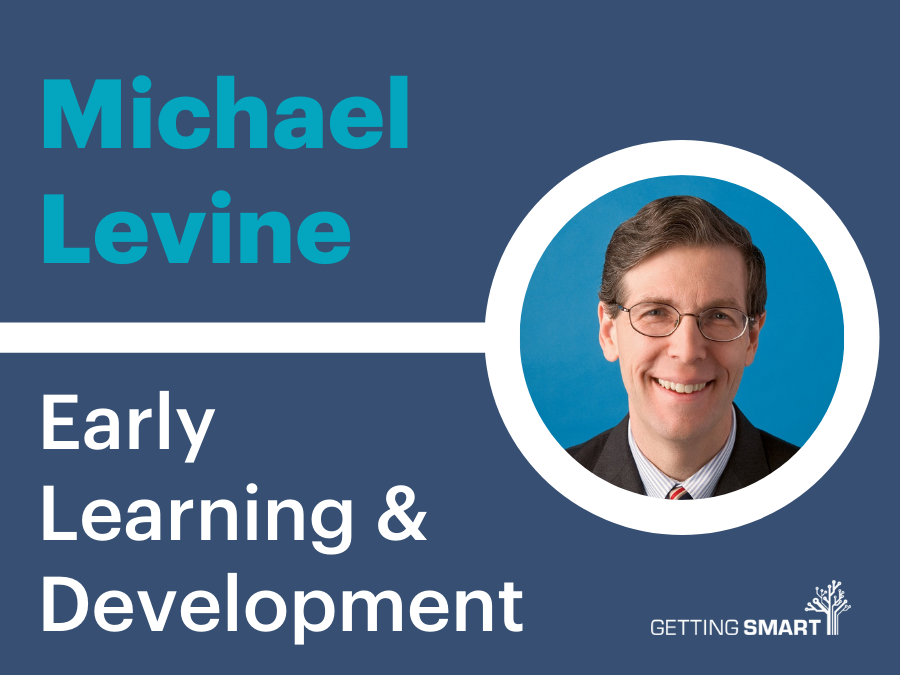
Michael Levine on A Research-Based Approach to Early Learning & Development
- Can I learn a lot
- Do I like the team
- Can you make a big difference in the world?
Transcript
This transcript has not been edited for spelling accuracy.
Hey, are you interested in promoting your product, organization, or thoughts to a wide-ranging audience of educators, business leaders, education leaders, and more? This could be your spot. Yep, imagine your ad right here. Find out more about expanding your reach and catalyzing the future with like-minded leaders by clicking the link in the show notes or emailing jessica at gettingsmart.com. Let’s get back to the show.
You’re listening to the Getting Smart podcast. I’m Tom Van Der Rook, and today we’re talking with my friend Michael Labine. He’s the SVP of Noggin. That’s Nickelodeon’s director-consumer, interactive learning service. Michael’s a longtime friend and colleague. He is unflappably pleasant and unusually brilliant. Michael, what a treat to have you on the podcast. Oh my gosh, Tom Van Der Rook. Such a pleasure to be here. That was way too kind, but let’s get into it.
We, Michael, we’ve had this 20 or 25 years of beautiful and unusual, sometimes unforeseen intersections in education and technology. I recently learned about one that I didn’t even know about. When I joined the Gates Foundation, when we were just in formation, actually I joined the Gates Library Foundation in 1999, and learned that Bill and Melinda were really big fans of Andrew Carnegie and of
Vartan Grugorian, who was leading the Carnegie Corporation. They had learned so much from them, and they had launched in 1998 a giant library project to wire America’s libraries. Did you and Carnegie have anything to do with influencing that? Yeah, thanks, Tom. I think we may have. Vartan Grugorian was, as you suggested, the president of Carnegie Corporation, beginning at some point in 1997. I had been on the staff
there since 1990, leading the early childhood development work, as well as some of the school reform and public media initiatives. I got a call one day soon after Vartan had begun at the Corporation to say that he was having a meeting with Patty Steinsiefer, as well as Mrs. Gates, to discuss Andrew Carnegie’s work and his legacy in having built literally thousands of libraries as part of his initial philanthropy. Would I have some interest in advising what he had to
say to the Foundation executives? Gates was very, very young, as you suggested at that point, as an important philanthropy, and everyone was looking to them to get a sense of what they might do. Vartan would help for me, to be honest, and he didn’t need much prompting because he had been the man who had turned around the New York Public Library in the midst of the New York City fiscal crisis in the late 80s into the early 90s. And so libraries were certainly on his mind,
but he asked me to give him some ideas and he pitched these ideas to the Gates Foundation. I had the privilege of writing out four pages of what a national initiative might look like to modernize the libraries and to do kind of a modern day Andrew Carnegie-ish initiative. And I’m proud to say that Patty and Melinda Gates and others loved what Vartan gave them and no credit to me because it was an obvious idea, but they activated it and from time to time they’d check in with
Vartan and he’d check in with me and I don’t know, hundreds of millions of dollars later, the Gates had their first major programmatic initiative that has served tens, if not hundreds of millions of families since. So I think it’s a good example of situational leadership and the ability to begin something new with sort of a modernizing of a tried-and-true film-through-fit approach. So I was proud to be a small part of it and to tell this story for the first time on your
podcast. It’s so exciting to make that connection. When I joined the Gates Library Foundation, it was Patty and a program officer and a couple of public relations folks and 150 librarians. They staffed up to actually wire every library in America and to install computers. Gateway computer had a whole plant set up just for library computers and those librarians went library to library state by state around the United States, wiring libraries in the late 90s and through the
first five years of the knots. One thing we can say about it, Tom, starting to interrupt is especially this last year, you don’t know when a philanthropic initiative is going to be prescient. Like at Carnegie, we used to talk about the study that General Miradol did in 1948 about race and poverty in America was ridden off by the foundation as a noble study. It became the basis for Brown versus Bordeaux-Vette along with the other
research that was done about educational injustice. This initiative some 20 years ago by the Gates Foundation, can you imagine our lives during the pandemic or the lives of folks who didn’t have access to the world’s information if we didn’t have libraries and Google search and the world’s information of people’s fingertips? It just was trans. One of the pieces of the infrastructure that we needed to get through the pandemic successfully was laid in place right then and there.
So in the fall of 1999, I worked with you and Michelle K. O. to stand up high schools for new century. That was really the first large small schools project in America in effort to try to transform struggling schools in New York City. You left Carnegie and ran Rob Reiner’s Foundation for a few years and then had the chance to lead the efforts at the Asia Society. Our next real introduction, what was attractive about what Tony was doing at Asia Society?
Yeah, so I had the pleasure of working with a team at Carnegie that really cared about both social impact and social justice but also about building a shared future that is about global education and the connections between what Americans were doing and what the rest of the world was up to. And Vivian Stewart, who was one of my colleagues and a key executive at Carnegie and Tony Jackson, who many of your listeners might know for his work on
small schools, the reinvention of middle schools through a vision called turning points, as well as the work that he’s done on social justice and inter-group relations, came together at Asia Society because we wanted to continue some of the work that we’ve done philanthropically to actually be more engaged in transforming schools and other institutions. And so the team there met you as part of our mission to teach about Asia and other world regions, languages and cultures.
This was in the post-911 moment where you and your listeners might recall there was an enormous amount of xenophobia, an enormous amount of othering Islamic children and families, but other folks who are different from the mainstream. And we thought that it was a moment to help Asia Society, which is sort of a unique cultural resource that had not done a lot of work with kids of color, with kids in need, to kind of transform some of the deep
knowledge that Asia Society had around language and culture and use it to influence school reform. So you were, I believe, a program director leading the education work at Gates, and you had this big idea to invest a billion dollars in the creation of small schools. And New York City was one of your allies as the new chancellor there, Joel Klein, wanted to transform what I would call sort of a calcified school system that needed a dose of innovation
and change. And so working with you and Jim Shelton and other folks who were on the Gates staff at that point, and Joel Klein and Kristen Kane and Garth Harris and other people who are members of the Children First Committee in New York, they recruited us to create some new small schools with an international theme for new schools in New York. And then we built with support, generous support from Gates and many others, a whole schools network, which is called the
National Study School Network. And there are hundreds of international schools that exist, not just because of that stimulus, but because of the interest in teaching about other regions, languages, and culture. So that was, I think, a really, really important time. So 20 years later or so, there’s still a movement to globalize and to internationalize public schools with dual language immersion programs, some in Mandarin, some in Arabic, some in Spanish, of course.
That was a big part of the initiative back then. But also learning about the rest of the world is a critical part of creating a shared future for all of our kids, especially now. I’ll note for our listeners that Asia Society still has really great resources on global education and global competencies. They have a beautiful set of design principles that we’ll link to in the show notes. We actually accessed those last month for a school design that we’re
working on. So it’s really a terrific legacy, both in terms of a great network of schools and great resources available globally. Michael, in 2007, you became the executive director at the Joan Ganz Cooney Center, better known for Sesame Street, one of its programs. What was attractive to you about Sesame Street and the Cooney Center? Yeah, it was sort of a return to my early childhood roots. I have a background in developmental psychology and social policy and
trained with one of the great developmentalists of Oak Pass entry, you were a Brown from Brenner as an undergraduate. So I had an interest in my portfolio, both in my jobs before Carnegie as a mayoral aid in New York City, but also at Carnegie where I’m an early childhood field. But also was an extension of the work that I had done in Asia Society since Sesame really is the longest street in the world. It really is a place that cares about not only ABCs in one, two, three,
for domestic consumption, but very much involved in creating global education and resources from the work in Sub-Saharan Africa around HIV AIDS prevention to the peace and conflict resolution work in the Middle East to a whole range of different things in South Asia. So I was asked to form a new R&D center and lab and to join the senior team at Sesame in 2007. It was a time where the iPhone was just about to be launched, the iPad had not yet been launched, and these new
media is what we called them back then and I was VP for new media as well as Executive Director for Education at Asia Society. So we’re beginning to think about the kind of work Tom that you’ve been pioneering for the last 20 years, what is the new digital promise. And so the team at Sesame at that point wanted a new unit. They named it after the brilliant and not as well known as she should be, Joan Ganscuni, the founder of Sesame Street and Sesame Workshop, otherwise known as
the Children’s Television Workshop. Anyway, so I was to form an R&D lab to identify what’s coming next, what digital innovations could inform the early childhood development work of Sesame Street, but also the field building institution. So spent a decade there doing a whole range of different research projects and I’m glad to talk about any and all of those, but we definitely met up along the way. But Michael, what do you think you learned about
early childhood development in your time at Sesame? Yeah, a ton about the use of models and the use of sort of immersive media and immersive technologies to help young minds be shaped in a constructive and a constructivist sort of way. I think the main thing that worried me as the digital promise was introduced to younger and younger children, one of the developers of the touch screen at IDEO once told me that they didn’t realize that the interactive touch screen was
and the iPhone itself was designed perfectly for the fingers of a three-year-old. They didn’t realize that initially, but you didn’t have to be a genius to sort of realize just what a game changer the interactive touch screen was for kids who couldn’t navigate with a mouse or didn’t have any literacy skills yet that this touch screen technology opened up the world to their fingertips. So what I learned at Sesame was sort of the power of the new digital technologies,
but also how shall I put it, the less constructive uses of digital technology for consumption in early childhood, the fact that so many profiteers and product developers saw the marketplace pretty early on and began to develop things that were not evidence-based and not that they were harmful, but there were lots of, I would say, less than true marketing claims made about the digital promise. And so what we were trying to do at the CUNY Center was sort all that out.
The other thing that I think had changed was a lot of play and learn patterns and families so that parents who viewed the kind of brand equity and the educational equity built into things like Sesame or Nickelodeon, which is where I am now, or PBS, would park their kids without the scaffolding and the support that was needed. This happened also with television, with educational television, no decades ago. But what I think we learned about the unique
affordances of digital technologies was the ability to unite or connect generations in purpose. So I think that that’s one of the big takeaways from the 10 years at CUNY Center was that we need to really advocate for designs that are intergenerational. Michael, about a year and a half ago, you joined Nickelodeon. What was attractive about the noggin brand and the opportunity at Nick? Yeah, no. So for many years at Sesame, we were doing, I think, very, very strong work, especially
New International to introduce the power of educational media to change lives. But we didn’t have a distribution network that was built in. We had partners at PBS and partners at HBO and partners everywhere, but we didn’t have the pipes to really distribute what it was that we were doing. We were always reliant on some other partner. And in thinking about digital innovation there, too, and personalization of the kinds of digital innovations for individual kids,
we didn’t have the architecture or the engineering to create the next generation of truly supportive, scaffolded digital technologies. But by coming to noggin, which was originally a Sesame idea, by the way, your listeners might not know that, Sesame and Nickelodeon iCom and the Henson Company came together in 1999, right around the same time that you were thinking of the transformative ideas at Gates Foundation, they were thinking about the first online, anytime anywhere,
worldwide web-driven delivery system called noggin. I won’t get into all the history of noggin and it’s a scent and it’s a decline, but suffice to say within a few years, Sesame and Henson cashed out, they actually made a lot of money off of the deal. Another interesting story is that the money that Sesame made off of the early noggin deal funded the use of the Muppets into perpetuity at Sesame Workshop. It’s a nice little fun fact for your audience. Anyway, I was attracted to noggin
about a year and a half ago because I always wanted to create a digital age Sesame Street. Not that Sesame Street isn’t doing good work in this area, but because they don’t have their own pipes to distribute, I thought that a big broadcast, a big multiplex company like Nickelodeon, which is part of ViacomCBS, would be a good place to test out this idea of creating something that would be new and personalized. So we went to work, we’ve created a whole range of new resources,
and we’re on a very steep growth path. Thank goodness. For somebody who’s not a parent or a grandparent of toddlers like me, what is noggin? What could parents find there and why would it be useful? No, thanks for asking. So noggin is Nick Jr. preschool and early elementary school learning service. It has all sorts of different educational content, which is, you know, briefed and developed by my educational and impact team. What distinguishes noggin is the number of genres
of content that are available. Some are interactive like games and what we call play long videos. Nickelodeon is very well known for its popular characters, just like Sesame Street. We’ve got ours. We’ve got the Paw Patrol. We’ve got Dora the Explorer. We’ve got Blues Clues and you. We’ve got Santiago to see. So these are very pop culture, iconic characters. I can’t tell you, I’m a really, I think I’ve watched all of those episodes. So I apologize to you for that.
But the kids love it. And so what we do is we take the IP as well as our own original production at noggin and we array it in different kinds of educational sequences. I won’t get into all the details, but suffice to say, we’ve got a noggin learning framework, which connects skills to knowledge. We’re very, very big on background knowledge and the fact that you need to create interest driven or passion driven learning. It begins as young as two and three where
kids love fashion or they love dinosaurs or they love oceans. So we try to tie our characters who are both through marketing and through learning science models and icons for our kids to deliver, you know, wholesome, but also I would call it fun and hard kinds of, you know, learning experiences for them. During COVID, we’ve done a lot to kind of their, you know, consumption and engagement has risen, which as a child development expert concerns me. So talking to our parents and talking
to our experts, we’ve created things for close listening skills like a whole new podcast series. We’ve created maker tools like art and music maker tools. We’re adding a lot of stem sort of experimental work with our characters are doing hypotheses and, you know, you know, learning about how kernels turn into popcorn or going to a farm and observing how, you know, farm to table actually influences a four year old. So we’ve been doing a lot of thinking about, you know,
the next generation of innovation, which is not consumption. And we’ve also been working quite a lot on recovery and resilience. So you’ll see on Noggin today, if you’re a parent, music, and you’ll see on Noggin today, if you’re a kid, more representation of who you are, because we are working with creators of color in new and different ways. We just created a Hamilton for preschoolers with Chris Jackson of Hamilton, George Washington and Moana fame. We just did a design competition
actually inspired by the work that you did at Gates, which has lasted, you know, decades where you put a challenge out there, a grand challenge out there, and you don’t use your own talent. You you know, you crowdsource it and you see who comes in through the transom. So we created this new album called big heart beats, which is all about social and emotional development and social justice education. And we got hundreds of submissions from creators of color there. So we’re experimenting,
we’re trying new things, we’re partnering with charter school networks to see whether or not going forward, the curriculum of the place can be connected to the curriculum of the space. So there’s a whole range of different things that we’ve been, we’ve been having some fun at Noggin because we’re a popular destination, but we’ve also been, I would say, you know, really affected by all that’s going on around us in the world.
You must have seen a big uptick in viewership over the last year and a half. We did, we grew. So we did a couple of things. I mean, first of all, we just made Noggin available for everyone, for free, for the first, you know, a few months of the pandemic, which, you know, was our wanting to be, you know, generous. It wasn’t a bad marketing tool also, I would admit. So we grew over 100% during the first six months. We’re continuing to grow, but not at that pace.
We also decided to continue to give Noggin away for free to tens of thousands of low-income families through Noggin Cares. A new version of Noggin Cares will be announced in the fall as part of back to school. We also launched new research on racial justice and inequality, which we just begun to release in terms of the kinds of conversations that families need to have. And we’re releasing a major study next month on risk and resilience during COVID, where we talked to
a thousand low-income families about not just all the screw-ups that happened, you know, during COVID between home and school, but the new coping behaviors and new assets that have been born, which I think are real, really important as we move forward. Michael, I wonder after three years in the nonprofit space, you know, and I’d like you to reflect on your first two years in the media business, do you think you’ve been able to
both have a high bar for impact and quality and also hit business metrics for profit? Yeah, it’s such a great question. As you suggested, I just had a government and nonprofit career to date. And I had some reservations about joining a big company, especially one that was going through its own merger the moment that I was joining via CommonCBS were merging. But I have to say, like the CEO of Nickelodeon, who’s, you know, my indirect boss, Brian Robbins, has just had a vision
and been amazingly supportive of the team, which is led by, you know, Kristen Kane, who you and I have known since, you know, the Department of Education Day. So I think if you’re a mission-driven company within another company that is mostly around entertainment, that there are challenges in translation and challenges in sort of explaining what you’re doing, for sure. But there’s also the resources and the leadership of the place, especially, you know, during the last year, where
purpose has become sort of, you know, central to everyone who’s working within this company, where we’re seen as the, you know, like not only the little engine that could, but the group that is actually making a really huge difference with, you know, young families on the educational side. So what we found to be true, which I didn’t expect was, you know, yes, there are more clearance points and yes, things can move more slowly than the kind of startups that you and I
have been involved in that drain. But the scale of impact that we can have and the resources that we can, you know, command and deploy are very, very significant. So it’s still a little bit of a long shot. Like I look for three things when I join a new enterprise. One, can I learn a lot? Jack, like I’m learning a ton. I’ve never made, you know, content for kids before. Two, do I like the team that I’m working with? Are they smart to do, you know, like,
can I engage, you know, with them? And we’ve got an amazing, you know, team. Three, can you make a really big difference in the world? We’ll see. That’s our aim. It’s a little bit of a long shot. But, you know, what did Margaret Mead say? We’ve got a small team and that’s the only thing that’ll change the world. Michael, this podcast and our practice here at Getting Smart is really about innovations and learning. I wonder as we begin to come out of this pandemic, we begin to think about
the next school year. How do you think about the innovation opportunity when it comes to learning and development, particularly for younger children? Yeah, it’s risky business. We’ve been through a lot and we need to recognize that first. And there will be kind of natural resistance to change, even though everything has changed this last year and everything, but a lot of things have changed this last year. So I am a little bit worried that those who try
to innovate will be less bold than they need to be and that we’ll see a lot of old wine and new bottles that, you know, the worksheets and, you know, the story time, you know, teacher reading the book, you know, over the internet will, you know, just sort of be ported, you know, back into the classroom. Early childhood has been really resistant and often with good reason to the use of technology because technology can become an electronic babysitter, as you know. Sometimes we need 20
minutes to take a shower or get a meal and a dose of, you know, noggin or sesame is definitely indicated. But in thinking about blended learning systems and personalized learning systems of the future, early childhood educators have a ways to go. And I think that we’re getting really close, Tom, to be able to do some different things. So one of the things that we did during the, during COVID, which was, you know, in many respects, a failure was to align the noggin curriculum with a validated
early childhood curriculum from the apple tree charter school network and connected to a family strengthening application called sparkler. So we put together a really dynamic trio of resources that families could use during COVID. And then the uptake was weaker than we would have expected because of implementation difficulties. Lots of families were stressed out and weren’t able to get online or their kids, you know, were sharing devices with three other children. And it’s just,
you know, this was a very, very, very hard year. So I think early childhood development has both the capacity to innovate because there’s kind of less structure there. There’s more degrees of freedom to innovate because there’s less of a system. But also they’ve got the challenge of not having both technical and intellectual resources to use technology yet. And so I do think there’s like a really big opportunity for social entrepreneurs. And I would count our company as sort of a
social entrepreneur in this space to come up with new things that could scale in the future. With all the spending that’s happening around recovery and the talk about an infrastructure bill, I fear that early learning is being left behind. It feels like one layer of infrastructure America needs is broader and better access to high quality early learning and development. Do you have any thoughts on what you’d like to see America do in this decade to extend access
to quality early learning? Yeah, no, for sure. I mean, first of all, I think what we’ve learned from COVID is that we do need a technological infrastructure. So the work that the FCC and Biden and other advocates are doing around digital equality will benefit families with young children. The new study that’s coming out on June 24 from New America, Rutgers and supported by Noggin and Carnegie on digital inequality will speak to the fact that so many families are still under
connected. So that like, if the conferees in the Senate think that the infrastructure bill for America should not include technology infrastructure, they’re sadly mistaken. That is absolutely essential. In terms of early childhood development, I mean, I alluded to this in the last answer. I do think that the new administration in a number of governors, including your governor in Colorado, governors in California, governors in other parts of the country in Florida have really invested
a lot in early childhood development through universal pre-K programs. But the glue that’s needed from the federal government and the expansion that’s needed to ensure that all three and four year olds have access to preschool is a hundred billion or more proposition that Biden has suggested we need and has proposed that we need. But we’ll see whether or not that is something that actually gets passed. So we need a system starting at age three of universal access
to preschool for sure. And then beyond that, I would say what’s really missing is kind of a set of program models that meet the needs of today’s families. Most of the things that you see the long term cost benefit research indicating works for early childhood, peri preschool, episodarian, the work that James Heckman has done at University of Chicago through the Heckman equation. That’s all based on programs that were designed in the 60s and 70s. And things
like the parent child centers or Head Start, which have scaled since then, need a big modernization movement. They need to have much more of an emphasis on personalization. They need to have much more of an emphasis on assessment and outcomes. And they need to have a laser focus on professional development and professional pathways. All those things exist in fits and starts. But I would say we’ve got to really radically upgrade both the human capital within the early
childhood system, not that the folks who are working in it aren’t committed and terrific human beings, but there does need to be an upgrading in a pathway, you know, up from the lowest level of credential to the advanced, you know, kind of, if you think about the innovations in brain science and epigenetics over the last decade and the kind of knowledge that you actually need to know in order to teach kids to read or to teach kids early emotional development skills, it is more like
neuroscience and more like rocket science. We need the most trained, the most capable educators in early childhood. And the business model doesn’t, doesn’t work. Michael, that reminds me of did you learn a nonprofit where we both serve on the board. You and I serve with three former governors. We’re honored to serve with a great group that is trying to advance next generation professional learning for educators. So thanks for serving on that board. Thanks to everybody
for listening to the podcast today. We’ve been talking to Michael Levine. We appreciate his leadership in early learning and digital media. Michael, our conversation reminded me of a recent chat that we had with Greg Barron and Ryan Rzewski, the authors of When You Wonder, You’re Learning, a great book that’s a tribute to Mr. Rogers and, and Fred Rogers’ leadership in early childhood. It’s a terrific book, Tom. And if people want to learn just a little bit more about
early literacy and the promise and, you know, I guess moderate impact of technology to date, they can pick up the book that I wrote with Lisa Guernsey. It’s called Tap, Click, Read, Growing Readers in World of Screens. Thanks. Great. And we’ll, we’ll link to that in the show notes. Michael, what a treat to catch up. Thanks for joining us. It was a great pleasure. And you reminded me of so many things in our checkered past, Tom Van Der Rack. Thanks so much
for inviting me to join you. It’s been great to be with you. Thanks everybody for listening and keep learning and keep innovating.
0 Comments
Leave a Comment
Your email address will not be published. All fields are required.