


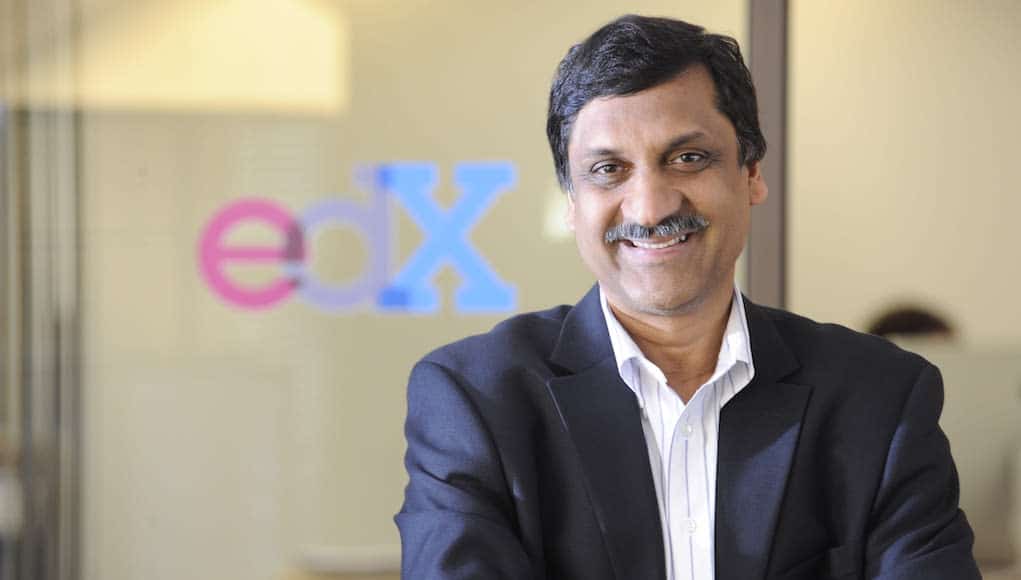
Podcast: Anant Agarwal on Extended Access to Education
Key Takeaways: [1:35] Anant shares what led him to the Indian Institute of Technology Madras. [3:07] Anant speaks about the quality of education he felt he received at IIT Madras. [4:45] After IIT, Anant went to Standford to study Electrical Engineering and Computer Science. He speaks a bit about his experience there. [5:31] Anant speaks about his 32-year career at MIT and the various positions he has served. [6:42] Anant shares the quick origin story of the Computer Science and AI Lab (or CSAIL as it is better known). [7:07] Anant shares the genesis of edX. [9:34] What does Anant believe to be the first real Massive Open Online Course (MOOC)? [11:20] What does Anant think are the pros and cons of making edX an open, non-profit platform? [15:00] Nate McClennon speaks about Getting Smart’s new book, The Power of Place. [16:09] Would Anant say that MOOCs are very much alive and well today? [18:41] Is moving towards shorter skill-oriented certificates and away from degrees a big future trend? [21:27] Are they creating more corporate partnerships with edX? And are they seeing more corporate employers sponsoring online learning? [23:57] Does Anant see the tech giants (such as Amazon, Google, etc.) as new competitors in technical education, partners, or both? [25:32] As a non-profit, does it make it easier to partner with tech giants in technical education? [26:42] How do professionals continuously build tech skills, success/soft skills, and job skills through edX? [28:41] Does edX have any high school partners or high school students on their platform? [30:06] Anant highlights some of the new and interesting courses on edX. [31:22] Anant shares what’s on the roadmap for edX. [33:41] Tom thanks Anant for joining the podcast and for his leadership in this space.
Mentioned in This Episode: Anant Agarwal edX MIT Harvard University The Education Commission Coursera MOOC MIT OpenCourseWare Khan Academy The Power of Place: Authentic Learning Through Place-Based Education, by Tom Vander Ark, Dr. Emily Liebtag, and Nate McClennon MicroMasters Programs — edX
For more, see:
- Competency Tracking Tools Are Overdue
- Pre-K.com: Using Technology to Elevate Early Childhood Education
- The Future of Work Is About Humans
Stay in-the-know with innovations in learning by signing up for the weekly Smart Update.
Transcript
This transcript has not been edited for spelling accuracy.
Your listening to the Getting Smart podcast where we unpack what is new and innovative in education. I’m your host Jessica and today we’re talking with Anant Argawal, founder and CEO of edX. Anant has been a computer science professor at MIT for 32 years. In 2012 he founded edX, a partnership between MIT and Harvard to extend open access to the
courses taught by the best professors in the world and today he shares more of his story and the work he’s doing to extend access to more learners. Let’s listen in to his interview with Tom. Anant, Argawal, it’s great to have you on the podcast. It’s a real pleasure to be here.
Did you grow up in Mangalore, India? Yes, I did. I grew up in Mangalore, India. It’s a little town by the coast, the Arabian Sea coast of India. I love southern Indian food.
Did you have a good math and science education in high school? Well, both the southern Indian food and the southern Indian math and science education were both very good. I think the food was much spicier and better. Yes.
We had, I think at the end of the day, the quality of the education is directly correlated to the quality of teachers. I had some, actually went to a Catholic high school, a Catholic school, the Saint Aloysius College and they had some great teachers in both math, science and other subjects. How did you get to IIT Madras on the east coast?
By fluke. It’s very hard to get into the IITs. IIT Madras was no exception. There’s a huge entrance exam and 1% of people that apply get in. I was fortunate enough to get in and it was on the east coast of India.
It’s on the Bay of Bengal side. I’m very fortunate to have made it through to IIT Madras. That must have been in the, was that the late 70s, early 80s? 1977. Did you, yeah, that’s the year I went to school.
Did you drive to Madras? It’s like 700 kilometers across the southern part of India, right? Yeah. It was, we could not go as a crow flies from Mangalore to Madras because there is a big mountain range called the western guards that come in the middle.
So instead you take the train, so I took a train that goes south, almost all the way to the southern tip of India. And then goes back up north like in a nice little smiley face from Mangalore to Madras. And it was a, it’s about a 20 hour, 20 hour train ride. But you got a great education.
This is the, people don’t remember that it, there really wasn’t many well developed computer science degrees back in the late 70s, right? Well, you know, there were not many computer science degrees in the late 70s and neither did I have one. IIT Madras did not have a computer science degree.
In fact, my degree was in electrical engineering. And you know, I learned to program by myself. I didn’t take a programming class. I just learned to program myself. There was, we had a huge IBM mainframe.
I forget, I think it was a 370, one of those mainframes where we programmed using punch cards. I was doing the same thing at the same time in the late 70s and you’d miss a period on a punch card in the middle of a 300 card deck and have to go back to the computer center, right?
You know, Tom, you know what’s worse than that? What’s worse than that is you’re carrying a deck of punch cards. And the sequence matters. Oh, it does. And you’re carrying a bunch of cards.
And as you’re riding your bike in the harsh weather, the computer center to give them your deck of punch cards. And you can see where the story ends. It is drop your deck of punch cards and then just scattered all over the floor. And now you have a real mess on your hands.
So you’re trying to get the whole thing back in the gear. You did well enough at IIT to get into Stanford where you finished a PhD in both doubly and computer science. Is that right? Right.
So I went on to do my PhD at Stanford and my PhD thesis was certainly very much in computer architecture and sort of a computer science related topic. And I was in the computer systems lab, which was sort of in the lab that sat between computer science and doubly. And my advisor was actually John Hennessy.
And I joined him in 1980, late 1982 when he was a young and untenured professor at Stanford. You’ve been at MIT now for 32 years. And I noted that at one point you led the computer science and AI lab. When did you take that over? Yes, I’ve been teaching at MIT for, as you said, 32 years since late 87.
And in 2011, I took over as the director of MIT’s Computer Science and AI Lab, which is sort of the hub of the computer science and AI activity at MIT. Right. And as a result, one of the hubs for planet Earth of AI, I noticed last night when I was looking at the lab that one of the predecessor organizations was the AI Lab, which was founded
in 1959, the year I was born. Some people don’t realize that people have been working hard at AI for 60 years now. I know. It looks like you and I were born in the same year. I did not realize that the AI Lab was born in the same year.
So the Computer Science and AI Lab at MIT, CSAIL, as it is better known, was a… Two labs came together. The lab for computer science and the AI Lab came together and joined up in the early part of the century and became CSAIL as a combined lab. Tell us about the origin story of edX.
You guys are about eight years old now, right? Yeah, we are eight years young and it relates to CSAIL. We were in CSAIL in 2011. We were sort of dreaming at MIT, a number of MIT leaders, Rafael Reif, who was the provost at that time, other leaders.
We were brainstorming about how technology has transformed every field known to mankind, digital technology, but education has been immune or had been immune until then. There had not been any major innovation in education for a while. And MIT had launched MIT OpenCourseWare 10 years previous to that around 2000. And so we were thinking, you know, how about applying digital technology to education and
taking education to the next level? And so the computer science and AI Lab was a natural place to do this. So in 2011, we incubated edX in the basement, literally the basement of the computer science and AI Lab, like it was a Skunkworks project. And we were doing it in the basement of CSAIL.
We built the whole new open source platform. We decided to go out as a nonprofit. Harvard and MIT teamed up at that point. And it was initially called MITX. You know, we were doing things so fast.
We didn’t have a name for what we were doing. And so, you know, we set up its code named, the press release came out on December 19th of 2011, and the code named it MITX. And then people said, wow, that’s a great name. You know, which agency did you pay to come up with that name?
And we said, oh, we talked to ourselves. It’s a flex holder. This code name is not half bad. And so it became MITX. And then Harvard and MIT teamed up and we became edX in May.
And edX was launched formally in May of 2012. So this wasn’t happening in a vacuum. On the left coast, Andrew Neng and Daphne Kohler had formed Coursera in that same year. I usually think back to the beginning of MOOCs as Andrew Neng’s course the year before. But what would you claim as the first real MOOC?
You know, there’s always been a challenge in defining what is a MOOC. I like to go back to MIT’s open courseware, which came out in more than a decade before all of this. The MOOC movement, so to speak, where MIT put up all its courses online and all the course content available online for free to the whole world. My own course in circuitry electronics was part of it.
You know, that inspired Sal Khan to create a lot of the tutorials and exercises and so on that he built on Khan Academy. And certainly, Sal Khan was a huge inspiration, huge, huge inspiration to me. Turns out he was my student at MIT in the mid-90s. And so for us, the progression was open courseware, the video, using videos effectively,
and computer grading as in Khan Academy. And then we added edX was our course on edX for the first time. We offered a certificate on edX. It was the first time a discussion forum got integrated with the course for the first time, you know, as part of the platform.
And so I would say, you know, a number of things came together as we launched our first courses on edX. So as I mentioned, other folks were organizing around MOOCs as for-profit and ventured-backed organizations. You decided to launch this open nonprofit platform. How do you think about the pros and cons of doing that?
You know, it’s one of those things when you’re starting something this big. You know, you do spend some time thinking about how you’re going to do it. My own experience was not just as an MIT professor, but I had started several companies, all for-profit companies before that. edX is my first nonprofit. And so the early days of edX in 2011, the leadership of Harvard and MIT and myself and others,
we brainstormed about what’s the best way of doing this. And very quickly, it took us all of seven seconds to say, look, it needs to be a nonprofit and it needs to be an open-source platform. And I think it’s sort of the way we think in Cambridge. I think it’s the water from the Charles River that makes you think like this.
We felt education is a human right. And we need to be making decisions for education in a way that is good for humanity, unfettered from the constraints or, what shall I say, you know, constraints or challenges for profits. And so we launched it as a nonprofit. We also announced this would be an open-source platform so that anybody could also take a platform and use it for free.
So I think it’s Harvard and MIT legacy that we do things in this way. And the fundamental difference between a for-profit and a nonprofit. I think the for-profits would lead you to believe that, oh, it’s just a tax status. And my argument is if you believe that the only difference between a nonprofit and a for-profit is tax status, then, boy, do I have a bridge to sell you? The fundamental difference is between a nonprofit and a for-profit.
You know, almost every single decision we make at edX is from the lens of being a nonprofit. And we make decisions very fundamentally, differently. So for example, making a platform open-source. We are the only MOOC platform that is open-source. If you’re a for-profit, why would you give away your crown jewels to the world for free?
And because we were a nonprofit, we made it open-source because that was the right thing to do. And you make decisions as being the right thing to do, even if financially it may not be the optimal decision for the shareholders. And so, and because of that decision, the edX platform has just a very large number of assessment types and so on that we’re contributed to by the community. It has also become, if you count open edX and edX instantiations, it has also now become the world’s largest learning platform. It’s got over 50 million learners from every single country in the world.
It’s the largest learning platform today. So the open-source decision is one example of how you make decisions as a nonprofit. I think a number of other decisions, such as the kind of programs you launch, we launched micro-bachelors programs that are modular programs targeted at learners around the world who haven’t been able to complete a bachelor’s degree. A lot of what we do really comes back to our nonprofit groups. Hi, I’m Nate McLennan, co-author of the new book, The Power of Place.
Something unexpected happens when you explore a community for the first time. Your worldview shifts with each question, each interaction, and each inquiry. You understand the place more deeply and yet the deeper you go, the more you realize you have to learn. And the deeper you go, the more you see the opportunities to make a positive impact. This is The Power of Place.
My most important learning has come from place in the outdoors, jobs, conversations, and explorations, all teaching me skills and knowledge that were just as important as what I learned in school. I see that I can make an impact. I see that I can always learn. And I see that my actions create ripple effects across communities and ecosystems. This is what our young people need to learn, that they matter and their place matters.
They can make change happen in place and every learner has the right to make a difference. You’re invited to explore or continue your own place-based journey with us through our new book, The Power of Place. The Power of Place is available for order at the link in the show notes or by visiting www.gettingsmart.com. I guess some learners might be surprised to learn that you’ve had 50 million learners on your platform and that MOOCs are alive and well. They launched with such hype in 2012-2013.
People have sort of forgotten about them, but would you say that these large-scale open courseware platforms are very much alive and well today? Absolutely, they’re very much alive and well. I think the hype is gone. Thank goodness. So we can all hunker down and do what is right.
The learners on Open edX platforms and edX are way over, not just 50, way over maybe even 60 million. Many countries have adopted Open edX like China, Russia, Israel, France and others. The whole MOOC movement is alive and well, although the hype is not there, which is good. Today on edX, we have launched a number of degree programs. We have nearly 15 master’s degree programs, including a radical $24,000 MBA from Boston University,
$10,000 cybersecurity master’s from Georgia Tech, and a $10,000 computer science master’s from UT Austin, an accounting master’s from Indiana, one from ASU. So we’ve launched some really high quality, incredibly ultra low priced master’s degrees. That’s the other thing. If you look at a master’s in computer science, it’s $10,000.
As a non-profit, our partners in edX look to see how can we provide the most affordable option. But if you look at the for-profits, their master’s degrees are two to three times more expensive than edX. So the whole way of thinking is different. The hype is gone, but we’re offering degrees. We’re offering new micro-credentials.
We launched the micro-bachelor’s, which is a modular credential at the bachelor’s level. We launched that a couple of weeks ago. We are upskilling and re-skilling workforces that are in the US and the world. So the online learning movement and the movement is going really, really strong. Is this a big future trend of modularity of moving away from degrees and moving towards
a shorter skill-oriented certificates? I wouldn’t say that it’s moving away from degrees. I would say that the two are very synergistic. I think people want to have their cake and they want to eat it too. Maybe it’s just the move from thinking of education as something that happens from birth to age 20 to shift to lifelong learning.
Absolutely. People want to learn throughout life. In the past, all you could get was a bachelor’s degree or a master’s degree. It’s so fived. You got it from one institution, cost a lot of money.
You went through a arduous admissions process and you had to go to a campus and it was really hard. But with edX, what we’ve done is at the master’s level, we’ve launched micro-masters, which is a modular credential that you can earn from one university. You can stack up multiple of these and get a full degree. So for example, we have a master’s in supply chain management from Arizona State University on edX. But the micro-masters for that comes from MIT.
So we are seeing a new model of education where you create these modular credentials and then you can stack up multiple of these credentials from multiple universities, fully online, open admissions, radically priced and get full degrees. So you can have modularity and you can get full degrees as well, which ultimately gives incredible choice to the learner. You can also be learning throughout life because degrees and lifelong learning don’t go hand in hand. Let’s say I’m 35 years old and I already have a bachelor’s or a master’s degree.
What are the chances I’m going to go back to college and spend two years in college away from my family? No way. So for lifelong learning, we have to have these modular credit-backed credentials. And the credit backing is important because once I get the modular credential, I might say, hey, this was great. Maybe two years from now, I get another modular credential.
And then I realize, you know what? I’m halfway through to a degree. So let me go and get a few more of these credentials and then I get another degree. And so the modularity and being able to learn in these modular bite-sized chunks and get credentials in bite-sized chunks is very, very important for the future of work and upskilling and lifelong learning.
Are you creating more corporate partnerships and do you see more corporate, more employers sponsoring online learning? Absolutely. I think you’re seeing more and more of that. edX has a very robust business-to-business operation where we have over 500 companies that are enrolling their learners into our micro-masters program. So we just launched our micro-bachelors program and our micro-bachelors program, which is a modular program at the bachelor’s level.
It’s about six credits. It’s open admissions. It costs merely $166 per credit, which is pennies on the dollar compared to the price set a lot of universities. And it stacks up to full bachelor’s degrees as well. And so just as an example, there’s a micro-bachelors in computer science from NYU, one in IT from Western governors.
And so we work with a lot of companies. In fact, many companies like it so much that they funded the development of Walmart, SunTrust, Lumina Foundation, IBM, a number of other partners, company partners. We’re very excited about it. Boeing have given us a lot of feedback and funding to launch the micro-bachelors. And now many of these companies are having their employees take these programs.
And we are actively working with a number of employers who pay for their employees to take these programs because for the employer, so it solves a number of problems. The one is that they get to retain the employees. And if you look at some of the survey from Deloitte, which showed that the number one thing that Valendiel is asking for from their employers is professional development and more education. So this is an incredible way for employers to retain their employee base by having them paying for their modular credentials. And because these credentials are modular, an employer doesn’t have to either get stuck by a big master’s degree bill or a bachelor’s degree bill or opportunity cost of losing their employee for four years.
Here, the employee can be doing these modular credentials in small chunks and learning at their own pace as they go along, and the employer support it. It looks like just in the last year, we’ve seen the big tech giants sort of move into the education space themselves. Amazon made a big announcement recently that they were going to spend $700 million upskilling their own workforce. They’ve introduced a lot of their own courseware. Google has introduced some.
Do you see the tech giants as new competitors in technical education, or are they partners or sometimes both? I think it’s sometimes both is the right answer. It’s sometimes both is sort of the right answer in most things. So we have incredible, incredible micro credentials and courses on edX from IBM in topics like how do you create a chatbot and AI and machine learning and data science? We have over 100 courses over time from Microsoft in topics like how do you visualize data in Excel and power various tools, machine learning.
We have courses from the Linux Foundation. We have courses from Red Hat. We have a number of courses from many, many companies that are actively not just consuming courses on edX from university partners, but they’re also offering courses. And learners are very excited about learning from both companies and from universities. I suspect as a nonprofit, it probably makes it a bit easier for you to partner with them in different ways than it might be for other players in the MOOC space?
Absolutely. I think we are a nonprofit. And so in that sense, we tend to be much more of a partner for some of the companies versus a longer term competitor. And also because a platform is open source, many of the companies also use the open source edX platform. So for example, Microsoft did all of these things.
They had courses on edX and Microsoft certificates on edX are signed by none other than, you know, Sacha Nadella, their CEO. And so they’re incredibly valuable to people. They also use edX courses for their own employees inside Microsoft. And third, they’ve they also have used the open edX platform to launch their own courses on their own platform. They manage themselves using open edX.
And so edX tends to be just a great partner, both because we are nonprofit and we also open source. All right. This is a new topic, but it’s a challenging one. What about success skills or what some people might call soft skills? And I think you’ve proven in the last decade that you can you can help people upskill and technical areas really well.
But how in the world, the professionals keep building both tech skills and job skills and how can MOOCs help here? Oh, MOOCs can absolutely help you. What is interesting is that, you know, we take a lot of guidance from corporations. edX has a corporate advisory board and about four years ago, you know, when they were advising us to work in a courses to create, we were all ready and prepared for all give us more Python, give us more AI. But they of course told us that analytics and so on.
But what came loud and clear is they wanted courses and soft skills and leadership and so on. So we went out and partnered with a number of our partners, both universities and companies. And now we’ve launched a number of soft skills courses on edX. And believe it or not, you can teach soft skills online. So we have a professional certificate program from Rochester Institute of Technology.
It’s a fantastic program in soft skills. It has short courses in critical thinking, storytelling, communication, teamwork and collaboration, presentation skills. And these are extremely popular, not just with individuals, but also with companies. So you have a professional certificate soft skills course and all you have to do is Google soft skills course and Google will take you to the edX soft skills courses. We also have soft skills courses from some companies as well.
We have courses on inclusive leadership. These are very popular and they are very much, very eminently teachable online. That’s great. Many of our listeners are involved in high school education. Do you have any high school partners or high school students on the platform? Oh yeah, about 10% of our learners are in high school or close to high school.
Many of them are learners on edX who from 5 years of age to 98 years of age. And we have a number of micro bachelor’s programs that are very appealing to high schoolers because let’s say you’re in high school somewhere and take up a micro bachelor’s program from NYU for instance in computer science. And so by the time you graduate from high school, you have courses from a university. These are all credit backed. You get credit on a university transcript that you can then transfer into various universities.
And so you can take college level classes while you are in high school. We also have a lot of high school courses on edX. We have a large number of high school AP courses on the platform and you can take these for free. And from universities like Rice from MIT from Boston University. So many top universities are offering a number of these high school AP courses and of course micro bachelor’s will appeal to both high schoolers and others.
Any other new and interesting courses on edX that you want to mention? You know, you and exciting courses keep coming up on a regular basis. One of the programs that is causing a lot of recent excitement is a MicroMasters in finance from Sloan. Some, you know, it’s real rock star courses in finance from MIT. That’s making waves.
But we also have some incredible courses in, we just learned some incredible courses in deep learning from the University of Montreal. You know, you may remember Joshua Bengio won the Turing Award in computer science, which is sort of the Nobel for computer science. He wanted for his part breaking work in, you know, convolutional networks and so on in deep learning. And he is the director of this program.
And you can go and see the video. You can go and see him in the videos. And so we are offering courses from the absolute top in a field in absolute cutting edge area. So to me, this is another of those exciting programs. Anything on the path forward that you can share with us?
So I’m really excited about the MicroBachelor’s programs where for the first time, the MOOC movement is now approaching the undergraduate credentials. You know, we launched MicroMasters five years ago with a lot of success. You know, we have 15 MicroMasters on edX today and over four million learners have enrolled in them. We launched MicroBachelors, which are modular programs at the undergraduate level. And there’s a lot of interest from corporations who want to upskill their employee basis.
And as you know, various studies are showing that by 2030, half of today’s employees will be out of a job. And companies are looking to upskill their workforces and re-skill them into newer roles. And so the IT foundations, MicroBachelors, the computer science, MicroBachelors are just great examples where companies can pay for their students and sign them up. And you know, there’s an interesting article in Forbes about this being kind of the third wave of education where, you know, the first wave was of online education, where the first wave was for-profit companies making hay with online education.
And they fell out of favor, you know, like the for-profits like Phoenix and other for-profits. The second wave was non-profits came out with online learning, oftentimes teaming up with for-profits. And today we are in the third wave, so to speak, where we are now, the companies are getting into it, where they see it as their corporate social responsibility to upskill their employee basis. And so with edX, we are a nonprofit, and we offer these programs, and they can, the companies can pay for or learners can pay. First of all, our programs, people can learn for free.
And even if learners have to pay themselves, it’s incredibly low cost. You could earn, you know, as you stack up MicroBachelors, it will lead to bachelor’s degrees that are in all about $20,000. And so it’s very inexpensive, and companies are willing to pay for that as well. It’s really the most exciting part of higher education, and Anant, we appreciate your leadership over the last 20 years. You’ve made a great education, more accessible to everyone on earth, and we appreciate that.
Oh, thank you. And as you know, it always takes a village, huge, huge kudos to our university partners and corporate partners in recognizing what a serious issue this is for the world, and stepping in to help. And particularly MIT and Harvard for enabling edX to launch this as a nonprofit, so that we didn’t have to go raise money from venture capital, where, you know, ROI for the investor tends to have moving directions that may not be in the best way possible. No, it was really brave leadership for both institutions almost 10 years ago, so we appreciate it, and we appreciate your leadership in this space. Thanks for being on the podcast.
Oh, thank you, Tom. It’s been such a pleasure chatting with you. A big thanks to Anant for taking time to talk with us for this week’s episode. We appreciate the work that he and his team at edX are doing to extend open access. And for more on all things innovations and learning, be sure to check out our blog at GettingSmart.com. Lastly, don’t forget to hit subscribe so you don’t miss out on any future episodes, and every Wednesday morning, our latest interview, it will be ready to press play.
That’s it for today, listeners. For the Getting Smart podcast, this is Jessica signing off.



0 Comments
Leave a Comment
Your email address will not be published. All fields are required.