

Podcast: Jal Mehta on Provoking Deeper Learning in High School
 Mehta observed that his mentor Richard Elmore was always the most knowledgeable person in the room in large part because he spent time in schools every week. Mehta followed suit and visited the best high schools in the country and co-authored a new book about his tours, In Search of Deeper Learning: The Quest to Remake the American High School.
In his frequent school visits, Mehta often finds a lack of powerful learning in the core curriculum. He observes that many of the structures of school work against deeper, more powerful engagement in core classes–the blocks are short and rushed, inauthentic and not relevant–and as a result, there is little critical thinking in most classrooms even in schools that come recommended.
Mehta often finds the most powerful learning outside the core–in world languages, choir, theatre and extracurriculars. There, he frequently finds aligned, purposeful learning with a clear arch driven by performance feedback.
A sociologist by training, Mehta said, “The best part of visiting schools and meeting with students is our opportunity to be anthropological observers.”
When Mehta and his co-author Sarah Fine from High Tech High GSE visit a school, they request the opportunity to follow two students, one upper track learner and one lower track learner. (He regrets that those exist but because they do, they want to get the full picture). After polite chit chat and a few classes, Mehta said the tour guides open up about the school and begin to gain a real sense of what’s happening.
Rather than seeing disassociated parts, Mehta looks for points of integration, where students are doing real work, what David Perkins calls whole game learning (e.g., we don’t just let little kids play catch to learn baseball, we engage them in T-ball, a junior version of the game). Rather than just reading poetry, a school could ask students to join the world of poets by hosting a poetry salon.
In primary grades, he appreciates seeing some agency and choice being exercised. He appreciates seeing expanded optionality in the middle grades while simultaneously expanding their horizons.
In most high schools, students recreate science experiments with predictable outcomes. However, because science is the study of the unknown, Mehta appreciates schools that ask students to take on problems without easy answers.
Mehta’s undergraduate degree was interdisciplinary. He appreciates seeing youth take on extended and integrated challenges but he also sees value in the exploration of disciplines.
To make room for more co-constructed exploration, he urges schools to pare back on the “need to know” list and create more opportunity to go deep. “In life, you mostly need skills to do things,” argues Mehta and that often comes from a hard sprint to a public product.
While a fan of project-based learning he advises educators not to conflate deeper learning with PBL because not all of it is high quality (see HQPBL.org).
With so much opportunity to create powerful learning experiences, Mehta’s school visits left him with a bias towards action–he’d like to see more experimentation aiming at deeper learning. But he doesn’t expect a single model to emerge. As he observed in his last book, Allure of Order, “Not every form will solve every problem.”
About your own search for deeper learning, Mehta urges, “Think of your students as apprentices,” try more whole-game learning. Make room for depth over breadth. And, give up some control.
Key Takeaways:
[1:08] About Mehta’s upbringing and early education.
[4:06] Dr. Mehta speaks about his mentor, Richard Elmore, and what led him to spend time in other schools.
[9:09] What powerful deeper learning looks like in primary grades.
[12:15] What powerful deeper learning looks like in middle school.
[14:18] What powerful deeper learning looks like in high school. Dr. Mehta also gives some of his favorite examples he has seen.
[18:11] Should we have discipline-based courses? Is that still the best way to organize high school?
[25:48] Is Dr. Mehta optimistic about the new exercises being built around what graduates should know and be able to do (AKA a ‘portrait of a graduate’)?
[28:00] Tom gives his take on the ‘portrait of a graduate’ processes.
[28:56] Tom and Dr. Mehta discuss how communities need to choose the way in which they work together with other people to build new learning experiences and new learning organizations.
[32:57] Dr. Mehta gives his advice on visiting schools; how to pick them and how to learn as much as you can when you visit them.
[37:00] Did Dr. Mehta leave this anthropological project of his optimistic about the direction of the American high school?
Mentioned in this Episode:
In Search of Deeper Learning: The Quest to Remake the American High School, by Jal Mehta
and Sarah Fine
Better Together: How to Leverage School Networks For Smarter Personalized and Project Based Learning, by Tom Vander Ark and Lydia Dobyns
No Child Left Behind Act
4.0 Schools
The Allure of Order: High Hopes, Dashed Expectations, and the Troubled Quest to Remake American Schooling, by Jal Mehta
For more see:
Mehta observed that his mentor Richard Elmore was always the most knowledgeable person in the room in large part because he spent time in schools every week. Mehta followed suit and visited the best high schools in the country and co-authored a new book about his tours, In Search of Deeper Learning: The Quest to Remake the American High School.
In his frequent school visits, Mehta often finds a lack of powerful learning in the core curriculum. He observes that many of the structures of school work against deeper, more powerful engagement in core classes–the blocks are short and rushed, inauthentic and not relevant–and as a result, there is little critical thinking in most classrooms even in schools that come recommended.
Mehta often finds the most powerful learning outside the core–in world languages, choir, theatre and extracurriculars. There, he frequently finds aligned, purposeful learning with a clear arch driven by performance feedback.
A sociologist by training, Mehta said, “The best part of visiting schools and meeting with students is our opportunity to be anthropological observers.”
When Mehta and his co-author Sarah Fine from High Tech High GSE visit a school, they request the opportunity to follow two students, one upper track learner and one lower track learner. (He regrets that those exist but because they do, they want to get the full picture). After polite chit chat and a few classes, Mehta said the tour guides open up about the school and begin to gain a real sense of what’s happening.
Rather than seeing disassociated parts, Mehta looks for points of integration, where students are doing real work, what David Perkins calls whole game learning (e.g., we don’t just let little kids play catch to learn baseball, we engage them in T-ball, a junior version of the game). Rather than just reading poetry, a school could ask students to join the world of poets by hosting a poetry salon.
In primary grades, he appreciates seeing some agency and choice being exercised. He appreciates seeing expanded optionality in the middle grades while simultaneously expanding their horizons.
In most high schools, students recreate science experiments with predictable outcomes. However, because science is the study of the unknown, Mehta appreciates schools that ask students to take on problems without easy answers.
Mehta’s undergraduate degree was interdisciplinary. He appreciates seeing youth take on extended and integrated challenges but he also sees value in the exploration of disciplines.
To make room for more co-constructed exploration, he urges schools to pare back on the “need to know” list and create more opportunity to go deep. “In life, you mostly need skills to do things,” argues Mehta and that often comes from a hard sprint to a public product.
While a fan of project-based learning he advises educators not to conflate deeper learning with PBL because not all of it is high quality (see HQPBL.org).
With so much opportunity to create powerful learning experiences, Mehta’s school visits left him with a bias towards action–he’d like to see more experimentation aiming at deeper learning. But he doesn’t expect a single model to emerge. As he observed in his last book, Allure of Order, “Not every form will solve every problem.”
About your own search for deeper learning, Mehta urges, “Think of your students as apprentices,” try more whole-game learning. Make room for depth over breadth. And, give up some control.
Key Takeaways:
[1:08] About Mehta’s upbringing and early education.
[4:06] Dr. Mehta speaks about his mentor, Richard Elmore, and what led him to spend time in other schools.
[9:09] What powerful deeper learning looks like in primary grades.
[12:15] What powerful deeper learning looks like in middle school.
[14:18] What powerful deeper learning looks like in high school. Dr. Mehta also gives some of his favorite examples he has seen.
[18:11] Should we have discipline-based courses? Is that still the best way to organize high school?
[25:48] Is Dr. Mehta optimistic about the new exercises being built around what graduates should know and be able to do (AKA a ‘portrait of a graduate’)?
[28:00] Tom gives his take on the ‘portrait of a graduate’ processes.
[28:56] Tom and Dr. Mehta discuss how communities need to choose the way in which they work together with other people to build new learning experiences and new learning organizations.
[32:57] Dr. Mehta gives his advice on visiting schools; how to pick them and how to learn as much as you can when you visit them.
[37:00] Did Dr. Mehta leave this anthropological project of his optimistic about the direction of the American high school?
Mentioned in this Episode:
In Search of Deeper Learning: The Quest to Remake the American High School, by Jal Mehta
and Sarah Fine
Better Together: How to Leverage School Networks For Smarter Personalized and Project Based Learning, by Tom Vander Ark and Lydia Dobyns
No Child Left Behind Act
4.0 Schools
The Allure of Order: High Hopes, Dashed Expectations, and the Troubled Quest to Remake American Schooling, by Jal Mehta
For more see:
- Learner-Centered Iowa BIG Propels Jemar Lee
- Listening to Kids and Designing From Scratch for Timeless Learning
- Students Learn Project Management From HQPBL Experiences
Stay in-the-know with innovations in learning by signing up for the weekly Smart Update.
Transcript
This transcript has not been edited for spelling accuracy.
We’re listening to the Getting Smart podcast. Where we unpack what is new and innovative in education. We’re your host Jessica and Caroline. And today we’re excited to bring you an episode with Dr. Jal Mehta. Dr. Mehta grew up in Baltimore and is the son of a school administrator and a college
professor. Now as an assistant professor at Harvard’s Graduate School of Education, Mehta is a leading advocate for deeper learning. He appreciated that his mentor, Richard Elmore, was always a knowledgeable person in the room because he spent time in schools every week.
That’s right, and Dr. Mehta followed suit and visited the best high schools in the country, which led him to co-author a new book in search of deeper learning, The Quest to Remake the American High School. He recently spoke with Tom about his observations and today we get to share those with you. Let’s listen in.
Jal Mehta, welcome to the Getting Smart podcast. Thanks for having me, Tom. Hey, it’s a treat to have you on. I heard you grew up in Baltimore, is that right? I did.
And did you actually go to school where your mom was in charge? She was second in charge. She was the associate head of school. She was a private progressive school in Baltimore. I was particularly fortunate that she was not only the associate head of school, but
when I was four and I was getting admitted to the school, she was also the admissions director, which I’m told was fortunate because the admissions test required you to play memory or something with some cartoon characters from Disney or things like that. We didn’t watch this movie, so I didn’t know those characters, so I failed that test. So it was fortunate that my mom was the admissions director, though that also suggests that perhaps
she should have revisited some of her procedures. But yes. Did you ever get in trouble? That’s a good question. Were you a compliant student?
I mean, mostly I was as I am now a student who did pretty well in school, but questioned why the school was doing this or that. I can remember I was the editor of the school newspaper, and so in that role I would write editorials, and my editorials would say, why does the administration do this, or why does the administration do that?
When my mom said to me one night over dinner, you know, Joel, I am the administration. If you have a problem, why can’t we just talk about it over dinner? So it was sort of particularly great in that I went to school, but then I had sort of a second education over dinner sort of discussing what had happened in school and why. So kind of the education conversations I’m having now, I’ve been having my whole life.
Right. No, it’s kind of meta because your dad was also a university professor, right? My dad was a theater professor and director. So through that, I got to, you know, I learned something about the arts, a lot of conversations in my household also about, you know, belonging to a public university.
My dad taught at UMBC, which the president there for a long time, and still is Freeman Herbowski, who has done a lot of good things for the university, raised its profile in a number of ways. But at the same time, my dad was always wondering, you know, why so much money going to STEM and why not more money going to the arts?
And so sort of those conversations about, you know, should the funding of a university be, you know, connected directly to the sort of economic priorities of its graduates, or is there a broader mission to a university? And so we kind of, we’re having those discussions from the beginning. We’re talking today because you recently released a great book called In Search of Deeper Learning
the Quest to Remake the American High School. You and I visit a lot of high schools, and they’re really weird places, aren’t they? They are weird, but also great places. I mean, you know, compared to my colleagues, some of my colleagues who, you know, either sit in their office and, you know, run numbers or dig through the archives and read documents,
the chance to go to schools and talk with students and teachers and parents and administrators, you know, it really is the best way to learn. When I came here to the Ed School, my mentor was a man named Richard Elmore, some of your listeners may know. You know, we were just part of a lot of conversations with policy people and other folks.
And Richard always seemed to be the most knowledgeable person in the room. And I eventually wondered why that was, and I realized it was because every week he was, you know, in an actual school and other people were going off of, you know, what they’d seen or experienced 20 or 30 years ago, and it was just sort of totally different ballgame. So I really wanted to have a chance to spend a lot of time in schools, and it was really gratifying.
The best part really was often meeting with students. You know, frequently we would get a lunch period to, you’ve probably done this where, you know, you just sort of like brown bag your lunch and you sit around a table and you talk with the students without the faculty present about the school. Students are such sort of penetrating anthropological observers of their environments.
And so it was just, it was really great. We really enjoyed a lot of the research. We spend time in schools every week all over the country, when we can, all over the world. I said weird places because we’ve inherited hundreds of years of practices that have divided schools up into things called disciplines, and we’ve organized around things called courses and
committees that met 120 years ago still have a lot to do with how the place is constructed and what buildings look like today and how kids move through the day. So they are, they’re places that can be wonderfully alive with learning, but they have hundreds of years of tradition that are also really hard to move away from, right? I think that’s right.
It was wonderful just to like spend the time with the kids, but it was not wonderful to be part of the institutions. And ironically, we thought that in a lot of cases the faculty were struggling against some of those things that you just mentioned as well as the students. So, you know, we make a big point in the book to say that so-called sort of peripheral spaces in
schools, electives, extracurriculars, clubs are just sort of much more aligned with what we know about powerful learning in that, you know, there are, they take place, there’s a clear purpose to what students are doing, there’s an arc of learning, there’s feedback which comes sort of towards the end of producing something. And then in comparison, a lot of what happens in kind of normal disciplinary classes felt very
inauthentic, not that relevant to anything that anyone was that interested in, etc., etc. And so I do think that history that you described, what Ty and Cuban call the grammar of schooling was very present in our observations. And the schools that we visited, you know, they were recommended schools. So schools that somebody had suggested as places that were either doing, you know,
what might be called today 21st century skills or particularly rigorous forms of traditional learning. And a lot of what we saw was pretty disappointing when measured against criteria like were students doing higher order thinking tasks, were students engaged and passionate in the work that they were doing, even though these schools were highly recommended, a lot of the time students were
doing work that was low level and not that engaging. And so I think one thing I would want your listeners to know is, you know, don’t look at the labels of schools. So school might be blended or competency based or project based or, you know, might have a portfolio assessment or a number of things, structures which are good.
But like what what actually happens within those structures really matters a lot. And the sort of pull of history is really strong. Let’s help our listeners by making this tangible. Joel, I’d like you to try to create an image of what deeper learning, what powerful learning might look like at like three different levels.
Let’s start with primary grades, sort of thinking K3, what’s your sense of what deeper learning looks like there? So I think the sort of, basically, I think that the sort of the principles are the same. But the way that they meet kids at different developmental stages are a little different. But you know, to give an example, so the principles are that students should have some agency and choice, which we actually do a lot better with, I think, with really small children, preschool,
your garden, regi, Amelia, Montessori, like, you know, there are some modes which give kids a lot of choice and agency. And then, you know, relevance and then sort of some form of feedback that would allow you to get better at what you were doing. So there are as many ways to do that as there are, you know, subjects in schools, you know,
like you could, you know, one example might be like a poetry salon, you know, we saw a school where students were writing their own poems, they got visited by a sort of local poet, they got some feedback on their poems, and then they like presented their poems to each other in the form of a like poetry salon. So one of the sort of principles we talk about in the book is that this idea from Dave Perkins that powerful learning is often the whole game at the junior level.
And Dave’s point is that, you know, you don’t teach kids to play baseball by having a year of running and a year of catching and a year of pitching and a year of batting and tell them that they’ll actually get to play a game in graduate school sometime, you know, like that you got little seven year olds, you know, running around the field trying to do the whole game. And what that does is it gives the students some sense, the learner some sense of like,
what is this enterprise I’m engaged in? Why is it like, why do people want to do this? Where am I going with this? And then within that you work on the parts. So in the in the poetry example, you see that, right? Like you’re, you’re, you join the world of people who are known as poets. And with that come certain conventions and certain rules which you’re learning and you’re applying at whatever level you can do it, and you’re getting feedback from your classmates,
and eventually you’re presenting it. And so, you know, you could do the same thing at an Iowa Writers Workshop, it just would be a lot more sophisticated, but the sort of like core ideas would be the same. What might we add at the in the middle grades? If we visited a middle school, what kind of powerful learning would you hope to see? My favorite middle school example was at a school and you may have seen this one
where a really wise leader told me something along the lines of if you ask kids for their interests, you’ll get, you know, basketball and video games. But if you ask them about their questions, you’ll be really, it’ll be really interesting to see sort of what range of questions they had. So, at one school they asked kids to brainstorm, you know, all the sort of like big questions they had about the world and the universe. And then they put them up on a sheet of paper and then
they stick or voted to sort of see which one was the most popular. And the most popular question among the adolescents at this school was, how is the world going to end? So, you know, a little morbid, but perhaps, you know, fitting the like 12 to 13 to 14 year old, you know, brain. And then they split the kids up into teams and they researched different scenarios, climate change, infectious disease, nuclear war. And then there was a presentation day where they each shared
their scenarios and the sort of likelihood of those scenarios happening. So that’s a good example because you start with a question that’s really authentic to kids. It leads in a lot of different sort of interesting interconnected directions. And then through that, you can, you know, you can build in real skills. So like to do those things like the climate change example, you know, you have to learn how to sort real sources from fake sources, figure out how to weigh evidence. So
you can you can sort of build a lot of skills, you can do some stuff with sort of elementary statistics in terms of the likelihood. So essentially, you’re sort of threading the kind of core skills you want to be building anyway, through these, through these questions. All right, let’s move on to high school, the subject of your book. And maybe what you could do here is just a couple vignettes from some of your favorite high schools, what you saw and why you
thought it was powerful. Well, core subjects, you know, science was a really big arena where we felt like there was a big divide between sort of like the school version of science and the real version of science. So the school version of science is essentially to go through a set of procedures to demonstrate to yourself in a lab, a principle that Newton or Darwin or somebody has already established to be true. And no real scientist would do that. There’s there’s just no
point, right? Like you might replicate a reason experiment if you thought that there were reasons to but you wouldn’t spend time sort of demonstrating to yourself a principle that’s already known. I mean, science is really about exploring the unknown, not sort of demonstrating to yourself the known. So at one school, they had in 10th grade, they taught a course called methods of scientific investigation. And the purpose of that was basically to sort of learn how to do real
science. And so the questions were not, you know, that spectacular, but they were chosen by the kids. So an example of a question might be something like, if you listen to music on your headphones, will you be kind of more or less efficient at doing your homework? Right? So like, that’s not a like a world breaking question, but it’s a real question. And you could imagine the answer being, you know, one or the other, or it depends on the circumstances or the nature of the music or the
nature of the kid, you know, there’s a lot of variability in that. And so within that, they taught the kids, you know, how to construct an experiment, a control group, they taught them, you know, how to use like software, which allowed them to access other scientific articles, they taught them like how to write an introduction, how to write a results section, you know, it took them basically like a whole semester to write essentially one paper about
a topic like that. But when you talk to the kids, and this was a STEM school, the kids in 11th and 12th grade went on to do things in the world and, you know, partnered with firms or they partnered with college labs to, you know, to do real scientific work. But the kids really credited the first course, this like methods of scientific investigation courses, the one that had really hooked them, because it really sort of changed their notion of like what it was that
scientists did, they like got to see all the sort of uncertainty that’s inherent in the scientific process. So that’s a good example from a disciplinary class. And I think like talking about disciplinary classes is really important, because in a lot of schools, you’re not going to have the flexibility to always be doing project based learning. And so thinking about the ways in which you could do these things sort of within disciplinary classes, I think is really important.
And also, I think sometimes people just conflate like deeper learning and project based learning. And with the, you know, just a little bit of thinking, you can see that that’s flawed, because, you know, project based learning can be deeper shallow, it really depends on the nature of the thinking that’s going on, the nature of the project. You know, we went to a school where kids were, you know, sewing buttons onto puppets, and there were circuits involved, and we asked them about
this sort of underlying electrical engineering, and they like couldn’t say anything about that. So like, that’s not deep learning from my perspective. So anyway, it’s worth talking about in both the disciplines and in a project based setting. You talked about discipline based courses, should we even have discipline based courses? Is that still the best way to organize a place called high school?
It’s a really, really interesting question. I think I would mostly come down on the side of no, at the high school level, because kids don’t wake up in the morning interested in disciplinary questions. They wake up in the morning interested in real questions, which cut across disciplines. There was a school that one of my students here at the Harvard Ed School, you know, played a big role in organizing, and they made the principle of the school sort of every class should be like
an elective class. So essentially, like, assume that someone would have to want to opt into this class. So instead of like English nine, there was, you know, power, love, and justice in literature, you know. And so like, in that sense, I think that if we could move away from like English nine, history nine, history 10, math one, you know, algebra one, algebra two, etc. Like, I think that that would be good. I think the sort of complicated part for me and Tom, I’d be interested to hear
what you think about this is, you know, I did an interdisciplinary undergraduate major in what at the university I went to was called social studies, which is sort of like a mixture of social theory and history. And it really took on sort of like big questions about like, how the modern world had come into being and how we should think about that. And I found that really interesting. And then I went to graduate school, and I got a PhD in sociology. And I really learned how like one
discipline worked. And now I teach again at an Ed School, which is an interdisciplinary place, which has psychology, sociology, economics, etc. And at the moment, I’m really glad that I’ve done all of those things that it was useful like spending some time, like actually in a discipline, and then using that to sort of have a lens to interrogate some questions. So it’s like nice to have a sort of purchase point. And so if, if sort of all education all the way through,
we’re sort of non disciplinarily based, I’m not convinced that necessarily would be good. But I think that at the younger ages, you know, people are interested in real world things. And those real world things cut across the things that we call disciplines. And so we would have more luck if we organized around the real world things, and we fed through some of the disciplinary knowledge through it, then if we organized around the disciplines and try to make those disciplines
interesting to people, because there’s just sort of limits to that, I think. What do you think? I think a better, better mixture that you would be helpful, if we could build a map of the things generally thought of as being useful to know and be able to do, and had more flexibility to construct a sequence of interdisciplinary projects, or maybe co construct interdisciplinary projects with a group of learners, and supplement those with both skill sprints and problem solving,
and literacy, but also socratic seminars where we have opportunities to go deep in, in the questions resident in a particular discipline that that sort of a mixture would be more productive. But I appreciate the need for both. Yeah, I think that’s, I really like the idea. I think the challenge, Yalla, is that we just haven’t found a new organizing principle. We’ve, for several hundred years, sort of reinforced by the Committee of Ten, organized our lives around
these things called courses that are 180 days long, and it’s not only the pedagogical construct, it’s the architectural construct, and it’s the communications construct, it’s how we describe the experience that we had. And that construct really does inhibit the interdisciplinary studies, but we haven’t created either new ways to organize schools and schedule the human beings that interact there. And we haven’t developed new measures of learning
that help us describe the new capabilities that we have. So it does feel like we have an invention problem that we need to solve before we can move into a much more dynamic sequence of learning experiences that young people and teachers interact in. Yeah, I agree. I like both parts of what you said. If we could draw a big map and have students and faculty co-construct together, what set of experiences would allow you. Because in life, you mostly need skills and
abilities to do things, and you need to know how to read and be able to do math up to a certain level. But beyond that, if I gave a group of college-educated adults a quiz on mitochondria and the French Revolution and a whole variety of topics that people studied in school, people would not do that well on that quiz. And so the idea that there’s all these things that we need people to know and that they’re going to remember them down the road seems pretty false. It seems like
we would do better to pare back that list to the really, really, really big picture essential things that we think that you need to know to function as an adult in the world. And then otherwise, create a lot more flexibility. And the thing you want to hold constant on are the skills, people’s ability to read, write, communicate, empathize, collaborate, etc. And there are lots of ways to achieve those things. There’s a lot up for grabs right now in our sector, right,
when we’re asking a lot of these pretty fundamental questions about how to organize school and how to measure learning and how to communicate that with other stakeholders. That’s true. Makes it an interesting time to be doing this. Yeah, I think so. I think that there, I think if we sort of stepped back a little bit,
you know, no child left behind wound down, though some of the mindsets from no child left behind persist, but as policy it wound down. And Common Core was the next thing, though it took off more in some places than others. And then there’s Big Void in Washington, nothing’s happening there. So I do feel like we’re sort of in a kind of undefined space where the previous things are gone or weakened and sort of what should replace them is not yet defined. So I do find that sort of
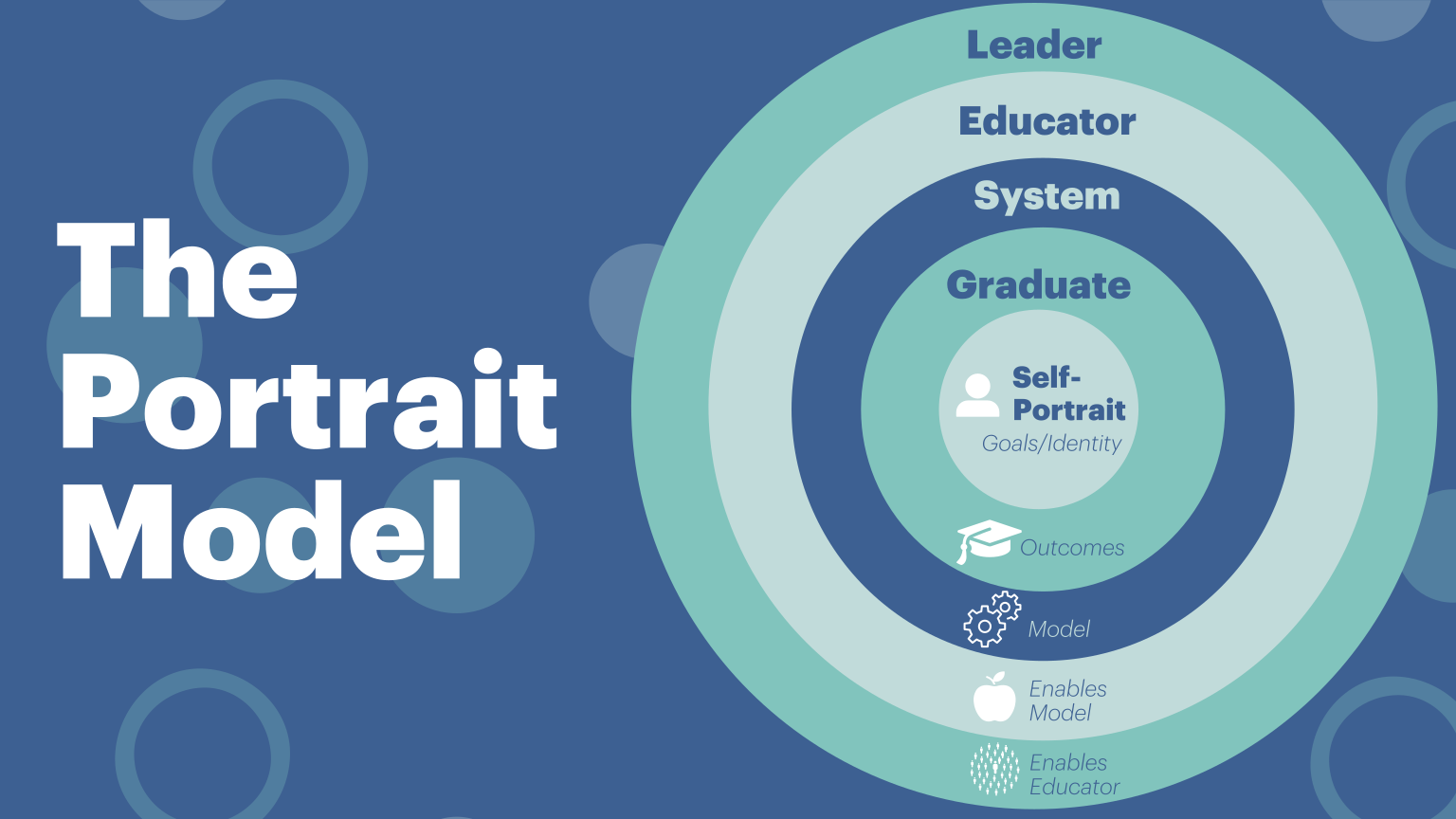
a sort of optimistic, it’s, I can imagine to some people it might feel a little disorienting, but to folks who want significant change, it seems like a good opportunity. There are hundreds of communities around the country, probably thousands around the world that are trying to build new pictures of what graduates should know and be able to do. Some people call them a portrait of a graduate. Are you optimistic about those kinds of exercises?
Necessary, but not sufficient. So I think it’s, what’s healthy about that, right, is that you bring together a bunch of different stakeholders and you ask them really fundamentally, like at the end of this process, like what do you want an 18 year old to know and be able to do? And when you do that, no one says, you know, they must understand like this kind of chemical reaction. Right, people say we need people who can think, who can empathize, who can solve the world’s
problems, who can write, etc, etc. Like if you did a Google image search for portraits of a graduate, each community is defining that differently, but there’s a lot of overlap in this sort of big picture skills that people are seeking. So that part seems healthy. It’s like a way of stepping back from what we think we know about this enterprise and thinking about what we really want. My questions come like, well, what happens after that? So you define your portrait of a graduate
of a graduate and you say that, you know, you want to do the six C’s or whatever, wherever you land, like, are you really going to then realign your structures, rethink how you do teaching and learning, change the shape of the day, change the nature of the disciplines, etc, etc, in line with what you’re, with what you’re doing. So I think it’s a, I think it’s a good step, but I’m interested to sort of hear from districts and some of the ones that you’ve profiled, like Albemarle and others,
have really made a commitment to following through. But I think that they did that because it’s not just the sort of the process, it’s the leadership of the district was really committed to rethinking a lot of things closer to the ground. What has your experience been with those portrait of a graduate processes? That, as you said, they’re necessary, but not sufficient. They’re important to
have a community conversation so that you voice what’s happening in the world and some of the implications and begin to translate those into a new set of learning goals. I think we’ve found that people that try to do the work without having that community conversation get fired. Yeah. I mean, I went and gave a version of this talk at a school and the people from the art, music, and CTE department came up to me after and they said, you’re the first person to ever speak
at this school and say that we were doing it right and other people had something to learn from us. I really do think there is some truth to it. No, I, what we usually do at this juncture is encourage people to read our last book, Better Together, about working in networks. So our thesis has been that we’re trying to do really difficult work of trying to redefine what kids should know and be able to do,
reconceptualize learning experiences as you’ve done around deeper learning, build new learning models, then construct new school models around those, the structure system schedules and supports, and then build community around that. And those six tasks are enormously difficult in and of themselves and to do them simultaneously is unbelievably difficult and complex and often expensive. And so we would argue that in some way, communities need to choose the way in which
they’ll work together with other people to build new learning experiences and new learning organizations because the work is really hard. Yeah. And I guess also just sort of human psychology being what it is, seems like, you know, change comes from people experiencing success in some small way and that feeding their dire for more change. So I think in any such process, I would want to make sure there are
lots of opportunities for people to try things in a small way, sort of like a bias towards action, but, you know, some moderate sized action. And it’s hard to think about like how all the pieces will get aligned. And, you know, we quote Sizer in the book is saying like, if you want to change something, you need to change everything. And there is some truth to that. But it’s also the case that, you know, for real people trying to make change, trying to find some way that they can,
you know, have experiences on a smaller scale that would give them appetite for a larger scale is pretty important. So I love, love, love that people really need to try to take that that bias towards action seriously. I want to give a shout out to Matt Candler and 4.0 schools. I think they’ve now Hassan Hassan, who’s who’s leading that organization. I think he’s helped the sector understand that you don’t have to change everything that you can start an afternoon
program that can turn into a summer program that can turn into a micro school that we can we can use the principles of iterative development to learn on small scales. We love folks like Kettle Moraine that have used this principle to reinvent their high school by starting micro schools inside their high school. So I think this bias towards action of not assuming that you have to blow up a 2,500 student high school but that you can start with a very small experiment and let it
become what it wants to become is a is super important advice. I also think, you know, so my first book was called The Allure of Order, and it was about how policy makers try to, you know, put legible categories onto everything, but learning is complicated and requires a lot of skill on the part of teachers and thus it’s not easy to sort of like rationalize from afar. And so I think the point that you just made is really important,
right, which is that like not every form will solve every problem. So like, you know, maybe within a 2,500 person high school, you know, maybe there should be six or seven, you know, communities of different sorts that are that are doing different things and maybe that meets the variety of student and adult needs. I could do this for another hour, but I want to I want to try to close with some advice on visiting schools. I think you and I have both visited a lot of schools and we believe
it’s been, you know, the most powerful part of our professional learning. Maybe you could give people some tips for how to visit schools, how to pick them, and and then how to learn as much as you can when you visit them. Sure. Well, let’s start with the second part. You know, when we went to a school, so I did this with my collaborator, Sarah Fine, who couldn’t join us today, but was a full kind of co-author and co-participant in this book. And when we went to a school, you know, our general
procedure was to just ask whoever had sponsored the visit if they could give us, you know, two kids. One, this was mostly high school. So one kid who was in most of these schools continue to be tracked. That just continues to be the reality. So we asked, like, can you give us like one kid who’s sort of, like, in the sort of upper tracks and one kid who’s in sort of the lower tracks? And will that kid sort of be our host for the day? And that’s just a really good way to see a school because you get to see,
you know, five or six or seven things over the course of a day. You don’t have the adults who are sponsoring you, you know, monitoring every minute of your visit and, you know, directing you to this class as opposed to that class. You get sort of like a real cross-section of what’s going on. And by getting a student as your host, you know, that person has to talk to you all day. And so, you know, you run out of chit chat after, like maybe other people are better at chit chat than I
am, but, you know, you run out of like the weather type chit chat after, you know, a few minutes. And then after that, like, you can just fill that time with asking them all sorts of questions about the school and then that kid will go to lunch and then you can sit with them while they have lunch and then you’ll start talking to their friends. And gradually, you’ll get some sense of what’s happening at the school. And if so, two of you do that across two different tracks, you know,
just after like a day or two, you have some big sense, you have a pretty good sort of cross-sectional sense of what is happening at a school. So that’s sort of one piece of advice. And I think, you know, if you read Seizer’s books, for example, it’s pretty clear that he also often had students as his hosts and that worked well. And then within that, I think like another thing that we did was, you know, once we’ve done that sort of cross-sectional part, we use that to identify what are the most
interesting kind of spaces within a school. So at many schools, if you do the cross-sectional work, what you’re going to see is a little dispiriting. But if you sort of zero in on particular programs, activities, extracurriculars, etc., it’ll be a lot more exciting. And it’ll also just be more interesting. You’ll learn more because the people in those spaces have sort of figured out how to do something interesting and different. So then we spent a lot of time, like the majority of the
data in our book reflect that history that you described at the beginning. And so as a result, most of that time was not that exciting or high level for students. That was like the majority of what we saw. But we kind of adjusted our strategy after about a year. And rather than writing a sort of like another indictment of the American High School, we decided to sort of follow the spaces that were most interesting. So if you read our book, you’ll see that like we put all the negative
data into the first chapter. And then each of the next seven chapters sort of focus on different parts of the high points we saw in different places. So I would encourage people as they visit to get some sense of the whole, but then also to concentrate on the things that are most interesting to them and then like spend some real sustained over time time with those in those spaces. And then you know, you can learn new things and get energized.
I guess last question is, did you leave this this sort of anthropological project of yours optimistic about the direction of the American High School? It’s really interesting that you asked that because, you know, as we as we share the book, and we go out and we talk to people who’ve read the book, the people people split on reading the book seems to be really 50 50, you know, some people read the book and they’re like, wow,
like after all this time, you know, you must be ready to, you know, jump out a window after seeing all of these classes that weren’t that, you know, engaging and dispiriting. And then other people are like, wow, your your book’s really optimistic because, you know, you saw all of these, you know, great exceptions teachers classrooms extracurriculars electives. And, you know, when we were talking to a newspaper editor when we were doing an op ed, he said, you know,
I think your book is really optimistic. And I said, well, why is that? And he said, well, we’re not going to become Finland’s like we’re not going to magically, you know, increase the professionalization of our teachers or pay our teachers a lot more or any of those things. But what your book shows is that like the same teachers if given a little bit more space and flexibility and sort of different boxes to work within can do really great stuff. So the guy who’s,
you know, rushing through, you know, 10 empires between Mesopotamia and the French Revolution at 10 in the morning might be teaching an elective on the Cold War at two in the afternoon. And that elective might be really interesting, even if the class in the morning he was teaching was really sort of surface level. So I think there are kind of optimistic and pessimistic ways to read what we did. And I really think that actually is the combination that we need. My colleague at
the Kennedy School, Marshall Ganz, who is a longtime community organizer, says that change is about urgency plus hope. And he kind of he looks at us education folks and he says, you guys are long on urgency and short on hope. And so we tried, you know, pretty consciously to balance those things that like, we need the urgency, we need to sort of remake, as you say, an institution that was created more than a century ago by a committee of 10 mostly white men
that have organized the experiences of students ever since. So we need that urgency. But on the other hand, like we know what’s possible, it’s already happening. It’s happening everywhere. It’s not only happening in the most sort of innovative lighthouse, charter, magnet schools. There’s some of this stuff happening in pretty much every school. And so the question is like, how might we expand that? And I think that we could.
Yeah, I left your book really optimistic. And I guess to combine with a lot of the schools that we have both visited, I’m very optimistic about what is happening in American high schools. And it’s like you, it’s a little my view is a little bit skewed by visiting a lot of schools where it’s reported that cool things are happening for kids. But we are really excited about the amount of deeper learning that we see across America and the fact
that it’s more important than ever that kids be engaged in real meaningful work. And so we would just encourage everybody listening that’s interested in high schools to read this new book in search of deeper learning the quest to remake the American high school. It’s a terrific contribution. Joel made it. We just we really appreciate your work and joining us on the Getting Smart podcast. Thanks for having me, Tom. And the appreciation for the work is
very much mutual. I’ve learned tremendous amount from you through the years. A big thanks to Dr. Metta for joining us for this week’s episode. We appreciate his leadership and deeper learning. For more on deeper learning, you can listen to episode 187 with Jamar Lee, a graduate from Iowa big or episode 163 about designing from scratch for timeless learning with Pam Moran. We’ve got them included in the show notes and on today’s blog post. And one more
thing, make sure you’re subscribed to the podcast. We don’t want you to miss out on some of the great interviews coming later this spring and summer. And we also wouldn’t mind if you left us a quick rating or review. That’s it for today listeners. Thanks for tuning in. And we’ll see you next week for the Getting Smart podcast. This is Caroline and Jessica signing off. Thank you.

Jenny Finn
Thank you for this. I really appreciate this conversation. At Springhouse Community School where we are reimagining the purpose and practice of education and very much are experimenting with everything you mention in this podcast. We are doing, and experimenting with, what you are talking about what is needed here in education. We have Fields of Study, are phenomena-based and not siloing subjects, have students at every level of leadership (including creating curricular and pedagogical structure), and more. The question you asked about what do we want a graduate to know/be when they graduate, we ask this for every learner in the community- the portrait of a learner- and develop what we do based on that. That is an organic, emergent process and requires a lot of imagination, failure, and resiliency. If you are interested in learning more about what we are finding, please contact me.
Jenny Finn
Also, as I am listening to you talk about visiting- this happens all the time at Springhouse- we would love to have one of our students be your tour guide- this is what we normally do and it's awesome! We were even named a must-see school by Education Reimagined!
https://education-reimagined.org/9-learner-centered-environments-you-must-visit/