


Zoe Weil on Educating a Generation of Solutionaries
Key Points
-
A solutionary is not the same as a problem solver. They bring an ethical component and strive to ensure there are no negative consequences.
-
We do students a disservice if we don’t allow them to create change.
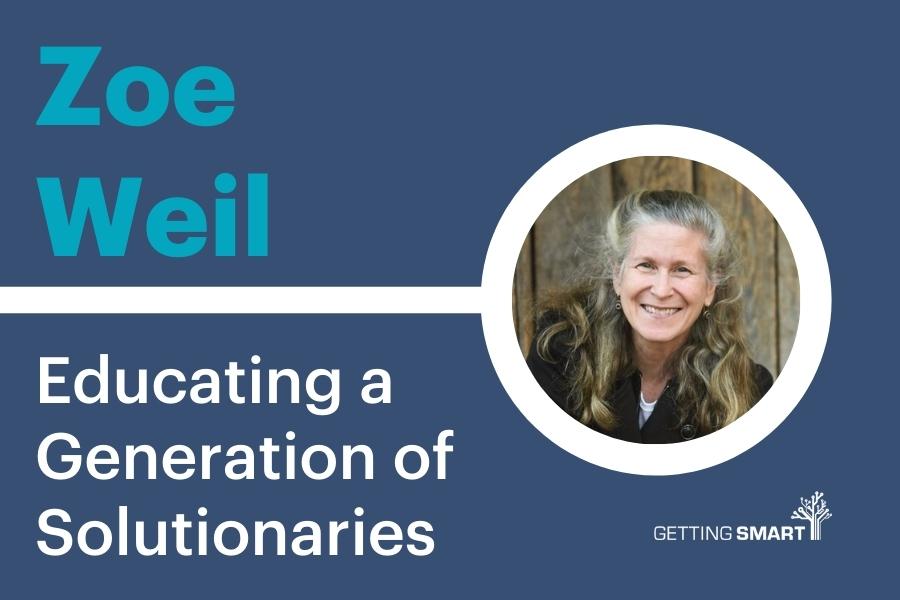
On this episode of the Getting Smart Podcast Rebecca Midles is joined by Zoe Weil, co-founder and president of the Institute for Humane Education, and a pioneer in the comprehensive humane education movement.
She is also the author of the book The World Becomes What We Teach: Educating a Generation of Solutionaries, as well as numerous other books and TED Talks.
A solutionary is somebody who can identify unsustainable unjust and inhumane systems and then develop solutions that do the most good and the least harm, for everybody and by everybody. I mean all people other species and the environment.
Zoe Weil
Links:
- The World Becomes What We Teach: Educating a Generation of Solutionaries
- Institute for Humane Education
- Free Solutionary Guidebook for teachers
- Solutionary micro credential program
- Online Graduate Programs with Antioch University
- Difference Making
Transcript
This transcript has not been edited for spelling accuracy.
Hey listeners, if you’ve been following Getting Smart for a while or read some of our blogs, you’ve heard us say that it’s never been easier or more important to make a difference. But how can we support learners in understanding their power to make an impact? Our Difference Making series is a great place to start. Check out our book, workshops, and blogs to learn how to support your community of learners
at GettingSmart.com. That’s GettingSmart.com. Alright, let’s get to the show. Get Getting Smart You listened to the Getting Smart podcast.
I’m Rebecca Middles and today I’m joined by Zo Wile, co-founder and president of the Institute for Humane Education and a pioneer in the comprehensive humane education movement. She is also the author of the book, The World Becomes What We Teach, Educating a Generation of Solutionaries, as well as numerous other books and TED Talks. Thank you so much for being here.
Thank you, Rebecca. It’s a pleasure. Let’s start off with telling us more about psychosynthesis counseling. What is that? So when I was trained in psychosynthesis, which was many decades ago, it was a form of counseling and therapy that relied upon the intrinsic wisdom and knowledge of the individual to create change. And I loved that concept that within us, we had everything that we need to find the right path.
Well, I’m seriously now really interested in how that led you to this book. And let’s start with a quote. To be solutionaries, students begin by bringing a solutionary lens to problems that they notice in the world and study in school. I’m also a fan of that word. Could you share what that term means to you? Sure. So I did not originate this word. It’s been around for a little while.
Our former executive director came up with it, but he came up with it independently. Grace Lee Boggs in Chicago had come up with this word a decade prior to that or more. And the first time I heard it, I loved it. The word just spoke to me. And we have been the organization and the people who have really promoted and spread this word and this concept. And we’ve also defined it.
So when people hear the word solutionary, I think that even though it’s a made up word, everybody has a sense of what it probably means. It probably means a problem solver of some sort, but maybe a slightly more augmented problem solver like a revolutionary problem solver, a solutionary. And I think that what we sense that it might mean is exactly what it should mean and a little bit more. So I am going to define it because it’s really important to us that the definition that we’re using and promoting for how we need to educate a generation of solutionaries really be the one that we focus on.
So a solutionary is somebody who can identify unsustainable, unjust and inhumane systems and then develop solutions that do the most good and the least harm for everybody. And by everybody, I mean all people, other species and the environment that sustains us. So a solutionary is not the same thing as a problem solver. You know, an engineer can be a problem solver. Somebody doing a math problem can solve that problem.
But a solutionary brings an ethical component and strives to the greatest degree possible to ensure that there are no unintended negative consequences in the process of solving a problem. So let’s say you want to solve a problem related to social injustice. You still have to make sure that your solution is not causing harm and suffering to other animals, let’s say, or to the environment. And let’s say you want to solve an environmental problem. Like, you know, you live in the Pacific Northwest where we know that the northern spotted owl was placed on the endangered species list.
And that led to stopping logging in the old growth forest, which led to a lot of people losing their jobs. So a solutionary in looking to solve the problem of the decline of the northern spotted owl would also have to think about a solution that did not cause suffering and harm to people. And that would mean, well, if we’re going to stop logging, we have to have other jobs that pay as well and that protect the livelihoods of people. So that’s how a solutionary thinks. They think the whole big picture, they look for the causes of problems, both the root causes and the systemic causes, when they want to create change.
Love the spotted owl example very much my childhood growing up was a conversation that I heard often. I love that example. So I also feel like I too in my own way was trying to advocate for this word like yourself. I was very drawn to it. And I love the way you described it.
It makes it more far reaching. I like the way that when it comes across, it also feels like it emphasizes the process and the act of versus a static solution. Like problem solving can just like there’s one answer, you’re done, you’ve moved on. I feel like the way you’ve described it also really emphasizes that this is an inner of stance, a mindset, and that we’re constantly kind of looking for ways to solve problems. But the impact of them is part of that process.
So love that you took time to define that for us. Well, let me just say a little more about that because that’s exactly right, Rebecca. So solutionary isn’t, you know, it’s, it’s not just a noun. It’s an adjective as well. It actually can describe a solution.
So a solution isn’t solutionary if it has unintended negative consequences on any group. A solution isn’t solutionary if it doesn’t address the cause of the problem. So, you know, there are many things that students do in schools these days that are community service oriented or their humanitarian efforts. So students may be encouraged to give money to a cause that might be, you know, alleviating a problem but not solving the problem. Or they might be donating food to a food pantry or doing a beach cleanup or a road cleanup.
And all of those things are really great to do. And, and, and they are examples of humanitarian efforts, but they are not solutionary. They are not stopping hunger at the source. They are not stopping poverty. They are not stopping pollution or littering.
They are trying to clean up after a problem rather than solve the problem. Great reminder. I know my children will often ask that too, as they do humanitarian efforts. How is this impacting the larger picture? And I think as adults, it’s good for us to remember not to ignore those questions, not to put them on the table,
but to really dig into that piece to begin that thinking. What was your light bulb moment towards wanting to make the world a better place? You’ve given us great examples and it reminds us of a lot of the work that we do in the area of difference making. But what was your light bulb moment towards wanting to make the world a better place? There wasn’t just one.
I was a pretty sensitive kid and as I learned about injustices and atrocities in the world, I was really upset about them. So I remember in high school learning about racial injustice and realizing it had, it didn’t just end with slavery, it was still persisting. And I remember in college learning about animal cruelty and environmental destruction,
just being really upset about these things. But I didn’t see the path toward how I could make a difference about all these things I cared about. I cared about human rights, I cared about animal protection, I cared about environmental sustainability. How could I pull it all together? And when I was in graduate school, I found this program that offered week-long courses to middle school students.
This was at the University of Pennsylvania and I pitched a bunch of courses. And one of them was on environmental issues, one was on animal issues, one was on media literacy. Anyway, the director of the program, she said yes to all of my courses and so I was offering all these courses. And they didn’t all run by the way, apparently she was saying yes to everybody because there were so many courses and not enough kids to fill them. But what was interesting was that my animal issues course was the second most popular of the 60 courses that were offered that summer.
Second only to robotics and I didn’t mind that I was second to robotics because I was a Star Trek fan, so I was really interested in robotics too. But what ended up happening in that course is I taught about what was happening to animals and the kids became really interested in making a difference. One boy after learning about product testing on animals, which is where everything from personal care items and oven cleaner and soaps and cosmetics are dripped into the eyes of conscious rabbits and force fed to them and corn to use the kill and smeared on their abraded skin. He went home that night and he made his own homemade leaflets and this was in 1987.
He did not have a personal computer. He literally hand wrote a bunch of leaflets and he came in the next day and he wanted to hand them out. Not to his fellow classmates who’d all learned about this, but on the street in Philadelphia. So while the rest of us were having lunch, he was standing in a Philadelphia street corner handing out his leaflets. He became a change maker overnight and he was 12 years old.
And I realized that summer that this was my life’s work that educating young people in age appropriate ways about the issues of our time and allowing them to become agents of change to actually use literacy, numeracy, science and all the subjects they were learning about to actually make a difference. I wanted to do that. So that course essentially was my light bulb week realizing that there was a whole field out here, which I call humane education and you know the Institute for humane education stemmed later from all of this work. And that if we can educate young people and allow them to actually follow their interests and their concerns and so that when they learn about racial injustice, they’re not just reading books and crying by themselves at home the way I was.
They are actually able to engage collaboratively to be solutionaries who create positive change. And I, I really believe that education is the root system that underlies every other societal system. So while there are many different arenas of professions careers I could have followed this one to me ultimately felt like the most powerful, the most strategic, the most likely to lead to adjust sustainable and humane future. I was fortunate enough when I was an educator to learn that if you didn’t teach action with history, you were isolating students and that feeling like they could make an impact and have a role in that and what I hear you saying is beyond defining the future of learning and learning experiences for learners and giving them opportunities to explore that to intentionally go into teaching and learning experiences with that as the outcome that that is what we’re making space for, and that we plan for that when we’re when we’re in that classroom.
Love, I love that you highlight that what’s changed in the revised edition between 2016 and now on 2021 when this came out. Well, when the book first came out we hadn’t been facing a pandemic, and a lot of the ideas hadn’t really been implemented yet in any significant degree, and George Floyd hadn’t been murdered and we hadn’t had a huge racial reckoning in our country and and those things all made me feel it was really important to revise the book. And so now in the appendix there are some examples of how the solutionary approach is taking root and there’s an entire county in California San Mateo County which has 270 schools and 23 school districts serving more than 113,000 students. And my book and this approach has become the philosophy and framework for the entire county and their thanks yeah I’m really excited about what’s happening there under the direction of Andrew you going and who’s the environmental literacy coordinator in the county Office of Education. So I wanted to revise the book to you know share some of these stories and to really look at at some of the current issues. And one thing that I added to the book to is something that I’ve seen happen that gets back to what you were just saying about teaching history but without action.
So, about six years ago, I was asked to speak at middle school and I was talking to the fourth and fifth graders and I asked them what they thought were the biggest problems in the world, and I wrote down everything they said on a whiteboard they filled the whiteboard with the same problems that adults say I mean one boy even said sex trafficking. These were fifth, you know fourth and fifth, sorry, they’re fifth and sixth graders. And I was, I then asked them to raise their hands if they could imagine a solving the problems that they listed on the whiteboard and of the 45 kids in the class, only five raised their hands that they could even imagine us solving the problems that they listed. And I realized I had to stop everything. It was such a horrifying moment because I thought you know if these young kids can’t even imagine us solving these problems, then what’s gonna, what’s gonna inspire them to even try. So, I did a guided visualization with them where I asked them to close their eyes and imagine that they were very old and approaching the end of a very long and well lived life.
And I asked them to imagine themselves sitting on a park bench on a beautiful day and the air is clean and waterways are clean and the birds are singing and there hasn’t been a war in decades and nobody goes to bed hungry because they had no choice. And then I asked them to imagine a child coming up and joining them on the park bench. And I asked them to imagine that the child had been studying history and learning about much darker times times that they had lived through. And then the child asked them all these questions about those times and about how things changed. And then the child asks a final question which is, what role did you play in helping to bring about this better world. So, while they still had their eyes closed, I asked them to imagine what they would want to say to that child. And then while they still had their eyes closed, I asked them to raise their hands if now they could imagine us solving the problems that they had listed on the whiteboard.
And the ratio completely reversed, 40 hands went up in the air. And that was a really important moment for me. It made me realize that we do young people a grave disservice when we do not remind them about how much has changed for the better in my own lifetime and tremendous amount has changed for the better. And if we don’t allow them to be part of creating change. So a couple of years later, I was speaking to a fifth grade class in Guadalajara, Mexico. And I asked those students to raise their hands if they could imagine us solving the problems in the world and every hand flew up in the air. Like what was different? What was different was that their teacher was teaching them in age appropriate ways about problems and they were engaged in solving them.
So they’d been solving them at their own school. The school had put up solar panels, they had created a composting system, they had refillable water jugs as opposed to single use plastic water bottles. These kids knew the problems could be solved because they were solving them. And young people need that desperately. We are seeing growing rates of anxiety and depression among young people. That was another reason I wanted to revise the book. This is essential work. Young people need to know that they can make a difference. If they don’t feel that, that anxiety and depression is just going to grow. And every single day we are inundated with bad news, even though many things are still getting better. And if we don’t change what happens in schools, I fear for the future. And if we do change what happens in schools, the future could be so bright.
I remember you talking a little bit about that in the book as well, about your experience. And the listeners here, if you want to hear more about that, that’s in this book about your experience of having to see those hands not go up and how motivating that was for you. That leads me to another example that you shared where you talk about how important it is, as you’re saying right now, to make school as relevant and meaningful as possible. We must guide young people who are on the verge, I like this piece too, who are on the verge of major personal decision making to find their learning toward their own goals, concerns and dreams. I feel like that’s so important. Students need to see themselves as leading their own life ahead that they may not know what they need right then, but if they’re passionate about something, they know how to find it. That is such a driver for me, that their path can’t be decided for them or they’re stuck. And I love that in addition to all of this about making a difference in their community and in the world, you emphasize the fact that they need to see that sooner than later, and then how that impacts them and how they lead their own life.
And you give us an example. You talk about where teachers, what would it be like, imagine if you could ask these four questions, I’m going to read them. What challenges in my community and the world must concern me, most concern me. And what do I love to do? What am I good at? And what do I need to learn? And just asking us to imagine what it would be like to give those four questions to learners. Can you tell more about that example? Sure. So, not every class is going to have the flexibility to have students pursue exactly what they’re passionate about solving, what issues they most concern them. But by asking that question, it helps students also to think about, you know, the limited concerns that we may have. How do I look? You know, who’s going to sit next to me at lunch today and learn about issues in the world and feel compassion and empathy for others, get outside of ourselves. And as soon as we care about somebody else, this next question, what am I good at, is one that we can ask ourselves and it evolves over time. And schools often evaluate us on very narrow things that we’re good at, right? Because that’s what’s graded. But if you really invite young people to think about what they’re good at and to think beyond how they’re assessed in schools, they may feel suddenly very empowered and feel a lot of confidence about being a good mediator, being a good listener, being a good friend.
Being a good dancer, being good at arts, being a good researcher, being a good thinker, even if, you know, maybe it doesn’t translate into math problems, they may still recognize they’re a good investigator, good question asker, all sorts of things they may be good at. It’s not to say that they’re going to know everything that they’re good at when they’re young. I mean, we as adults still don’t know all the things we’re good at. We haven’t tried a lot of things. But to allow ourselves to think about the answer to that question. And then to ask, what do I love to do? And there are so many things that we may love to do also that aren’t assessed. But if we can find the place where the answer to those three questions meets, what am I good at? What do I love to do? And what do I care about? Our life is kind of golden. I mean, I feel so lucky that I got to find out the answer to those three questions. And I’m talking to you because I answered those questions for myself, not even realizing I was doing that. And then that fourth question, what do I need to learn? Well, that sets you on the path toward lifelong learning and your education to achieve this sweet spot where you get to apply what you’re good at, what you love to do toward what you care about.
And it’s just a win for a great life and a great contribution to the world. And, you know, all of this work becoming a solutionary, it just, and teaching youth to be solutionaries, it’s just a win on every level. It’s a win for kids. It’s a win for schools and communities. It’s a win for the world. It’s a win for teachers. You know, what are we waiting for? Exactly. So I know listeners are probably really excited about all of these resources you’re sharing. I would would encourage them to look through the appendix as well. You have short stories, real world examples, you define what that means. You have a 14 step process for transforming all schools into solutionary schools, including I might add rubrics, which are so helpful so you can see where you’re at in the past, see what you need next. You have the language to know what to ask for. All of those great resources in your appendix. I would encourage folks to check that out, as well as maybe we can move into you have shared so much. What is next for this kind of thinking? Well, really making it foundational to schools everywhere. I mean, I that’s big goal, but it is our goal.
This kind of learning. I mean, right now administrators and teachers are so overwhelmed because of the pandemic, as well as pushback on social justice issues and a lot of teachers and administrators just want things to go back to normal and just want to avoid controversy and being yelled at and conflict. And. What’s what’s worrisome about that is that this solutionary approach is the answer to all of it, right? So the solutionary approach is the corrective to polarization and debate and hostility. It asks. Of all of us that we learn from one another that we reach out to all stakeholders that we identify problems and we don’t debate who’s right and who’s wrong, but we work to solve them in these ways that do the most good and the least harm for everybody. It’s such a powerfully positive process that would so enliven the educational prospect right now when we need it most. And so what’s next is is making this foundational. It’s elevating the purpose of schooling so that the very mission becomes. Let’s educate this generation of solutionaries who have critical thinking skills, strategic and systems thinking skills, creative thinking skills and big hearts. And they’re applying all these thinking skills to actually making this world a better place for everyone.
Absolutely. I’ve talked about where they can find out more in your book, but where can listeners find out even more other resources that you might suggest. So they can come to our website humaneeducation.org and we we really have soup to nuts at our website. So we have a free downloadable solutionary guidebook for teachers, a student version called how to be a solutionary. We have loads of lesson plans and activities. We have curricular units. We also have a solutionary micro credential program which is a 30 hour asynchronous online program for teachers to learn how to be solutionaries themselves and educate their students to be solutionaries. And for those who really want to go deep, we have online graduate programs with Antioch University. We have an M. Ed program and M. A. A graduate certificate and a specialization in humane education in the EdD program, the doctorate in education program.
So if you want to get a taste, head over to our website. We also have some short animated videos about the solutionary process and what is humane education can find it all there. Wonderful resources to find out how we can help learners become solutionaries and difference makers. And I love your line about we do students at disservice if we don’t allow them to create change, they need to see a place in this work. Thank you so much for sharing with us today. Oh, thank you so much Rebecca. It’s been a pleasure. Thanks for tuning into the Getting Smart podcast today. We want this podcast to be actionable and insightful and a great way to learn about what’s next in learning. In order to stay on the cutting edge, we need people in the field to tell us what they’re hearing, what they’re wanting and what they’re needing to learn more about.
Got a topic or a guest in mind? Send your recommendations to me, Mason at GettingSmart.com. And if you like what you’re hearing, don’t forget to leave a review on Apple podcasts or subscribe wherever you listen. Feel free to share the podcast on social media using the hashtag GS Podcasts. Thanks so much.


0 Comments
Leave a Comment
Your email address will not be published. All fields are required.