

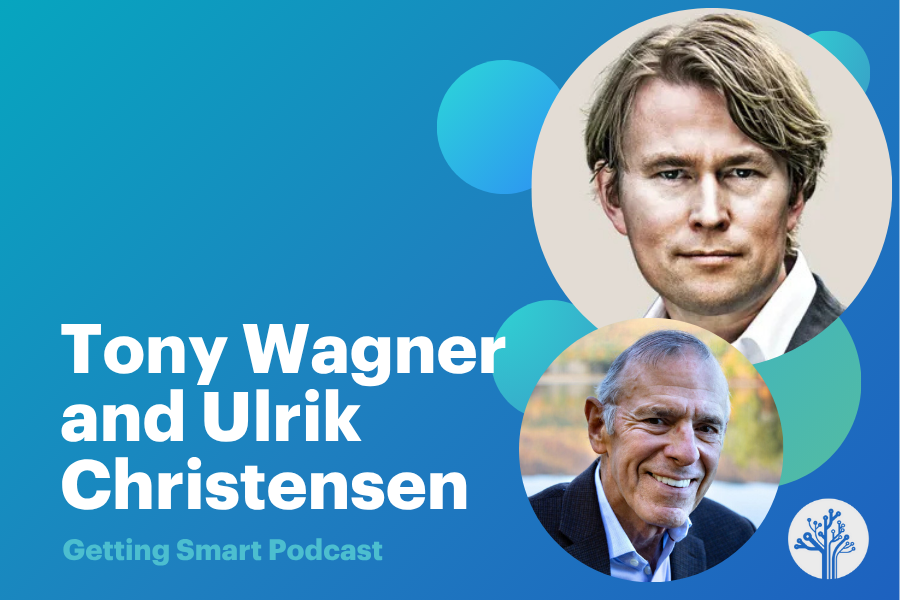
Tony Wagner and Ulrik Christensen on Why Deeper Learning is Essential in an Age of Distraction
Key Points
-
Mastery learning emphasizes intrinsic motivation, student agency, and individual learning pathways, preparing students for a rapidly changing world.
-
Real-world applications, such as internships and project-based learning, are crucial for developing deeper learning and lifelong skills.
Shownotes





In this episode of the Getting Smart Podcast, Tom Vander Ark is joined by Dr. Tony Wagner and Dr. Ulrik Christensen to dive into their new book, Mastery: Why Deeper Learning is Essential in the Age of Distraction. Together, they unpack the concept of mastery learning, why it matters in today’s rapidly changing world, and how it connects to deeper learning and student agency. The conversation highlights innovative approaches to education, real-world examples from schools like Red Bridge and Olin College, and the critical need to foster intrinsic motivation and lifelong learning skills. Whether you’re an educator, policymaker, or passionate about the future of learning, this is a must-listen episode!
Outline
- (00:00) Introduction to Mastery Learning
- (11:10) The Changing Nature of Work and Learning
- (16:33) Assessment and Curriculum Changes
- (26:58) Team-Based Learning and Real-World Applications
- (31:54) Scaling and Implementation
Introduction to Mastery Learning
Tom Vander Ark: What is mastery learning, and why does it matter? How, where, and when do we make mastery judgments? What does mastery have to do with deeper learning, especially in this age of AI? You’re listening to the Getting Smart Podcast.
I’m Tom Vander Ark, and to discuss a few of those questions, we’re welcoming Dr. Tony Wagner and Dr. Ulrik Christensen, authors of the great new book Mastery: Why Deeper Learning Is Essential in the Age of Distraction. Ulrik and Tony, welcome.
Tony Wagner: Thank you. Great to be here.
Tom Vander Ark: Tony, I think this is book number eight for you, right?
Tony Wagner: It is eight. I really loved the first seven, learned a lot from them like the rest of the world, and I really appreciate this one.
Tony Wagner: Well, I got very lucky in that Ulrik and I decided to partner on this, and I think his perspective just enriched the book immeasurably.
Tom Vander Ark: Ulrik, you have such an interesting background. You’re a medical doctor by training, a tech executive, and an edtech executive. Why did the subject of mastery learning interest you? I’m particularly interested because you experienced the licensure system, right? Did your professional background and your recent experience in edtech contribute to your interest in writing this book?
Ulrik Christensen: Yeah, so I think the important part of that story is that my original interest was really in human factors—how to avoid human errors on operating teams and in emergency medicine. I was building simulators first, so it was all applied knowledge. It was all about how to get teams to work, how to get them to communicate, and how to get people to learn how to learn. Part of that led to the need to solve another problem, which is the one we are most known for—adaptive learning. How do you acquire knowledge? But that has never been the goal or my big interest. It was just a means to an end because what we could see was that when we were trying to get physicians and nurses to perform better under pressure, often their knowledge models broke down. They didn’t know enough or didn’t know it in a way that they could actually use it.
So, you had these extreme cases of professionals who had been through a dozen years of training or more, and then their knowledge was, in many ways, useless. That led to a 15-year detour in my career. But that’s why my real interest is still in what you can do with what you know—not how many plastic cards you can get or how many standardized tests you can pass.
Tom Vander Ark: I really appreciate that, and that thought sort of comes to life in the subtitle: Why Deeper Learning Is Essential in the Age of Distraction. This book is really about deeper learning—how you learn and apply useful knowledge quickly and in context. I really appreciate your professional interest in this. I want to come back and talk about how the world has changed in the four years since this book idea was launched. But Tony, mastery learning—how do you feel about the title and subject of this book? Because it felt like it really became a deeper learning book.
Tony Wagner: Well, I’m delighted by it. I credit Ulrik for pushing me in this direction. He was fond of saying, “The Global Achievement Gap is a great description of what’s wrong with education, but you really need to go further and talk about where we should be going with education.” I was on that track when I wrote about the seven survival skills in The Global Achievement Gap. I was really talking about the importance of skills over academic content knowledge, and that’s one of the starting points for this book. But what’s been fun is learning about all of these experiments—this R&D that’s been going on for the last 15 years since I started writing The Global Achievement Gap—where many people are moving towards a more mastery-based or competency-based curriculum from K to gray. That’s what’s new and different about this book—all of these rich and interesting examples, both from the workplace and from K through graduate school, that really come alive.
Tom Vander Ark: I was happy that the book really came to life in that way with a description of so many powerful learning experiences and environments. A reflection off the top: Mastery learning—or competency-based learning, as some people call it—has, by many of its adherents, been turned into a sterile exercise, usually limited to basic skills, obsessed with making accurate, discrete judgments, and in doing so, making learning boring as hell. There are still a few networks of schools that treat mastery that way—narrow definition, small bites, right answers, and no application. I was really happy to find that your book didn’t spend any time on those.
Tom Vander Ark: It really explored environments that have a fresh set of learning goals, Tony, many of them built on your seven survival skills. I think, in many respects, the durable skills movement of today probably built on those survival skills. So, I loved what I found.
Tony Wagner: Well, we make that distinction early on, Tom, because that concerned us. We didn’t want our work associated with what has become another new form of drudgery in American education. The key distinction that we make is around motivation—intrinsic motivation—something I know you’re deeply concerned with. You talk about co-authorship; other folks talk about agency. But the idea is developing not just the skill but also the will to really master something, to become good at something, proficient. So, we argue that voice and choice—student voice and choice—are absolutely essential elements of any mastery-based learning enterprise.
Ulrik Christensen: And you can say, Tom, that it was really a deliberate decision here to ask, are we willing to just give up on what the term mastery could really mean because somebody has abused it or, at least, let it slide? Or should we try to redefine it to what it really should mean? We were seeking high and low for a different way to frame what we were trying to say. Then we decided to see if we could redefine the stakes here.
Tony Wagner: And, of course, it helped that we were both on the board of the Mastery Transcript Consortium (MTC), and they were already using the terminology in ways that we agreed with. So, we, in a sense, are building on what MTC started.
Tom Vander Ark: Tony, I want to jump into the middle of the book with that invitation, in the chapter on secondary schools, where you really bring to life what mastery learning and deeper learning could look like. You start out with our friends at Gibson Ek here in Issaquah, Washington. It’s a Big Picture school. Tony, I remember you introduced me to Big Picture in Peter McWalters’ office in 1999. Schools are still innovating on that model. Gibson Ek added the mastery transcript to the Big Picture model. Why start that chapter out with the Gibson Ek story?
Tony Wagner: Well, there are different approaches to mastery-based learning. Some are adaptations of the existing high school model, like CAPS, which is really working only in the area of elective courses. As we all know, kids have fewer and fewer elective options in high school. So, that’s a very limited intervention. Whereas Gibson Ek starts from scratch. They say, “Tabula rasa, let’s imagine the way school really could and should be.” I know this is a topic near and dear to your heart, Tom. You’ve been at this for 25 years now, I think.
Tom Vander Ark: Since you were my district coach here in Federal Way. Before we started recording, we were talking about this experience gap that’s opening up, where it’s harder for young people to get really great learning experiences, and they’re more and more required to get that first job. So, there’s this opening up of an employment gap. Tony mentioned the CAPS network. I’m on the board there and a super fan. It’s a national network of schools and career centers that are trying to create internships, client-connected projects, and entrepreneurial experiences that will help give kids a set of experiences that I hope stack into closing that experience gap. But, Ulrik, I was surprised and pleased to find them as an example of what powerful mastery learning looks like.
Ulrik Christensen: Yeah, and I agree. Another one I know you’re very familiar with is the Spark NC project in North Carolina. That is also a really strong attempt to say, how do we get education closer to useful skills and the kinds of total toolboxes that I think will be needed? One thing that is interesting is that when we started writing the book, this was probably an aspiration for a much better world. Today, it’s an imperative to deal with this because, as an example, we have reduced our company’s hiring of people with an academic background as learning engineers by 80-90% in less than 12 months. We may be a little ahead of the curve, but this is something that will be pervasive in academically heavy jobs. That leads to the next part: what instead? Who will actually benefit from this? I’ve spent the entire summer suddenly programming after 35 years of giving up on all aspirations of programming. Today, I’m able to do things where we normally needed an army of people, whether it was for analytics or basic legwork or coding. But a lot of those entry-level jobs are down 35% in job postings in the U.S. in a year and a half. If we have that situation, we’re suddenly ending up with a no man’s land between people graduating and where you can contribute enough to actually be employable. So, that lack of employability that Tony has written about in seven books is suddenly way more of a clear and present danger than it’s ever been before.
Assessment and Curriculum Changes
Ulrik Christensen: We’re suddenly ending up with a no man’s land between people graduating and where they can contribute enough to actually be employable. So, that lack of employability that Tony has written about in seven books is suddenly way more of a clear and present danger than it’s ever been before.
Tom Vander Ark: Ulrik, you just did a beautiful job of describing a postsecondary learning journey, right? It’s sort of a new vision for mastery learning. It was purposeful. It was embedded in real, authentic work. It was in real time. It had cycles of demonstrated learning, right? So, it was iterative; it was demonstrated. That’s quite different than the dated picture that many people might have of mastery learning, which is very sequential—right and wrong answers. This is, I think, a much more dynamic, applied, generative vision of what mastery learning could look like.
Ulrik Christensen: I agree. I have not felt this way since I was eight years old—this summer, I’ve woken up at 2 a.m. to go back to coding because I’m able to build things that I’m interested in. I don’t have to wait for anybody. I’ve been able to draw on people to learn new things. At the level we are discussing now, mastery learning of this kind is so addictive that you can become so productive that we also need to take care of that problem at some point. But coming back to the scary thing: asking the right questions and being able to define what good looks like has a huge bias toward people who are already experienced and extremely knowledgeable. That maybe leads to the next and final important point: people who think that knowledge is going to go away are wrong. The more you know, the more you’ll be able to benefit from this wave of possibilities.
Tom Vander Ark: In part because you can ask better questions, you can recognize opportunity—that takes knowledge and skill as well as curiosity. I want to do a little deep dive on initiative and entrepreneurship skills. I think these are brand-new priorities and skills that you’ve been describing. Tony, in The Global Achievement Gap, number three was agility and adaptability, and number four was initiative and entrepreneurship. You probably wrote that book 12 or 14 years ago. That advice is super prescient. I think these are the most important priorities. You were talking about them 13 or 14 years ago, and they’re just beginning to show up in people’s portrait of a graduate or learner profile. So, I don’t know—a series of challenges here that I want to have you describe for us. One, you have to name these as priorities, and then two, you really have to completely rethink the kind of learner experience that would cultivate agility, initiative, and entrepreneurship. Those are things not cultivated by a traditional learning environment and traditional learning experience. So, I don’t know—say more about how we make those priorities and what kinds of new experiences we need to create space for, permission for, and support for.
Tony Wagner: One of the things we begin with as a premise in the book is that if you’re really saying all kids can reach similar levels of competency through life stages, they’re not going to all do that at the same time. So, that’s the first premise or foundation of education that we attempt to dismantle—that individual learning happens at different rates. That’s point one. We basically discard the whole idea of seat time served as a basis for a credit. We believe you should have to demonstrate core competencies, and you can do them in lots of different ways—through internships, presentations, defenses of knowledge, or portfolios, as the Mastery Transcript Consortium does. That leads to the second idea of individualizing each person’s ways of developing mastery and showing competence. One size absolutely cannot fit all in this world. Then that gets back to the problem of assessment. The standardized forms of assessment, which have driven education increasingly into the ground for the last 25 years, do not serve these purposes in any way, shape, or form. You have to use more qualitative forms of assessment. I’m fond of saying let’s be less data-driven—although there’s a role for that—and more evidence-based. Collective human judgment informed by evidence is what I think becomes the new norm for this more qualitative form of assessment. If you’re not assessing these skills, just naming them is a nice exercise, but it gets you absolutely nowhere. If you’re not changing the curriculum in terms of both time and experience, you’re not going to get anywhere.
Tom Vander Ark: Ulrik, what you were describing to me is a sprint to value. You were trying to create value for a community. You spotted an opportunity to create value, and you’ve put yourself on this iterative sprint. That, to me, is the heart of entrepreneurship. That’s why I was so excited to see so many examples of that kind of learning in both the secondary and postsecondary chapters. That strikes me, though, as not typical of how we think of mastery learning because it’s hard to assess a value contribution. How much value did you add to your community if that’s really the desired outcome? Is that a new challenge?
Ulrik Christensen: The nice thing is that with what I just described, there are some very concrete things that come out of it that you can assess and touch and feel. If they are relevant, just the fact of which problems you choose to embark on trying to solve is significant.
Shorts Content
Team-Based Learning and Real-World Applications
Ulrik Christensen: Just the fact of which problems you choose to embark on trying to solve is significant. If they have relevance, it’s a different kind of thing than trying to prove that you did 20 hours of community service by serving lemonade at the church. Whereas if you’ve actually solved a problem by developing a new planning app for the local community, or you’re an entrepreneur solving a problem that has social relevance—or for that matter, you just show that you’re a thinking person who can think beyond short tweets and reels—that’s a different level of contribution. I think there are different ways we can accumulate the evidence of what’s going on.
Tom Vander Ark: I got a great question at the last ASU+GSV conference where somebody stood up and asked, “Should we assess outcomes of individuals and teams using smart tools? Should we credential work done with a co-intelligence?” In other words, you described this sprint that you’re on of using coding tools to create an app, and what’s being assessed is the quality of that app that you produced with a co-intelligence. So that’s an interesting new assessment question. Should we be assessing outcomes that used co-intelligence—co-writing, co-coding? What’s your take on that?
Ulrik Christensen: I think so. The seven or eight different projects I’ve done over the summer—and that’s not an exaggeration—if you look at the width and breadth of those, I think it would be very easy for humans to say why they’re relevant and what impact they’ve had. Whereas if you try to explain to a chatbot what it was or try to come up with some kind of standardized measure, I actually think it would be a harder problem to write that code and application that will do that. For some of this, there is a really large part that comes back to the way the Mastery Transcript Consortium (MTC) operates, which is transparency of what it was you produced. What came out of it might actually, for a while, be the better option. I’m not so fixated on trying to solve everything with technology. I’m actually a big fan of making hybrid solutions. I think something here where we come up with a good architecture that makes it evident and transparent what lies behind it, with humans who are able to put common sense behind where this fits in, might actually be something where we have to live with the risk that it’s not an exact science, but it’s something that is better. Standardized tests are not exact either—they’re exactly bad or unreliable. I think we just have to live with a different kind of risk and inaccuracy.
Tom Vander Ark: Tony, let’s go back to elementary education and paint a picture or two of what this might look like in an elementary setting. You gave some really great examples in the book. Do you want to mention one or two?
Tony Wagner: The examples we describe, both a group of charter schools in Hawaii and the independent school Red Bridge started by Alia Friedman, have in common that they’re primarily focused on social-emotional learning (SEL). This is something we used to focus on in kindergarten at least, but we gave it up entirely with what has become increasingly a test-prep curriculum, starting in kindergarten and first grade. A reading of those chapters might suggest that’s all these schools cared about, but in the background, they are also critically focused on those core competencies. There’s a great story from Red Bridge. There are no grades at Red Bridge. Kids can apply twice a year to go to the next level of autonomy, as they describe it.
This six-year-old was applying for the next level of autonomy, and his teachers, in the process of assessing and making this joint decision, reminded him that there’s going to be a level of reading required in this next level of autonomy—reading directions, reading for understanding—that might be challenging for him. He came back a day or two later and said, “You know, I’ve thought about this. I think I need more time to get better at reading.” When you have that kind of conversation, both about the hard skill of reading and the skill of self-assessment and reflection, then you’ve got an incredibly powerful foundation for lifelong learning, which is one of the core arguments we make in the book. Today’s world, more than any other moment in history, demands that for us to thrive—for work, for civic engagement, for personal health and well-being—lifelong learning becomes the highest priority.
Tom Vander Ark: Tony, in our very first conversation about this book three or four years ago, we talked about the importance of agency—of learners owning the outcomes and being able to self-assess. Your story about Red Bridge was a beautiful one where students petition to advance to the next level of autonomy. They’re making the case for their own advancement by demonstrating their own learning. Red Bridge kids really own their own learning. Tony, I think you sent me to Chugach, Alaska, in 1999, and I saw the same thing where kids owned their own learning. They could tell you right where they were and describe what they needed to do to move to the next level of autonomy. Your story made me smile about that sense of agency and ownership.
Tony Wagner: I remember from the Chugach example, which was a K-12 competency-based curriculum, kids had a map on their desks of what the competencies were that they had to show proficiency in to graduate. They had to map their way through this flow chart to those levels of proficiency. Each one had a different path, but they all had a clear understanding of where they had to be in five or seven years.
Higher Education and Scaling Mastery Learning
Tom Vander Ark: Tony, I’ll jump to college. I think you also took me to Olin College for my first visit, probably in 2001 or 2002. We met President Rick Miller, who I hung out with last week, by the way. I’d love both of you to reflect on a fresh vision for higher education and what this could look like. Tony, is Olin a good picture of what’s next?
Tony Wagner: I think it’s a great model, a great example. Once again, none of these are perfect. You might argue, “Well, Red Bridge is an independent school. Olin is not cheap.” But they’re all doing the kind of educational R&D that I think is required. In Olin’s case, all courses are interdisciplinary, problem-based, or challenge-based. Students do, I don’t know how many projects every year. I think by the end of four years, they’ve done 12 major projects, including, as a requirement for their senior year, working on a team on a real-world problem in a real company or nonprofit. These kids are being snapped up by all the high-tech companies because they are so far beyond the entry-level employees who are coming out of other colleges, including MIT, Caltech, and others.
Tom Vander Ark: Ulrik, investor Ryan Craig suggests that apprenticeships are part of the postsecondary solution. Maybe 3% of American workers get access to apprenticeships. He thinks it should be a 30% solution. Do you see apprenticeships and, more broadly, earn-and-learn ladders as part of the postsecondary solution?
Ulrik Christensen: I think that’s an absolute given. If you also look at the quantum leap that a university like Northeastern has taken, it’s basically based on doing these co-ops, where they insist on integrating them into a college experience. But I think it is very closely tied to what we just talked about—owning the journey. One of the things that was scary when we did this was that for adults, it was really, really hard to find good mastery-based and deeper learning examples outside professions that had a very certain characteristic: you were dying, or your patients or clients were dying, or there was severe disability at least as a consequence if you didn’t have mastery learning. The most extreme ones are the ones where you’re dying yourself. If you took pilots, for example, who originally went to true proficiency-based learning, they had to prove things in a simulator. The one we are profiling disproportionately, Tony would say, in the book is cave divers. That’s because it’s the most extreme example. It’s the most extreme case. That’s why I’m here in Sardinia, trying to work on these R&D projects with them. That’s because these divers die themselves. The ones who are left now are the ones who didn’t die during the 1990s and 2000s when they were doing all these explorations.
Ulrik Christensen: That comes back to a really important point about teamwork. First of all, they own the end goal—to stay alive. But the second part is that because they train and perform as a team later, all education is geared around team performance. I remember when I took their first courses, I was surprised that when they were doing skills evaluations, you were allowed to help each other. Actually, you’re not allowed not to help each other. You could be the one who was not on the spot to do some basic drill underwater, and the instructor afterward would say, “Why didn’t you help? If you saw that, why didn’t you say it?” That was an eye-opening experience as an adult who’s gone through so much postgraduate training. Suddenly, it’s another—it is not an option; it’s a requirement. We didn’t find many of those in adult life, and colleges are almost even worse because they’re so individualistic. I think the Olin model and similar models have to break this silo down where you perform as an individual for four years in college.
Tom Vander Ark: I want to start to wrap up with some thoughts on scaling and how we take this new vision for powerful learning to scale. Ulrik, I wrote a book five years ago on platform networks, and I’m convinced that platform networks are at least part of the solution here. Earlier, you mentioned Spark NC. That strikes me as a great example of a network of high schools in North Carolina using your Area9 platform to create modular, competency-based, stackable experiences that students can co-author into pathways. In your book, you also mentioned Building 21—a great example of a competency-based, very experiential learning network of schools. I assume you share my conviction that platform networks are going to be a part of taking this vision to scale.
Ulrik Christensen: Absolutely. If you don’t end up with this intertwining of all the different players and their interests in this, I think we will continue in this isolationism—if that’s even an English word—that education has suffered from. That’s just not the new world. The new world is different.
Tony Wagner: I’m reminded of Etienne Wenger’s concept of communities of practice, and I deeply believe that communities of practice focusing on and solving problems of practice are the true engine of change. Education is one of the most isolated professions in modern work life. The platform is essential, but I also think there are enabling policies that we could get into, which have to change to make that platform work more productively and powerfully.
Tom Vander Ark: Tony, you made the case around page 100, I think, probably in the assessment chapter, that all of these schools that you featured—almost all of these schools—were playing a double game. They were doing mastery education, and then they had to do this translation to survive in the world. These schools are really doing double work. I want to just echo that states have a real opportunity to create spaces for these schools to grow and then to scale. So yes, policy matters, right?
Tony Wagner: Absolutely. It’s policy that enables this kind of educational R&D. That means taking a hard look at certification requirements for new schools. It means rethinking assessment practices. It means funding R&D. I argue that every district ought to have a lab school. That ought to be just built in, and that’s where we train teachers instead of in these isolated universities that churn out graduates who have no idea where to start teaching. There’s a kind of multiple win-win here if we really rethink some of these longstanding structures.
Scaling and Implementation
Tom Vander Ark: Ulrik, this isn’t your eighth book. What was the process like of writing a book with Tony?
Ulrik Christensen: It was fascinating because we had discussed many of these things before, and the book came about because we were both frustrated that there were too few solutions. The daunting task of deciding to spend from at least first or second grade all the way up through retirement almost ended up being a—it also took four years. It took a lot longer than we expected. We probably did twice as many interviews and twice as much research as we expected to do. But luckily, we had a publisher that was very patient and basically said, “We don’t care about when the book is ready as long as it’s good.”
Tom Vander Ark: It’s a super important contribution. We’re talking to Tony Wagner and Ulrik Christensen about their new book Mastery: Why Deeper Learning Is Essential in an Age of Distraction. Tony, any shoutouts you want to give? Any words of gratitude for folks who helped you on this journey?
Tony Wagner: There were lots of folks. First of all, Saja Bot added really great content to the book, to a number of interviews, and to some of the site visits. She was very helpful. The network, Tom, that you’ve continued to feed in so many ways is doing such incredible work. There are so many people we could be thanking for all of the R&D and the sacrifices they have made to enable this new kind of education to emerge and begin to thrive. Without the courage of these educators who are in the trenches every day, we would have had nothing to write about.
Tom Vander Ark: It was such a fun read because I turned the page and got a big smile, thinking, “Oh yeah, I remember when Tony took me there. They’re still doing the Lord’s work.” It was a lot of fun and even better than expected. We’d encourage everybody to get a copy of Mastery: Why Deeper Learning Is Essential in an Age of Distraction. It’s an important contribution. It was a good idea four years ago, Ulrik, but I think it’s a must-read today for the new and confusing challenges that we face. I think the book’s even more relevant.
Thanks to our producer, Mason Pashia, and the whole Getting Smart team that makes this possible every week. Until next week, keep learning, keep leading, and keep innovating for mastery.
Guest Bio
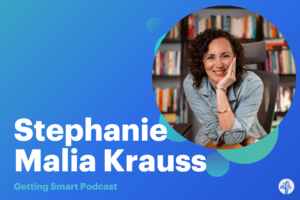
Dr. Tony Wagner
A globally recognized expert in education, TONY WAGNER is currently a Senior Research Fellow at the Learning Policy Institute, founded by Linda Darling-Hammond in 2015. Prior to this appointment, Tony held a variety of positions at Harvard University for more than twenty years, including four years as an Expert in Residence at the Harvard Innovation Lab and the founder and co-director, for more than a decade, of the Change Leadership Group at the Harvard Graduate School of Education. His previous work experience includes twelve years as a high school teacher, K-8 principal, university professor in teacher education, and founding executive director of Educators for Social Responsibility. He is the author of eight books and numerous articles. He has also worked on two wide-viewed education documentaries. His latest book, Mastery: Why Deeper Learning is Essential in an Age of Distraction, will be published by Basic Books in September 2025.
Dr. Ulrik Christensen
Ulrik Juul Christensen, MD, is a globally recognized authority in learning technology, known for his pioneering work in adaptive learning, data-driven content development, and simulation-based debriefing technologies. As the chief strategist at the Area9 Group, he has overseen the creation of innovative platforms that optimize business processes for large corporations, spearhead digital product design, and drive corporate training through intelligent, adaptive learning solutions.
In 1997, while still a medical student, Christensen founded his first company, Sophus Medical, which was acquired by Laerdal Medical in 2002. From 2002 to 2006, he led Laerdal’s global learning technology initiatives, helping shape the future of the field. In 2006, he co-founded Area9 Group, which has become a leader in personalized and adaptive learning, producing over 1,500 adaptive learning products used by millions of students every semester. In 2014, a subsidiary (Area9 Education) was sold to McGraw-Hill Education, after which Area9 Learning was established to focus on corporate and organizational adaptive learning as well as general educational technologies.
Links


0 Comments
Leave a Comment
Your email address will not be published. All fields are required.