

Todd Smith and John Batcher on Helping Students Find Their Why
Key Points
-
The data matters. Businesses discuss success in terms of ROI but this is so different from how education measures success.
-
Students have to first understand themselves.
This episode of the Getting Smart Podcast is sponsored by Smart Sprints. Find out more here.
On this episode of the Getting Smart Podcast Shawnee Caruthers is joined by co-founders of Symphony Workforce, Todd Smith and John Batcher. Symphony Workforce is a gamified solution for career discovery and talent acquisition.
Let’s listen in as they discuss connecting students to their community, what district and workforce partnerships look like and more.
Between the ages of 13-18, students should serve in as many micro-internships work experiences as possible to discover their god-given gifts.
Todd Smith
Links:
Transcript
This transcript has not been edited for spelling accuracy.
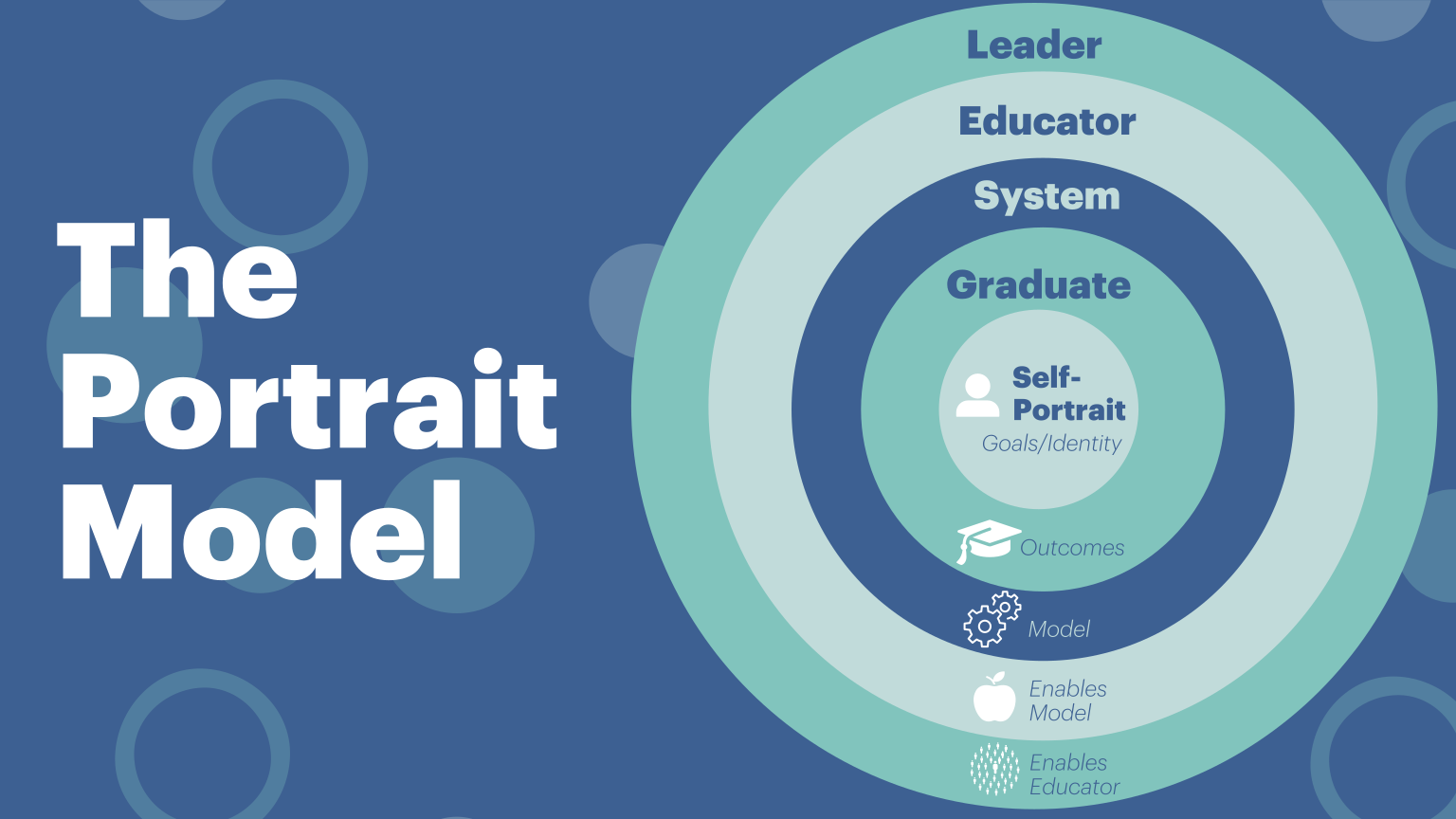
At Getting Smart, we believe in the power of networks, communities, and uniting around a common purpose. Our next Smart Sprint, a two-week cohort-based learning experience, focuses on bringing your portrait of a graduate to life. It kicks off on April 11th, and we’d love for you, your district, or your organization to be a part of it. Come with a draft of your portrait of a graduate and an open mind. Learn more at www.gettingsmart.com.
You’re listening to the Getting Smart podcast. I’m Shonnie Corellors, and today I’m joined by the co-founders of Symphony Workforce, Todd Smith and John Batcher. Symphony Workforce is a gamified solution for career discovery and talent acquisition. Todd and John, thanks so much for being here today. Absolutely. Thanks for having us. Yeah, absolutely. I’m going to start with Todd. I’m doing some work around real-world learning in Kansas City, and real-world learning in itself is
a kind of a by-state regional agreement effort between the Missouri and Kansas school districts and state agencies about offering better solutions for students post-high school. I think we all can agree that the high school department is no longer in that. So there needs to be some additional options and then some experiences that take students a little bit further. In the case of real-world learning, it’s centered around like internships and entrepreneurial experiences,
making sure that they have some industry recognized credentials, college credit, etc. and what we’re finding as the more that they have access to that, the more that we’re that they’re prepared for a successful post-high school life, whether that’s college or straight to work, etc. So, but through this process, we begin to understand that the industry speaks a completely different language than traditional education, right? Todd, do you agree? And how can we help raise
that gap? So let me first give some context, right? So I grew up in a family where my mother was a superintendent of schools. We are, and I’ve run businesses in terms of obviously CEO of this one, I’ve led tech teams, I’ve led worldwide teams. Industry talks in terms of ROI, return on investment. Bottom line, right? Can you help me solve this problem that is preventing me from making money or giving me a solution that’s going to help me make more money? Education is trapped in a
concept or language that says, here’s a flat piece of paper we call a transcript. We’re going to give you basic information that we want you to memorize and be able to regurgitate on call, but we’re not truly in a business of teaching you at light speed which industry works. So in that, both are necessary, but business is speaking Portuguese, right? And education is speaking in cave drawing, right? There’s that kind of difference, right? You need the fundamentals of the way traditional education
is being taught, but not in a way that prohibits you from thinking and design thinking and thinking and entrepreneurial and having a growth mindset which industry desires. And so that’s the gap, the custom that stands between those. And as you said, between the ages of 13 and 18, students should have as many micro internships, apprenticeships where they can prove what they are God given to do, right? What are your blessings? What are your gifts? Can I attach that to
solving a problem which then can then attach to a career by title, then it will attach to do I want to be an employee or do I want to be an employee or and now industry on the other side of that can go, hey, I just submitted a problem out there into the ether. I had a thousand kids taken of those thousand kids, 500 said they liked my problem and my company. Of those 500, 250 live close enough to my location that I would love to meet. And of that 250, 700 or 72 have the soft skills that were
identified to be part of my culture. I now want to meet those 72 and those 72 should own their right, their ownership, their brand enough to go. Thank you for your invite. I don’t want to or yes, I do. And let’s say now there’s 32 of those kids that say, hey, we’re a fit. Let’s move forward. And every kid should have that opportunity. Every business should have that kind of data and access because that’s real. Yeah, no, that’s really great that that data piece is important.
And as you were talking, it made me think of the importance of just like building that network capacity, especially if you’re a student that doesn’t traditionally have access to those various networks of companies that don’t necessarily look like you or people that you may not encounter. So how is that important for students to be able to kind of have that social capital in order to kind of move beyond high school and kind of navigate what it means to be a citizen?
So John and I have a partnership, but we also also have a brotherhood, but then we also have this unique thing that binds us together. And that is, I grew up in St. Paul, Minnesota. I grew up in Irving. I know black history, African history, and America’s history. I know it all unfiltered. And I grew up in that lens all the way through high school. And then I had a stroke of luck by ending up at the University of South Dakota in
Bermuda and finding a whole new group of brothers that I played football with and people I went to school with. And I went back to farms and I went back and mended fence and pulled calf and did all these different things and realized that they had struggled in rural America that I just didn’t know. Right. So in St. Paul, Minnesota, two businesses closed. It was a vacuum, not a problem. Two more businesses filled right in and we just kept it moving. But in Clone, South Dakota, if you have
two businesses closed, a whole town can go away. Right. So the thing that I realized, both places have this struggle with access. Right. So how do I get access? If I’m way out in rural, I don’t have access to broadband. How do I get access to the companies throughout a given state? Right. Or how am I in an urban area and think the access that I have isn’t authentic. Right. Are they really judging me? I’m the content of my character. Right. And so that’s the problem. And that’s the
thing that we fixed through our platform called Find The Why. Yeah, absolutely. John, speaking of just the access, which I know is like, like Todd was saying, just kind of the basis of why you all do what you do or at least a part of it. Can you walk us through that symphony workforce model and like how does the school or a district partner with you and just kind of talk about where starts and kind of the length of experiences, etc. Yeah, sure. So as kids come in a couple
different ways, one, we do have formal partnerships with schools and school districts like OPS or Bellevue or, you know, some of the other outstates like Chadron. And so whether rural or urban, we have the largest school district in the state that’s partnering with us. And it looks different than the largest school district in the outstate area. And that’s okay. The other way young people come and participate on Find The Why, which is the name of our platform, is just because it’s
organic. We have kids come and they build their teams and by volition, they’re going to invite their teammates, which come from other places. And so between social media and kids coming organically to join other teams, that’s really how young people discover us in addition to those more formalized relationships. And it grows from there. There’s this snowball effect that we’ve seen over the last year and a half that as young people jump in and they take a challenge from a
cool company and tell their peers about it, all of a sudden it grows. And that’s how we wanted it to grow. You know, most of the great movements have been grassroots based movements. And so we could have paid our way to get there. But the better way is to offer kids an incentive of things like prize money and access to game fight systems and access to these cool companies and offering them those authentic problems to solve like Todd talked about. How do you put a real problem in
front of a young person who really wants to make a difference? But they didn’t have the access before. And now because this is a mobile platform, we can all of a sudden say we have erased a lot of barriers. We’ve erased the barriers of socioeconomic background, of geography. And in this pandemic world of those kids who are actually going to school and those kids whose school’s been canceled on, that wasn’t the kids fault. And I’m not blaming anybody. That’s just the state of life that we’re
living in right now. And so how do we erase and let you eliminate a lot of those barriers and give young people that authentic opportunity to engage those businesses and have access to those businesses regardless of what they look like or where they came from. And that’s really a hallmark of what we’re trying to do when we start talking about access. And when we talk about our growth, it’s because we’ve eliminated those barriers that kids from all different walks of life have
come to compete on the platform. Yeah, sounds like students get some real voice and choice, which everyone says that is important. But it sounds like you all are truly making it a part of what you all do in your business model. And it sounds like it’s being out for you all. Yeah, when kids come, we have always said we are student driven first. And so when we make decisions as a team or with our board, we’re saying, is this good for the young person?
That’s one of the litmus tests that every decision has to pass. And then we’re saying it’s student driven in that there are multiple companies with multiple problems in the platform at any given time. So if it doesn’t fit one kid’s schedule, but it fit another young person’s schedule, awesome, jump in, solve it. And if you if you don’t have time or it’s just in the way because my football, you know, playoffs were that weekend, or I had a final or whatever, great, in 30 days,
we will rinse and repeat, there’ll be new companies with new problems. And so we’re very much focused on that student driven kind of kind of status. Yeah, is you all are helping the students navigate kind of just like, quote unquote, adults do in this real world, how do you balance your schedule with the things you also have to do your extracurriculars, etc. And so, Ty, when you’re thinking about those real life challenges or the real world challenges, how do you connect to real world
challenges and organizations? What are some examples that you can give? So what’s funny is, when we go to talk with CEOs, and they say, Well, you know, we have a whole HR staff and they well, and they talk to schools and they’ve talked to kids and I go, And how’s that working for you? They’re like, It’s horrible. Right? Well, if it’s horrible, why do you think it’s horrible? Well, because we don’t know how to connect to them. And so how about this? Every kid that I
know has one of these things, crazy things called the cell phone. I have a 15 year old daughter, she won’t let it out of her hand. Right? And so she knows where TikTok is, she knows where Snapchat is, she knows how to engage them. And they know what’s real and what’s not. Right? So we deal with companies such as Chick-fil-A who says, Hey, I have a real problem. I know everyone just thinks we do chicken here. But if we don’t solve a styrofoam cup challenge, the problem that we’re having,
then our PNL, our problem law statement could take a major hit because of fines. We need young people to solve this. We have a thousand engineers and we can’t solve it. You solve it. Kids came out of the woodwork from 41 states to solve it. When we are trying to get kids back in school around COVID, we said, Hey, you know what? Every adult’s talking about how to get kids back in school. You know who they’re not asking? Kids. We had kids from 41 states come out and say, Hey, this is how
we should do it. They had apps, they had designs, they had systems. You said, Hey, how do we stop school shooting? You know, we asked kids another batch of design. We said, Hey, build a new social media platform. Right when Facebook was getting drugged through the mud, right? And kids came out from the woodwork. And here’s the beauty. This is another thing that adults will say. Well, how do you segment kids? How do you segment them so that you know everyone’s on a playing field and you
know, some kids not more advantage than another kid. We say ingenuity or side hustle or Nate, you know, genius, they’re all inside a degree or two of each other. So we have middle school kids competing in open challenges against kids from Berkeley. And middle school teams are placing the top 10 in the nation. Right? These, these kids are dynamic. They think outside the box. They no longer try to think about cooking a turkey in an oven for four hours. They want to microwave it.
Right? I want it now. And so as we talked about, you know, even before this call started, everyone who’s on our platform wants to return on investment on their time. In order to do that, you have to give them real problems to solve, give them real mentors to engage. And it has to be an efficient way that they can connect with. And that’s what we do on our platform. Yeah, John, Todd talked about that kind of like that right now mentality. And we do live in that
world of social media where they feel like they can make a tick tock and now all of a sudden they’re playing with it. Sometimes it happens, but most times it doesn’t. But we still need students to really connect with their communities and be in service to the communities. Do you find that the things that you do are the, when students are connecting to these real world challenges, does this really help young people to connect to their local community? Or how else do you think
that serve in this community? Or how else do you think about serving the community through the Symphony Workforce Platform? Sure. As you look across the board, and this is a great question when we love to answer, as you look across the board, you look at young people who are ready to engage businesses in their backyard. They just don’t know how or they don’t have the access to their own backyard. And so when Todd talked about access, that’s what we’re talking about. And they
don’t know that business even exists in a lot of cases. I mean, if you look at a hospital, for example, if we take one of our hospital clients, they are a miniature city. They have every aspect of a city from janitorial all the way through leadership to people who are doctors and nurses and everything in between. But a young person that’s sitting there as a sophomore in high school goes, if I’m not a doctor or nurse, I don’t go to a hospital, belong in a hospital. They have no concept of what that is.
And so this really opens their lens and opens their aperture. And all of a sudden they go, wow, I could be an attorney and work for a hospital. I can be an actuary and work in the healthcare setting. And so that is our goal. And it’s our goal to connect them back to someone in their community or at least their region that says, Hey, by the way, we do that right here. And so our goal is first and foremost, student driven and student access. But then it’s student access to those
authentic opportunities that are right there for them. And so that looks like that local setting. Can we keep them local? Can we keep them in the state? Better yet, can we keep them in their small town? So that small town doesn’t go away. And maybe they have a job that’s part of a more metro or urban area, but they can still do that work from that remote setting. And so it becomes this concept of a lifestyle choice. And how do I have a life work, not necessarily balanced,
like our parents were seeking of, I work and I have my compartment here and I have my life over here. It’s more of this life work integration that we’re really focused on. How can you live where you want to live and do what you want to do? And this allows those young people to explore those opportunities to live that life. Yeah, I love that. So, Ty, how do you all provide credit for these experiences that John was just talking about? So there’s two things. One, we’re working with
local colleges to give actual college credit for experiencing three, four of our challenges on one side. We’re working with several companies at the state level around apprenticeships, being the funnel in apprenticeships, where they get certifications and credit. Right. And now we’re going to start to work with school districts and these are conversations that are yet to be had around how do these play into your CTE realm in your school where kids get credit at the
high school level. And so those are the three paths. I would also like to pivot back to something. We are, every generation has their own X, Y, right. This is generation COVID. In part of generation COVID, that the data has told us is that the mental scars related back to COVID and missing three years or having three years of your schooling impacted are deep and significant. Suicide rates are up, right? Sub-harm rates are up. And so one of the
things that we do as a core fundamental of our platform, we help students understand themselves. There’s three assessments on our gamify platform where they get points for finishing these assessments, but they start to learn themselves. How do I handle stress? How do I handle situational confrontation? Right. How do I, where do I want to take my life? Where’s my life integration? Where do I live? Where am I from? What do I like? What do I dislike? How much do I
want to go to school? All these different pieces. And finally, there’s a 360 element to our assessments where teammates take this word stack and they relate it to each other. So now I know how my peers think of me. So in case I was thinking something negative about myself, I could have bounced it off something that goes, no, no, no, no, I am a good person. I do have places to work and get better, but I, but I am dynamic and I do actually have a goal, right?
So I have somewhere to go. If I don’t have somewhere to go, it’s very easy to fall backwards. Yeah. No, I love that you brought into that, that SEL component, because as teachers and educators, et cetera, we often think about SEL, but it’s not so much at the top of mind for students, but because you’re right, they’ve lived through this pandemic. Now they are a greater touch to who they are and what they’re bringing to the world and the essential skills that they are,
are not building on. So John, as you think about the experiences that you all offer through Symphony, how can you bundle those into a larger credit credential batch, et cetera, so that when they are filling these things, they now have some sort of portable proof that when they go to these companies that this is how I feel about myself, but now I can like physically show you that this is true. Yeah. We offer kids what we call a digital resume at this point, and it updates off of all
of their data and all of the challenges that they take in through the Find The White platform that automatically updates, and they can choose to share that as they see fit. We never share it. All of this student’s data remains the student’s data. It’s all private to them, but if they want to bring that up with a guidance counselor or maybe show that to somebody who’s a mentor or leading an internship or apprentice program, they can start sharing that. And that
talks, that gets to what Todd was talking about. It shows some of their social, emotional growth and trajectory, but it also shows the real world challenges and how they answered those particular problems. And oh, by the way, here’s my video showing and pitching my solution. And so they have this dynamic piece that they don’t have to update like their old paper resume. It automatically updates and they carry it with them on their phone. So in addition to a transcript
and maybe that traditional resume, they have this that maybe more dynamically represents them than either of the prior two. And that’s really critical when we start talking about, are they wanting to go to two-year or four-year? We can certainly offer credentialing. We can certainly connect them with companies who are willing to pay for their education, whether two or four-year or certification programs. And we love doing that. But more so, we want to equip them with the tools and data to
know which of those choices is even right for them. And that’s where this really comes in, that’s all great. And we can help them with that through the platform, but they need to know about themselves like Todd was talking about. And then that translates to that next step. So, John, how do you help them with that storytelling piece? Because now they have all of the materials, but then when they’re standing in front of this, either a college recruiter or a
job recruiter or hiring manager, et cetera, how do you help them to have that confidence and have those warriors truly tell their story? Yeah. So, number one, they already did it. So now they’re just talking about what they’ve done. They don’t have to perform. They already did the performance, so to speak. All they need to do is bring up on their mobile phone, which Todd said they have with them all the time. And they have the confidence to not only know the technology, but now they’re
in their medium, they’re in their world, and they’re inviting someone else into their world to say, hey, here’s what I did. And oh, by the way, here, let me scroll to this and I’ll show you my solution. And here are all of my data points. And so now they have all the data that they know, and they’re armed with it, and they’re well armed in a medium that they’re really comfortable in. And so they’re very willing to talk about it with others, more so than a transcript, which
how many students have ever read a transcript? Or they wrote this resume, but what do you say about, I worked at Dairy Queen. I mean, Dairy Queen’s a great place. But what do you say about it other than I served customers with excellence? I don’t know. I mean, how do you bring out what you really did? And that’s what Find The Y allows these young kids to do is they now have something that is in their language to share with others and invite others into. Yeah, I love that they’re having
the opportunity to dig deep in that Y. As someone with an older kid who is going through the process now, it is so critical. And so often students don’t and young people don’t really get to that point until they’re, you know, post high school 19, 2021. But you all are given those students to the opportunity to do it at a younger age and do it with people at all different levels. And so they’re being able to really widen their perspective. But earlier, we mentioned like, TikTok famous and
things of that nature. And those are kind of like entrepreneurial experiences, right? There are so many ways now for them to get to that standpoint. So as you all think about entrepreneurship, are any of those experiences measurable on the platform? Tyler, John, you know, whoever wants to answer that. So the premise has always been, we want students to pick from problems they want to solve to find careers, much like you have student athletes that play particular sports to then become recruited,
right? So they get recruited to go to college, right? They get recruited to go that next step. We want kids to A, decide what their sport is, right? Using sport as an acronym for career, then have multiple schools recruiting them, i.e. multiple companies recruiting them to then move forward in the process and to move forward debt free. So you think about the blessing that is to be able to, as a human, to know that you’re wanted, that you’ve discovered your process in your path,
then to be recognized and recruited for something as a, if you’re an introvert, that is unique to you that no one else knows about so that you can drive forward to be a better person, husband, wife, brother, sister, all those things, right? It is a secondary that a kid comes up with such a dynamic idea that companies are like, holy smokes. I had no idea. We had, we had a thousand kids take this challenge and we had six ideas that we never thought about. Yes, we want to use those,
not only those ideas, but we’ve got to have those kids. And Chodney, this really speaks to the idea that we don’t have a preconceived notion of what a solution should look like. And most of these young people, when you look at middle school and high school kids and even early college, haven’t heard no enough to say, well, it can’t be done that way. And so they come up with innovative solutions that engineers at these companies go, well,
we thought about that, but it really can’t be done that way. And then somebody goes, well, why not? And these kids are willing to ask, why not all the time? And without constraints. And that’s, again, the hallmark of the platform is you don’t have constraints and the hallmark of the kids’ solutions is oftentimes they’re unbound by these constraints that the world throws on a solution or a company or an idea over time. And so we try to break those and students are awesome at breaking.
Why not? Such an important question that can just like turn everything on this head. So we, you all were talking more about the businesses and early we were talking about the social capital and students being able to kind of build mentors. And so when we think about more of that mentorship component, does the platform empower mentorships over time beyond the projects or is it limited to the project that they’re working on? So it’s twofold. So one of the mentors are limited to the
project that they are working on. And it’s purposeful that way from a safety standpoint. And so that kids are asking mentors, much like they go to Google. I mean, that’s this generation. These kids haven’t been alive when there wasn’t Google, right? And so that exchange happens really well. And we want to make sure kids develop the skill of taking critical feedback and then doing something positive with it. Now, we partner with some organizations, Partnership for Kids, JAG, where
we can take that mentorship and that information so that thinking that digital resume that John described, I can go back to Partnership for Kids or JAG and their mentorship that they have there that’s face to face, they can take that digital resume go, Hey, here’s what I’ve been working on. Here’s what I’m doing. Here’s my passion. What do you think? Oh, and then so that gives that relationship depth, right? The more depth we can give their relationships outside of us,
so they can talk about real things. Instead of the counselor saying, well, I, you know, I, I guess your father was a farmer and your cousin was a farmer. I guess like you’re going to be a farmer. I guess your dad was this or your mom was this. I guess you’re going to be this because I only have 22 minutes to spend with you over the course of the year. Now you can walk in and go, here’s where my digital resume is. What do we do here? Oh, here are seven colleges that are looking
for you. Here are 14 businesses that are looking for you. Now everything has depth in meaning. And that’s what we continue to drive the kids and the adults around kids. Right. I’m super excited anytime there are platforms like Symphony that comes around where you make a difference with one, but then it starts to change the whole trajectory of a family. And that’s so exciting. And I can’t wait to continue to follow to see how that expands over time based on the work that you are doing.
You all are doing. So, John, where can listeners go to find out more about the work that you all are doing? Yeah, find the why is a homepage where you can go on the web. And then all of our social is at go find the why. And those are two great places to get started. And then where we do a lot of our more adult facing work is under the symphony workforce banner symphonyworkforce.org. Okay, so we’re talking about find the why. So I will be remiss if I didn’t ask about you all’s
why. We’ll start with Todd. Why? Why are you doing this work? Wow. So one of my big moments in life is when I believe I said, God’s lap and he told me, Hey, I built you for this race. Now I need you to go help waves of people. And I didn’t question it. I didn’t pause on it. It’s who he built me to be. And so whether it is through coaching or mentoring, I knew I had to figure out a bigger way to get waves of kids into their spot, because there’s nothing like it. When you can see a young person
that finds their reason and their mountain decline, not the one you told them to climb, but their mountain. Now you’re changing generations of people, right? And when you can get someone in that space, what also happens for that young person is their ears open, and their mouth gets a little quiet. And they can start hearing the differences around them and embracing the difference in understanding other people’s pains, they become more empathetic,
more sympathetic, more driven. That’s my point. If I can make that happen, if I can be part of that, a lot of our other noise goes away. Her people hurt people. When you can help heal people, they heal people. Right? And so that is my why. I have to do that. Yeah, for me, it’s the classic when we ask people, what’s the word you put on a t-shirt? And my word
is matter. And it’s been that for decades around the idea of how is what I’m doing going to matter, not only to these people here, but is it going to echo? Is it going to have further generational impact? And I’ve looked for people who have that, and that mostly comes from service. And so for me, my why is I want to be doing something that’s going to matter. And I think that most of the time, that comes when you can have a long tail on the generational impact. So picking young people,
middle school, high school, college, and that early career, for me was unnatural because I want them to avoid some of the pitfalls that I, you know, the pits that I fell in. But also I want to be a springboard and say, Hey, here’s how you build your network. Here’s how you build your social capital. Here’s how you gain access. And I think for me, it all comes back to that one word of matter. Yeah, well, you all are doing some really great work that matters. We
really appreciate you all being here today and in sharing with us about the great work that symphony is doing. And thank you. We just encourage everyone to keep learning and keep innovating for equity. Thank you guys. Feel free to share the podcast on social media using the hashtag GS Podcasts. Thanks so much.

0 Comments
Leave a Comment
Your email address will not be published. All fields are required.