

Podcast: Michael Horn on Choosing College
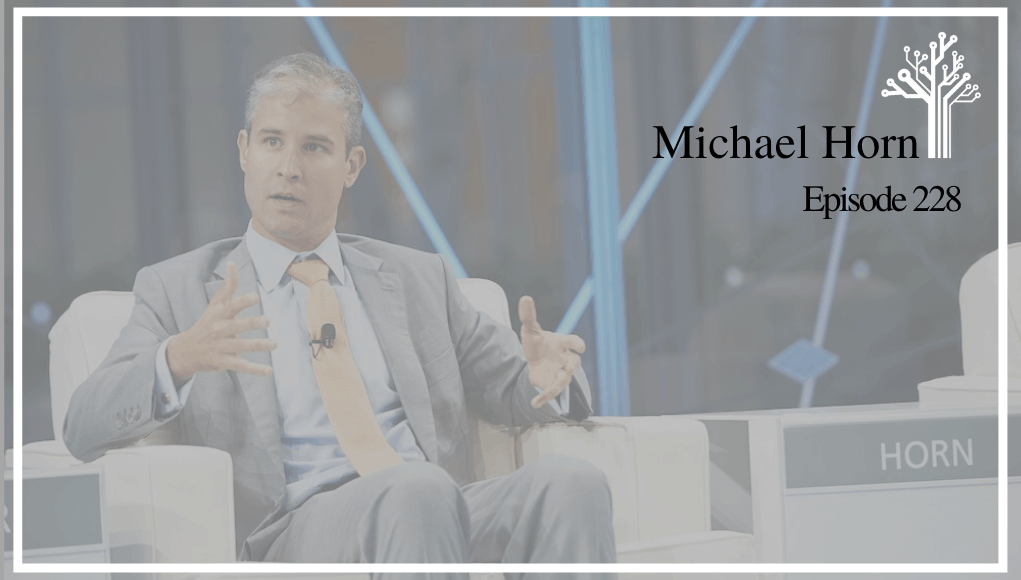
After Yale, Michael Horn thought about law school but gained admission to Harvard Business School. He’s thought a lot about that process and how it shaped his life. His new book, Choosing College, unpacks all the reasons people go to college and offers advice to college seekers and operators.
Horn had the good fortune to be sitting in the second row of Clayton Christensen’s innovation course when he asked if anyone wanted to co-author a book on K-12—and the foresight to visit him after class to volunteer. Two years later, Disrupting Class was published. Ten years later, we all talk about disruptive innovation (as if we understood it).
After co-founding the Christensen Institute, Horn directed the education program for a dozen years, applying innovation theory to policy and practice in K-12 and higher education.
After writing American Enterprise paper on Disrupting College with Christensen, Horn shifted the majority of his time to advising higher education leaders. With Bob Moesta, he began applying Christensen’s ‘jobs to be done’ framework to the increasingly complex landscape of postsecondary learning. After a series of deep interviews, they identified five reasons people choose the colleges they do—the ‘jobs people hire college to do’:
- Help me get into my best school: the classic experience relying on traditional rankings;
- Help me do what’s expected of me: fulfilling parent and teacher expectations (a terrible and often expensive reason to go to school);
- Help me get away: a move away from an unpleasant situation, but not necessarily toward something positive;
- Help me step it up: with anticipated events, a decision to be better; and
- Help me extend myself: the personal decision to invest in self-improvement.
The main point of the book for college seekers: to get clear about the question “why college?” Also: “what is it you really want from the experience?” And until you’re really clear about that, avoid racking up lots of debt at an expensive school.
While they don’t deal extensively with the high school guidance function in the book, Horn said helping young people figure out who they are and what they want out of a postsecondary experience is critical.
“We’ve narrowed the curriculum and discounted experiential learning experiences,” said Horn. To answer the Choosing College questions, “young people need more of these exploratory experiences,” added Horn.
For parents, guardians, teachers, and advisors, Horn said, “We cannot leave college choosing to luck.”
The Equity Dilemma That Comes With Nuance
Not all kids need to go to college, at least not right out of high school. That observation has kicked up some criticism of the book from equity advocates, Horn said.
One of the problems with pushing for college for all is the new worst-case scenario: debt without a degree. Another problem is that it doesn’t recognize all the new earn-and-learn tech career ladders available.
Some of his ed reform colleagues have said, “It’s great for upper-income students to focus on developing a sense of purpose; low-income kids just need to go to college.”
Horn thinks clarity of purpose is important for all young people to avoid wasting time and money on a poorly fitting postsecondary choice. But that requires broad experiences, relationship-based advising, and the resources to provide them.
The key, explained Horn, is to “create a system where all students are aware of and exposed to different pathways without predetermining them.”
The book features the career education focus of Cajon Valley USD (@cajonvalleyusd), where Kindergarten through eighth-grade students cycle through more than 50 career explorations while reflecting on strengths, interests, and values.
Advice to Operators
With all of these reasons people have for attending, most colleges serve very different customer segments but typically don’t recognize the varied motivations.
“Colleges try to be all things to all people, but this different jobs-to-be-done are pulling against each other, resulting in one-size-fits-none and driving up overhead dealing with all the complexity,” Horn said.
Horn is sympathetic to Ryan Craig’s call for expanded access to free or debt-free sprints to a good first job. In many cases, that will involve a high school and community college in partnership with an employer (see recent features on Infosys and Dallas ISD). Horn sees innovations like these creating new options and advancing competency-based learning.
Horn argues that, like college seekers, college operators need to get clear about their sense of purpose. And with greater clarity, focus on innovations that deliver value.
If someone you know is thinking about higher education, get them a copy of Choosing College How to Make Better Learning Decisions Throughout Your Life. It informs college choosers as well as college leaders.
Key Takeaways:
[2:30] What was Michael’s musical interest that drew him to Yale?
[2:58] What job did Michael want a Harvard MBA for?
[4:12] Is Harvard Business School where Michael met Clayton Christensen?
[5:08] Tom and Michael speak about the early process of writing Disrupting Class.
[5:57] Michael speaks about the experience of working on Disrupting Class with Clay.
[6:43] Michael speaks about his time spent at Christensen Institute.
[7:12] Michael’s biggest takeaway from a dozen years spent at Christensen Institute.
[8:08] Tom and Michael discuss what disruptive innovation is and why it is so important.
[9:12] Why did Michael make the shift from K-12 to higher-ed in the last four years?
[10:57] Tom and Michael discuss how reimagining higher ed may be the key to transforming the secondary school experience.
[13:18] Why college may not be the right choice for all students right away after high school.
[14:52] Why Michael decided to write a book more for college seekers rather than college operators.
[17:50] Michael outlines the five reasons why students decide to go to college from his book, Choosing College.
[20:12] Michael speaks about the guidance gap in high school and how he thinks high school advisors, educators, and guidance counselors understand this.
[23:55] What high school should be at its core.
[26:24] Michael responds to criticism of his book, Choosing College.
[27:00] Tom and Michael speak about why high schools should be helping students understand their sense of purpose and the importance of making a contribution to the world.
[29:40] Tom and Michael speak about the shift to life-long learning in education.
[31:25] Michael gives his take on Ryan Craig’s book, A New U.
[36:30] How the higher ed landscape is changing and how the lines are blurring between high school and college.
Mentioned in This Episode:
Disrupting Class: How Disruptive Innovation Will Change the Way the World Learns, by Michael Horn, Clayton Christensen, and Curtis Johnson
“Disrupting College” Paper by Michael Horn, Clayton Christensen, Louis Soares, and Louis Caldera
Choosing College: How to Make Better Learning Decisions Throughout Your Life, by Michael Horn and Bob Moesta
Yale University
Harvard Business School
Christensen Institute
Michael B. Horn
Clayton Christensen
Gisèle Huff
Who You Know: Unlocking Innovations That Expand Students’ Networks, by Julie Freeland Fisher
A New U: Faster + Cheaper Alternatives to College, by Ryan Craig
Dallas ISD
Dr. Michael Hinojosa
Grit: The Power of Passion and Perseverance, by Angela Duckworth
For more postsecondary choices, see
- Does College Still Pay? Seven New Rules for Making a Good College Choices
- Ryan Craig on Last-Mile Training as an Alternative to Higher Ed (Podcast)
- How Faster + Cheaper Alternatives Will Replace Most of HigherEd
- Podcast: Michael Hinojosa on Making Dallas Schools Work
Stay in-the-know with innovations in learning by signing up for the weekly Smart Update.
This blog was originally published on Forbes.
Episode Transcript
We’re listening to the Getting Smart podcast where we unpack what is new and innovative in education. Michael Horn has been a thought leader in education from the day Clay Christensen took him on as a co-author of Disrupting Class. After the book came out in 2008, Horn went on to lead the education practice at the Christensen Institute for a dozen years. Four years ago, after writing a paper called Disrupting College with Christensen, Michael shifted the majority
of his time to advising higher education leaders. Horn’s new book, Choosing College, How to Make Better Learning Decisions Throughout Your Life, informs college choosers as well as college leaders. Let’s listen in as Tom talks to Michael about his book and more. Michael Horn, welcome to the Getting Smart podcast. Thanks so much for having me, Tom. It’s such a treat to have you on. It’s been too long. Yeah, I know. I was thinking to myself,
there were years there where we were traveling weekly together, getting to do work in the various state capitals and with various mission schools and providers, and we don’t get to do it nearly enough these days. It’s good to catch up. I want to go take you in the way back machine to high school. Where’d you get high school? I went to Walt Whitman High School in Bethesda, Maryland, public school that has a lot of characteristics of a private school, if I’m
honest. Why did you pick Yale or why did Yale pick you? Yeah, so I picked Yale because frankly, the energy of the campus was just infectious when I went there over to summer visit and I fell in love with it. Tried to say I didn’t want to go over and over again because I thought New Haven was, my mom had brainwashed me into thinking New Haven was this place where I would suffer terrible bodily harm. But I just over and over again couldn’t get it out of my head and
convinced myself that the programs around music that at the time I really wanted would be good. Why did Yale pick me? I have no idea. I like to think that the well-rounded nature that I presented was certainly part of it and that embodied a lot of what Yale wants to see, which is not just academic excellence, but also people who are going to be members of the community, volunteering in a lot of different extracurriculars and creating a more robust campus life. What was the musical
interest? Yeah, so I guess I am but barely play any more outside of Disney tunes, a pianist. And I am both jazz and classically trained and I wanted to make sure that Yale would have enough of a jazz program. I knew it had great classical teachers and legacy and so forth, but I was less sure about the jazz opportunities and I got satisfied enough and then did almost nothing with it after Freshman. That’s interesting. I didn’t know that. What job did you want a Harvard MBA to do
for you? Yeah, so it’s interesting. Before I wrote this new book, Choosing College, I would have told you it was to transition out of the public policy world and into the business world. That’s why I went to business school. It was interesting when you looked at my actual decisions and what I actually did, not what I said, but what I actually did. It was clear that I hired Harvard Business School to get into my best business school. I had been originally thinking I would apply to joint
MBA JD programs, so business and law school. I did not get into Harvard Law School, got into the Harvard Business School and I remember visiting with my parents and we walked around the campus and anyone who’s been there, it’s gorgeous. The rest of the colleges and schools at Harvard College Versailles because they’re envious of it. And my dad looked at me and said, you’d be crazy not to go here. And within one week of enrolling, I forgot about law school
altogether, realizing I had no desire to practice law and just totally immersed myself in the business school experience. But it was really much more get into a great school for a certain sake than a concrete image of what I actually would do. Is that where you met Clay Christensen? That is. I took his class second year and at the end of class in November, he cavileerly, as Clay sometimes does, said anyone interested in writing a book with me on public
K-12 education, stopped by. Were you the kid sitting in the front row? I was the kid in the second row, I think. I still remember where I sat in the class as does he, which is fascinating. But it’s funny, Tom. I didn’t realize, when I signed on, I didn’t realize Clay had attempted to write what became disrupting class like four times earlier. And I think you were involved in some of those conversations, if I’m not mistaken. And I just had no knowledge or sense of that. It’s an
interesting question if I had, would I have signed on still to do it? But it obviously worked out. I remember some of those early drafts, they were a little bit of a mess. And you were super helpful in pushing us and cleaning them up, which was great. I mean, it was, you know, disrupting classes like this process where we dug deep, I think we had some kernels of really good ideas. And then folks like you and a few others really dug in and didn’t just
sort of cursely read it and say, yeah, it’s okay, you know, change one thing. Like, I remember you were reading drafts, and then you’d send me an email and say, going out for a walk on the beach, I’ll be back with more. And it was like line by line feedback with deep conceptual ideas that really I think pushed us to not settle for sort of a surface level treatment of public schools, which made it I think a lot better. It must have been an amazing
experience for you. You ended up spending several years working on that with Clay, right? Yeah, it was so I guess two years. I mean, you know, Clay, he would say, oh, the book will take a six months to write, we’ll publish it and then I’ll find you whatever job you actually want. And two years later, the book actually came out. And then I remember actually meeting you in person for the first time in Colorado at a convening that our friend Giselle Huff had helped organize.
And I remember being just terrified out of my mind, trying to figure out how to participate with all these luminaries in attendance. But it over time became obviously my life and career, the focus on trying to allow every single child to build passion and fulfill potential. You had the good fortune to spend, was it 12 or 14 years at Christensen Institute? More than? Yeah, it was roughly, but it’s the Institute now we founded in May 2007. So I guess
it’s now 12 years old, a little over. I was there for just about a decade before I stepped out full time. And I still get to spend a day a week with them. What would you say is your big takeaway from a dozen years there? Yeah, I think the big takeaway is that Clay’s body of innovation theory has a lot of important things to say on a variety of societal problems, not just education. And it’s able to draw to your point counterintuitive conclusions that just a lot of people take for
granted or don’t see in a variety of places. And then if you really want to have impact, it’s not enough to just write that first draft or that first book or that first article, but you got to actually really immerse yourself with the players in the field. So you can help them see the possibilities and so forth. And then I think the last thing I guess I would say is, it’s also then occasionally important to step back outside of that echo chamber to say, okay,
are we being fully honest with what is likely to work or not likely to work based on what we’re seeing rather than just getting caught up in the exciting moment. It’s interesting, Michael, that I like a lot of people, I think just now take for granted disruptive innovation theory. It’s just part of my mental model and how I think about the world and just a signal of how important Clay’s work has been to many of us. Yeah. And it’s interesting also, right? There’s people who’ve
actually read the work and built it in. There’s like the second layer, right? Who have taken disruptive innovation as a buzz phrase and not actually understood its meaning and distorted it, I think, in unfortunate ways where they call things disruptive. Ultimately, disruptive innovation is really a game theory with technology and it’s more a theory of competition rather than success per se. And I think it’s been distorted in some unfortunate ways by that second rung who
just use it cavalierly or a third rung who just hate the notion even though it so clearly exists in all parts of our society. After a dozen years working in K-12, why the shift to higher ed where you’ve spent most of your time and attention for the last four years? Yeah. So I should say, you know, I still do spend time in K-12 education. It’s probably 20 or 30% of my time now whereas higher education is probably 70%. The shift I think started happening gradually around 2010,
2011. Clay and I wrote with Luis Soras at the Center for American Progress, a big piece called Disrupting College. And a lot of the ideas in disrupting class, people in higher ed were constantly applying in the realm of higher education. And so part of it was we naturally got pulled into it. And there’s a lot more disruption, I would argue, occurring in higher ed than K-12. And so it was more natural for a lot of the ideas. The other thing that happened was folks like Gunner
Councilman persuaded me that ultimately K-12 to some degree is a dependent system on higher ed. In other words, what we think of as a quality high school is one that gets its students into quote unquote good colleges. And if college is aiming at the wrong things or premised on the wrong things, then that’s going to screw up our definition of what a good high school is, which then in turn screws up our definition of what a good middle school is and
elementary school and so forth. And so if you really want to have impact, I think my initial work thought was like, we’ll go to the earliest point possible and then work your way up. I’ve been persuaded that you actually have to change the higher ed system itself maybe first and at least in an interdependent way with K-12. And you’ve got to change the linkages to employers as well. That’s I think it’s really true and it’s interesting that that observation is exacerbated
by trends that we started 30 years ago. I know I was 20 years ago an advocate for the All Kids College Ready mantra, which is equity focused, but ended up having the unintended consequence of focusing all of high school efforts on college prep. And it really ended up destroying both the good and the bad of CTE and just focused the whole engine on the college selection process. So I think it exacerbated the higher ed is driving the bus syndrome. So I think there’s
some truth to the we have to reform, redesign, reimagine higher ed to have a full opportunity to transform secondary school experience. Yeah, and you know, it’s interesting, Tom, I think you’re right on everything you just said there. Two thoughts. One, it’s important, by the way, that all of us are able to see things that we wrote or said or pushed for or whatever, right and be able to revise as we as new facts and come to the ground. I think far too many
thinkers in education and leaders do that enough that that there we should be more interested all of us in the truth rather than being right. We’ve done that and it’s heard in politics. We don’t let people revise, relearn, reconsider, but it’s it’s clearly as dynamic as things are in education, business and global affairs. If we’re not all reconsidering what we what we used to think we’re all in trouble. Yeah, I totally agree. And I just it’s it’s an observation that
my colleague at the Christensen Institute recently made about clay that he’s more interested in the truth than being right. And so he adapts and evolves his own research and thinking and theories over time. And I just think it’s something that we all ought to do in terms of what we’ve seen in college and high school. I think your your observation is correct as well. Something you know, I’ve gotten I guess a little my new book, Choosing College, has only been out a few
weeks. But if there’s if there’s any hammering on it, I think some people have hammered on our statement that college is not the right place for all students, you know, right away after high school by any means. And I think people have been upset to read that in some cases. But it’s just so evidently true that at least as it currently constructed, colleges are not serving well, huge numbers of students, they’re not built to do so. And so it’s not that, you know, college
doesn’t make sense for some students some of the time, it’s that we need to have colleges innovating and redesigning themselves and creating new thoughtful programs. And we also need to create a multiplicity of pathways that aren’t prejudiced by your state in life, but more by your passion and what you want to do. That’s clearly the case for the changes in all the context variables. College got more expensive, some got less relevant, the business world has changed a lot. And so it does
seem clear now that college is not the right place for everybody. One thing that you make really clear in your book is that you shouldn’t go without a clear sense of purpose, and you definitely shouldn’t go and rack up debt without a clear sense of purpose. So I want to dive into that. You do a really remarkable job of laying out the reasons that people go to college. And you dissect that in a way that I don’t think anyone else has. But before we do that, I’m curious why you decided
to write a book for college seekers more than college operators? Yeah, it’s a great question. It wasn’t where we started either. We started with the hypothesis of the Christensen Institute that because students were coming to college with many different jobs to be done in our language or, you know, many different reasons effectively, that colleges in an effort to be all things to all people were catering for these very different whys that were pulling against each other and
therefore they were suboptimal for all, sort of one-size-fits-none operations. And it was also driving up a lot of overhead costs that was increasing cost of college, dealing with the complexity of these different pathways that you needed to have, because you were serving students with all these different whys. So we started from a very supply side, if you will, mentality, which is where a lot of my work has been. And frankly, as we did the research, so for the
jobs we’ve done, work for your listeners, you basically do really deep interviews with students who have recently made a choice around switching to something, so choosing college in this case, and not to ask them why they made the decision that they did, but basically to reconstruct a mini-documentary of the choices that they made and the events that impacted it. And from that, you diagnosed these whys. And what was fascinating was just the stories themselves were so interesting
and different from the New York Times reading crowd that you often hear. And the jobs were not at all what we expected. And out of it, we said, we think we have some advice and guardrails that we ought to write to parents and students directly to help them, not just with the college choice, but lifelong learning decisions that occur after high school period. And so that sort of became the orientation. And then me still being so ensconced in working with colleges and universities and the
education system more generally, felt like we also had to do something for what does this mean for colleges and universities. So obviously, the last part of the book, the last couple of chapters, is aimed at them. And I would say that’s where it gets a little wonkier. Not all students will want to read that part of the book. But I think it’s also where I’m at, you know, some in some ways, I think some of my best writing appeared or in best prescriptions, I think that I’ve done period
appeared in that part, because we were able to see things just from such a different vantage point from the demand side, if you will, that’s very different from how most colleges and universities view their markets, if you will. Could you just quickly outline the jobs to be done? Like, why do people go to college? What are the different reasons? Yeah, so the five ones we found, the first one is help me get into my best school. So the quick summary of that is these are students who
are all about getting in for the best as they define the best. So certain communities that might align with US News and World Report rankings, other communities, it might be the best within a 100 mile radius of where you live. But they’re all about sort of that classic college experience, brick and mortar campus, reinvent themselves with new people, sort of the college dream that we’ve sold. The second one is help me do what’s expected of me. So this is a flip side of the help me get
into my best school, but these students are doing to go into college to satisfy someone else in their life, their parents, their friends, their community, their educators, mentors, etc. It turns out to be a terrible reason, by the way, to go to a four-year school because you’re super apathetic and when adversity hits, you drop out or transfer pretty quickly. The third one, help me get away. So these are students who are running from something, abusive stepfather, bad family, bad hometown,
whatever it is, but not necessarily towards something. Another really bad reason for four-year school. The fourth one, help me step it up is a super interesting one. These are students who they like part of their lives, but they also look at something like the job that they hold and they say, this isn’t who I am and there’s some event about to hit them and they say, I’ve got to step it up. It’s now or never. I can do better than this. I can be better. And so they
go back to school to get skills and certifications to improve their lock in life. And then the last one is what we’re calling help me extend myself. So these are students who are in an okay place in life and they sort of look around them and they say, I’m going to make the time and money to invest in myself for further education because I’ve always wanted to be more, learn more, challenge myself in some way. And so these are students who are much more going back in some ways for learning’s
sake, but there is something more burning that they want to be or prove something to themselves in so doing. But if it doesn’t work out, they can go back to what they have been doing and they also that’s an okay outcome. It’s a great, interesting, I think, provocative list. I want to jump ahead and talk about high school guidance. Well, it just strikes me that the biggest gap that we face in high school, we all talk about the achievement gap. But I think it’s the guidance gap. It’s the
who has thoughtful adults walking alongside them at home and at school helping them make good choices. I guess what I had not thought about until your book was that those guidance relationships really ought to get at this job to be done, right? They ought to understand the context variables that that you’ve uncovered and incorporate that into into the pathways that young people are introduced to in high school and ultimately the post-secondary
choices. So have you thought about how to help high school advisors and guidance counselors understand this job to be on framework? Yeah, so 100% agree with your framing. I think we haven’t yet figured out how to crack that conversation yet. I think a miss in the book is that it occurred to me before the book went to press that we ought to write something to counselors and that not just counselors, frankly, all of high school educators because they have to be much more
purposeful about building in opportunities for students to have experiential learning where they really immerse themselves in a variety of experiences to start to learn who I am. I like more of this, less of that, build passion and so forth. And the unfortunate byproduct of a lot of some of the ed reforms over recent years, you know, focused on test scores has been a narrowing of the curriculum and sort of an elimination of some of those opportunities in many schools.
And I frankly will say this is a place where I’ve come around. I think I’ve discounted some of those experiential learning opportunities and the necessity of them early on in a lot of my work. And I’ve come to believe that they’re incredibly important and that we’ve got to provide these opportunities. And so high school has got to be more built and tailored around that first and foremost. And then second to your point, I think if guidance counselors could actually,
and teachers frankly as well, could understand the markers, if you will, of the job, you know, gee, based on what the student is doing and prioritizing in their lives, it seems like the progress that they’re trying to make, therefore, you know, this set of recommendations, right? We could help make much better upfront recommendations and not leave the college choosing process to luck in effect. And so I think that’s a conversation, frankly, I’m hoping that
we can spend more time on in our writing and research over the next couple years. But I also hope, frankly, like people like you and others out there who are writing and thinking about this stuff will take the framework and build on it to unearth these thoughts and observations that counselors and educators ought to be considering. And even so far as saying like, how do you actually help students understand the jobs to be done framework so that they can be constantly assessing
what’s the progress I’m trying to make in this circumstance? And sort of having that metacognition, if you will, about where am I and what am I trying to go toward? I think would be tremendously valuable if we could build that in as a muscle or skill set in students, certainly in high school, but maybe even earlier in middle and elementary school. Yeah, I want to acknowledge, we’ve corresponded about this, Michael. I want to acknowledge that
the interesting parallel path here that our future of work investigation has really brought us back to the idea that high school fundamentally, not just in guidance, but in its core experiences, has to be about helping young people understand who they are and what they’re good at and what they care about. And that those observations ought to be incorporated into this path forward, but the experiences they have in high school and what they do after high school.
And so we just, you wrote about it. Yeah, you wrote about it also. I mean, some of your writings made its way into the book. Like the district you profiled outside of San Diego, I’m blanking out the name right now. Yeah, right, that exposes students in very intentional ways to a variety of pathways. You know, my colleague, Julia Freeland Fisher with her book, Who You Know, what I realized in reading her book was I have never, I don’t think met an engineer
until like junior or senior year of college. And I didn’t know that that pathway even existed. Like I just didn’t know what it means meant. And it’s such a miss when we don’t intentionally curate and give people opportunities. And it’s not like, I think a lot of the guided pathway stuff at community colleges right now is like, you know, one or two lectures on this career pathway. And then you say, is it for me or not? That’s just not good enough. We need a real exposure
and immersion in it to get a sense of, do I like the work? And am I capable of doing the things that I need to do to be able to get into the line of work? Right? So, you know, the easy one to see that is you may love the idea of being a doctor. If you can’t pass organic chemistry, it’s going to be a problem, right? And so understanding not just do I love the work, but what are the pathways into it? And if it’s not the right pathway for you, then stepping back and saying, okay, what is it
about being a doctor that actually appeals to you and sort of breaking down that job, right, to its different component parts and saying, okay, what are five things other pathways that might be like it that would excite you all the way through? And doing a much more intentional job of that. I’ve been struck. So the other criticism of the book that’s come out early on is I’ve been struck by the number of people who sort of said, well, that’s great for upper and middle income students
to be able to think about passion and purpose, but low income people like they just got to survive and like get to college and so forth. I’ve just been struck by how many people sort of discount the building of passion and purpose in low income communities. And it just seems so wrong to me and short sighted because the outcomes don’t work unless you build that. And so I love your thoughts frankly on this, but it seems like there’s a big blind spot right now in the education conversation
on this question. The new book that we’re working on is really wrestling with this. And the core focus is that high school ought to help people understand their sense of purpose. But I guess the way that we’ve dealt with it is that our book is not just follow your passion. It’s make a contribution and that focus on contribution can incorporate your context variables that say, I just need to get a job to support my family. We think there are still really positive ways
to help young people get on that track of I need to get a good job to support my family and do it in a way that has a service mindset, one that can incorporate or grow into a sense of purpose. But I would say that we’re really wrestling with these equity issues. And for me who’s spent 30 years arguing that every kid ought to have a fair shot at college and the American dream, I want to be really, really careful when I uncouple and stop advocating for the all kids
and college that it’s with an equity first lens. All of that said to say this is it’s very tricky. Yeah, it’s interesting. I mean, right if we didn’t have bias in society, we wouldn’t worry about some of these things, but we know we do. And so the question is how do you, I think, create a system where all students are aware of and exposed to the pathways and then can choose the right one for them without others sort of predetermining that. And I agree to tricky,
it’s really tricky. I have the sense that if we were better at personalizing learning in a much more mastery based system in the K eight years, that by the time you got to high school, you could do a lot more exploration. And that would potentially allow you to sort of work your way around it, because students all students, not just some students, but all students would actually be getting lots of exposure and lots of reps through a variety of pathways. And I liked your way of
saying it how they can contribute to society. And then that might become systematic as opposed to well, just for kids. But I think part of it is also we’re in the middle of a sort of a 50 year shift from a go to school, go to work mentality to lifelong learning, right? And understanding that most human beings after the age of 16 will be on a earn and learn ladder of some sort. Yeah, 100%. Right. And none of us full none of us fully understand that. And we haven’t fully adopted our
public policy systems to incorporate that new view of life. But that’s what life will be like for our kids and our grandkids. Yeah, it’s been interesting. Some reporters have snorkely asked, are you saving for college for your daughters, my daughters? And my answer is yes, for two reasons. One, I don’t know what they will pick, right? And I don’t know what the cost will be of that. And I want them to have options is the more is the I don’t necessarily want them to go to a certain
college, I want them to have options is the point and the ability to choose for them. The second thing is, because of what you were just saying around the earn and learn and lifelong learning, not just sort of casually, but but in informal and formal settings interspersed with your career and life, that is almost certainly going to be the future. Over the net of someone’s life, the cost of education may actually be quite similar to what right now is for an episodic
four year period. And so to be able to prepare someone to be able to have that those dollars in cushion, if you will, I think it’s still going to make a heck of a lot of sense, even if it’s not spent at one time, if that makes sense. I think the most provocative education book of 2018 was Ryan Craig’s book called a new you in it. He he said two things he said, if, if you get a free ride to a great selective school or if your family can afford it,
go for it. For everybody else, a hard sprint to a good first job makes the most sense. What, what do you like? Where do you push back against Ryan Craig’s supposition? Yeah, so I when I blurb his book, I said it was the book I wish I had had the courage to write, but the I I buy large parts of that. My only hesitation, I think, is that college is not just sort of the knowledge you get to be able to enter a job, but the social
capital that you accrue to get into a certain job. And Frank Bruni, I think did a good job in his 2014 book, I think, where you go is not who you’ll be showing that for many students, going to quote unquote, not the name brand college, if you work hard, apply yourself and meet the right people can produce great outcomes. And so I think in some ways, in certain regions, certain parts of society, the local colleges still have a strong stranglehold,
right on those relationships and networks. And so in some cases, it still might be a really good choice for you if you go there and apply yourself and come out the other side. And we certainly saw that in our research, too, was that plenty of students who didn’t go to name brand schools did great because they came in with a sense of purpose, and we’re able to drive through it very clearly. So that’s my only hesitation with what he’s saying. The, but I think the point is right,
which is we need to be thinking much more about value in this equation, right? And what is value for you as a student can only be defined in the context of why you’re going and the job to be done. And it’s not an absolute, we often, and I’m guilty of this as well, in education, we often talk about quality as sort of an absolute and don’t acknowledge that it changes based on someone’s situation and the objective they have at that point in front of them.
Two examples that I think the new competitor in higher ed, if you’re president of Shlupko State, the new competitor is not State University, it’s the tech company down the street. So last week, I flew to Phoenix for the grand opening of the Infosys Tech Hub. Infosys is probably the biggest tech trainer in the world. They developed a great facility for hiring young people in India and putting them through a finishing school. And they brought that to America where they’ve already
hired 10,000 people. They go to second tier cities and they partner with community colleges. They hire young people and put them through a long finishing school that gives them tech and team skills. I think that is part of what Ryan Craig is talking about. It’s a new pathway to a great job. It’s a sponsored version of higher education. It’s quite specific to a job path. It’s very dynamic, high degree of value. I think these new sort of tech pathways that are provided by employers
might be what kills a lot of second and third tier colleges. Do you buy that? I 100% agree. Yeah, I buy it. I mean, you know, I’m on the record, obviously, saying 25% of schools will close or merge in the next 20 years. And I think a large part of that is business models are breaking and demographics are going against them. But the third part of it is these, as Ryan Craig would say, faster and cheaper pathways and do a first job. And it’s more what you
were just saying, these emergent pathways that will have very clear posting signs, if you will, for students that, you know, if Infosys is doing the training, you know that there’s an employer behind it that is excited and ready to hire. And that sort of, that will be the brand, if you will, that upsets a lot of these post-secondary providers. And it’s, I think a lot of people said, oh, Michael and Claire just talking about online learning and disruptive innovation and so forth.
I think that’s sort of a mischaracterization of it. It’s these college alternatives that are emerging. That’s sort of the third rail that will upend a lot of these smaller places you never heard of. Here’s another example. A couple weeks ago, as in Dallas interviewed Dr. Ina Hossa, the superintendent. Dallas itself, DSISD has 25 P-Tech high schools. So these are high schools where you can earn an associate degree, get high-to-cork experience, and a job offer from one of the
tech companies in Dallas. That’s a remarkable development just in one city that I think is a signal that the hybrid landscape is going to change a lot in the 2020s. Yeah, and it does a great job also of something that I know we’ve talked about in the past, but the blurring of lines between what is high school and what is college, right? These arbitrary markers that were created well over a century ago for very different reasons in a system that was built to
sort students into various pathways, those sorts of innovations start to blur those lines in really interesting ways and beg the question, what is high school, what is college, what is career, right? And I think that’s a really healthy thing because I think these arbitrary structures don’t hold the same meaning in today’s society that they used to do, and it’s not like we’re going to beat them up in a top-down way, but sort of that organic innovation on the ground. I think over time,
you know, 50 years from now, we’ll look back and say, oh, whoa, like we don’t have high school and then cut college cut in the same way that we used to. We’re running long, but I’m having so much fun. Do you have a few minutes to do a quick lightning round? Let’s do a lightning round. Let’s do it. Why didn’t online learning transform secondary education? Yes. Can I just give two seconds of context? Disrupting class said by 2019, 50% of all high school
courses would be delivered online in some form or fashion. We didn’t have the language for blended learning at the time, but we clearly believed that it would mostly be. Yeah, they’re mostly blended now, so that’s more than 50%. I think we hit that, right? It hasn’t been very transformative, right? That’s the point, right? Which is the miss. I think it’s because we under, you and I have been pushing on this for ages. The system of assessment still stinks.
The way we measure outcomes in K-12 schools still stinks. We’re looking at arbitrary proficiency metrics rather than individual growth. Even people’s understanding of growth still stinks. And on top of that, our training of leaders, our building of buildings has not done the things that we need to unstick us from the factory model education system. So we have the digital learning, but it has conformed itself to the system as opposed to the system evolving.
Why hasn’t blended learning completely transformed K-8 education? Yeah, I think same sets of reasons, right? The one thing I would say that I’m sort of most disappointed at is it feels to me like every math class at least, right? In K-3 math, if they just went to a simple station rotation with ST math and like a Dreambox or Zern or, one of these relatively proven providers at this point, at least 80% of kids,
that would be a better math education for them. And my disappointment is just that we haven’t seen, while there’s a ton of blended learning going on at that level, I think we’ve sort of under-invested in just the operations of making that simple thing work. Why isn’t competency-based learning transformed K-12 yet? Yeah, I mean, frankly, I think we haven’t done the hard work of creating the systems to allow it.
And policy change is not like just having a seat time waiver is not enough. It’s much more about the funding and assessment infrastructures that we’ve paid attention to. And I think business models are fundamentally predicated on how you pay for something. And right now, we pay for average daily attendance. We need to be paying for average daily progress instead. And that would reorient the system radically.
Will AR and VR be a big part of the education and training landscape in 2025? I think in certain applications, yes. But I’m not as big on the hype there, I think. I would like to see AR and VR much more heavily used in terms of robust simulations to change how we train doctors and nurses and people on the front line so that they could have an actual set of practical experiences where they actually confront every scenario, or 80% of the
scenarios that they might see before they start going into residency. So that residency and things like that become less time-based and more mastery-based. And I think AR and VR could be incredibly valuable in that if the regulators would embrace it more in state boards and things like that. But it’s really going to take work at the state board level to allow a much more robust use of it. I don’t know. You probably have stronger views on this than I do. I think I feel like the
jury is still out on how deep it will go in our education system. Will everyone have a blockchain profile in 2025? This is definitely your area more than mine. My sense is that’s going to be slower moving than people think. Because even though privacy has become an issue for a certain percentage of people, I think people in education don’t have a clear sense of blockchain yet and what it actually
is doing outside of an association with Bitcoin, which is a manifestation of using blockchain, but it’s not blockchain. So I think it’s going to take longer than that. What percentage of high schools will not be organized around time-based courses in, let’s say, 20, 25? What percentage will not? What percentage of high schools will be structured in a new way, not entirely around
courses and credits? Yeah. I think 10 to 20 percent, maybe. It’s sort of my instinct. I guess my takeaway from disrupting class was we wrote about all these pieces and we didn’t get some of them right, but it’s just the technology piece, the disruption piece, if you will. That just moves. And then all these policy things that you got to do because it’s a public system, just take a heck of a lot longer to get the adults out of the way, if you will.
Well, we also, as you acknowledge, we have a set of invention problems. We have to invent new ways to manage these blended competency-based models to capture and communicate learning, to pay, you have to reinvent school finance. So there’s both technology and policy invention challenges here. Unfortunately, I think I can only find about a dozen schools around the country that are really architectured in novel ways, not using time-based courses. I hope it’s 10 or 20 percent
by 2025, but we have work to do. Yeah. I think I should say, even as I’m thinking it through, I agree with everything you said, and I remain skeptical, I guess. That’s a very high-end estimate. I would say that’s the best hope. But part of our challenge also is there are lots of smart people working on, say, restructuring the school finance, and they don’t understand this larger landscape, this systematic landscape we’re having this conversation about right now. So they’re doing it
in a silo separated from this conversation, and those silos need to be unified so that we’re having this more deep thought as we reinvent these systems. Because once you reinvent school finance in one state, it takes 15 years for you to revisit it. And so those are your political cycles. You just don’t get enough reps at the fast iteration you need for robust innovation. As a result, one of my big frustrations was when Angela Duckworth came out with her book about grit
and perseverance, that needs to be intricately tied into this competency-based or mastery-based conversation because you literally can’t build grit in people unless you have a system that says you keep working at something until you master it, which is the opposite of our time-based system today. And for those conversations to be occurring in parallel as opposed to integrated is just a huge miss. Will there be a larger percentage of colleges or maybe more rather post-secondary
options that are competency-based by 2025? I think there will be more than the K-12 system just because of the employer linkages you just laid out and the rise of portfolios, at least in tech jobs being taken more seriously as a way to get employment that are apart from sort of a bubble multiple choice test. Yeah, I think just the rise of boot camps, corporate options, corporate influenced options, as you and Clay would have said, around the edges in post-sec is where we’re
going to see rapid growth of these new personalized competency-based structures. Yep, I think that’s exactly right. And the more you link it to employers, here’s the other thing we haven’t said, employers have to do a much better job in turn of identifying the actual competencies that they need at the heart of their roles. And until they do that, that will actually trap the post-secondary system a little bit. Michael Horne, what a treat to have you on that getting started podcast.
Thanks for joining us. Tom, thanks a million and hope we can have these conversations more often than we already do. A big thanks to Michael for joining us for today’s episode. We appreciate his thoughtful analysis of the complex college landscape. For more on higher education, make sure you listen to episode 215 with Paul LeBlanc and Connie Yowell from Southern New Hampshire University. They talk about how they’re extending access to higher ed from Chicago to Rwanda.
We’ve got it linked in the show notes and on the blog. Okay, lastly, before you go, make sure you leave us a rating and hit subscribe if you’re not already. You’ll get our episodes as soon as they drop on Wednesday mornings and you won’t want to miss some of our upcoming interviews. That’s it for today, listeners. Thanks for tuning in. For the Getting Smart podcast, this is Jessica, signing off.






0 Comments
Leave a Comment
Your email address will not be published. All fields are required.