


Podcast: Katherine Prince on Navigating the Future of Learning
- Automating choices: Artificial intelligence is embedded in every facet of live automating many experiences and interactions but raising new questions about bias and what we can trust.
- Civic superpowers: Individuals and impact organizations are using participatory media and machine learning to reweave social fabric and help meet the complex demands facing communities.
- Accelerating brains: Rapid advances in technology and neuroscience and pharmacology are combining to transform our cognitive abilities in intended and unintended ways. They are reshaping how we partner with digital tools, relate with one another and engage with our surroundings.
- Toxic narratives: The narratives and the metrics of success and achievement that shape people’s aspirations, choices, and behaviors are becoming increasingly detrimental to individual and social health and are contributing to growing toxicity in systems and institutions.
- Remaking geographies: Migration patterns, small-scale production and efforts to grow place-based and cultural assets are combining to reshape local geographies in response to economic transition and climate volatility.
 Sample questions provide a facilitation guide for community conversations.
“The next decade represents an opportunity to imagine new kinds of education structures, practices, and programs that support the healthy development of young people, enable lifelong learning and drive community vitality,” concludes the KnowledgeWorks team.
Sample questions provide a facilitation guide for community conversations.
“The next decade represents an opportunity to imagine new kinds of education structures, practices, and programs that support the healthy development of young people, enable lifelong learning and drive community vitality,” concludes the KnowledgeWorks team.
Key Takeaways: [1:01] When and why did KnowledgeWorks begin forecasting the future of learning? [2:10] Katherine and Tom dive right into the first key-driver category outlined in the strategy guide: automating choices. [3:40] Katherine gives an explanation of the second category: civic superpowers. [5:09] Katherine speaks about the third category: accelerating brains. [6:37] Katherine explains the fourth category: toxic narratives. [8:27] Katherine speaks about the fifth category: remaking geographies. [9:14] How does climate crisis fit into KnowledgeWorks’ forecast? And how does Katherine think about learning to mitigate the climate crisis as well as learning how to adapt to it? [11:33] In the strategy guide, they outline five opportunities for moving toward a shared horizon in education. Katherine begins by explaining their first opportunity: civic engagement for the smart age. [12:54] Katherine explains the second opportunity: a learning lifestyle. [14:40] Katherine explains the third outlined opportunity: systemic interdependence. [16:16] Katherine explains the fourth opportunity: smart technologies for all. [18:49] Katherine explains the fifth and final opportunity: many selves, many stories. [20:37] What can learning communities start to address to begin taking advantage of these opportunities? [22:27] In the guide, under “Taking Action Now,” they ask: “How might you modify these strategies to reflect how your organization or your ecosystem’s vision, values, and context?” Katherine answers this question from her own perspective. [23:05] Would Katherine consider this guide as a collective action plan? [23:52] The last set of questions they ask under “Taking Action Now” is around resources. Has Katherine seen any interesting trends there about people developing new resources or reallocating resources? [24:51] How KnowledgeWorks’ forecasts have had major impact. [26:54] What should people do next? Katherine gives her recommended next steps, whether you’re a civic leader or a teacher, to catalyze change in your community. [28:18] Where to find the strategy guide, Katherine, and learn more online!
Mentioned in This Episode: KnowledgeWorks Strategic Mindset at KnowledgeWorks Katherine Prince on LinkedIn Katherine Prince’s Profile on KnowledgeWorks KnowlegeWorks’ 2018 Forecast: “Navigating the Future of Learning” “Navigating the Future of Learning: A Strategy Guide” “Greta Thunberg, 16-Year-Old Swedish Environmental Activist, Has Been Nominated for the Nobel Peace Prize” Better Together: How to Leverage School Networks for Smarter Personalized and Project-Based Learning, by Tom Vander Ark and Lydia Dobyns Smart Cities that Work for Everyone: 7 Keys to Education & Employment, by Tom Vander Ark with Mary Ryerse KnowledgeWorks’ Twitter: @KnowledgeWorks Katherine Prince’s Twitter: @KatPrince
For more see- KnowledgeWorks On Redefining Readiness (2017 podcast with Katherine Prince)
- Skills of the Future: How to Thrive in the Complex New World
- Leadership and Design Skills Chart the Future of Work
- Education in the Age of Agility
Stay in-the-know with innovations in learning by signing up for the weekly Smart Update.
Transcript
This transcript has not been edited for spelling accuracy.
We’re listening to the Getting Smart podcast. Where we unpack what is new and innovative in education. I’m your host Jessica and today we get to listen in to a conversation with Catherine Prince. Catherine leads the foresight practice at KnowledgeWorks.
Every couple years since 2006, they’ve been issuing 10-year forecasts. The 2018 forecast is called Navigating the Future of Learning. We’ve got it linked in the show notes and on the blog. And they recently released a strategy guide that reviews the five driving trends in that forecast along with five opportunities they’ve added.
Let’s listen in as Catherine describes the strategy guide with Tom. Catherine Prince, welcome back to the Getting Smart podcast. Thanks Tom, it’s good to be here. It’s great to have you on again. We really appreciate KnowledgeWorks’ commitment to forecasting the big trends in global learning.
Tell us about that practice. When did it really get started and where are you in the arc of your work? Sure. So KnowledgeWorks started forecasting the future of learning back in 2006. And we now have a cycle by which every three years we produce a comprehensive 10-year forecast
on the future of learning. Those really take a step back from the day to day and what people tend to be aware of in terms of innovation and directions within education. And they look at external forces of change that could impact the field. And we call those forces of change drivers of change, which are bundles of trends in
the world that we think have a big impact on education. So in November of 2018, we released our fifth comprehensive forecast on future of learning, which is called Navigating the Future of Learning. And we followed that in June with a strategy guide responding to that forecast. And the strategy guide emphasizes less what changes are out there on the horizon and more
what can education stakeholders do to respond to them. Thanks. That’s a great summary. Let’s dive in and talk about some of those drivers. The first one you talk about is automating choices.
This is the life with smart machines category, right? That’s right. So we’re really digging in here to how smart machines are increasingly becoming embedded in our lives and how they’re automating many of our experiences and our services and many of the ways they interact with one another.
And from an educational perspective and indeed from a societal one, these developments are opening up more opportunities for efficiency and personalization. But then they’re also raising questions related to what we can trust, whether data is unbiased, therefore whether the decisions coming out of smart machines are fair. And then also how much kind of individual agency or free will we are actually exercising.
Super important driver. Like you, we’ve been writing a lot about this. And I think for digital literacy, that has really been a priority for a lot of schools for the last 10 years. We need to add algorithmic awareness so that young people appreciate that every screen
they look at is being curated by the set of algorithms. So this is a super important driver for every job cluster, every sector of the economy. So we appreciate that you led with that one. The second one, civic superpowers is really interesting. What’s that about?
So it’s really about individuals and groups, whether they’re non-profits or volunteer organizations using participatory media and some of these other smart technologies to kind of flex their civic muscles and find new ways of exercising and extending their voice in the civic sphere. So we’re seeing a real effort to use some of these tools along with other long established practices to fill a growing governance gap, trying to kind of fill in for perceived lack
of direction and leadership from governments, and kind of over a much corporate influence in the civic sphere, really with the hopes that this collective action can help reweave the social fabric and kind of redefine civic engagement. Yeah, we, like you, we appreciate the paradox in this category because on one hand, communities are facing new complicated issues with unprecedented verpidity.
And on the other hand, as you guys point out, it’s never been easier to make a difference. You know, Greta is my favorite example, the 16 year old Swede who’s been nominated for the Nobel Prize. So it’s never been easier to make a difference and it’s never been more important. So civic superpowers.
Yeah. Accelerating brains. How is neuroscience coming into play? So we’re really seeing neuroscience along with other advances in technology having impacts on our cognitive abilities.
So whether that’s reshaping how we partner with digital tools or the ways in which we use non-digital practices to kind of tend to or modify our brains, our cognitive wellbeing and our cognitive performance, we’re finding that we really have more kind of tools and practices available. So there are a lot of questions that play about how we’re changing our world, whether
we’re intentionally trying to hone our cognitive performance or just through our exposure to pervasive media. And what are we doing to our brains and what does that mean for kind of individual learner agency and educational settings and all sorts of big questions? Lots of categories here.
People like Elon Musk are really excited about neural mesh, right? There’s other drug treatments that are another way in. People exploring psychotropics. So there’s a lot of interesting research and experimentation going on here. Absolutely.
And some of it can be quite frightening and some of it quite benign and established, for example, the increasing use of meditative practices as an alternative to discipline in educational settings. Toxic narratives, what’s that about? So here we’re seeing that our long-established narratives and metrics of success and achievement
are really increasingly out of sync with not just future reality but also with current reality. So we’re seeing more and more stress for youth and adults and more and more social strain. So really we’re seeing a misalignments between our narratives about what it means to be successful and therefore what we measure in regard to success and our current and future
realities. Would you say that that’s related to the automating choices that we and our community increasingly live in kind of a social media gully of our own creation that we co-create with an algorithm? That is certainly a factor.
We’re definitely seeing increasing social pollution and there is an element of it that’s caused by or exacerbated by the filter levels we inhabit, kind of going down our narrow channels of kind of affinity. But I think there are other factors at play too. So things like having one general narrative of what it means to be successful after high
school or kind of the narrow measures that we bring to educational other forms of achievement. So it’s also come into play. And for adults, we’re seeing more and more stress in the workplace as work changes and people are having to either work in new structures or keep reinventing themselves to stay relevant. That’s an interesting bundle of trends.
So I like your formulation there. The last one you have is remaking geographies. What trends are you seeing there? So we are seeing many local communities needing to remake themselves in phase of deep transitions such as economic shifts, climate volatility.
There’s a lot here to do with the kind of changing economy and kind of more and more small scale production and kind of different employment and industry structures. But also another element here is just shifting migration patterns as people move in search of livable communities however they define that. So real opportunity and sometimes a desperate need for communities to say, who are we now
for the future in response to a whole host of kind of change factors. Catherine, I wrote a blog last week suggesting that the climate crisis was itself had risen to a mega trend and one likely to be really influential in how we think about learning and human development over the next decade. It sounds like you’ve incorporated that into remaking geographies but more broadly how do
you think about the climate crisis both learning to mitigate the climate crisis and learning to adapt to the climate crisis? How do you see that fitting into your forecast? As you pointed out we did specifically weave it into the remaking geographies driver but I also understand how you name it as a mega trend and that it’s one of these omnipresent
factors that affect all human life as well as all of life. And I think there is going to be a huge learning curve in terms of figuring out collectively how to respond to it. I could see that the stresses that it brings will kind of increase some of the kinds of things we talk about with toxic narratives and kind of placing more stress on individuals
and communities while we’re adapting to new realities. But also there could be some of these other developments could help us find new ways of grappling with how to respond. But I think climate is a big part of a big volatile factor that people are going to really need to be navigating together and there’s probably a tension in our society between the focus
that we place on individual success and then the need to respond collectively and constructively. No, that’s a great point. I do think in education we’ve been, and I think even about our own practice at getting smart really focused on personalized learning. And I think climate is an example of a trend that’s going to push us more towards the we
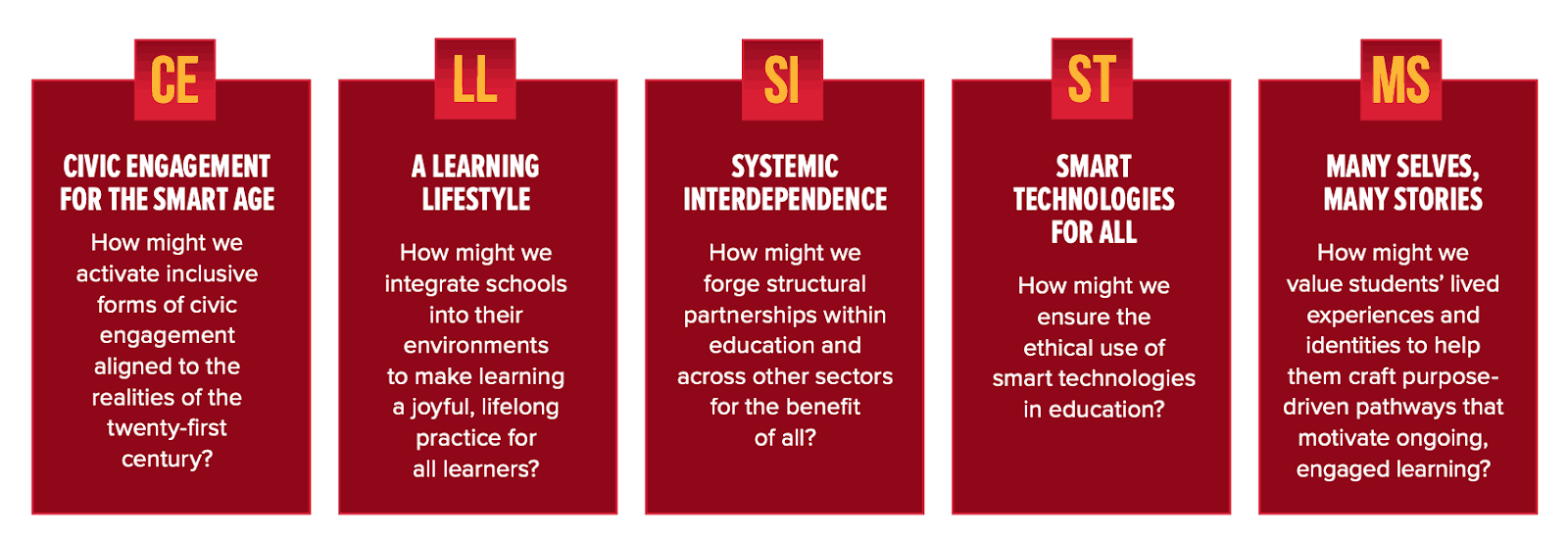
and me and thinking more about collective outcomes in addition to individual outcomes. Let’s jump to the opportunities. Your report does a nice job of identifying a set of opportunities. Should we jump in with civic engagement? Sure.
So this opportunity to, I mean, all of these opportunities are really looking at how, given the changes on the horizon, might education leaders and influencers and innovators respond to kind of move toward a future of learning that is more equitable, that’s more human-centered and that has more ability to adapt and respond to the changing landscape as an ecosystem. So with civic engagement for the smart age, we’re really looking at the opportunity to think about
activating inclusive forms of civic engagement that fit 20th century, 21st century realities. So very much related to the civic superpowers driver of change. We think that education institutions have a real opportunity to empower learners to contribute directly to democracy and help tackle the challenges that we’re facing. Yeah, we love that idea.
As I said earlier, it’s never been easier to make a difference. And we increasingly, like you think about school as a place where young people can begin to make a contribution, particularly through civic engagement. So we love that you’ve started there. What about a learning lifestyle?
So here we see a real opportunity for schools to be integrated more deeply into their environments so that more assets from across the community are really integral to people’s experience in learning. And the goal here would be not just to do it because we can, but to really help make learning a joyful, lifelong practice for all learners that starts with that kind of ecosystem, a kind of cross-community type view in the K through 12 years and then just extends throughout a lifetime.
So with this, we think there’s a real opportunity to expand what we think of as expertise that can contribute to education, bringing in all kinds of community-based organizations besides schools and post-secondary institutions, but also other kinds of expertise, elders, artists and small business owners and such. And to think a new about mentorship, kind of how can we recharge that, not just with an academic, but also with a social-emotional focus.
And at the same time, making sure to elevate the role of traditional educators, even as we’re expanding our understanding of who’s involved. Yeah, I love that category. We just finished a book on place-based learning and encouraging people to take the view of city as classroom. And we’re excited about the combination of place-based learning and competency-based learning as we get better at helping young people capture and communicate their new capabilities.
We can really begin to take advantage of any time, anywhere learning. So we love this category. How about systemic interdependence? Yeah, so this is really looking at an opportunity for traditional education institutions to work across sectors and collaborate with other sectors and indeed with one another to achieve greater benefits.
So we’re seeing a lot of big problems, such as climate change, that don’t have single-sector solutions. And even if we’re thinking just about supporting learners and meeting all of their needs, that’s not solely within the purview of traditional educational institutions. So this is really thinking about kind of breaking down silos and cultivating web-based exchange that can help everyone be more effective and can move toward what we would like for learners.
So lots about partnership, finding leverage points and systems besides education and expanding peer-to-peer support and partnership capacity. Yeah, that’s great. We wrote a book a couple years ago called Smart Cities that we tried to make this point. And Catherine, it reminds me of a trip to Dallas a month ago where I saw 25 P-TECH schools, which is a great example of combining high school and college and internships into a rapid, supported pathway to high-tech employment.
So a great example of cross-sector partnerships that are creating new opportunities for youth. Absolutely. Smart tech for all. Yeah, so getting back to our discussion about smart technologies and the kinds of ways we’re being increasingly able to tinker with ourselves, there’s a lot that we need to be attending to about making sure that we’re using smart tech technologies ethically in education
because of course those technologies are only as good as the code that powers them and the practices that are guiding their use. So the stakeholders whom we convened to identify these opportunities really thought it was urgent that we manage the ethical considerations around these kinds of things. Doing things like spotlighting digital rights and helping learners who have a really savvy sense and understanding of their digital literacy and their rights, but also thinking about how educators can be collaborating with tech development companies to co-developing schools that really make sense and not guard not to just what kind of the operations of educational institutions but also their values.
And then a real need to think about kind of broad models of governance related to smart technologies since they are so complex and this pursuit of their ethical use will benefit from having a lot of different kinds of people and expertise involved in guiding it. That’s a great category. So interesting as we’re on the cusp of adding another three or four billion people to the internet and dramatically increasing the speeds available on the internet. Some people would say we’re at the point of greatest learning opportunity in human history. This category of smart tech for all is going to be an important one for the next decade.
Yeah, and we really wanted to emphasize that there’s a role and education needs to be really intentional in guiding that so that it is as equitable and as effective as possible. You know, the decisions made in the next 10 years are either going to begin to close the income gap or it’s just going to continue to accelerate. So I really appreciate that statement of that idea of education being an integral player and the intentional guiding intentionally the use of technology. The last opportunity that you talk about is many selves, many stories. What is that about? So that’s about really trying to find ways to value students lived experiences and identities in educational settings so that they’re crafting their own purpose-driven pathway, not just learning what others tell them they need to learn.
And the idea here is that if people really have a sense of their own purpose, their own direction in their lives, even if it’s a temporary view of the young person, that that can really help motivate ongoing and engaged learning while also respecting learners for who they are and enabling them to really bring their full selves and their full histories to learning environments. So again, what we talked about before in regard to the expansion of narratives of success comes into play. We really see an opportunity for those to be broadened. There’s also a real opportunity to teach not just for self-discovery and that sense of purpose that I mentioned, but also for healing as more and more learners experience trauma and as we have histories of inequity and trauma to contend with. And then really trying to help the broader public also see that as we work to kind of broaden our understanding of what we’re doing in learning environments and what we’re asking learners to achieve, that we bring people along and show that there are kind of ways of being successful in and beyond learning environments other than the established ones that we tend to take as given, but we’re situated in historical moments along the way.
That is a great category. We appreciate you adding that. We love the idea of purpose-driven pathways. We’re writing a book on that subject. Let’s wrap up by talking about some of the questions that learning communities can address to begin to take advantage of these opportunities. Sure. I think most foundationally is to ask what is a learning community’s vision for the future of learning and many learning communities of course already have those, but we also brought into the strategy guide some elements to consider for those who might be wanting to refresh their visions. Then I think same well, what strategies from this guide or what opportunity areas seem most relevant, kind of particular circumstances I think would be a way in. So not trying to say I’m going to tackle all these opportunities at once, but to say, you know, this one strikes me for my organization for some reason.
And then thinking about well, are the strategies within it relevant or maybe not, but maybe there’s another set of strategies that relate to it that would be relevant. So I think those are some good starting points and I’d even say if something seems really perturbing, that might be an interesting place to look too, in that that might yield something that’s worth attending to as an organization, things about moving to the future of learning. I’d like the idea that there were a couple of things. One is you don’t need to take on everything at once in that in each community may have a slightly different set of priorities given the challenges in the community or the assets in the community. So holding a community conversation to identify priorities, thinking about the work in phases. You asked the question, how might you modify these strategies to reflect your organization or your ecosystems vision values and context.
So what’s the right answer and sequence for you? Seems like a great place to get started. Yeah. And then, you know, once, once there is that sense of direction, even then, you can’t do it all at once. So thinking about really breaking it down to what’s the first step and then what resources could be redirect to pursue those strategies. That kind of thing can make it make this kind of change that we’re talking about feel more approachable.
You talk about really turning this into a project plan and trying to. What would you think of it as collective action of a group of organizations working in concert in partnership? You know, I think in its fullest expression, it would need to be particularly with some other kind of partnership and ecosystem opportunities that are out there. But I think even in single organization, there could be really effective responses that that a group or an individual could lead. There’s so many layers of response to the changing horizon that are that are valid.
And again, the scope of it and the pace, I think is going to be very context specific. Your last set of questions are around resources. Have you seen interesting trends there about people developing new resources or reallocating resources? It’s I think it’s pretty nascent still. And so much of this is in the space of future possibility.
I mean, we’ve seen some interesting efforts in the museum and library community based organizations space where we’ve seen some networks of those kinds of organizations come together and try to create kind of integrated out of school time opportunities for learners. And those in all honesty have been kind of difficult to sustain in some communities because initial funding has passed. It’s hard to know how to finance them or once and throughout it’s kind of hard to know how to manage and govern them. So we’re definitely not saying that this is easy, but that it’s worthy. Catherine is in St. Brain Colorado over the weekend and that’s in Longmont just 30 miles north of Denver.
It’s a community that won a race to the top grant and I3 grant. They’ve built a lot of community partnerships and and so some of this work started almost 10 years ago with some kind of one time funding opportunities. But it’s exciting to see what that has yielded 10 years down the down the line. It’s a group of communities working together with business with civic leaders to create amazing learning opportunities for kids. So it’s exciting to see some of those big grants from 10 years ago really coming to fruition now.
And it’s a great reminder that what we set in place now could have a huge impact in 10 years and will help determine what’s possible for learners and for the education system then. It is and sometimes we’re so short-sighted about this. You know, people a couple years after a race to the top would say, oh, that didn’t work out very well. We didn’t get the big bump in the scores that we had hoped. But you know, for me, this is a great example of how a community had really been transformed and the kinds of learning experiences that young people have and the connection with those experiences to employment pathways is just dramatically altered life in that community.
And it took about 10 years really for that to play out. So sometimes we need to take the long view. We do and know that maybe test scores while they have a role are not necessarily going to tell the full picture and that you need to know more broadly about how we know something has been successful. So you’ve mentioned some of this before but like where what should people do next? How would you describe one or two kind of first steps if you’re a teacher or a school leader, maybe a civic leader?
What could you do to catalyze change in your community? So I think bringing together a group within one sphere of influence as we talked about to kind of articulate either a comprehensive vision for learning in the community or a more specific kind of goal. To kind of get some collective sense that the world is changing and we need to respond together to that. I think that’s really foundational for people to kind of align diverse efforts, especially when working across organizations. And then again, kind of looking at kind of what’s high priority here?
What are the big challenges and opportunities locally and then crossing those with some understanding of how the world is changing? So again, we’re not going to be able to necessarily retool everything or respond to every trend or driver change, but trying to get a sense of priority within all that could be done. We appreciate this report. It’s like all of your work. It’s thought provoking.
It’s interesting. We’ve spent the last 10 minutes talking about the next steps. It’s also super practical. So thanks for giving us an overview. The report is called Navigating the Future of Learning, a Strategy Guide.
Where can people find that, Catherine? You can find that on KnowledgeWorks website, which is knowledgeworks.org, and it’s free to download. They can find you on Twitter at at cat prints. That’s right. And KnowledgeWorks is on Twitter at at KnowledgeWorks.
Great. Check it out. It’s a super thought provoking guide. It’s worth using. Your community will benefit from it. Catherine, thanks for joining us on the podcast again.
Thanks for having me, Tom. Thank you to Catherine for joining us for the podcast. We appreciate KnowledgeWorks sustained commitment to foresight. Their forecasts are always thought provoking and help us see the challenges and opportunities ahead. Tom’s friendly amendment was that the climate crisis will have a big influence on education in the next decade.
For a review of seven important books on that topic, see episode 210 with Greg Smith. We’ve got it linked in the show notes and on the blog. And as always, make sure you rate and review the show. While you’re at it, tell a friend about us, share your favorite episode on Twitter or Facebook, and tag us so we can see. Okay, that’s it for today, listeners.
Thank you for tuning in to the Getting Smart podcast. This is Jessica, signing off.



0 Comments
Leave a Comment
Your email address will not be published. All fields are required.