

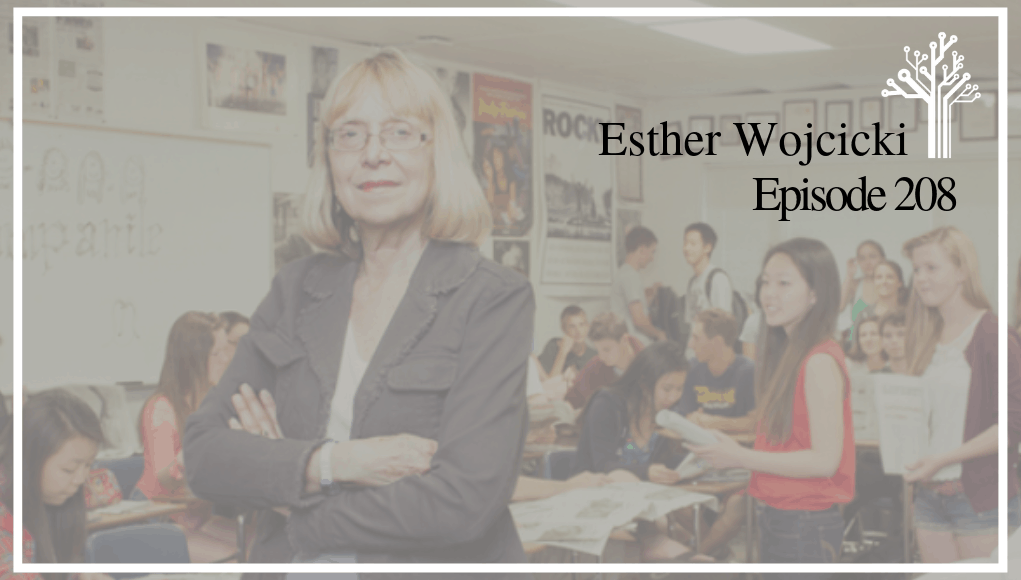
Podcast: Esther Wojcicki on Raising Successful People
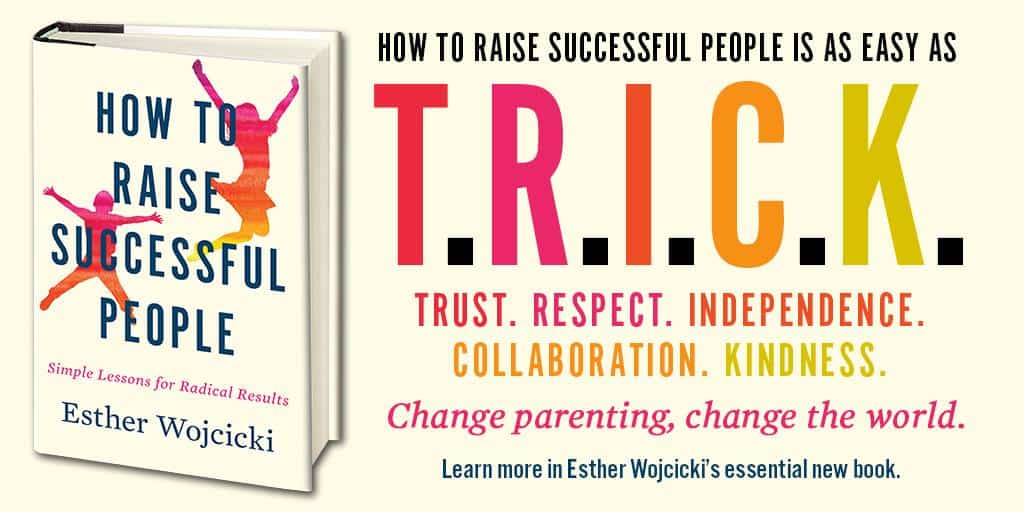 In her new book, How to Raise Successful People: Simple Lessons for Radical Results, Wojcicki outlines the values of successful homes (or schools, programs, or companies): Trust, Respect, Independence, Collaboration, and Kindness (TRICK).
“Most important is trust,” said Wojcicki. Helicopter parenting is the opposite of trust, it just makes kids feel fearful on their own. “The main thing is helping them become independent,” added Wojcicki.
Kindness–that’s best learned by modeling. So is a sense of humor explained Wojcicki.
Set high expectations? Sure said Wojcicki, but give kids a chance to try again, teach iteration rather than punishment.
The Wojcicki girls benefited from living in Switzerland for a few years and traveling extensively. She also encouraged projects that the girls could work on together, building collaborative experiences
Wojcicki kids (and grandkids) all start working at the age of 15. “Children realize the world works when everyone has a job.” explained Wojcicki.
On issues like screen time, she suggests including kids in the process and mutually deciding on an amount of time. But, of course, no phones at the dinner table.
The same common sense principles that recognize human dignity and build agency and autonomy have worked as well at home and school for Wojcicki.
Key Takeaways:
[2:36] Where and how did Esther’s passion for journalism first begin?
[7:41] What was the state of student writing and journalism when Esther began as a teacher at Palo Alto High School in 1984?
[12:12] What does Esther believe to have been the key ingredients to the current success of Palo Alto and its journalism program.
[17:11] Esther summarizes the conditions that allow a world-class program such as the journalism program at Palo Alto to exist.
[23:17] Esther speaks about her first book, Moonshots in Education, and explains what the Moonshot Manifesto is all about!
[24:52] Esther speaks about the Journalistic Learning Initiative she created in collaboration with the University of Oregon.
[26:49] From her book, How to Raise Successful People, Esther explains her important acronym, T.R.I.C.K, that are the key values crucial to raising successful children, a successful classroom, and managing a successful company.
[38:02] Have Esther or her daughter’s developed useful tech management tools around screen time?
[40:54] Esther gives her recommendations on when and how to expose children to the world of work.
[42:45] When did Esther let her girls know that she was writing a book on how to raise successful people?
Mentioned in This Episode:
Mason Pashia — Getting Smart’s new Growth & Marketing Manager
How to Raise Successful People: Simple Lessons for Radical Results, by Esther Wojcicki
ASU GSV Summit
Palo Alto High School
Moonshots.org
Moonshots in Education: Blended Learning in the Classroom, by Esther Wojcicki, Lance Izumi, and Alicia Chang
Journalistic Learning Initiative
For more see
In her new book, How to Raise Successful People: Simple Lessons for Radical Results, Wojcicki outlines the values of successful homes (or schools, programs, or companies): Trust, Respect, Independence, Collaboration, and Kindness (TRICK).
“Most important is trust,” said Wojcicki. Helicopter parenting is the opposite of trust, it just makes kids feel fearful on their own. “The main thing is helping them become independent,” added Wojcicki.
Kindness–that’s best learned by modeling. So is a sense of humor explained Wojcicki.
Set high expectations? Sure said Wojcicki, but give kids a chance to try again, teach iteration rather than punishment.
The Wojcicki girls benefited from living in Switzerland for a few years and traveling extensively. She also encouraged projects that the girls could work on together, building collaborative experiences
Wojcicki kids (and grandkids) all start working at the age of 15. “Children realize the world works when everyone has a job.” explained Wojcicki.
On issues like screen time, she suggests including kids in the process and mutually deciding on an amount of time. But, of course, no phones at the dinner table.
The same common sense principles that recognize human dignity and build agency and autonomy have worked as well at home and school for Wojcicki.
Key Takeaways:
[2:36] Where and how did Esther’s passion for journalism first begin?
[7:41] What was the state of student writing and journalism when Esther began as a teacher at Palo Alto High School in 1984?
[12:12] What does Esther believe to have been the key ingredients to the current success of Palo Alto and its journalism program.
[17:11] Esther summarizes the conditions that allow a world-class program such as the journalism program at Palo Alto to exist.
[23:17] Esther speaks about her first book, Moonshots in Education, and explains what the Moonshot Manifesto is all about!
[24:52] Esther speaks about the Journalistic Learning Initiative she created in collaboration with the University of Oregon.
[26:49] From her book, How to Raise Successful People, Esther explains her important acronym, T.R.I.C.K, that are the key values crucial to raising successful children, a successful classroom, and managing a successful company.
[38:02] Have Esther or her daughter’s developed useful tech management tools around screen time?
[40:54] Esther gives her recommendations on when and how to expose children to the world of work.
[42:45] When did Esther let her girls know that she was writing a book on how to raise successful people?
Mentioned in This Episode:
Mason Pashia — Getting Smart’s new Growth & Marketing Manager
How to Raise Successful People: Simple Lessons for Radical Results, by Esther Wojcicki
ASU GSV Summit
Palo Alto High School
Moonshots.org
Moonshots in Education: Blended Learning in the Classroom, by Esther Wojcicki, Lance Izumi, and Alicia Chang
Journalistic Learning Initiative
For more see
- Wojcicki’s Classroom and Book Encourage Shooting for the Moon
- Professional Grade: Magic Happens When Students Own High Standards
Stay in-the-know with innovations in learning by signing up for the weekly Smart Update.
Transcript
This transcript has not been edited for spelling accuracy.
We’re listening to the Getting Smart podcast. Where we unpack what is new and innovative in education. We’re your host, Caroline. And Mason. And today we’re talking with Esther Wojciki.
But first I’d love to introduce you to Mason Pasha, who recently joined our team to lead our marketing efforts. You can read more about Mason on the GettingSmart.com team page. Mason, tell me about the values of your family that have impacted your life and career today. Thanks for the introduction, Caroline.
Excited to be a part of the GS team. My parents are both artists, painter and an architect, so I had creativity instilled from a pretty young age. And also a lot of different self-starter bones in my body. So kind of moving forward, I did a lot of passion-based work.
And there was a lot of encouraged failure and the effort to try everything. I love that. I think we had a lot of that in our family too, where we were encouraged to try and success didn’t always have to be the outcome that just started the journey was part of our value system.
And I think that’s really why I resonate with Esther’s message. Her new book, How to Raise Successful People, simple lessons for radical results. Esther spends time outlining the values of successful homes. They can also be attributed to schools, programs and companies as well. And she uses a method that she calls TRIC, which stands for trust, respect, independence,
collaboration and kindness. While honing her craft as an educator, Wajeki was raising three daughters using the same principles. In this podcast, Esther discusses teaching her children independence, modeling the important behavior, setting expectations, learning failure and traveling.
Let’s listen to Tom and Esther discuss her career and her lessons outlined in her new book. Esther Wajeki, welcome to the Getting Smart podcast. I’m very happy to be here. Thank you so much for inviting me.
What an absolute treat to have you on. It was really great to see you last week in San Diego. I really love that conference, you know, ASUGSV. And I really had a great time meeting lots of friends, including you. We’re remarking that there are about a thousand of our good friends standing together in a
lobby. It is like a giant reunion. It’s about a thousand. Really, it was incredible. I mean, I couldn’t move maybe three feet and then I met somebody else that I really liked.
So, and then I was hoping to see. So yeah, I think I just need to spend more time there also. Esther, I very frequently refer to you as the world’s best journalism teacher. And I want to talk about where this started. And I learned recently that you started very early as a paid journalist.
What was your first writing assignment? Well, I started really early as a paid journalist. I was 14 years old and I somehow had the courage to go and talk to the people at this little newspaper called The Sunland to Hung a Record Ledger. I needed a job and I wasn’t very good at doing any of the other things that most teenagers
were doing like working in a grocery store or dress shop or something. And so I went there and applied for a job and these guys were kind of shocked. But they were really happy to see me, which was really nice because they decided to hire me and they said they would help train me, which I thought was wonderful. And they would pay me three cents a word.
Now most people would get very excited about three cents a word, but I was pretty excited. And so that’s where my career started. And I actually first started writing, they first trained me how to write obituaries, which is kind of terrible. Do you still read obituaries?
Every now and then I read them. The ones that they wanted me to write were kind of like personality features only. I couldn’t interview the person that was in this feature. They were already dead. And while you were busy becoming your high school valedictorian, you were also the editor
of the newspaper. I’m guessing there was a good English teacher behind that. Do you recall having a good writing instruction in high school? Actually I had a good English journalism teacher and she encouraged me a lot. And I had no idea.
It’s kind of interesting what a fog you’re in when you’re a teenager. I didn’t realize that I really had any talent whatsoever. But she encouraged me and I became editor of my high school newspaper. And it was a very tiny little paper. It didn’t look anything like any newspapers really looked like.
But it was fun and I had a good time. And I mean, I’m not sure. I really learned a lot of writing styles. But I learned enough and it empowered me. But it was, I think you and I share this sense that these production experiences, good writing
on a deadline for a public audience, that that’s super valuable experience that you had and must have been formative because you spent 40 years helping other people have those kind of experiences. Yeah, it’s absolutely true. I mean, I think journalists learn skills that are so important for life, which is one of
the reasons why I use it as a teaching tool. I think more kids should have that opportunity and not just. Yeah, why do you? You went to Berkeley. Did you have good writing experiences there?
So at Berkeley, I had pretty good writing experiences also. I had a double major of English literature, which was basically American lit and then political science. And I had to write all the time and all those classes. But also I continued to write for the Berkeley Daily Gazette because I still needed to earn
money. I was a poor student. And somehow I seemed to see newspapers as a way to earn money. I don’t know why that happened to me, but it worked out. And so I did that at the same time.
I was going to school. And why did you study French at the Sorbonne? Well, I moved. I got married early. I was like, well, fortunately, I guess, or whatever.
I’m still married to the same guy that I picked back then when I was 20. Another super smart human being, Stanley. Stanley, yeah, super smart human being. And he got a fellowship, National Science Foundation Fellowship, to go to Europe. And so we moved to Geneva, Switzerland.
And I didn’t speak a single word of French, but I learned it really quickly over there at the University of Geneva. And I enrolled in the School of International Relations. And I must say it was a fantastic program there. And then I moved from there to Paris to the Sorbonne.
And at this point, I already spoke French. And so that’s why I went to Europe, to Paris, and had a wonderful time. I must say it was a great experience. We’re going to come back and talk about having kids and raising extraordinary women. But I want to fast forward to Palo Alto High School.
I think you showed up there in the fall of, was it 84 or 85? 84. In the fall of 1984. 84. What was the state of student writing and particularly journalism in the fall of 84?
Well, there were some very exciting kids there, excited kids, I should say, who were excited that I came. The program was pretty small. There were about 19 students in the program. And the newspaper was small.
It was between, it was on a regular basis, it came out every couple of weeks. And it was six pages long. It was your typical high school newspaper. The back page was a calendar. So really we had just four, five pages at the most for us to, for the kids to write anything.
The program was run by a very authoritarian person. Let’s put it that way. He felt that it was really important for him to always be the last person and the final say on whatever was. He was the editor in chief, right?
Well, he was the teacher. He was also the editor in chief. And so I was expected to do the same thing, you know, because when you come in as a new young teacher, that’s what they expect you to do. Just take over their program and do it the same way.
And I did for a while, you know, because you’re new and everybody’s watching you. So I did that for a while, but then I realized this just didn’t work. You know, the kids did not like this at all. And so I shifted and I decided to give them more control and hope that no one noticed. And so, you know, gradually I was shifting more control to their students.
But by the second year, I’d become a little bit more empowered and brazen. And so I just threw the entire program out and started my own way of teaching. That was pretty much collaborative. And not only that, I got rid of the book. I was a terrible book.
And I brought in newspapers on a daily basis. Fortunately, the Mercury News, San Jose Mercury News used to give me free papers. But then also I went to, you know, have the little stands where they have a lot of free newspapers. Well, I just took 20 papers and I, you know, had them for my students.
And we used the real paper as an as a textbook because that’s what we were doing, writing for a real world and not just a high school newspaper. So I dramatically changed what was going on in the classroom. And you were teaching in modest circumstances, I think, sort of in a modular building? Well, when I first was teaching, I was, they put me upstairs in this building called the
Tower Building. I had a small room up there. And then after, you know, a couple of years, they moved me to what is called a portable, which is really a trailer that they drag onto campus and then put wooden slots around it so you can’t see the wheels.
And yeah, so I was in a trailer for 30 years. That was, uh, yeah. I wish everybody listening could could visit because I want to fast forward to today. Now when you visit Pali, there’s a spectacular building called the Media Arts Center. And when you walk in, um, you don’t first notice teachers, you notice students working
with other students. And you’ll quickly see evidence of about 10 world-class publications. And you’re in this world-class facility, observing what look like student-led enterprises. And you may find Wodge sitting in the kitchen maybe having a little salad. It’s really extraordinary.
When you, you must smile when you, when you visit that place and how do you reflect on the key ingredients to what, what I think is widely considered the best journalism program in the country? Well, I’m first of all really honored and excited to have that building and it was supported by the taxpayers in Palo Alto.
And also my colleague Paul Kandel, um, who helped me get the whole thing going. You know, he was, he was so excited about this building. We were all excited about the building. So we had a lot of input into what was, you know, what they were planning. And it’s really a student-run system of publications.
There’s not just one publication. There’s not just a newspaper. There’s multiple magazines and there’s television and we also have radio and we have podcasting and we have, we make movies. So every, what we’re trying to do there is to give every student who would like to be
part of the program an opportunity to express themselves in any medium that they’re interested in. And so they take a beginning journalism class that last 20 weeks. And then from that class, they have a choice of a variety of different, um, ways of expressing themselves and ways of being involved.
And the program has now about 700 kids involved. And yeah, part of, I mean, I would say the number one attraction that all these kids are going for is empowerment and freedom. They get to make a lot of decisions on their own and then they get to publish and it’s in a highly respected publication.
So they all want to be part of it, which is for me, it’s wonderful. So Esther, maybe you could describe some students progressing to leadership roles for these various publications. So how, maybe you can describe some of the student leadership. So on every publication, we have editors in chief and then we have associate editors and
page editors and senior writers. So what we try to do is allow, we disperse the power to some degree and we allow as many kids as possible to have leadership roles because they’re learning a lot about leadership and about collaboration and about working in a sort of high stress environment. Journalism is somewhat high stress because you always have a deadline and you have to
collect the information and then you have to verify the information and you have to write it up in a way that everybody is going to want to read it. So the main, the main leaders are the editors in chief and for example in the student newspaper that I advise together with my colleague Rod Saturday. We have five editors in chief and those editors are in charge of the program.
They really, they’re doing it and I and my colleague, we kind of keep an eye on, make sure that they don’t need anything, that the program is kind of going the right direction. But for the most part, we really don’t have to do much of anything because they’re so smart and these aren’t just gifted kids. These are regular kids who rise to the occasion and become amazing.
So if all kids are given an opportunity to have this kind of a leadership experience, they too can rise to the occasion because we have associate editors and page editors and advertising managers. All these publications are self-supporting. So the kids have to raise the revenue in order to get the publication to be published.
So if they can’t raise the revenue for some reason, it can be just online. But all the revenue is raised. They do a great job and that’s because they’re really passionate about it and they own it. It belongs to them. It’s their publication and they’re really proud of it.
Of course, I’m very proud of them. And so, you know, all the other advisors are proud of them. There’s a total of seven advisors in addition to me now because we have so many kids involved in this program. So you know, 700 kids is a lot of kids.
I sat in on one of those editorial meetings and high stakes and pressure-filled dutch describe it. It’s interesting that with students in charge and they really do take these publications very, very seriously. I’ve written a couple of times about the conditions under which teenagers do world class work.
The Pali journalism program is one of a few places where I’ve witnessed teenagers doing really world class work. And I don’t know, how might you summarize the conditions that exist that allow that to happen? You’ve talked about empowerment, right?
What are the other conditions? Right. So, most kids, when they come into the beginning journalism program, they are waiting for you to tell them what to do because that’s the way they’ve been trained. We take them in the 10th grade.
And so, they’ve had 10 years of being told what to do. So initially, it’s a little difficult for them to realize that they get to make these decisions. One of the hardest things is for them to realize that they’re in control. But that not only is it hard, it’s exciting for them.
It’s just initially that is something that they have to learn how to do. But once they, I mean, let me tell you, they learn how to do it pretty fast. And then once they feel confident being in control, then what that does is it spreads to their entire life. They feel empowered and they feel like they can do anything that they want to do in all
the classes that they’re taking so that it spreads to their social studies, English, math, whatever. They feel much more capable as human beings. And this is a skill or a way, a mindset, I should even say, a way of thinking about yourself that all students should have and that all students should feel like they can
achieve it no matter what. If you fail the first time, which is usually what happens when they’re learning how to do this in the journalism program, they make a lot of mistakes. You can’t write something right the first time. And sometimes kids have to revise like 10 times.
But it’s not considered shameful. In fact, it shows that you have the grit to continue doing that. And this, again, the fact that it’s okay to fail and start again and do it again and do it again, this again spreads to all areas of their life. It’s like, wow, I should be able to do this in my social studies class or my math class.
And they do and it impacts their image of themselves, which is what you want them to feel. Feel empowered for life. Yeah, the amazing thing that I’ve seen there is that kids are getting frequent and often really tough feedback, but it comes from peers or maybe even an external audience, right?
A critic of their work. It’s really authentic, either audience or peer feedback. It doesn’t have to come from you as the teacher. It does not come from me. The majority of feedback comes from their peers or from the outside world when their
articles are published, but it’s primarily peers. And there’s a culture there where it’s very important to establish a culture where we’re all working together to produce this product that we want to be proud of. And so while we’re criticizing what it is that you produced, we’re not criticizing you. We’re trying to help you be a better writer or a better researcher or a better whatever
it is that you’re working on. So it’s a sense of camaraderie and community. It’s a very supportive community. Actually, a lot of the kids say it feels like a very large family. That’s what we’re striving for because they all try to help each other be the best that
they can be. And again, this sense of community and family follows them through life. A lot of these kids remain friends for years. And it’s exciting for me as a teacher to see how successful they can be. You know, Esther, we see this somewhat freaky and in really great sports programs that create
a culture and a tradition of excellence. And kids that grow up in a community, they want to grow up and be part of that sports team. And you’ve been able to do that in an academic program. And it’s so exciting that I think even young people in Palo Alto know about the journalism
program there. It really is a great example of a flywheel of excellence in an academic program. Well, it’s interesting that you said that about us, the sports team, because when I first started doing that, I first started being the advisor for the newspaper there, I thought to myself, this was conscious.
I want to have the same kind of team spirit that they have in the sports teams. I wanted this to be a team, an intellectual team. And I wanted all the kids to feel like they were part of a team. So one of the things that I mean, I did a lot of things that the teams do. So we had t-shirts that, you know, I figured this is a team, right?
And all the teams have refreshments, you know, because they need it. And I feel like my kids need it too. And then the whole mentality is like, we’re working on this project together. Okay, maybe we’re not playing a game, but our game is a newspaper or a magazine or a television.
And you know, that mentality works. Kids loved it. Yes, sir. In 2015, you published a fun book called Moonshots in Education. You launched a cool site called Moonshots.org.
What is the Moonshot manifesto in short? So the Moonshots in Education book was my first book and it has a summary of what I do in the journalism program. In fact, I took a lot of my lesson plans and put them in there. And then I had a couple chapters that were written by my students to show exactly what
kind of work students can do. I mean, they can write just as well as I can. And then there’s a chapter in there about how to search intelligently, because that’s one of the things kids need to know how to do. You’re online, you need to get the information, you need to get it right, you need to be able
to evaluate the source. And then another chapter on just how to, or another part of the book, I should say, on just how to interview and how to reach out and get information. So that’s a book that I targeted for teachers. And it’s still there, it’s still valuable.
I must say, I think I need to revise it because some of the links in that book, some of the companies, they’re not there anymore. They change quick. So yeah, the tech world and tech world changes quickly. But the ideas in the book are valid.
And so when I revise it, I’m going to add new links that hopefully will stay a little bit longer than this one. I love Moonshot because it really does outline all the ways that you’ve been successful in creating autonomy and agency in the classroom. You’ve also worked with the University of Oregon on the Journalistic Learning Initiative
and captured a lot of your lessons learned on how to teach journalism, right? That’s right. The Journalistic Learning Initiative at the University of Oregon is one of the projects that I worked on and I’m still working. It’s a professor at Madison that I’ve been working with for a few years and we’re in
about 10 schools there where we send in journalism kids that have been trained as journalists in the University of Oregon and they become mentors for the teachers to help the teachers implement journalism programs and seems to be very successful. And we also had a few schools in Los Angeles where we’re also doing the same thing. And now what I’d like to do is be able to do this for more schools nationwide and worldwide
because these skills are, they’re fun and they’re so effective. And they help kids, you know, transition to the 21st century easily because we’re using a lot of tech skills and we don’t teach tech per se, but it’s part of the program. So we do teach tech, but it’s not like this, you’re taking a tech class. It’s like you’re taking a journalism class.
And by the way, you’re going to need to know how to use tech in order to do it. Very kids should graduate with a handful of really powerful production and presentation publication experiences. Everybody can learn more about this at JournalisticLearning.com. All right, we’ve got to move on to these, what we were supposed to talk about today
is you have this great new book out called How to Race Successful People, Simple Lessons for Radical Results. Yes. So while you were leading the world’s best journalism program, you were also raising three extraordinary daughters, Susan, who’s now the CEO of YouTube, Janet, who’s a professor
of pediatrics and Anne, who’s the co-founder and CEO of 23andMe. And now that I’m a grandparent, I also want to note that you have nine grandkids, right? That’s right, nine grandchildren and one more coming. Yeah, I only have one, but one on the way. So you have summarized a couple of the lessons learned in a great acronym, TRIC.
So what is the TRIC to parenting today? So this is the TRIC to parenting, but it’s also the TRIC to the classroom. And it’s also the TRIC to having a successful company for the CEOs. So TRIC stands for the acronym, stands for Trust, Resact, Independence, Collaboration, and Kindness.
And I’ll tell you, it works like a charm in the classroom and it works really well as a parent. It’s a parenting TRIC. So the first thing that I used to, actually the first thing that’s the most important is trust.
And when you trust your kids as a parent or as an educator, they feel trust themselves. They feel much better about themselves because they’re like, oh, that person I respect, trust me. And so, you know, I should trust my own instincts. So it’s a very empowering way of thinking.
And that’s what happens in the classroom. I actually, I couldn’t understand why all these kids were taking my class, to be honest. And so it was in the 1990s when the classes were really growing like crazy. I asked the kids, like, I don’t really understand what’s so special about this class. Why are you taking it?
Other than I sort of had that, you know, fun team mentality. And I thought, well, maybe it’s because it’s fun, you know, or, you know, maybe it’s like a team or I couldn’t figure it out. Anyway, the number one thing they said to me is you trust us. And you know, that didn’t register.
It took, you know, they said the next year and I was like, God, there must be something to this trust business that I really don’t understand. But it turns out that’s the most important thing because that makes the difference. And that is what you were witnessing when you came to see the program. Those kids trust each other to give proper feedback, to respect each other, to take care
of the program, to work together as a team. Trust is the key. And the same thing is true in parenting. You know, when you trust your child, trust them to just, I mean, even do little things around the house, you know, to help decide what to have for dinner that night or help
decide what you’re going to be doing this weekend. That’s a very empowering thing for kids. And so that’s the first part of the acronym. Yeah. The first three are so related, trust, respect and independence.
Right. It’s become so common since you and I were raising kids to be helicopter parents, to be, you know, it feels like a dangerous world there. So how do we avoid helicoptering as kids get older? Well, you should avoid helicoptering totally.
Because helicoptering is just the opposite of trust. So when you helicopter, you’re basically saying that I don’t trust that you can do this by yourself. You’re going to need some help. And by the way, I’m going to help you.
And kids that grow up with helicopter parents tend to feel somewhat fearful when they have to do things on their own. And there’s a friend of mine that wrote a book, she’s the former dean of admissions at Stanford University, Julie Litcott Haynes. And the reason she wrote the book is because a lot of these helicopter parents actually
go to college with their kids. And they are, they’re moving in right, well, they don’t have the same housing, but they’re moving close by so that they can continue to help their child in case there’s any kind of problem. We even have professors at major universities who complain that, you know, if something happens
in a classroom, a parent will call up for an 18 or 19 or 20-year-old. So what are we training these kids to do to be dependent on you all the time? It doesn’t seem to work very well. So that’s part of why I suggest starting not helicopter parenting early on, because your children are going to grow up to feel much more empowered and capable if you take
that step to start. And I did that, by the way, everybody wanted to know, like, what did you do with your daughters? How did you get them to be so empowered the way they are? So I didn’t have this acronym back then. I didn’t know exactly, you know, what I was doing.
I had to develop the acronym. But one thing I knew from day one when they were born, the main thing I wanted to train them to be was independent. I wanted them to be able to do as much for themselves as they possibly could. I didn’t want them to be dependent on anyone.
Yeah. So Esther, I have to ask you a hard question. As a father of now grown daughters, you have to be careful of what you wish for, because I live in a house of powerful women. There were times, particularly in the middle teenage years, when this seemed unpleasant.
Right? Yes. Where it was working itself out. So how do you make it through the teenage years when they’re beginning to exercise their independence?
Well, number one, you have to have a sense of humor. It helps. My husband used to say, I feel outnumbered here. It’s crazy. Right.
And then I can, Stanley and I have to go get a drink and talk about this. That’s true. You should. But then to top it off, you know, we had a dog named Truffle, a female dog. Who produced nine puppies.
So he was like, this is crazy. I cannot believe all these females in the family. But actually with the sense of humor, and you know, as long as the girls didn’t take themselves too seriously, it worked out pretty well. And you know, I never really had your typical teenage girl problems with my daughters in
the sense that, you know, they were always independent, but also thinking about other people. They were always kind. And I think people learn kindness not by you lecturing to them. They learn kindness by modeling after you.
And somehow I think that that came across. Let’s talk about expectations for a minute. My parents set high expectations for both for behavior and achievement. How do you think about that? Yeah, I think you set high expectations.
And then if they don’t reach those high expectations, you’re like, well, no problem. Let’s just try again. And I think the problem comes when there’s punitive action, if the expectations are not met. But if you have an idea that iteration is important, you know, that’s basically the
way that you should work. Just for example, like Susan, when she was the oldest, she was the first one to take the PSAT test. And you know, I wasn’t paying a lot of attention. I didn’t realize, oh my God, maybe this test was important.
I didn’t pay any attention. So she didn’t prepare for it at all. As a matter of fact, the night before she went out to a party. And then she took the test. And then of course, she didn’t get a very good score.
Was like kind of miserable. And I was like, Susan, maybe you should take this a little bit more seriously. You know, this is sort of like important to get into college. And so the next time around, she did, you know, she got one of those books. That’s what SAT prep book or something.
And she studied for it. And then her scores went up dramatically. But you know, there was no, I wasn’t mad. You know, I figured that’s her life. It’s her choice.
And then she wanted to do it. She personally wanted to improve her own scores. And so she did. And I think that’s held for pretty much everything in our lives, or my children’s lives. If they didn’t do well, the idea was like, let’s do it again until you get it right.
And I think that that took a lot of the pressure off. Esther, you like to travel. You and Stanley have traveled a lot. Did you do that with your kids? Oh, yeah.
We traveled. We lived in Switzerland when my daughters were, Susan was 12, I think, 11 or 12. And Anne was in the first grade. And I sent them to the public schools in France. They just had to integrate.
And again, this was tough, you know, because they didn’t speak French. I’ll tell you, they learned to speak French really fast. And they did really, really well. And I thought that that was an important experience for them. They all say that that was great.
And then we traveled a lot during the year since we lived in Geneva. It was easy for us to get anywhere, you know, you’re right in the center of Europe. So we took a lot of daily weekend trips all over the place. And so I think that it was fun. It was educational.
They learned a lot about the world and about different people and how interesting it is to be in different countries. Yeah, it was wonderful. Travel is great for kids. Great for everybody, actually.
Have you or your daughters developed some useful tech management tools, particularly around screen time? Yeah. So we have limited time. The kids can’t be on the internet for an unlimited period of time.
And what we’ve done and what my daughters have done is come up with a mutually decided amount of time. So the kids have input and the parents have input and they decide how much time is appropriate. And then the kids just maintain that schedule. And I know it sounds like it’s impossible, but if the kids are part of the decision making
process and they decide how much time they should have together with parents, it’s much easier to enforce because the kids came up with the idea. And that works. But the kids know that it’s important not to spend too much time online because they know it’s not good for them.
And so they self-regulate a lot. And there’s no phones at any of our dinner tables at all. And nobody, not the parents either because I think one of the problems that a lot of families have is the kids are not allowed to have the phones, but then the parents have it.
And so kids do what they see you do. They do not do what you say. So you have to monitor yourself as well. You cannot just expect the kids to do it. Now family agreements are really key.
We’ve talked about publication experiences. What about the performing arts? Are those important for kids? And visual arts, I guess. Oh yeah, performing arts is like journalism.
These are projects that kids work on. Frequently they can work together, especially performing arts. You’re in a play. You build a lot of the same skills. So some kind of collaborative experience is really important for kids.
So in the journalism situation, you have a product. But in the performing arts, you also have a product that’s just on stage. And so that’s actually really great. And in sports, you also have a product. You’ve got a game.
And so kids learn a lot of these, you know, the collaboration skills and communication skills by participating in all of these. I think the main advantage journalism has is that you’re learning the writing skills. But you know, all the other programs are also incredibly valuable. And I recommend them highly.
It’s great if kids can even do all of them. But sometimes that might be just too much. What about exposing children and young adults to the world of work? Like how and when? What recommendations do you have there?
Well, so all my grandchildren, they start working at the age of 15 in some kind of local store, you know, I don’t know, doing whatever is possible for a 15-year-old to do. In this case, there’s like a local game place where they can work and help other kids or they apply for jobs. But I think it’s important for them to realize that the world, the world works when everybody
has a job and can contribute in some way to making the world better. So I think all kids should have some kind of a job. And you need a work permit in California at the age of 16. And so you can apply for a work permit at school and then do see whether or not there isn’t something you can do.
I think that’s not going to be a thing. So my grandson is our primary job each year right now, I think almost the same as our child because she has five kids or six children. So I think that’s the main thing is when we get even over there, when we are away from some elder people.
I’m not a fan of slime, but it looks like all the kids like slime. She was making slime and then selling little pots of slime, both online and in person. She had quite a busy business, is all I can say. I did not buy any because I’m not interested. I’m not a slime lover, but it looks like I’m in the wrong age group for slime.
When did you let your girls know that you’re writing a book on how to raise successful people? I told them about two and a half years ago and they’re like, they all laughed. They’re like, Mom, what you’re going to do? Why are you writing a book? You’ve got too much going anyway.
How are you going to write a book? They thought it was pretty funny. Anyway, then it started to happen. And then also then I had to have them read the book in advance. I had to make sure they got everything right.
How much editing did you allow them to do? Actually, they could give me suggestions on anything and I would change it. So I was very open to it. It was pretty funny because in some cases, when I told the story, the book is full of stories, they would say, Mom, it wasn’t me that did that.
It was Susan or Janet would like, it was Anne. I know that. I didn’t do it. So that was the main bone of contention of who did what. It was really funny.
No, it’s a delightful book. It is full of great stories and wow, you can be super proud of an amazing group of daughters and equally proud of the legacy of the journalism program at Pali. Esther, it’s been such a treat to talk with you about both parenting and teaching. Thanks so much for joining us.
I’m honored again. Thank you so much for inviting me and I hope everybody enjoys the book, buys the book and then can implement it in their own family because I think it will make a huge difference in making your family get along well. It will.
How to raise successful people. Esther Wozeki. Thanks for being on the podcast. Thank you. Thanks to Esther for joining us today.
We loved hearing from Esther about her new book and the important life lesson she shared with her children. Be sure to check out her book, How to Raise Successful People, Simple Lessons for Radical Results. We’ll have the book linked in the show notes and on our blog as well.
Thanks for tuning in today for the Getting Smart podcast. This is Caroline. And this is Mason. Signing off.



0 Comments
Leave a Comment
Your email address will not be published. All fields are required.