

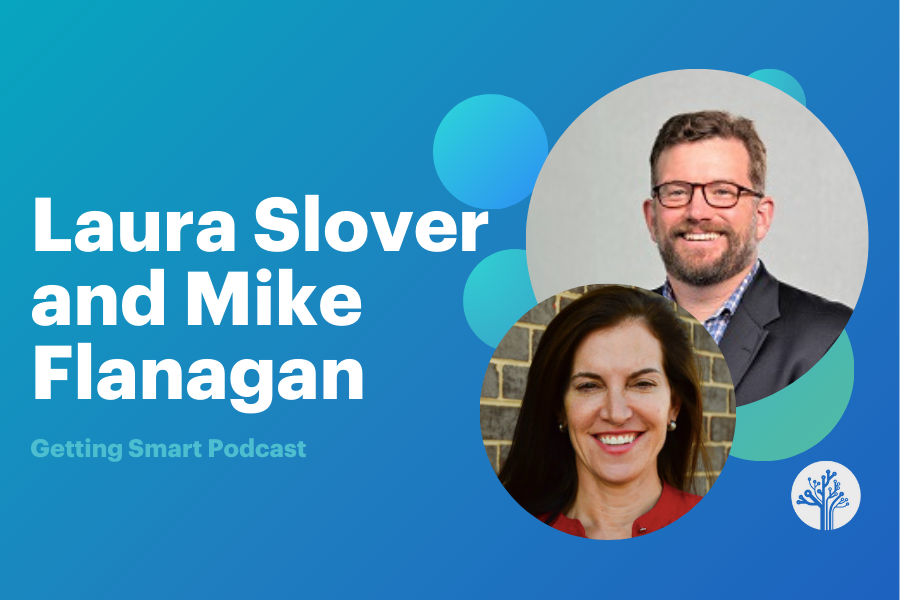
Laura Slover and Mike Flanagan on Skills for the Future
Key Points
-
The Skills for the Future initiative by ETS and Carnegie Foundation aims to broaden educational goals and provide meaningful assessments that capture student learning both in and out of the classroom.
-
The Mastery Transcript Consortium seeks to replace traditional transcripts with competency-based records that better reflect student abilities and are valued by colleges and employers.
Shownotes



In this episode of the Getting Smart podcast, Tom Vander Ark is in conversation with Laura Slover and Mike Flanagan, focusing on the transformative initiatives in education being spearheaded by ETS and the Mastery Transcript Consortium (MTC). The discussion gets into the Skills for the Future initiative, emphasizing the shift from traditional education models towards competency-based education that aligns with the demands of a rapidly evolving workforce. This initiative, a collaboration between ETS and the Carnegie Foundation, seeks to broaden educational goals beyond conventional academics to include essential skills like communication, critical thinking, and civic engagement. By embedding innovative assessment tools in several states, the program aims to capture authentic evidence of student learning both in and out of the classroom, thus preparing students more effectively for future challenges.
Mike Flanagan elaborates on how the Mastery Transcript Consortium is pioneering a new way to document student achievements, moving away from standard transcripts to a more holistic representation of student skills and competencies. This approach is not only about acknowledging diverse learning experiences but also about creating equitable opportunities for all students, regardless of their school’s reputation. By integrating MTC’s innovative records with ETS’s expertise in valid and reliable assessments, this partnership promises to deliver a system that is both authentic and universally credible. As these new educational frameworks and assessment tools gain traction, they have the potential to redefine success in education, providing students with personalized learning paths that foster their unique strengths and prepare them for lifelong success.

Discover the latest in learning innovations
Sign up for our weekly newsletter.
Outline
- (00:00) Introduction and Guest Welcome
- (01:26) The Role of Achieve and the Standards Movement
- (06:11) Mastery Transcript Consortium: Origins and Goals
- (09:33) Skills for the Future Initiative
- (22:05) Future of Education: Assessments and Signals
Introduction and Guest Welcome
Tom Vander Ark: Brighter goals, engaging experiences, and better signals. That’s the Carnegie Foundation ETS Skills for the Future framework. We’re talking about that today on the Getting Smart Podcast. I’m Tom Vander Ark, and I’m joined today by Laura Slover, the managing director of Skills for the Future at ETS. Hi, Laura.
Laura Slover: Hi, Tom. Nice to be here.
Tom Vander Ark: We’re also joined by Mike Flanagan from the Mastery Transcript Consortium, now five months into being part of ETS. Is that right, Mike?
Mike Flanagan: That’s exactly right. Yeah, we’re a part of the ETS family of companies. Nice to see you, Tom.
Tom Vander Ark: Great to see you both. You’re fresh from Aurora, where I think you both presented. Is that right?
Laura Slover: Yes, we did.
Mike Flanagan: I didn’t. We actually reached a nice milestone where we had multiple schools talking about how they’re using MTC’s records. So I didn’t have to present, but I had some colleagues talk about higher ed uptake, which I’m sure we’ll cover later in the conversation.
The Role of Achieve and the Standards Movement
Tom Vander Ark: I should mention that I’m still a board member of the Mastery Transcript Consortium, and I noticed a lot of social media coverage last week with schools showcasing their mastery transcripts. You had a good showing there. Laura, I’ve been thinking about our intersections 25 years ago, during the early days of the standards movement.
You’ve really been a key architect of the education system. I was mentioning to Mike earlier that Achieve was a remarkable organization. People may forget the key political role Achieve played. Your board consisted of governors and CEOs. It really owned the American education agenda at a high level. Is that a bit of an overstatement, or is that fair?
Laura Slover: No, I don’t think it’s an overstatement at all. When Achieve was launched, it was during the National Governors Association Summit in 1997. Governors and CEOs came together to figure out how to jumpstart the next generation of school reform and ensure that all kids were being prepared for success.
Out of that work came the American Diploma Project, a real emphasis on state leadership, and the idea of ensuring that both the K-12 sector and higher education and business communities were working together to put kids on the path to success.
Tom Vander Ark: It was a time of truly remarkable bipartisan support. You had Republican and Democratic governors, and even on the Hill, there was broad support for higher expectations for all students. It was an agenda centered on better measures and accountability systems, ensuring every family in America had access to good schools. I think people forget how broad the political and business support was for this. Achieve played a critical role in orchestrating that. I appreciate the role you played there with Mike Cohen. Reflecting on your time leading at Achieve and PARCC, what’s your takeaway from those 20-plus years, Laura?
Laura Slover: You’re making me sound and feel old! But honestly, I think we’re at a new beginning point. Achieve, with governors and CEOs, really set the stage for the college and career readiness agenda, ensuring that all students, regardless of their background or zip code, had a fair shot at a quality education.
That work was instrumental in laying the foundation for where we are now. While the world has changed—technology has advanced, our understanding of education has evolved, and we’ve experienced a pandemic—the core elements of education that prepare students for work and college in equitable ways remain central.
Tom Vander Ark: I have a wonky question, Laura. I remember in 2000, as No Child Left Behind was coming together, many of us advocated for both growth and proficiency measures. But we struggled to develop reliable ways to measure growth. As a result, the focus shifted to grade-level proficiency, which we’ve been measuring for the past 20 years. Does that align with your memory?
Laura Slover: Certainly, at the outset, there was much more focus on outputs rather than growth. Over the years, states have varied in how they track and measure growth. Some made significant progress, while others struggled to integrate it effectively.
Mastery Transcript Consortium: Origins and Goals
Tom Vander Ark: Mike, it’s interesting to note that as No Child Left Behind was coming together, there was also a progressive schools movement. Hundreds of innovative public and private schools were being formed, some within networks. One result of that movement was the Hawken School in Cleveland and, eventually, the Mastery Transcript Consortium, started by progressive school leader Scott Looney.
After a career spanning education and technology, how did you intersect with Scott at the origin of the Mastery Transcript Consortium?
Mike Flanagan: Scott, the founder of MTC and still the head of school at Hawken, was on my board for a technology organization I was leading in my last job. We were a tech group within a nonprofit association. After replatforming the product, our association had what’s called a happy problem—too much surplus revenue, which in 501(c)(3) terms is a euphemism for profit.
That technology was acquired by a private equity company around the same time Scott was starting MTC. Years ago, I was a classroom teacher, and my first tech job was in what was then the corporate learning and web-based training space. We focused on competency models and backward design processes to identify essential skills for particular roles. It’s fascinating to see those concepts come full circle now.
Tom Vander Ark: Is it fair to say that Looney and the group he organized were looking for a new way to signal student success? What was the original goal?
Mike Flanagan: Yes, that’s fair. There was a general consensus among progressive schools, charter schools, and other learner-centered models that they wanted to make high school more relevant, engaging, and experiential. But none of that rich learning was showing up on traditional transcripts.
The traditional system packages high school experiences into Carnegie units, grades, and academic subjects. While that’s useful, it has become so embedded in policy, accountability, and funding systems that it constrains innovation. The idea behind MTC was simple: create an alternative credentialing system for schools to embrace. Through collective action, make it legible, acceptable, and valued by higher education and the workforce.
Skills for the Future Initiative
Tom Vander Ark: That aspiration is, I think, part of what has brought you two together. Laura, I reflected on how you were a key architect of the last 30 years of education reform. Now, with Skills for the Future, including the Mastery Transcript, you’re helping architect the framework for the next 30 years. How do you think about that initiative? What is it? How is the Carnegie Foundation involved, and why is it important?
Laura Slover: Mike and I are happily on this path together to envision the next 30 years. The Skills for the Future initiative began as a partnership between Carnegie and ETS. Amit Sevak from ETS and Tim Knowles from Carnegie recognized that both the Carnegie Unit, introduced by the Carnegie Foundation, and standardized testing, which ETS helped pioneer 75 years ago, had profoundly shaped education.
While those innovations were impactful, they also constrained new thinking. Together, the two organizations said, “Let’s rethink education and change the architecture.” Carnegie has been working on revolutionizing the Carnegie Unit, moving away from the idea that time equates to learning. Instead, the focus is on competency-based education that emphasizes outcomes and recognizes that learning happens everywhere.
Kids are in school for 180 days a year, six hours a day (including lunch). That’s a limited amount of time, yet we know they’re learning through activities, jobs, and apprenticeships outside of school. However, much of that learning is invisible to us because we don’t have ways to capture it. Additionally, traditional assessments—such as end-of-year state tests—often provide data too late and are not aligned with what students are actually doing in the classroom. There’s been a growing disconnect and frustration with both systems.
Tom Vander Ark: I want to underscore the irony that Tim Knowles is now leading the Carnegie Foundation, which created the Carnegie Unit, while Mike is leading MTC, an initiative designed to move beyond it. It’s fascinating to see these efforts converge.
I also want to acknowledge the inspiration XQ has provided in high school reform over the last decade. XQ inspired Carnegie, which then partnered with ETS. Earlier, I described Skills for the Future as focusing on three elements: broader goals beyond reading, writing, and math; powerful, engaging experiences that bring learning to life; and better signals that clearly communicate student capabilities. ETS seems to be building assessments aligned with this new framework. Is that how you think about it? Are you working to build assessments for these broader goals?
Laura Slover: Yes and yes. ETS and Carnegie came together in the spring of 2023, announcing a partnership to change the education architecture. The first phase involved extensive research. The goal was to broaden the scope of student learning and focus on a wider set of skills predictive of success in high school graduation, college completion, work readiness, and community well-being.
They examined economic research, state initiatives, international frameworks, and concepts like Portraits of a Graduate, now adopted by nearly half the states. While Portraits redefine what students should know and be able to do, they’re often aspirational and not fully enacted.
From their research, ETS and Carnegie identified 11 skills that consistently appeared across frameworks—skills like communication, collaboration, curiosity, critical thinking, and civic engagement. These became the foundation for the initiative. The next step is to ensure these skills are not only infused into learning experiences but also measured in meaningful ways.
We’re not working in isolation. We’re partnering with five states—Indiana, North Carolina, Rhode Island, Wisconsin, and Nevada. These states are fleshing out their Portraits of a Graduate and collaborating to measure those skills. This spring, we’ll pilot tools in classrooms to capture authentic evidence of skill development, both inside and outside of school.
Tom Vander Ark: On the Portrait of a Graduate, Mike, that’s usually the first step for a school joining the Mastery Transcript Consortium, right? A school or system starts by developing or adopting a portrait or profile of a learner. Is that correct?
Mike Flanagan: Yes, that’s right. One of the biggest misconceptions is that schools come to us looking for transcripts or records. In reality, they’re grappling with the decision they’ve already made to embrace competencies and embed them into their classroom and assessment practices. It just so happens that once you do that—once you incorporate rich, authentic demonstrations of learning—you’re perfectly positioned to generate better records and credentials that communicate those competencies effectively.
Tom Vander Ark: Laura, let’s drill down on what’s new in assessment. One major difference between this initiative and the standards movement of the past is that the latter focused heavily on reading, writing, and math. Now, the focus has expanded to include a broader set of job- and citizenship-ready skills. How specifically will the assessment systems you’re working on differ from traditional end-of-course or end-of-year standardized tests?
Laura Slover: I’m so glad you asked because what we’re building is exactly the opposite of traditional end-of-year standardized assessments. We’re shifting toward a suite of tools and authentic experiences that capture skills predictive of success in post-secondary education, careers, and life. These include collaboration, communication, creativity, critical thinking, and persistence.
We also want to recognize and capture evidence of learning wherever it happens—in school, extracurricular activities, sports, internships, and even caregiving responsibilities. For example, some states have a large number of students balancing family caregiving with school. Their skills in leadership and responsibility deserve recognition.
The tools we’re piloting go beyond the sit-and-get model. They might include students recording a video presentation, completing a collaborative performance task, or engaging with AI-driven problem-solving tools like chatbots. The opportunities to use technology for innovative assessments are enormous, though we’re mindful of regulations like FERPA and privacy protections. The goal is to reflect the sophisticated work students already do outside of school.
Another important aspect is the “so what?” question. It’s not enough to measure these skills; we need to provide meaningful feedback. Instead of giving students a static score report, we envision a dynamic learning record or transcript that evolves over time. It would capture a student’s skills, abilities, and progress, providing insights into areas where they excel and areas for growth. For example, it might show that a student has leaned heavily into curiosity but hasn’t yet developed leadership skills, offering guidance on how to balance those strengths.
We’re also emphasizing that this process is about opening doors for students, not closing them. The goal is to identify and amplify their assets while giving them agency to shape their own development.
Mike Flanagan: To build on that, if we shift from single, high-stakes assessments to multiple data points collected over time, we’ll have richer information about individual learners. With that, we can begin generating personalized learning recommendations—insights that help educators tailor instruction to each student’s needs. This could reduce the burden on educators and alleviate some of the burnout that comes from trying to differentiate instruction for large classes. Advanced technology can make it easier for students to get what they need, when they need it, from the right human support.
Future of Education: Assessments and Signals
Tom Vander Ark: As we shift from talking about assessments to better signals, let’s explore how these tools translate into actionable information for students, teachers, and stakeholders. Laura, your team is building these new assessments. How will this information turn into better signals? And Mike, how does the Mastery Transcript fit into this picture with its tracking system and learner records?
Mike Flanagan: One realization we had early on is that many of the first schools adopting our records already had a lot of reputational capital. Whether they were independent schools, charter schools, or district schools, their credentials were often trusted because of the school’s name recognition. That’s great from a practical standpoint but not equitable.
The goal should be that any school—regardless of its zip code or reputation—can create a record that’s valued by colleges and employers. This is where ETS has been a game-changer for us. By combining MTC’s grassroots approach with ETS’s ability to create reliable, valid signals, we’re building a system that’s both authentic and universally credible.
Laura Slover: Exactly. We like to think of ourselves as peanut butter and chocolate—better together! MTC brings the authenticity of real-world, competency-based education, while ETS contributes external validation and comparability. Together, we can set common expectations across schools while respecting their individuality.
Mike Flanagan: We started with the summative record—the Mastery Transcript—because we wanted to plant a flag and say, “At the end of high school, students deserve a record that captures their story, not just sterile metrics like GPA and credit hours.” But as we worked with more schools, we realized there’s a need for tools that support the entire journey.
For example, we now offer a learning record that can complement traditional transcripts. Schools that aren’t ready to move away from courses and grades can use it as a “page two” to showcase rich competency data. Additionally, we developed a progress tracker for schools to monitor student growth over four years, tagging evidence to show how skills are developing over time.
Laura Slover: With all these data points from authentic learning and skills-based assessments, we can reduce the need for standardized testing. The rich, robust information collected from student work and experiences is often more predictive of outcomes than traditional tests. This isn’t a stealth effort to eliminate high-stakes tests—it’s a public effort to rethink their purpose. If assessments are about helping students grow and succeed, then we need to design them differently.
Tom Vander Ark: Mike, I was at your summit a month ago and met several early members of MTC. It’s amazing to see schools graduating students with mastery transcripts, which are being accepted by top colleges. The system works, and now, with Laura’s team, it’s becoming even better. What’s next for this initiative? Tell us about the pilot and how you see it scaling over the next five years.
Laura Slover: We’re incredibly excited about the pilot launching this spring in five states: Indiana, North Carolina, Rhode Island, Wisconsin, and Nevada. We’ll work with districts and schools to capture authentic student work and administer up to 20 tasks on a rolling basis from February through spring. This isn’t a sit-and-get experience—it’s about collecting data over time to paint a complete picture of student learning.
We anticipate involving around 5,000 students in this initial pilot. Our goal is to have a small footprint to keep it manageable while gathering enough data to validate our measures and build evidence. We’re also working with a phenomenal technical advisory committee of national experts to ensure we get this right.
Beyond this spring, we’ll take what we learn from the pilot and expand. While we had to cap the initial group at five states due to capacity, there’s significant interest from other states and districts. Looking ahead to next year, we plan to broaden the scope and bring in additional partners.
Our ultimate goal is to create a scalable, sustainable system that works for all students. As the country transitions to a more tech-driven economy from a knowledge-based one, the timing feels right. There’s growing demand for educational models that prepare students with the skills they need to thrive in a rapidly changing world.
Tom Vander Ark: That’s an exciting vision, Laura. It sounds like you’ll be handling more demand than you can accommodate for a while. Where can people go to learn more about Skills for the Future?
Laura Slover: We’re launching a new website soon, and we’ll include the link in the show notes. The site will have resources and updates for anyone interested in our work.
Tom Vander Ark: Great. And for those who want to learn more about the Mastery Transcript, where should they go?
Mike Flanagan: They can visit mastery.org. It’s the central hub for everything related to the Mastery Transcript and our tools.
Tom Vander Ark: This is such an exciting moment in education. The framework you’re building feels like a blueprint for the next 30 years—broader goals, more powerful and engaging learning experiences, real-time assessments, and better signals like learner records and transcripts. Laura Slover and Mike Flanagan, thank you so much for joining us today.
Laura Slover: Thank you, Tom. It’s been a pleasure.
Mike Flanagan: Thanks, Tom. Great to be here.
Tom Vander Ark: And thanks to our producer, Mason Pashia. Until next time, keep learning, keep leading, and keep innovating for equity. See you next week.
Laura Slover
Laura Slover is Managing Director of Skills for the Future, a joint initiative of ETS and Carnegie Foundation to transform education and measure what matters most.
Previously, she was the founder and CEO of CenterPoint Education Solutions. Laura started her career as a high school English teacher in Colorado. She was the Senior Vice President at Achieve, Inc. and then was the founding CEO of the Partnership for Assessment of College and Careers (PARCC), a consortium of states advancing college- and career-readiness through quality assessments. She lives in Washington, DC, where she served eight years on the Board of Education.
Mike Flanagan
Mike Flanagan is the CEO of the Mastery Transcript Consortium (MTC), a growing group of high schools creating a digital high school transcript that opens up opportunity for each and every student — from all backgrounds, locations, and types of schools — to have their unique strengths, abilities, interests, and histories fostered, understood, and celebrated.
Mike oversaw the design and development of Mastery Transcript software products, connecting with members and advisors to manage the MTC product roadmap till May, 2021. He is an experienced education technology executive, most recently having served as CEO of the Services Division at the National Association of Independent Schools, where he led a complete redesign and relaunch of their School and Student Services financial aid platforms.
Links

Holly Montano
Very refreshing to know this work is being done. I look forward to seeing assessments shift.