

Jennifer Seydel and David Sobel on Whole School Sustainability
Key Points
-
Sustainability is balancing people, profit, planet. The triple bottom line is being translated by GSNN into language that K12 will understand and implement.
-
Civic action and civic change must be a core part of the curriculum.
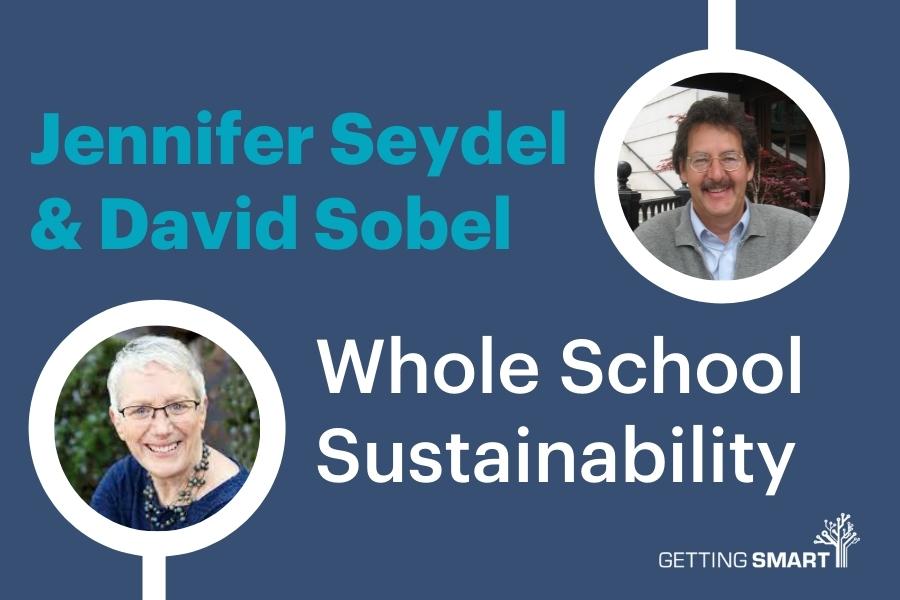
On this episode of the Getting Smart Podcast Nate McClennen is joined by Jennifer Seydel and David Sobel, co-authors of the new book Trailblazers for Whole School Sustainability.
Jenny is the Executive Director of the Green Schools National Network and has decades of experience in the classroom and building new green schools around the world.
David is an avid writer and speaker on outdoor education and play-based learning and is the Professor Emeritus in the Education Department at Antioch University New England.
Let’s listen in as they discuss schools that focus on sustainability as a core part of their mission.
In a lot of cases, it starts with just a couple of teachers who are really passionate about place-based education.
David Sobel
A 10000 mile journey begins with one step.
Jennifer Seydel
Links:
- Trailblazers for Whole School Sustainability
- David Sobel
- Green Schools Town Hall
- Green Schools National Network
- Boulder Valley
- Prairie Crossing
- Encinitas Union School District
Transcript
This transcript has not been edited for spelling accuracy.
Hey listeners, before we jump in today, we wanted to thank you for choosing to spend your time with us on the Getting Smart podcast. If you’re interested in more conversations and thoughts on the future of learning, be sure to check out GettingSmart.com, our regularly updated blog that highlights the most innovative schools, leaders, and practices in education.
We post every weekday and hope that you find the stories and voices inspirational. Alright, let’s get into the episode. Welcome to the Getting Smart podcast. I’m Nate McLennan and I am so excited today to have Jenny Seidel and David Sobel, co-authors of the new book Trailblazers for whole scale sustainability, which are stories of schools
that are focusing on sustainability as a core part of their mission. I have met both Jenny and David a few times out at Teton Science Schools in my past previous work and so excited to continue the conversation around place based education around green schools around how do we create schools that are thinking about sustainability for the future.
Jenny is the executive director of the green schools national network, 300 plus schools and growing who are all focused on sustainability, decades of experience in classrooms and has built green schools all over the world. And David is one of the early adopters and builders of the place based education movement. I have looked at many of his and read I think every single one of his books on place based
education. He’s an avid writer and speaker and he’s a professor emeritus at the education department at Antioch University, New England. So David, Jenny, so excited for you all to be here today. Welcome.
What a great thing. Absolutely. It’s great to be here. I’m super excited and honored to be sitting with the two of you who I have admired for years, your work.
So it’s great to be here. Well and I’ve asked both of you as we’re talking today, so the book Trailblazers for Whole School Sustainability is chock full of tangible school examples of how do you create schools that are focused on sustainability in a variety of ways. So I’m excited to hear a bunch of very specific examples from schools, from the book and other
things that you’d like to share with our audience. So as we open up, I always am interested in how people start their paths. So for each of you, maybe Jenny first and then David, what an important event or experience led you down the track of sustainability and environmental work? Is there a specific instance or did it grow over time?
Was there a pivot in your life? Jenny, what are your thoughts on that? Oh my gosh, there actually have been a lot of pivots in my life and a lot of moments that have led me here that has driven my passion to be the leader of the Green Schools National Network.
I think it goes back to being grounded and in the natural world. So I think of all of the time spent as a child camping and exploring with my family. And then taking courses in college that allowed me to continue this exploration and going out on adventure and understanding the impact that it was having on me as an individual and my confidence and my compassion for others.
And then I think the difficulty of sharing these kinds of experiences with my students as a teacher was significant in trying to figure out how can we do this work? This is the most important work that we have to do. And I think it was that drive trying to overcome the challenges in public education to do this kind of work that increased my quest and pushed me outside of the classroom to figure out
how to do this work. I always say I had negligent parents. And so I was a free range kid and I grew up on the beach and in salt marshes and did lots of stuff that I would not now allow my own children to do if they were still young. And so I feel like my environmental ethic and my care for the natural world is grounded
in that exploratory experience I had. And then there was a significant turning point and of course I took in college in which I actually had to do a field based research class and it was a study of the territorial behavior of red wing blackbirds. And it was the first time when I understood that knowledge resided in places rather than
in books. So it was the first time when something like I did something and I extracted information from the natural world rather than just reading about it. And so that was a big turning point for me. I love that.
It makes me think of the how far you explored as a kid. It makes me think of there’s an interesting home range study of young people over generations and you see home ranges that parents allow their children to go shrink, shrink, shrink over generations. What we were able to do as young people was a lot more than what current generations are
allowed to do. So I appreciate that. And I appreciate the learning from place. It is so tangible and so real that it makes more sense and it’s more contextualized and more relevant and engaging.
I love the concept of free range and I don’t know that my parents were negligent, but I think that they would have been, they would have become more strict. They were pretty strict if they knew some of the things that we were doing because we were out rambling around the woods and the prairies and there were experiences climbing to the tip top of barns that I think my parents would have been like, oh my God, I can’t believe
you do that. I look back now and think of hanging on the pulley systems to get up to the peak of the barn and those were life changing experiences that allowed me to understand risk taking, too, which has allowed the risk taking in my career and as a leader. I do believe sort of that those early experiences.
I have a recollection of a tree we called the Pegasus tree in my backyard. I grew up on a farm outside of Boston and that Pegasus tree had a top blown off by lightning. So there was a big open space at the top and it was probably 100 feet in the air and we were always up there just hanging out and my parents had no idea that we were in that tree.
So, okay, well, thank you both. Really interesting background. So I’m going to start with you, Jenny, some definitions. So we’re talking a lot about sustainability. It’s in the title of the book that you both wrote.
Just wrote, how are you defining sustainability? How does this relate to this challenge, this climate change challenge we’re talking about and we’re experiencing in the world right now? How do economics fit in? Just trying to understand and contextualize sustainability for our listeners.
Sure. So the classic definition of sustainability, we can talk about people profit planets. So the triple bottom line. So that triangle of how people interact with the planet and the influence on economy. So how do we bring those into balance?
But sustainability, we also look at ensuring that we’re making decisions that allow for future generations to live and sustain a quality of life that is important for all of us. So in our work as the Green Schools National Network, we’ve really been trying to translate the triple bottom line into language that K-12 educators understand. And so what we talk about now is health equity and sustainability in our schools.
And those concepts are big. But when we look at what superintendents and school boards across the country are responsible for, they’re responsible for balancing a budget, they’re responsible for keeping their students safe and they’re responsible for preparing their students for the future. And so when we look at those three things, we can see those in the triple bottom line.
And so our efforts have been, how do we do this in K-12 education? The corporate world is so far ahead of us. And so our journey over the last since 2017 has really been to document how schools are doing this, the impact that it’s having on their budgets, reducing their carbon footprint, keeping their students healthy and preparing them for the future.
I like that really tangible connection to the day-to-day leadership challenges of schools and the work of schools. David, the book is, I think, uniquely organized around the Green Schools focus points of leadership, culture and climate, curriculum instruction, and then facilities and operations. And you have examples under each one of those that different authors have written.
So in your experience, you’re keenly focused on place-based education, which seems to me as a curriculum and instruction approach. Do you see more and more in your work when you’re looking at schools, this leadership element, this culture and climate, facilities and operations? Are all of these present in these schools that are moving forward that you’ve modeled?
Or is it usually one or one or the other? Or what’s your thought on the emphasis on these different areas? Yeah, it’s rarely all of them. It’s unusual when you actually get to all of them. And there are a few examples in the book where the schools with really sophisticated leadership
over long periods of time have gotten to all of them. But in a lot of cases, it starts with one or two really invested energetic leaders, and they could be teacher leaders or they could be administrative leaders who get things going and then gradually recruit others to join them. So in a lot of cases, it starts with a couple of teachers who are really invested in place-based
education. They understand that classroom and book-driven instruction has its limits. They want to make schooling and curriculum more relevant, more problem and project-based, and they initiate things. And then they tend to recruit others and start to advocate for the kinds of things they’re
doing with the administrators who then make that possible. I would build on that any of the four leadership curriculum and instruction, culture, climate, or facilities and operations provide an entry point. As some of the schools, when you look at the last section, the work in those schools and school districts were driven first in the facilities and operations side and then backed into curriculum
and instruction. There were teachers, dynamic teachers who were doing place-based education, and then they were able to come together. And then we have other schools that have started on the climate and culture side where they wanted their students to become responsible ecological citizens.
So they were focusing on climate and culture and then all of a sudden it was like, we have to change the way we’re operating. Oh, we have to change what we’re teaching and how we’re teaching. So I think any and all of those are entry points that can be successful. Yeah, one of my favorite chapters in the book is the one written by Tim Cole, who was a
facilities person essentially in Virginia City public schools. He identifies really clear that Virginia, not Virginia City, Virginia Beach, right, is one of the most conservative communities in the country. And his story of starting with facilities change and then that expanding into all the other elements of sustainability is fascinating.
And if it can happen in Virginia Beach, it can pretty much happen anywhere. I think the other case study that fascinates me is the Philadelphia story, that it actually started by the outside of the school district. It was the community that was committed to sustainability and it was the community sustainability action plan.
And they recruited the superintendent and the superintendent became the champion with the support of somebody in the operations side and then shifted into curriculum and instruction. So the beauty of the case studies is that each of these, if you go back far enough, has an origin story.
And those origin stories might not be in the chapters, but when you know them and you see where they’ve come to the case study that’s documented in the chapter, it’s super exciting. The other thing that is even more exciting is where they are now. So this is a point in time. These case studies are a point in time, but every single one of these schools and school
districts that are documented, even with COVID in the mix, is in a completely different place on their sustainability journey. So it is interesting. It’s always, we document in the literature and books, we say, here’s a case study now, but of course these schools keep moving, which makes me think a little bit about the, I’ve
thought a lot about the stickiness of models. And when I was at Teton Science Schools and we built the place network, we were working with small rural schools. And I was always thinking in our team about how do we make sure that this work that they’re doing persists beyond the leader, beyond the school board, beyond an initiative, beyond
funding or whatever the case may be. And I’m wondering if either of you have opinions on what allows these efforts to persist in schools. What are the most, the key elements around persistence? Because our listeners want to know that they want to start an initiative, but if they leave
that initiative needs to keep going. I’m going to hit with Boulder Valley. So we have a case study of Boulder Valley that really talks about their food system. I believe it’s in the, let me see which section it is because they are now hitting on all four components.
I think it’s a, it’s the story of their food system. Laura Smith’s Waste Not What Not chapter 14. Boulder Valley started on the facility, actually Boulder Valley’s journey started with a community effort for the board to pass a sustainability statement and policy. And that was actually about, I think 12 years ago, 10 or 12 years ago now.
And it was just that statement. And in that board policy was the statement that the superintendent would report back to the board on progress toward sustainability. They have, I need to look it up, their specific language in that board policy that requires them to report, the superintendent report back on educating students about sustainability,
including the district in a way to improve health and decrease environmental impact. And so that board policy and board commitment has stayed. And so that superintendent, whoever that superintendent, there’s been at least one shift, maybe two since that policy was passed, has required the superintendent to do the work.
And as each department in the district has done the work, it’s gone deeper and become much more systematic and systems, you know, across all systems of the district. So a board directive written in has been super helpful. David, what about you? Do you see critical factors and persistence of these initiatives?
Yeah. So two different examples of stickiness. One is that once the curriculum initiatives get started, they have to be formalized. So it has to get made into policy. So you need to rewrite curriculum.
And in a couple of the cases in the book, you need to rewrite curriculum along the lines of the Education for Sustainability Guidelines. And otherwise, without the rewritten curriculum, then as soon as teachers leave, it evaporates and you just revert back to the conventional approach. So the rewritten curriculum is nicely illustrated in the Prairie Crossing chapter in which Jenny’s
worked with them a lot and they’ve used a lot of any cloud sustainability curriculum guidelines. And they’ve prioritized a lot of teacher professional development around rewritten, attending to these guidelines and writing curriculum that has outcomes that align with the Education for Sustainability Guidelines.
So it’s got to become policy and it has to become written into job descriptions for new hires. So there are all these different levels of policy solidification that make things sticky. Another form of stickiness, so it’s not a case study that’s in this school, but it’s a case study that I worked on in a Michigan public school district where there was a really
good nature preschool and through a lot of efforts, the private nature preschool convinced the public schools to start a public kindergarten. And the parent interest in the nature kindergarten option was so great that instead of starting one nature kindergarten, they had to start three. And then they had nature kindergarten and then kids were going into a conventional first
grade and the parents were realizing how much their kids missed the nature-based experience in kindergarten. So it was parent advocacy that led to the creation of nature first grade. That also led to the implementation of nature second grade. So it was parent interest and demand that was the sticky factor that led to school change.
That was somewhat of a function of really good public education about what was going on in the new nature and place-based education option versus the traditional option. So good parent education engenders a population of parents that want the change. And demand the change. I mean, again, our advocating for the change.
I want to talk about another aspect of stickiness, which I think there are hidden examples in the book. So Amy Illingworth in Chapter 2 in Encinitas is an example of what we call sticky leadership. So and there’s another superintendent. So Tim Baird, who wrote the foreword, was the superintendent in Encinitas and shaped
a lot of the work that was happening in Encinitas that Amy wrote about as the new curriculum and instruction leader for the district. But there are other people who have worked under Tim who are because they experienced how sustainability can shape culture and climate and academic achievement in their schools because of their experience working under Tim Baird have now taken these concepts out
to their school districts as they are now superintendents or school leaders in different schools. And so there’s another, we call it sticky leadership that once you experience a whole a school that has embraced whole school sustainability and you can see it playing out in the climate and culture of the school, the achievement of students, what it can do to build the culture
of your faculty and staff. Those kinds of things you take with you and implement then in new places in the progress of your own career. So I think there’s a professional stickiness that is happening as well that is important, an important part of the movement.
It’s that, there’s that we used to call it the multiplier effect, right? So if you have a bunch of people working at an innovative school doing work around sustainability and place-based education, by default they learn about the ethos of that place. So when they go on to become school leaders or teachers at other places, they have influence in those other spheres, this multiplier effect.
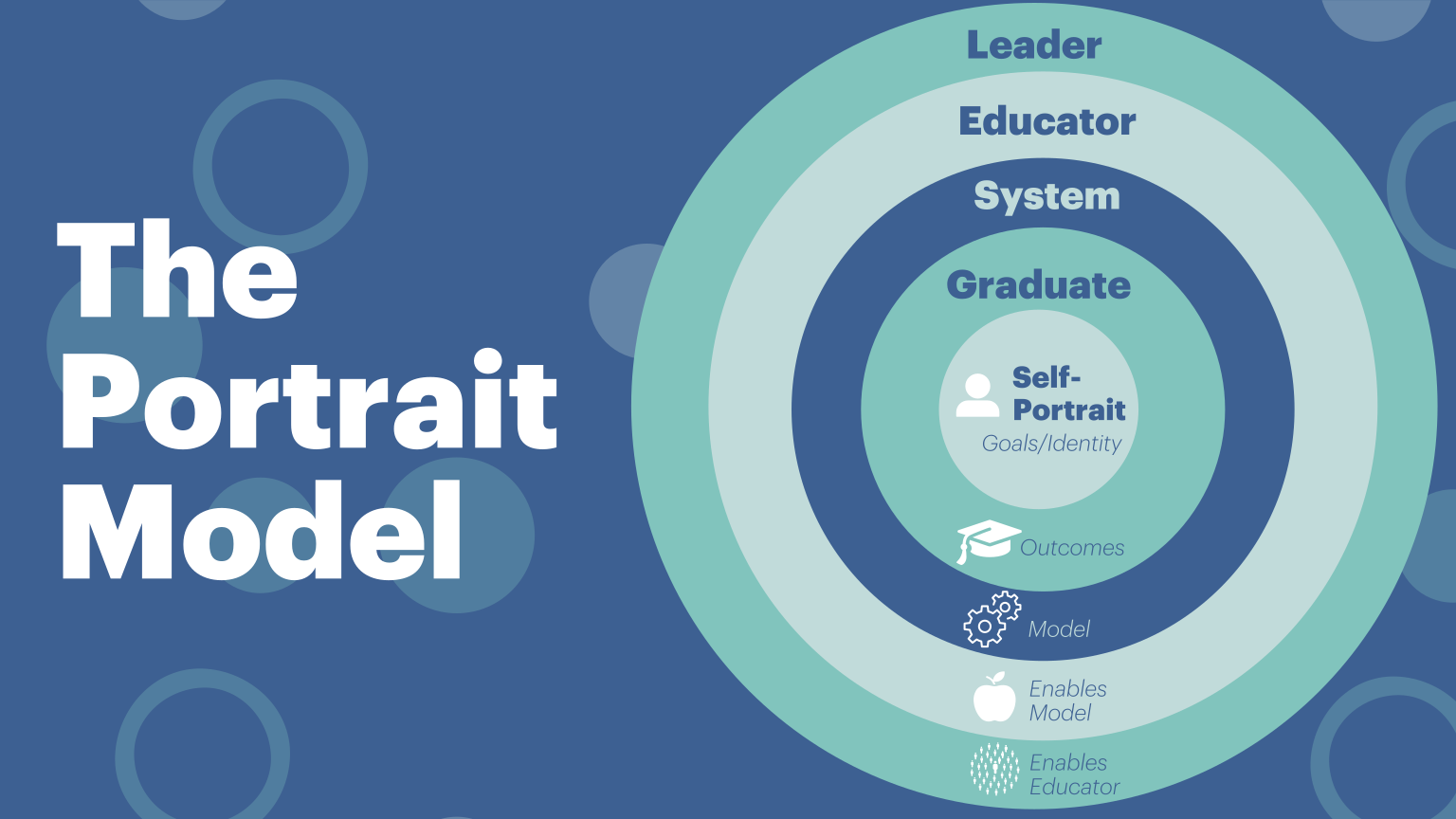
So there’s a lot of things we’ve talked about with stickiness. So we’ve talked about board policy, rewriting the curriculum and make sure that you’re aligned with the sustainability indicators and education for sustainability. In practice is so interesting to me is that I think schools should always create their own portraits of educators that are built off of what they expect out of their teachers.
So they’re not hiring blindly for those who can teach and are subject matter experts, but they’re hiring for philosophical alignment. And I think too often we don’t do that, so it makes it more difficult sometimes. And then I appreciate this community partnership parent voice example that you all spoke about is that parents can advocate once they see models that make sense and they can be incredible
connectors. So let’s just pivot for a second. And you have made at Green Schools, the network, the Green Schools National Network has made a very specific decision around putting equity at the center. And I’m curious if that was a, when did that happen and how has that really important notion
integrated into the sustainability work? Jenny, maybe you’d start with that and then David, you could provide some examples. Sure, as we started, so when we started, our original GreenPrint was a one page document with, you know, it was activity based, kind of like, you know, it could look like a checklist. And in 17, when we launched the network and, you know, started working with some of the
early adopters of whole school sustainability, we knew that we needed to update, upgrade the GreenPrint. So we pulled, we facilitated a number of leadership summits with our leaders to help them help us redefine the GreenPrint. And it was very clear in our conversations that our urban educators could not find themselves
in traditional environmental education or could not see themselves addressing climate change issues without also looking at the justice issues and the environmental justice issues in their communities. And so it was, it was those conversations that informed us that said, okay, this is going to be inclusive if we really do believe that every child should attend a Green Healthy Sustainable
School, which used to be our tagline in the very early stages, that we needed to reframe the conversation so that all educators and all communities could see them in this work. And so as we started having those conversations, this would have been, you know, four years ago when the conversation started, we started looking at language, where, where does equity live?
What is the perspective of equity in K-12 education? What would happen in our communities if all schools, you know, supported all learners and all learners were lifted to, you know, a level of achievement? What would happen? And so we, it was fascinating to look at the economic development concepts, the economic
models that are out there that allow us to see what happens when we lift everybody in education. Racial justice, community, Black Lives Matter emerged so powerfully strong with the death of George Floyd. Our educators, our partners were saying, what are we doing?
We need to make a much more powerful statement. And so that’s when, you know, we were in the midst of rewriting the GreenPrint, revisioning with new mission and vision statements. And that’s when we were like, all right, we’re stepping out here, even though most people only see the issue related to the planet, we know that the inequities, the economic inequities,
the racial equities, the health inequities, we know that if we don’t address those, we are not preparing humanity for the future. And that to us was a turning point and where we put our foot down. We are right now doing a listening and learning tour with all of our schools to learn about what equity programs they are implementing, what are the best practices we have built
and baked them into the current GreenPrint, but we know that they need further development. And so we are in the process of, you know, learning more about what that looks like as that in that intersection, you know, that conversation, that intersectionality conversation. Yeah. And I think that’s so important when we think about environmental education and place-based education and connecting with equity is the way forward.
It is the way towards a sustainable future for humanity. So, David, any comments on that, examples, thoughts around the equity question? Yeah, there’s a good chapter written by Joel Tolman, who’s a teacher at the Common Ground School in New Haven. And he does a really nice job of unpacking the whole notion of urban education, which we all implicitly presume is challenging and problematic and racially loaded in terms
of its problems and says that, you know, we have to reconceptualize urban education as being grounded in understanding the city and the issues of the city. And that’s where the curriculum ought to be. So, as opposed to the educational model that assumes that urban kids need academic isolation and focus on academic skills, it needs to be much broader than that. You have to open up the walls of the school and make the city the classroom
and make civic action and civic change an implicit part of the curriculum. And in doing that, what happens is that the academic rigor increases and the rate of high school completion and college acceptance goes up. And so that’s an equity issue in terms of making sure that the students of color are getting as much access to higher education as the white population. Similarly, at the Cottonwood School in Portland, the piece written by Sarah
Anderson, there’s a seventh and eighth grade component of the curriculum, which is always about social equity change in the community. And so students, you know, they, students help to identify an environmental or a social equity issue and then actually take initiatives to do something about it. So there’s a nice example that’s not so much a, it’s more of an environmental issue of children taking on the responsibility for a campaign on limiting smoking in public parks.
They did another one on equity for people in same-sex couples that were experiencing violence in the home. It was really interesting. It was one of those interesting issues that never occurred to me, but they had identified it and then advocated with city council other political groups for positive change. So we’re training kids to advocate for improvements in environmental quality and social equity as part of the curriculum.
I remember at the national conference, one of the early conferences, so this was probably eight years ago, we had a young man, Charles Ordon III do a keynote and he stood up and he said, you know, you continue to talk about educating us for our future, but this is our future. And you need and you need to get out of our way because we understand and know the future that we want. And so I think that in these schools, when we empower students and give them voice
to understand their communities and the needs of their communities, it is not just about climate change. It is about justice and it is about equity and it is about policy and the power differentials that play out and the students get it. Even our, you know, kindergarten students can understand equity and the needs of all and we need to get out of their way and support them and nurture those parts of us that are inherent to who we are as an organism and, you know,
taught out of us through conditioning. So, right. I think there’s a repeated theme in this pod and others that we’ve had of young people, agency for young people and us as adults making sure that we’re guiding and coaching but not getting in the way and really the north star being that every young person has the ability to make a difference in the world in whatever way makes sense to them. And we’re just, we’re not there yet. We need to make a lot more progress and this network,
the anecdotes in your book are talking about ways to do that. It does, the other thing it makes me think about is this false conception between rural and urban that rural is only ecological and urban is only social justice. And I think we need to, for our listeners, really think carefully and say, place is about all those things. You have social justice issues in rural places and you have ecological issues in urban places and really it’s about all those things together in any place
that are commonalities for young people to address. So, super important. I want to pivot with one last question and then we’ll close but earlier this week I had a fascinating podcast on the educational metaverse. So, you know, an entirely different place, digital in nature, gamified thinking about equity in all sorts of ways, thinking about purpose making and thinking about engagement with young people. So, we all know watching the acceleration of technology,
watching the way the big tech industry is moving and watching young people interact with technology that this is going to become a more and more important role. So, both of you, maybe David first and then Jenny, like where do you see sustainability and technology intersecting? What’s the challenge? What’s the opportunity in that area? So, when I was working on my dissertation, I had the pleasure of just doing a lot of deep study and understanding how we understand our role in the
more than human community. My dissertation was on ecological identity development and I might not get the name right. I’m going to apologize in advance. There was a gentleman, I believe his name was Peter Kahn, who was doing research at the time and this was quite a while ago, on how whether the digital interface allowed people to develop an empathic relationship with other organisms. And he actually found that it does allow that to emerge. You know, in my own experiential
focus, I’m like, oh my god, how could you not have a relationship with the natural world, a personal tactile relationship? And so, I think that there is, that gives me hope that we can connect more people with the natural world if we use technology efficiently and effectively. So, that’s one thing. The other thing is, I do think that there are ways to leverage technology to expand how we think and understand about how the world works. And so, our team, you know,
is very cautiously trying to find an entry point where we can teach ourselves, you know, first. And so, we’ve got a project that we’re conceptualizing right now in relationship just to the physical plant of the school. But the, there is potential. And I, you know, I don’t want to ever say that human relationships and real world experiences and real world connections with the natural world are not needed. I don’t think that we’re ever going to be to that place. I don’t want us ever to be
in that place. But there is, you know, we have to find the balance to be able to help people connect and understand the ripple effect of every decision they make. And I think the metaverse might be able to help us do that conceptually. Yeah. I mean, it’s inevitable that it’s coming and it’s how we address it and live into it in ways that advanced sustainability are going to be critical. David, any thoughts on that as you’ve listened?
You know, all things in moderation. So, really good developmental research on the relationship between childhood, wild experience in the natural world and adult environmental values and behaviors. And pretty, pretty much kind of established law at this point, this notion. So, you can’t preclude childhood experience in the natural world without sacrificing this environmental values and behaviors which are going to be at the foundation of, you know, living in a sustainable way.
On the other hand, technological tools as vehicles for communication and children and us being conscious about training and providing education in kids on how to use technological tools, iMovie and PowerPoints and simulations, those things are really valuable as long as they’re tools in the service of the larger purpose and we don’t collapse education which happened last year. You know, education got collapsed into the digital world.
That collapsing is, you know, it’s kind of like the creation of the black hole. That’ll create a black hole. So, as long as we understand technology and service of the bigger goals, then I think we can accomplish good things. Yeah, I think it’s a vehicle rather than the destination. So, it is a useful tool but the destination needs to be a sustainable planet, sustainable worlds for these young people and us as adults that are living in it.
We, I think we could talk for hours and hours on these topics. Unfortunately, we’re getting close to the end of our time. So, I wanted to just wrap some big picture themes. Certainly, we’ve talked about the importance of equity and the integration of equity as a key element of sustainability and how that plays out in the network. I love the conversation around stickiness and what are the elements as schools are looking to adopt and perhaps joining the network.
They’ll be inspired by reading the book. So, the elements of board level policy, leadership, getting teachers who are bought into the philosophy, community partnerships, etc., etc. So, all things really important and I love this last part of the conversation around how are we thinking about sustainability and technology. So, I’m going to bridge our wrap here and just ask you both just if you had a very succinct piece of advice for our listeners, whether they’re educators or
leaders in education or those who are involved in the ecosystem. Jenny, what’s one takeaway, important piece that you’d like people to know and hear from you? A 10,000 mile journey begins with one step. I think that it’s unpeeling an onion and so just take the first step and you’ll be fascinated by where it leads you. That’s interesting because it’s pretty almost exactly what I was going to say. The way I was
going to say it is, you know, I understand that you’re in it for the long haul and one of the articles, one of the chapters in the book documents the change over 25 years in one school district in Northern California and, you know, a lot of people, you know, a lot of people assume, you know, change happens in three years. You know, it happens in 10 or 20 years. And so if you’re invested, make sure you’re invested for a while.
Right, right. That persistence matters. David, Jenny, thank you so much for joining us today. For our listeners, go to greenschoolsnationalnetwork.org. All the links we spoke about today and information will be in the show notes. Please pick up the book Trailblazers for whole school sustainability to get a bunch of different examples of how schools have done this work in real time and made a difference for the lives of young people and the planet we live on.
And then keep sharing and learning. There’s great examples, borrow liberally and make good things happen at your institution. So thank you both again. Keep learning and keep innovating for equity everybody and we’ll see you next time on the podcast. Thanks so much. Thanks for tuning into the Getting Smart podcast today. We want this podcast to be actionable and insightful and a great way to learn about what’s next in learning.
In order to stay on the cutting edge, we need people in the field to tell us what they’re hearing, what they’re wanting and what they’re needing to learn more about. Got a topic or a guest in mind? Send your recommendations to me, Mason at GettingSmart.com. And if you like what you’re hearing, don’t forget to leave a review and Apple podcasts or subscribe wherever you listen. Feel free to share the podcast on social media using the hashtag GS Podcasts. Thanks so much.

0 Comments
Leave a Comment
Your email address will not be published. All fields are required.