


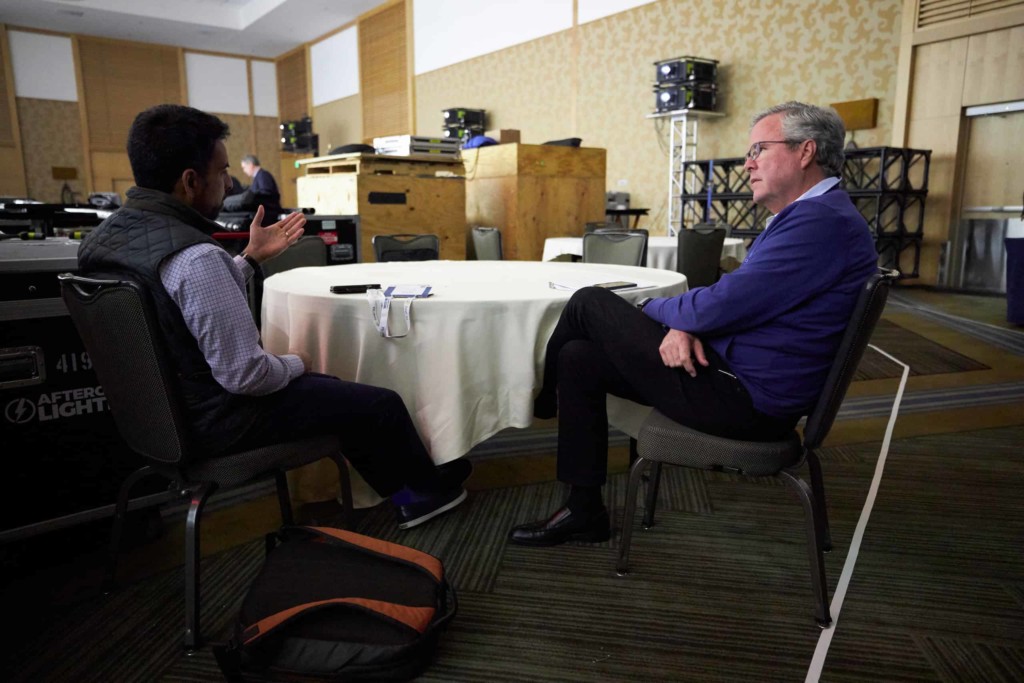
Jeb Bush on Digital Learning Now!
- Student Eligibility: All students are digital learners.
- Student Access: All students have access to high-quality digital content and online courses.
- Personalized Learning: All students can customize their education using digital content through an approved provider.
- Advancement: Students progress based on demonstrated competency.
- Content: Digital content, instructional materials, and online and blended learning courses are high quality.
- Instruction: Digital instruction and teachers are high-quality.
- Providers: All students have access to multiple high-quality providers.
- Assessment and Accountability: Student learning is the metric for evaluating the quality of content and instruction.
- Funding: Funding creates incentives for performance, options, and innovation.
- Delivery: Infrastructure supports digital learning.
Key Takeaways: [1:31] Jeb Bush shares his take on the current impact COVID-19 is having on the world. [4:19] The silver lining from massive disruption. [5:21] How only two months into the school closures the benefits of digital learning have been made apparent. [5:55] How Jeb Bush’s early views on education were formed, what he learned from visiting schools across America, and how he began to appreciate how technology could assist in serving children (in regards to education) better. [8:49] How Florida’s biggest districts have weathered this crisis through Jeb’s leadership, his team, and their partnerships. [13:32] Going in the ‘Wayback machine,’ Jeb reflects on how the conversation between him and Tom about developing a new education policy framework came about in 2010. [15:56] About the Getting Through microsite. [16:34] Why Digital Learning Now’s first three of the ‘10 Elements of High-Quality Digital Learning’ (1. Student Eligibility 2. Student Access and 3. Personalized Learning) are especially relevant and important today. [18:17] Important, key elements of a high-quality education system (from DLN’s 10 elements): 5. Quality Content 6. Quality Instruction 7. Quality Choice 8. Assessment and Accountability. [20:26] Why this idea of ‘students progress based on demonstrated competency’ is so important to Jeb and ExcelinEd. [23:52] Challenges with the existing education system. [26:19] The progress regarding infrastructures supporting digital learning. [28:28] What’s next for ExcelinEd. [30:37] Tom thanks Jeb for joining the Getting Smart podcast!
Mentioned in This Episode: Jeb Bush The Foundation for Excellence in Education (ExcelinEd) Digital Learning Now The Unthinkable: Who Survives When Disaster Strikes — and Why, by Amanda Riple Florida Virtual School GettingSmart.com/GettingThrough Digital Learning Now’s 10 Elements of High-Quality Digital Learning
For more seeStay in-the-know with innovations in learning by signing up for the weekly Smart Update.
Transcript
This transcript has not been edited for spelling accuracy.
You’re listening to the Getting Smart podcast, where we unpack what is new and innovative in education. I’m your host, Jessica, and today we’re bringing you an interview Tom recently did with former Governor Jeb Bush. Bush served as the 43rd governor of Florida from 1999 until 2006.
After leaving office, he formed and still chairs the Foundation for Excellence in Education, also known as Excelinid. The national nonprofit organization focuses on state education policy and continues the important work that Bush championed in Florida. In 2010, Bush launched Digital Learning Now, a policy roadmap for the future of education.
With his co-chair, former West Virginia Governor Bob Wise, an all-star group of 100 advisors was formed, and after 100 conversations in 100 days, a policy platform for the future was unveiled. The 10-point platform stressed access to personalized digital learning for all students, including take-home devices and broadband for all teachers and all learners.
States and school districts that follow Digital Learning Now’s advice have been serving students well and were well-prepared when the pandemic closed schools back in March. Let’s listen in as Tom talks to Governor Bush about digital learning. Governor Jeb Bush, welcome to the Getting Smart podcast. Thomas, a joy to be with you.
Hey, it’s great to reconnect again. Governor Bush, what the heck is happening to the world? What’s your take? How do you process what we’re going through? Well, you know, we never focus on the high-impact, unforeseen events.
They always come in all sorts of different ways. I guess as humans, we have all these defense mechanisms so that we don’t go crazy, and so we don’t plan, we don’t prepare as well as we probably should. I’m reading a book by Amanda Ripley called Unthinkable. I don’t know if you’ve read it.
It describes this kind of how we react to crisis, how we kind of don’t want to admit the fact that these things, while they’re unforeseen, they do happen. And I think we were caught, the globe was, and the United States was. Only we lead in these pandemic events. And in our case, we were behind the eight ball to start with.
And it’s created a lot of tragedy starting in your hometown and now all across the United States. The impact of this, Tom, is going to be, there’ll be some positive things out of it, of course, but the immediate impact is all the trends that were happening pre-pandemic, I think, will accelerate as it relates to digitization of our economy, as it relates to lower-weight
job wage suppression, which had been reversed. We were getting higher income, but I think now businesses, as they adapt to the new reality, will innovate towards automation at a much more rapid pace. The health consequences of just being for three months in our homes is going to be impactful, not just the coronavirus, but other diseases.
Think of all the people that haven’t gone to see their doctors or haven’t gotten their cancer treatments or their infusions or their knee operation. We basically put a pause on the world and there’s going to be consequences for sure. And I worry a lot for a lot of people in our country. I’m afraid we’re going to have a lumpy long-term recovery where part of the economy is growing
and great guns and big regions and big sectors are really going to experience depression-level unemployment. I’m afraid this is going to be long and difficult and it’s going to be really tough on state budgets and as a result on school budgets, right? It’s likely, I think there’s probably another stimulus or whatever we’re calling it this
time. It does stimulate something when you’re asking people not to spend money, but there will need to be more support for the local and state governments and school districts, of course. But here’s the positive thing, it’s hard to talk about in the midst of a pandemic, but
in times of massive disruption historically have come incredible businesses. The complacency that exists when times are good is shattered. Disruption brings big-time innovations. I read recently, I hope it’s true, Isaac Newton invented the laws of gravity and calculus while he was quarantining from the plague.
Living in a, for two years apparently, staying safe and living on a farm. And so I do think that from this, I’m not sure exactly what the set of positive things will come, but they’re coming for sure. And history doesn’t, it’s not linear. It’s two steps forward, five steps back, 15 steps forward.
That’s the kind of world we live in. And my guess is it’s going to be an extraordinary time for some of us and real hardship for others. Let’s turn our attention to education. It’s interesting, Governor, that we’re two months into these school closures and suddenly everyone in the United States, in fact, around the world is now appreciates the benefits of digital learning.
Yeah, they do. And I think a lot of parents appreciate teachers too. No question about that, right? The custodial aspect of school is clearly a priority. Governor, you were, you were a governor in, for two terms in Florida, you were elected in 88,
served from 99 to 2006. I just looked it up a few minutes ago. Florida Virtual School started a couple months before you took office. But I wondered if you can recall where and how your early views on education were formed and particularly when you began to appreciate the ways in which technology could help us develop new models
and serve more kids better. Well, in 1998, when I ran, I went to visit 260 schools. I had pretty deeply held beliefs about opening the systems up and more choice for parents. But it’s, it’s eyeopening to go visit that many schools and to listen, have the humility to take some incoming because people were either fearful or angry at my views on some things.
And I learned a lot. And what I learned was, A, the, the access to quality education is really uneven. It was uneven in Florida. The schools that were predominantly where students in poverty went to did not have the range of, of courses that the schools in the more affluent areas did.
And we had low expectations for every kid. I’ll never forget watching a kid struggle with a question. The baseball game starts at three, it ends at 430. How long’s the game? And he was trying to, he was doing remedial work to pass an eighth grade level aptitude test,
you know, to get to graduate from high school. And many states at that time had no high school graduation tests. But we had a 50% graduation rate and we required an eighth grade level test. It just, you know, that’s just shameful. So all these experiences led me to believe that we needed a much more diverse offering
and higher expectations and real accountability. And digital learning can play, at that time it was in its infancy, but it could, it could play into this day, I think now even more so, it can play a really important role of dealing with the inequities in our education system. If you can’t access, because you’re in a low income school, AP courses, then online learning can provide
that chance to do it in a dramatic way. And Florida Virtual School is a great example of expanding AP classes in that regard. There’s all sorts of reasons going forward why students will be at home. Having this additional means by which teachers can teach kids is going to be really important. So the work we did with digital learning now after I was governor,
I think the principles that you worked on so effectively apply even more so today. Let’s come back to that in just a second. I do, I do want to note, Governor, that we, we’ve interviewed a number of folks from Florida. And it’s, it’s really quite remarkable that the big districts in Florida, which are some of the biggest in the United States,
have also been the best to respond to this pandemic. And I think it’s obviously a variety of factors, but the, the leadership that you and your team showed early in the 2000s, the way you scaled Florida Virtual School and the way Florida Virtual partnered with those districts to help them implement blended and personalized learning and with a kind of a statewide online learning partner. That and the fact that you encourage people to be prepared for,
for crisis has really meant that Florida districts have led the way during this pandemic. And as I told Julie Young, the founder of Florida Virtual School, that I think you and Julie and others really deserve a lot of credit for how well Florida has weathered this crisis compared to other states. So a lot of us appreciate that. Well, the date and Broward and I think all of the large school districts of operate were operational
almost immediately for a couple reasons. One, we do have a longer tradition with virtual learning, both the private businesses, the first state that they connections was involved in and K-12 was Florida. Secondly, Florida Virtual School is the largest, I think, digital learning platform in the United States. Third, these districts have scale and so they can develop their own additional programs, which they’ve done. And they’ve done something that is really important going forward, which is
they’ve trained teachers on how you teach virtually. It’s not the same thing. I mean, universities are struggling with this right now too. You don’t just take what you do in the classroom and just put it online. That’s not effective. But if you train teachers to be able to be effective teachers online, which is different than in the classroom, you can get really meaningful results. So devices, internet access, teacher development, and then training all this stuff
because in Florida, we have hurricanes and so our superintendents are smart to be able to prepare for something that’s definitely going to happen. In fact, hurricane season starts June 1st in Florida and in this time of a pandemic, imagine how we’re going to have to deal with that. But I know for a fact, because Craig Fugate, who has had a FEMA during the Obama administration and my director of emergency management for eight years when I was governor, told me yesterday he
was on the call with 67 superintendents. That’s the number of districts we have talking about how you prepare for hurricane season in a pandemic. And so we do, I’m proud of Florida in that regard. We do think about these things constantly and because of that, we got online places, sadly, including districts in Washington State, Fairfax County in Virginia, very fluent area. They couldn’t do it. And then there’s this political argument, I think, that some people
believe, which I think is really astounding, which is if we can’t provide access to every student, we’re not going to provide it to anybody. Wow. I mean, that’s the greatest attitude I’ve ever heard it. It was frustrating and alarming to see the lack of preparation and then that sort of response. So a lot of people have leadership these days, you know, across the board, basically, you have two kinds of leaders, you have the ones that say, this is the chance for us to serve.
And the others say, dog ate my homework. I think we need to serve the leaders right now, not the one using a way why can’t do something. Right. It has been rewarding to see so many servant leaders step up. We, every day here at Getting Smart, we have the chance to interact with teachers and leaders that are just doing extraordinary work for kids. And it’s really heartening to see that there’s a lot of the former. Jeb, I want to go in the way back machine.
It’s a couple years after you were out of office. It was 2010. I can’t remember how we connected on this, but it was a summer of 2010. And we had the chance to talk about developing a new education policy framework, a framework that would guide the United States into a new era that would offer every family in the country great learning options that would, you know, incorporate and leverage digital technology. Do you remember what, how did that
conversation start? I think it was your idea. I normally steal people, other people’s ideas. And so this probably was already in your mind. And our foundation was looking to do, go beyond where we were. And I felt like this was an important element of what we could offer. And you were the leading, you know, thinker on digital learning at the time. And Bob Wise was passionate about it as well. And so we, off we went. And there was, we got philanthropic and
corporate support. And you put together a phenomenal group of leaders to advise. We set, we set some aspirational goals or what you said. You said an aspirational timeframe. I remember that. I think I said, you know, we could write this policy framework. It probably take six months. And I think you said, no time we have about 100 days. Sounds like me. Right. And I think it was because there are a bunch of key
races coming up in the fall. And you wanted to really try to impact how the political dialogue across the country. Yeah. And so it’s, it’s, it caught on in some states for sure. You remember, we graded states based on a set of criteria that we measured their effectiveness on. And interestingly, the states that were, did the best in that, in that accountability grading system were the ones that disproportionately did better in the pandemic where we went from classroom to home.
Hey listeners, it’s your host, Jessica. I wanted to just take a quick break to share an important resource with you. Recently, our team launched the Getting Through Micro-Site to support educators, leaders and families on the path forward during this unprecedented and uncertain time. There’s something there for everyone, whether you’re just getting started with your transition to distance learning, or you’ve had plans in place for a while and now have the opportunity
to share your work and guidance with others. We hope this gives you a place for your voice and an opportunity to learn. We know we will get through this together. Check it out at GettingSmart.com slash Getting Through. Okay, now back to the show. I want to mention, there was the digital learning now, it resulted from, it was 100 days and 100 experts and about 100 phone conferences. Now they would, they would be Zoom conferences.
And in a great steering committee that hammered out this 10 point policy platform, I want to take a really quick spin through here. The first three are about student eligibility, student access, personalized learning. The theme there in the opening bullets was that every student should have the ability to customize their education using digital content and that all kids should have access to really high quality content and online
courses. We’ve made some progress on that front, but that still feels like an important goal, right? Absolutely. In fact, more imperative now than ever before. A study came out last year that 25% of juniors in high school are capable of taking college level work. And then you think about all the juniors in high school that are ninth grade, eighth grade level readers and the remediation rate. So you have this big gap in learning and digital learning can help deal with that
academic divide that exists that basically determines your fate and life in so many ways. And so providing access to making sure that the digital divide is wiped out. It should be, if we’re going to spend money on infrastructure, that would be a great place to start this now. And making sure that the barriers of access are eliminated as well, I think would enhance student learning all across the spectrum of achievement. I’m going to skip number four,
which is on competency. And I want to come back to that because you and your foundation have been national leaders on that. But five, six and seven in the policy platform talked about high quality content, high quality teachers and instruction. You’ve already talked about the importance of supporting teachers with great training and professional development. And then really encouraging states to have multiple high quality providers. And then aid is on
quality assessment and accountability. So a lot of the key elements of a high quality education system are called out here. My dream about this would be that teachers would manage the learning process and students would be more accountable for their learning, that they would take more responsibility for it. And that you could envision a teacher partnering with an extraordinary teacher online, a teacher in the classroom with a teacher online that is the best in their field,
being able to share the teaching experience where students are moving at their own pace, but always moving forward. And you can do that now. When we were developing this strategy, the Wi-Fi was not available to too many. Access to the internet was slower. Now you’re we’re reaching the point with an investment in infrastructure where you could have the learning experience be extended beyond the classroom into homes, into businesses, into all sorts of other
places where content can be delivered that is of the highest quality. I think this is one of those areas where the pandemic is going to create an explosion of innovation and exciting progress in this whole field. It certainly feels that way. And I just think many, many more people, you know, most parents now have a sense that that is possible. I want to go back and just underscore this idea of advancements that students for grass based on demonstrated competency. That’s
always been important to you. It’s something that you have stressed in that Excel and Ed continues to be a leader on. It feels like we’ve made a little bit of progress on this front, but not much in the last 10 years. Why is this so important? I think it’s important because students were not in a monolithic society anymore. We have students with very different backgrounds. They learn differently, very diverse, very diverse in terms of family structures and
incomes in their family. And to suggest that a teacher sits in front of 25 kids and can teach to those 25 students effectively is an impossible task. You have to the teacher by default has to teach to the medium, if you will, to the mean. And the net result is kids that could achieve far faster are held back and kids that struggle are pushed along. And it’s the exact wrong system for the 21st century because we now have the ability to harness technology
to be able to customize the learning experience where competency becomes the measurement of success. Now, so that goes against everything of the governance model of K-12 education, doesn’t it? 180 days is the measurement of completing a grade. We have end of year exams that measure how a student’s doing. And you have passing on breathing basically in most states, social promotion is allowed. And so you have a very monolithic system
in a very diverse kind of environment. And it assumed there was no technology available when it was designed that way. Gosh, I mean, we have gone way past that and every other aspect of society just seems to me that moving to that model, which doesn’t mean because, you know, one thing I think is really important, parents want their children to go back to school. They want to go back to work and they want their children to socialize and to learn all the other
aspects of what a school experience can bring. They want them to go to school, most of them do, for sure. I’m not suggesting we digitize education and we’re all in, you know, just allowing students to do whatever they want. But you could harness this concept and you would have far, far greater results. You’d have more kids graduating from high school capable of work or going to college. You would, you know, eliminate a massive amount of remediation. And you would deal with the tragedy
of kids graduating with a high school degree that can’t read and can’t calculate math. I mean, we’re not fooling anybody when a kid is functionally illiterate getting a high school diploma. They can’t get, they can’t pass a test to get into the military. They have to retake high school reading or math to get to start community college. They can’t get a job. So the whole system is designed in another era and it’s just not relevant anymore. We’re going to see tens of
millions of kids go back to school with bigger gaps than ever. Some are going to be a year ahead. Some will have be a year behind. Sometimes those will be the same kid where they’ve advanced in reading and fell back in math. And to think that we can just put everybody in the same grade and move them up, I think is naive. So it seems like a great time to try to take first steps in communities that haven’t done this to become more competency based. But I appreciated the
strong leadership that digital learning now advanced around competency. We also had a funding section that was really interesting and creative that suggested that funding should be portable and flexible and performance based in many ways the same way you funded Florida virtual. That would help to match up the funding system to a competency based advancement model that you just described. Yeah. I mean, that’s the other challenge with the existing system. It’s based on funding is
butts in a seat, not based on how you progress, what the progress is. And people want to protect the funding and there will be real efforts to protect it in a downturn economy for sure. But moving to this model would require a different set of assessments and the funding should follow the success of the child for sure. It’s not easy. This is difficult work. Monopoly is kind of don’t go quietly into the night. Really good intended people inside our systems
are doing great work for sure. But changing this is a big change. And so in our country, normally what happens is we’re a bottom up country. There will be other school districts in the handful that are operating this fashion now. We’ll take this on because they see it clear after the pandemic. And that success then will maybe make it easier for others to do the same. Right. Well, your foundation has provided support to a number of states that have created
competency based pilots and the teams doing a great job supporting that sort of bottom up innovation. So a lot of us have appreciated your leadership, Excel and Ed’s leadership on this front. And Governor, number number 10 is delivery. It says infrastructure supports digital learning, replacing textbooks and providing mobile devices, high speed broadband, internet for access for teachers and students. Wow, that that was that was 10 years ago. I thought we had made more
progress on this front than we actually have. You know, we came close to one to one and in most schools and most schools connected to the internet. But boy, this pandemic showed that we haven’t made much progress in in access to at homes for teachers and students. So yeah, most of the I mean, if you look at the funding for infrastructure, most of the technology monies that are spent are spent on in school technology. Most of the infrastructure monies
that are spent, digital infrastructure monies that are spent are not based on a national strategy. The E rate monies, you know, are an example of that. There’s a lot of money being spent to wire up schools. But what we ought to be thinking about is can we create a national strategy to wipe out the digital divide? There’s districts that have done phenomenal work by creating, you know, turning their school buses into Wi Fi hot zones. There’s there’s lots of ways to skin this
cat. But I do think I hope that Washington won’t just bail out things in this in this, you know, providing support, which has been historic, the amount of money being spent. I hope we also actually spend money on infrastructure. And digital infrastructure is a place where you could get the biggest bang for your buck. So I think there’s a possibility of in the next months that there will be an infrastructure bill. And we’re working to just,
you know, humbly suggest that this should be there should be a national aspiration to eliminate the digital divide. I think we can do it. Well, Governor, I appreciate your leadership in the last 30 years. This digital learning now was was a bit ahead of its time. But as we’ve just suggested, all 10 points of that platform were made a lot of sense in the states and districts that have followed those are are doing great today during this during this pandemic. So I
appreciate your leadership putting that together. You mentioned Governor Bob Wise from the Alliance who was a terrific partner in this. Great guy. Anything else you want to add on what Excel and Ed is is working on today or what’s next for for you and the foundation on the education front? Well, this is one of the areas maybe we’ll get the band back together again, Tom, but this is definitely a place where we want to play a constructive role. We’ve always been an advocate of
of customization of learning if there’s so many different names for this, whether it’s customizing or or moving to a competency based model. That’s an element of what we focus on. We focus on the achievement gap, which still tragically still exists with a real focus on becoming subject matter experts on on early childhood literacy. And we’re we’re expanding our expertise and our support for the credential movement. One of the aspirations, I think for
our country should be that every every student graduates from high school with college credit under their belt and with a nationally recognized certificate that says that they can begin work to be able to achieve a above average wage job. And that that aspiration, I think, would be really beneficial for the long term benefits of our country. So and there are ways to do it. So we focus on the doable and and we’ll continue to work in the states. We’re not a DC based
policy organization. We focus where the state policymakers are because I think that’s the place with the greatest potential. Governor Jeff Bush, thanks for being on the Getting Smart podcast. We appreciate your leadership in Florida and and nationally. Thanks. Thanks Roy. Do Tom. A big thank you to Governor Bush for taking time to be on this week’s episode. We appreciate his leadership on digital and competency based learning.
For more on how Florida districts are coping with COVID, see episode 255 with Dan Gole, chief academic officer for Broward County Schools. He shares advice and lessons learned on leading in crisis. We’ve got it linked in the show notes and in the blog if you want to check it out. And before you go, make sure you hit subscribe so you don’t miss out on any future episodes. And we’d of course love it if you left us a rating. Thanks for tuning in this week for
the Getting Smart podcast. This is Jessica signing off.


0 Comments
Leave a Comment
Your email address will not be published. All fields are required.