


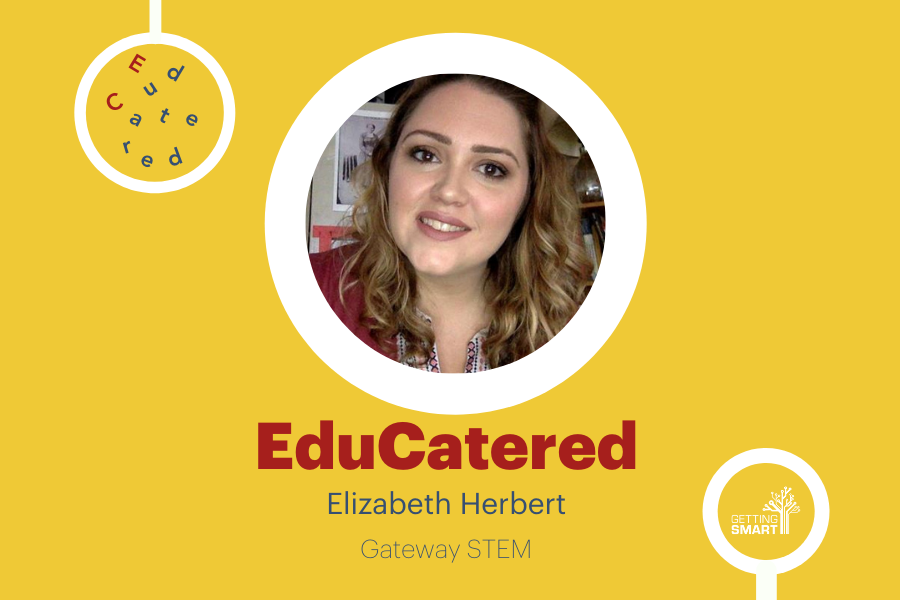
EduCatered: Elizabeth Herbert
Key Points
-
It’s so important to pay attention to students as a whole person.
-
We must learn to, and help our students learn to, see success without leaving where you’re from.
We are thrilled to bring you a new podcast from Getting Smart called EduCatered: A Podcast That’s Catered to Educators. Subscribe here!
On this episode of EduCatered we’re joined by Elizabeth Herbert, the Social Studies Department Chair at Gateway STEM high school in St. Louis Public Schools. Elizabeth spent some time teaching in Costa Rica and Nicagaragua and you’ll likely find her obsessing over her cats, binge-watching or reading a great thriller.
Shawnee and Elizabeth talk about a range of topics – from food stories and geography to the importance of attention and community organizing. Let’s dig in!
On Food
“I would choose pear preserves for my recipe. It’s a regional food that speaks to my version of being a second degree southerner.”
On Diversity
“[Diversity] is important for me to be uncomfortable with, I think, as a white person […] it questions our notions of normativity.”
On Teaching
“I work for these kids, none of the things that I do should be made easier at their expense.”
Links
Transcript
This transcript has not been edited for spelling accuracy.
Hey, come on in. Welcome to Educator, a podcast that’s catered to educators. I’m your host, Shani, and getting smart food, education, and innovation are at the heart of our recipe. This podcast mixes it all together to get to know teachers that are doing the work and making a difference. We start with the appetizer. What makes these educators unique? Then to the main course, stories and experiences that have helped to shape their practice. Finally, dessert, some
tips for what you can do next, creating a future of learning that works for everyone. Let’s dig in. Okay, thanks for joining us today. I’m thrilled to be joined by Elizabeth Herber, the social studies department chair at Gateway Stem High School in St. Louis Public Schools. Elizabeth has spent some time teaching in Costa Rica and Nicaragua, and you’ll likely find her obsessing over her cats. Ben’s watching or reading a great thriller. Elizabeth, thanks so much for
joining us today on Educator. How are you? I’m doing well. Thank you for having me. Yeah, absolutely. Now we’re going to talk about some food here in a minute, but you also hit on another getting smart love with just binge watching. What are you currently binge watching or what is one of the most favorite things you’ve ever binge watched? I just finished watching Yellow Jackets this weekend, which I really enjoyed. I’m in the middle of, I want to say it’s called Article 81 or Archive 81,
which has kind of a similar vibe to Yellow Jackets. I like things that keep me guessing. Yeah. Yeah. Maybe that’s why you went into education as well. Definitely keeps you guessing every day. I’m sure. Well, it’s always nice to talk to someone in Missouri, my home state. And like I said, we at Getting Smart just really, really love food. And although we have some really great places to eat in Missouri, just across the country, you know, there are some fabulous places
to eat. So when you think about food, if you were to contribute a recipe to a cookbook, what would it be? Oh, that’s a really hard question, which a lot of the things that I like to cook the most, frankly, don’t feel like something that’s like appropriate for me to contribute to a cookbook. For example, there’s a Cuban dish, ropa vieja, that I love to make, but I am not Cuban. So that’s not really my food story to tell. So when I think about, you know, I, when I was in graduate school,
I got a master’s in American studies, my focus was on food and culture and feminism. And so when I think about, I guess, recipes that fit my interests and also seem to tell my actual story, I would probably submit a recipe for pear preserves. Both of my parents are from Mississippi. That’s where they’re a deep Mississippi stock. And my dad’s mother used to make pear preserves off of her pear tree. And after she passed away, I remember when my dad ate the last jar that she
had made. And he was, you know, that was sad, but it was a moment for him to remember her. And since then, I have been trying to make it a yearly tradition to make pear preserves for Christmas. And I think that it’s very simple. It’s just hard pears, ideally off a tree, a whole bunch of sugar, and time. And it’s a very nostalgic and regional food that speaks to my version of being a second degree southerner, I guess. So that would, that would be my contribution.
I love that. I love just the notion of food stories. That’s a new way to say it and how food is so weaved into who we are and what we remember are memories, such, such good fabric. You talked about your food story and being able to tell your own story and who you are when you think about diversity. What’s your diversity? So that was a, you know, you guys kind of provided me a framework for what might be discussed. And that was actually a question that I
didn’t quite understand. And I figured it was probably written in that way to be kind of as open as possible. For me, I am, I am white. I don’t really have like a, that white ethnicity that maybe some people claim like Irish or German. Technically, that’s true. But that’s not, for the most part, most of my family has been on this continent for quite some time. But in terms of, I guess, my, I don’t know, my personal diversity, I would say is rooted in
the, like, different geographies of the United States. Like I said, both of my parents are from Mississippi. My entire extended family is from that area. My parents moved to the Washington, D.C. area in the early 80s. That’s where I was born. That’s where I grew up. And that’s where they still live. And I guess, for me, for Elizabeth’s diversity, I, my diversity is maybe movement around the country, as well as other countries and kind of maintaining my desire to seek out
diverse experiences, particularly geographically. Yeah, I don’t know. That was a, that was a really tough one for me. I’m, I’m just like pretty waspy white Anglo-Saxon Protestant. And, you know, it’s, it’s one of those questions that, that is important for me to be uncomfortable with, I think, as a white person, or for it to kind of be like, wait, what is my diversity? Because it questions our notions of normativity. Yeah, no, you definitely articulated it correctly, that when we think of
diversity, we do typically think of race. But when we think of it a little bit deeper, it goes to those things that you mentioned, like movement and being uncomfortable with maybe not understanding what that answer is and seeking a different way to answer it. So thank you for sharing your thoughts on that. Earlier you mentioned about binge watching and things to keep you guessing and and it made me think of education. So why education? Why did you choose education?
For me, schools were always a place where I felt safe, like they made sense to me, they seemed designed for me. I was always really good at it. And I began to realize that that’s not true for everyone or probably even most people. Schools are often used as a source of like oppression or control or ways to force conformity. And I want to participate in the challenging, ugly, gritty work of making public schools in the United States safe for everyone and not reflective and not only for
for kind of like this traditionally powerful, hegemonic, white, upper class group. And I believe in the ideals of public education and I want to work toward those ideals, which have never come true. But I believe that they can and I want to be part of that work. And I also, I just really like high schoolers. I think they’re combative and creative and they’re so funny and they they make me, I’m not a particularly emotional person, but there’s just something about being
with high schoolers and they just get me choked up all the time, even when they’re not doing anything, anything really, like they’re just sitting there and I’m like, wow, look at you, look at you on the cusp of adulthood. So for me, education, I think is about recognizing that ideals of this country have not been met. And this is a place where I think that I can help push us, you know, millimeter by millimeter closer to something that benefits everybody. And that doesn’t harm people. And
I don’t want schools to be a place where people are harmed and they are. And I’d like to participate in getting rid of that system. Yeah, you were talking about the ideas of this country have not been met and how school was a safe place for you and that if we were to put that kind of an umbrella, we might be calling that like a sense of belonging. And so how does fostering belonging contribute to your individual practice? So in my opinion, the most important part of teaching is building
relationships. When students, when you have real genuine, messy relationships with students, they know that they belong in your room. And, you know, for the most part, I have control over these four walls. But if I can get them to feel like they belong in here, then that’s at least one place where they feel safe and like they belong. And I think that with building relationships, you have this incredible opportunity to open yourself and students up to vulnerability. And
in my opinion, that’s where real learning happens is kind of in those moments of vulnerability, those moments of discomfort where you don’t understand something or something you thought you believed is being challenged. And you can’t get students to that space until they are, until there’s a real relationship there where they know that you see them as a human being and that you want to engage with every part of them, not just the part that fits the standard or
fits the day’s objective or aligns with some test question. And I think that building meaningful relationships is also a really powerful way of breaking down damaging power structures that exist in a lot of classrooms, power structures that are built on things like obedience, compliance, rigid hierarchies. And if you build the real relationship, then the students are able to feel some agency and ownership over their own learning and their own exploring without worrying
that they’re breaking some school social norm. And when they’re safe to ask questions and collaborate and advocate, they don’t only feel like they belong, but they feel like they own the place. So for me, belonging leads to ownership. And that’s ultimately, that’s the power I want my kids to feel is that they own themselves, they own their learning, they own their education, they own their relationships, that they aren’t, that they’re an active participant in everything,
they’re not just a recipient. Yeah, no, we talk a lot about student agency. So that’s definitely right on the mark. And I know that teachers are often encouraged to build relationships with their students at the beginning of the year. And then sometimes it’s not carried through. So how do you go about building those relationships so that students can get to that point of feeling that sense of agency and safety and belonging? What are some of the things you do?
For me, so there’s always going to be the kids who it’s super easy to build a relationship with, right? There’s some kids who just like adults, they like interacting with adults. And those are pretty easy to maintain, right? Those are the ones that you’re never going to have a problem if you ask them for whatever, you go sit next to them and they’re perfectly willing to talk to you. I think I also, in terms of kind of getting the other kids, I try to pay attention to like, what
are they doing when they’re not, maybe when I see them in the hall? Or if they have just come in the room and they’re just maybe on their phone, even though they’re supposed to be doing the assignment, like what are they doing? Are they listening to music? Are they playing some kind of game? When I see them in the hall, who are they hanging out with? Do they seem to have like some kind of sports ball with them? So like paying attention to them, I guess as a whole person, and sometimes
that means seeking out context clues, because not every kid is, you know, I’m not the kind of person who’s like, hi, look at me, these are the things I’m interested in. So just paying attention to everything. And I think also a lot of kids at the beginning of, you know, with that whole concept of get to know them in the beginning of the year, a lot of kids are like, okay, well, if I can just get through that part, I won’t have to do this again. And for me, I try to make it really clear, like,
I will not be giving up on getting to know you. I understand you’re quiet right now, and that’s fine. We can revisit next week or next month. But like, I’m still here like, Hey, what you doing? What are you doing? So I think just that like, never giving up on kids, which could mean a million different things, right? You could be talking about a behavioral issue, you could be talking about an academic issue, you could be talking about not giving up the fight with the
cell phone or whatever. When you don’t give up from August to May, they see that and they, I think that really helps them be more open to you because they know that like, oh, no matter what I do, Ms. Herbert is still going to bother me. And so eventually, sometimes that works. Well, it seems like you spend a lot of time just being really reflective on the things that are happening in your classroom, or just with particular students. And you spend a lot of
time just rethinking what is something you wish more educators would rethink? I think that I really, really, really wish that educators would rethink the role of compliance in their classroom. I understand, you know, I think compliance is all about like rigid, this is the way things are done. It’s very teacher centered. And I think compliance minimizes children to make things easier on the adults. And the thing is, I work for these kids, right? Nothing that I
do should be about making things easier for me at their expense. And some of the stuff that, I guess, gets me about compliance, and this is both on teacher levels as well as kind of larger levels, like perfect attendance awards, that’s a compliance thing. White normative language techniques, right? Like demanding code switching or demanding or minimizing the way that people talk. That’s about compliance. Defining success only in terms of academics. That is about compliance.
Kind of puritanical notions of how we should dress. That’s about compliance. The way kids move in the building, the way kids talk to each other, that’s not even our relationship. And we get kind of sucked into like, oh, you should talk to your friends nicely. That’s really not my relationship to police. So I think that procedures are important. Defining expectations are important. But those creating procedures and creating expectations should not be a top down exercise,
especially when the adults in the building have had really different lived experiences than the students that they’re teaching. When there’s no consideration of what basically like what this country has defined as like acceptable behavior through kind of like a white middle class lens has nothing to do with my kids for the most part. And there’s not, I just want to make, I want to, I would encourage teachers to
to stop being afraid of what happens when compliance becomes secondary. You know, like, let’s stop expecting the worst from the kids. Assume that most things that they do are going to be fine. And the most important thing that they do in your classroom is learn. It’s not that they comply with somewhat arbitrary directives or expectations. So I would like to see teachers prioritize learning over compliance. Yeah, no, those are some really great gems that you just dropped some great
mic drop moments. And I’m looking around your classroom in the back of you and I may mention of how cultural, how diverse your posters are the Frida Kahlo’s, the Black Lives Matter, and lots of others. And it seems like you’re really just open to different ideas and different perspectives. And I’m sure that you’re listening to different people in your community as well. So who is one voice in your community that you would recommend other educators check out? So here in St. Louis,
there is a guy his name is Jonathan Pulfis, P-U-L-P-H-U-S. I worked with him a little bit at a school that I used to work at. He’s a community organizer. He is a his tight his job title is St. Louis Peace Program Associate at the American Friends Service Committee, which is like the Quakers, somehow related to the Quakers. He has a podcast called Learn Zawati. And what really impresses me about him is he has this very kind of lofty educational
background, but he is so deeply embedded in the in the community that he grew up in, which is, I don’t know if it’s Northside or Westside St. Louis areas that have, that experience a really disproportionate amount of violence. But he is, you know, I love how he occupies two spaces like this super white Quaker space, right? And pretty white like academia. But then he also is like, no, I, you know, I live on the block where I grew up. And those
are my friends. And that’s who I post on my Facebook are my friends. And I think that I want to one of my goals, moving forward is to move the partnership that I had with them at my old school to this one. Because I think that it’s important for kids to see success that doesn’t involve leaving where you’re from. There’s nothing wrong with where you’re from. And I want to get away from the idea of like escaping challenges when the the Northside and the Westside of St. Louis
are beautiful, culturally rich, like dynamic places that deserve people. And I think that he’s just he’s really passionate about the power of kids to connect to one another and solve problems that way. I worked with him in terms of peer mediation and generating a restorative justice student court. And he’s really passionate about making sure that that students home lives are acknowledged when they’re at school, that they don’t have to pretend that they’re somebody else when they’re in an
academic environment. And he’s really passionate about fostering emotional intelligence in students. So I think he is an incredible person and a great asset to St. Louis and especially to our schools. Well, I think you are a great asset to St. Louis. Oh, thank you. To your school at Gateway Stam High School. It has been a pleasure talking to you. Thank you so much for sharing and continuing to be an advocate for students and finding those partnerships that
really matter and just making students feel like they belong and that they are enough. So it has been a joy talking to you. Thank you, Elizabeth. Thank you so much for having me. Yes. Thanks for joining Educator. Thanks for tuning in today. We hope you found this conversation inspiring, illuminating and actionable. We love getting to talk with our wide range of guests about what makes us unique, alike and connected. Know someone who will make a great guest on the podcast?
Email mason at gettingsmart.com and don’t forget to subscribe wherever you get your podcasts. It really helps to get more people around the table. Bon Appetit!




0 Comments
Leave a Comment
Your email address will not be published. All fields are required.