


Dr. Michael Conner on the Disruptive Excellence Framework
Key Points
-
Innovation, creativity and equity are the core themes that must be at the center of redesign.
-
You can come up with innovative next steps, but then you must look at them through the lens of equity to check yourself and your impact.
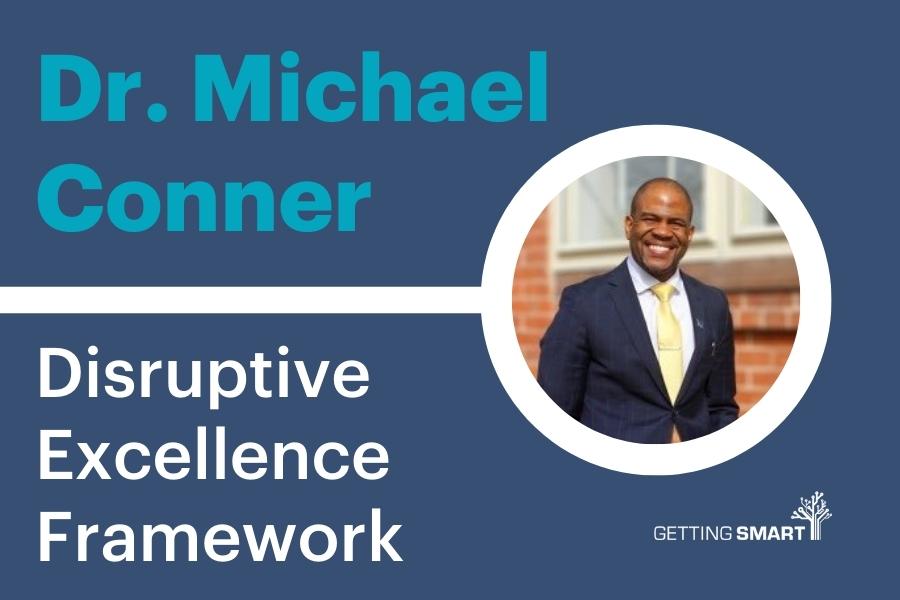
On this episode of the Getting Smart Podcast, Tom Vander Ark is joined by Dr. Michael T. Conner, CEO/Founder of the Agile Evolutionary Group. Dr. Conner served as Superintendent of Schools (Middletown, CT), Chief Academic Officer (Norwalk, CT), Assistant Superintendent of Teaching and Learning (Willimantic, CT) and Principal of Augusta Lewis Troup School (New Haven, CT). He is the creator and architect of the Disruptive Excellence Framework.
Open base innovation can create a holistic approach to an organizational strategy.
Dr. Michael Conner
Links:
- Agile Evolution Group
- Dr. Michael Conner Twitter
- Dr. Michael Conner LinkedIn
- Thomas Siebel – Digital Transformation
- What’s Next – Clay Christensen
- Atul Gwande
Transcript
This transcript has not been edited for spelling accuracy.
Michael, what are the disruptive sciences? The disruptive sciences is essentially the innovation sciences and the behavioral sciences interface together. When we talk about innovation science in the context of education, it’s more an alliance of adopted principles of creating a model that is grounded in agile, in lean processes,
research and development where you’re constantly running whether it be A, B tests or split designs within the school itself to be able to scale different initiatives or innovations. The behavioral sciences aspect of it is when you’re grounding behavioral culture, BQ, as opposed to situational analysis or even learn behaviors, but grounding your cultural strategy based off of the behavioral quotients of your team, of the stakeholders, of your
education entity and to be able to wrap that in the innovation sciences. Because again, when you think about creating an environment that’s grounded on agile principles, you really have to understand the people and capacity in order to drive this level of transformation or even progressive ideologies in education. The disruptive sciences is more in a lack of innovation, right?
Thought to power, a process of taking an idea from inception to impact. I think that in order for us to survive in this new paradigm, it’s going to require this leadership of incorporating the disruptive sciences. You’re listening to the Getting Smart Podcast. I’m Tom VanRook and I’m joined today by Dr. Michael T. Conner.
He’s the founder and CEO of Agile Evolutionary Group. Dr. Conner has been a school and system leader in Connecticut for more than 15 years, most recently served as superintendent in Milltown. Michael, you started as a teacher, an elementary teacher. What was your path to becoming a fourth grade teacher in Connecticut?
Wow, that’s a great question, Tom. Thank you for having me. First, I would say that leading for me to become a teacher was ultimately my experience within the K-12 trajectory myself. One, feeling and seeing the inequities.
It wasn’t inequities or equities back then, but knowing the inequities that I was experiencing, coupling with the microaggressions and implicit biases of black male students in the 90s, specifically when you wanted more rigor, when you wanted more classes to challenge you intellectually as well as to stimulate you. We had a fight for that.
My path to becoming a teacher and my why is that no family should have to fight for quality and rigor. That was the first step and me wanting to become a teacher. Then I said, you know what, I want to have a seat at the table. That’s where that trajectory or that vision to become a superintendent came along as well.
Where’d you go to high school, Michael? Yeah, Brantford High School, Brantford, Connecticut. Grew up in Connecticut. Was that a relatively diverse high school? I would say in a class of, we were at a class of around 300, roughly about 10 African Americans,
maybe 20 black and brown students total in that graduating class. So the decision to become a teacher was more, there’s probably some teachers that had a big influence on you, but it sounds like becoming a teacher was also an act of social justice, a calling to make things right. It made the purpose clear. When you are able to see what the purpose is, what the drive is, I always had that internal activism even at a younger age.
So to be able to ensure that the instruction environment is safe for students, students to be able to take risk, to be able to challenge them free of any biases or preconceived notions, just because of a demographic subgroup that they belong to. So those are the real reasons why I wanted to become a teacher. Again, I loved every second of being a teacher, especially applying some of the research and theory to our students
and seeing some of the students grow when I was in the classroom, practitioner back then. So yeah, it was my why that drove me into the education industry. Michael, you moved pretty quickly into school leadership. What propelled you so quickly into leadership roles? My curiosity of learning my initial stance of impact, right?
And I know that, you know, if you look at these from a statistical lens, the correlation of learning and impact together, you can really have some desirable and exponential outcomes from students. So yeah, I went through that really, really, really diverse background from an education sense, traditional research, conducted research that was part of my dissertation, which is now, you know, I would like to say, a part of the education fad that we talk about culturally responsive practices,
but this curiosity around emerging technologies, data analytics and business and operating model disruption. I’m starting to couple both, where now we’re using those practices, using, you know, let’s say design thinking as an example to go through the design thinking process with the foundational research that’s embedded in our schools. So yeah, it’s just been a great, great, great experience, divergent experience with different learning experiences for me from a professional learning sense to be able to apply in Middletown.
When you had the opportunity to lead Middletown, Middletown like Merritton next door is a one high school town, very good districts traditionally. Was that sort of a good to grade opportunity for you? Was that a district that historically had done pretty well? What was the opportunity set that drew you to the leadership role in Merritt, Middletown? Yeah, I think every opportunity, you know, Middletown is just the same as any other district, right?
There’s elements and tenants that you can strategically apply for the continuous improvement process. There were great things that, you know, they were already doing, but I think that when we look at the national landscape in the context of our problem of practice, how do we create structures and systems that are more equitable for all students? I think that’s one, you know, problem variable that a lot of superintendents across the country are dealing with.
And then two, defining what innovation is in alignment to the economic or market demand, right? Being able to not only efficiently build upon these systems that are already in place, micro innovation as Clay Christensen would define, but how do we now move it to this level of radical innovation where now students are experiencing their education experience and the brick and mortar, but is emulating the broader economic demand.
So I think those are the twofolded big problem of practices that I was dealing with. But what superintendent is it, right? Because historically, you’ve got these standardized structures that’s built on equality. How do we eliminate that? The Carnegie unit that identifies specific hours, what makes a determined amount of hours mastery within whatever specific content.
So those are the things that I think that we still have to keep ruffling with and experiment for innovation. Middletown was a place where affluent white kids were all going to college and that wasn’t true of everybody. So I think you found equity gaps there that you tried to surface and work on. And that can, in some respects, that can be even harder to do in a place that’s traditionally high performing, at least for affluent kids. I love the plan.
I guess you actually put two plans together, one right before the pandemic and then one during the pandemic. The Middletown 2024 plan focuses on elevating innovation, creativity and equity. So I obviously love the three themes of that plan. Was that crazy to try to build that with outreach to your faculty and your community during a pandemic? Yeah, and you know, Tom, great point because Middletown 2021, when I first got in my entry plan, I saw it was grounded in data.
I used the traditional process to collect that information, right? But I think the expanded learning, you know, specifically now when our plan was up right when the pandemic occurred. So we had to go in this process of designing the plan. But, you know, when we talk about innovation, right? And when we talk about closing equity gaps, specifically in the context of access and opportunity, what we did was a crowdsourcing campaign.
Crowd-based innovation in the context of where now multiple entities within the ecosystem are just a stakeholder groups within the ecosystem was able to build upon specific ideas, cogitate on, you know, one particular focus, whether it be around social emotional learning or whether it be about racial equity or social justice, or whether it be around access and opportunity. Students, parents, staff members through this crowdsourcing approach was able to get the necessary data to create the goals and strategies of Middletown 2024. So when you see elements of creativity, elevating creativity, equity and innovation, you can actually break the realms down of the strategies where you hear the voices of the students, hear the voices of our stakeholders. And more importantly, hear the voices of our leaders and teachers as well.
So it was more efficient and more effective by going to this hybrid of mind and the gap between the physical and digital world and in lieu of how I did it. So the first time. But again, this shows you how open-based innovation can create a holistic approach to an organizational strategy. I just want to repeat those themes of innovation, creativity and equity. Most traditional school systems actively squelch all three of those dimensions of innovation, creativity and equity.
And so it’s a beautiful plan done under crazy circumstances. So Michael, you were named a commissioner when the superintendent’s association developed this national learning 2025 commission. You and I both had the chance to serve as a commissioner. I think that’s really where you went. And I had the first opportunity to work together and in any depth.
And I, for one, just loved having the chance to work with you. And I so deeply appreciate the contributions you made to that effort. It was a real learning experience for me. What was that like for you? Yeah, scary initially, right?
You know, when I first got selected, I was like, well, you know, what an honor to develop that report. Then, you know, when you get on when we got on that first initial Zoom call, you know, you see the likes of Tom Vander Arc. You see the likes of Dr. Mel Bussmith, some of the superintendents that were a part of this sharing contrarious. It was a little intimidating, Tom. It was sort of the who’s who of American education.
Yeah. And but otherwise in that, it was probably one of the best learning experiences, right? To be able to pick the minds of the, you know, some of the most revered educators in the country. And to feel that I had a contribution in developing that report and seeing some of my language in that report. It’s just absolutely an honor.
Michael, I particularly appreciate the uncomfortable leadership role that you took on. I appreciate Dr. LaVelle Brown, the Ithaca superintendent, the two of you about halfway through. Notice that this mostly white commission had to come up with comfortable, you know, mostly white language. You said that. The report was, it looked like it was adding up to something interesting, but not important because it really didn’t.
It hadn’t brought issues of racial justice to the forefront. And so one, just thank you for the courage that you had to lead us to a better place. But are you happy with where that ended up? Yeah, you know what? Yes, I’m happy where it ended up in the report. Absolutely.
Right. I think I was more, I think I was happier with regards to this actually being a discussion among some of the biggest educators in the country. Right. Because what we noticed, or I can say what I noticed was that, you know, we were coming up with amazing theory. We were coming up with some of the best next practices in the context of, you know, disruption and innovation. What was obsolete was looking at that through an equity lens, looking at it through this lens of cultural competence, right?
Metabolizing cultural confidence and cultural relevancy within that document and being able to bring it out, right? To have discussions when we talk about, you know, redesigning a model to be iterative. What does that look like in the context of black and brown students and how do we ensure access is an opportunity is there for them in a personalized manner? So being able to bring that conversation and discussion to the group and have us be able to cogitate specifically around how we can strengthen those. Realistic realms from a racial equity lens.
I think that was more impactful than those words going in a report because I know 33 change agents are going to look at that differently. Well, we settled on language in the culture section of the report. We settled on language that says no learner marginalized. So it’s an important theme in there. It’s not quite the the language that you and Dr. Brown suggested, but it is central to that report.
And so your contribution was was a really important one as you push this towards innovation, creativity and equity. So so you you’ve now left Middletown and are working full time on sharing a new innovation framework with America. It sounds like the your Middletown work, your work with ASA, we’re both learning opportunities for you and in building the new framework that you’re sharing. But tell us about Agile Evolutionary Group and your new disruptive excellence framework. Yeah. So AG was developed just primarily for the sense of what you and I were talking about being able to build capacity around these transformative practices.
As we might as we move into what I like to call the AC stage after COVID-19 stage. Education went through three different paradigms before COVID. Right. We know what was going on before COVID and industrialized model standardized schools. But we saw a perpetuating achievement gap. Right. We saw this draconian slide and achievement with specific subsets.
Then the conversations around equity started to begin. We entered the stage of during COVID. Right. During COVID was I call it the great state of experimentation where technology was invited into the classrooms. We had to go asynchronous synchronous learning.
We had to learn a variety of different strategies to ensure that we kept kids on target. Right. There wasn’t this high perseveration on standardized assessments or high stakes accountability metrics, but more in the lines of are we ensuring that the whole child, whole school, whole community is receiving exactly what they need. I.e. moving away from high stakes accountability to equity. Now as we go into this AC stage, we have to take that grounded learning from the during COVID stage and disrupt what we’re going back to,
which is the industrial model. Right. Because this is the first academic year, typical academic year as defined by Chris Menish since the 2018-19 academic year. What do we normally do when we get comfortable? We revert back to the what the legacy. This is a time and opportunity we cannot revert back to the legacy, but continue having this disruptive mindset,
incorporating these sciences and expanding the work of being agile or the work of design thinking and grounded those innovation strategies to expand for all students. We have to create a new model. Generation Alpha, Generation Z are fundamentally different from how you and I were educated. So we have to create that model for them.
So this is the most, I think, important stage of education in a very, very, very long time. I would argue that we’ve never been at an unprecedented point where now we’re allowed to reimagine the model. We’re allowed to be incubators of innovators without anybody having this level of opposition. Yes, there’s going to be opposition, right? Because you’re asking people to think differently and to do things differently.
But now we can be able to capitalize on this opportunity. Tell us about the work that you’ll be leading at AEG. Will it most of it be in the form of professional learning cohorts or consulting or both? Yeah, both Tom. One element that I’m bringing on is this process called the organizational diagnostic scans.
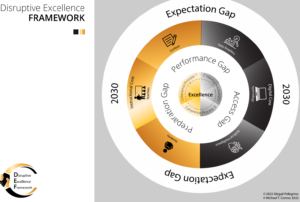
And what I do in alignment to the disruptive excellence framework, I’ll be able to analyze, collect a variety of different data sets and cooperate all those data sets, to identify the patterns and themes and then make specific recommendations to follow that continuum of innovation going from experimentation to systematization. And four, what I like to call strategic dimensions.
First is instructional systems. Second is education and innovation. Third is culture and excellence. And the fourth is operating systems. And what I will do is provide recommendations to next steps based off of my quantitative
and qualitative analysis of that. Provide the district with a summary that could be in alignment with their strategic plan or be a grounded guidepost to develop a strategic plan within the district. Executive coaching is more in the lines of one-on-one coaching and context stuff. I’m going to use a cognitive approach of coaching, but it’s going to be around the dimensions of
challenge leadership, challenge driven leadership, focused on how do you maintain and mitigate the idleral synchrocies within an iterative model of education? What does it look like in the context of ensuring all stakeholders within the ecosystem have voice? So it’s really that transformative leadership process. How do you manage your change management process around the continuous improvement cycle?
Using the disruptive excellence framework. So, you know, those processes around organizational diagnostic scans, executive coaching, of course, I think one of the flagship things that we’re going to be doing is building leadership capabilities around the disruptive excellence framework and disruptive sciences itself. So there’s multiple realms of AEG, you know, organizational scans.
Those reports are going to be amazing, especially grounded in how we can move to, I like to call the AC stage Delta 2030 identified by McKenzie, but more importantly, developing leaders around this type of mindset. The hypothesis is pretty much that if we can develop a broad base within this coalition, the highly politicized world that we live in and polarized as well,
we can be able to push those people out to continue the necessary work for kids. Michael, I want to sort of dive into your education vision a bit. Let’s say you’ve worked with a system for three or four years. So we’re 2027. What does fourth grade look like in a system that’s been engaging with
the disruptive excellence framework? You’ll see a system where the traditional brick and mortar is not the same, where traditional schools develop a quote unquote stem program, which I would call it an architectural innovation level two coherence process two, is where that you would develop a vertical track that outlines only two verticals that usually
districts create, whether it be robotics and drone, that’s their stem. But you have to be able to create a space where now you have what I like to call your core, your core grounded industries, which is computer science, exploration, and digital fabrication, but you have to be able to expand that to two pathways that are aligned to the industry demand of that community. Now you have a fabrication center where students are going in the fabrication
center and working with different programs. You have asynchronous learning that can be delivered through a university focused on coding. Now you have joint and robotics development, where now you’re testing as well as developing the drones itself and including robotics. So you have to be able to create those type of spaces for learning. I know in middle town what I did, I created what I call the New England hub of Silicon Valley and the innovation lab
consisted of a fabrication center, a creative garage, a digital room where now students are analyzing, developing coding as well as receiving mixed realities for them to get the true experience of learning. That should be the learning environment for students, where now students are truly Tom, what you and I love, co-authors of learning. It’s not didactyl monolithic instruction where teacher is disseminating information, but now teacher is facilitating
that learning where students are co-authoring through their experiences. So there should be artificial intelligence, machine learning, where not only are students interacting with an avatar or interacting with technology, but the precision of the zone of proximal development of instructions into that level of personalization, where the teacher is using that data to be able to form variety of different activities, strength and differentiation. So hopefully I don’t see grade
levels soon, right? What are grade levels? Hopefully I don’t see your students in ninth grade not and be able to take courses that they want to be able to take because they have to they have to take the courses within their regular standardization. So school should look fundamentally different, right? Students should have open campuses where they’re exploring in different industries. We need to fundamentally reimagine, redesign our model right now because
right now we are not preparing students for this digital economy in 2030. Michael, I think we’re, this is a question about leadership, system leadership in particular. It feels like we’re experiencing a national campaign against innovation and equity in American schools and we’re seeing some traditionally good school boards flip to people that seem to have a different agenda that one that is not about community, that one is not about equity. What’s your advice for
current and aspiring system leaders in this contentious time? Continue to be systems leaders, right? Continue to ensure that your more purpose, your ethical compass will continue you to be able to drive that. Change agents, Tom, you know, have a very short life to live. I think it’s probably even smaller now with the level of politics that’s involved in education. So as a change agent, you have to be able to articulate your strategy, develop your coalition, ensure that you’re a
visionarian and continue the equity work, continue the excellence work, continue the innovation work because, you know, in 10, 15 years, Tom, you and I know society’s not going to look the same. It’s going to be dominated by technology. We’re already seeing an increased amount of blue collar jobs being eliminated because of systems are being automated, right? And we have to be able to prepare students, right, how to live in this digital operating world in an analogous operating
world. But you have to push that, right? Status quo to me has, is mediocrity has been accepted in education. If we continue to push, build that coalition, hopefully we’ll be able to ensure that we are preparing kids correctly. Because right now, the model that we’re in, especially coming out of the pandemic from the education lens, we need to disrupt it fundamentally. Michael, as you’re building the disruptive excellence framework, you read 47 books, including some of your work, Tom.
Pick one or two that, one or two of those voices that you think were really resonating with me. What voices do you want to lift up? Oh, wow. Tom, your work as well, you know, always. Thomas Sebal, his work with digital transformation was amazing. Clay Trishinson’s book, What’s Next, was great. Big data that I read about, you know, exactitude of data sets and how data sets supposed to be messy with big data. And exactitude, you know,
is not the we’re going causality versus correlations. I read a plethora. Aatu Gwande’s book, a variety of different individuals. But it was a good experience. And that was the impetus that of me developing the disruptive excellence framework. It was, you know, from a variety of different works. Michael Tushman’s work, Exploit and Explore. You know, his book around that, his theory and creating
impedextrous environments. Yeah, it was, it was great, Tom. It was a great, I will call, self-directed learning experience, heterogagi, as we would say in the education lens. Well, I appreciate that. While you did some reading in education, you were reading broadly about systems change and social change and technology change. So, been a productive period for you. Yeah, I’m Tom. I’m looking forward to
broadening this out nationally, right? This has been one of the most best learning experiences from a personal standpoint. But from a professional standpoint, I got to expand on the deep exploration of the baseline that I created in Middletown. So I think that, you know, the experience that I had with the learning coupled with, you know, me diving in these books and they created this framework and subsequent protocols and scaffolds to be able to support that.
Hopefully, I’ll be able to get it out there and support leaders in this very arduous task of redesigning and reimagining education for the future. Hey, we’ve been talking to Dr. Michael Connor, who’s the founder of the Agile Evolutionary Group. Michael, if people want to know more, where can they find you? Where can they learn more? Yeah, my website is officially live, Agile Evolutionary Group. You’ll be able to find that. And then also, there’s a link on the bottom
of the website where if they want to know more information or get in contact with me, they can be able to fill that out on the website itself and then also via Twitter at docconner.com. Dr. Michael Connor, I so appreciate the chance over the last two years to learn with and from you to present with you. I love your insights and energy. I’m super excited about your new group. I hope we have the chance to work together in a handful of places and try to do the good work
together. Absolutely, Tom. And thank you for having me on. You know, it was a great honor to serve with you on the Learning 2025 National Commission and support in my work beyond that as well. And it would be a stream of honor to get a chance to work with you on a project or anything. Because again, I think that we need to broaden the coalition and we can do it together. Thanks, Michael. Thanks, our producer and creative director, Mason Pasha and the whole Getting Smart team for making this
podcast possible. We’ll see you next week. In the meantime, keep learning, keep leading for equity. See you soon. Thanks for tuning into the Getting Smart podcast today. We want this podcast to be actionable and insightful and a great way to learn about what’s next in learning. In order to stay on the cutting edge, we need people in the field to tell us what they’re hearing, what they’re wanting, and what they’re needing to learn more about. Got a topic or a guest in mind? Send your recommendations
to me, Mason at GettingSmart.com. And if you like what you’re hearing, don’t forget to leave a review on Apple Podcasts or subscribe wherever you listen. Feel free to share the podcast on social media using the hashtag GS Podcasts. Thanks so much.


0 Comments
Leave a Comment
Your email address will not be published. All fields are required.